Why in the News
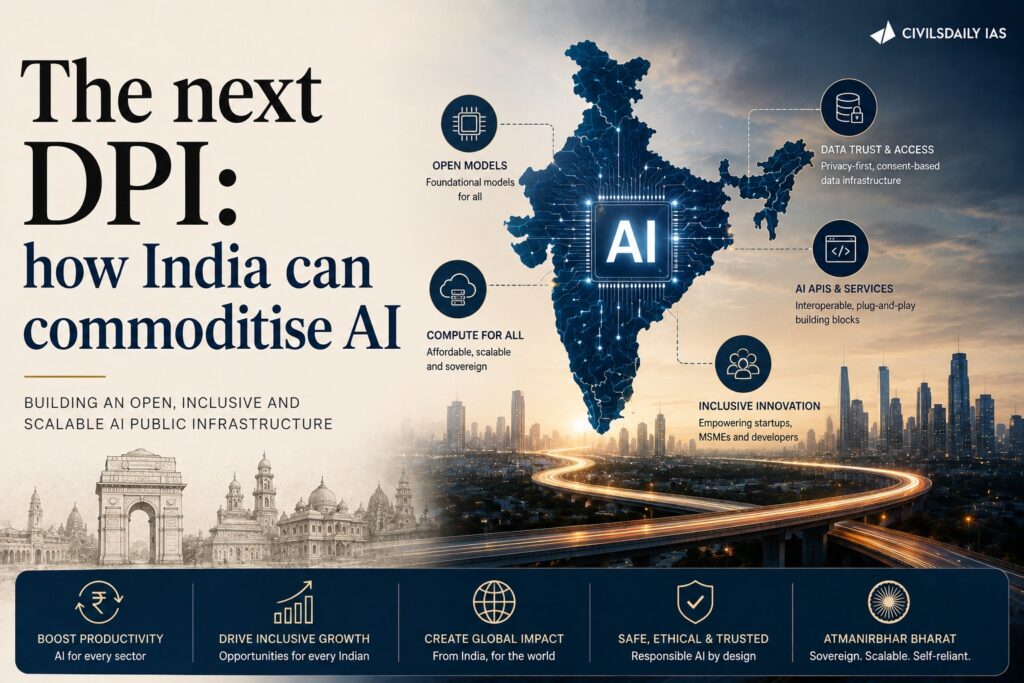
India built its identity, payments and data systems as free, interoperable public infrastructure, and the same approach is now being proposed for artificial intelligence (AI). The proposal argues that India should target the cost of running AI models rather than compete with global technology companies to build them, since it cannot win a capital race against firms that already dominate frontier model training. It comes as India remains a net importer of finished intelligence despite supplying a large share of the data, talent and engineering behind the world’s leading AI models.
What is Digital Public Infrastructure (DPI)?
- Digital Public Infrastructure: Digital Public Infrastructure (DPI) refers to open, interoperable digital systems, built and standardised by the state, on which private companies and citizens can build services.
- India’s stack: India’s DPI stack combines Aadhaar for identity, the Unified Payments Interface (UPI) for payments, and the Data Empowerment and Protection Architecture (DEPA), operationalised through Account Aggregators, for consent based data sharing.
- Design principle: In each case, the state built the underlying protocol and made it free or near free to use, while private companies compete on the applications built on top of it.
What made India’s identity, payments and data stack globally distinctive?
- Identity at scale: Aadhaar enrolled 1.4 billion people and turned identity verification from an expensive paper process into a low cost application programming interface (API) call.
- Payments at scale: UPI made digital payments effectively free, processing around 20 billion transactions a month at near zero cost.
- Cheap data: The cost of one gigabyte of mobile data in India fell from about $4 in September 2016 to under 30 cents by 2019, after one telecom operator absorbed the fixed cost of a nationwide 4G network and priced at marginal cost, forcing competitors to match.
- Scale of adoption: Roughly 500 million people came online within five years of that price fall, powering India’s digital payments, startup and direct benefit transfer ecosystem.
What is the extractive trade India faces in artificial intelligence?
- India’s contribution: India supplies an outsized share of the data, engineering talent and research behind the world’s leading AI models, with its universities and diaspora furnishing a large share of the research talent behind major laboratories.
- India’s import bill: Indian startups must rent that same intelligence back as dollar priced API tokens, subject to export controls and hosted on servers outside the country, on terms set outside India.
- Historical parallel: The pattern mirrors colonial era trade, where raw cotton was shipped out and finished cloth bought back at a markup.
What are the pillars of India’s proposed AI token economy?
- Compute: The IndiaAI Mission, backed by an outlay of about Rs 10,372 crore, has empanelled private cloud providers to onboard over 38,000 graphics processing units (GPUs), with a target of 100,000, letting eligible startups and researchers access compute at about Rs 65 per GPU hour.
- Open models: The proposal calls for any AI model built using state subsidised compute or public datasets, including anonymised legal, agricultural and educational data in India’s 22 official languages, to be released under an open weights licence, so private companies compete on applications rather than owning the underlying model.
- Distribution: A proposed Unified Intelligence Interface (UII), styled as a UPI for AI, would be an open, standardised gateway through which any application could call any model, sovereign or private, with shared standards for identity, consent, billing and safety.
What do other countries’ digital infrastructure models show about India’s combination?
- Estonia: Estonia operates a world class digital identity system but has no payments rail comparable to UPI.
- Brazil: Brazil’s Pix is a free, widely used instant payments rail, but it functions as a standalone system without an equivalent identity or data sharing layer.
- Singapore: Singapore runs Singpass for digital identity and SGFinDex for consolidated financial data access, built as separate systems rather than one integrated stack.
- European Union: The European Union has built open banking and data portability rules, but has not combined them with a single free national identity or payments system.
- India’s distinction: India’s claim to leadership rests specifically on operating identity, payments and data sharing as one interoperable public stack, a combination no other country has built at the same scale.
Can the model that crashed the price of data work the same way for artificial intelligence?
- Different economics conceded: The proposal itself concedes that India cannot win a capital race against global technology companies in training frontier AI models, since that race rewards the scale of capital already held by a small number of firms.
- Recalibrated target: It argues the correct target is instead the cost of running, or making inferences from, existing models, treating inference cost the way earlier reforms treated the cost of data and transactions.
- Untested assumption: Unlike telecom spectrum or a payments protocol, frontier AI models require continuous retraining and enormous ongoing compute investment, so a one time cost crash of the kind seen in mobile data may not hold for long in AI.
What are the challenges to India’s proposed AI token economy?
- Hyperscaler capital gap: Global technology companies that already dominate frontier model training can subsidise inference pricing far below what India’s compute base can match, even after the mission scales to 100,000 GPUs.
- Open weights disincentive: A mandatory open weights licence for any model built on subsidised compute or public data could discourage private investment in cutting edge model development within India, since firms could not fully capture the returns.
- Power and grid constraints: Data centre clusters need dedicated, reliable electricity and transmission capacity, and India’s grid planning does not yet treat AI compute load as a distinct category to plan for.
- Chip supply dependence: Scaling to 100,000 GPUs depends on continued access to export controlled semiconductors, mostly manufactured outside India, exposing the plan to global chip supply and export control decisions beyond its control.
- Data privacy exposure: Aggregating public datasets such as legal rulings, health records and agricultural data for AI training raises consent and privacy questions that a data protection framework would need to resolve first.
- Subsidy sustainability: A national freemium token model, funded partly by diverting subsidy allocations, risks being gamed by ineligible users or becoming fiscally unsustainable if adopted at the scale the proposal envisions.
Conclusion
India’s identity, payments and data systems became cheap because the state built the rails and let market competition crash the price on top of them. The proposal argues the same design can make artificial intelligence inference cheap, provided India targets running costs rather than the unwinnable race to train frontier models. Whether India’s power capacity, chip access and open weights mandate can support that shift remains unresolved.
Back2Basics
IndiaAI Mission
- Ministry: The IndiaAI Mission is administered by the Ministry of Electronics and Information Technology (MeitY).
- Approval: It was approved by the Union Cabinet in March 2024 with an outlay of about Rs 10,372 crore.
- Aim: It aims to build public private compute infrastructure, support indigenous foundational AI models, and expand access to AI applications, skilling and startup financing.
- Structure: The mission is organised around pillars covering compute infrastructure, foundational models, datasets platforms, application development, skilling, startup financing, and safe and trusted AI.
AI Token Economy
The AI token economy or tokenomics is a new financial framework where tokens (the basic units of text, audio, or visual data that AI models process) function as the foundational currency of digital work, computation, and enterprise spending.
Core Mechanics of AI Tokens
- The Atomic Unit: Unlike traditional software priced by user seats or flat subscriptions, AI is metered and billed per inferential act (input and output tokens).
- Conversion Rate: Roughly 1,500 English words equal about 2,048 tokens, varying by model. Every prompt, background system instruction, and retrieved file consumes this resource.
- Macro Indicator: Macroeconomists track token volume like kilowatt-hours or steel production to measure digital output and productivity across industries.
