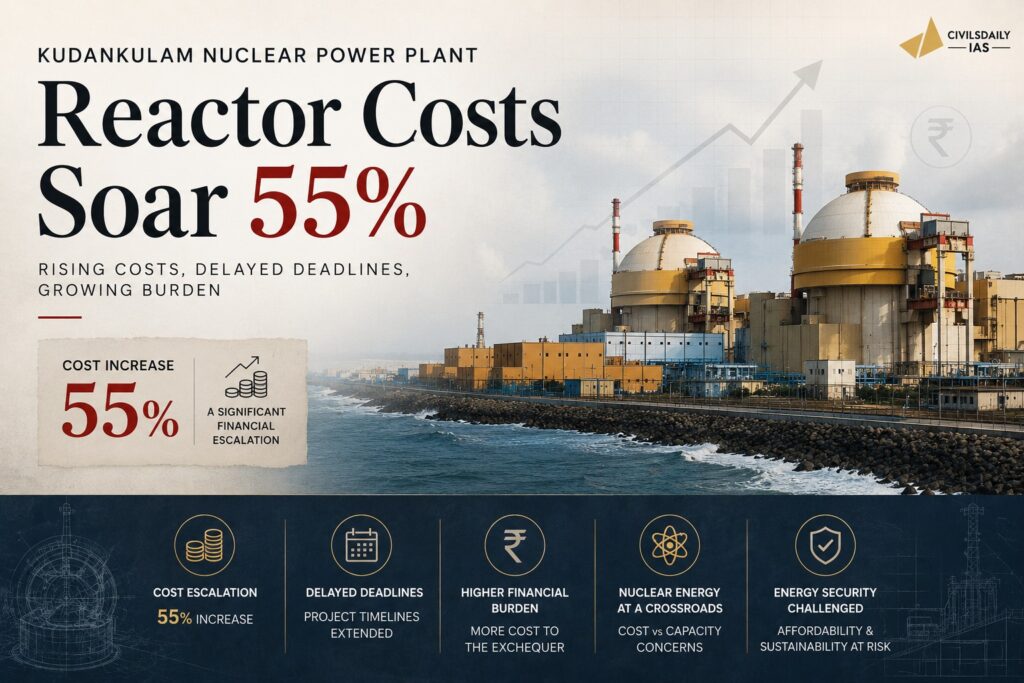
Why in the News?
The cost of Units 3 to 6 of the Kudankulam Nuclear Power Plant (KKNPP) has increased by 55%, from ₹89,470 crore to ₹1,38,330 crore, mainly due to disruptions caused by the Russia-Ukraine war. The development comes as India opens its civil nuclear sector to private participation.
Why has the Cost Increased?
- War-related disruptions: Higher prices of imported reactor components, logistics and raw materials.
- Construction delays: Longer project timelines increased financing and interest costs.
- Capital-intensive nature: Capital cost accounts for nearly 60% of the Levelised Cost of Electricity (LCOE) in nuclear power.
- Sector-wide trend: Similar cost escalation has been observed at the Rajasthan Atomic Power Project.
Significance
- Supports India’s goal of expanding clean, low-carbon electricity.
- Highlights challenges in attracting private investment into nuclear energy.
- Cost escalation may increase electricity tariffs and affect project viability.
- Emphasises the need for resilient nuclear supply chains.
Challenges
- High upfront capital investment.
- Long construction and payback periods.
- Dependence on imported reactor technology and components.
- Land acquisition and local opposition.
- Geopolitical risks affecting global supply chains.
Kudankulam Nuclear Power Plant (KKNPP)
- Located in Tirunelveli district, Tamil Nadu.
- Built with technical collaboration between India and Russia.
- Uses VVER (Water-Water Energetic Reactor), a type of Pressurised Water Reactor (PWR).
- Operated by the Nuclear Power Corporation of India Limited (NPCIL).
Department of Atomic Energy (DAE)
- Established in 1954.
- Functions directly under the Prime Minister’s Office.
- Responsible for nuclear energy policy, research and development.
Atomic Energy Regulatory Board (AERB)
- Established in 1983.
- India’s independent nuclear safety regulator.
- Regulates radiation safety, nuclear installations and licensing.
- Does not determine nuclear tariffs or policy.
India’s Three-Stage Nuclear Power Programme
- Stage I: Pressurised Heavy Water Reactors (PHWRs) using natural uranium.
- Stage II: Fast Breeder Reactors (FBRs) using plutonium.
- Stage III: Thorium-based reactors using U-233, leveraging India’s large thorium reserves.
India’s Major Nuclear Power Plants
- Kudankulam (Tamil Nadu), Tarapur (Maharashtra), Kakrapar (Gujarat), Rawatbhata (Rajasthan), Kaiga (Karnataka), Narora (Uttar Pradesh), Kalpakkam (Tamil Nadu), Gorakhpur (Haryana, under construction)
[2018, GS3, 15.0 marks] With growing energy needs should India keep on expanding its nuclear energy programme? Discuss the facts and fears associated with nuclear energy.
[2020] In India, why are some nuclear reactors kept under “IAEA safeguards” while others are not ?
a) Some use uranium and others use thorium
b) Some use imported uranium and others use domestic supplies
c) Some are operated by foreign enterprises and others are operated by domestic enterprises
d) Some are State-owned and others are privately-owned
