Why in the News
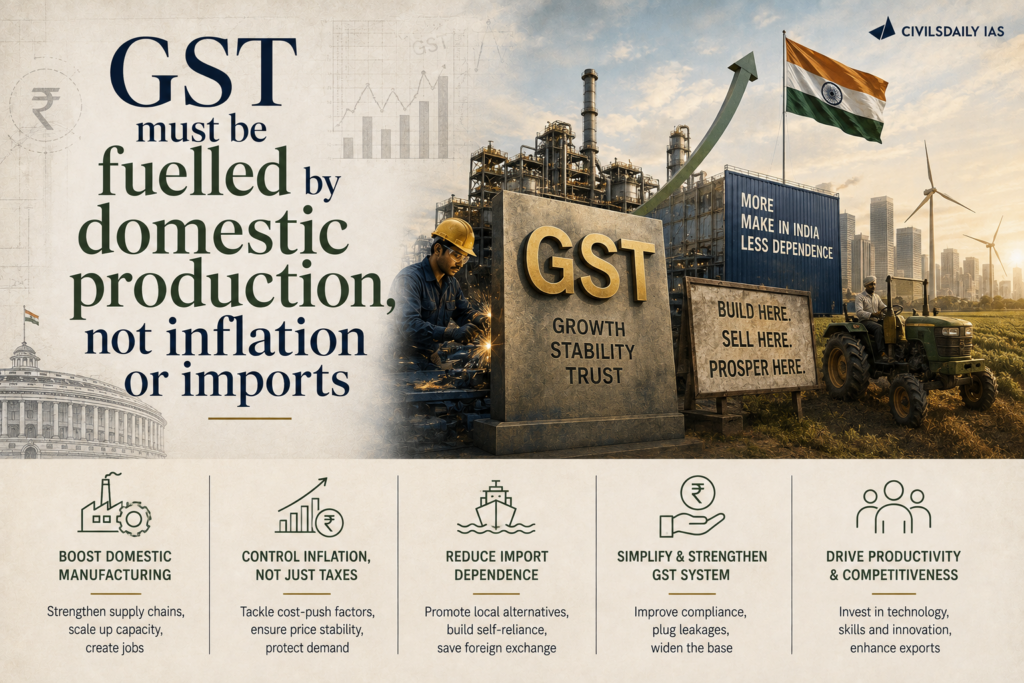
Record monthly Goods and Services Tax collection was driven more by imports and price rise than by domestic output. The tension is between a headline revenue high and a weak production base underneath it.
What is the Goods and Services Tax (GST)?
- Indirect tax: The Goods and Services Tax (GST) is a destination based tax on the supply of goods and services, in force since July 2017.
- Dual structure: It has a Central component and a State component, with an Integrated GST (IGST) on inter state and import transactions.
- Council: Rates are set by the GST Council, a federal body of the Union and States.
What does the latest collection actually show?
- Headline figure: July GST touched Rs 2.11 lakh crore, up 15.4% year on year.
- Import driven: Integrated GST (IGST) on imports grew 26.9%, against just 4.5% for the domestic component.
- Price effect: Rupee depreciation and high Wholesale Price Index manufacturing inflation of 7.18% inflated the nominal figure.
Why is the revenue base narrow?
- Geographic concentration: Collection is heavily skewed toward a handful of industrialized or consumption-heavy regions. Only 16 States and Union Territories were above the national average collection.
- Weak domestic demand: Sluggish home production limits the tax base.
- Inflation illusion: A rising nominal collection can mask flat real activity. Rising nominal collection numbers can be deceptive, as high wholesale price inflation and currency depreciation artificially inflate transaction values.
Conclusion
Strong collection numbers are being read as growth when they partly reflect imports and inflation. A broad based GST 3.0 must widen the domestic production base rather than lean on price rise.
Back2Basic
GST 2.0
Launched in 2025, GST 2.0 is a major overhaul of India’s indirect taxation system. It simplifies the multi-tier structure into core merit (5%) and standard (18%) slabs, eliminates the old 12% and 28% categories for most items, and introduces a 40% demerit rate for luxury and sin goods.
Key Tax Slab Changes
- Nil / 0%: Life and health insurance, basic food staples (UHT milk, paneer, Indian breads), and 33 life-saving medicines.
- 5% (Merit Rate): Common household essentials, agricultural machinery (tractors, harvesters), gym/fitness services, and handicrafts.
- 18% (Standard Rate): Consumer durables (TVs, ACs), small cars, two-wheelers, and cement.
- 40% (Demerit Rate): Luxury cars, aerated drinks, pan masala, and tobacco products
PYQ Relevance
[UPSC 2019] Enumerate the indirect taxes which have been subsumed in the goods and services tax (GST) in India. Also, comment on the revenue implications of the GST introduced in India since July 2017.
Linkage: The PYQ examines the revenue implications of GST and its impact on India’s indirect tax system. The article evaluates GST revenue quality, showing that recent collections are driven more by imports and inflation than broad-based domestic economic growth.