Why in the News
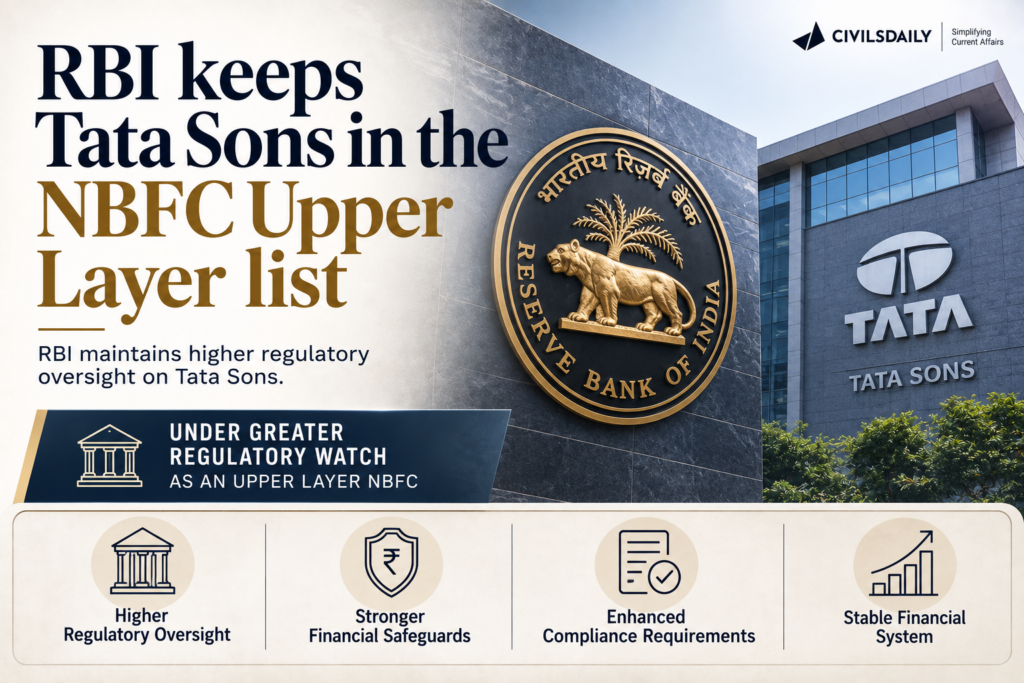
The Reserve Bank of India (RBI) has retained Tata Sons in the NBFC Upper Layer (NBFC-UL) under its Scale Based Regulation (SBR) framework. This revives the requirement for Tata Sons to list on a stock exchange, while its request for deregistration as an NBFC remains under RBI’s consideration.
What is the NBFC Upper Layer under the Scale Based Regulation (SBR) Framework?
- Definition: The Scale Based Regulation (SBR) framework classifies NBFCs into four layers based on their size, activity and risk profile.
- Upper Layer (NBFC-UL): Covers large, systemically important NBFCs requiring enhanced regulatory oversight.
- Eligibility: RBI identifies NBFC-UL entities with assets of Rs 1 lakh crore or more.
- Mandatory Listing: An NBFC classified in the Upper Layer must list on a recognised stock exchange within three years.
- Minimum Tenure: Once classified, an NBFC remains in the Upper Layer for at least five years, even if it later falls below the threshold.
What is a Core Investment Company (CIC)?
- Definition: A Core Investment Company (CIC) is an NBFC that primarily holds investments in its group companies rather than engaging in public lending.
- Tata Sons: RBI classifies Tata Sons as a Core Investment Company under the NBFC Upper Layer.
Why has the listing issue resurfaced?
- Debt Repaid: Tata Sons repaid its borrowings in 2024 and no longer directly raises public funds.
- Indirect Public Funds: RBI considers investments held by listed Tata companies in Tata Sons as an indirect form of public funding.
- Deregistration Pending: Tata Sons has sought deregistration as an NBFC, but RBI has stated that the Upper Layer classification is without prejudice to that request.
- Internal Differences: The proposed listing has divided the Tata Trusts, while the Pallonji Mistry Group supports listing to unlock shareholder value.
What additional regulations apply to NBFC Upper Layer entities?
- Capital Requirements: Higher capital adequacy norms, including Common Equity Tier 1 (CET1) requirements.
- Governance Standards: Mandatory board committees, stronger provisioning norms and prudent compensation policies.
- Current Coverage: RBI has classified 17 NBFCs in the Upper Layer, including Bajaj Finance, Tata Capital and Shriram Finance.
[2026] Consider the following statements about the Non-Banking Financial Companies (NBFCs) in India:
1. NBFCs cannot accept demand deposits.
2. All the NBFCs operating in India have to be registered with the RBI.
3. NBFCs form part of the payment and settlement system and can issue cheque drawn on itself.
4. Deposit insurance facility of Deposit Insurance and Credit Guarantee Corporation (DICGC) is not available to the depositors of deposit taking NBFCs.
Which of the statements given above is/are correct?
(a) 1 and 4
(b) 1, 2 and 3
(c) 4 only
(d) 2, 3 and 4