Why in News
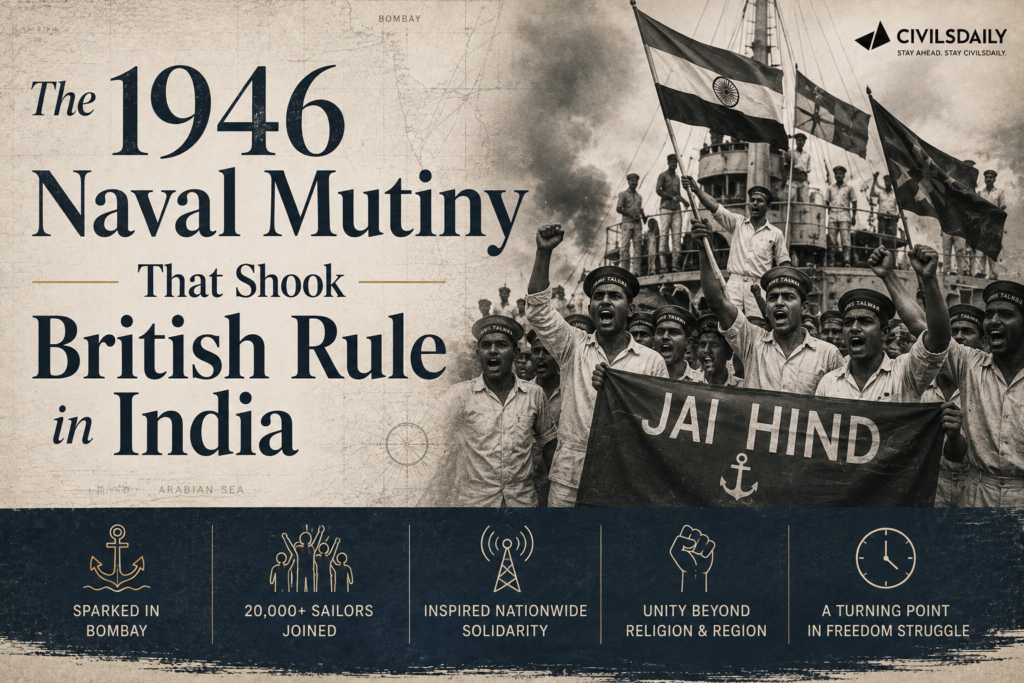
The Royal Indian Navy (RIN) uprising began in Bombay on 18 February 1946 and spread to about 78 ships and 20 shore establishments, involving nearly 20,000 personnel. It demonstrated that British India’s armed forces could no longer be relied upon to suppress nationalist resistance.
Causes
- Poor food, living conditions and service grievances
- Racial discrimination by British officers
- Post-war demobilisation and loss of status
- Anger over the INA trials
- Abuse of sailors by Commander Arthur Frederick King.
Demands
- Action against Commander King
- Better pay, food and service conditions
- Withdrawal of Indian troops from Indonesia
- Free trials for INA detainees.
Spread & Suppression
- Involved 78 ships + 20 shore establishments
- Spread to Mumbai and Karachi, with civilian support
- Strikers seized Butcher Island and removed British flags
- Police firing in Bombay on 22 February killed at least 400 people, with estimates ranging higher.
Significance
- Air Force and Army units also showed mutinous conduct
- British realised Indian forces might not obey orders to suppress Indians
- Thus, the uprising hastened the transfer of power
- Often described by naval historians as the “last war of independence.”
Key Facts
- 18-23 February 1946: Uprising
- M.S. Khan: Naval Central Strike Committee president
- Madan Singh: Vice-president
- 23 February: Strikers surrendered
- 2001: Memorial unveiled at Colaba, Mumbai
- Butcher Island: Now Jawahar Dweep.
“[2014, GS1, 10 marks] In what ways did the naval mutiny prove to be the last nail in the coffin of British colonial aspirations in India?”
[2017] With reference to Indian freedom struggle, consider the following events :
1. Mutiny in Royal Indian Navy
2. Quit India Movement launched
3. Second Round Table Conference
What is the correct chronological sequence of the above events ?
(a) 1-2-3
(b) 2-1-3
(c) 3-2-1
(d) 3-1-2
