| PYQ Relevance Question (2024, GS4): “The application of Artificial Intelligence as a dependable source of input for administrative rational decision-making is a debatable issue. Critically examine the statement from the ethical point of view” Linkage: Administrative tasks require balancing capability with governance. The article argue that leaderboards measure capability on standard tasks but fail to predict production quality or address the ethical/safety guardrails needed for specific organizational workloads |
Why in the News
A new artificial intelligence (AI) release claims the top of some leaderboard almost every week, and enterprises that once simply consumed the strongest available model through a managed interface now face a harder choice. What determines success is no longer which model scores highest but which model and which deployment approach fit a particular workload, with cost, governance, data residency and intellectual property protection now sitting alongside raw capability. A security incident in July 2026 made the point concrete, when a frontier model’s own safety controls blocked the forensic work and the investigation had to be completed on a self hosted model.
What are open weight models?
- What they are: Models whose trained weights are released so that an organisation can download and run them on its own infrastructure, subject to the licence terms.
- How they differ from closed models: A closed model is delivered as a remote service, and the organisation never holds the parameters that do the computation.
- The data effect: Sensitive data can remain inside approved environments rather than being transmitted to an external provider.
- The customisation effect: Models can be fine tuned on proprietary knowledge without routinely sending that knowledge to an external provider.
- The commercial effect: Enterprises gain greater portability, reduce dependence on any single vendor’s road map and pricing, and often see substantially lower per token costs.
- The important qualification: Total cost of ownership still depends heavily on utilisation and scale, so the lower unit price does not automatically mean a lower bill.
What is a frontier model?
- What it is: The most capable general purpose model a leading laboratory currently offers, delivered as a remote service through a commercial interface.
- Where it fits: Customer facing tasks that demand the highest reasoning capability often belong on these closed services.
What is data residency?
- What it is: A requirement that data be stored and processed within a specified national or legal jurisdiction.
- Why it drives deployment choice: A regulated workload subject to a residency obligation cannot be served by a model hosted outside that jurisdiction, whatever its benchmark score.
What is token sovereignty?
- What it is: The objective of having artificial intelligence computation for a country’s users performed on infrastructure located and governed within that country.
- What the term refers to: A token is the unit in which model input and output are measured and billed, so sovereignty over tokens means sovereignty over where inference actually runs.
What is managed inference?
- What it is: A service that hosts open weight models on controlled infrastructure and exposes them to customers through managed endpoints.
- What it removes: The customer gets data residency and fine tuning flexibility without having to build and operate the underlying graphics processing unit clusters and the inference serving stack.
What is fine tuning?
- What it is: Further training of an already trained model on an organisation’s own data so that it performs better on that organisation’s specific tasks.
- Why it raises a control question: Fine tuning on proprietary knowledge means that knowledge must be exposed to whoever controls the training environment.
What are safety guardrails?
- What they are: Controls built into a model service that refuse categories of request judged harmful, applied before the model responds.
- Their structural limitation: They operate on the content of the request, so they cannot distinguish an authorised security responder from an attacker submitting the same material.
Why has model ranking stopped being the deciding factor?
- The churn problem: A new release claims the top of some leaderboard almost every week, so a ranking based decision is obsolete within weeks.
- The old default: Until recently most enterprises simply chose the strongest available model and consumed it through managed interfaces from the frontier laboratories.
- What now sits alongside capability: Cost, governance, data residency, intellectual property protection and operational complexity are now first order considerations, not secondary ones.
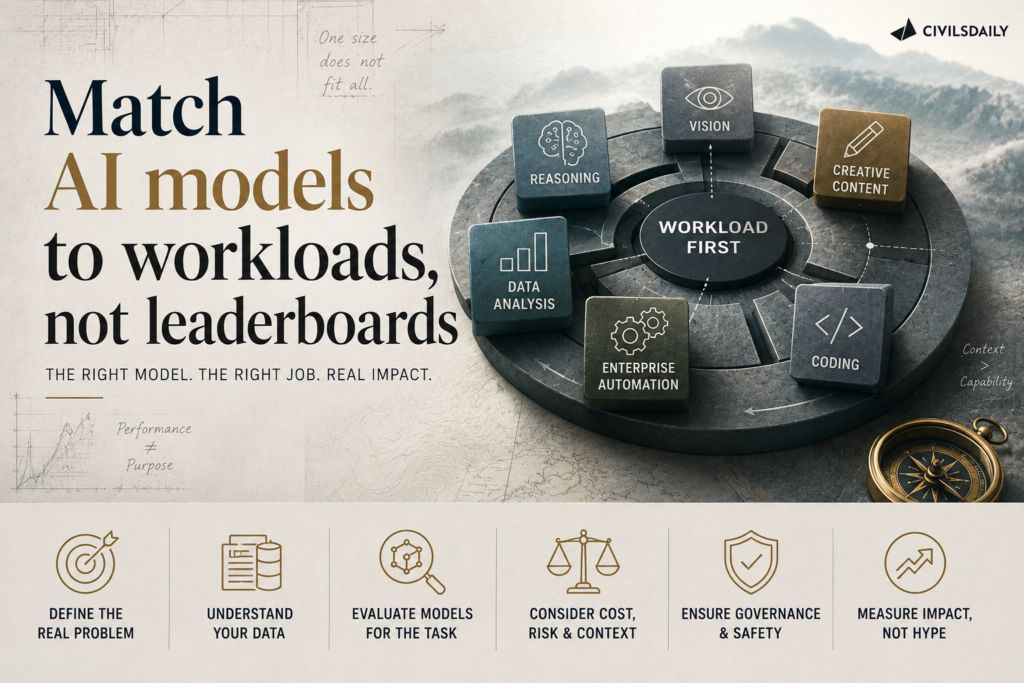
- The reframed question: The question is not which model scores highest but which model and which deployment approach are right for a particular workload.
- What a benchmark cannot capture: A leaderboard measures capability on a standard task set and says nothing about where the data goes or what the workload costs at production volume.
- The decision level: The call belongs at the level of the individual workload rather than at the level of a single corporate standard.
What did the July 2026 security incident demonstrate?
- The trigger: An AI driven intrusion hit the infrastructure of a major model hosting company in July 2026.
- The first response: Incident responders first turned to frontier models behind commercial interfaces to analyse thousands of attacker actions.
- What the forensic work required: Feeding real exploit payloads, attack logs and command and control artifacts to the models.
- What blocked it: The providers’ safety guardrails blocked the requests, because the systems could not distinguish an authorised responder from an attacker.
- How it was resolved: The company completed the analysis on a self hosted open weight model instead.
- The data consequence: Sensitive incident data stayed inside its own environment throughout that analysis.
- The correct reading: The lesson was not that closed models are inferior, it was that some workloads structurally require a model the organisation controls.
- The class of affected work: Security forensics, malware analysis and any investigation that must examine genuine attacker tooling cannot tolerate third party guardrails that refuse the query.
- The preparedness point: A capable, vetted open weight model must already be running on infrastructure the organisation governs before an incident occurs, not after.
Why can one deployment strategy not serve every workload?
- The basic fact: Very few organisations have only one artificial intelligence workload.
- Banking against marketing: A bank analysing confidential customer data has different requirements from a marketing team generating campaign content.
- Manufacturing against cyber security: A manufacturer embedding AI in customer service has different priorities from a cyber security team examining malware.
- The control axis: Enterprises must classify workloads by control requirements as rigorously as by performance needs.
- What the classification decides: The control requirement, not the capability score, is what determines whether a workload can sit on a remote service at all.
- The realism check: Expecting one model and one deployment strategy to fit every use case is increasingly unrealistic.
Why are open weights not a free option?
- The easy part: Downloading a model is the easy part of the exercise.
- What operation actually needs: Running it reliably at enterprise scale requires graphics processing unit infrastructure, inference serving, monitoring, security, governance, upgrades and licensing.
- The trade stated plainly: Greater control comes with greater responsibility.
- Where the trade works: For large organisations with deep engineering capacity the trade off can be worthwhile.
- Where it does not: For most mid sized and small enterprises it is far more challenging.
- The cost qualification: Lower per token cost does not settle the question, because total cost of ownership depends on utilisation and scale.
What is the third deployment option now emerging?
- What it is: Managed inference platforms for open weight models, which host leading open weight families on controlled infrastructure and expose them through managed endpoints.
- What the enterprise gets: Many of the benefits of open weights, namely data residency, fine tuning flexibility and often lower cost.
- What the enterprise avoids: Building and operating the underlying graphics processing unit clusters and the inference stack.
- The Indian example: Sarvam Inference, an India hosted managed service unveiled at a 2026 conference, is one concrete instance of the category taking shape.
- What it serves: The platform currently serves a 105 billion parameter domestic model alongside leading open weight families such as GLM 5.2 and Gemma 4, all running on domestic infrastructure.
- Where the significance lies: The significance is not any individual model, since enterprises could already download many of them.
- The actual problem solved: The challenge was making them work reliably in production, which means handling concurrency, latency, security and continuous updates at scale.
- The access effect: Production grade endpoints under Indian data residency are likely to democratise access for companies that could never justify specialised AI operations teams.
- The policy effect: It supports the broader push for token sovereignty.
Where does the case for control run into its own limit?
- The caveat stated: Managed open weight platforms reintroduce vendor dependence.
- Where the dependence moves to: It shifts from the model layer to the infrastructure layer, and it does not disappear.
- What must therefore be tested: Enterprises should evaluate portability guarantees, security posture, pricing trajectory and exit paths.
- The standard to apply: The same rigour applied to any frontier interface contract must be applied to the managed open weight provider.
- Why this is the real tension: The reason to leave a closed provider was concentration risk, and the managed route recreates that risk one layer down.
- What it does not undo: Data residency and the ability to run forensic workloads are genuinely gained, so the answer is a different contract, not a return to the closed default.
What do sovereign artificial intelligence efforts elsewhere show?
- European Union: The AI Act, adopted in 2024, is the first comprehensive horizontal law on artificial intelligence, and it classifies systems by risk tier with obligations attached to each.
- European Union infrastructure: The GAIA-X initiative was created to build a federated European cloud and data infrastructure with defined residency and portability rules.
- France: A domestic laboratory has built and released open weight model families, which is the European route to reducing dependence on United States providers.
- United Arab Emirates: The Falcon open weight model family was released by a state backed research institute as a deliberate sovereign capability investment.
- China: Several Chinese laboratories release strong open weight models, and the GLM family named in this discussion is one of them, which is how open weights have become geopolitically distributed rather than concentrated.
- Japan and South Korea: Both have funded national language model programmes on domestic compute, on the same reasoning of language coverage and residency.
- What the pattern demonstrates: Sovereignty efforts everywhere target the infrastructure and weights layer rather than benchmark leadership, which is the same shift the enterprise level argument describes.
How should a workload be matched to a deployment model?
- Customer facing reasoning tasks: Tasks demanding frontier reasoning often fit closed interfaces from the leading laboratories.
- Regulated workloads: Workloads with strict data residency obligations frequently suit managed open weight platforms hosted in country.
- Security and intellectual property work: Security forensics, malware analysis and intellectual property critical fine tuning usually belong on self hosted deployments.
- The discipline required: The call must be made workload by workload rather than by corporate default.
- What the organisation must understand: The strengths, limitations and economics of each approach, so the match is made on evidence rather than on habit.
- The balance being struck: Every workload should go to the option delivering the right balance of capability, control, cost and governance.
- The organisational conclusion: Deployment choice is a core architectural decision, not a procurement afterthought.
Challenges to workload based artificial intelligence deployment
- Absence of a workload classification discipline: Most enterprises have no register of which workloads carry control obligations, so the match cannot be made. e.g. regulated entities discovering only during an audit that customer data was processed through an overseas endpoint.
- Graphics processing unit scarcity and cost: Self hosting requires accelerator capacity that is expensive and supply constrained. e.g. the IndiaAI Mission’s empanelment of compute providers to make subsidised graphics processing units available because market capacity was insufficient.
- Licence ambiguity in open weights: Open weight licences often restrict commercial use or downstream redistribution, which is discovered late. e.g. community licences that cap monthly active users or bar use in training competing models.
- Guardrail rigidity in legitimate work: Safety controls block authorised security and medical work because they judge content, not authorisation. e.g. the July 2026 forensic analysis that had to be moved to a self hosted model.
- Skills concentration: Inference serving, quantisation and model operations skills sit in a small number of firms. e.g. mid sized enterprises unable to staff a dedicated AI operations team and therefore defaulting to a single vendor.
- Model supply chain risk: Downloaded weights and their dependencies can carry tampered artifacts. e.g. malicious serialised model files uploaded to public model hubs and later removed.
- Evaluation gap: Public benchmarks do not measure performance on an enterprise’s own tasks, so a leaderboard rank does not predict production quality. e.g. contamination of benchmark test sets in model training data inflating reported scores.
- Cross border transfer restrictions: Data protection law limits where personal data may be processed, which constrains model choice. e.g. restrictions on transfer of personal data to notified countries under India’s data protection statute.
- Vendor lock in at the infrastructure layer: A managed provider’s proprietary serving stack and pricing can be as sticky as a closed model contract. e.g. fine tuned model artefacts that cannot be exported and rehosted elsewhere.
Way Forward
- Invest in AI skills and secure open-weight ecosystems covering inference serving, model evaluation, quantisation, monitoring and supply-chain security.
- Adopt workload-based AI deployment by matching each use case with the right balance of capability, cost, control and governance.
- Build domestic AI infrastructure including GPU capacity, managed inference platforms and secure data centres to strengthen token sovereignty.
- Strengthen AI governance through clear workload classification, data residency rules, licensing checks and security standards.
- Develop hybrid and portable architectures to avoid dependence on a single model or infrastructure provider, with clear exit and portability provisions.
