| Question (2025, GS2): “What are the challenges before the Indian economy when the world is moving away from free trade and multilateralism to protectionism and bilateralism? How can these challenges be met? Linkage: This is the most direct parallel. The US tariffs on China and the subsequent report accusing India of “enabling” evasion are prime examples of the move toward protectionism and the resulting challenges for India’s trade policy. |
Mentor Comment
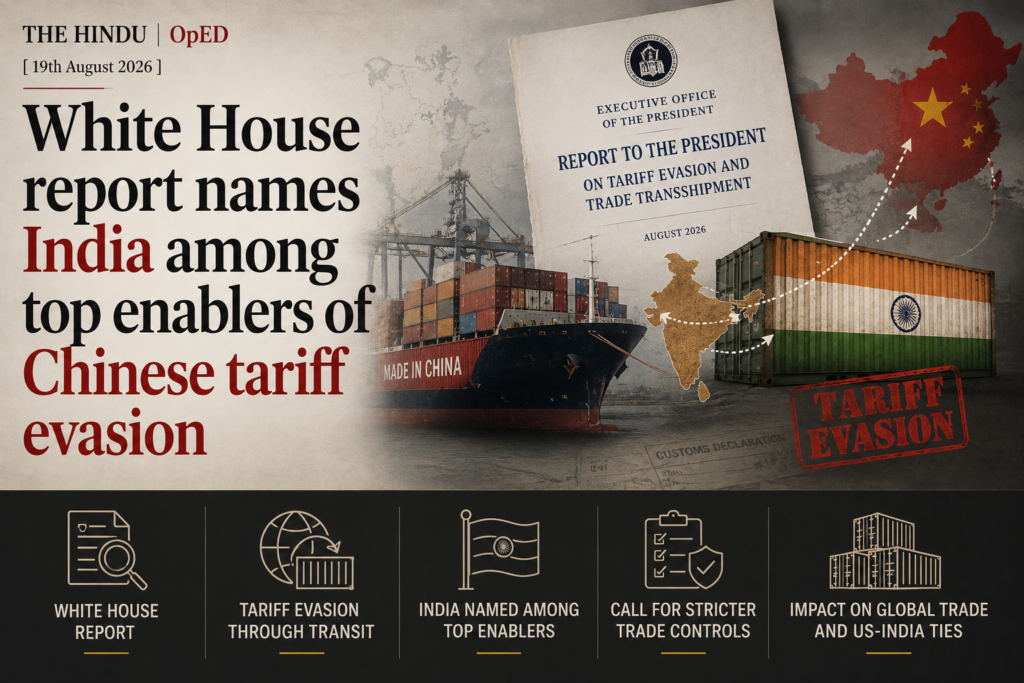
A recent White House report naming around 40 countries places India among the top enablers of China’s evasion of United States tariffs. The charge lands at the moment when the composition of India’s imports from China is shifting from finished products to intermediate goods, which points to genuine domestic assembly rather than cosmetic relabelling. India’s record of granting tariff concessions ahead of negotiations is what makes the accusation consequential.
What is the tariff evasion India is accused of enabling?
- The alleged route: The accusation is that India and the other named countries import Chinese goods, make minor modifications to them, and re-export them to the United States.
- The gain being alleged: Goods routed this way enter the United States at lower tariffs than Chinese origin goods would have faced.
- Why origin matters: A minor modification does not change the country of origin of a good, so the practice is treated as circumvention rather than manufacturing.
- Status of the charge: The United States has not yet announced punitive action on the basis of this assessment.
What are intermediate goods?
- Definition: Intermediate goods are inputs, parts and components bought by a producer and used up in making a finished good, rather than sold directly to the final consumer.
- What their share signals: A rising share of intermediate goods in imports indicates that the assembly and manufacturing stages are happening domestically, since the buyer is importing parts and not products.
What is the e-commerce inventory model?
- Definition: Under the inventory model, an online retail platform owns the stock it sells and sells it directly to consumers, in contrast to the marketplace model where the platform only connects third party sellers to buyers.
- The Indian restriction: Foreign direct investment in the inventory based model of e-commerce was long barred in India, and that restriction was diluted recently.
What does the White House report allege, and how wide is its net?
- Scale of the exercise: The report names around 40 countries in all, so the finding is a global mapping of tariff circumvention rather than a charge framed against India alone.
- India’s placement: India is placed among the top enablers of Chinese evasion of United States tariffs within that list.
- The economic stake: The accusation has the potential to be the most harmful to the Indian economy among the recent charges levelled, because it targets export access rather than a single product line.
- Escalation risk: Punitive action based on the assessment is a conceivable next step, and the absence of action so far is not an assurance.
Why does the changing composition of India’s imports from China cut against the accusation?
- The dependence is not disputed: Chinese imports form a significant pillar of Indian manufacturing, and the government itself has admitted they are an important part of the Make in India story.
- The composition has shifted: India is moving away from importing finished products, making cosmetic changes and selling them.
- What is rising instead: The share of intermediate goods in Indian imports from China has been steadily rising.
- What that means in practice: India is doing much of its own assembly and manufacturing in several sectors, relying on China and other countries only for the parts required.
- Direction of travel: This shift is a step towards full scale manufacturing in India, which is the opposite of the relabelling the report describes.
What does India’s record of tariff concessions to the United States show?
- High end motorcycles, first cut: After criticism of India’s tariffs during the first term of the United States President, India cut these tariffs to 50 percent in 2018 from the earlier band of 60 percent to 75 percent.
- High end motorcycles, second cut: India cut the same tariff further to 40 percent in February 2025, before trade deal talks had even started.
- Shrimp feed: Import duties on shrimp feed and its components were slashed in the February 2024 Budget, a key ask of the United States.
- Poultry: Tariffs on frozen duck and turkey were reduced in the same way.
- E-commerce: Allowing foreign direct investment in the inventory model of e-commerce met a demand that a large American platform had lobbied for over a decade, and diluted a long held Indian position.
How did the punitive tariffs reshape India’s oil sourcing?
- The instrument: Punitive United States tariffs of 50 percent were imposed on India, and the pressure pushed India to diversify away from Russian oil.
- The measured shift: Russia’s share in India’s oil imports fell below 20 percent in January 2026, from nearly double that level when the tariffs were imposed six months earlier.
- What was set aside: The shift happened despite India’s strident claims of energy sovereignty and despite the discount it was receiving on Russian crude.
- A prior instance: The same pattern had played out with Venezuelan oil in 2019.
- The partial reversal: The West Asia crisis and a temporary United States reprieve are what turned India back towards Russian oil, not a change in the underlying pressure.
Why does each concession make the next demand more likely?
- The concessions were rational in isolation: The United States can wield immense pressure, which makes each individual concession understandable on its own terms.
- The cumulative effect runs the other way: That record of accommodation has emboldened the United States to make increasing demands.
- Pre-emptive timing compounds it: Cutting motorcycle tariffs before trade talks had started surrendered a bargaining chip without obtaining anything in exchange.
- The present charge is the test: A charge aimed at India’s manufacturing imports would, if conceded, hit the input base of Indian industry rather than a single tariff line.
- The required break: India needs to start pushing back, since resisting on this issue is what stops the sequence of concessions from continuing.
Challenges to India resisting United States trade pressure
- Export market concentration: The United States is India’s largest single export destination, so retaliation carries asymmetric cost. e.g. gems and jewellery and textile exporters in Surat and Tiruppur face immediate order cancellations when tariffs move.
- Input dependence on China: Resisting the transshipment charge while deepening reliance on Chinese parts is politically difficult. e.g. solar cell and module assembly in India still draws heavily on imported Chinese cells and wafers.
- Weak rules of origin enforcement: Establishing that value addition is genuine requires documentation Indian exporters often cannot produce. e.g. the Customs (Administration of Rules of Origin under Trade Agreements) Rules, 2020 were introduced precisely because origin claims under trade agreements were being made without supporting cost data.
- Energy exposure: Oil sourcing decisions can be reversed by sanctions pressure faster than supply contracts can be rewritten. e.g. Russia’s share of India’s oil imports fell below 20 percent by January 2026 within six months of the punitive tariffs.
- Limited retaliation capacity: India’s counter tariff options are small relative to the size of the American market. e.g. India’s retaliatory duties on American apples and almonds were eventually withdrawn as part of a dispute settlement.
- Multilateral fallback weakened: The dispute settlement route is unavailable while the appellate mechanism remains non functional. e.g. the World Trade Organization Appellate Body has been without a quorum since December 2019.
- Investment signalling: A public trade confrontation can deter the foreign investment India is simultaneously courting for manufacturing. e.g. electronics assembly investment decisions track tariff certainty as closely as they track incentive outlays.
Conclusion
The transshipment charge misreads a real change in India’s trade with China, since the rising share of intermediate goods shows domestic assembly rather than cosmetic modification of finished Chinese products. The deeper problem is India’s record of conceding on motorcycles, shrimp feed, poultry, e-commerce and oil sourcing ahead of or under pressure, which has invited larger demands each time. Conceding on manufacturing inputs would strike at the base of domestic production itself, and that is where the pattern has to stop.
Foundational Context: India United States Trade
- Scale of the relationship: The United States is India’s largest trading partner in goods and its single largest export destination, and India has run a goods trade surplus with it for many years.
- Composition: India’s exports are concentrated in engineering goods, gems and jewellery, pharmaceuticals, textiles and petroleum products, while imports are led by crude oil, aircraft, machinery and defence equipment.
- Services and remittances: The relationship extends beyond goods into information technology services exports and the largest single source of inward remittances to India.
- Preference withdrawal: India was removed from the United States Generalised System of Preferences in 2019, ending duty free access for a set of Indian exports.
- Structural asymmetry: India’s dependence on the American market for demand is larger than the American economy’s dependence on Indian supply, which sets the bargaining balance.
Laws and Rules Governing India’s Trade Policy and Origin Rules
- Foreign Trade (Development and Regulation) Act, 1992: Empowers the Central government to make provisions for the development and regulation of foreign trade and to formulate the Foreign Trade Policy.
- Directorate General of Foreign Trade: Created under this Act as the authority that issues import and export authorisations and notifies policy changes.
- Customs Act, 1962: Provides the framework for levy and collection of customs duty, valuation, and confiscation for misdeclaration of goods.
- Customs Tariff Act, 1975: Carries the tariff schedules and the enabling provisions for anti dumping, countervailing and safeguard duties.
- Customs (Administration of Rules of Origin under Trade Agreements) Rules, 2020: Place the burden on the importer to hold and produce origin and value addition information when claiming preferential duty under a trade agreement.
- Foreign Exchange Management Act, 1999: Governs the foreign direct investment regime, including the conditions applicable to e-commerce entities.
Back2Basics: Make in India
- Launched: 25 September 2014, as a national programme to raise the share of manufacturing in output and employment.
- Nodal agency: The Department for Promotion of Industry and Internal Trade (DPIIT) under the Ministry of Commerce and Industry.
- Original coverage: 25 sectors spanning automobiles, electronics, defence manufacturing, textiles, pharmaceuticals and renewable energy.
- Stated objective: Raising the manufacturing share of Gross Domestic Product to 25 percent and creating large scale industrial employment.
- Four pillars: New processes through ease of doing business, new infrastructure through industrial corridors, new sectors opened to foreign direct investment, and a new mindset treating government as a facilitator.
- Second phase: Make in India 2.0 extended the programme across 27 sectors, covering both manufacturing and services.
Government Initiatives
- Production Linked Incentive schemes: Outlay linked incentives on incremental sales across sectors including electronics, pharmaceuticals, automobiles and solar modules, targeted at domestic and export oriented manufacturers.
- Remission of Duties and Taxes on Exported Products (RoDTEP): Refunds embedded central, State and local duties that are not otherwise rebated, available to exporters across most tariff lines.
- Districts as Export Hubs: Identifies a product with export potential in each district and builds an institutional mechanism to support producers there.
- Trade Infrastructure for Export Scheme (TIES): Funds export linked infrastructure such as testing laboratories, cold chains and border haats through State agencies.
- Interest Equalisation Scheme: Provides a subvention on pre and post shipment rupee export credit, targeted at labour intensive sectors and micro, small and medium enterprises.
- PM Gati Shakti National Master Plan: A multimodal connectivity plan intended to reduce logistics cost, which is a direct determinant of export competitiveness.
Key Facts about India’s Trade Architecture
- Foreign Trade Policy 2023: Notified without a fixed end date, replacing the earlier five year policy cycle.
- World Trade Organization: India is a founding member from 1 January 1995 and was earlier a contracting party to the General Agreement on Tariffs and Trade from 1948.
- Appellate Body paralysis: The World Trade Organization’s Appellate Body has been unable to hear appeals since December 2019 for want of quorum.
- Generalised System of Preferences: India’s beneficiary status under the United States programme was withdrawn in 2019.
- Rules of origin: Preferential origin under India’s trade agreements is normally established through a combination of change in tariff heading and a minimum domestic value addition requirement.
Challenges in India’s External Trade
- Narrow export basket: A few sectors carry a disproportionate share of export earnings. e.g. petroleum products, gems and jewellery and pharmaceuticals together account for a large share of merchandise exports.
- High logistics cost: Delivered cost erodes tariff advantages won at the negotiating table. e.g. turnaround time at Indian ports remains higher than at Singapore or Colombo transshipment hubs.
- Non tariff barriers abroad: Standards and certification requirements block market access even at zero duty. e.g. European Union restrictions on Indian shrimp and basmati consignments over residue limits.
- Trade deficit with China: Manufacturing growth deepens the input dependence that the deficit reflects. e.g. active pharmaceutical ingredient imports from China underpin India’s own formulation exports.
- Currency and commodity exposure: Import bills move with global oil and gold prices regardless of export performance. e.g. gold imports of $71.98 billion in 2025-26 widened the current account pressure.
- Weak participation in global value chains: India remains outside the large regional production networks that set input sourcing rules. e.g. India stayed out of the Regional Comprehensive Economic Partnership in 2019.
Way Forward
- Document value addition: Build a verifiable, firm level record of domestic value addition in export sectors so that transshipment allegations can be answered with data rather than assertion.
- Negotiate rather than pre-empt: Hold tariff concessions until a reciprocal commitment is on the table, since unilateral cuts before talks forfeit bargaining value.
- Deepen component manufacturing: Extend incentives from final assembly to components and sub assemblies so that the intermediate goods share shifts from imports to domestic supply.
- Diversify export destinations: Use the concluded trade agreements to shift a measurable share of exports away from a single dominant market.
- Strengthen origin administration: Equip customs with certification and audit capacity under the origin rules so that genuine Indian manufacturing is distinguishable from routing.
- Secure energy optionality: Maintain diversified term contracts for crude so that sourcing decisions are not dictated by tariff threats.
“[2025, GS3, 10 marks] What are the challenges before the Indian economy when the world is moving away from free trade and multilateralism to protectionism and bilateralism? How can these challenges be met?”
