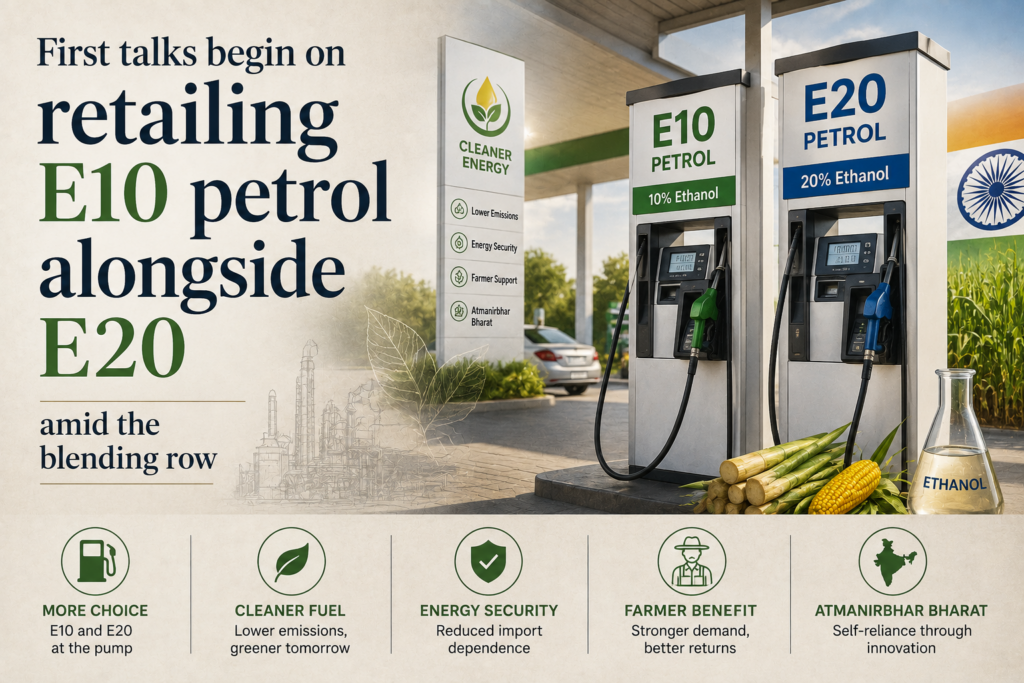
Why in the News
Early exploratory discussions have begun within the government and the fuel industry on whether E10 petrol can be retailed alongside E20, which is currently the only standard petrol variant sold across the country. The trigger is a policy success that has produced a consumer problem: India reached 20 percent ethanol blending five years ahead of the original deadline, which pushed the entire retail network onto a fuel that most vehicles on the road were never certified for. The question now is whether a national fuel supply chain built for a single base grade can be reopened to two.
What is the Ethanol Blended Petrol (EBP) Programme?
- About: The Ethanol Blended Petrol Programme requires oil marketing companies to blend ethanol into petrol at a mandated percentage before sale, so that a share of transport fuel demand is met from domestically produced ethanol.
- Administering ministry: Run by the Ministry of Petroleum and Natural Gas, with the Ministry of Road Transport and Highways on vehicle compatibility and the Department of Food and Public Distribution on feedstock supply.
- Policy basis: Formalised under the National Policy on Biofuels, 2018, which sets the indicative blending target and defines permitted feedstocks.
- Objectives: Reduce crude oil import dependence, cut foreign exchange outgo, provide an assured market for surplus sugarcane and foodgrain, and lower tailpipe carbon monoxide and hydrocarbon emissions.
- Beneficiaries: Sugarcane and maize farmers, sugar mills and distilleries, and vehicle owners through the retail fuel price.
- Achievement: India reached 20 percent ethanol blending in petrol in 2025, five years ahead of the original target, and the milestone has been credited with displacing about 310 lakh tonnes of crude and saving roughly Rs 1.9 lakh crore in foreign exchange.
What is E20 petrol?
- Composition: E20 is a blend of 80 percent petrol and 20 percent ethanol by volume.
- Current status: It is the only standard petrol variant sold across the country, and a notification of 17 February 2026 requires all States and Union Territories to sell E20 at a minimum Research Octane Number of 95 from 1 April 2026.
What is E10 petrol?
- Composition: E10 is a blend of 90 percent petrol and 10 percent ethanol by volume.
- Why it is at issue: Older vehicles, particularly two wheelers, were certified for E10 petrol, and E10 was the base retail grade until the network shifted entirely to E20.
What are Bharat Stage 6 phase two norms?
- Definition: Bharat Stage 6 phase two is the second stage of India’s sixth generation vehicle emission standard, which tightened real driving emission and on board diagnostic requirements for vehicles manufactured from April 2023.
- Relevance here: Full E20 material compatibility was mandated under these norms, which is why April 2023 is the dividing line between compliant and non compliant vehicles.
Components of the Ethanol Blended Petrol Programme, by lifecycle stage
| Component and official instrument (lifecycle stage) | Intervention and official numbers | Primary stakeholder |
|---|---|---|
| Permitted feedstock list under the National Policy on Biofuels, 2018 (feedstock and input) | Allows ethanol from sugarcane juice, sugar and sugar syrup, B heavy molasses, C heavy molasses, damaged foodgrain, maize and surplus rice; no per unit figure attaches to this component | Sugarcane and maize farmers, sugar mills |
| Ethanol Interest Subvention Scheme (financing) | Interest subvention on loans for setting up new distilleries and expanding existing molasses based and grain based capacity; the release states the subvention period, not a fixed outlay per plant | Distilleries and sugar mills |
| Pradhan Mantri JI-VAN Yojana (plant or asset build, advanced biofuels) | Viability gap funding for second generation ethanol projects using lignocellulosic feedstock such as agricultural residue | Technology developers and oil marketing companies |
| Administered ethanol procurement price (production and pricing) | Differential ex mill prices fixed by the Cabinet Committee on Economic Affairs for each feedstock route, highest for the sugarcane juice route and lowest for the C heavy molasses route | Sugar mills and distilleries |
| Long term offtake agreements by oil marketing companies (distribution and evacuation) | Assured purchase of tendered ethanol volumes for each ethanol supply year, which runs from November to October | Oil marketing companies and distilleries |
| E20 as the base retail grade (offtake and demand) | 20 percent blending achieved in 2025, five years ahead of the 2030 target; minimum Research Octane Number of 95 required for E20 sold from 1 April 2026 | Vehicle owners |
What has triggered the rethink on a lower blend?
- The consumer complaint: Opposition to E20 has come from several quarters, with claims of notable reduction in mileage and engine component wear in older vehicles whose engines were not designed for higher ethanol blends.
- The government’s position on mileage: The drop in mileage in older vehicles would be 3 to 5 percent at most, and would be outweighed by E20’s benefits as a superior fuel.
- The government’s position on engine damage: Claims that E20 could damage engine components have been consistently rejected.
- The parliamentary figure: A reduction in fuel economy of 2 to 6 percent depending on vehicle category and vintage has been stated in Parliament.
- The absence of choice: Questions have been raised on why motorists are not offered a choice between pure petrol, E10 and E20, and some Opposition leaders have taken up the same point.
- The first official break: A co authored opinion article published on 17 August 2026 by the Chief Economic Adviser called for a lower ethanol petrol blend such as E10 to be made available alongside E20. The views were personal, and it is the first instance of a high ranking government official publicly calling for more petrol options.
- The stated rationale for restoring E10: Restoring a lower blend at the pumps alongside the option to buy E20 would calm public concern, lower total ethanol use instead of raising it, and protect the existing fleet while the retrofit programme catches up.
Which vehicles are actually affected?
- The compliance line: Petrol vehicles manufactured and sold after April 2023 are considered fully E20 compliant, since this was mandated under Bharat Stage 6 phase two emission norms.
- What that leaves out: All vehicles currently being sold are E20 compliant, but most vehicles sold prior to 2023 are not.
- The scale of the gap: Of about 310 million petrol vehicles in use, only about 70 million built after April 2023 carry factory certified E20 compatibility.
- How long the legacy fleet stays on the road: The permissible life of a petrol vehicle in the National Capital Region is 15 years, which means cars manufactured in 2022 can be in use until 2037 under current norms.
- The most exposed category: The discussions were initiated specifically with older vehicles, particularly two wheelers, that were certified for E10 petrol, in mind.
Why is retailing E10 alongside E20 a logistical problem?
- A parallel supply chain: Retailing E10 and E20 simultaneously requires a complex, parallel supply chain stretching from refineries to pumps.
- The volume distinction: Two or three premium petrol variants already coexist with the base fuel, and their consumption is minuscule compared with base petrol, so offering small volumes alongside E20 is manageable. Retailing E10 in large volumes is a different problem, since the existing chain has shifted entirely to E20.
- Underground storage is the binding constraint: Most retail outlets use single or dual underground tanks, so adding E10 alongside E20 would require replacing them with a dual tank system for petrol at thousands of pumps.
- Dispensing equipment: Outlets would additionally need separate dispensers for the base fuel.
- The government’s July position: Offering multiple grades of base fuel across the country would create an “enormous logistical challenge”, raise costs and reduce operational efficiencies in India’s complex fuel retail network.
- The sunk investment argument: The shift to E20 required massive investments already made, and reverting to a lower blend would not be prudent.
- Where the talks stand: The discussions are described as “preliminary” and as “keeping the older vehicles in mind”, are being held on technical and non technical aspects of the fuel retail supply chain, and no concrete conclusions have been arrived at.
Where does the blending success pull against the consumer?
- A target met is not a fleet protected: Reaching 20 percent blending five years early moved the entire retail network onto a fuel that roughly four fifths of the petrol fleet was never certified for.
- The choice question has no cheap answer: Restoring choice requires physical infrastructure at thousands of outlets, so the demand for choice and the cost of supplying it move in opposite directions.
- Lower blend means lower ethanol demand: Restoring E10 would lower total ethanol use, which cuts against the assured offtake that distilleries and sugar mills invested against.
- Retrofit is the alternative to reversal: Protecting the existing fleet through a retrofit programme leaves E20 intact but transfers the cost from the fuel network to the vehicle owner.
- The time horizon is fixed by vehicle life: With 2022 vehicles running until 2037, the mismatch persists for over a decade regardless of which route is chosen.
Challenges to the Ethanol Blended Petrol Programme
- Legacy fleet incompatibility: The bulk of vehicles on the road predate the E20 mandate. e.g. of about 310 million petrol vehicles in use, only about 70 million built after April 2023 carry factory certified E20 compatibility.
- Fuel economy loss: Ethanol has lower energy density than petrol, so the same volume delivers fewer kilometres. e.g. the government puts the drop at 3 to 5 percent in older vehicles, and a range of 2 to 6 percent by category and vintage has been stated in Parliament.
- Water footprint of feedstock: Sugarcane based ethanol carries a heavy irrigation demand in water stressed regions. e.g. sugarcane in Maharashtra’s Marathwada draws heavily on groundwater while occupying a small share of the cropped area.
- Food versus fuel diversion: Grain routed to distilleries competes with food and feed use. e.g. surplus rice from the Food Corporation of India and maize have been diverted to ethanol, tightening maize supply for the poultry feed industry.
- Fuel quality disputes: Contamination claims undermine public confidence in the blend. e.g. chloride and moisture contamination claims were raised against E20 in 2026 and rejected by state oil marketing companies after pan India testing.
- Supply chain rigidity: The retail network has been optimised for a single base grade. e.g. restoring E10 would require dual underground tanks and separate dispensers at thousands of outlets.
- Geographic concentration of distillery capacity: Ethanol production clusters in a few States, requiring long haul movement. e.g. Uttar Pradesh, Maharashtra and Karnataka account for the bulk of capacity, so deficit States in the east and north east draw on long distance tanker movement.
- Material compatibility in older engines: Ethanol acts on certain elastomers and metals used in pre 2023 fuel systems. e.g. rubber fuel lines and aluminium components in older two wheelers were specified against E10, not E20.
What do other countries’ dual grade fuel markets show?
- Brazil: Mandates a high anhydrous ethanol blend in gasoline, raised to 30 percent in 2025, and sells hydrous ethanol as a separate grade at the same forecourt for its flex fuel fleet. The design feature is that the vehicle fleet was converted to flex fuel first, and the fuel grade followed.
- United States: E10 is the de facto base gasoline, with E15 and E85 offered at selected stations rather than universally. The design feature is that higher blends are optional and geographically limited, so no station is forced to carry every grade.
- Thailand: Retails gasohol E10, E20 and E85 simultaneously through its state fuel retailer network. The design feature is a differential excise structure that prices higher blends below lower ones, so demand shifts by price rather than by mandate.
- Germany: Sells Super E10 alongside a Super E5 protection grade, retained specifically for vehicles not certified for the higher blend. The design feature is the legal obligation on larger stations to keep the lower blend available, which is the arrangement now being examined in India.
- France: Retails SP95-E10 alongside SP98, with the lower ethanol grade preserved for older vehicles, and publishes a vehicle compatibility list so owners can check before filling. The design feature is that consumer information was issued as a public compatibility register, not left to manufacturers.
Conclusion
India met its 20 percent blending target five years early, and the cost of that speed is a national retail network carrying a single fuel grade that most of the vehicle fleet was never certified for. Discussions on retailing E10 alongside E20 are at a preliminary stage with no conclusions reached, and the binding constraint is physical, being underground tank and dispenser capacity at thousands of outlets rather than ethanol availability. The next development to watch is whether the government converts the current exploratory talks into a formal feasibility study, since the mismatch persists until the pre 2023 fleet ages out around 2037.
