Why in the News
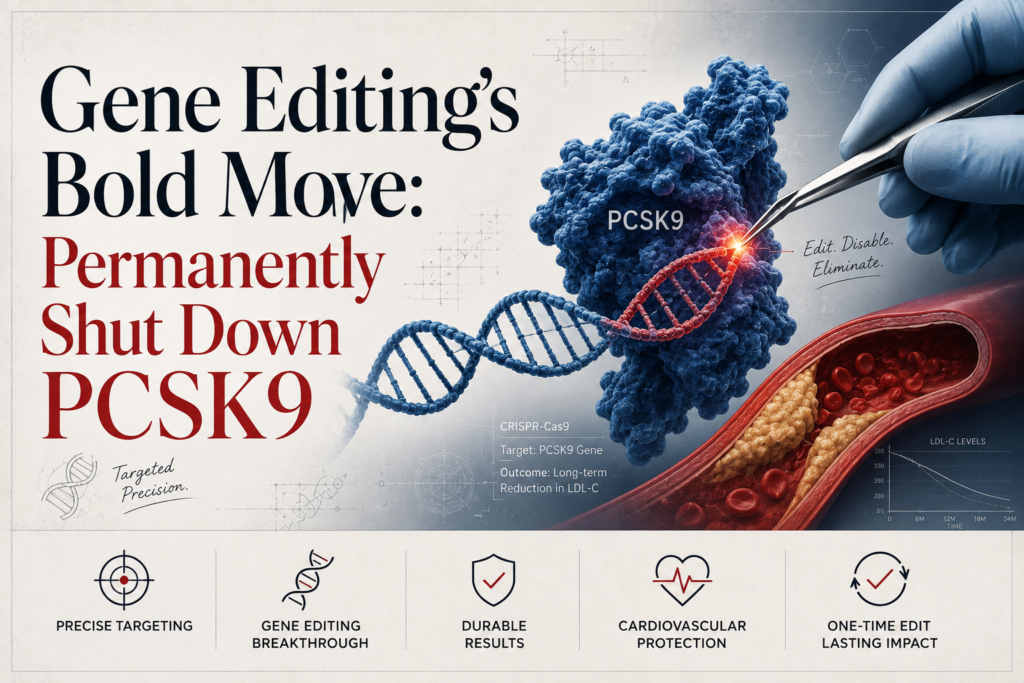
VERVE-102, an experimental in vivo base editing therapy delivered as a single intravenous infusion, permanently switches off the PCSK9 gene inside liver cells and cut LDL cholesterol by about 62 percent in a phase 1 trial. Cholesterol control has until now been a lifelong compliance problem, and a one time genetic change replaces that problem with a permanent, irreversible one.
How does VERVE-102 work?
- What it is: VERVE-102 is not a traditional drug. It is a form of in vivo gene editing, meaning the editing is done inside the patient’s body rather than on cells removed and returned.
- Step 1, delivery: Genetic instructions are delivered through a single intravenous infusion.
- Step 2, the edit: Those instructions make a one time targeted change to the DNA inside liver cells, altering a single base in the PCSK9 gene.
- Step 3, the effect: The edited liver cells permanently lose the ability to produce PCSK9.
- Step 4, the outcome: With PCSK9 production switched off, the liver clears more LDL cholesterol from the blood, and the effect persists without repeat dosing.
- The stated goal: A single infusion that permanently reduces the liver’s ability to produce PCSK9, so that a one and done cholesterol treatment could eventually replace conventional medicines.
What is LDL cholesterol?
- Definition: LDL (low-density lipoprotein) is called bad cholesterol because high levels make it stick to artery walls and form hard fatty deposits called plaque.
- Why it matters: These deposits narrow the arteries and block blood flow, which raises the risk of heart attacks and strokes.
What is PCSK9 and why is it the target?
- What it is: PCSK9 is a protein involved in regulating LDL cholesterol in the blood.
- The natural experiment: People who naturally carry certain loss-of-function changes in the PCSK9 gene have lower LDL cholesterol throughout their lives and a lower risk of coronary heart disease.
- The inference: Reducing PCSK9 activity is therefore a safe and effective route to lowering cardiovascular risk.
- Confirmed by drugs: PCSK9 monoclonal antibodies substantially reduce LDL cholesterol and cardiovascular events, confirming the target.
- The limitation VERVE-102 addresses: Traditional medicines temporarily block PCSK9 or reduce its production, so their effects require continued treatment.
What did the phase 1 trial find?
- LDL reduction: LDL cholesterol fell by about 62 percent in the highest dose group after four weeks.
- PCSK9 reduction: PCSK9 levels in that group fell by about 88 percent.
- Absolute fall: LDL cholesterol decreased by approximately 78 mg/dL on average.
- Follow up length: Some participants were followed for at least one year, and the longest follow up reached 18 months.
- Durability so far: The reductions in PCSK9 and LDL cholesterol were relatively stable across that period.
How much cardiovascular risk does that reduction translate into?
- The established ratio: For every 1 mmol/L reduction in LDL cholesterol, cardiovascular risk falls by 20 to 22 percent.
- Worked case: An LDL cholesterol of 4.0 mmol/L, approximately 155 mg/dL, falling to 1.6 mmol/L is a 60 percent reduction.
- Effect of that case: That fall halves the patient’s cardiovascular risk.
- What remains unproven: VERVE-102 has not yet been shown to prevent heart attacks or strokes directly.
- The supporting evidence: All cholesterol lowering trials so far have shown that lower cholesterol means fewer cardiovascular events, and drugs blocking the PCSK9 protein have been shown to reduce heart attacks.
How does it compare with the treatments already in use?
- Statins: Usually the foundation of treatment. They are relatively inexpensive, widely available, and supported by extensive evidence showing reductions in cardiovascular events.
- Ezetimibe: A cholesterol absorption inhibitor, taken orally, that works by blocking cholesterol from being absorbed in the small intestine.
- PCSK9 antibody medicines: They produce powerful LDL reductions and have demonstrated cardiovascular benefits, but require repeated injections.
- Inclisiran: It reduces PCSK9 production and can lower LDL cholesterol by roughly 50 percent, with less frequent dosing that makes long term treatment easier. It does not permanently modify DNA.
- The distinguishing feature of VERVE-102: Every existing option acts temporarily and must be continued. VERVE-102 makes a permanent change to DNA.
Does permanence justify the loss of reversibility?
- The compliance case: Repeat prescriptions and remembering daily doses are a standing burden, and a safe one time treatment would remove that burden entirely.
- The unknown: This is a permanent change and the long term consequences are not yet known, so treated patients will need close observation.
- The reassurance from biology: Naturally occurring loss-of-function mutations of the gene exist, and people carrying them have less heart disease and live longer, which is the basis for the trial.
- The evidence horizon problem: An 18 month period is very different from proving that an effect will last for decades, and that requires further research.
- The current standing of the therapy: It is a potential future option for selected high risk patients, not a replacement for statins, ezetimibe, PCSK9 inhibitors or inclisiran.
- Trial breadth: More diverse trials are needed to establish whether the effect holds across populations over decades.
Who would be considered for it first?
- Familial hypercholesterolemia: An inherited condition producing very high LDL cholesterol from birth, whose patients have the most to gain from a permanent reduction.
- Very high cardiovascular risk patients: Those whose risk is not controlled by existing therapy would be the second group.
- The staging logic: Beginning with these groups allows observation for problems before any wider use.
- What it is not yet: It is not a population level cholesterol intervention and is not positioned as one.
Challenges to VERVE-102
- Irreversibility of a permanent edit: A therapy that cannot be stopped removes the physician’s ability to withdraw treatment, e.g. a statin prescription can be discontinued the day an adverse effect appears, while an edited liver cell population cannot be restored.
- Evidence horizon is short: Durability is established only to 18 months, e.g. statin cardiovascular outcome evidence rests on trials such as the Heart Protection Study that ran over five years in more than 20,000 participants.
- Delivery vector and off target risk: Gene therapy delivery carries historical safety precedent, e.g. the 1999 death of a participant in an adenoviral vector gene therapy trial in the United States halted the field for years.
- Cost and access: One time genetic therapies have been priced far beyond public health budgets, e.g. Casgevy, the first approved CRISPR based therapy, is priced at over two million dollars per patient in the United States.
- Population applicability: Early phase cohorts do not establish effect across differing lipid profiles, e.g. coronary artery disease in South Asians presents roughly a decade earlier and at lower body mass index than in western populations.
- Regulatory pathway for permanent somatic edits: Approval frameworks for irreversible somatic edits are still forming, e.g. India’s National Guidelines for Gene Therapy Product Development and Clinical Trials, 2019 permit somatic editing under review but bar germline editing outright.
- The competing benchmark is already cheap: A one time therapy must justify a large upfront price against an existing generic, e.g. statins cost a few rupees a day in India and are on the National List of Essential Medicines.
Conclusion
The central finding is that a permanent genetic switch off of PCSK9 through a single infusion produces LDL reductions larger than any daily medicine achieves, and that the reduction has held for 18 months. What remains unresolved is whether a permanent change is safe across a lifetime, and whether the LDL reduction converts into fewer heart attacks and strokes, neither of which the phase 1 data can answer. Until large outcome trials report, the therapy stands as an option for familial hypercholesterolemia and very high risk patients rather than a replacement for statins, ezetimibe, PCSK9 inhibitors or inclisiran.
PYQ Relevance:
Question (2021, GS3): “What are the research and developmental achievements in applied biotechnology? How will these achievements help to uplift the poorer sections of society?
Linkage: Applied biotechnology is the primary field where gene editing techniques (like CRISPR) are developed to address challenges in health and agriculture, which can specifically benefit the underprivileged
