Why in the News
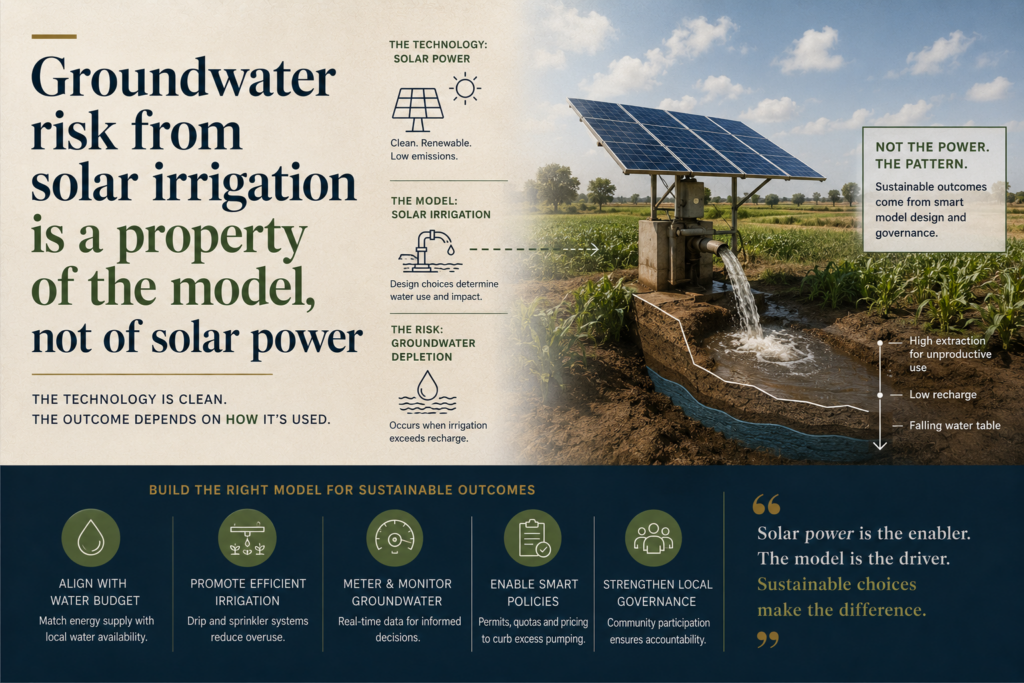
India’s agricultural solar programme has installed over 2.5 million solar pumps in five years, and the government is now preparing PM-KUSUM 2.0. The standard objection is that free solar power removes every incentive to limit pumping and will therefore deepen the groundwater crisis. That objection treats solar irrigation as a single model, when the groundwater outcome is determined by ownership structure, pricing incentive and local hydrogeology.
What is PM-KUSUM?
- About: The Pradhan Mantri Kisan Urja Suraksha evam Utthan Mahabhiyan (PM-KUSUM) is India’s agricultural solar programme, administered by the Ministry of New and Renewable Energy.
- Delivery so far: It has installed over 2.5 million solar pumps over the past five years, made affordable for smallholder farmers through subsidies.
- Three routes: It supports decentralised grid connected solar plants on barren land, standalone off grid solar pumps, and the solarisation of existing grid connected agricultural pumps.
- Next stage: The government is preparing PM-KUSUM 2.0, whose design challenge is to advance the clean energy transition without worsening an already over exploited groundwater base.
What is a feed in tariff?
- About: A feed in tariff is a guaranteed per unit price at which a distribution utility buys electricity that a small generator exports to the grid.
- Why it matters here: A high enough tariff converts every unit of electricity not used for pumping into cash income, so saving water becomes profitable rather than merely virtuous.
Why is the standard objection to solar irrigation incomplete?
- The objection itself: Heavily subsidised or free electricity has driven unsustainable groundwater abstraction, falling water tables, depleting aquifers and growing fiscal burdens on energy utilities, and solar is assumed to extend that pattern.
- First gap, the single model assumption: The debate treats solar irrigation as one model, typically a farmer running a standalone pump with no incentive to conserve water, when models differ by design, ownership structure and pricing incentive.
- Second gap, energy as the only variable: The debate discounts local hydrogeology, cropping patterns, marginal returns to irrigation and soil type, all of which shape irrigation behaviour independently of the energy source.
- Third gap, evaluation in a silo: Solar irrigation is judged as either a water intervention or an energy intervention, when its consequences span water, energy and food together.
- The reframed question: The question is not whether solar irrigation is inherently good or bad for groundwater, but what kind of model is deployed, where, and with what incentives.
How do ownership and pricing change the groundwater outcome?
- Grid connected models create a price for restraint: Models that let farmers sell surplus solar electricity back to the grid give a direct financial reward for using less water.
- Gujarat’s Suryashakti Kisan Yojana: Around 100 agricultural feeders were transitioned to solar energy under the scheme.
- Measured behaviour change: Solar farmers showed significantly slower growth in energy consumption and in irrigation application than non solar farmers, indicating more sustainable water use.
- The tariff that produced it: The scheme offered around Rs 7 per unit as a feed in tariff, a meaningful incentive to conserve electricity and export energy.
- Income effect: By exporting energy, farmers earned an average of roughly Rs 21,900 annually, converting them from energy consumers into energy producers.
- Standalone pumps vary too: Even for standalone off grid pumps under PM-KUSUM, utilisation and the extent to which the pump replaces diesel rather than grid electricity vary widely with installed capacity, the depth of the water table and years of operating experience.
What does the Bangladesh model show about pricing solar water?
- The dominant model there: Bangladesh’s most common arrangement is the fee for service centralised solar model, in which a pump owner supplies water to multiple farmers within a fixed command area.
- The revenue logic: The owner earns from selling water, so the pump is operated as a business rather than as a private convenience.
- The measured result: Farmers using solar irrigation did not apply more water than farmers using diesel, even though solar irrigation was 20 to 30 percent cheaper.
- The mechanism behind it: Excessive irrigation by one farmer reduces the operator’s ability to serve others, so efficient and equitable groundwater use becomes a condition of the business remaining financially sustainable.
- What the case demonstrates: A cheaper energy source did not raise water use once the water itself carried a price and a rationing constraint.
Why does the same pump produce different outcomes across regions?
- Hard rock aquifer regions: Where storage capacity is limited and cropping is rainfed, each additional unit of irrigation water yields high marginal benefit, and water use changed little between solar and non solar users regardless of the energy source.
- Punjab and Haryana: Irrigation is already widespread and dominated by water intensive rice and wheat, leaving little scope to expand irrigated area, so solar is unlikely to drive further over exploitation.
- The real question in those States: Whether solar can make water, energy and food systems more sustainable by replacing subsidised fossil fuel electricity with grid connected solar, cutting subsidy costs and emissions together.
- Eastern India: Irrigation expansion has been constrained by access to energy rather than to water, with large rainfed areas, high diesel costs and unreliable power.
- Policy consequence: Solar irrigation policy must follow a differentiated regional approach with context specific model choice, paired with stronger groundwater monitoring and adaptive management to catch emerging stress early.
What does solar irrigation change beyond groundwater?
- Emissions from pumping: Groundwater irrigation in India is estimated to generate between 45 and 62 million tonnes of carbon dioxide a year.
- Fiscal burden: Agricultural electricity subsidies across States amount to over Rs 1 lakh crore a year.
- Per farmer mitigation: Estimates from Gujarat suggest each grid connected solar farmer offsets approximately 12.3 tonnes of carbon dioxide annually through on farm solar use and electricity exported to the grid.
- Payback on public money: Subsidies covered nearly one fourth of government investments within the first two years.
- Scale of the opportunity: Applied across India’s more than 25 million agricultural pumps, the mitigation and fiscal implications are substantial.
Should policy prioritise saving water or expanding access?
- The case for saving water: In water stressed regions, grid connected solar can be expanded through individual pumps or by taking entire agricultural feeders solar, with both models rewarding farmers for saving water.
- The case for expanding access: Where farmers still lack reliable irrigation, the priority is expanding access rather than saving water.
- The instrument each case needs: Standalone solar pumps remain the preferred option in areas with limited irrigation, poor grid access and low groundwater risk.
- The distributional point: Emphasis should shift from individual ownership to scaling through water user associations, water selling entrepreneurs and farmer cooperatives in India’s most irrigation deprived regions.
- Why the tension is real: A single national design cannot simultaneously suppress pumping in Punjab and expand it in Bihar, so the same programme must carry two opposite incentive structures.
Why has the current design of both models underperformed?
- Weak uptake of surplus sale: The approach of paying farmers to save water by selling surplus electricity to the grid has seen limited uptake.
- Feeder transitions do not change behaviour: Feeder level transitions to solar have performed better on delivery, but in their current form do little to change pumping behaviour.
- What individual pumps need: Simpler grid connection procedures and attractive buyback prices that reflect the local value of water and crops.
- What distribution companies need: Distribution companies (DISCOMs), which buy and supply the power, must themselves be incentivised to support the individual pump model.
- What feeder solarisation needs: Pairing with water saving incentives such as support for micro irrigation and direct cash payments for reduced pumping, on the model of Punjab’s Pani Bachao Paisa Kamao and Haryana’s Mera Pani Meri Virasat schemes, so the gain is not confined to the distribution company.
Challenges to PM-KUSUM
- Farmer contribution barrier: Even after central and State subsidy, the residual farmer share blocks the poorest applicants. e.g. smallholders in Bihar and Jharkhand, where the same pump costs a larger share of annual income than in Gujarat.
- Slow solarisation of existing pumps: Retrofitting grid connected pumps depends on a distribution company agreeing to buy the surplus at a workable price. e.g. the limited uptake of the surplus sale route recorded in the current programme.
- Feeder solarisation without behavioural conditions: Solarising a feeder cuts the utility’s power purchase cost without altering how much a farmer pumps. e.g. feeder transitions that improved supply economics while leaving abstraction unchanged.
- Unmetered farm supply: Without metering, neither pumping nor saving can be measured, so a water saving payment has no basis. e.g. Punjab, where agricultural supply is largely flat rate and unmetered.
- Land availability for decentralised plants: Barren and fallow land near substations is scarce in densely cultivated districts. e.g. canal command areas of western Uttar Pradesh with almost no uncultivated parcels.
- After sales service: A solar pump with no local technician becomes a stranded asset. e.g. standalone pumps idling in remote blocks for want of repair and spare parts.
- Equity of ownership: Individual ownership concentrates the benefit in farmers who already own a borewell and a landholding. e.g. tenant cultivators and landless water buyers, who gain nothing from a pump subsidy tied to land title.
Conclusion
The groundwater question about solar irrigation has been asked at the wrong level, because the outcome is set by ownership structure, pricing incentive and local hydrogeology rather than by the energy source. Gujarat’s feed in tariff and Bangladesh’s fee for service model both show that water use falls once restraint carries a price, while standalone pumps in energy constrained Eastern India are correctly an access instrument rather than a conservation one. PM-KUSUM 2.0 therefore has to carry two opposite incentive structures within one programme, tightened in water stressed States and loosened where irrigation is scarce. The unresolved condition is measurement, since no water saving payment can operate on a farm supply that is neither metered nor monitored.
“[2025, GS3, 15 marks] Examine the factors responsible for depleting groundwater in India. What are the steps taken by the government to mitigate such depletion of groundwater?”
