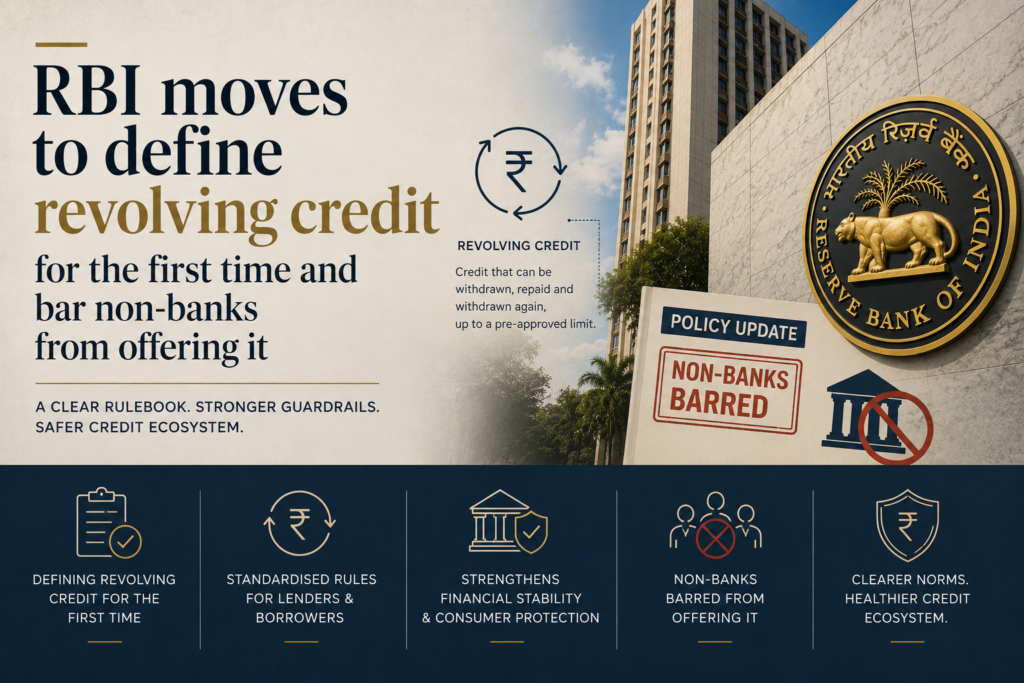
Why in the News
The Reserve Bank of India (RBI) has proposed the first ever regulatory definitions of a term loan and revolving credit, and any facility failing the term loan test would become revolving credit that non-banking financial companies can no longer offer. Revolving credit is the instrument that carried formal finance into rural India, where income is seasonal and expenses run months ahead of receipts. The regulator is now weighing that inclusion gain against the risk of debt recycling through digital credit lines.
What is revolving credit?
- About: Revolving credit comes with a pre approved credit limit against which a borrower can draw, repay and reuse without applying afresh each time.
- Contrast with a term loan: A normal term loan is sanctioned once and repaid in fixed instalments, and the limit is not restored after repayment.
- Function for the borrower: It works as a financial buffer, letting households, farmers and small entrepreneurs manage short term cash needs, emergencies and income fluctuations.
- Function for the lender: It provides recurring income streams, better utilisation of existing credit infrastructure and higher returns on assets through repeated usage.
Why does rural India need revolving rather than term credit?
- Weight in the economy: Rural India contributes 46 to 50 percent of gross domestic product, and its income is largely seasonal.
- The cash flow mismatch: Farmers incur expenses on seeds, fertilisers, labour and irrigation months ahead of the income stream, and structural rigidity in the formal credit framework does not match that timing.
- What revolving credit does: It bridges the gap by supplying liquidity as and when it is required rather than in a single sanctioned tranche.
- Protective function: It acts as a shield against financial shocks and against informal loan sharks.
- The instruments it produced: The Kisan Credit Card (KCC), overdraft facilities, self help group credit lines, microfinance linked loans and, increasingly, digital credit products.
- Beyond the farm: Rural micro enterprises depend on flexible working capital, and the self help group and bank linkage programme supported by NABARD has created one of the world’s largest community based credit ecosystems.
What has the Kisan Credit Card delivered?
- Introduction: The KCC scheme was introduced in 1998-99 as the principal form of revolving credit in rural areas.
- Widening scope: It expanded beyond crop cultivation to allied activities such as dairy, fisheries and animal husbandry.
- Current spread: More than 7.72 crore KCCs are active nationwide.
- Who holds them: The majority of beneficiaries are small and marginal farmers.
- Broader effect: The share of rural households accessing institutional credit channels such as the KCC has risen significantly.
How have non-banking financial companies become the main channel?
- Why they entered: Small ticket unsecured revolving loans carry higher interest rates on higher risk, so the untapped rural market offered both volume and yield.
- Product spread: Non-banking financial companies (NBFCs) expanded revolving credit through consumer credit lines, digital loans, merchant finance, working capital loans to micro, small and medium enterprises, and fintech partnerships.
- Last mile role: They became a pillar of last mile credit delivery in rural and semi urban areas where banks face high transaction costs, lack of collateral and information asymmetry.
- Scale: More than 9,000 registered NBFCs operate in India, the vast majority in the Base Layer, with overall outstanding credit of Rs 58.61 lakh crore by mid-2026.
- Composition of the rural footprint: It is driven by microfinance institutions, gold loan companies, vehicle financiers, and lenders to micro, small and medium enterprises and small ticket retail borrowers.
- The gap in it: Agriculture remains a relatively small component of overall NBFC lending.
What does the microfinance data show?
- Portfolio outstanding now: The portfolio outstanding of the microfinance sector, comprising NBFC microfinance institutions and small finance banks, stood at Rs 2.77 lakh crore as at March-end 2026.
- The two preceding years: It was Rs 3.35 lakh crore a year earlier and Rs 3.78 lakh crore as at March-end 2024.
- Rate of contraction: Total microfinance portfolio outstanding fell by about 17 percent year on year to Rs 2.77 lakh crore by March 2026, per the SIDBI-Equifax report.
- Geographic concentration: The top five States, Bihar, Uttar Pradesh, Tamil Nadu, West Bengal and Karnataka, account for 57 percent of total portfolio outstanding.
- What the numbers indicate: A two year contraction of over a quarter in the portfolio, concentrated in five States, signals asset quality stress rather than a policy induced slowdown.
What is the RBI proposing to change?
- First ever definitions: The RBI is proposing an amendment that defines term loan and revolving credit for the first time.
- The term loan test: A term loan may be disbursed in one or more tranches, but repayment must follow a fixed schedule.
- The reuse bar: Once repaid, the credit limit cannot be restored or reused.
- The residual category: Any facility that does not meet this definition will be treated as revolving credit.
- The operative restriction: Revolving credit, so defined, is what NBFCs can no longer offer.
Why is the RBI concerned?
- Evergreening: The regulator has repeatedly flagged the rapid growth of unsecured retail credit, particularly through fintech and NBFC partnerships offering high risk products as revolving credit.
- Masked indebtedness: It remains sceptical of forms of revolving credit where repayment patterns conceal the true level of household indebtedness.
- Ease outpacing discipline: Technology has made borrowing easier and faster than financial discipline, and multiple borrowings through various applications with weak due diligence have elevated risk.
- Underwriting by algorithm: Some digital platforms relied on algorithms and alternative data without sufficient assessment of repayment capacity.
- Purpose of the borrowing: Unlike farm or business revolving credit, many digital credit lines financed consumption rather than income generation.
- Official assessment: The latest Economic Survey acknowledged the critical role of NBFCs in inclusion while warning that unchecked expansion can weaken household balance sheets.
Can the restriction be tightened without pushing borrowers back to informal lenders?
- The regulator’s mandate: The RBI must tread a delicate balance between financial inclusion and financial stability, and both claims are legitimate.
- The case against a blanket bar: A blanket restriction may be counterproductive, since the microfinance space has historically been underserved and lending is already muted on asset quality pressures and limited funding access.
- The instruments at stake: The KCC and similar instruments are essential for growth, while unchecked and easy accessibility through digital platforms and consumer finance channels creates fresh vulnerability.
- The real policy problem: The challenge is to identify credit that helps in income generation and separate it from credit that finances consumption, since the two carry different repayment logic.
- The failure mode: Excessive regulatory tightening may push borrowers back towards informal lenders, defeating the very purpose of financial inclusion.
Challenges to Revolving Credit in Rural India
- Debt recycling: A revolving limit lets a borrower repay one obligation by drawing on another without the stress becoming visible. e.g. a household clearing one digital credit line by drawing on a second application in the same month.
- Multi lending and over indebtedness: Several lenders extending limits to the same household produce a repayment burden none of them has measured. e.g. the microfinance portfolio contracting by about 17 percent year on year to Rs 2.77 lakh crore by March 2026.
- Geographic concentration of risk: A localised shock hits a disproportionate share of the sector’s book. e.g. Bihar, Uttar Pradesh, Tamil Nadu, West Bengal and Karnataka holding 57 percent of microfinance portfolio outstanding.
- Consumption financing: Credit that funds consumption creates no repayment capacity of its own. e.g. digital credit lines used for durables and lifestyle spending rather than for working capital.
- Weak underwriting: Alternative data and algorithmic scoring substitute for an assessment of cash flow. e.g. platforms sanctioning limits without verifying seasonal farm income.
- Exclusion of tenant cultivators: Revolving farm credit is tied to land records, so the actual cultivator is often ineligible. e.g. oral lessees who cannot produce title to obtain a Kisan Credit Card.
- Delinquency and capital cost: Unchecked expansion raises delinquencies and capital requirements together, so profitability depends entirely on risk controls. e.g. small finance banks tightening disbursement after the microfinance portfolio fell from Rs 3.78 lakh crore in March 2024.
Conclusion
Revolving credit solved a timing problem that term lending could not, which is why the Kisan Credit Card, self help group credit lines and NBFC credit lines became the core of rural financial inclusion. The RBI is now proposing the first regulatory definitions of a term loan and revolving credit, with the effect that non-banks would be barred from the residual revolving category. The stated concern is evergreening and masked household indebtedness through fintech linked digital credit rather than farm or enterprise credit. The measure is at the proposal stage, and its success will be judged by whether the definitional line separates income generating credit from consumption credit, since a blanket restriction would return underserved borrowers to informal lenders.
“[2014, GS3, 12.5 marks] “In the villages itself no form of credit organization will be suitable except the cooperative society.”-All India Rural Credit Survey. Discuss this statement in the background of agricultural finance in India. What constraints and challenges do financial institutions supplying agricultural finance face? How can technology be used to better reach and serve rural clients?”
