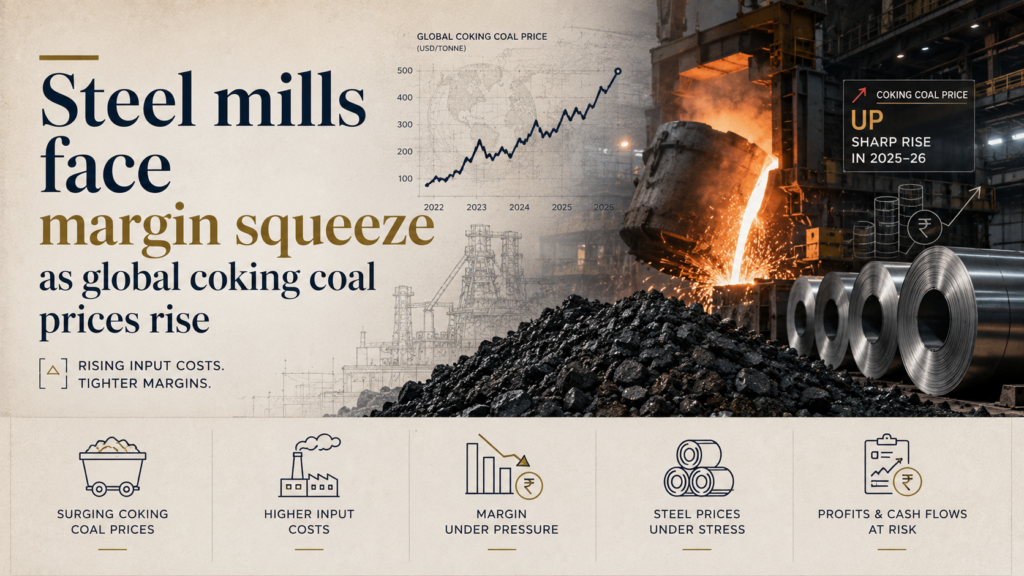
Why in the News
Premium hard coking coal has averaged $236 per metric ton freight on board Australia in the first seven months of 2026, a jump of 25 percent over last year. Indian steelmakers import 95 percent of their coking coal and face competition from cheap Chinese steel at the selling end, so the input shock cannot be passed on to buyers.
What is coking coal and why does it decide steelmaking costs?
- Definition: Coking coal is a low ash, low sulphur coal that is baked into coke, the carbon source that both fuels the blast furnace and chemically strips oxygen from iron ore. It is not interchangeable with the thermal coal used in power stations.
- Share of cost: Coking coal accounts for nearly 40 percent of steel production costs, which makes its price the single largest swing factor in a mill’s margin.
- Import dependence: India meets 95 percent of its coking coal needs through imports, with at least half shipped from Australia.
- Cost transmission: For blast furnace based steelmakers, every $10 a ton increase in coking coal prices adds approximately $7 to $9 per metric ton to steelmaking costs.
What does freight on board (FOB) Australia mean?
- Price basis: Freight on board (FOB) is the price of the cargo at the loading port, before ocean freight and insurance are added. The $236 per metric ton benchmark is therefore the Australian port price, not the delivered Indian cost.
Why have global coking coal prices risen this year?
- Australian supply disruptions: Output interruptions at Australian mines removed tonnage from a market where India sources at least half its requirement.
- Slower ramp up at new mines: New Australian capacity has come on stream more slowly than expected, so the supply gap was not filled.
- Middle East conflict: The conflict in the Middle East provided price support across the seaborne coal complex.
- Shanxi accident: A large accident at a coal mine in Shanxi, China removed further tonnage from the market in the most recent phase of the price rise.
- Benchmark movement: Premium hard coking coal averaged $236 per metric ton FOB Australia over the first seven months of 2026, 25 percent above the previous year, on the metallurgical coal and coke market assessment of the consultancy CRU.
- Outlook for the rest of the year: Costs are likely to remain high in the second half of 2026, partly due to the loss of supply following the Shanxi coal mine disaster, on the assessment of BMI, a unit of Fitch Solutions.
How does the price rise transmit into Indian mills’ balance sheets?
- Direct cost pass through: Each $10 a ton rise in coking coal adds $7 to $9 per metric ton to blast furnace steelmaking cost, on the estimate of an executive at a large steel mill.
- Volume exposure widens the hit: Coking coal imports are expected to rise by 2 million to 3 million tons in 2026-27, from 64 million tons a year earlier, on the estimate of the commodities consultancy BigMint, so the higher price applies to a larger tonnage.
- Freight adds on top of the cargo price: Trade flows have tightened with high demand from India and higher diesel, freight and insurance costs, on the assessment of Moody’s Ratings, raising the delivered cost above the FOB benchmark.
- Margin compression is already reported: Executives at three leading steelmakers report squeezed margins with little headroom to raise steel prices.
Why can Indian mills not pass the cost on to buyers?
- Cheap Chinese steel sets the ceiling: Competition from cheap Chinese steel leaves little headroom to raise domestic steel prices even as input costs rise.
- Tariffs have not stopped the inflow: Shipments from China have increased despite import tariffs on some grades, so the trade remedy has not restored pricing power.
- Demand is strong but price inelastic: Domestic demand is buoyant on the back of infrastructure spending and strong economic growth, and that demand is being served at prices anchored by imports.
- Cost push and price ceiling combine: The squeeze operates from both ends at once, on the input side by coking coal and on the output side by import competition.
What does the squeeze mean for India’s steel capacity expansion?
- Capital expenditure at risk: Squeezed margins could impede investment and delay capacity expansion at a time when Indian steelmakers are stepping up spending.
- Demand case remains intact: The expansion plans are driven by infrastructure led domestic demand and strong economic growth, so a delay is a supply side failure rather than a demand failure.
- Import bill widens: Rising coking coal import volumes alongside rising prices widen the trade exposure of a sector already dependent on a single dominant supplier.
What do the source geographies of India’s coking coal reveal about its exposure?
- Australia, the anchor supplier: Australia ships at least half of India’s coking coal and is expected to continue doing so, which makes an Australian supply interruption an Indian cost event.
- China, both a supply and a competition risk: The Shanxi mine accident tightened coking coal supply, and rising Chinese steel shipments simultaneously cap Indian mills’ selling prices.
- Russia, a discount that has faded: Russian coal accounted for 24 percent of India’s coking coal imports in recent years, and the discounts on it have diminished over the past two years.
- Mozambique and the United States, the diversification margin: Imports from Russia, Mozambique and the United States are all set to rise as India spreads its sourcing.
- The Middle East, a freight channel rather than a supply channel: The United States and Iran war raises diesel, freight and insurance costs on seaborne routes rather than removing coal tonnage.
Challenges to India’s coking coal supply security
- Extreme import concentration: A 95 percent import share with at least half from one country leaves no domestic buffer against a single supplier’s disruption. e.g. Australian supply disruptions in 2026 alone lifted the premium hard coking coal benchmark to an average of $236 per metric ton.
- Domestic coking coal is largely unusable raw: Indian coking coal carries high ash content and needs washing and blending with imported low ash coal before it can enter a blast furnace. e.g. the Jharia coalfield in Jharkhand holds India’s only significant prime coking coal deposits and still cannot substitute imports without beneficiation.
- No pricing power at the selling end: Import competition caps steel prices, so cost shocks are absorbed in the margin rather than recovered from the customer. e.g. Chinese shipments into India rose in 2026 despite import tariffs on some grades.
- Freight and insurance are a second, uncorrelated shock: Shipping cost spikes hit the delivered price even when the cargo price is stable. e.g. the United States and Iran war raised diesel, freight and insurance costs on the routes carrying Indian bound coal.
- Capacity expansion is the first casualty: Compressed margins delay the capital expenditure cycle rather than current output, so the damage appears years later. e.g. Indian mills stepping up spending to serve infrastructure driven demand now face investment decisions taken under a squeezed margin.
- The scrap based alternative route is supply constrained: Electric arc and induction furnace steelmaking avoids coking coal but depends on scrap that India does not generate in sufficient volume. e.g. India continues to import ferrous scrap despite the Steel Scrap Recycling Policy, 2019.
Conclusion
India’s steel sector faces a cost shock it cannot pass on, because a 95 percent import dependence on coking coal sits alongside a domestic price ceiling set by cheap Chinese steel. Coking coal is set to remain expensive through the second half of 2026 following the Shanxi supply loss, and import volumes are projected to rise by 2 million to 3 million tons in 2026-27. The immediate risk is not to current production but to the capacity expansion India needs to meet infrastructure led demand. Reducing the exposure requires domestic beneficiation capacity and a wider supplier base, neither of which can be built within a single price cycle.
Steel Sector in India
- Global standing: India is the world’s largest crude steel producer after China and the world’s largest producer of direct reduced iron, also called sponge iron.
- Two production routes: The blast furnace and basic oxygen furnace route depends on coking coal and iron ore, and the electric arc furnace, induction furnace and direct reduced iron route depends on scrap, natural gas or non coking coal.
- Policy target: The National Steel Policy, 2017 targets 300 million tonnes of crude steel capacity and per capita finished steel consumption of 158 kg by 2030-31.
- Structural dependence: India holds large thermal coal reserves but very limited prime coking coal, so the raw material constraint is qualitative rather than quantitative.
- Trade position: India moved to being a net importer of finished steel in recent years, which is why import competition now shapes domestic pricing.
Government Initiatives for the Steel Sector
- Production Linked Incentive Scheme for Specialty Steel: Approved in 2021 to incentivise domestic manufacture of value added grades such as coated steel, high strength steel and electrical steel that India otherwise imports.
- Mission Purvodaya: Launched in 2020 to build an integrated steel hub in eastern India, drawing on the iron ore and coal belt of Odisha, Jharkhand, West Bengal, Chhattisgarh and Andhra Pradesh.
- Steel Scrap Recycling Policy, 2019: Sets up a framework of registered scrapping centres to raise domestic scrap availability and reduce reliance on imported scrap and on coking coal based production.
- Domestically Manufactured Iron and Steel Products Policy: Provides preference to domestically manufactured iron and steel in government procurement, to anchor demand for local mills.
- Steel Import Monitoring System: Requires advance registration of steel imports so that the government has near real time visibility of import volumes, grades and prices.
- Mission Coking Coal: A Ministry of Coal initiative to raise domestic raw coking coal production and washing capacity so that the import share falls over time.
- Green Steel Taxonomy: Notified in 2024 to define and star rate low emission steel, creating a domestic standard ahead of carbon border measures in export markets.
Key Facts about Coking Coal and Indian Steel
- Jharia coalfield: Located in Jharkhand, it holds India’s only significant reserves of prime coking coal and has been affected by long running underground mine fires.
- Ash content problem: Indian coking coal typically carries ash levels well above the imported grades, which is why it must be washed and blended rather than used directly.
- Coke, not coal, enters the furnace: Coking coal is converted to metallurgical coke in coke ovens before charging into the blast furnace.
- Administering ministry: The steel sector is administered by the Ministry of Steel and coal by the Ministry of Coal, which is why coking coal policy sits across two ministries.
- Non coking coal use: The sponge iron route uses non coking coal, which India produces domestically in large volumes, and is the reason India leads the world in direct reduced iron.
“[2020, GS1, 15 marks] Account for the present location of iron and steel industries away from the source of raw material, by giving examples.”
