Why in the News
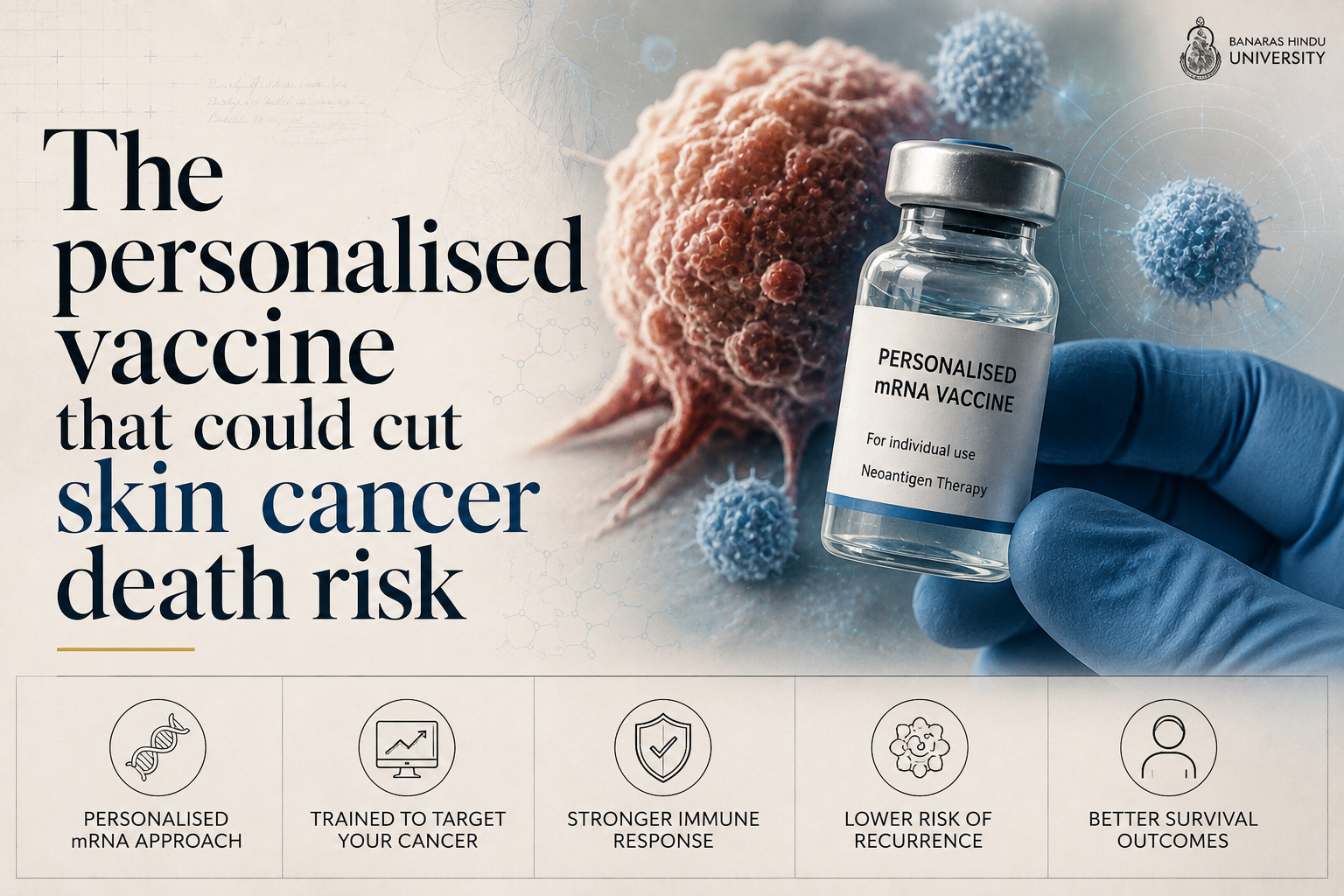
A new personalised cancer vaccine, intismeran, administered alongside the immunotherapy drug Keytruda, has been shown in Phase 3 results to reduce the risk of death from the recurrence and spread of skin cancer.
How does intismeran work?
- Step one, read the tumour: The therapy begins by identifying the mutations, called neoantigens, in a sample of the patient’s own tumour.
- Step two, build the instruction set: A vaccine is then made of synthetically developed messenger RNA (mRNA), a single stranded molecule that carries genetic instructions from DNA in the cell nucleus and tells the cell which proteins to make. Each treatment consists of mRNA coding for 34 such neoantigens.
- Step three, administer and translate: Once administered, the body generates these proteins from the mRNA instructions.
- Step four, present to the immune system: The body then presents those proteins to the immune system, which is trained to recognise them as belonging to the cancer.
Why must a cancer vaccine be personalised?
- Neoantigens exist only on cancer cells: Neoantigens are proteins found only on the cancerous cells, which the body’s immune system can be trained to recognise.
- They differ from patient to patient: These neoantigens vary from person to person, so they become an identifier for that individual’s cancer and cannot be mass produced as a single formulation.
- The principle is the same as any vaccine: A vaccine for an infectious disease contains the antigen from a pathogen, the proteins or lipids that train the immune system to recognise and fight it, and this therapy contains cancer neoantigens instead.
- The benefit is immunological memory: The cancer’s fingerprint enters the immune system’s memory, so if the cancer returns the body can recognise it immediately and mount a response, prolonging recurrence free survival.
- A decade of work behind one result: Work on this approach has run for around a decade, and this is the first clinical breakthrough.
What did the Phase 3 study find?
- Death risk from recurrence fell: When the vaccine was given with Keytruda, the risk of death owing to recurrence of skin cancer went down by 49 per cent.
- Death risk from spread fell further: The risk of death owing to the cancer spreading went down by 59 per cent.
- The comparison arm matters: Both results are measured against treatment with Keytruda alone, not against no treatment.
- The comparison arm is already strong: Keytruda (pembrolizumab, a checkpoint inhibitor that blocks the PD-1 receptor cancer cells use to switch off the immune response against them) has over the years been shown to be much more effective in treating certain cancers than traditional chemotherapy, so the gain sits on top of an established benchmark.
- Side effects were mild: The most common side effects noted in the study were fatigue, injection site pain and chills.
What does this mean for India?
- Reason one, the disease is rare here: Melanoma is one of the most common types of cancer in the caucasian population, and is not commonly seen among Indians.
- The share is a fraction of a per cent: Globocan, short for Global Cancer Observatory, an online platform that maintains cancer statistics, shows that melanoma accounts for only 0.26 per cent of all cancer cases in India and 0.17 per cent of deaths.
- Reason two, cost: Most patients in India are unable to afford Keytruda even with patient assistance programmes, and a combination therapy compounds a barrier that already exists for the immunotherapy alone.
- Access to immunotherapy is already narrow: A real world study from Tata Memorial Hospital showed that only 1.6 per cent of the patients who need such immunotherapy are able to access it.
Challenges to personalised mRNA cancer vaccines
- Every dose is a separate manufacturing run: The vaccine must be sequenced, designed and produced per patient, so the process cannot be batched and the turnaround competes with tumour progression. Eg. Each treatment encodes 34 neoantigens specific to one person’s tumour. Fix. Build automated, closed-system manufacturing units co-located with cancer centres, on the model already used for cell therapy production.
- Cost scales with individualisation: A therapy that cannot be mass produced carries no volume discount, so the price gap over a standard drug widens rather than narrows with adoption. Eg. Even the standard companion immunotherapy reaches only 1.6 per cent of Indian patients who need it. Fix. Negotiate outcome linked pricing, where payment is tied to recurrence free survival achieved rather than to doses supplied.
- Cold chain requirements restrict reach: mRNA products require ultra-low temperature storage and transport, which most Indian district level oncology facilities do not have. Eg. Covid-19 mRNA vaccines were never widely deployed in India partly for this reason. Fix. Extend the cold chain built for the universal immunisation programme with ultra-low temperature capacity at regional cancer centres before such therapies are introduced.
- Tumours can escape the target: Cancer cells can lose the targeted antigen over time, which is the known failure mode of antigen directed immunotherapy. Eg. Relapse through antigen escape is documented in CAR-T cell therapy for blood cancers. Fix. Design vaccines against multiple conserved neoantigens and pair them with checkpoint inhibitors, so escape from one target does not end the response.
- Regulatory pathways assume a fixed product: Approval systems are built to assess an identical formulation across a trial population, while each dose here differs by design. Eg. India’s biotechnology approvals are already split across the Department of Biotechnology, the drug regulator and the environment ministry. Fix. Create a platform approval route that licenses the manufacturing process and the design algorithm rather than each individual product.
- The evidence is disease specific: The result is established for melanoma alone, and benefit in the cancers that dominate India’s burden is not demonstrated. Eg. Melanoma is 0.26 per cent of Indian cancer cases while breast, oral and cervical cancers account for the bulk. Fix. Prioritise Indian participation in trials of the same platform for oral, breast and cervical cancers, so approval evidence is generated on the local disease profile.
Conclusion
A personalised mRNA vaccine has for the first time produced a meaningful clinical benefit in cancer, cutting the risk of death from recurrence by 49 per cent and from spread by 59 per cent when added to an existing immunotherapy. The result validates the principle that a therapy can be built against each patient’s own tumour mutations rather than against a disease in general. For India the immediate impact is limited, because melanoma is rare here and the companion drug reaches under two per cent of the patients who need it. The question that remains open is whether the platform is extended to the cancers that actually dominate India’s disease burden.
“[2022, GS3, 15 marks] What is the basic principle behind vaccine development? How do vaccines work? What approaches were adopted by the Indian vaccine manufacturers to produce COVID-19 vaccines?”
