Why in the News
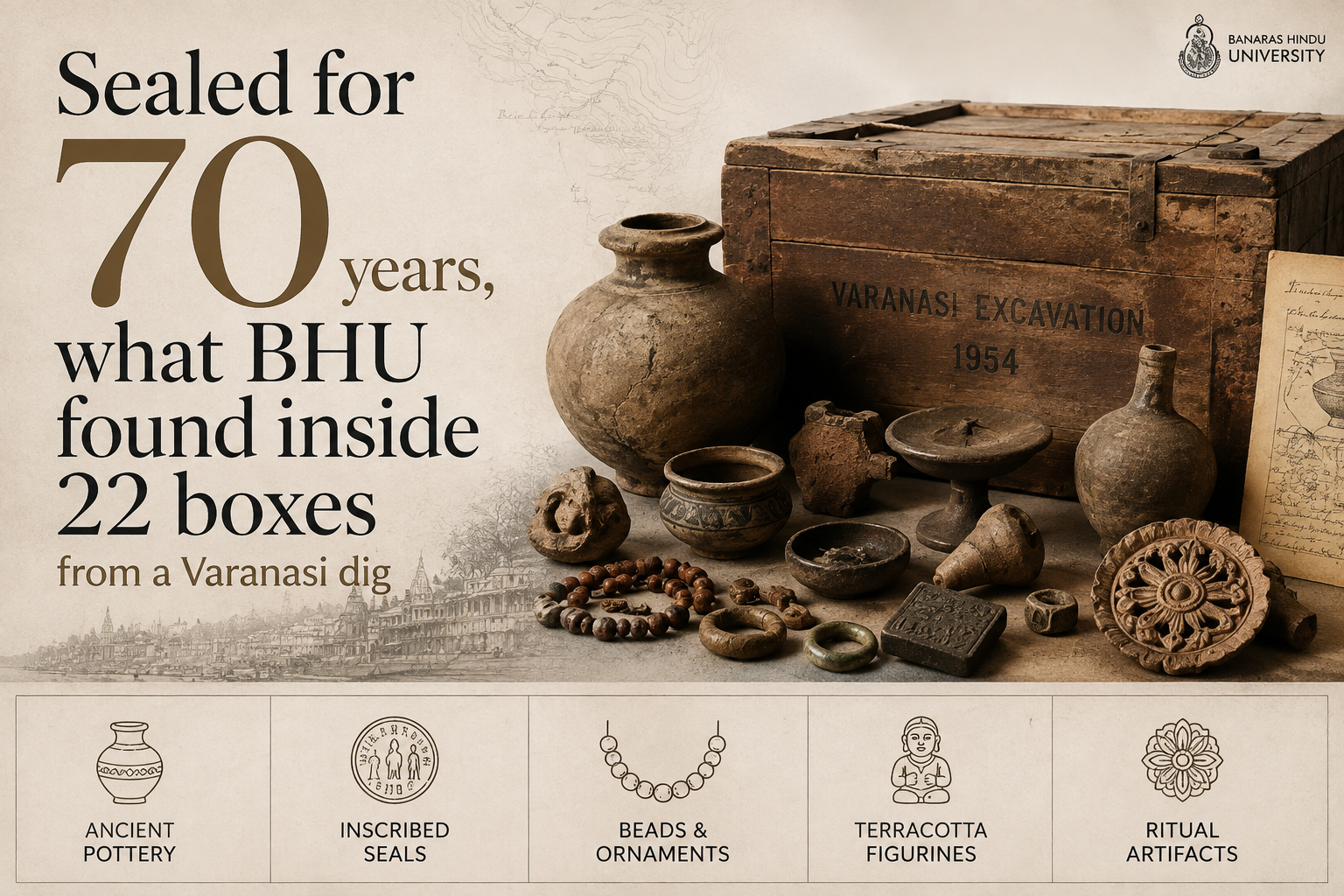
Banaras Hindu University (BHU) opened 22 boxes on 20 August 2026 that had lain unopened for nearly 70 years, and found more than 10,000 artefacts, including painted black pottery believed to be nearly 3,000 years old.
What is the Rajghat archaeological site?
- Location: Rajghat lies on the north-eastern edge of Varanasi, near the confluence of the Ganga and the Varuna rivers.
- Significance: It is one of the most important archaeological sites in the middle Ganga Valley.
- Historical identity: The area was part of ancient Varanasi, which served as the capital of the Kashi kingdom, also known as the Kashi Mahajanapad.
- Chronology: Archaeologists have divided the history of the site into six cultural periods, beginning around 800 BC and continuing up to the medieval period.
What did the 22 boxes contain?
- The artefact count: The boxes held more than 10,000 artefacts in total.
- The dating anchor: Among them is painted black pottery believed to be nearly 3,000 years old.
- The object categories: The boxes contain sculptures, ancient coins, tools, stamp seals and objects made of copper, ivory and bone.
- A separate photographic archive: They also held around 3,000 glass slides and more than 5,000 photographic negatives documenting archaeological sites across India, including Rajghat, Manjhi, Ratnagiri, Ajanta and Ellora.
- Rare images within the archive: The photographs include rare images of idols of Vishnu, Shiva and Buddha, which are being examined and will be restored as part of the department’s conservation work.
- The condition of the containers: The trunks were found in an advanced state of deterioration, which makes the recovery and preservation of the material inside particularly significant.
Why do the seals and inscriptions matter?
- Inscribed seals are present: Several of the seals recovered bear inscriptions, including some written in the Brahmi script.
- Who will read them: Researchers specialising in epigraphy at BHU will study them, and experts from other universities may be consulted where specialised expertise is required.
- What they can establish: The inscriptions can help researchers understand the scripts, systems of governance, and trade and economic systems of the periods in which they were used.
- Seals settled the site’s identity earlier: During the earlier excavations, seals and sealings bearing the name ‘Varanasi’ were found, and these findings helped establish the site’s connection with ancient Varanasi.
Why did the material stay unstudied for 70 years?
- The site was found by accident: The first archaeological remains at Rajghat were discovered in 1939 during the expansion of the Kashi railway station, and were sent to the ASI for examination.
- The excavation ran for twelve years: Excavations were carried out jointly by the ASI and BHU between 1957 and 1969, under the supervision of BHU Professor A K Narain and the archaeologist T N Roy.
- What the excavations found: They unearthed remains of ancient settlements, including structures believed to be houses, terracotta objects, seals and other artefacts, which allowed researchers to trace the development of human settlement at Rajghat over several centuries.
- Documentation stopped short of study: Professor Narain documented the excavations in four volumes, and a large part of the material recovered was not studied in detail.
- The techniques did not exist then: The Vice-Chancellor noted that the objects were excavated at a time when advanced scientific techniques for archaeological research were not available in India.
What happens to the material now?
- Three research teams have been formed: The department has constituted three specialised research teams to conserve and document the material.
- The stated purpose: The department has undertaken advanced research on its archaeological collections to allow scholars to reassess historical chronologies and produce new insights into ancient Indian civilisation.
- A parallel recovery is already under way: A month earlier, experts opened a box containing a human skeleton recovered from the same site, which had also remained sealed for around 70 years.
- Ancient DNA work has begun: A team specialising in ancient DNA collected samples from that skeleton for genetic and bio-archaeological analysis.
- What that analysis is expected to yield: The analysis is expected to provide clues about the people who lived in Varanasi around 1,000 years ago.
“[2024] Consider the following information:
Archaeological Site :: State :: Description
1. Chandraketugarh : Odisha : Trading Port town
2. Inamgaon : Maharashtra : Chalcolithic site
3. Mangadu : Kerala : Megalithic site
4. Salihundam : Andhra Pradesh : Rock-cut cave shrines
In which of the above rows is the given information correctly matched?
(a) 1 and 2 only
(b) 2 and 3 only
(c) 3 and 4
(d) 1 and 4
