Why in the News
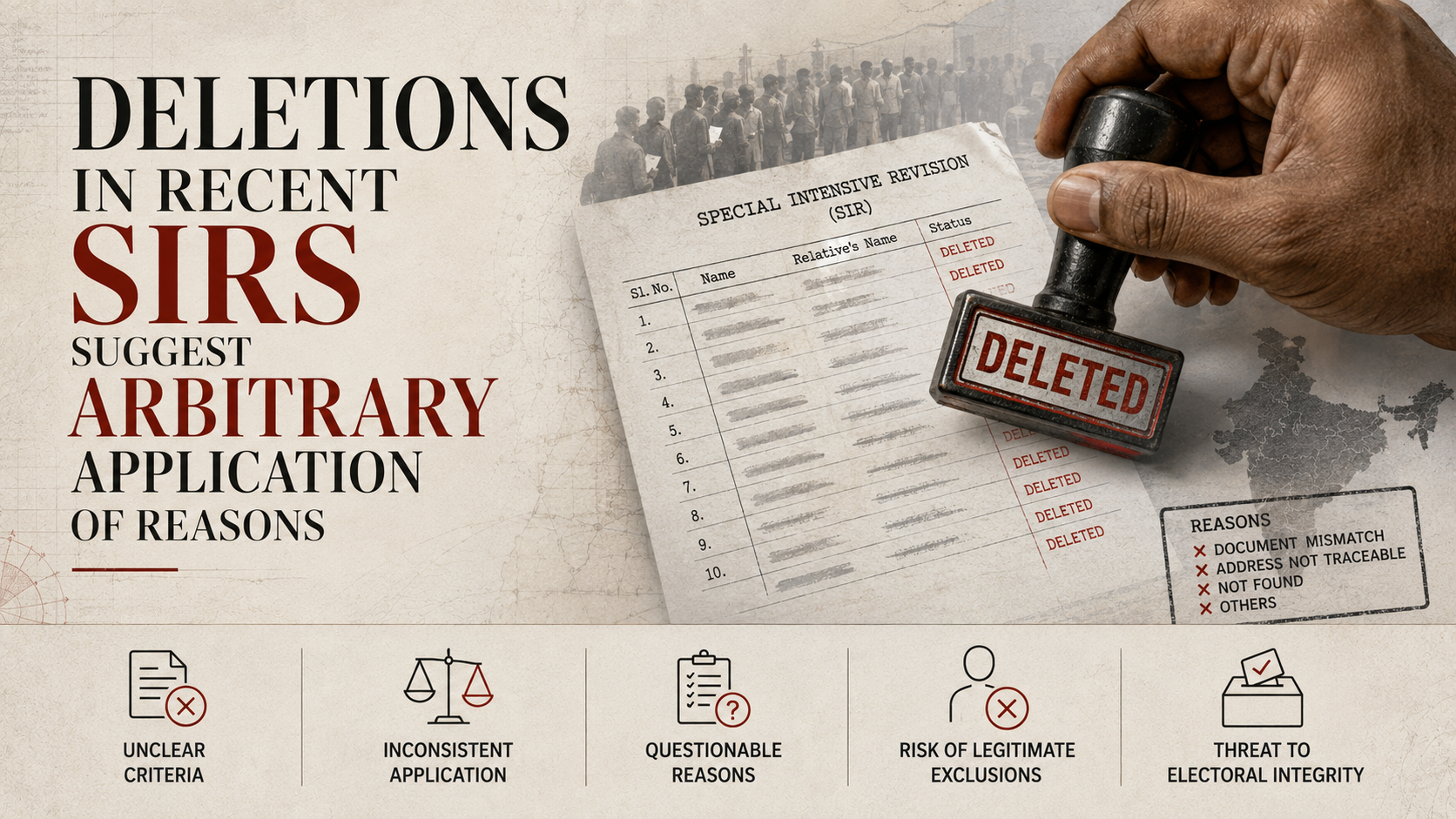
Draft electoral rolls released after the enumeration phase of the Special Intensive Revision (SIR), an exercise conducted by the Election Commission to verify every elector afresh rather than only updating additions and deletions, show wide variation in the reasons recorded for deleting names in Karnataka and Telangana. Both states saw roughly one-fifth of their electors deleted, the highest share among major states. A reason-wise breakdown of the deletions shows extreme, inconsistent use of the two largest deletion categories, “Shifted” and “Absent”, across constituencies of comparable size. The Election Commission has not defined when a Booth-level Officer (BLO) should mark an elector “Shifted” rather than “Absent”, and has never published the break-up between the two categories.
What do the numbers show?
- No defined threshold between categories: The Election Commission’s Manual on Electoral Rolls, 2023 states that a person absent temporarily from their ordinary residence does not, by law, cease to be ordinarily resident there, which raises the question of whether an elector found “Absent” during enumeration should be deleted at all. The manual gives BLOs no rule for choosing between “Shifted” and “Absent”.
- Wide swings between similar constituencies in Telangana: Of 1,79,510 deletions in Jubilee Hills, 83% were marked “Shifted” and only 15,000 “Absent”. In the comparably sized Nizamabad (Urban), 50,307 of 83,282 deletions were marked “Absent”. In Nakrekal (SC), all 20,169 deletions were marked as reasons other than “Absent”, with not a single elector recorded as absent.
- Wide swings in Karnataka: In Hebbal, 87% of 1.3 lakh deletions were marked “Shifted” and only 287 “Absent”. In Hubli-Dharwad-East, roughly 25,000 of 47,000 deletions were marked “Absent”. In Bommanahalli, 2.65 lakh electors, 54.8% of the roll, were deleted, with only about 9,700 marked deceased.
- Aggregated official reporting hides the pattern: The Election Commission has only ever published a combined figure for “Shifted” and “Absent” deletions in every state where the SIR has run. The category-wise breakdown used in this analysis was derived independently by processing thousands of constituency-level deletion lists.
Conclusion
The scale of variation in reason-coding for deletions, without a defined rule separating “Shifted” from “Absent”, points to inconsistent application rather than a uniformly applied enumeration standard. The Election Commission has not made public a category-wise breakdown for any SIR state, leaving independent verification as the only route to auditing how deletions are being classified.
Back2Basics: Special Intensive Revision (SIR)
- SIR is a full re-verification of the electoral roll, requiring every elector to be freshly enumerated, unlike the routine annual “Summary Revision” that only processes additions, deletions and corrections against the existing roll.
- Deletions during SIR are coded under four broad reasons: Shifted (or Permanently Shifted), Absent, Deceased and Duplicate.
“[2024, GS2, 10 marks] Examine the need for electoral reforms as suggested by various committees with particular reference to “one nation-one election” principle.”