Why in the News
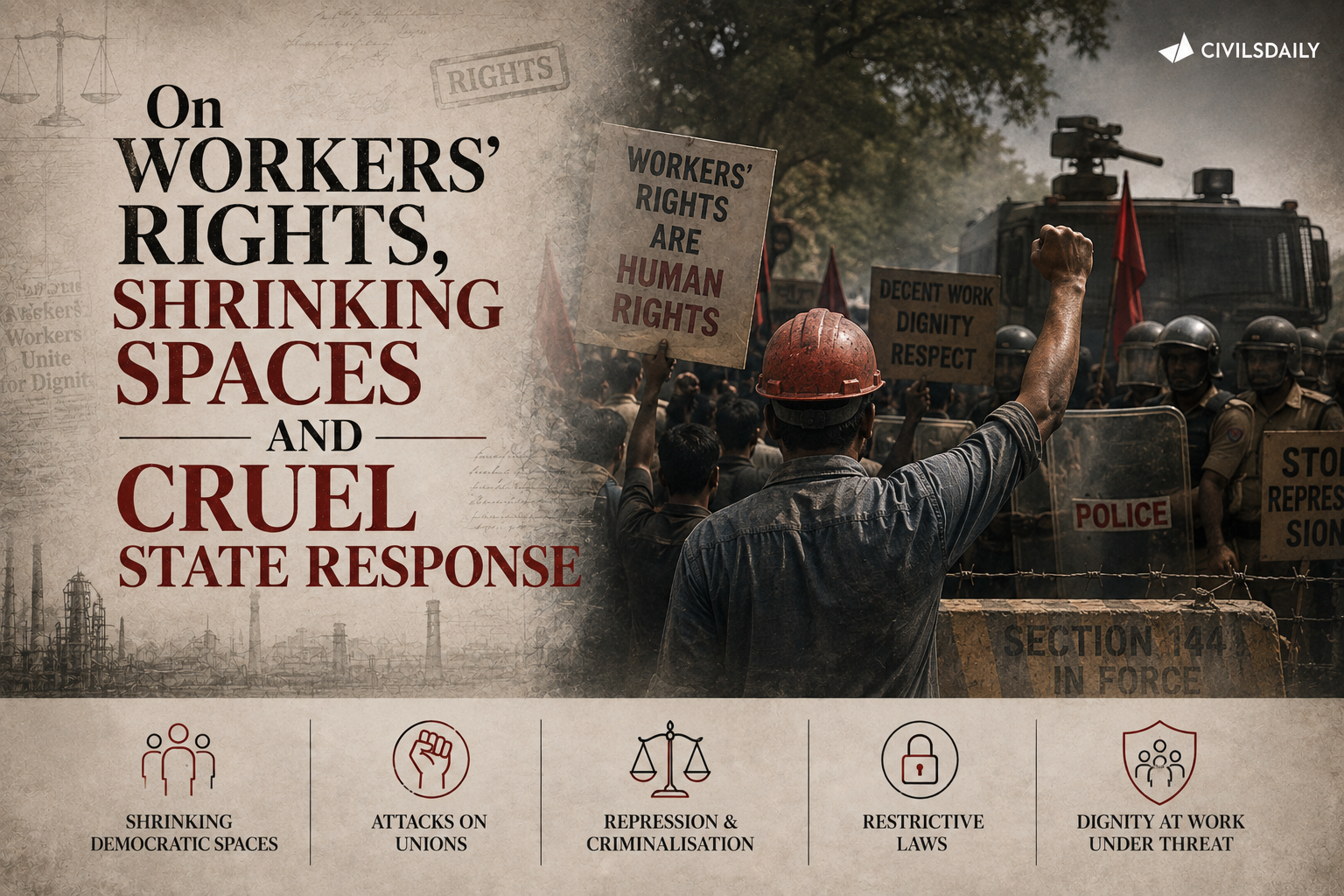
An opinion piece has linked the invocation of the National Security Act, 1980 (NSA) against wage protesters in Noida and Ghaziabad to a longer decline in trade unionism and a spread of casual, contract based labour across India’s unorganised sector. The piece follows a wage protest by thousands of workers on 13 April, after which the Noida police floated a theory that the agitation was sponsored by “Pakistan based handlers” and radical leftists, and about 200 people were arrested, two of them booked under the NSA. The piece argues that the same law once reserved for genuine threats to State security is now being used against ordinary economic protest and ideological dissent.
What is the National Security Act, 1980?
- Preventive detention power: The Act lets the Union or a State government detain a person without trial for up to twelve months where it is satisfied that the person’s activities are prejudicial to the defence of India, State security, public order or the maintenance of essential supplies.
- Subjective satisfaction standard: Detention rests on the detaining authority’s own assessment of a future risk rather than on a proven criminal act, so no conviction or specific offence needs to be established beforehand.
- Limited disclosure of grounds: The grounds for detention must ordinarily be communicated to the detainee within days of the order, but can be withheld where disclosure is considered against the public interest.
- Advisory Board review: An Advisory Board that includes sitting or former High Court judges reviews each detention within a set period, though its proceedings are not equivalent to a full trial.
How did the state respond to the Noida and Ghaziabad wage protest?
- A wage protest turned into a security case: Thousands of workers in Noida and Ghaziabad took to the streets on 13 April demanding higher wages. The Noida police, caught off guard, floated a theory that the agitation was sponsored by “Pakistan based handlers” and radical leftists.
- Mass arrests followed: About 200 people were arrested on charges of inciting violence.
- Two individuals were booked under the NSA: Journalist Satyam Verma and Delhi University student Akriti Chaudhary were held under the NSA, for their ideological leanings rather than for any specific act.
- The underlying wage demand was met, but the case was not withdrawn: The Uttar Pradesh government announced higher wages for the workers, while those arrested fought a difficult legal battle and continue to face its aftermath even after coming out of jail.
Why has India’s unorganised workforce lost the power to resist such treatment?
- A largely unrecorded toll: Forty thousand to fifty thousand casual workers die every year from occupational hazards in India’s unorganised sector, according to numerous research studies, and many more deaths go unrecorded in official data altogether.
- A sector too large to protect through informal goodwill alone: The unorganised sector employs nearly 80 percent of India’s workforce, so lapses in protection affect the majority of working people rather than a small margin.
- Trade unionism has receded since liberalisation: The movement that once produced leaders such as George Fernandes has weakened sharply as India’s economy has liberalised.
- Casualisation spread from the media into government itself: From the 1990s, news organisations began hiring staff on contract rather than on the payroll, part of a wider trend already under way in other sectors. The Centre and State governments, the country’s largest employers, eventually adopted the same contract based hiring as a way to save cost, entrenching the casualisation of labour.
- The result is a workforce with no leverage: Workers and employees today have little means to demand better conditions or resist injustice.
- Left parties have lost political weight: The Left is losing political strength and relevance, and the term “leftist” is now used as a pejorative in social media discourse.
What historical precedent of ideological accommodation has been abandoned?
- Trade unions once worked across ideological lines: In Kanpur in 1985, leaders of the CITU (Centre of Indian Trade Unions), the AITUC (All India Trade Union Congress), the INTUC (Indian National Trade Union Congress) and the BMS (Bharatiya Mazdoor Sangh) shared a camaraderie and jointly took up the cause of labour despite their ideological differences.
- Workers won rights through sustained struggle, not political patronage: Workers in textile mills and in the defence sector earned their rights through consistent struggles against management.
- A trade unionist held a Brahmin dominated seat for two decades: Kanpur, despite being a predominantly Brahmin constituency, was represented in the Lok Sabha by S M Banerjee, a veteran trade union leader, from 1957 to 1977.
- Political rivals once mourned an ideological opponent: In 1997, the BJP’s national executive passed a resolution mourning the assassination of AISA (All India Students Association) leader and former JNU (Jawaharlal Nehru University) Students Union president Chandrashekhar, killed by Mohammed Shahabuddin in Siwan. Chandrashekhar belonged to a Naxal aligned ideological stream.
- That same accommodation would now be treated as suspect: The piece argues that the 1997 BJP resolution, if found in someone’s possession today, would itself risk being treated as seditious material by the Uttar Pradesh Police.
What tension does criminalising ideological material expose?
- Possession of a book is being treated as an offence: A book on Marxism, or on Gaza or the Palestinian struggle, is being categorised as criminal material when found in an individual’s possession.
- Marxist ideology sits within India’s constitutional mainstream: Marxist ideology is as much a part of India’s political mainstream as the Congress or the BJP, and every political party that swears loyalty to the Constitution is allowed to grow and function in the country.
Challenges to invoking the National Security Act against protest and dissent
- Vague and subjective grounds for invocation: The Act permits detention on the executive’s own subjective satisfaction that a person’s activities are prejudicial to public order, without a defined evidentiary threshold. Eg. In 2020, the National Security Act was invoked against a doctor in Uttar Pradesh over a public speech, and the Allahabad High Court quashed the detention in 2021 for lacking any evidence of an actual threat to public order. Fix. Require a documented, judicially reviewable threshold of imminent public order harm before invocation, rather than the detaining authority’s subjective satisfaction alone.
- Weak disclosure of the case against the detainee: Grounds for detention can be withheld where disclosure is considered against the public interest, leaving the detainee unable to mount a full challenge. Eg. Detainees under the Act have often learned the specific allegations against them only after approaching High Courts through habeas corpus petitions. Fix. Mandate disclosure of detention grounds within a fixed period, with any exception reviewed by a judicial officer rather than decided by the detaining authority itself.
- The Advisory Board functions as an executive check rather than a judicial one: The Board that reviews detention orders has historically confirmed most of the orders referred to it, and its proceedings offer limited scope for legal representation. Fix. Allow legal representation before the Advisory Board and require it to publish reasoned orders, so its review carries genuine weight.
- A chilling effect on journalists and students: Using a preventive security law against people over their reading material or ideological leanings, rather than any proven act, discourages lawful reporting and dissent. Eg. A Manipur journalist was detained under the Act in 2018 over a social media post criticising the state’s Chief Minister. Fix. Confine invocation of the Act to demonstrable threats to public order, with judicial pre screening required in cases involving journalists and students.
Conclusion
The Noida episode shows that as trade union protections have eroded and labour has been casualised, the state has increasingly reached for security legislation such as the National Security Act to answer a wage protest, extending a pattern of criminalising political dissent that earlier generations of political rivals once resisted. Whether the arrested journalist and student receive a fair hearing, and whether India’s civil liberties framework is reformed to prevent such recourse to preventive detention against economic protest, remains unresolved.
Current Status of Personal Liberty in India
- A broad but conditional guarantee: Personal liberty covers freedom of speech, assembly, association, and movement under Article 19(1)(a) to (e), and the right to life and personal liberty under Article 21, all subject to reasonable restrictions the state may impose by law.
- A carved out exception for preventive detention: Article 22 protects against arbitrary arrest and detention, but specifically permits preventive detention laws such as the National Security Act, 1980 and the Unlawful Activities (Prevention) Act, 1967, under which a person can be held without a trial.
- Judicial reading has widened even as detention powers remain broad: Courts have steadily expanded what Article 21 protects, yet the power to preventively detain still rests largely on the executive’s own satisfaction rather than on prior judicial approval.
Constitutional Provisions Related to Personal Liberty
- Article 19(1)(a): Guarantees freedom of speech and expression.
- Article 19(1)(b): Guarantees freedom of peaceful assembly.
- Article 19(1)(c): Guarantees freedom of association.
- Article 21: Guarantees the right to life and personal liberty, protecting against arbitrary state action.
- Article 22: Protects against arbitrary arrest and detention, while permitting preventive detention laws as a specific exception.
Major debates surrounding Personal Liberty
- Security law versus proportionality: Whether preventive detention laws such as the National Security Act curtail personal liberty beyond what public order genuinely requires.
- Dissent versus disorder: Whether vague grounds such as public order or prejudicial activity are being used to criminalise lawful dissent rather than address genuine security threats.
- Judicial expansion versus executive discretion: The gap between the judiciary’s expansive reading of Article 21 protections and the limited judicial oversight available at the point of preventive arrest itself.
Laws and Rules Governing Personal Liberty and Preventive Detention
- Unlawful Activities (Prevention) Act, 1967: Allows the government to designate organisations and individuals as unlawful or as terrorists, and permits prolonged detention before trial in cases involving alleged threats to India’s sovereignty and integrity.
- Bharatiya Nyaya Sanhita, 2023, Section 152: Replaced the sedition offence earlier defined under Section 124A of the Indian Penal Code, 1860, penalising acts that excite secession, armed rebellion, or subversive activity.
- Bharatiya Nagarik Suraksha Sanhita, 2023: Governs the ordinary process of arrest, remand and bail that a preventive detention law such as the National Security Act bypasses.
[2024] Right to privacy is intrinsic to life and personal liberty and is inherently protected under Article 21 of the Constitution. Explain. In this reference discuss the law relating to D.N.A. testing of a child in the womb to establish its paternity.”
