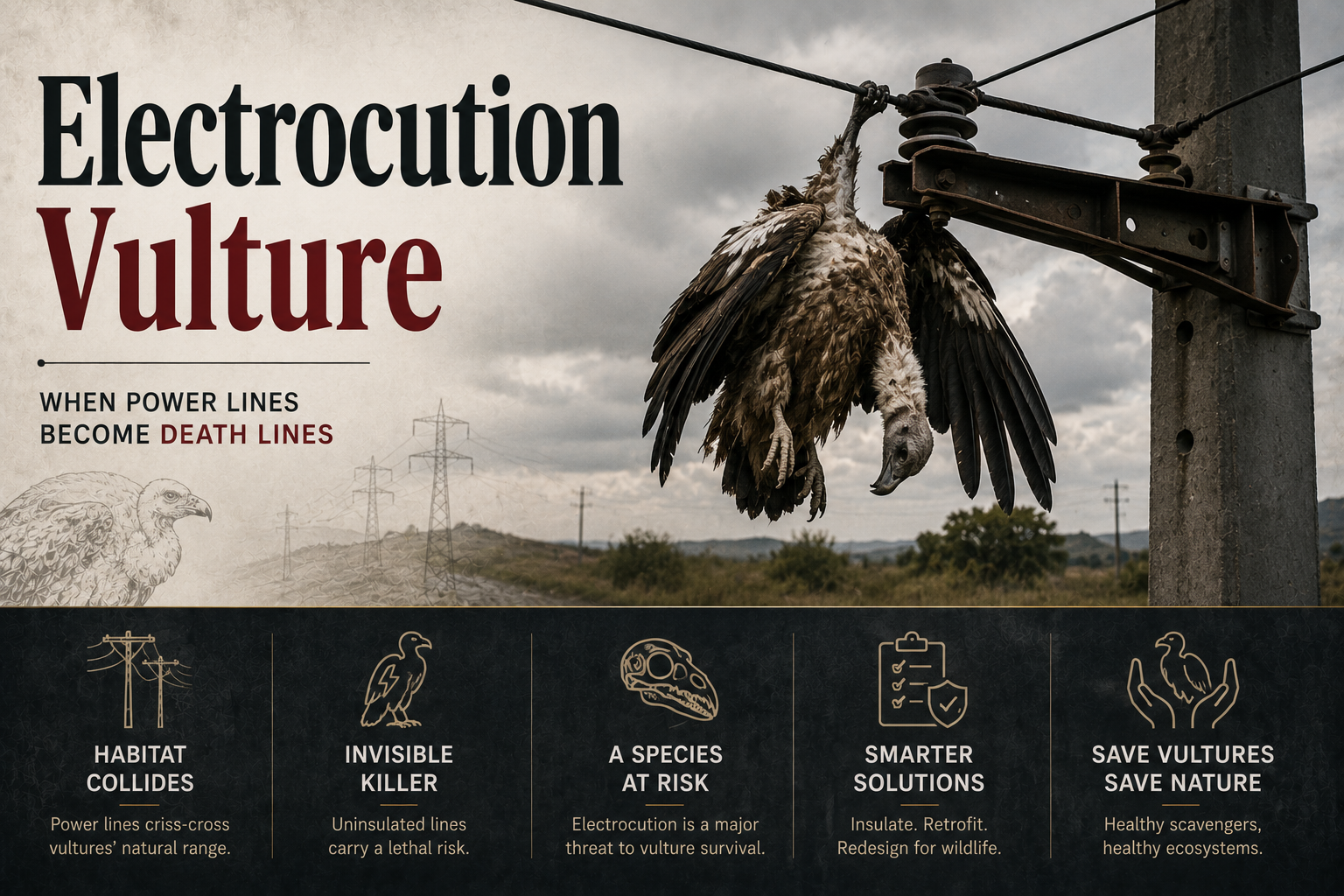
Why in the News
Electrocution on India’s expanding power infrastructure is emerging as a threat to vultures capable of overtaking the chemical poisoning that caused their collapse.
How far did the chemical crash take India’s vultures?
- The loss was among the world’s worst recorded: Numbers fell by 99.5 per cent by 2007 from a high of around four crore in the 1980s.
- Three species were nearly wiped out: The white-rumped, Indian and slender-billed vultures were the worst affected.
- The cause was a veterinary painkiller: Diclofenac administered to cattle destroyed the kidneys of vultures that fed on the carcasses.
- The regulatory response came in stages: The government banned diclofenac first, then added bans in 2023 on aceclofenac and ketoprofen among other NSAIDs.
- The population has not returned: One official survey reported in 2025 that vultures were nesting at only 50 per cent of their historic nesting sites.
What did the collapse cost beyond the birds?
- Carcasses stayed exposed for longer: The loss of scavengers left livestock carcasses in the open, which supported feral dog populations.
- Rabies outbreaks followed: The growth in feral dog numbers led to outbreaks of rabies.
- Human mortality rose 4 per cent: A 2024 study in the American Economic Review estimated that increase as a consequence of the vulture decline.
- The damages were valued at 69.4 billion dollars a year: The same study put the associated cost to India at that figure.
Why does power infrastructure kill vultures specifically?
- A wingspan can bridge two conductors: A large individual can contact two conductors at once, which is what completes the circuit through the bird.
- The birds seek elevated perches: Vultures habitually perch on elevated structures and are drawn to open landscapes, which is what a transmission corridor provides.
- Predictable food concentrates them: Vultures congregate where food availability is predictable, and dumping of food waste around electrical installations creates exactly that draw.
- Medium-voltage lines are also lethal: An assessment prepared for the State Climate Resilient Power System Development Project recorded an Egyptian vulture and steppe eagles electrocuted on medium-voltage rather than high-voltage lines.
Why is the evidence on electrocution weaker than the threat?
- The deaths are removed before they are recorded: Avian electrocution is likely under-documented in India, since a dead bird can be taken by people or eaten by scavengers.
- The comparison with drugs understates the risk: Electrocution has not become as deadly as NSAIDs were, and the population it now acts on is a fraction of the one the drugs acted on.
- A local population can be lost to it alone: Research has noted that persistent mortality from electrocution by itself could render a local population extinct.
- Waiting for the data repeats the first failure: The fragility of the surviving population and the proliferation of unsafe power infrastructure are together the case for acting before the mortality record matures.
Which interventions has the evidence actually tested?
- Moving the food source worked: Relocating a livestock carcass dump 2.4 km away from high-tension power infrastructure near Dehradun in Uttarakhand may have saved these scavengers from electrocution, per a recent study in the Journal of Threatened Taxa.
- Separation is the cheapest measure available: Keeping vulture feeding sites away from power infrastructure is a siting decision rather than a capital works programme.
- Insulating conductors removes the contact risk: Covering energised components stops a bird bridging them.
- Increasing clearances answers the wingspan: Widening the gap between energised and grounded components has to be sized against vulture wingspans rather than against smaller birds.
- Safe perches redirect the birds: Installing perches that carry no current gives raptors an alternative to the energised structure.
Challenges to vulture conservation in India
- Human formulations substitute for the banned veterinary drug: Multi-dose human vials of diclofenac remain on sale and are diverted to cattle, so the ban is defeated at the pharmacy counter. Eg. India capped the human diclofenac vial at 3 ml in 2015 because larger vials were being used on livestock.
The Fix: Make sale of injectable diclofenac without a veterinary prescription an enforceable offence policed by drug inspectors rather than by forest staff. - New painkillers enter the market faster than they are tested: A molecule is approved for cattle without a vulture safety trial, so each ban is followed by the next drug. Eg. Nimesulide has been shown to be toxic to Gyps vultures and remains in veterinary use.
The Fix: Require safety testing on Gyps vultures as a condition of veterinary marketing approval for any NSAID, with meloxicam as the reference safe alternative. - Captive breeding cannot outpace adult mortality: Vultures lay a single egg a year and mature slowly, so releases add birds far more slowly than a landscape threat removes them. Eg. The Jatayu Conservation Breeding Centre at Pinjore has released birds only in small annual batches.
The Fix: Certify the release landscape as safe before any release, with drug residue sampling and line insulation audited as the precondition. - The food base has been engineered away: Rendering and burial of livestock carcasses removes the open food supply that once sustained large scavenger populations. Eg. Vulture restaurants in Maharashtra and Punjab exist because the traditional open carcass dump has disappeared from many districts.
The Fix: Fund supplementary feeding sites from State animal husbandry budgets and site them by rule away from transmission corridors. - No agency is answerable for bird deaths on power lines: Transmission and distribution utilities carry no reporting duty for wildlife mortality, so the threat has no dataset behind it. Eg. Bird deaths on power lines in the Thar landscape became visible only after Great Indian Bustard litigation forced surveys.
The Fix: Make wildlife mortality reporting a licence condition for transmission and distribution licensees, with the returns published by the State electricity regulator. - Bird safe design is not written into line standards: Construction standards specify electrical clearances, not clearances sized for large raptors. Eg. Directions on undergrounding power lines in Great Indian Bustard habitat were later narrowed on feasibility and cost grounds.
The Fix: Write raptor safe pole and cross-arm geometry into the national electricity standards for new lines in identified vulture landscapes.
Conclusion
The chemical crash was answerable on paper, because a single molecule could be identified and banned. Electrocution offers no such lever, since the killing agent is ordinary infrastructure doing what it was built to do. The unresolved tension is that conservation authority sits with forest departments while the hazard sits with the power sector, and no rule connects the two. Until that link is made, the threat will keep being measured only after the fact.
Back2Basics: White-rumped Vulture
- Status: Listed as Critically Endangered on the IUCN Red List and protected under Schedule I of the Wild Life (Protection) Act, 1972.
- Identification: It carries a white neck ruff and a white rump against black and brown plumage.
- Range and nesting: It is found near human settlements across northern and central India, nesting in tall trees and on cliffs.
- Ecological role: It is a social scavenger that feeds in flocks on carrion, garbage and slaughterhouse waste, which is how a small population clears waste across a wide landscape.
[2012] Vultures which used to be very common in Indian countryside some years ago are rarely seen nowadays. This is attributed to:
(a) the destruction of their nesting sites by new invasive species disease among them
(b) a drug used by cattle owners for treating their diseased cattle persistent and fatal
(c) scarcity of food available to them
(d) a widespread, persistent and fatal disease among them