Why in the News
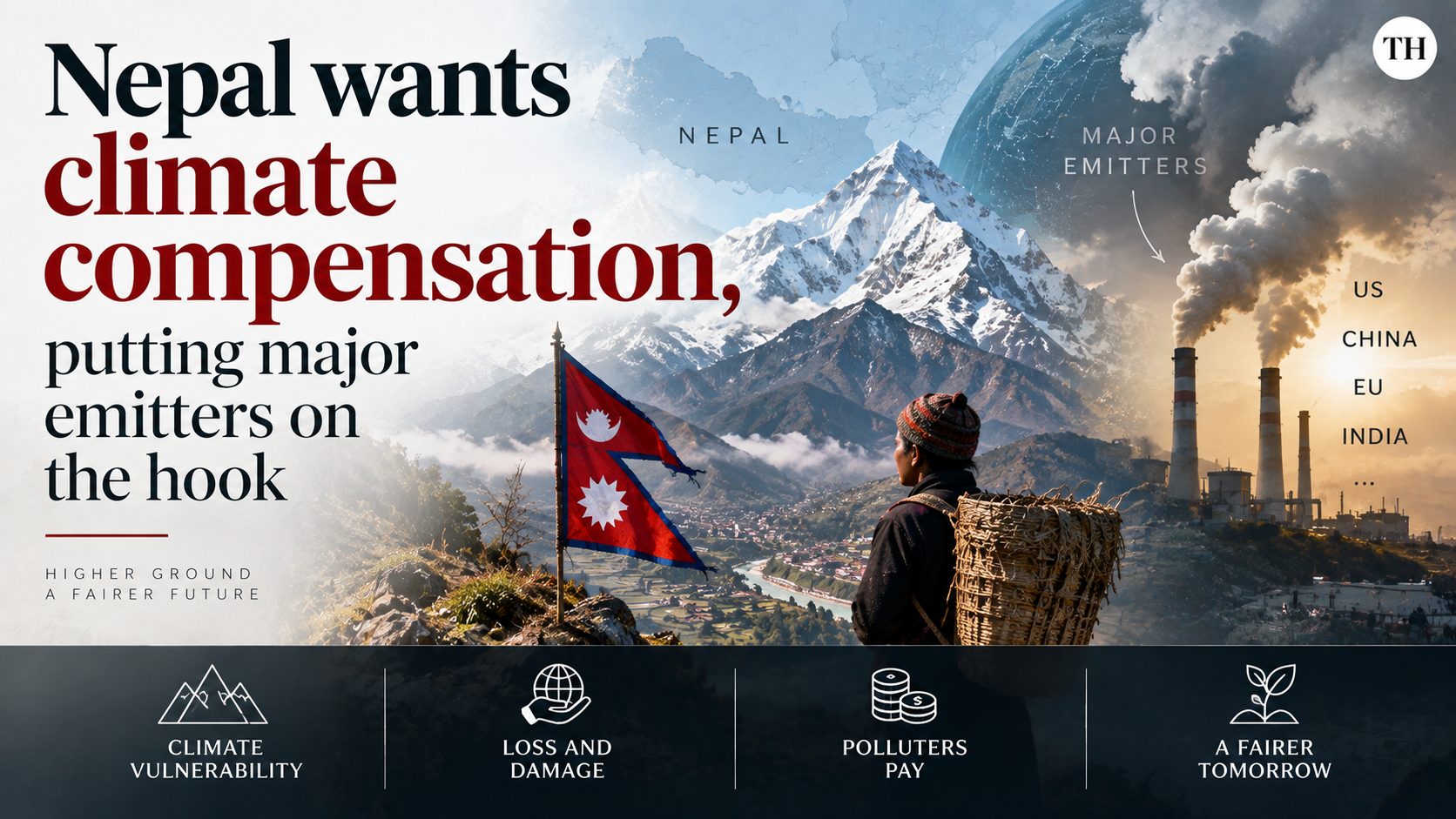
Nepal has demanded direct climate compensation from the United States, China and India, the world’s three largest emitters. The demand follows the glacial collapse of 26 August on the Nepal China border, which killed over 1,200 people and buried hydropower tunnels and valleys downstream. Nepal’s Foreign Minister has framed the country as paying the ultimate price for a crisis it did not create.
What is the Fund for Responding to Loss and Damage?
- What it is for: It is the dedicated financing mechanism for climate damage that has already occurred and can no longer be adapted to, as distinct from funds for mitigation or for adaptation.
- How it came about: Vulnerable nations secured its establishment at COP27 in 2022, after decades of resistance from developed countries to any dedicated loss and damage facility.
- When it began operating: It was operationalised a year later at COP28.
- Where it sits: It is temporarily hosted by the World Bank, which places a development lender at the centre of a compensation mechanism.
Why does Nepal sit at the centre of climate injustice?
- Its own contribution is negligible: Nepal accounts for 0.1 percent of global greenhouse gas emissions and generates almost all its electricity from renewable hydropower.
- Its geography is the exposure: The Hindu Kush Himalayas, described as the “Third Pole”, are warming at nearly twice the global average, and their glaciers are melting at 10 times their historical norms.
- The driver is remote, not local: Warming in the North Eurasian Arctic disrupts planetary waves and the stratospheric polar vortex, which in turn destabilises the South Asian monsoon.
- The scale was misread: The major powers treated the event as a localised weather emergency manageable with temporary relief, when the cryosphere failure cascaded down into densely populated valleys.
What did the disaster do to Nepal’s economy?
- It struck the sector the country had bet on: Nepal’s strategy for economic sovereignty rested on harnessing 43,000 MW of commercially viable hydropower to become a regional energy exporter, and it had only recently achieved net exporter status.
- A tenth of installed capacity is gone: The floods crippled approximately 10 percent of installed capacity, wiping out older surface level plants such as Devighat and burying under construction projects in mud.
- The trade position reversed overnight: A country banking on power exports to narrow its trade deficit with India halted exports and began importing power to survive the winter.
- Rebuilding costs more than building did: Climate resilient underground engineering will raise future project costs by 10 to 12 percent.
- The bill is a tenth of the economy: Total damages are estimated between 4 billion dollars and 7 billion dollars, roughly a tenth of Nepal’s entire gross domestic product.
Why has Nepal named the United States, China and India?
- The case against the United States is cumulative: America accounts for over 20 percent of cumulative global emissions since 1850, which anchors the claim in historical liability rather than current output.
- The case against China is proximity and data: China is the current top annual emitter, and Nepali officials had asked at a bilateral meeting in Kathmandu in May 2026 for real time data sharing on glacial lakes and avalanches in the Tibetan region.
- What China supplied instead: Beijing provided only heavy rain forecasts, and the absence of transboundary early warning proved fatal when the glacial lake burst.
- The case against India inverts India’s own argument: New Delhi has long cited low per capita emissions and demanded “common but differentiated responsibilities” from the West, and Nepal now applies that logic regionally to South Asia’s largest economy and emitter.
- India’s regional conduct is part of the charge: India’s refusal to buy power from Nepali projects built by Chinese contractors has complicated Nepal’s recovery and spread the friction horizontally across the region.
Why can the existing fund not answer the demand?
- The fund is smaller than one country’s damage: It holds a mere 700 million dollars in pledges, against a single catastrophe costing several billion.
- The grant ceiling makes the arithmetic absurd: Pilot phase rules cap individual grants at between 5 million and 20 million dollars, so the maximum available payout answers a fraction of one percent of the loss.
- Speed is the second failure: The mechanism is handicapped by slow moving bureaucracy, and Nepal’s out of cycle demand on 1 September forces its board to decide whether it can respond to a live emergency at all.
- Compensation may arrive as debt: Debt saddled developing nations fear that money routed through a development lender converts into loans, turning a liability payment into a further obligation.
- The major powers answered with relief, not liability: China and India responded with helicopters, rescue teams and medicines, which supplies assistance while conceding no legal responsibility.
Challenges to Nepal’s compensation claim
- The climate treaty framework expressly rules out liability: The decision adopting the Paris Agreement records that loss and damage provisions do not involve or provide a basis for any liability or compensation. Eg. Developed countries insisted on that language in 2015 as the price of accepting loss and damage in the text at all.
The Fix: Pursue the claim through state responsibility and human rights forums in parallel, so the treaty carve out does not extinguish the legal route entirely. - Attributing a single collapse to named emitters is contested: Compensation requires linking one event to specific contributors, and attribution science produces probabilities rather than the causal certainty a liability claim needs. Eg. The International Court of Justice advisory proceedings on climate obligations turned substantially on whether such a link can ground state responsibility.
The Fix: Commission an independent forensic attribution study of the 26 August collapse before the claim reaches any forum, so the demand rests on published evidence. - Pledged climate money has a record of not arriving: Announced sums and disbursed sums diverge by years in climate finance. Eg. The 100 billion dollar a year promise made for 2020 at Copenhagen in 2009 was reported as met only in 2022.
The Fix: Attach disbursement deadlines and public tracking to each pledge, so a pledge that is not paid is visible rather than absorbed into a cumulative total. - Upstream data sharing rests on no binding obligation: Early warning for glacial hazards depends on the upstream state volunteering information, and no treaty compels it. Eg. Hydrological data on the Brahmaputra reaches India through renewable memoranda of understanding, and sharing lapsed after the 2017 Doklam standoff.
The Fix: Negotiate a Hindu Kush Himalaya data protocol with automatic sensor level transmission, so glacial lake readings do not depend on the state of bilateral relations. - Regional politics undercuts regional claims: Nepal is asking India for differentiated responsibility while its recovery is being slowed by an Indian trade restriction. Eg. Power from Nepali projects built by Chinese contractors is refused entry to the Indian market.
The Fix: Separate the power trade rules from the security screening by publishing objective eligibility criteria, so recovery generation is not blocked by contractor nationality.
Conclusion
Nepal’s claim will not be paid, and that was never the whole point of making it. A country responsible for a rounding error in global emissions has converted a disaster into a legal argument, and the argument lands on India rather than only on the West. The precedent it sets is that differentiated responsibility runs downward as well as upward, which is uncomfortable for every middle emitter that has used the doctrine as a shield. What to watch is the fund board’s response to an out of cycle demand, since a refusal establishes that the mechanism handles paperwork rather than emergencies.
Back2Basics: Common But Differentiated Responsibilities
- What the principle holds: All states share responsibility for protecting the global environment, and their obligations differ according to their historical contribution to the problem and their present capacity to act.
- Where it is written: It appears as Principle 7 of the 1992 Rio Declaration and in Article 3.1 of the United Nations Framework Convention on Climate Change (UNFCCC), 1992.
- How it was first operationalised: The Kyoto Protocol, 1997 split countries into Annex I parties carrying binding emission targets and non Annex I parties carrying none.
- How the Paris Agreement restated it: The 2015 text retains the principle “in the light of different national circumstances”, replacing the fixed two group split with nationally determined contributions.
“[2017, GS3, 15 marks] ‘Climate Change’ is a global problem. How India will be affected by climate change? How Himalayan and coastal states of India will be affected by climate change?
