Why in the News
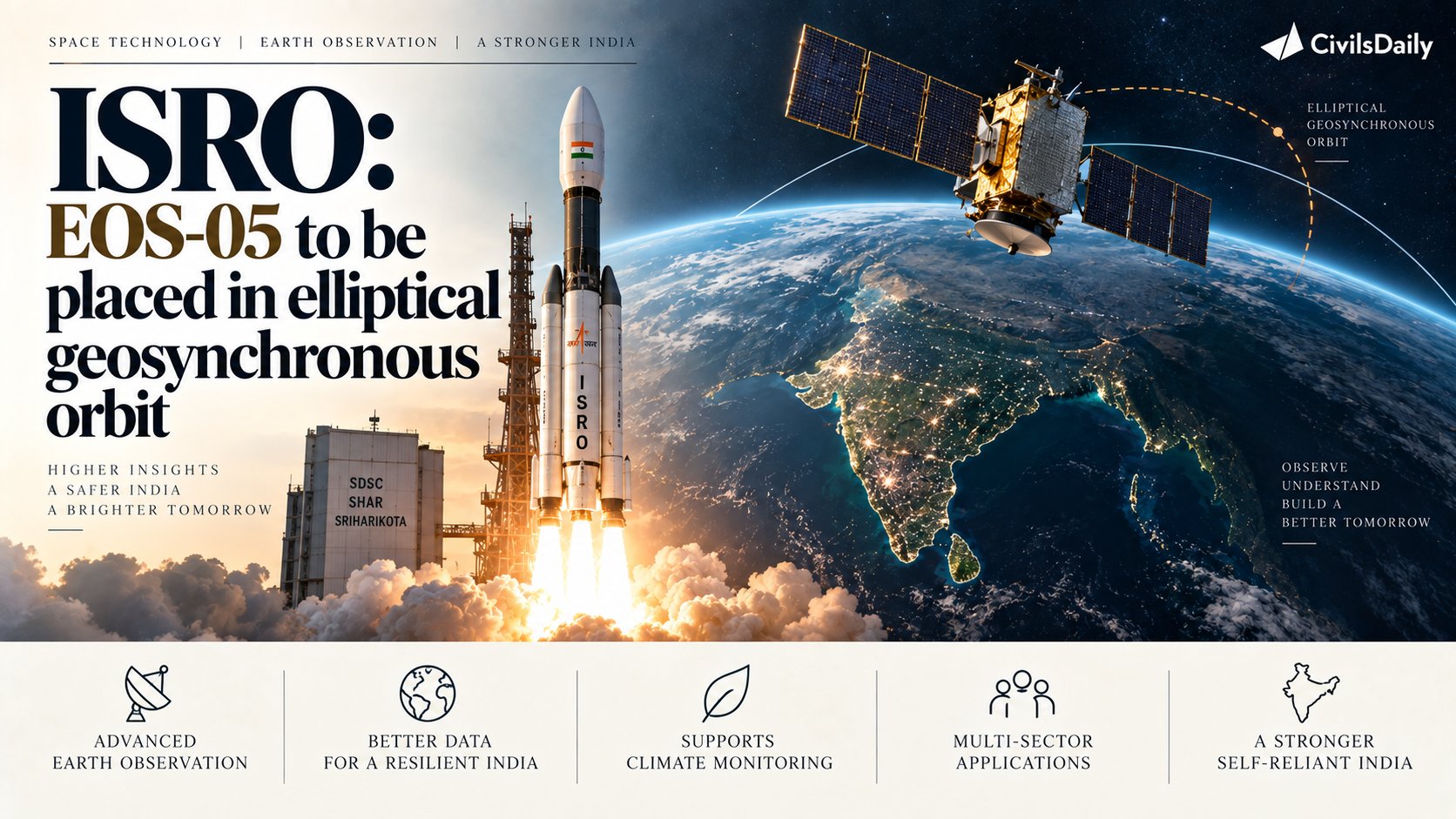
EOS-05, India’s Earth observation satellite, is being placed in a slightly elliptical geosynchronous orbit. It is the first Indian Earth observation satellite to use a geosynchronous orbit. It was launched by GSLV-F17 and is undergoing successive orbit-raising manoeuvres.
Geosynchronous Orbit
- Satellite’s orbital period equals Earth’s rotational period.
- It moves in synchrony with Earth’s rotation.
- Geostationary orbit is a special type of geosynchronous orbit.
- Geostationary orbit is:
- Circular
- Equatorial
- At about 35,786 km altitude
- Geosynchronous orbits can also be inclined or elliptical.
EOS-05: Significance
- Uses a slightly elliptical geosynchronous orbit for persistent observation.
- Can provide continuous monitoring of a specific region.
- Potential applications include:
- Weather monitoring
- Maritime surveillance
- Strategic applications, including use by the Indian Navy.
Limitations
- Lower spatial resolution: Greater distance from Earth compared with LEO satellites.
- Limited coverage: Persistent observation of one region comes at the cost of wider coverage.
- Cloud and night limitations: Optical imaging is affected by clouds and darkness.
- Radar complement: Satellites such as RISAT and NISAR can overcome some optical limitations.
- Orbital congestion: Requires effective space situational awareness and collision avoidance.
GSLV: Back to Basics
- Full form: Geosynchronous Satellite Launch Vehicle.
- Three-stage launch vehicle developed by ISRO.
- Uses an indigenous cryogenic upper stage using liquid hydrogen and liquid oxygen.
- Primarily designed for placing satellites into geosynchronous transfer orbit (GTO).
- Lies between PSLV and LVM3 in the launch vehicle family.
Prelims Pointers
- Geosynchronous → Orbital period equal to Earth’s rotation.
- Geostationary → Circular + equatorial + geosynchronous.
- Geostationary altitude → ~35,786 km.
- EOS-05 → Geosynchronous Earth observation mission.
- GSLV → Geosynchronous transfer orbit.
- PSLV → Polar/sun-synchronous missions.
- LVM3 → Higher lift capability than GSLV.
- IS4OM → Safe and sustainable space operations management.
“[2018] With reference to India’s satellite launch vehicles, consider the following statements :
1.PSLVs launch the satellites useful for Earth resources monitoring whereas GSLVs are designed mainly to launch communication satellites.
2.Satellites launched by PSLV appear to remain permanently fixed in the same position in the sky, as viewed from a particular location on Earth.
3.GSLV Mk III is a four-stage launch vehicle with the first and third stages using solid rocket motors, and the second and fourth stages using liquid rocket engines.
Which of the statements given above is/are correct?
(a) 1 only
(b) 2 and 3
(c) 1 and 2
(d) 3 only
