Why in the News
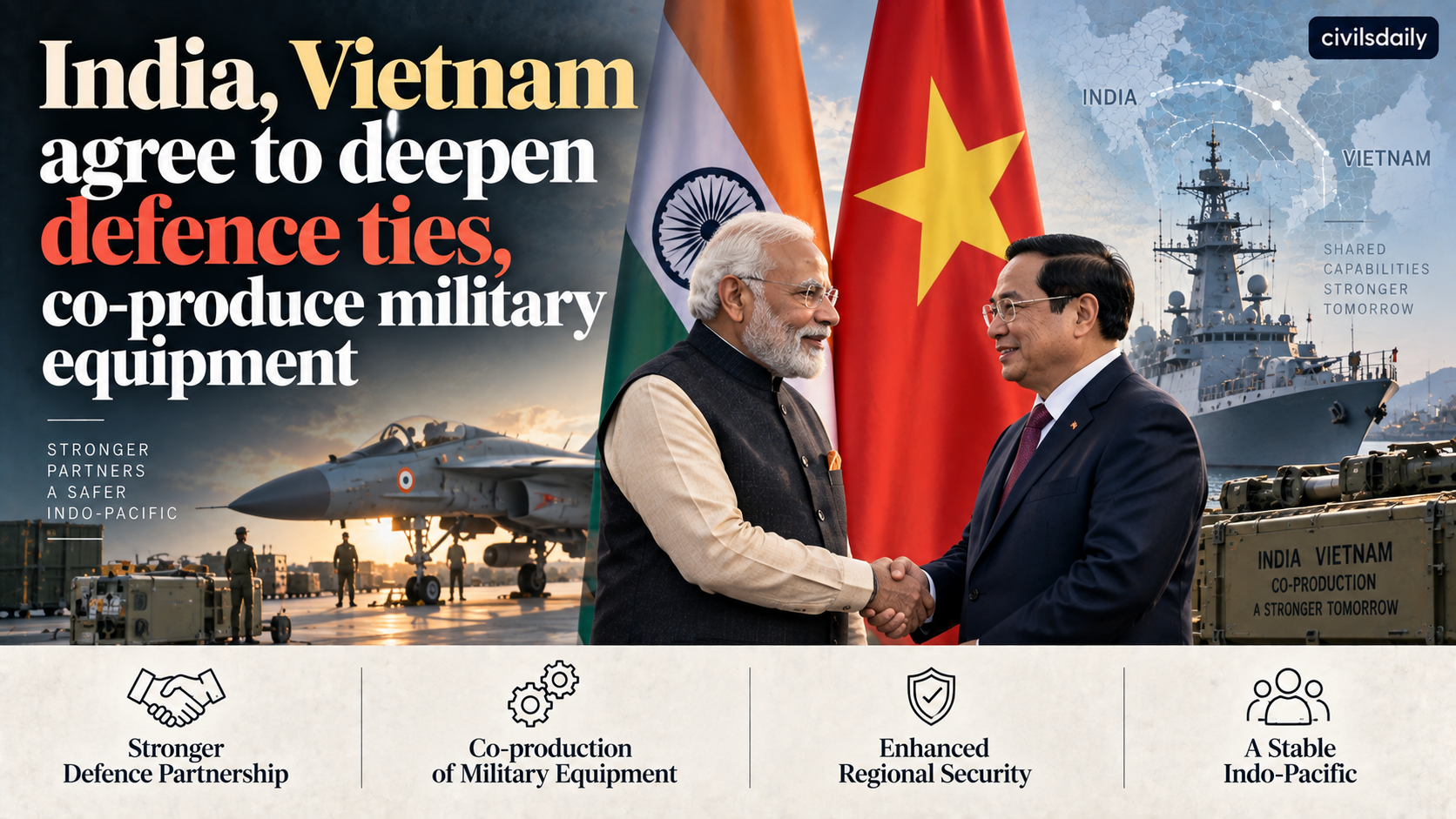
India and Vietnam have agreed to deepen defence and security cooperation, including through joint production of Indian defence items. The agreement came out of the 19th India Vietnam Joint Commission Meeting on trade, economic, scientific and technological cooperation, chaired jointly by the two foreign ministers in New Delhi. The Joint Commission met for the first time in three years, and it met after the relationship had been raised to an Enhanced Comprehensive Strategic Partnership during the State Visit from Vietnam in May 2026. India’s defence supply to Vietnam has so far run through gifted platforms and lines of credit. Joint production changes what the relationship is, from the transfer of equipment to a stake in Vietnam’s own defence industry, in a region where China’s assertive behaviour in the Indo Pacific is the shared concern.
What is the India Vietnam Enhanced Comprehensive Strategic Partnership?
- The tier: The highest level at which India holds bilateral ties with Vietnam, reached during the State Visit of Vietnam’s General Secretary and President in May 2026.
- A regional first: Vietnam is the first country in the region with which India has bilateral ties at that level.
- Defence as a central pillar: Defence and security cooperation sits among the central pillars of the partnership.
- The review mechanism: The Joint Commission Meeting on trade, economic, scientific and technological cooperation is where the full spectrum of the partnership is reviewed by the two foreign ministers.
How has India’s defence supply to Vietnam been built so far?
- A gifted platform: India gifted the indigenously built missile corvette INS Kirpan to Vietnam in July 2023.
- Credit financed boats: Twelve high speed guard boats built by Larsen & Toubro were handed over in June 2022, under a bilateral line of credit of USD 100 million.
- Further lines of credit: Two more lines of credit, of USD 120 million and USD 180 million, were signed between the Exim Bank of India and Vietnam’s Finance Ministry in July 2024 and are being executed now.
- Beyond equipment: Engagement has diversified into wider military to military dialogue, capacity building and training across all arms of the forces.
What did the two sides identify beyond defence?
- Trade and supply chains: Expanding trade, investments and mutually beneficial supply chains.
- Market access: Access for Indian marine and agricultural products and pharmaceuticals.
- Connectivity: Financial, port and air connectivity between the two countries.
- New sectors: Opportunities in nuclear energy and the space sector.
- Standards and heritage: Cooperation on standards for seafarers, and on heritage conservation.
- People to people ties: Capacity building and people to people ties, with the growing popularity of yoga in Vietnam noted. Next year will be observed as the Year of India Vietnam Friendship, marking 55 years of diplomatic ties.
Where does Vietnam sit in India’s regional frameworks?
- Act East Policy: Vietnam is a key pillar of India’s Act East Policy, a relationship rooted in deep civilisational linkages.
- Vision MAHASAGAR: Vietnam is a key partner in Vision MAHASAGAR, meaning Mutual and Holistic Advancement for Security and Growth Across Regions, which is India’s stated outlook for the Indo Pacific.
- The ASEAN track: Vietnam is an important partner within India’s Comprehensive Strategic Partnership with the Association of Southeast Asian Nations (ASEAN).
- Maritime cooperation: Vietnam’s engagement under India’s Indo Pacific Oceans Initiative (IPOI) was welcomed at the meeting.
- The strategic backdrop: The deepening of defence ties was framed against China’s assertive behaviour in the Indo Pacific region.
Challenges to India Vietnam defence joint production
- A Russian origin inventory: Vietnam’s forces run largely on Russian platforms, which limits what Indian systems can be integrated into without redesign. Eg. Vietnam’s Kilo class submarines and Su 30 combat aircraft are of Russian origin.
The Fix: Concentrate joint production on segments where Indian industry already services Russian origin fleets, such as spares, sensors and patrol craft. - Vietnam’s balancing with China: Vietnam manages an economic relationship with China that constrains how visible its defence alignment can be. Eg. China remains Vietnam’s largest trading partner.
The Fix: Keep the programme industrial and commercial in framing, delivered through shipyards and licensed production rather than through basing or joint patrols. - Slow conversion of credit into deliveries: Indian lines of credit take years to become contracted orders, because procurement approvals and yard capacity lag the signing. Eg. The defence line of credit of USD 500 million extended to Vietnam in 2016 took years to translate into orders.
The Fix: Attach dated milestones and a named executing yard to each tranche of an existing line of credit. - Competition on terms, not goodwill: Vietnam has diversified its arms procurement toward suppliers offering technology transfer, so India bids against others on commercial terms. Eg. Israeli suppliers have provided Vietnam with air defence systems and small arms production lines.
The Fix: Build transfer of technology and local content commitments into the joint production package instead of offering finished units.
Conclusion
The relationship has moved past the stage at which India’s contribution can be counted in platforms handed over. Joint production asks India to be a supplier that stays, through spares, training and yard capacity inside Vietnam. The marker to watch is whether the two sides name a first item and a manufacturer, rather than announcing a further round of credit.
Back2Basics: Indo Pacific Oceans Initiative
- Announced by India at the East Asia Summit in Bangkok in November 2019.
- An open, non treaty based arrangement for cooperation on maritime security and the sustainable use of ocean resources.
- Organised around seven pillars, including maritime security, maritime ecology, maritime resources, disaster risk reduction and management, and trade connectivity and maritime transport.
- Individual pillars are led by partner countries rather than directed by a central secretariat.
Matching Previous Year Question
“[2020, GS2, 15 marks] What is the significance of Indo-US defence deals over Indo-Russian defence deals? Discuss with reference to stability in the Indo-Pacific region.”