| Question (2023, GS3 – 10 Marks): Faster economic growth requires increased share of the manufacturing sector in GDP, particularly of MSMEs. Comment on the present policies of the Government in this regard. Linkage: This is the most direct parallel. While QCOs aim to elevate product quality, enforcing mandatory standards on basic intermediate inputs creates compliance burdens and supply bottlenecks for MSMEs. The recent relaxation via the Transition Facilitation Order, 2026 reflects a policy course-correction to protect MSME competitiveness and manufacturing growth. |
Mentor Comment
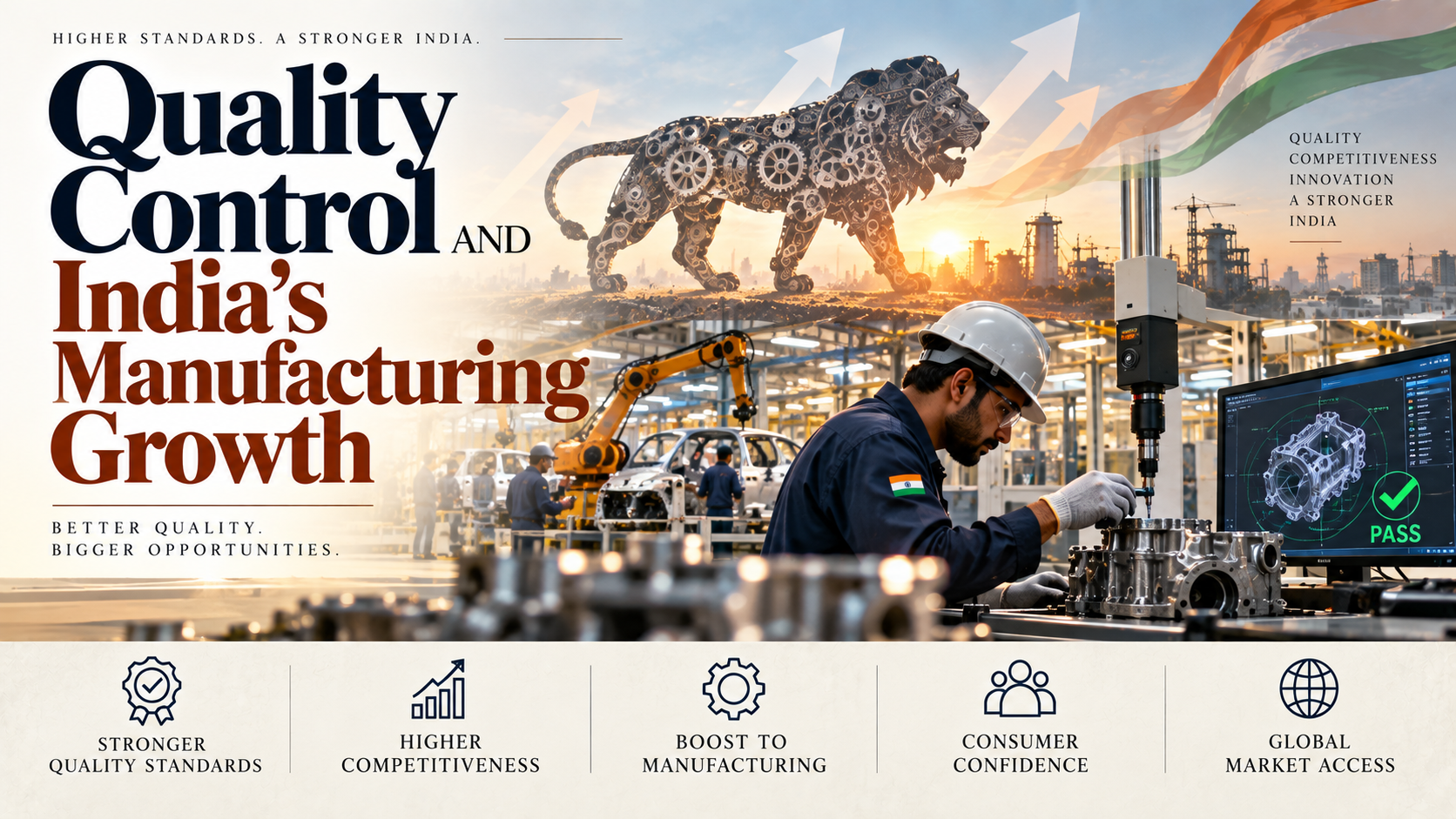
India’s Quality Control Order (QCO) regime has begun to contract, with several orders revoked or suspended since late 2025, particularly those covering intermediate goods. The Department for Promotion of Industry and Internal Trade (DPIIT) has notified the Transition Facilitation (Quality Control) Order, 2026, which lets an eligible firm source temporarily from an alternative class of certified supplier. A study by the Centre for Social and Economic Progress (CSEP) finds that QCOs on chemical inputs cut value addition in large user firms and profitability in small ones. Concerns over India’s QCOs and other non tariff barriers also surfaced at the World Trade Organization’s (WTO) eighth Trade Policy Review of India, held in July 2026. The contested point is whether a regime designed to raise product quality should be judged by the number of products it covers or by what it does to the scale and competitiveness of the firms that must comply.
What is a Quality Control Order?
- Mandatory conformity to an Indian Standard: A QCO is issued by the administering ministry or department under the Bureau of Indian Standards Act, 2016. It makes conformity to a specified Indian Standard and a Bureau of Indian Standards (BIS) certification compulsory for the listed products.
- Application to domestic output and imports alike: Once a QCO is in force, a covered product cannot be manufactured, imported, stored for sale or sold without that certification. An import faces the same requirement as domestic production.
- Two certification routes: BIS Scheme-I is a licence to use the Standard Mark on a product, granted after factory inspection and testing. BIS Scheme-II issues a Certificate of Conformity for a consignment or a batch.
- Input orders versus output orders: A QCO on a finished good regulates what reaches the consumer. A QCO on an intermediate input regulates what a downstream manufacturer is allowed to buy.
How far did the QCO net expand, and what remains to be reassessed?
- Rapid expansion after 2019: The number of products covered under QCOs rose from 88 in 2019 to 765 by the end of December 2024.
- The slowdown: The pace of expansion slowed considerably towards the end of 2025. Several QCOs were revoked or suspended, particularly those covering intermediate goods.
- What drove the shift: Mandatory certification on intermediates had raised concerns about input availability, costs and potential supply chain disruptions.
- The unfinished list: More than 600 QCO covered products remain to be reassessed. These include several critical intermediate inputs used across chemicals, steel, textiles, machinery and electronics, and rubber and plastics.
What does the Transition Facilitation (Quality Control) Order, 2026 do?
- Issuing authority and date: DPIIT notified the order on 25 June 2026.
- The mechanism: An eligible firm facing difficulty in obtaining BIS Scheme-I certification may source products temporarily from BIS Scheme-II licensed suppliers.
- Sectors covered: The mechanism applies in specified sectors, including toys, footwear and air conditioners.
- Access conditions: Use of the mechanism is subject to prescribed eligibility criteria and to approval by a committee constituted by DPIIT.
What does the CSEP study find about QCOs on chemical inputs?
- Why chemicals: Chemicals are critical intermediate inputs for downstream sectors such as rubber and plastics, pharmaceuticals and electronics.
- Growth of coverage: The first QCO for a chemical product was introduced in 2018. The number of chemical products covered rose to 52 by 2024.
- Growth of exposure: The share of chemical using firms exposed to regulation on the input side rose from 11.8 per cent in 2019 to 56.6 per cent in 2024.
- Effect on larger firms: Input QCOs are associated with a 9.6 per cent increase in production alongside a 37 per cent decline in gross value added (GVA), meaning output value minus the cost of bought in inputs. Larger firms sustain output at the cost of lower value addition.
- Effect on smaller firms: Input QCOs have no statistically significant effect on production or GVA among smaller firms. They are associated with a 47.6 per cent decline in profitability.
- What the size split shows: Larger firms can pass at least part of the higher input cost through to output prices. Smaller firms have a more limited ability to absorb rising input costs and the additional compliance costs.
Why has the QCO regime become a trade question?
- The forum: The concerns were raised during the WTO’s eighth Trade Policy Review of India.
- Raised by major trading partners: The European Union and the United States raised them.
- Raised by partners in the same bloc: Fellow BRICS members, including Brazil, China and Indonesia, raised them as well, so the objection does not track a single trade bloc’s interest.
Challenges to the Quality Control Order regime
- Compliance cost falls hardest on the smallest firms: Certification fees, testing, factory inspection and documentation are largely fixed costs, so they take a far larger share of a small firm’s turnover. Eg. Of India’s roughly 6.4 crore micro, small and medium enterprises (MSMEs), only about 14 per cent have access to formal credit, so certification costs come out of working capital.
The Fix: Give smaller firms dedicated certification assistance, with designed exemptions or transition periods where compliance costs are particularly burdensome. - Certification capacity does not scale with coverage: Recognised testing laboratory and inspection capacity limits how fast licences can be issued once a product is brought under an order. Eg. Waiting periods for foreign manufacturer licences have been a standing complaint from importers of intermediate goods.
The Fix: Expand third party conformity assessment through accredited private laboratories, so licence issuance is not gated on the regulator’s own testing capacity. - Input regulation transmits into sectors it was never aimed at: An order placed on an intermediate raises the input cost of every industry that buys it, whatever the order’s own purpose was. Eg. Standards on steel long products raise input costs for engineering goods, automotive components and capital goods producers at once.
The Fix: Make a supply chain impact assessment a mandatory part of both the design of a new order and the reassessment of an existing one. - A standard can operate as protection rather than quality assurance: A mandatory standard on an import heavy input restricts supply and raises the domestic price without improving what reaches the consumer. Eg. The WTO Agreement on Technical Barriers to Trade requires that a technical regulation not be more trade restrictive than necessary to fulfil a legitimate objective.
The Fix: Publish the risk assessment and the stated objective behind each order at notification, so the instrument is testable against its own purpose. - Quality regulation without surveillance produces paper compliance: A mandatory mark improves quality only where market surveillance detects and penalises non conforming goods actually on sale. Eg. Counterfeit standard marks on low value consumer goods remain a recurring enforcement problem.
The Fix: Shift enforcement effort toward post market sample testing of goods on sale rather than toward licence issuance alone.
Conclusion
The instrument under reassessment was designed to police what reaches the consumer, and its cost is landing instead on what a manufacturer is allowed to buy. That mismatch is what the reset has to correct, and a coverage count is the wrong measure of whether it has. The test worth applying is whether quality standards improve products without constraining the scale, efficiency and competitiveness of Indian manufacturing. The marker to watch is whether the reassessment of the remaining intermediate input orders carries a supply chain impact assessment and a separate track for smaller firms, or whether it proceeds product by product as before.
Manufacturing in India
- Share and scale: Manufacturing contributes around 17 per cent of India’s GDP. Output is projected to reach approximately $1 trillion in FY 2025-26.
- Global standing: India holds around 2.8 per cent of global manufacturing output, against China’s roughly 29 per cent.
- Trade and investment: Merchandise exports reached around $437.7 billion in FY25, with non petroleum exports at a record $374.3 billion. Foreign direct investment into manufacturing rose 18 per cent to $19.04 billion in FY25.
- Structural concentration: Three states account for around 40 per cent of net value added. Only around 4.7 per cent of the workforce has formal skill training.
Government Initiatives for the Manufacturing Sector
- National Manufacturing Mission: Launched in the 2025-26 Budget, it unifies manufacturing policy, execution and governance and prioritises clean and sustainable manufacturing. It targets a 25 per cent manufacturing share of GDP by 2035.
- Make in India: The programme promotes domestic manufacturing and investment across identified priority sectors, and is the umbrella framing under which the sector’s GDP share target sits.
- Production Linked Incentive (PLI) scheme: It offers output linked incentives across 14 sectors, including mobiles, electronics, pharmaceuticals, textiles and drones. It had drawn over ₹1.76 lakh crore of realised investment as of March 2025.
- India Semiconductor Mission: A ₹76,000 crore framework has approved 10 projects worth around ₹1.60 lakh crore, covering silicon fabs, silicon carbide units and advanced packaging.
- National Logistics Policy: It aims to cut logistics costs and improve supply chain efficiency for manufacturers.
Back2Basics: WTO Trade Policy Review
- What it is: The Trade Policy Review Mechanism is a World Trade Organization process under which a member’s trade policies and practices are examined by the full membership.
- Basis: It was established under Annex 3 of the Marrakesh Agreement establishing the World Trade Organization, 1994.
- Frequency: The frequency of a member’s review depends on its share of world trade, so the largest traders are reviewed most often.
- What it is not: The review is a transparency exercise. It is not a dispute settlement proceeding and it enforces no obligation.