Mains GS3: GS3-12.Effects of liberalization on the economy, changes in industrial policy and their effects on industrial growth
Why in the News?
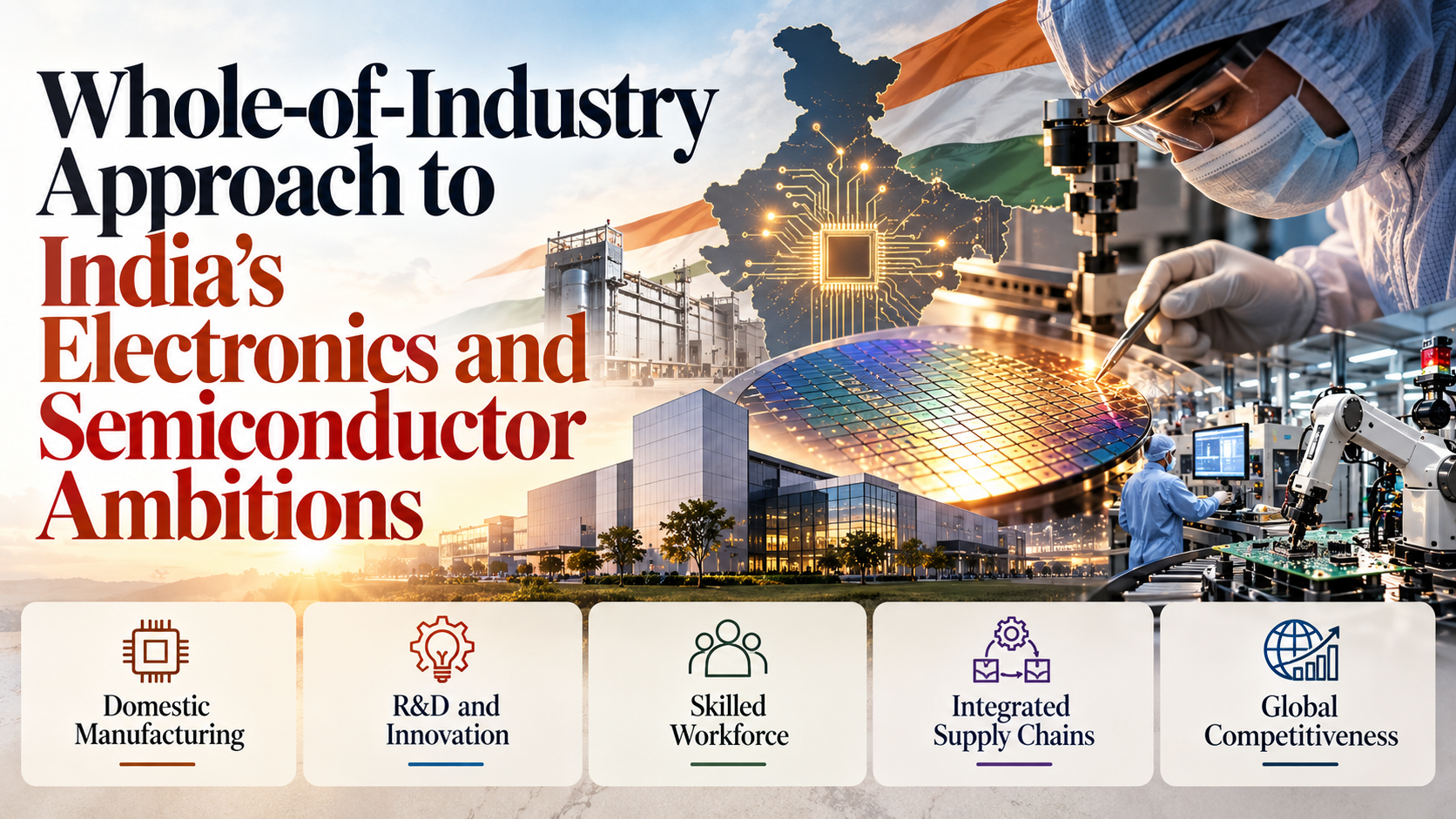
The SEMICON India 2026 panel discussion highlighted the need for a coordinated “whole-of-industry” approach to build India’s globally competitive electronics and semiconductor ecosystem.
Industry leaders stressed collaboration across the semiconductor value chain, from design and manufacturing to packaging, components and end-use applications.
Key Highlights
Panel: “Industry Associations Advancing India’s National Agenda”.
Held during SEMICON India 2026.
Moderated by Amitesh Kumar Sinha, CEO, India Semiconductor Mission (ISM).
600+ exhibitors, including nearly 300 international companies, participated.
56 MoUs, strategic initiatives and industry announcements were recorded.
Focus areas included manufacturing, design, packaging, AI, R&D, logistics and skilling.
Government has approved 12 semiconductor projects under the Semicon India programme.
5 commercial semiconductor units were operational as of September 2026.
Whole-of-Industry Approach
Recognises growing interdependence between:
Semiconductors
Electronics manufacturing
Components
Materials
Chip design
Packaging and testing
End-use applications
Seeks stronger coordination among different industry associations.
Proposed mechanism would facilitate continuous dialogue, coordination and collective action.
It does not replace specialised industry associations, but provides a common platform for cross-sector cooperation.
“Silicon to Systems” Vision
Emphasises integration of:
Design
Manufacturing
Packaging
Electronics
Technology solutions
The objective is to create a stronger and more resilient semiconductor ecosystem.
India’s semiconductor ambitions are increasingly moving beyond individual manufacturing facilities towards ecosystem-wide capabilities.
Government Support
Production Linked Incentive (PLI) schemes support domestic electronics and semiconductor capabilities.
India Semiconductor Mission (ISM) is supporting development of the semiconductor ecosystem.
Semicon India programme has approved 12 semiconductor projects.
5 commercial semiconductor units were operational as of September 2026.
Prelims Quick Revision
SEMICON India 2026 focused on India’s semiconductor and electronics ecosystem.
Panel discussion: “Industry Associations Advancing India’s National Agenda”.
Panel moderated by CEO, India Semiconductor Mission.
600+ exhibitors, including nearly 300 international companies.
56 MoUs and strategic initiatives announced.
12 semiconductor projects approved under the Semicon India programme.
5 commercial semiconductor units operational as of September 2026.
“Silicon to Systems” emphasises integration across design, manufacturing, packaging, electronics and technology solutions.
UPSC Prelims Trap
Whole-of-industry approach does not mean replacing specialised industry associations. It aims to coordinate them through a common platform.
Semiconductor manufacturing is not limited to chip fabrication; the article emphasises the interconnected roles of materials, equipment, packaging, testing, electronics and design.
India Semiconductor Mission (ISM) and Semicon India programme are related to India’s semiconductor development but are not interchangeable terms.
The “Silicon to Systems” vision covers the broader ecosystem from design and manufacturing to packaging, electronics and technology solutions.