Why in the News?
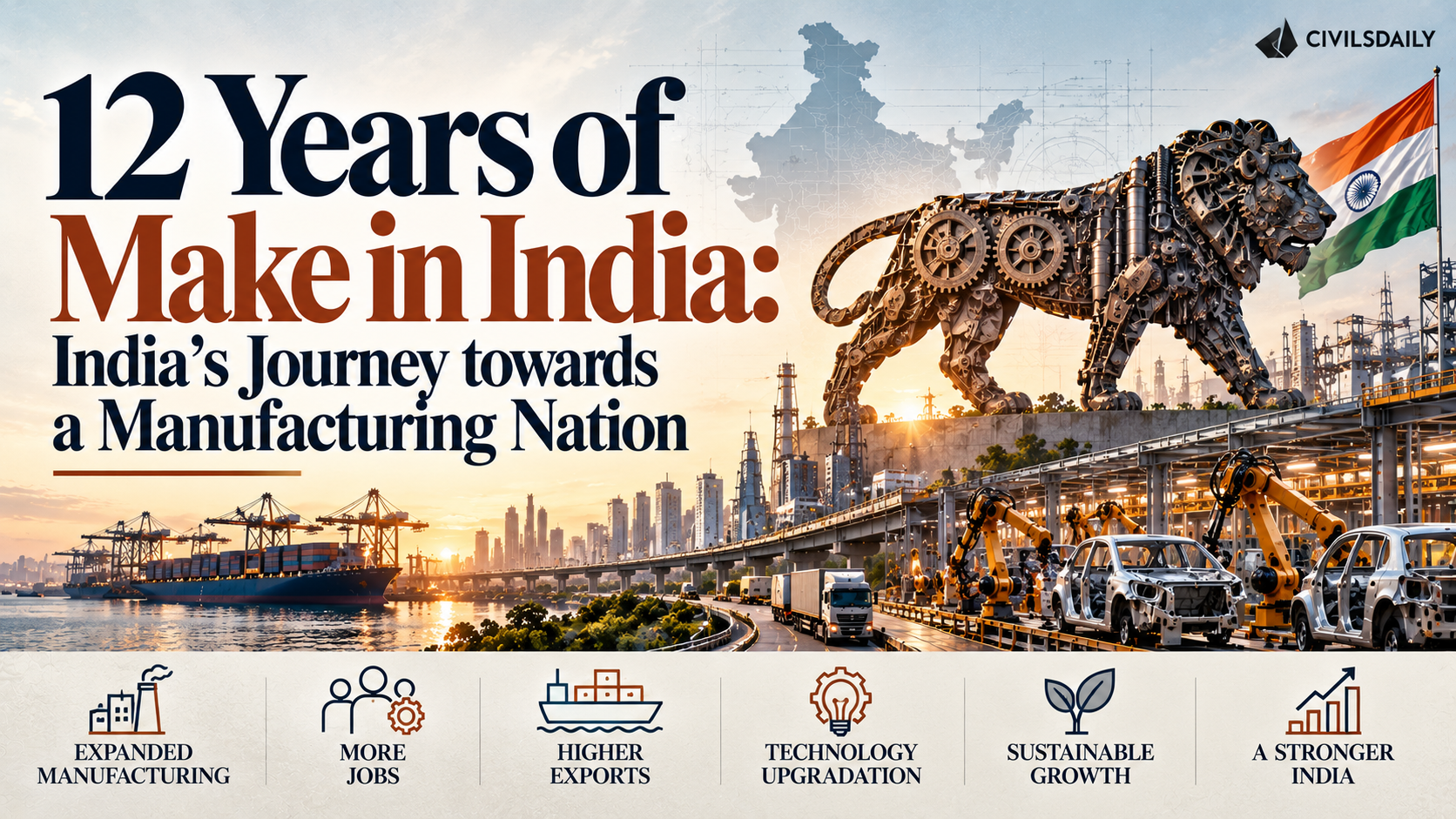
- Make in India completed 12 years on 25 September 2026.
- Launched in 2014, the initiative aims to strengthen India’s manufacturing, investment, innovation and domestic production capabilities.
Key Highlights
- Make in India launched: 25 September 2014.
- Make in India 2.0: Covers 27 sectors, including 15 manufacturing and 12 services sectors.
- Manufacturing GVA recorded 10.88% CAGR between 2022-23 and 2025-26.
- Manufacturing component of IIP grew 7.0% during April-July 2026.
- Electronics production increased from ~₹1.9 lakh crore in 2014-15 to ~₹13.11 lakh crore in 2025-26.
- Mobile phone production increased from ~₹18,000 crore to ~₹6.27 lakh crore.
- Crude steel production increased from 81.7 MT to 170 MT between 2014-15 and 2025-26.
- Indigenous defence production reached ₹1.78 lakh crore in FY 2025-26.
- Cumulative FDI during 2014-15 to 2025-26: USD 843 billion.
Manufacturing and Strategic Capabilities
- Pharmaceuticals
- India ranks 3rd globally by volume and 11th by value.
- Pharmaceutical turnover: ₹4,71,898 crore in 2024-25.
- Medical devices
- Domestic manufacturing increased by ~48.2% from 2019-20 to 2024-25.
- Rare-earth magnets
- Pilot plant for Nd-Fe-B magnets established at ARCI, Hyderabad, in March 2026.
- Important for EVs, renewable energy, electronics and advanced manufacturing.
- Space semiconductors
- ISRO and SCL developed VIKRAM3201 and KALPANA3201 microprocessors.
- Solar manufacturing
- Module capacity: 2.3 GW in 2014 → 192 GW in June 2026.
- Solar-cell capacity: 1.2 GW → ~30 GW over the same period.
Major Industrial Initiatives
- National Single Window System (NSWS)
- Common digital platform for identifying and applying for business approvals.
- Provides access to 327+ Central and 3,452 State approvals across 34 States/UTs.
- India Industrial Land Bank (IILB)
- GIS-enabled platform for industrial land information.
- As of May 2026: 4,220 industrial parks covering ~6.98 lakh hectares.
- PM GatiShakti
- Launched in October 2021.
- Uses geospatial data, satellite imagery and API integration for coordinated infrastructure planning.
- Production Linked Incentive (PLI)
- Covers 14 sectors.
- By June 2026: ₹2.40 lakh crore investment and over ₹22.66 lakh crore production/sales.
- Startup India
- Launched in January 2016.
- ~2.54 lakh recognised startups as of September 2026.
Recent Manufacturing Schemes
- PLI for Specialty Steel
- Third round launched in November 2025.
- Covers super alloys, CRGO steel, stainless steel, titanium alloys and coated steels.
- Sintered Rare Earth Permanent Magnets
- ₹7,280 crore allocation.
- Target: 6,000 MTPA integrated capacity.
- BHAVYA
- ₹33,660 crore for 100 investment-ready industrial parks.
- Mobile Phone Manufacturing Scheme
- ₹62,500 crore for FY 2026-27 to FY 2030-31.
- Semicon 2.0
- ₹1,27,500 crore allocation for semiconductor ecosystem development.
- BHAVYA Rasayan
- ₹3,030 crore for three dedicated chemical parks.
Prelims Quick Revision
- Make in India: launched 25 September 2014.
- Make in India 2.0: 27 sectors = 15 manufacturing + 12 services.
- Manufacturing GVA CAGR, 2022-23 to 2025-26: 10.88%.
- Crude steel production: 81.7 MT → 170 MT.
- Defence production FY 2025-26: ₹1.78 lakh crore.
- PM GatiShakti: launched October 2021.
- PLI covers 14 sectors.
- Semicon 2.0: ₹1,27,500 crore allocation.
- Rare-earth magnet scheme: ₹7,280 crore, target 6,000 MTPA.
- BHAVYA: ₹33,660 crore for 100 industrial parks.
UPSC Prelims Trap
- Make in India was launched in 2014, while PM GatiShakti was launched in 2021.
- Make in India 2.0 covers 27 sectors, not 27 manufacturing sectors.
- PLI covers 14 sectors, while Make in India 2.0 covers 27 sectors.
- IILB is a GIS-enabled industrial land information platform, whereas NSWS facilitates access to business approvals.
- Semicon 2.0 focuses on the broader semiconductor ecosystem, including design, manufacturing, advanced packaging, materials, equipment, research and talent development.