| Question (2019, GS2 – 10 Marks): “From the resolution of contentious issues regarding distribution of legislative powers by the courts, ‘Principle of Federal Supremacy’ and ‘Harmonious Construction’ have emerged. Explain. Linkage: The B.R. Enterprises judgment is a classic example of harmonious construction and reading down a statute. The Supreme Court harmonized Union List Entry 40 (Lotteries organized by the Government of India or a State) and State List powers with Article 301 (Freedom of Trade and Commerce) to prevent discriminatory protectionism between states. |
Mentor Comment
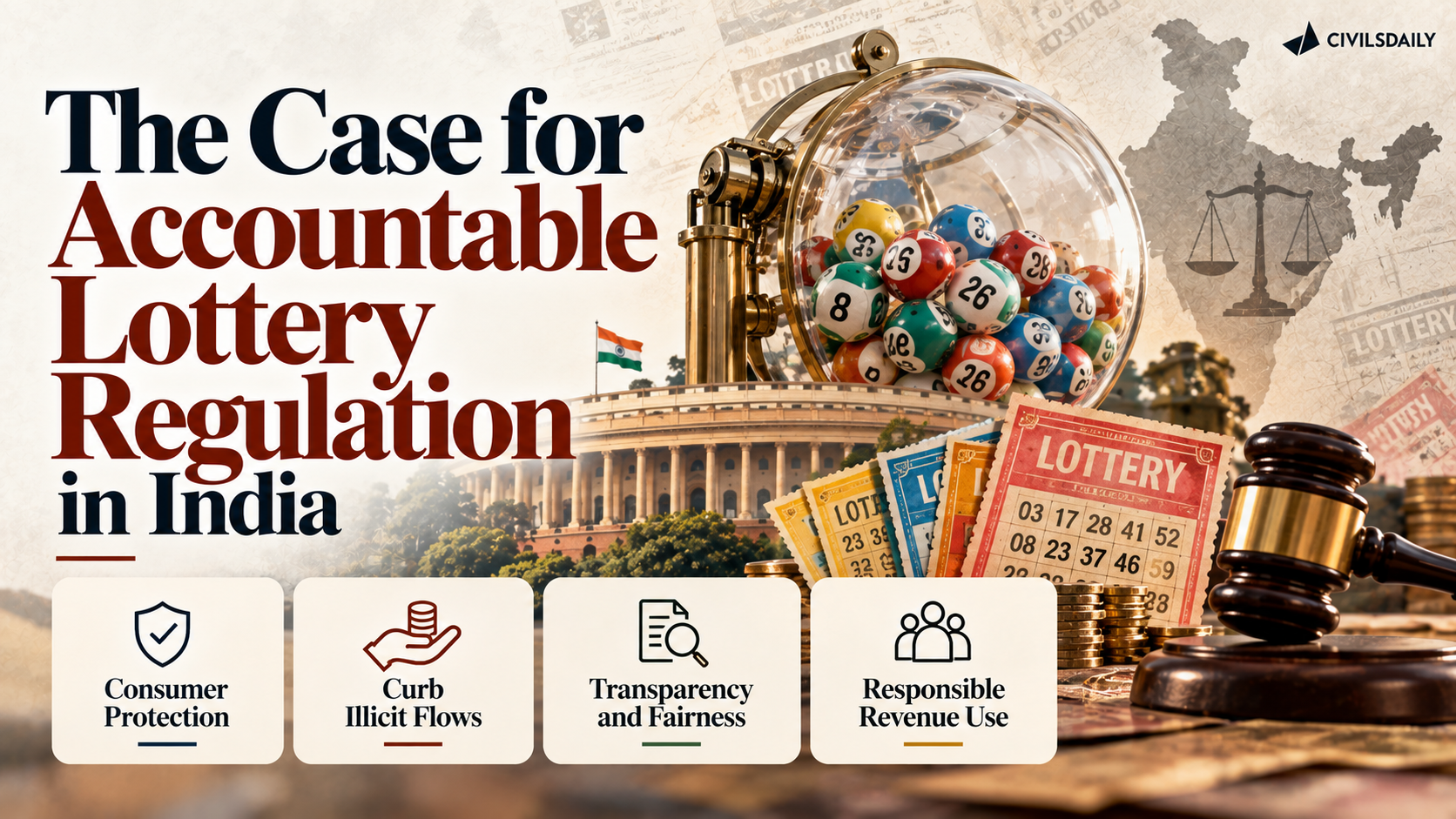
Prohibition of a vice with persistent demand removes legal supply and leaves the demand intact. The Lotteries (Regulation) Act, 1998 lets a State organise a lottery and lets a State prohibit lotteries organised by others. B.R. Enterprises vs State of U.P. (1999) read that second power down, so a State may exclude other States’ lotteries only by abandoning its own and becoming wholly lottery free. Faced with that trade off between revenue and regulatory control, two large States chose total prohibition and forfeited the option of running an accountable public lottery. The contest is between a State’s interest in supervising what is sold inside its territory and a legal rule built as an all or nothing choice.
What does the Lotteries (Regulation) Act, 1998 provide?
- Legislative competence: Government organised lotteries fall under Entry 40 of the Union List.
- Section 4: The Act permits States to organise lotteries subject to the conditions in Section 4. Section 4 also permits a State to sell tickets directly, or through distributors or agents.
- Section 5: Section 5 empowers a State to prohibit lotteries organised by other States inside its territory.
- Section 6: Section 6 empowers the Union government to prohibit a lottery in violation of Sections 4 and 5.
What harms do lotteries carry?
- Regressive burden: Lotteries disproportionately burden poorer households. They encourage a household to stake scarce income on a remote chance of reward.
- Compulsive play: Rapid draws and instant games encourage compulsive play and loss chasing.
- Distorted risk perception: Giant jackpots distort the perception of risk.
- Sales practices: Credit sales, opaque odds and manipulative advertising compound these harms.
- What the harms justify: These are arguments for stringent regulation, not necessarily for prohibition.
What does a prohibition produce instead?
- Illegal channels: A ban pushes players towards smuggled tickets, offshore portals and unlicensed numbers betting such as matka, satta and single digit rackets.
- Absence of safeguards: These enterprises operate through cash agents and mule accounts. They carry no audits, no age restrictions, no secured prize funds and no effective remedy against fraud.
- Revenue forgone: Governments lose lottery surpluses and Goods and Services Tax (GST) revenue.
- Livelihoods and enforcement: Legitimate vendors, many of them poor or disabled, lose their livelihoods. Enforcement costs rise at the same time.
- The paradox of protection: A state seeking to protect the vulnerable leaves them at the mercy of unaccountable operators.
Is the state’s paternalism applied evenly across classes?
- Permitted speculation: An affluent citizen can day trade, use leveraged derivatives or speculate in crypto assets. The risk of ruinous losses in those markets is no bar to entry.
- No competence test: The state does not test competence before admitting a retail trader to these markets. Securities trading involves skill, and derivatives support hedging and price discovery.
- The regulator’s own finding: The Securities and Exchange Board of India (SEBI) found that the vast majority of day traders, and of traders in futures and options, incurred losses.
- Why markets are legal: Financial markets are legal because risks are disclosed, intermediaries are regulated and fraud is punished. Adult choice is preserved alongside those safeguards.
- Application to lotteries: Lotteries can follow the same principle, with more stringent safeguards appropriate to games of chance.
What does international practice show about regulating rather than banning?
- United States prohibition, 1920 to 1933: The United States imposed prohibition through the Eighteenth Amendment and the Volstead Act. It suppressed legal supply and left demand intact.
- What the ban produced: Prohibition fuelled a lucrative black market controlled by violent syndicates. Bootlegging corrupted public institutions, deprived governments of excise revenue and imposed heavy enforcement costs.
- The repeal: The Twenty First Amendment repealed prohibition, on the recognition that a regulated and taxed market causes fewer harms than an unenforceable ban.
- Controlled legality is the norm: Lotteries are legal in nearly four fifths of countries, with surpluses allocated transparently to education, health care, sports, welfare or infrastructure. Blanket prohibition survives mainly in countries enforcing strict Sharia based gambling prohibitions, such as Saudi Arabia, Iran and Brunei, and in closed ideological regimes such as Cuba.
- The public operator model: Nearly 70 per cent of lottery jurisdictions follow the public operator model. A government body, statutory authority or State owned company runs the lottery, and private firms supply retail and technology services.
- The concession model: The State regulates the lottery and grants operating rights to a private concessionaire.
- Federal practice: Lotteries operate in 45 of the 50 United States and Washington DC, in all 10 Canadian provinces and three territories, in all six Australian States and both mainland territories, and in all 16 German Lander.
- Cross border sales: Authorisation in one jurisdiction does not confer the right to sell in another. Cross border sales require the destination jurisdiction’s consent or its participation in a cooperative arrangement.
- Pooling without losing control: Powerball in the United States, Lotto 6/49 in Canada, the Australian lottery blocs and Germany’s national lottery bloc, the DLTB, let participating jurisdictions pool players and prizes without surrendering regulatory autonomy.
What does Indian law do to a State that wants to regulate rather than ban?
- Res extra commercium: Settled Supreme Court jurisprudence treats gambling, including State organised lotteries, as res extra commercium, meaning an activity outside the protection of Article 19(1)(g), the fundamental right to trade, and of Article 301, the freedom of trade across India.
- The alcohol parallel: A parallel doctrine applies to potable alcohol and allows a State to restrict or prohibit consignments from outside its territory.
- Why the all or nothing rule is hard to justify: A State directly oversees its own lottery administration. Its oversight of another State’s operations inside its territory is necessarily indirect, and it still bears the local enforcement burden.
- The choice two States made: Tamil Nadu in 2003 and Karnataka in 2007 chose total prohibition. Both gave up the option of running accountable public lotteries of their own.
- How many States run lotteries: A Lok Sabha reply of 14 March 2023 identified nine States operating lotteries: Arunachal Pradesh, Goa, Kerala, Maharashtra, Mizoram, Nagaland, Punjab, Sikkim and West Bengal.
- The fiscal context: Persistent State fiscal stress makes the widespread preference for prohibition worth reconsidering.
What would an accountable alternative look like?
- First amendment, to Section 5: Parliament should clarify that Section 5 applies whether or not the prohibiting State organises a lottery of its own. The consent of the destination State should be decisive, subject to uniform treatment.
- Uniform treatment: A State must either admit all outside lotteries or exclude them all.
- Second amendment, a new Section 4A: A new Section 4A should authorise two or more States to establish a common lottery by agreement, pooling players, prizes, technology and costs.
- Why compulsory access is no remedy: Smaller States, especially in the northeast, face exclusion from larger markets. Compulsory access is not the remedy for that exposure.
- Departmental operation: Marketing agents supply guaranteed revenue. Departmental operation is more transparent and opens retail distribution to small vendors, persons with disabilities, women’s self help groups and cooperatives. That widens livelihood opportunities and limits intermediary capture.
- The Kerala record: Kerala earned Rs 2,883.80 crore from its lottery in the 2023 to 2024 financial year. That total is Rs 1,129.71 crore in net lottery revenue and Rs 1,754.09 crore in State Goods and Services Tax.
- Where the surplus goes: Kerala channels its lottery surpluses into health care and welfare. Its model is a useful template for reform rather than the only one.
Conclusion
A vice with persistent demand does not disappear when the state withdraws the legal channel. The transaction moves to operators who keep no accounts and answer to no regulator. The real choice for a State is therefore between an auditable public supplier and an untraceable illegal one. Current law forces that choice into an all or nothing form, so a State that wants to shut out unaccountable outside operators must first shut down its own accountable one, and it is that single provision that has to change first.
Betting and Gambling Regulation in India
- Scale of the market: The online betting and gaming market was valued at 5.02 billion dollars in 2024 to 2025. It is projected to reach 10.77 billion dollars by 2030.
- User base: India has over 517 million online gamers, of whom 155 million play money based games. India accounts for 20 per cent of the global gaming user base.
- Split jurisdiction: Gambling is a State subject, and online gaming has been brought under the Union. That split produces persistent legal friction.
- The skill and chance test: In Dr. K.R. Lakshmanan v. State of Tamil Nadu (1996) the Court established the predominance of skill test. Horse racing qualified as a game of skill on that test.
Government Initiatives
- Promotion and Regulation of Online Gaming Act, 2025: The Act prohibits online money games, meaning real money betting, and permits e sports and social games.
- Online Gaming Authority of India: A central regulator under the Ministry of Electronics and Information Technology classifies games, issues digital certificates and handles enforcement.
- Blocking duty on intermediaries: Amendments to the information technology intermediary guidelines require an intermediary to block any platform flagged as a money game by the Authority.