| Question (2018, GS2 – 10 Marks): In the light of recent controversy regarding the use of Electronic Voting Machines (EVM), what are the challenges before the Election Commission of India to ensure the trustworthiness of elections in India? Linkage: Addresses the primary constitutional burden placed on the ECI—ensuring public confidence, administrative neutrality, and procedural integrity in conducting free and fair elections amidst institutional controversies. [2017] Consider the following statements: 1. The Election Commission of India is a five-member body. 2. Union Ministry of Home Affairs decides the election schedule for the conduct of both general elections and bye-elections. 3. Election Commission resolves the disputes relating to splits/mergers of recognized political parties. Which of the statements given above is/are correct? (a) 1 and 2 only (b) 2 only (c) 2 and 3 only (d) 3 only |
Mentor’s Comment
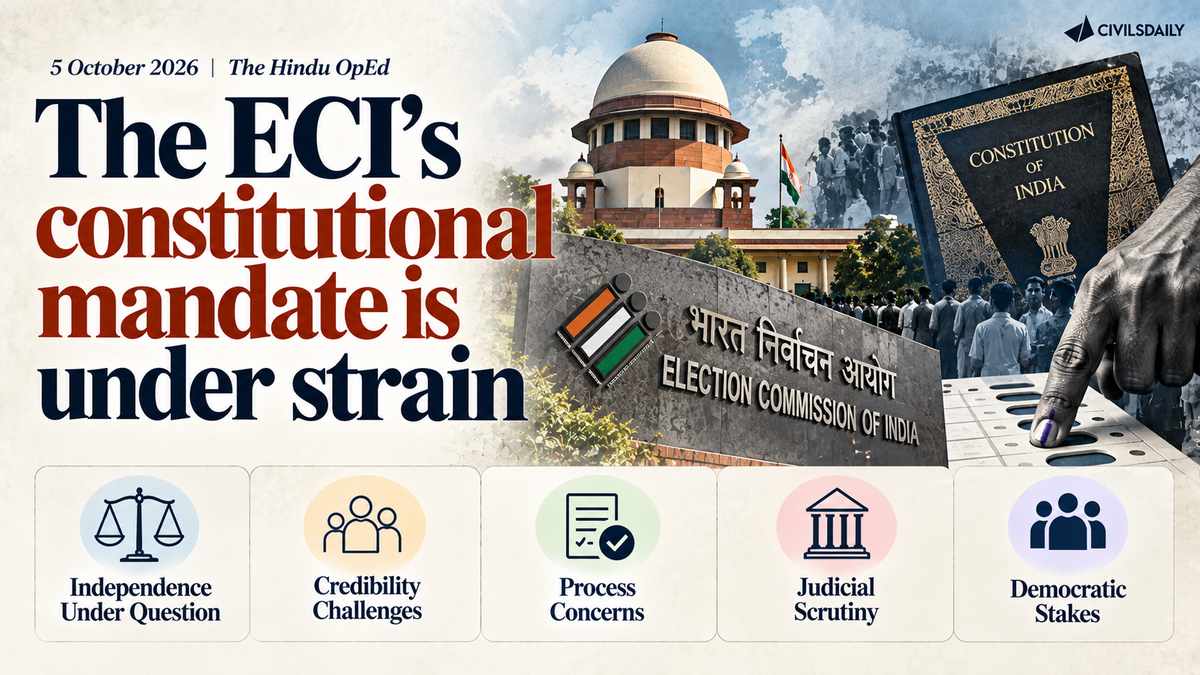
The Constituent Assembly made the Election Commission independent so that it could protect voters from the executive. The Special Intensive Revision shows the reverse: independence without accountability allows the Commission itself to exclude voters. The reform question is not the Commission’s autonomy but the checks on the person who exercises it, in removal, appointment and immunity.
Why in the News
The Constitution placed the Election Commission of India (ECI) beyond executive control to stop partisan deletion of voters, yet the ECI now faces charges of mass deletion through a revision the law does not name. A former Secretary General of the Lok Sabha argues the Special Intensive Revision (SIR) lacks a legal basis and the Chief Election Commissioner (CEC)‘s unilateral decisions have created a constitutional crisis.
Why did the Constitution-makers centralise and insulate the ECI?
- Original proposal: Draft Article 289 proposed decentralised machinery: a chief election commissioner in each province for State rolls and elections, and one at the Centre for national polls.
- Why it was rejected: Provincial commissioners, mostly Chief Ministers’ nominees, had deleted voters seen as opponents. Dr. B.R. Ambedkar moved a new Article centralising the machinery “outside the control of the executive government”.
- Loyalist fear: Shibban Lal Saxena feared a loyalist CEC and proposed appointment by a two-thirds parliamentary vote, like United States Senate confirmation.
- The takeaway: The mass deletion of voters that drove centralisation is now alleged against the central body itself.
Does the law provide for a special intensive revision?
- Ordinary revision: Section 21(2) of the Representation of the People (RP) Act, 1950 provides for revision before each general election or by-election, or in any year the ECI directs.
- Method: Under Rule 25 of the Registration of Electors Rules, 1960, that revision may be intensive (roll prepared afresh), summary (existing roll updated), or partly both.
- Special revision: Section 21(3) allows a special revision for reasons recorded, but only for “any constituency or part of a constituency” where special circumstances exist.
- Limits of Article 324: Article 324 lets the ECI act where statute is silent, never against the law. Eg. Mohinder Singh Gill (1978) recognised this gap-filling power.
Why do the deletions and the decision process raise constitutional questions?
- Scale of removal: About 13 crore voters have reportedly been removed nationwide, possibly the largest disenfranchisement exercise in any democracy.
- Article 326 conflict: Article 326 provides for universal adult suffrage, so its scheme is to include eligible voters. The SIR has instead worked to exclude them.
- Unilateral CEC: The two Election Commissioners (ECs) say they were excluded from crucial decisions. The author argues a decision the CEC takes alone is invalid, as is every action that follows.
Can the CEC be held to account?
- Impeachment route: Opposition parties plan an impeachment motion. The CEC is removed like a Supreme Court judge, only on proved misbehaviour.
- Threshold barrier: The presiding officers of both Houses can disallow such a motion at the threshold.
- Lifelong immunity: Section 16 of the Chief Election Commissioner and Other Election Commissioners (Appointment, Conditions of Service and Term of Office) Act, 2023 shields the CEC and ECs from civil and criminal liability for life, which even the President lacks.
Challenges
- Ambiguous statute: Section 21(3) does not define a special revision’s scale, so a State-wide exercise is contestable.
- Burden on electors: Deleted electors must prove eligibility to return. Eg. Lal Babu Hussein (1995) on this burden.
- No internal check: Decisions without the full Commission leave no record of dissent.
- Accountability gap: Threshold rejection of motions and lifelong immunity together leave little route to examine a CEC’s conduct.
Way Forward
- Amend Section 21: Parliament should define State-wide revision, its procedure and safeguards in the RP Act.
- Recorded collective decisions: The ECI should take every SIR decision by a recorded vote of all three members.
- Narrow immunity: Parliament should limit Section 16 to acts done in good faith during the term.
- Notice before deletion: No name should leave the roll without individual notice and a hearing.
Conclusion
The ECI is now accused of the very exclusion it was built to prevent. Whether the Supreme Court tests the SIR’s legal basis before the remaining final rolls are published is what to watch.
Independence of the Election Commission of India
- Appointment: Anoop Baranwal v. Union of India (2023) placed the Chief Justice of India on the selection panel until Parliament legislated. The 2023 Act replaced the Chief Justice with a Cabinet Minister.
- Unequal removal protection: An EC, unlike the CEC, can be removed on the CEC’s recommendation, so ECs lack the CEC’s security of tenure.
- Financial dependence: The ECI’s expenses are not charged on the Consolidated Fund of India, so they need Parliament’s vote. The Law Commission’s 255th Report recommended charging them.
- Post-retirement posts: No constitutional bar stops a CEC or EC taking a later government post.