Why in the News
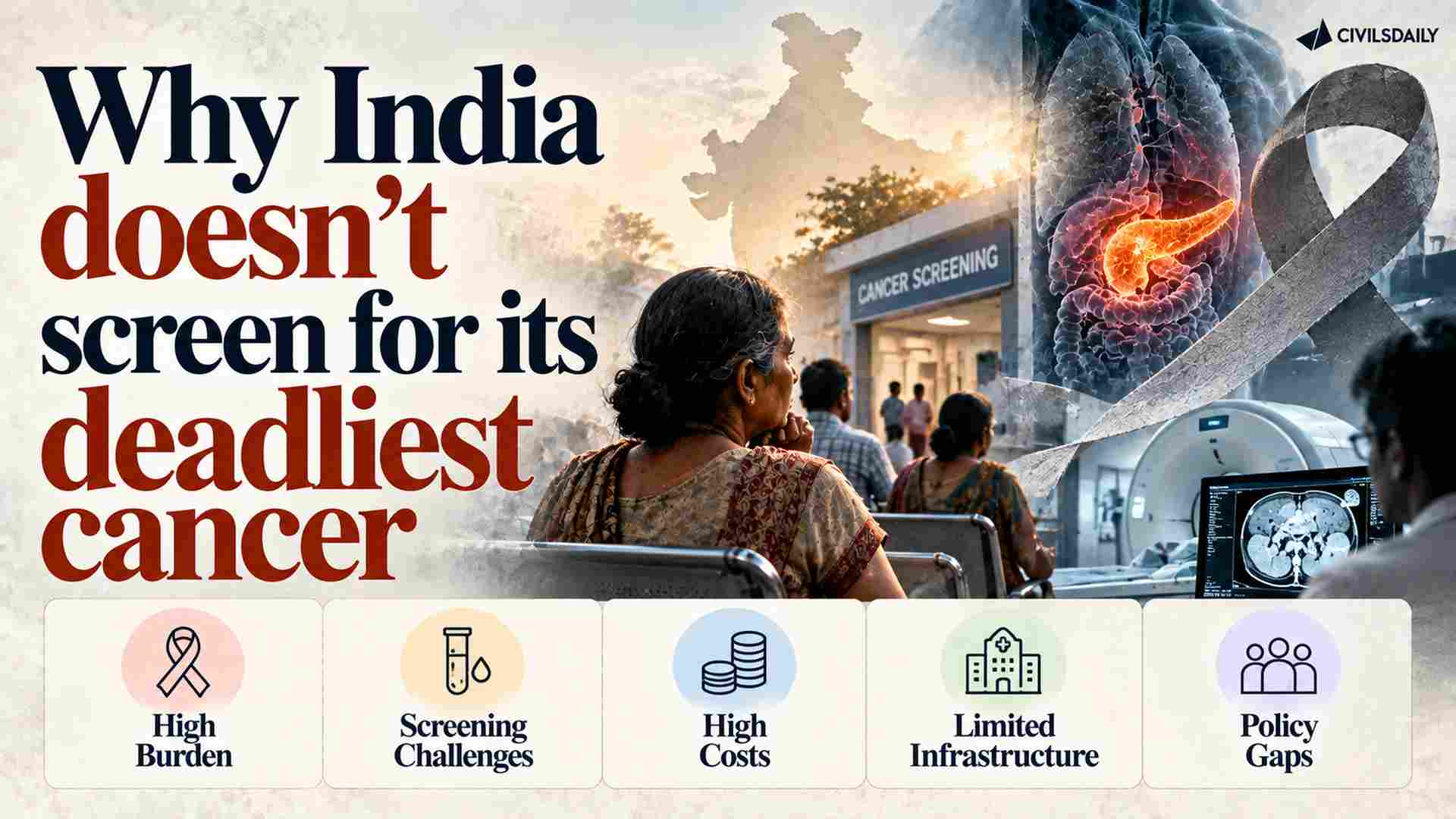
Lung cancer has become India’s leading cause of cancer deaths, yet the government’s screening programme at primary health centres (PHCs) still looks only for breast, oral and cervical cancer. Most patients reach hospital after the disease has spread, when survival chances are low.
What is lung cancer screening, and why does India need it?
- What screening is: Screening tests symptom-free people to catch disease early, like a smoke alarm before a fire spreads. For lung cancer the tool is low-dose computed tomography (LDCT), a reduced-radiation CT scan.
- Late diagnosis: Lung cancer has no easy test, so 93% of Indian cases are diagnosed at an advanced stage.
- Survival gap: Up to 80% of patients survive five years when the cancer is found at stage one, against a small fraction at a late stage.
- Current PHC tests: PHCs use cheap checks: a clinical breast exam, a visual oral exam and visual inspection with acetic acid, which turns cervical cancer cells white.
- The takeaway: India screens for the cancers that are cheap to detect, not for the one that now kills the most.
How fast is the burden rising?
- Rising deaths: Between 2022 and 2024, lung cancer deaths rose by almost a third, moving it from fourth to first among cancer killers.
- Rising cases: New cases rose by more than a third over the same two years, lifting lung cancer from fourth to third in incidence.
- Data source: The figures come from the Global Cancer Observatory of the International Agency for Research on Cancer (IARC), the World Health Organization’s cancer agency.
Why has India not added lung cancer screening?
- Cost of screening: An Indian Council of Medical Research (ICMR) study compared LDCT with chest X-rays and with no screening. LDCT cost the most but gave the highest net monetary benefit, meaning health gains valued in money, minus costs.
- Availability of LDCT: PHCs lack CT machines, so people must travel to higher centres, where LDCT is offered only on suspicion.
- Population at risk: Global guidelines screen only older, long-term heavy cigarette smokers, missing India’s many non-smoker patients and beedi smokers.
- TB false positives: Some fear that India’s high tuberculosis (TB) burden would produce false alarms on scans. A 2021 Mumbai pilot and a 2025 All India Institute of Medical Sciences (AIIMS) study found no such problem.
Who should be screened, and what evidence is India building?
- Wider high-risk criteria: A 2024 expert statement urged adding beedi smoking, second-hand smoke, biomass fuel, fumes and domestic smoke. Ambient air pollution is flagged as an emerging threat.
- ICMR verdict: The ICMR study called LDCT a “cost-effective strategy” and urged policymakers to consider integrating it into national cancer screening programmes.
- Indian evidence: The Indian Lung Screening Trial tests LDCT, and the Air Pollution and Cancer Research Ecosystem (AIRCARE) studies how pollution adds to lung cancer risk.
- Actionable warnings: Quitting still cuts risk. Cigarette packs could tell smokers over 60 with 20 years of smoking to get screened.
Challenges
- Diagnostic capacity: CT machines and radiologists sit in district and tertiary hospitals, far from most patients.
- Follow-up burden: Screening finds nodules needing repeat scans and biopsies.
- Undefined Indian risk group: No validated criteria yet identify high-risk non-smokers for screening.
- Low uptake: Symptom-free people rarely travel for a test that costs time and wages.
Way Forward
- Validated criteria: The Union Health Ministry should finalise Indian high-risk criteria using Indian Lung Screening Trial results.
- District hospital pilots: Start LDCT for high-risk groups at district hospitals, with PHCs referring eligible people.
- Institutional screening now: Hospitals with CT machines should offer screening ahead of a national programme.
- Linked cessation services: Pair every screening centre with tobacco cessation counselling.
Conclusion
India’s cancer screening follows what is cheap to test rather than what kills most, and lung cancer’s rise has exposed that gap. Whether the ICMR’s evidence and the Indian trials lead the Health Ministry to add LDCT for defined high-risk groups is the decision to watch.
Key numbers
- Lung cancer deaths: 75,031 (2022) to 98,687 (2024), from 8.2% to 10.9% of cancer deaths, IARC Global Cancer Observatory.
- New lung cancer cases: 81,748 (2022) to 1.12 lakh (2024), from 5.8% to 7.2% of new cancer cases.
- Late-stage five-year survival: 7% to 18%.
- Global LDCT eligibility: ages 50 to 80, a pack of cigarettes a day for at least 20 years.
[2024, GS2, 15 marks] In a crucial domain like the public healthcare system, the Indian State should play a vital role to contain the adverse impact of marketisation of the system. Suggest some measures through which the State can enhance the reach of public healthcare at the grassroots level.”
