1.Ethics and Human Interface: Essence, Determinants and Consequences of Ethics in – Human Actions; Dimensions of Ethics; Ethics – in Private and Public Relationships.
Applied Ethics
“In Indian culture and value system, an equal opportunity has been provided irrespective of gender identity. The number of women in public service has been steadily increasing over the years.” Examine the gender specific challenges faced by female public servants and suggest to increase their efficiency in discharging their duties and maintaining high standards of probity.
2024
10
Gobal warming and climate change are the outcomes of human greed in the name of development, indicating the direction in which extinction of organisms including human beings is heading towards loss of life on Earth. How do you put an end to this to protect life and bring equilibrium between the society and the environment ?
2024
10
The application of Artificial Intelligence as a dependable source of input for administrative rational decision-making is a debatable issue. Critically examine the statement from the ethical point of view.
2024
10
Determinants of Ethics
“The concept of Just and Unjust is contextual. What was just a year back, may turn out to be unjust in today’s context. Changing context should be constantly under scrutiny to prevent miscarriage of justice.” Examine the above statement with suitable examples.
2024
10
Dimensions of Ethics
“Ethics encompasses several key dimensions that are crucial in guiding individuals and organizations towards morally responsible behaviour.” Explain the key dimensions of ethics that influence human actions Discuss how these dimensions shape ethical decision-making in the professional context.
2024
10
3.Attitude: Content, Structure, Function; its Influence and Relation with Thought and Behaviour; Moral and Political Attitudes; Social Influence and Persuasion.
Attitude for Civil Servants
Mindless addiction to Form, ignoring the Substance of the matter, results in rendering of injustice. A perceptive civil servant is one who ignores such literalness and carries out true intent. Examine the above statement with suitable illustrations.
2024
10
5.Contributions of Moral Thinkers and Philosophers from India and World
Immanuel Kant
“In law, a man is guilty when he violates the rights of others. In ethics, he is guilty if he only thinks of doing so.” — Immanuel Kant
2024
10
Sardar Patel
“Faith is of no avail in the absence of strength. Faith and strength, both are essential to accomplish any great work.” — Sardar Patel
2024
10
Swami Vivekananda
“Learn everything that is good from others, but bring it in, and in your own way absorb it, do not become others.” — Swami Vivekananda
2024
10
7.Public/Civil Service Values and Ethics in Public Administration: Status and Problems; Ethical Concerns and Dilemmas in Government and Private Institutions; Laws, Rules, Regulations and Conscience as Sources of Ethical Guidance; Accountability and Ethical Governance; Strengthening of Ethical and Moral Values in Governance; ethical Issues in International Relations and Funding; Corporate Governance
Ethical Issues in International Relations and funding
“It is not enough to talk about peace, one must believe in it; and it is not enough to believe in it, one must act upon it” In the present context, the major weapon industries of the developed nations are adversely influencing continuation of number of wars for their own self-interest, all around the world. What are the ethical considerations of the powerful nations in today’s international arena to stop continuation of ongoing conflicts?
2024
10
Laws, Rules, Regulations and Conscience as Ethical Guidance
The soul of the new law, Bharatiya Nyaya Sanhita (BNS) is Justice, Equality and Impartiality based on Indian culture and ethos. Discuss this in the light of major shift from a doctrine of punishment to justice in the present judicial system.
2024
10
8.Probity in Governance: Concept of Public Service; Philosophical Basis of Governance and Probity; Information Sharing and Transparency in Government, Right to information; Codes of Ethics, Codes of Conduct, Citizen’s Charters, Work Culture, Quality of Service Delivery, utilization of Public Funds, Challenges of Corruption.
Codes of Ethics and Codes of Conduct
The ‘Code of Conduct and ‘Code of Ethics’ are the sources of guidance in public administration. There is code of conduct already in operation, whereas code of ethics is not yet put in place. Suggest a suitable mode. for code of ethics to maintain integrity, probity and transparency. governance.
2024
10
Quality of Service Delivery
Mission Karmayogi is aiming for maintaining a very high standard of conduct and behaviour to ensure efficiency for serving citizens and in developing oneself. How will this scheme empower the civil servants in enhancing productive efficiency and delivering the services at the grassroots level?
01. Indian Economy (issues re: planning, mobilisation of resources, growth, development, employment);
Monetary policy
What are the causes of persistent high food inflation in India? Comment on the effectiveness of the monetary policy of the RBI to control this type of inflation.
10
2024
02. Inclusive growth and issues arising from it
Inclusive Growth
Examine the pattern and trend of public expenditure on social services in the post-reforms period in India. To what extent this has been in consonance with achieving the objective of inclusive growth?
10
2024
12.Effects of Liberalisation on the economy; Changes in Industrial policy & their effects on industrial growth
Labour Reforms
Discuss the merits and demerits of the four ‘Labour Codes’ in the context of labour market reforms in India. What has been the progress so far in this regard?
What is the need for expanding the regional air connectivity in India? In this context, discuss the government’s UDAN Scheme and its achievements.
15
2024
Agriculture
04. Major Crops – Cropping patterns in various parts of the country
Millets
Explain the role of millets for ensuring health and nutritional security in India.
10
2024
05. Different types of irrigation and irrigation systems
Irrigation system and Challenges
What are the major challenges faced by Indian irrigation system in recent times? State the measures taken by the government for efficient irrigation management.
15
2024
08. Issues related to direct and indirect farm subsidies and MSP; PDS (objectives, functioning, limitations, revamping, issues of buffer stocks & food security), Technology Missions
Buffer stock & food Security
Elucidate the importance of buffer stocks for stabilizing agricultural prices in India. What are the challenges associated with the storage of buffer stock? Discuss.
15
2024
11. Land Reforms in India
Land Reforms
What were the factors responsible for the successful implementation of land reforms in some parts of the country? Elaborate.
10
2024
Environment
17. Conservation, environmental pollution and degradation, environmental impact assessment
EIA
What role do environmental NGOs and activists play in influencing Environmental Impact Assessment (EIA) outcomes for major projects in India? Cite four examples with all important details.
10
2024
Environmental Pollution and Mitigation
Industrial pollution of river water is a significant environmental issue in India. Discuss the various mitigation measures to deal with this problem and also the government’s initiatives in this regard.
10
2024
Disaster Management
18. Disaster and Disaster Management
Disaster Risk Reduction
What is disaster resilience? How is it determined? Describe various elements of a resilience framework. Also mention the global targets of the Sendai Framework for Disaster Risk Reduction (2015-2030).
15
2024
Urban floods
Flooding in urban areas is an emerging climate-induced disaster. Discuss the causes of this disaster. Mention the features of two such major floods in the last two decades in India. Describe the policies and frameworks in India that aim at tackling such floods.
15
2024
S&T
14. Science and Technology- developments and their applications and effects in everyday life
Tech in crisis Management
The world is facing an acute shortage of clean and safe freshwater. What are the alternative technologies which can solve this crisis? Briefly discuss any three such technologies citing their key merits and demerits.
15
2024
Tech solutions for daily challenges
What is the technology being employed for electronic toll collection on highways? What are its advantages and limitations? What are the proposed changes that will make this process seamless? Would this transition carry any potential hazards?
10
2024
16. Awareness in the fields of IT, Space, Computers, robotics, nano-technology, bio-technology and issues relating to intellectual property rights
Intellectual Property Rights
What is the present world scenario of intellectual property rights with respect to life materials? Although, India is second in the world to file patents, still only a few have been commercialized. Explain the reasons behind this less commercialization.
10
2024
Space Technology
What are asteroids? How real is the threat of them causing extinction of life? What strategies have been developed to prevent such a catastrophe?
15
2024
Internal Security
21. Challenges to internal security through communication networks, role of media and social networking sites in internal security challenges, basics of cyber security; money-laundering and its prevention.
Data Governance
Describe the context and salient features of the Digital Personal Data Protection Act, 2023 Total
10
2024
Role of Media and Social Networking sites in Internal Security Threats
Social media and encrypting messaging services pose a serious security challenge. What measures have been adopted at various levels to address the security implications of social media? Also suggest any other remedies to address the problem.
15
2024
22. Security challenges and their management in border areas – linkages of organized crime with terrorism.
Border Area Management
India has a long and troubled border with China and Pakistan fraught with contentious issues. Examine the conflicting issues and security challenges along the border. Also give out the development being undertaken in these areas under the Border Area Development Programme (BADP) and Border Infrastructure and Management (BIM) Scheme.
15
2024
Organized Crime and Terrorism
Explain how narco-terrorism has emerged as a serious threat across the country. Suggest suitable measures to counter narco-terrorism.
01. Indian Constitution-Historical underpinnings & evolution; Features, amendments, significant provisions, basic structure of Constitution
Fundamental Rights
Right to privacy is intrinsic to life and personal liberty and is inherently protected under Article 21 of the Constitution. Explain. In this reference discuss the law relating to D.N.A. testing of a child in the womb to establish its paternity.
15
2024
02. Functions & responsibilities of the Union and the States; issues and challenges of federal structure;
Federalism
What changes has the Union Government recently introduced in the domain of Centre-State relations? Suggest measures to be adopted to build the trust between the Centre and the States and for strengthening federalism.
15
2024
03. Separation of Powers between different organs, dispute redressal mechanisms and institutions
Executive Vs Legislature
“The growth of cabinet system has practically resulted in the marginalisation of the parliamentary supremacy.” Elucidate.
10
2024
04. Devolution of powers and finances up to local levels and challenges therein
Local Self Government
Analyse the role of local bodies in providing good governance at local level and bring out the pros and cons merging the rural local bodies with the urban local bodies.
10
2024
05. Comparison of Indian constitutional scheme with other countries’
Constitutional Comparison
Discuss India as a secular state and compare with the secular principles of the US constitution
15
2024
07. Structure, organization and functioning of the Executive and the Judiciary—Ministries and Departments of the Government; pressure groups and formal/informal associations and their role in the Polity
Judiciary
Explain the reasons for the growth of public interest litigation in India. As a result of it, has the Indian Supreme Court emerged as the world’s most powerful judiciary?
15
2024
Alternate Dispute Resolution
Explain and distinguish between Lok Adalats and Arbitration Tribunals. Whether they entertain civil as well as criminal cases ?
08. Salient features of the Representation of People’s Act.
Elections
Examine the need for electoral reforms as suggested by various committees with particular reference to “one nation-one election” principle.
10
2024
Governance
09. Appointment to various Constitutional posts; Constitutional Bodies (powers, functions and responsibilities); Statutory, Regulatory and Quasi-judicial bodies
Constitutional Bodies
“The duty of the Comptroller and Auditor General is not merely to ensure the legality of expenditure but also its propriety.” Comment.
10
2024
11.Development processes and the development industry —the role of NGOs, SHGs, various groups and associations, donors, charities, institutional and other stakeholders.
Donor Agencies
Public charitable trusts have the potential to make India’s development more inclusive as they relate to certain vital public issues. Comment.
10
2024
15. Transaparency and accountability (institutional and other measures); Citizens Charter, E-Governance (applications, models, successes, limitations, potential)
Citizens Charter
The Citizens’charter has been a land mark initiative in ensuring citizen-centric administration. But it is yet to reach its full potential. Identify the factors hindering the realisation of its promise and suggest measures to overcome them.
15
2024
E-governance
e-governance is not just about the routine application of digital technology in service delivery process. It is as much about multifarious interactions for ensuring transparency and accountability. In this context evaluate the role of the ‘Interactive Service Model’ of e-governance.
15
2024
16. Role of Civil Services in a democracy.
Civil Services
The Doctrine of Democratic Governance makes it necessary that the public perception of the integrity and commitment of civil servants becomes absolutely positive. Discuss.
10
2024
Social Justice
13. Issues relating to development and management of Social Sector/Services relating to Health, Education, Human Resources.
Health
In a crucial domain like the public healthcare system, the Indian State should play a vital role to contain the adverse impact of marketisation of the system. Suggest some measures through which the State can enhance the reach of public healthcare at the grassroots level.
15
2024
Education
What are the aims and objects of the recently passed and enforced, The Public Examination (Prevention of Unfair Means) Act, 2024? Whether University/State Education Board examinations, too, are covered under the Act ?
15
2024
14. Issues relating to poverty and hunger
Poverty
Poverty and malnutrition create a vicious cycle, adversely affecting human capital formation. What steps can be taken to break the cycle?
10
2024
IR
18.Bilateral, regional and global groupings and agreements involving India and/or affecting India’s interests.
Bilateral Relations
Discuss the geopolitical and geostrategic importance of Maldives for India with a focus on global trade and energy flows. Further also discuss how this relationship affects India’s maritime security and regional stability amidst international competition?
10
2024
Central Asia
Critically analyse India’s evolving diplomatic, economic and strategic relations with the Central Asian Republics (CARs) highlighting their increasing significance in regional and global geopolitics.
10
2024
19.Effect of policies and politics of developed and developing countries on India’s interests, Indian diaspora.
Emerging World Order
The West is fostering India as an alternative to reduce dependence on China’s supply chain and as a strategic ally to counter China’s political and economic dominance.’ Explain this statement with examples.
10
2024
20.Important International institutions, agencies and fora- their structure, mandate.
United Nations
Terrorism has become a significant threat to global peace and security’. Evaluate the effectiveness of the United Nations Security Council’s Counter-Terrorism Committee (CTC) and its associated bodies in addressing and mitigating this threat at the international level.
GS1 has 15 syllabus topics spanning across 6 subjects. Within the 15 syllabus topics, each topic has at least 8 to 10 Microthemes. Example: syllabus topic ‘01. Indian Culture- Salient aspects of Art Forms, Literature and Architecture’ from ancient to modern times, which corresponds to Art and Culture subject has 8 Microthemes that see repeated questions.
In total there are approximately 200 Mains Microthemes spanning across all GS papers. More often than not, preparing these Microthemes will require you to go beyond core books.
01. Indian Culture- Salient aspects of Art Forms, Literature and Architecture from ancient to modern times.
Civilizations and their Highlights
Underline the changes in the field of society and economy from the Rig Vedic to the later Vedic period.
10
2024
Kingdoms and their Highlights
Estimate the contribution of Pallavas of Kanchi for the development of art and literature of South India.
10
2024
“Though the great Cholas are no more yet their name is still remembered with great pride because of their highest achievements in the domain of art and architecture.” Comment.
15
2024
Modern History
03. Freedom Struggle- Various stages, important contributors/contributions from different parts of the country
Various stages of Freedom struggle
What were the events that led to the Quit India Movement? Point out its results.
10
2024
World History
05. History of the world will include events from 18th century such as industrial revolution, world wars, redrawal of national boundaries, colonization, decolonization, political philosophies like communism, capitalism, socialism etc.— their forms and effect on the society.
Industrial Revolution
How far was the Industrial Revolution in England responsible for the decline of handicrafts and cottage industries in India?
15
2024
World wars
How far is it correct to say that the First World War was fought essentially for the preservation of balance of power?
15
2024
Society
06. Salient features of Indian Society; Diversity of India;
Diversity and pluralism
What is regional disparity? How does it differ from diversity? How serious is the issue of regional disparity in India?
15
2024
Critically analyse the proposition that there is a high correlation between India’s cultural diversities and socio-economic marginalities.
15
2024
Family
Intercaste marriages between castes which have socio-economic parity have increased, to some extent, but this is less true of interreligious marriages. Discuss.
10
2024
07. Role of women and women’s organization, population and associated issues, poverty and developmental issues.
Population and associated issues
What is the concept of a ‘demographic winter’? Is the world moving towards such a situation? Elaborate.
10
2024
Poverty and Developmental issues.
In dealing with socio-economic issues of development, what kind of collaboration between government, NGO’s and private sector would be most productive?
10
2024
Women and Associated concerns
Distinguish between gender equality, gender equity and women’s empowerment. Why is it important to take gender concerns into account in programme design and implementation?
10
2024
Population and associated issues
Why do large cities tend to attract more migrants than smaller towns? Discuss in the light of conditions in developing countries.
10
2024
09. Globalisation and its effects on Indian society
Women Migration
Globalization has increased urban migration by skilled, young, unmarried women from various classes. How has this trend impacted upon their personal freedom and relationship with family?
15
2024
10. Social empowerment, communalism, regionalism & secularism.
Social empowerment
Despite comprehensive policies for equity and social justice, underprivileged sections are not yet getting the full benefits of affirmative action envisaged by the Constitution. Comment.
15
2024
Geography
11. Salient Features of World Physical Geography
Climatology
What are aurora australis and aurora borealis? How are these triggered?
15
2024
12. Distribution of key Natural Resources (world, South Asia and Indian subcontinent)
Water Management
The groundwater potential of the gangetic valley is on a serious decline. How may it affect the food security of India?
15
2024
14. Important Geophysical phenomena such as earthquakes, Tsunami, Volcanic activity, cyclone etc.,
Cyclone
What is sea surface temperature rise? How does it affect the formation of tropical cyclones?
10
2024
Cloudbursts
What is the phenomenon of ‘cloudbursts’? Explain.
10
2024
Tornado
What is a twister? Why are the majority of twisters observed in areas around the Gulf of Mexico?
The UPSC Mathematics Optional syllabus is vast and highly conceptual, making it a favoured choice for candidates with a strong mathematical background. The syllabus hasn’t changed much from 2024. While it consists of key topics like Linear Algebra, Calculus, and Numerical Methods, understanding the depth of each subject is crucial for success. One often-overlooked aspect is the need for consistent practice, especially for topics like Differential Equations and Real Analysis.
Additionally, having a clear strategy for solving complex problems and revisiting foundational concepts regularly can be game-changing. This blog provides a detailed UPSC mathematics optional syllabus, book recommendations, and much more. Keep reading.
UPSC Maths Optional Syllabus 2024: Topics
UPSC Maths Optional Paper I
UPSC Maths Optional Paper II
Linear AlgebraCalculusAnalytic GeometryOrdinary Differential EquationsDynamics and StaticsVector Analysis
AlgebraReal AnalysisComplex AnalysisLinear ProgrammingPartial Differential EquationsNumerical Analysis and Computer ProgrammingMechanics and Fluid Dynamics
UPSC Maths Optional Syllabus: Paper I
Linear Algebra
Vector spaces over R and C, linear dependence and independence, subspaces, bases, dimensions, Linear transformations, rank and nullity, matrix of a linear transformation. Algebra of Matrices; Row and column reduction, Echelon form, congruence’s and similarity; Rank of a matrix; Inverse of a matrix; Solution of system of linear equations; Eigenvalues and eigenvectors, characteristic polynomial, Cayley-Hamilton theorem, Symmetric, skew-symmetric, Hermitian, skew-Hermitian, orthogonal and unitary matrices and their eigenvalues.
Calculus
Real numbers, functions of a real variable, limits, continuity, differentiability, mean-value theorem, Taylor’s theorem with remainders, indeterminate forms, maxima and minima, asymptotes; Curve tracing; Functions of two or three variables; Limits, continuity, partial derivatives, maxima and minima, Lagrange’s method of multipliers, Jacobian. Riemann’s definition of definite integrals; Indefinite integrals; Infinite and improper integrals; Double and triple integrals (evaluation techniques only); Areas, surface and volumes.
Analytic Geometry
Cartesian and polar coordinates in three dimensions, second-degree equations in three variables, reduction to Canonical forms; straight lines, the shortest distance between two skew lines, Plane, sphere, cone, cylinder, paraboloid, ellipsoid, hyperboloid of one and two sheets and their properties.
Ordinary Differential Equations
Formulation of differential equations; Equations of the first order and first degree, integrating factor; Orthogonal trajectory; Equations of first order but not of first degree, Clairaut’s equation, singular solution. Second and higher order linear equations with constant coefficients, complementary functions, particular integral and general solutions. Section order linear equations with variable coefficients, Euler-Cauchy equation; Determination of complete solution when one solution is known using the method of variation of parameters. Laplace and Inverse Laplace transforms and their properties, Laplace transforms of elementary functions. Application to initial value problems for 2nd order linear equations with constant coefficients.
Dynamics and Statics
Rectilinear motion, simple harmonic motion, motion in a plane, projectiles; Constrained motion; Work and energy, conservation of energy; Kepler’s laws, orbits under central forces. Equilibrium of a system of particles; Work and potential energy, friction, Common catenary; Principle of virtual work; Stability of equilibrium, equilibrium of forces in three dimensions.
Vector Analysis
Scalar and vector fields, differentiation of vector field of a scalar variable; Gradient, divergence and curl in cartesian and cylindrical coordinates; Higher order derivatives; Vector identities and vector equation. Application to geometry: Curves in space, curvature and torsion; Serret-Furenet’s formulae. Gauss and Stokes’ theorems, Green’s identities.
UPSC Maths Optional Syllabus: Paper II
Algebra
Groups, subgroups, cyclic groups, cosets, Lagrange’s Theorem, normal subgroups, quotient groups, homomorphism of groups, basic isomorphism theorems, permutation groups, Cayley’s theorem. Rings, subrings and ideals, homomorphisms of rings; Integral domains, principal ideal domains, Euclidean domains and unique factorization domains; Fields, quotient fields.
Real Analysis
Real number system as an ordered field with least upper bound property; Sequences, limit of a sequence, Cauchy sequence, completeness of real line; Series and its convergence, absolute and conditional convergence of series of real and complex terms, rearrangement of series. Continuity and uniform continuity of functions, properties of continuous functions on compact sets. Riemann integral, improper integrals; Fundamental theorems of integral calculus. Uniform convergence, continuity, differentiability and integrability for sequences and series of functions; Partial derivatives of functions of several (two or three) variables, maxima and minima.
Complex Analysis
Analytic function, Cauchy-Riemann equations, Cauchy’s theorem, Cauchy’s integral formula, power series, representation of an analytic function, Taylor’s series; Singularities; Laurent’s series; Cauchy’s residue theorem; Contour integration.
Linear Programming Linear programming problems, basic solution, basic feasible solution and optimal solution; Graphical method and simplex method of solutions; Duality. Transportation and assignment problems.
Partial Differential Equations
Family of surfaces in three dimensions and formulation of partial differential equations; Solution of quasilinear partial differential equations of the first order, Cauchy’s method of characteristics; Linear partial differential equations of the second order with constant coefficients, canonical form; Equation of a vibrating string, heat equation, Laplace equation and their solutions.
Numerical Analysis and Computer Programming
Numerical methods: Solution of algebraic and transcendental equations of one variable by bisection, Regula-Falsi and Newton-Raphson methods, solution of the system of linear equations by Gaussian Elimination and Gauss-Jorden (direct), Gauss-Seidel (iterative) methods. Newton’s (forward and backwards) and interpolation, Lagrange’s interpolation.
Numerical solution of ordinary differential equations: Euler and Runga Kutta methods.
Computer Programming: Binary system; Arithmetic and logical operations on numbers; Octal and Hexadecimal Systems; Conversion to and from decimal Systems; Algebra of binary numbers. Elements of computer systems and concept of memory; Basic logic gates and truth tables, Boolean algebra, normal forms. Representation of unsigned integers, signed integers and reals, double precision reals, and long integers. Algorithms and flow charts for solving numerical analysis problems.
Mechanics and Fluid Dynamics
Generalised coordinates; D’Alembert’s principle and Lagrange’s equations; Hamilton equations; Moment of inertia; Motion of rigid bodies in two dimensions. Equation of continuity; Euler’s equation of motion for inviscid flow; Stream-lines, the path of a particle; Potential flow; Two-dimensional and axisymmetric motion; Sources and sinks, vortex motion; Navier-Stokes equation for a viscous fluid.
Note: If you’re looking for a UPSC maths optional syllabus PDF download, you can visit the official UPSC website.
UPSC Mathematics Optional Books
Maths Paper
Topic
Books/Authors
Paper 1
Linear Algebra
– Schaum Series – Seymour Lipschutz- Linear Algebra – Hoffman and Kunze
Calculus
– Mathematical Analysis – S.C. Malik and Savita Arora- Elements of Real Analysis – Shanti Narayan and M.D. Raisinghania
– Ordinary and Partial Differential Equations – M.D. Raisinghania
Dynamics and Statics
– Krishna Series
Vector Analysis
– Schaum Series – Murray R. Spiegel
Paper 2
Algebra
– Contemporary Abstract Algebra – Joseph Gallian
Real Analysis
– Same as Calculus in Paper 1
Complex Analysis
– Schaum Series – Speigel, Lipschitz, Schiller, Spellman
Linear Programming
– Linear Programming and Game Theory – Lakshmi Shree Bandopadhyay
Partial Differential Equations (PDE)
– Same as ODE in Paper 1- Advanced Differential Equations – M.D. Raisinghania
Numerical Analysis
– Computer-Based Numerical and Statistical Techniques – M. Goyal- Numerical Methods – Jain, Iyengar, and Jain
Computer Programming
– Digital Logic and Computer Design – M. Morris Mano
Mechanics and Fluid Dynamics
– Krishna Series
Conclusion
While the UPSC Mathematics Optional syllabus is detailed and comprehensive, mastering it requires more than good books. Regular practice, time management, and strategic problem-solving are essential for success. It’s also important to stay updated with past years’ question papers and refine exam-writing skills. A well-structured study plan, with consistent revisions and mock tests, can significantly boost confidence and improve performance in the actual exam.
FAQs
What is the syllabus of maths optional UPSC?
The syllabus for UPSC Mathematics Optional includes:
Paper I: Linear Algebra, Calculus, Analytic Geometry, Ordinary Differential Equations, Dynamics and Statics, and Vector Analysis.
Paper II: Algebra, Real Analysis, Complex Analysis, Linear Programming, Partial Differential Equations, Numerical Analysis and Computer Programming, Mechanics, and Fluid Dynamics.
For a detailed syllabus, visit the official website of UPSC at upsc.gov.in.
Is a calculator allowed in IAS mains?
No, UPSC Civils doesn’t allow calculators inside the examination hall for mathematics exams.
How long does it take to finish the Maths optional for IAS?
It usually takes 6-7 months to complete Maths optional for IAS. Depending on your comfort, understanding, and effort, it could take less or more time. Those without a Maths background may need at least 7-8 months or more.
Can I crack UPSC if I am weak in maths?
Yes, you can crack UPSC even if you’re weak in maths. Focus on your strengths, choose optional subjects wisely, and work hard on general studies and other non-maths areas.
Is Mathematics a good optional for UPSC Civils?
Yes, mathematics is a good optional for UPSC Civils if you have a strong background in it. It offers scoring potential but requires consistent practice and a clear understanding of concepts.
Dr. Srinivasan faces a significant ethical dilemma between meeting corporate expectations and maintaining the ethical standards required in pharmaceutical research. Given the stakes involved it is essential to act in the interest of data integrity and patient safety.
What Would You Do in Such a Situation?
Reject Unethical Shortcuts: This includes refusing to manipulate clinical data, ignoring informed consent, or using patented compounds illegally.
Uphold Integrity: Follow all necessary regulatory protocols, such as rigorous testing and informed consent for all participants in clinical trials, and ensure the drug undergoes the full review process by regulatory authorities (e.g., FDA, EMA).
Communicate with Management: about the dangers and long-term repercussions of unethical practices, including potential legal liabilities, reputational damage, and harm to patients. Eg- Eg. Ranbaxy was fined $500 million by the U.S. FDA for taking unethical shortcuts, including falsifying drug test results
Seek Alternative Solutions: I would explore alternative solutions, such as increasing resources, extending timelines, or collaborating with external experts to meet the targets ethically.
Involve Ethical Committees: I would bring the issue to the company’s ethical review board or external advisory committees to ensure that decisions are guided by ethical principles.
Consider Whistleblowing as a Last Resort if management insists on unethical practices and refuses to address concerns. Eg- Theranos case
Options and Consequences in Light of Ethical Questions Involved:
Option
Pros
Cons
Proceed with Unethical Shortcuts
– Faster market entry, potential financial gains.
– Legal issues, reputational damage, harm to patients.
– Short-term pressure relief.
– Loss of trust in the company, future lawsuits.
Follow Ethical Protocols
– Ensures patient safety, scientific integrity.
– Delayed market entry, losing competitive edge.
– Avoids legal risks and maintains reputation.
– Financial impact due to slower processes.
Communicate Concerns to Management
– Promotes transparency and prevents long-term risks.
– Possible pushback from management.
– Builds trust within the organization.
– Delays in the drug’s market release.
Explore Ethical Alternatives
– Fast-tracks the process within ethical bounds.
– May not fully meet market demands.
– Can secure regulatory fast-tracking without risk.
– Requires additional resources and investment.
Whistleblowing
– Protects public safety and maintains integrity.
– Possible personal risks for Dr. Srinivasan.
– Ensures accountability and ethical practice in research.
– Internal conflicts and potential legal battles within the company.
How Can Data Ethics and Drug Ethics Save Humanity at Large in Such a Scenario?
Data Integrity in Clinical Trials: Ensuring transparency and accuracy in clinical trials prevents the approval of unsafe or ineffective drugs.
Data Ethics
Data Integrity in Clinical Trials: Ensuring transparency and accuracy in clinical trials prevents the approval of unsafe or ineffective drugs. Eg- in the Vioxx scandal, manipulated data led to thousands of deaths due to concealed adverse effects.
Preventing Bias and Misrepresentation: Proper data ethics ensures that data is not manipulated to support biased conclusions, preventing harm based on faulty research. Eg- AllTrials campaign
Safeguarding Privacy: Data ethics involves protecting participants’ personal and medical data, ensuring privacy and fostering trust in the system. Eg- In the UK Biobank, data from over 500,000 participants is securely stored with anonymization protocols
Informed Decision-Making on accurate, complete information.
Drug Ethics
Ensuring Patient Safety: by requiring thorough testing before approval, ensuring that drugs are safe for use. Eg- The thalidomide crisis showed how neglecting drug ethics led to widespread harm.
Upholding Informed Consent: Ethical drug trials ensure participants are fully informed about risks and benefits, respecting their autonomy.
Respecting Intellectual Property encourage innovation and fair competition in pharmaceutical development. Eg- collaboration between Gilead Sciences and other pharmaceutical companies in sharing patents during the HIV treatment rollout
Preventing Drug Abuse and Over-Promotion: regulate the marketing and promotion of drugs to prevent abuse and ensure that medicines are not overprescribed.
Balancing Profit and Public Health: Ethical drug practices ensure that public health is prioritized over corporate profits. Eg- Novartis providing drug Zolgensma for free to eligible patients with spinal muscular atrophy through a lottery system
“Science and ethics are not separate realms; they are intertwined. Integrity in science is essential for the progress of society.”
According to the Falkenmark Water Index, almost 76% of people in India live in water scarce conditions. Balancing the immediate needs of the public, ensuring economic stability, and addressing environmental sustainability requires a thoughtful, multi-stakeholder approach that prioritizes both equity and long-term resource management.
Guiding Principle – “सर्वे जनाः सुखिनो भवन्तु” (Sarve Janāḥ Sukhino Bhavantu) – “May all beings be happy.”
Options Available to the District Collector:
Enforce Water Conservation for All Stakeholders: enforcing strict rules on groundwater extraction for both farmers and industries.
Pros: Ensures equity in water usage, addressing farmers’ grievances about preferential treatment to industries.
Cons: Could cause tension with industries and lead to job losses if industrial processes are halted or limited.
Negotiate with Farmers: The DC can meet with the farmer delegation and explain the urgency of the water crisis and proposing temporary restrictions.
Pros: Defuses tensions, promotes trust, and potentially avoids prolonged protests.
Cons: May not fully address the immediate water shortage, as some farmers may remain dissatisfied with water restrictions.
Set Prioritized Water Allocation: Introduce priority-based water allocation, ensuring drinking water needs are met first, followed by essential agricultural and industrial uses.
Pros: Ensures fair distribution of water based on need and importance, striking a balance between agricultural and industrial use.
Cons: Both industries and farmers may still feel some restrictions, which could lead to dissatisfaction.
Introduce Temporary Rationing of Water: Impose water rationing on both farmers and industries, regulating usage through a quota system to prevent over-exploitation.
Pros: Encourages equitable distribution of scarce water resources and minimizes conflict
Cons: May hinder productivity in both agriculture and industry.
Engage in Community-Level Water Harvesting: Mobilize community-level water conservation programs such as rainwater harvesting and rejuvenation of local ponds or lakes.
Pros: Strengthens water security for all stakeholders, promotes community involvement, and offers a long-term solution.
Cons: Immediate water shortage concerns remain, as such projects take time to implement.
Actions to Address Stakeholders’ Interests:
Farmers:
Balanced Water Use Regulations: Implement fair regulations limiting water usage for both farmers and industries to ensure equitable distribution of water.
Promote Efficient Water Usage: Introduce water-efficient irrigation systems like drip irrigation.
Immediate Relief for Farmers: Offer financial compensation or subsidies for water-saving technologies.
Industries:
Utilize Treated Wastewater for non-essential processes to reduce their dependency on freshwater. Eg- Naroda industrial estate in Gujarat
Water Quota System that fairly allocates water for industrial use while ensuring minimal impact on the water crisis.
Incentivize Sustainable Practices such as recycling water or reducing consumption.
General Public:
Public Awareness and Transparency: Eg- Cape Town’s Day Zero campaign reduced public water consumption by over 50%.
Prioritized Water Allocation: Ensure that drinking water needs are prioritized above agricultural and industrial demands, emphasizing the importance of addressing human needs first.
Community-Level Water Harvesting: Mobilize efforts for rainwater harvesting. Eg- Rajasthan’s Jal Swavlamban Abhiyan
DEWAS MODEL- IAS officer Umakant Umrao in Dewas, Madhya Pradesh – creating over 16,000 ponds for water conservation and increasing groundwater levels.
Potential Administrative and Ethical Dilemmas:
Administrative Dilemmas:
Balancing Economic Stability vs. Resource Conservation: balancing the need for industries to remain operational and sustain employment against the necessity of conserving water to prevent a crisis.
Conflict Between Stakeholders (Farmers vs. Industry) creating a perception of bias in the administration’s decisions. This could create tension and social unrest.
Resource Allocation Under Crisis: Allocating water for critical needs such as drinking water, while limiting its use for agriculture and industry, poses a challenge in ensuring equitable resource management.
Use of Authority vs. Public Perception: The administrative challenge lies in maintaining authority without alienating the farming community. The District Collector must navigate this without appearing heavy-handed, while still enforcing necessary restrictions.
Ethical Dilemmas:
Equity vs. Efficiency: Ensuring fairness in water allocation between farmers and industries while maintaining operational efficiency is a complex ethical issue. Treating one stakeholder preferentially can lead to accusations of favoritism.
Transparency vs. Public Trust: Allegations of bribery by industries can undermine the credibility of water restrictions and cause widespread discontent.
Immediate Needs vs. Long-Term Sustainability: Focusing solely on immediate water needs without addressing long-term water management could exacerbate the problem in the future.
Economic Livelihood vs. Environmental Responsibility: The ethical responsibility to preserve water resources clashes with the need to keep industries operational to prevent unemployment.
In the face of this severe water crisis, the District Collector’s leadership will be tested. Upholding ethical principles and fostering mutual understanding will not only alleviate immediate tensions but also cultivate a sustainable and equitable approach to water resource management.
As Warren Buffett once said, “It takes 20 years to build a reputation and five minutes to ruin it.“ In Sneha’s case, being entrusted with the responsibility of managing the procurement for a super-specialty center requires her to prioritize transparency, fairness, and ethical standards over personal considerations.
Guiding Principle – “स्वार्थसंपन्नं कर्म न धर्माय कल्पते” (Svārthasaṃpannaṃ Karma Na Dharmāya Kalpate) – “Actions driven by self-interest do not lead to righteousness.”
Course of Action for Sneha:
Declare the Conflict of Interest to the hospital management and procurement committee. This will ensure honesty and transparency, upholding professional ethics.
Recuse Herself from the Decision-Making Process: She can delegate the responsibility of vendor selection to an impartial subcommittee. This demonstrates a commitment to objectivity and fairness.
Follow Hospital Governance Guidelines on procurement and conflict of interest, seeking advice from the legal or compliance department if needed.
Establish Transparent Procurement Criteria: These criteria should focus on aspects like quality of equipment, pricing, warranties, after-sales service, and vendor reliability.
Engage a Diverse Committee consisting of members from diverse departments (medical, financial, technical), allowing for multiple perspectives in the decision-making process.
Maintain Complete Documentation of the Process including all communications, evaluations, and justifications for the final decision. This creates a transparent paper trail that can be reviewed if any concerns arise later.
Consider External Auditing or third-party evaluation of the procurement process to further ensure fairness and transparency.
Communication with Vendors – Equal treatment and Clear communication about timelines, expectations, and selection criteria should be maintained.
Handle the Outcome with Integrity: Regardless of whether her brother’s company is selected or not, Sneha should ensure that she communicates the decision in a professional and transparent manner, especially within her family and among the stakeholders.
Justification for Sneha’s Decision:
Transparency and Integrity: Declaring the conflict of interest and recusing herself shows professional integrity, demonstrating that Sneha prioritizes the hospital’s interests over personal ones.
Fairness in Procurement:mDelegating the decision-making process ensures fair competition among vendors and guarantees that the hospital gets the best value for its investment.
Maintaining Reputation: By stepping aside, Sneha avoids any appearance of impropriety, preserving both her own reputation and the hospital’s credibility.
Protecting Long-Term Trust that the hospital management and colleagues have placed in her, avoiding any backlash or future doubts about her judgment.
Setting Ethical Precedents: By handling the situation ethically, Sneha sets a strong example for others, reinforcing virtue ethics, which emphasizes character and moral integrity.
How Medical Ethics is Compromised with Personal Interest:
Compromised Patient Care: Awarding a contract to her brother without merit risks compromising equipment quality, ultimately affecting patient care.
Breach of Professional Ethics: Favoring family in procurement violates impartiality, a core principle under the Indian Medical Council Regulations (2002).
Conflict of Interest: It leads to decisions that benefit an individual (in this case, Sneha’s brother) over the hospital’s duty to prioritize patient welfare and cost-effectiveness.
Erosion of Trust: Favoring a family member could lead to suspicion and distrust among colleagues, other vendors, and hospital stakeholders.
Ethical Duty to Patients: The principle of non-maleficence—“do no harm”—is core to medical ethics.
Negative Impact on Professional Integrity: Sneha’s involvement in awarding a contract to her brother could result in allegations of nepotism, damaging her own professional integrity and future career prospects, especially if suboptimal products are delivered.
Violation of Fiduciary Duty: Sneha’s fiduciary responsibility to the hospital is compromised by personal interests.
“Integrity is doing the right thing, even when no one is watching.” — C.S. Lewis
By choosing to prioritize integrity and transparency, she can ensure that her decisions serve not only her brother’s interests but, more importantly, the well-being of the patients and the reputation of the hospital.
Rohit, who himself was leading one of the contingents, got a message through his intelligence source that about ten hard core naxalites were hiding in a particular village with sophisticated weapons. Without wasting any time, Rohit reached the target village with his team and laid out a foolproof cordon and started carrying out a systematic search. During the search, his team managed to overpower all the naxalites along with their automatic weapons. However, in the meantime, more than five hundred tribal women surrounded the village and started marching towards the target house. They were shouting and demanding the immediate release of insurgents since they are their protectors and saviors. The situation on the ground was becoming very critical as the tribal women were extremely agitated and aggressive. Rohit tried to contact his superior officer, IG (Special Operations) of the state on the radio set and in mobile phone, but failed to do so due to poor connectivity. Rohit was in great dilemma since out of the naxalites apprehended, two were not only hard core top insurgents with prize money of ten lakhs on their heads, but were also involved in a recent ambush on the security forces. However, if he did not release the naxalites, the situation could get out of control since the tribal women were aggressively charging towards them. In that case, to control the situation Rohit might have to resort to firing which may lead to valuable loss of lives of civilians and would further complicate the situation.
What are the options available with Rohit to cope with the situation?
What are the ethical dilemmas being faced by Rohit?
Which of the options, do you think, would be more appropriate for Rohit to adopt and why?
In the present situation, what are the extra precautionary measures to be taken by the police in dealing with women protesters?
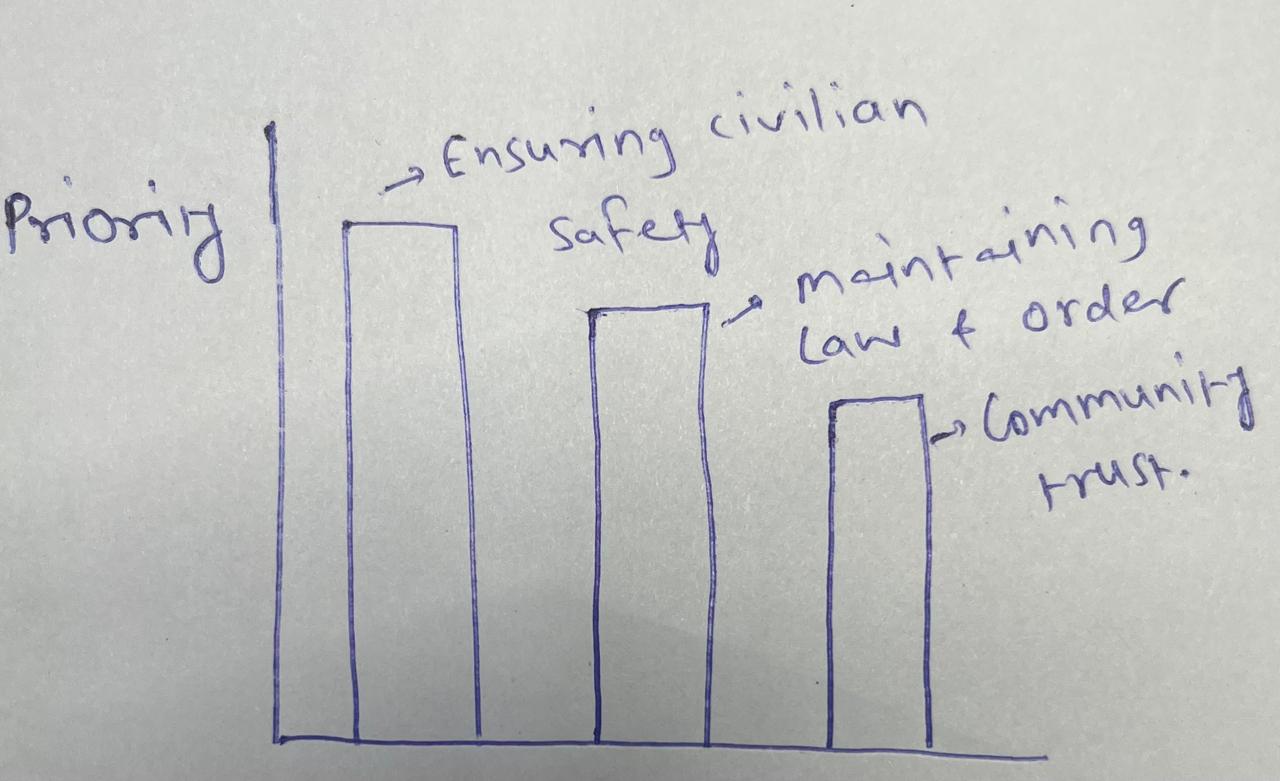
Former PM Manmohan Singh termed Naxalism as India’s biggest internal threat. Rohit’s operation successfully captured key insurgents, but the protest by tribal women creates a moral and operational challenge. He must balance immediate security needs with the long-term goal of maintaining peace, while adhering to ethical policing standards.
Options Available to Rohit:
Release the Naxalites: This may de-escalate the situation immediately, but compromises justice and rule of law, violating the ethical principle of Kantian duty.
Negotiate with the Women: Rohit could demonstrate empathy, patience, and non-violence by explaining legal consequences, urging peaceful dispersion.
Use Non-lethal Force: Employing non-lethal measures like tear gas shows prudence and respect for human rights, balancing utilitarianism by minimizing harm while maintaining public order.
Wait for Reinforcements: Waiting for backup demonstrates temperance and strategic thinking, ensuring that due process is followed while preventing unnecessary escalation.
Strategic Retreat: A temporary retreat would show wisdom and foresight, prioritizing the value of life and avoiding immediate confrontation, in line with virtue ethics.
Ethical Dilemmas Faced by Rohit:
Public Safety vs. Law Enforcement: Balancing public safety with capturing dangerous insurgents.
Use of Force vs. Human Rights: The potential need for force conflicts with the ethical duty to respect human rights, especially of vulnerable civilians.
Duty to Arrest vs. Public Sentiment: While Rohit’s duty is to uphold the law, he faces the challenge of balancing this with the sentiments and loyalty of the tribal community toward the naxalites.
Moral Responsibility vs. Professional Obligations: protecting the lives of the tribal women while ensuring public safety.
Justice vs Immediate Peace: Upholding law by detaining insurgents or releasing them to avoid unrest.
Short-term De-escalation vs. Long-term Security: The dilemma of whether to release the naxalites for immediate calm or risk long-term instability if they remain at large.
Non-Violence vs. Enforcement: The dilemma between adhering to the value of non-violence (by not using force against the women) and the need for strict enforcement to prevent insurgents from escaping.
Lack of Superior Guidance: Acting without immediate instructions from higher authorities
Most Appropriate Option:
Negotiate with the Women and De-escalate the Situation:
Course of Action
Justification
Call for Backup and Reinforcements
Ensures that law enforcement is reinforced without resorting to drastic measures
Use Non-Lethal Crowd Control Methods
Ensures civilian safety and prevents escalation to violence, upholding non-violence principles.
Allows the police to maintain control of the situation without compromising public trust.
Initiate Dialogue with Tribal Leaders
Demonstrates empathy and promotes trust-building.
Encourages peaceful resolution.
Secure the Insurgents and Hold Position
Upholds justice by preventing the release of dangerous criminals, ensuring long-term security of the region.
Demonstrates operational discipline, balancing tactical needs with civilian considerations.
Avoid Use of Lethal Force at All Costs
Prevents civilian casualties, which would escalate the situation and harm the public image of the police force.
Aligns with human rights principles and shows commitment to minimizing harm, which is essential for public trust.
Precautionary Measures for Dealing with Women Protesters:
Avoid Use of Force: Under no circumstances should lethal force be used against women protesters; non-lethal measures should only be employed as a last resort.
Engage Female Officers: Deploy female police officers to interact with the protesters, as this may calm the crowd and avoid escalation.
Maintain Clear Communication: Make an effort to communicate clearly with the women, ensuring they understand that the police are there for their safety and are not enemies.
Respect Cultural Sensitivities: Understand the cultural dynamics of the tribal women and avoid actions that could be perceived as disrespectful or oppressive.
Document the Situation: Ensure video recording of the events for transparency and accountability, to protect both the police and the community from later allegations of misconduct.
During the 2018 Sterlite Protest in Tamil Nadu, Rajesh Das, Additional Director General of Police (Law and Order), led efforts to manage the protests, deploying female police officers and prioritizing non-violent methods like negotiation and dialogue.
“Peace cannot be kept by force; it can only be achieved by understanding.” — Albert Einstein
Rohit is faced with a delicate situation that requires both strategic thinking and moral courage. The ethical principles of non-violence, duty, and long-term societal stability should guide his actions, ensuring both justice and peace in the region.
It was noted that unemployment was relatively high in the state. The problem of unemployment amongst graduates and those with higher education was much more grave. Thus they were vulnerable and soft targets.
In the review meeting taken by him with senior officers of DIG Range and above, it came to light that a new terrorist group has emerged at the global level. It has launched a massive drive to recruit young unemployed people. Special focus was to pick young people from a particular community. The said organization seemed to have the clear objective of utilizing/using them for carrying out militant activities. It was also gathered that the said (new) group is desperately trying to spread its tentacles in his state.
A definite/reliable intelligence tip was received by the State CID and Cyber Cell that a large number of such unemployed youth have already been contacted by the terrorist outfit/group through social media and local communal organizations and other contacts. The need of the hour was to act swiftly and to check these elements/designs before they assume serious proportions.
Discrete inquiries made by the police, through the Cyber Cell, revealed that good numbers of unemployed youth are very active on Facebook, Instagram and Twitter. On an average, many of them were spending 6-8 hours each day, using electronic devices/internet, etc. It also came to light that such unemployed youth were showing sympathy and endorsing the messages received from certain persons, allegedly the contact persons of that global terrorist group. Their social media accounts revealed their strong affinity to such groups in as much as many of them started forwarding anti-national tweets on their WhatsApp and Facebook, etc. It seemed that they succumbed to their ploy and started propagating secessionist ideology. Their posts were hyper-critical of the government’s initiatives, policies and subscribing to extreme beliefs and promoting extremism
What are the options available to Raman to tackle the above situation?
What measures would you suggest for strengthening the existing set-up to ensure that such groups do not succeed in penetrating and vitiating the atmosphere in the state?
In the above scenario, what action plan would you advise for enhancing the intelligence gathering mechanism of the police force?
In a recent case, a WhatsApp group named ‘Ghazwa E Hind’ was created by a Pakistani national, targeting Indian youths for radicalization. Similarly, 22 individuals from Kerala were found to have traveled to Afghanistan in 2016 to join ISIS.
Guiding Principle – “सत्यमेव जयते नानृतं” (Satyameva Jayate Nanritam) Truth alone triumphs, not falsehood.
Options for Raman to Tackle the Situation:
Take Strict Action Against Radicalized Youth:
Raman can initiate legal action, including arrests and detentions, against those already showing signs of radicalization. This could involve invoking anti-terror laws like the Unlawful Activities Prevention Act (UAPA) to curb further escalation.
Pros: Immediate containment of potential threats, sends a strong message to deter others.
Cons: Risks alienating the community and pushing some youth further into extremism due to perceived government oppression.
Consider It as a Social Problem and Focus on De-Radicalization:
Raman could approach the issue from a social reform perspective, viewing radicalization as a result of unemployment and disenfranchisement. Initiating counseling programs, educational campaigns, and engagement with community leaders can help bring vulnerable youth back into mainstream society.
Pros: Provides a long-term solution by addressing root causes of radicalization, fosters trust between law enforcement and the community.
Cons: Slow to show results, potential criticism for being too lenient on those already involved in extremist activities.
Madhyam Marga – A Middle Path:
Raman can adopt a balanced approach that combines strict law enforcement with community engagement and employment programs. This includes strengthening surveillance mechanisms, taking legal action against hardcore offenders while simultaneously focusing on job creation and education initiatives to prevent others from falling prey to extremist ideologies.
Pros: Balanced approach reduces immediate threats while addressing root causes, minimizes alienation of the community.
Cons: Requires significant coordination between multiple government agencies and can be resource-intensive.
Measures to Strengthen the Existing Set-up:
Enhancing Intelligence Networks: Raman can take inspiration from J&K Multi-Agency Intelligence Grid that brings together the Intelligence Bureau (IB), state police, military intelligence, and other central agencies to track and prevent the spread of terrorism.
Cyber Cell Expansion and Use of AI and big data analytics to monitor extremist content on social media, similar to hate speech detection algorithms used by Facebook and Twitter. Eg- Kerala Police’s Cyberdome initiative
Youth Engagement and Employment Drives: Launching a skill development program like the Nai Udaan Scheme in Jammu and Kashmir that can provide job opportunities for vulnerable youth, addressing the root cause of radicalization.
De-Radicalization Programs to provide counseling, psychological support, and education aimed at reintegrating the youth into society. Eg- Malaysia’s “Rukun Tetangga” (Community Development) de-radicalization program
Strict Regulation of Communal Organizations: Ensure that local communal organizations are closely monitored, and if any show signs of involvement in radicalizing youth, initiate strict actions under relevant laws, such as the Unlawful Activities (Prevention) Act (UAPA). Eg- action against organizations like the Popular Front of India (PFI)
Community Policing and Engagement to build trust and act as a bridge between law enforcement and citizens. Eg. Maharashtra Police’s Mohalla Committees.
Preventive Legislation and Monitoring: Strengthen laws on terrorist financing and online radicalization, using tools like the National Security Act, ensuring social justice in enforcement.
Public Awareness Campaigns: Initiate public awareness campaigns on the dangers of extremism, incorporating Gandhian values of Satyagraha and moral education.
Action Plan for Enhancing Intelligence Gathering Mechanism:
Enhanced HUMINT Networks: Deploy undercover officers and increase human intelligence (HUMINT) efforts by recruiting local informers within vulnerable communities
AI-based Predictive Policing: Implement AI tools to analyze social media and identify extremist activities early, following the successful use of predictive policing in the US and UK.
Establish Intelligence Sharing Networks: Set up a dedicated Intelligence Fusion Center in the state that can bring together law enforcement agencies (state police, cyber units, anti-terrorism squads) and central agencies (like IB and NIA) to share real-time information and intelligence.
Law Enforcement Training: regular intelligence training for local police officers to improve their ability to identify potential extremist activities in their jurisdiction.
Public Participation: anonymous public reporting systems like hotlines, apps, or online platforms where people can report suspicious online activity related to terrorist recruitment
“The greatest weapon against terrorism is not the gun, but the unity of communities and the strength of hope.”
By fostering unity and hope among young people, and by utilizing advanced intelligence mechanisms, the state can effectively counter the allure of extremist ideologies and create a safer environment for all its citizens.