💥Join UPSC 2027,2028 Mentorship (July Batch) + XFactor Notes & Microthemes PDF

Author: Ravi Ranjan

  • PRELIMS MAHASANGRAM 2022 || 40 Days Prelims Revision Plan  with TIKDAM lectures

    PRELIMS MAHASANGRAM 2022 || 40 Days Prelims Revision Plan with TIKDAM lectures

    Play Along with Your Favourite WAR COMMANDERS

    As the Prelims is getting closer, many tasks line up like static revisions, attempting mocks and wrapping up your current affairs. Quick revisions can help you remember the factual information on the final day.

    To take care of your quick revision plan, Civilsdaily is introducing Prelims Mahasangram 2022.

    The program will focus on targeted coverage of syllabus; Daily Discussion with Q&A; TIKDAM Lectures, weekly zoom calls.

    Program Starts on Monday 18th April, 2022.

    Your War Commanders are Core mentors from Civilsdaily. They mentored around 50 Aspirants in 2021 and more than 22 Aspirants cleared prelims following their Strategy.

    Now that the battleground is ready, Are you ready for the Mahasangram?

    • Complete the most important books like Laxmikant, Spectrum, NCERTs etc with  Prelims Battle: Gamified. 
    • Understand the Magic of Elimination through Lectures.
    • Win daily, weekly and eventually final War with your favourite War Commanders.
    • Be the top on the weekly Leaderboard and arrange a strategy session on Google Meet with your War Commanders.

    Major Components of The Program

    • Detailed Plan: You War commanders will provide you with a broader, Weekly and daily plan. They will also set Daily Accountability to ensure Consistency. Every morning you will be given a target to complete, which will be eventually taken up for discussion in the evening.
    • A Roadmap to secure 105 marks in Prelims 2022: You are not supposed to score 200 but just 100+ to secure a seat for mains 2022. Reading Everything in detail right now will create confusion and panic. Your War Lords will give you their smart strategy which helped their older spartans to clear prelims with flying colors. They will tell you the perfect plan to reach this milestone.
    • Daily Sessions: Evaluation is necessary after you complete your targets. Your War commanders will conduct daily sessions and ensure you do not miss any relevant topic. These session will be based on Q&A method on our Official Civilsdaily Space, Habitat.
    • Strategy: Strategy will definitely help you to plan your study for the next 45 days in a more efficient manner.You War commanders will provide you subject wise strategy specifically for prelims.
    • Daily and Weekly Leaderboard: Follow the daily schedule and earn reward points. 
    • Weekly Rewards: Those who get the top 5 spots on the weekly leaderboard will get a personal session with the mentors over google meet.
    • TIKDAM Lectures: Learn the Art of Elimination and Be the warrior who will win the war. Ravi Sir is one of the pioneers of Tikdam and he will help you in developing logics. These logics will definitely help you clear the exam. There will be 10 Tikdam sessions.

    You can get the joining and payment details for the program on the link given below:

    See How Tikdam Works even with the toughest questions:

    Q. Consider the following statements: 

    1. 21st February is declared to be the International Mother Language Day by UNICEF.

    2. The demand that Bangla has to be one of the national languages was raised in the Constituent Assembly of Pakistan. 

    Which of the above statements is/are correct? 

    (a) 1 only 

    (b) 2 only 

    (c) Both 1 and 2 

    (d) Neither 1 nor 2

    Statement-1:  It is a part of culture therefore it should be UNESCO not UNICEF. Also by TIKDAM Rule-1, Above statement should be incorrect.

    Statement 2: Present Bangladesh was a part of the then Pakistan. The statement does not say for the first time or only in the Assembly but a general statement that the demand was raised which sounds logical because East Bengal was a part of it as well. Therefore this statement should be correct.

    Q Consider the following statements: 

    1. Moringa (drumstick tree) is a leguminous evergreen tree. 

    2. The Tamarind tree is endemic to South Asia.

    3. In India, most of the tamarind is collected as minor forest produce. 

    4. India exports tamarind and seeds of moringa. 

    5. Seeds of moringa and tamarind can be used in the production of biofuels. 

    Which of the statements given above are correct? 

    (a) 1, 2, 4 and 5 

    (b) 3, 4 and 5 

    (c) 1, 3 and 4 

    (d) 1, 2, 3 and 5

    Almost every Indian has seen the Moringa Trees(Mungna, Saijan in hindi). They drop their leaves as we have seen. This means they are not evergreen. By eliminating we can get B as an answer.

    Q What is blue carbon? 

    (a) Carbon captured by oceans and coastal ecosystems 

    (b) Carbon sequestered in forest biomass and agricultural soils 

    (c) Carbon contained in petroleum and natural gas 

    (d) Carbon present in atmosphere

    We all know blue is used for Water/Oceans. Now option A has Ocean. 

    Q. With reference to the book “Desher Kather” written by Sakharam Ganesh Deuskar during the freedom struggle, consider the following statements : 

    1. It warned against the Colonial States hypnotic conquest of the mind. 

    2. It inspired the performance of swadeshi street plays and folk songs. 

    3. The use of desh‘ by Deuskar was in the specific context of the region of Bengal

    Which of the statements given above are curt? 

    (a) 1 and 2 only 

    (b) 2 and 3 only 

    (c) 1 and 3 only 

    (d) 1, 2 and 3 

    Anything in the context of Bengal used to start as ‘Bang.’ For example Bang Bhasha Prakashak Sabha, Bang Bhang, Bangladesh etc. Therefore Desh should not be in the context of Bengal. Now by simply eliminating S3 we can get the answer.

  • Prelims Spotlight: Foreign Travellers in Ancient and Medieval India

    Dear Aspirants,

    This Spotlight is a part of our Mission Nikaalo Prelims-2022

    JOIN THE SPECIAL SESSIONS ON OUR OFFICIAL SPACE

    Morning 12:00 PM  – Prelims Spotlight Session

    Evening 06:30  PM  – MCQs Session

    Noon 04:00 PM – Special Session by Shubham Sir

    Evening 08:00 PM  – Tests on Alternate Days

    Evening 09:00 PM – TIKDAM: Art of Elimination Session.

    Download Habitat app from the Playstore Join our Official Civilsdaily Space for GS and CSAT Here

    18th Apr 2022

    Travellers Visited India

    Contemporary Rulers

    Contribution.

    Deimachos

    Period: (320-273 BC)

    Who: Greek Ambassador

    Came India in the reign of Bindusara.

    Megasthenes

    Period: (302-298 B.C.)

    Who: Greek ethnographer & ambassador.

    Ambassador of Seleucus Nicator, who visited in the court of Chandragupta Maurya.

    Wrote an interesting book Indica.

    Ptolemy

    Period: 130 A.D.

    Who: From Greece and Geographer.

    Wrote “Geography of India” which gives the description of Ancient India.

    Fa-Hien

    Period: (405-411 A.D.)

    Who: Chinese Buddhist Monk

    Came to India in the reign of Chandragupta II Vikramaditya.

    –          Visited the birth place of Buddha, Lumbini.

    –          His Travelogue “Records of Buddhist Kingdoms”.

    –          Wrote Fo-Kyo-Ki.

    Hiuen-Tsang

    Period: (630-645 A.D.)

    Who: Chinese Buddhist Monk

    Visited India during the reign of Harshavardhana.

    –          Came through Tashkent and Swat Valley.

    –          Book is “Si-Yu-Ki or the records of western world”.

    I-tsing

    Period: ( 671- 695 A.D.)

    Who: Chinese traveller

    Visited India in connection with Buddhism.

    –          His works are Biographies of Eminent Monks.

    –          Gives useful information about the social, religious and cultural life of the people of this country.

    Al-Masudi

    Period: (957 A.D.)

    Who: Arab Traveller

    Gives an extensive account of India in his work “Muruj-ul-Zahab”.

    Al- Beruni or Abu Rehan Mahamud

    Period: (1024-1030 A.D.)

    Who: Muslim Scholar and Polymath

    Came along with Mahmud Ghazni during one of his Indian raids.

    –          First Muslim Scholar to study India also known as founder of Indology.

    –          Wrote “ Tahqiq-i-Hind/Kitab-ul-Hind.

    Marco Polo

    Period: (1292-1294 AD)

    Who: Venetian Traveller

    Visited South India in 1294 A.D during the reign of Pandyan ruler of Madurai, Madverman, Kulshekhara (1272-1311)

    His work “The Book of Sir Marco Polo” which gives an invaluable account of the economic history of India.

    Ibn Batuta

    Period: (1333-1347 A.D.)

    Who: Morrish traveller

    Visited India during the reign of Muhammad-Bin-Tughlaq.

    His book “ Rehla” (the travelogue)

    Shihabuddin al-Umari

    Period: (1348 A.D.)

    Who: Came from Damascus

    He gives a vivid account of India in his book “ Masalik albsar fi-mamalik al-amsar

    Nicolo Conti

    Period: (1420-1421 A.D.)

    Who: Venetian traveller

    Came during the rule of Devraya I of Sangam Dynasty of Vijayanagar empire.

    Given a graphic account of Vijayanagaras capital.

    Abdur Razzaq

    Period: (1443-1444 A.D.)

    Who: Persian traveller, Ambassador of Shahrukh of Timurid dynasty.

    –          Came during the rule of Devraya II of Sangam dynasty of Vijaynagar Empire.

    –          Came in India at Zamorin’s Calicut.

    Given a brief account of this countryside, in his Matla us Saddin wa Majuma ul Baharain.

    Athanasius Nikitin

    Period: (1470- 1474 A.D.)

    Who: Russian merchant

    Visited South India in 1470.

    -He describes the condition of the Bahmani kingdom under Muhammad III (1463-82).

    – His narrative “ The journey beyond 3 seas”

    Duarte Barbosa

    Period: (1500-1516 A.D.)

    Who: Portuguese traveller

    He has given a brief description of the government and the people of Vijayanagar Empire.

    Domingo Paes

    Period: (1520-1522 A.D.)

    Who: Portuguese traveller

    Visited the court of Krishnadeva Raya of Vijayanagar Empire.

    Fernao Nuniz

    Period: (1535-1537 A.D.)

    Who: Portuguese merchant

    Came during the rule of Achyutdeva Raya of Tuluv dynasty of vijayanagar Empire.

    Wrote history of the empire from its earliest times of the closing years of Achyutdeva Raya’s reign.

    John Hughen Von Linschotten

    Period: (1583 A.D.)

    Who: Dutch traveller

    Given a valuable account of the social and economic life of South India.

    William Hawkins

    Period: (1608-1611 A.D.)

    Who: Ambassador of James I, king of England.

    Came in India at the reign of Jahangir,the great Mughal Emperor. William finch came with him.

    Sir Thomas Roe

    Period: (1615-1619 A.D.)

    Who: Ambassador of James I, king of England.

    Came in India at the reign of Jahangir,the great Mughal Emperor.

    Edward Terry

    Period: (1616 A.D.)

    Who: Ambassador of Thomas Roe.

    Describe about Indian social (Gujarat) behaviour.

    Franciso Palsaert

    Period: (1620-1627 A.D.)

    Who: Dutch traveller stayed at Agra.

    Gave a vivid account of the flourishing trade at Surat, Ahmadabad, Broach, Cambay, Lahore, Multan etc.

    Peter Mundy

    Period: (1630-34 A.D.)

    Who: Italian traveller

    Came in the reign of the Mughal Emperor, Shahjahan.

    Gives valuable information about the living standard of the common people in the Mughal Empire.

    John Albert de Mandesto

    Period: (1638 A.D.)

    Who: German traveller

    Reached Surat in 1638 A.D.

    Jeen Baptiste Tavernier

    Period: (1638-1663 A.D.)

    Who: French traveller

    Visited India 6 times in the reign of Shahjahan and Aurangzeb.

    Nicolao Manucci

    Period: (1653-1708 A.D.)

    Who: Italian traveller

    He got service at the court of Dara Shikoh.

    Francois Bernier

    Period: (1656- 1717 A.D.)

    Who: French physician and Philosopher.

    Danishamand Khan, a noble of Aurangzeb was his patron.

    Jean de Thevenot

    Period: (1666 A.D.)

    Who: French traveller

    Given an account of cities like Ahmadabad, Cambay, Aurangabad and Golconda.

    John Fryer

    Period: (1672-1681 A.D.)

    Who: English traveller


    Given a vivid account of Surat and Bombay.

    Gemelli Careri

    Period: (1695 A.D.)

    Who: Italian traveller who landed at Daman.

    His remarks on the Mughal emperor’s military organisation and administration are important.


  • Important Groupings Related to India

    Now Free Tikdam Sessions on our Space

    Dear Aspirants,

    This Spotlight is a part of our Mission Nikaalo Prelims-2022

    JOIN THE SPECIAL SESSIONS ON OUR OFFICIAL SPACE

    Morning 12:00 PM  – Prelims Spotlight Session

    Evening 06:30  PM  – MCQs Session

    Noon 04:00 PM – Special Session by Shubham Sir

    Evening 08:00 PM  – Tests on Alternate Days

    Evening 09:00 PM – TIKDAM: Art of Elimination Session.

    Download Habitat app from the Playstore Join our Official Civilsdaily Space for GS and CSAT Here

    15th Apr 2022

    Trans-Pacific Partnership

    • The Trans-Pacific Partnership (TPP), or the Comprehensive and Progressive Agreement for Trans-Pacific Partnership (CPTPP), is a trade agreement between Australia, Brunei Darussalam, Canada, Chile, Japan, Malaysia, Mexico, New Zealand, Peru, Singapore, the United States (until 23 January 2017) and Vietnam
    • The TPP began as an expansion of the Trans-Pacific Strategic Economic Partnership Agreement (TPSEP or P4) signed by Brunei Darussalam, Chile, New Zealand, and Singapore in 2005
    • The TPP contains measures to lower both non-tariff and tariff barriers to trade and establish an investor-state dispute settlement (ISDS) mechanism
    • The agreement will enter into force after ratification by all signatories if this occurs within two years
    • APEC members may accede to the TPP, as may any other jurisdiction to which existing TPP members agree. After an application for membership is received, a commission of parties to the treaty negotiates conditions for accession.

    BRICS

    • BRICS is the acronym coined for an association of five major emerging national economies: Brazil, Russia, India, China and South Africa.
    • Originally the first four were grouped as “BRIC” (or “the BRICs”), before the induction of South Africa in 2010.
    • The BRICS members are known for their significant influence on regional affairs; all are members of G20.
    • Since 2009, the BRICS nations have met annually at formal summits. China hosted the 9th BRICS summit in Xiamen on September 2017, while Brazil hosted the most recent 11th BRICS summit on 13-14 November 2019.

    New Development Bank and the Fortaleza Declaration

    • During the sixth BRICS Summit in Fortaleza (2014), the leaders signed the Agreement establishing the New Development Bank (NDB).
    • In the Fortaleza Declaration, the leaders stressed that the NDB will strengthen cooperation among BRICS and will supplement the efforts of multilateral and regional financial institutions for global development, thus contributing to collective commitments for achieving the goal of strong, sustainable and balanced growth.
    • The bank was established in July 2015 by the BRICS countries (Brazil, Russia, India, China and South Africa).
    • The aim of the bank is to mobilize funding for infrastructure and sustainable development.
    • Its ownership structure is unique, as the BRICS countries each have an equal share and no country has any veto power.
    • In this sense, the bank is a physical expression of the desire of emerging markets to play a bigger role in global governance.
    • NDB was created to help fill the funding gap in the BRICS economies and was intended to grow its global scope over time.
    • The bank, with its subscribed capital base of US$50bn, is now poised to become a meaningful additional source of long-term finance for infrastructure in its member countries.

    Regional Comprehensive Economic Partnership (RCEP)

    • The Regional Comprehensive Economic Partnership (RCEP) is a trade deal that was being negotiated between 16 countries.
    • They include the 10 ASEAN members and the six countries with which the bloc has free trade agreements (FTAs) — India, Australia, China, Korea, Japan, and New Zealand.
    • The purpose of the deal is to create an “integrated market” spanning all 16 countries.
    • This means that it would be easier for the products and services of each of these countries to be available across the entire region.

    RCEP – India

    • It comprises half of the world population and accounts for nearly 40% of the global commerce and 35% of the GDP. RCEP would have become the world’s largest FTA after finalisation, with India being the third-biggest economy in it.
    • Without India, the RCEP does not look as attractive as it had seemed during negotiations.
    • Divided ASEAN – ASEAN has been keen on a diversified portfolio so that member states can deal with major powers and maintain their strategic autonomy. ASEAN member states have tried to keep the U.S. engaged in the region.
    • Act East policy has been well received. With China’s rise in the region, ASEAN member states have been keen on Indian involvement in the region.
    • Indo-Pacific – India’s entire Indo-Pacific strategy might be open to question if steps are not taken to restore India’s profile in the region.
    • Rejected China’s dominance – India signalled that, despite the costs, China’s rise has to be tackled both politically and economically.

    Shanghai Cooperation Organisation (SCO)

    • After the collapse of the Soviet Union in 1991, the then security and economic architecture in the Eurasian region dissolved and new structures had to come up.
    • The original Shanghai Five were China, Kazakhstan, Kyrgyzstan, Russia and Tajikistan.
    • The SCO was formed in 2001, with Uzbekistan included. It expanded in 2017 to include India and Pakistan.
    • Since its formation, the SCO has focused on regional non-traditional security, with counter-terrorism as a priority:
    • The fight against the “three evils” of terrorism, separatism and extremism has become its mantra.
    • Today, areas of cooperation include themes such as economics and culture.

    India’s entry to the SCO

    • India and Pakistan both were observer countries.
    • While Central Asian countries and China were not in favour of expansion initially, the main supporter — of India’s entry in particular — was Russia.
    • A widely held view is that Russia’s growing unease about an increasingly powerful China prompted it to push for its expansion.
    • From 2009 onwards, Russia officially supported India’s ambition to join the SCO. China then asked for its all-weather friend Pakistan’s entry.

    The Bay of Bengal Initiative for Multi-Sectoral Technical and Economic Cooperation (BIMSTEC)

    • The Bay of Bengal Initiative for Multi-Sectoral Technical and Economic Cooperation (BIMSTEC) is a regional organization comprising seven Member States lying in the littoral and adjacent areas of the Bay of Bengal constituting a contiguous regional unity. This sub-regional organization came into being on 6 June 1997 through the Bangkok Declaration.
    • The regional group constitutes a bridge between South and South-East Asia and represents a reinforcement of relations among these countries.
    • BIMSTEC has also established a platform for intra-regional cooperation between SAARC and ASEAN members.  The BIMSTEC region is home to around 1.5 billion people which constitute around 22% of the global population with a combined gross domestic product (GDP) of 2.7 trillion economies. In the last five years, BIMSTEC Member States have been able to sustain an average 6.5% economic growth trajectory despite a global financial meltdown.

    SAARC & SAARC Countries

    • The South Asian Association for Regional Cooperation (SAARC) is a regional intergovernmental organization and geopolitical union in South Asia.  Its member states include Afghanistan, Bangladesh, Bhutan, India, Nepal, the Maldives, Pakistan and Sri Lanka.  SAARC was founded in Dhaka in 1985.
    • Its secretariat is based in Kathmandu.
    • The organization promotes the development of economic and regional integration.
    • It launched the South Asian Free Trade Area in 2006.
    • SAARC maintains permanent diplomatic relations at the United Nation as an observer and has developed links with multilateral entities.
    • Observers Of SAARC: – States with observer status include Australia, China, the European Union, Iran, Japan, Mauritius Myanmar, South Korea and the United States.

    Association of Southeast Asian Nations (ASEAN)

    • The Association of Southeast Asian Nations is a regional intergovernmental organization comprising ten Southeast Asian countries
    • It promotes Pan-Asianism and intergovernmental cooperation and facilitates economic, political, security, military, educational and socio-cultural integration amongst its members and other Asian countries
    • It members are Indonesia, Malaysia, the Philippines, Singapore, Thailand, Brunei, Cambodia, Laos, Myanmar, and Vietnam
    • ASEAN shares land and maritime borders with India, China
    • ASEAN is an official United Nations Observer.

    The Nuclear Suppliers Group (NSG)

    • The Nuclear Suppliers Group (NSG) is a group of nuclear supplier countries that seeks to contribute to the non-proliferation of nuclear weapons through the implementation of two sets of Guidelines for nuclear exports and nuclear-related exports.
    • One of the critical elements for inclusion into the NSG is that the member countries need to signatories of the NPT, a proposal which India has categorically disagreed.
    • However considering India’s history of nuclear non-proliferation, the US and subsequently the NSG have shown some recognition and granted India with the waiver of dealing with other countries for nuclear technology.

    Organisation for the Prohibition of Chemical Weapons (OPCW)

    • OPCW is an intergovernmental organization and the implementing body for the Chemical Weapons Convention, which entered into force on 29 April 1997
    • The OPCW, with its 193 member states, has its seat in The Hague, Netherlands, and oversees the global endeavour for the permanent and verifiable elimination of chemical weapons
    • The organization promotes and verifies the adherence to the Chemical Weapons Convention, which prohibits the use of chemical weapons and requires their destruction
    • Verification consists both of evaluation of declarations by member states and onsite inspections
    • The OPCW has the power to say whether chemical weapons were used in an attack it has investigated
    • The organization was awarded the 2013 Nobel Peace Prize “for its extensive efforts to eliminate chemical weapons”

    The Australian Group

    • The Australia Group is a multilateral export control regime (MECR) and an informal group of countries (now joined by the European Commission) established in 1985 (after the use of chemical weapons by Iraq in 1984) to help member countries to identify those exports which need to be controlled so as not to contribute to the spread of chemical and biological weapons
    • The group, initially consisting of 15 members, held its first meeting in Brussels, Belgium, in September 1989. With the incorporation of India on January 19, 2018, it now has 43 members, including Australia, the European Commission, all 28 member states of the European Union, Ukraine, and Argentina
    • The name comes from Australia’s initiative to create the group. Australia manages the secretariat
    • The initial members of the group had different assessments of which chemical precursors should be subject to export control
    • Later adherents initially had no such controls
    • Today, members of the group maintain export controls on a uniform list of 54 compounds, including several that are not prohibited for export under the Chemical Weapons Convention but can be used in the manufacture of chemical weapons
    • In 2002, the group took two important steps to strengthen export control
    • The first was the “no-undercut” requirement, which stated that any member of the group considering making an export to another state that had already been denied an export by any other member of the group must first consult with that member state before approving the export
    • The second was the “catch-all” provision, which requires member states to halt all exports that could be used by importers in chemical or biological weapons programs, regardless of whether the export is on the group’s control lists.
    • Delegations representing the members meet every year in Paris, France

    WTO

    • US, UK and a few other countries set up, an interim organisation about trade named GATT (General Agreement on Tariff and Trade) in 1947
    • GATT was biased in favour of the developed countries and was called informally as the Rich men’s club.
    • So, the developing countries insisted on setting up the International Trade Organisation (ITO)
    • That’s the reason, the United Nations Conference on Trade and Development (UNCTAD) was set up in 1964 as an alternative, on the recommendation of the UN committee
    • Next development comes in Uruguay Round of GATT, it sought to expand the scope of the organisation by including, services, investment and intellectual property rights (IPR)
    • Agreements were ratified by the legislatures of 85 member-countries by year-end 1994.
    • On such rectification, the WTO started functioning from Jan 1, 1995, Marrakesh Agreement>

    Functions of WTO

    • The WTO deals with regulation of trade in goods, services and intellectual property between participating countries.
    • It provides a framework for negotiating trade agreements and a dispute resolution process aimed at enforcing participants’ adherence to WTO agreements, which are signed by representatives of member governments and ratified by their parliaments.

    G20

    • Formed in 1999, the G20 is an international forum of the governments and central bank governors from 20 major economies.
    • Collectively, the G20 economies account for around 85 percent of the Gross World Product (GWP), 80 percent of world trade.
    • To tackle the problems or the address issues that plague the world, the heads of governments of the G20 nations periodically participate in summits.
    • In addition to it, the group also hosts separate meetings of the finance ministers and foreign ministers.
    • The G20 has no permanent staff of its own and its chairmanship rotates annually between nations divided into regional groupings.

    Aims and objectives

    • The Group was formed with the aim of studying, reviewing, and promoting high-level discussion of policy issues pertaining to the promotion of international financial stability.
    • The forum aims to pre-empt the balance of payments problems and turmoil on financial markets by improved coordination of monetary, fiscal, and financial policies.
    • It seeks to address issues that go beyond the responsibilities of any one organisation.

    Member Countries

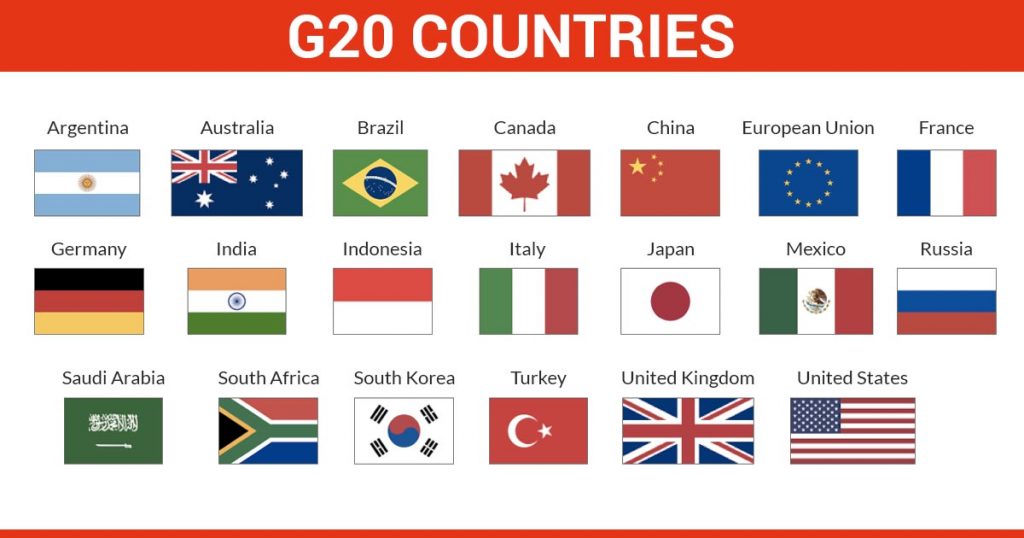
    The members of the G20 consist of 19 individual countries plus the European Union (EU).

    • The 19 member countries of the forum are Argentina, Australia, Brazil, Canada, China, France, Germany, India, Indonesia, Italy, Japan, Mexico, Russia, Saudi Arabia, South Africa, South Korea, Turkey, United Kingdom and the United States.
    • The European Union is represented by the European Commission and by the European Central Bank.

     Who are the G20 Sherpas?

    • A Sherpa is the personal representative of a head of state or government who prepares an international summit, particularly the annual G7 and G20 summits.
    • Between the summits, there are multiple Sherpa conferences where possible agreements are laid out.
    • This reduces the amount of time and resources required at the negotiations of the heads of state at the final summit.
    • The Sherpa is generally quite influential, although they do not have the authority to make a final decision about any given agreement.
    • The name is derived from the Sherpa people, a Nepalese ethnic group, who serve as guides and porters in the Himalayas, a reference to the fact that the Sherpa clears the way for a head of state at a major summit.

    G7

    • The G7 or the Group of Seven is a group of the seven most advanced economies as per the International Monetary Fund (IMF).
    • The seven countries are Canada, USA, UK, France, Germany, Japan and Italy. The EU is also represented in the G7.
    • These countries, with the seven largest IMF-described advanced economies in the world, represent 58% of the global net wealth ($317 trillion).
    • The G7 countries also represent more than 46% of the global gross domestic product (GDP) based on nominal values, and more than 32% of the global GDP based on purchasing power parity.
    • The requirements to be a member of the G7 are a high net national wealth and a high HDI (Human Development Index).

    Clueless about 2023 Preparation? Talk to your Friend, Philosopher and Guide.

    Fill up this form to schedule a free on-call discussion with senior mentor from Civilsdaily. Once submitted we will call you within 24 hours.

    Fill the Form HERE

  • [Prelims Spotlight] Budget and Eco Survey

    Now Free Tikdam Sessions on our Space

    Dear Aspirants,

    This Spotlight is a part of our Mission Nikaalo Prelims-2022

    JOIN THE SPECIAL SESSIONS ON OUR OFFICIAL SPACE

    Morning 12:00 PM  – Prelims Spotlight Session

    Evening 06:30  PM  – MCQs Session

    Noon 04:00 PM – Special Session by Shubham Sir

    Evening 08:00 PM  – Tests on Alternate Days

    Evening 09:00 PM – TIKDAM: Art of Elimination Session.

    Download Habitat app from the Playstore Join our Official Civilsdaily Space for GS and CSAT Here


    Prelims Spotlight: Budget and Economic Survey


    14th Apr 2022

    The Union Minister for Finance & Corporate Affairs has presented the Economic Survey 2021-22 in Parliament.

    [1] State of the Economy

    • Economic growth: Indian economy estimated to grow by 9.2 percent in real terms in 2021-22 (as per first advanced estimates) subsequent to a contraction of 7.3 percent in 2020-21. 
    • GDP growth: GDP projected to grow by 8- 8.5 percent in real terms in 2022-23.  
    • Agriculture and allied sectors: In line with the longer term trend, the area sown in the Kharif cycle of 2021-22 was again higher than in the previous year. In contrast to the steady performance of the primary sector, the industrial sector went through a big swing by first contracting by 7 per cent in 2020-21 and then expanding by 11.8 per cent in this financial year.

    [2] Fiscal Developments

    • Revenue receipts: These have gone up by 67.2 percent (YoY) as against an expected growth of 9.6 percent in the 2021-22 Budget Estimates.
    • Gross Tax Revenue: It registered a growth of over 50 percent during April to November, 2021 in YoY terms. 
    • Borrowings: With the enhanced borrowings on account of COVID-19, the Central Government debt has gone up from 49.1 percent of GDP in 2019-20 to 59.3 percent of GDP in 2020-21.

    [3] External Sectors

    • India’s merchandise exports and imports rebounded strongly and surpassed pre-COVID levels during the current financial year.
    • Net capital flows: These were higher at US$ 65.6 billion in the first half of 2021-22, on account of continued inflow of foreign investment, revival in net external commercial borrowings, higher banking capital and additional special drawing rights (SDR) allocation.
    • India’s external debt: It rose to US $ 593.1 billion at end-September 2021, from US $ 556.8 billion a year earlier, reflecting additional SDR allocation by IMF, coupled with higher commercial borrowings.
    • Foreign Exchange Reserves: It touched US $ 633.6 billion in Dec 2021 making India the fourth largest forex reserves holder in the world after China, Japan and Switzerland.

    [4] Monetary Management and Financial Intermediation

    • Repo was maintained: The liquidity in the system remained in surplus. Repo rate was maintained at 4 per cent in 2021-22.
    • GSAP: RBI undertook various measures such as G-Sec Acquisition Programme and Special Long-Term Repo Operations to provide further liquidity.
    • NPAs declined: The Gross Non-Performing Advances ratio of Scheduled Commercial Banks (SCBs) declined from 11.2 per cent at the end of 2017-18 to 6.9 per cent at the end of September, 2021.

    [5] Prices and Inflation

    • Control over food inflation: The decline in retail inflation was led by easing of food inflation. Proactive measures were taken to contain the price rise in pulses and edible oils.
    • Supply constraints eased: Effective supply-side management kept prices of most essential commodities under control during the year.
    • Fuel price reduction: Reduction in central excise and subsequent cuts in Value Added Tax by most States helped ease petrol and diesel prices.

    [6] Sustainable Development and Climate Change

    • Sustainable development: India’s overall score on the NITI Aayog SDG India Index and Dashboard improved to 66 in 2020-21 from 60 in 2019-20 and 57 in 2018-19.
    • Rise in forest cover: India has the tenth largest forest area in the world. In 2020, India ranked third globally in increasing its forest area during 2010 to 2020. In 2020, the forests covered 24% of India’s total geographical, accounting for 2% of the world’s total forest area.
    • Plastic waste management (PWM): In August 2021, the PWM Amendment Rules, 2021, was notified which is aimed at phasing out single use plastic by 2022.
    • Extended Producer Responsibility for plastic: Draft rules for plastic packaging was notified.
    • Pledge on Net-Zero Emissions: The PM participated at COP-26 in Glasgow. He announced ambitious targets to achieve net-zero by 2070.


    [7] Agriculture and Food Management

      • Minimum Support Price (MSP) policy: It is being used to promote crop diversification.
      • Allied sector growth: Allied sectors including animal husbandry, dairying and fisheries are steadily emerging to be high growth sectors and major drivers of overall growth in agriculture sector.
      • Food security:  Government has further extended the coverage of food security network through schemes like PM Gareeb Kalyan Yojana (PMGKY).
      • Income Support: Timely release of PM-KISAN Funds.

    [8] Industry and Infrastructure:

    • Index of Industrial Production (IIP): It grew at 17.4 percent (YoY) during April-November 2021 as compared to -15.3 percent in April-November 2020.
    • Extent of road construction per day: This has increased substantially in 2020-21 to 36.5 Kms per day from 28 Kms per day in 2019-20 – a rise of 30.4 percent.
    • Production Linked Incentive (PLI) Scheme: It gave a major boost to infrastructure-both physical as well as digital.
    • In contrast to the steady performance of the primary sector, the industrial sector went through a big swing by first contracting by 7 per cent in 2020-21 and then expanding by 11.8 per cent in this financial year.

    [9] Services Sector

    • Growth despite pandemic: Overall service Sector GVA is expected to grow by 8.2 percent in 2021-22.
    • Opening up of space sector to private players: Major government reform.
    • India becomes start-up hub: India has become 3rd largest start-up ecosystem in the world after US and China.
    • Unicorns in India: 44 Indian start-ups have achieved unicorn status in 2021 taking overall tally of unicorns to 83, most of which are in services sector.

    [10] Social Infrastructure and Employment

    • Universal vaccination: 157.94 crore doses of COVID-19 vaccines administered (as on 16th January 2022).
    • Employment recovery: As per the quarterly Periodic Labour Force Survey (PFLS) data up to March 2021, employment in urban sector affected by pandemic has recovered almost to the pre-pandemic level.
    • Expenditure on social services (health, education and others): This expenditure by Centre and States as a proportion of GDP increased from 6.2 % in 2014-15 to 8.6% in 2021-22.
    • National Family Health Survey-5:
    1. Total Fertility Rate (TFR) came down to 2 in 2019-21 from 2.2 in 2015-16
    2. Infant Mortality Rate (IMR), under-five mortality rate and institutional births have improved in 2019-21 over year 2015-16
    3. Jal Jeevan Mission (JJM): Under this, 83 districts have become ‘Har Ghar Jal’ districts.
    4. Continuance of MGNREGS: Increased allotment of funds to Mahatma Gandhi National Rural Employment Guarantee Scheme (MNREGS) to provide buffer for unorganized labour in rural areas during the pandemic.

    [11] Investment: Gross Fixed Capital Formation

    • Statistically it measures the value of acquisitions of new or existing fixed assets by the business sector, governments and “pure” households (excluding their unincorporated enterprises) less disposals of fixed assets. GFCF is a component of the expenditure on gross domestic product (GDP), and thus shows something about how much of the new value added in the economy is invested rather than consumed. GFCF is called “gross” because the measure does not make any adjustments to deduct the consumption of fixed capital (depreciation of fixed assets) from the investment figures.
    • Investment, as measured by Gross Fixed Capital Formation (GFCF) is expected to see strong growth of 15 per cent in 2021-22 and achieve full recovery of pre-pandemic level. Government’s policy thrust on quickening virtuous cycles of growth via capex and infrastructure spending has increased capital formation in the economy, lifting the investment to GDP ratio to about 29.6 per cent in 2021-22, the highest in seven years.
      BARBELL STRATEGY, SAFETY NETS & AGILE RESPONSE:
    • “Barbell Strategy”: It combined a bouquet of safety-nets to cushion the impact on vulnerable sections of society/business, with a flexible policy response based on a Bayesian updating of information. This is a common strategy used in financial markets to deal with extreme uncertainty.
    • The Agile approach is a well-established intellectual framework that is increasingly used in fields like project management and technology development. In an uncertain environment, the Agile framework responds by assessing outcomes in short iterations and constantly adjusting incrementally.
    • The Waterfall approach entails a detailed, initial assessment of the problem followed by a rigid up-front plan for implementation. This methodology works on the premise that all requirements can be understood at the beginning and therefore pre-commits to a certain path of action. This is the thinking reflected in five-year economic plans, and rigid urban master-plans.


  • Prelims Spotlight: Irrigation Application Methods and Sources

    Now Free Tikdam Sessions on our Space

    Dear Aspirants,

    This Spotlight is a part of our Mission Nikaalo Prelims-2022

    JOIN THE SPECIAL SESSIONS ON OUR OFFICIAL SPACE

    Morning 12:00 PM  – Prelims Spotlight Session

    Evening 06:30  PM  – MCQs Session

    Noon 04:00 PM – Special Session by Shubham Sir

    Evening 08:00 PM  – Tests on Alternate Days

    Evening 09:00 PM – TIKDAM: Art of Elimination Session.

    Download Habitat app from the Playstore Join our Official Civilsdaily Space for GS and CSAT Here

     
    13th Apr 2022

    Clueless about 2023 Preparation?

    Fill up this form to schedule a free on-call discussion with senior mentor from Civilsdaily. Once submitted we will call you within 24 hours.

    Fill the Form HERE
  • Prelims Spotlight: Major Rivers in India

    Now Free Tikdam Sessions on our Space

    Dear Aspirants,

    This Spotlight is a part of our Mission Nikaalo Prelims-2022

    JOIN THE SPECIAL SESSIONS ON OUR OFFICIAL SPACE

    Morning 12:00 PM  – Prelims Spotlight Session

    Evening 06:30  PM  – MCQs Session

    Noon 04:00 PM – Special Session by Shubham Sir

    Evening 08:00 PM  – Tests on Alternate Days

    Evening 09:00 PM – TIKDAM: Art of Elimination Session.

    Download Habitat app from the Playstore Join our Official Civilsdaily Space for GS and CSAT Here

    12th Apr, 2022

    Clueless about 2023 Preparation?

    Fill up this form to schedule a free on-call discussion with senior mentor from Civilsdaily. Once submitted we will call you within 24 hours.
    Fill the Form HERE

  • Prelims Spotlight: Protected Areas

    Now Free Tikdam Sessions on our Space

    Dear Aspirants,

    This Spotlight is a part of our Mission Nikaalo Prelims-2022

    Join The Special Sessions on Our Official Space

    Morning 12:00 PM  – Prelims Spotlight Session

    Evening 06:30  PM  – MCQs Session

    Noon 04:00 PM – Special Session by Praveen Sir

    Evening 08:00 PM  – Tests on Alternate Days

    Evening 09:00 PM – TIKDAM: Art of Elimination Session.

    Download Habitat app from the Playstore Join our Official Civilsdaily Space for GS and CSAT Here

    11th Apr 2022

    NATIONAL PARKS AND WILDLIFE SANCTUARIES IN INDIA

    NATIONAL PARKSSTATES
    Papikonda National ParkAndhra Pradesh
    Rajiv Gandhi National ParkAndhra Pradesh
    Lanjamadugu Wildlife SanctuaryAndhra Pradesh
    Namdapha National ParkArunachal Pradesh
    Dibang Wildlife SanctuaryArunachal Pradesh
    Manas National Park (UNESCO)Assam
    Nameri National ParkAssam
    Rajiv Gandhi Orang National ParkAssam
    Kaziranga National Park (UNESCO)Assam
    Dibru Sai Khowa National ParkAssam
    Gautam Budha Wildlife SanctuaryBihar
    Valmild National ParkBihar
    Rajgir Wildlife SanctuaryBihar
    Indravati National ParkChhattisgarh
    Achanakmar Wildlife SanctuaryChhattisgarh
    Kanger Valley National ParkChhattisgarh
    Tamor Pingla Wildlife SanctuaryChhattisgarh
    Guru Ghasi Das (Sanjay) National ParkChhattisgarh
    Gomarda Wildlife SanctuaryChhattisgarh
    Bhagwan Mahavir National ParkGoa
    Vansda National ParkGujarat
    Kutch Desert Wildlife SanctuaryGujarat
    Indian Wild Ass SanctuaryGujarat
    Marine National Park (First Marine National Park)Gujarat
    Black Buck National ParkGujarat
    Gir Forest National ParkGujarat
    Kalesar National ParkHaryana
    Sultanpur National ParkHaryana
    Lippa Asrang Wildlife SanctuaryHimachal Pradesh
    Tundah Wildlife SanctuaryHimachal Pradesh
    Inderkilla National ParkHimachal Pradesh
    Great Himalayan National ParkHimachal Pradesh
    Pin Valley National ParkHimachal Pradesh
    Khirganga National ParkHimachal Pradesh
    Simbalbara National ParkHimachal Pradesh
    Sechu Tuan Nala Wildlife SanctuaryHimachal Pradesh
    Salim All National ParkJammu & Kashmir
    Kishtwar National ParkJammu & Kashmir
    Hemis National Park (Largest in Area)Jammu & Kashmir
    Changtang Wildlife SanctuaryJammu & Kashmir
    Dachigam National ParkJammu & Kashmir
    Kara Koram Wildlife SanctuaryJammu & Kashmir
    Hirpora Wildlife SanctuaryJammu & Kashmir
    Lachipora Wildlife SanctuaryJammu & Kashmir
    Betla National ParkJharkhand
    Hazaribagh National ParkJharkhand
    Lawalong Wildlife SanctuaryJharkhand
    Nagarhole National ParkKarnataka
    Cauvery Wildlife SanctuaryKarnataka
    Kudremukh National ParkKarnataka
    Bannerghatta National ParkKarnataka
    Bandipur National ParkKarnataka
    Arabithittu Wildlife SanctuaryKarnataka
    Nugu Wildlife SanctuaryKarnataka
    Pushpagiri Wildlife SanctuaryKarnataka
    Chinnar Wild Life SanctuaryKerala
    Idukki Wildlife SanctuaryKerala
    Periyar National ParkKerala
    Silent Valley National ParkKerala
    Eravikulam National ParkKerala
    Parambikulam Wildlife SanctuaryKerala
    Malabar Wildlife SanctuaryKerala
    Anamudi Shola National ParkKerala
    Pampadum Shola National ParkKerala
    Pench National ParkMadhya Pradesh
    Bandhavgarh National Park (Highest Numbers of Tigers)Madhya Pradesh
    Kanha National ParkMadhya Pradesh
    Madhav National ParkMadhya Pradesh
    Panna National ParkMadhya Pradesh
    Satpura National ParkMadhya Pradesh
    Van Vihar National ParkMadhya Pradesh
    Gandhi Sagar SanctuaryMadhya Pradesh
    National Chambal SanctuaryMadhya Pradesh
    Mandla Plant Fossils National ParkMadhya Pradesh
    Pachmari Wildlife SanctuaryMadhya Pradesh
    Phen Wildlife SanctuaryMadhya Pradesh
    Ratapani Tiger ReserveMadhya Pradesh
    Sanjay National ParkMadhya Pradesh
    Chandoli National ParkMaharashtra
    Gugamal National ParkMaharashtra
    Sanjay Gandhi (Borivilli) National ParkMaharashtra
    Koyna Wildlife SanctuaryMaharashtra
    Navegaon National ParkMaharashtra
    Tadoba National ParkMaharashtra
    Dhakna Kolkaz Wildlife SanctuaryMaharashtra
    Phansad Wildlife SanctuaryMaharashtra
    Wain Ganga Wildlife SanctuaryMaharashtra
    Keibul Lamjao National ParkManipur
    Yagoupokpi Lokchao Wildlife SanctuaryManipur
    Nokrek National ParkMeghalaya
    Nongkhyllem Wildlife SanctuaryMeghalaya
    Balphakram National ParkMeghalaya
    Khawnglung Wildlife SanctuaryMizoram
    Murlen National ParkMizoram
    Ngengpui Wildlife SanctuaryMizoram
    Phawngpui Blue Mountain National ParkMizoram
    Pulebarze Wildlife SanctuaryNagaland
    Intanki National ParkNagaland
    Simplipal National ParkOrissa
    Chilka Wild Life SanctuaryOrissa
    Baisipalli Wildlife SanctuaryOrissa
    Bhitarkanika National ParkOrissa
    Debrigarh Wildlife SanctuaryOrissa
    Kuldiha Wildlife SanctuaryOrissa
    Ranthambore National ParkRajasthan
    Sariska National ParkRajasthan
    First National Park in the world, which was successfully adapted by Royal Bengal Tiger] 
    Darrah National ParkRajasthan
    Desert National ParkRajasthan
    Keoladeo National Park (UNESCO)Rajasthan
    Mount Abu Wildlife SanctuaryRajasthan
    Jawaharsagar Wildlife SanctuaryRajasthan
    Phulwari Wildlife SanctuaryRajasthan
     Keladevi Wildlife SanctuaryRajasthan
    Fambonglho Wildlife SanctuarySikkim
    Khangchendzonga National ParkSikkim
    Kyongnosla Alpine SanctuarySikkim
    Pangolakha Wildlife SanctuarySikkim
    Shingba Rhododendron SanctuarySikkim
    Mukurthi National ParkTamilnadu
    Shenbagathoppu Grizzled Squirrel Wildlife SanctuaryTamilnadu
    Satyamanglam wild Life SanctuaryTamilnadu
    Indira Gandhi (Annamalai) National ParkTamilnadu
    Guindy National ParkTamilnadu
    Mudumalai National ParkTamilnadu
    Vettangundi Wildlife SanctuaryTamilnadu
    Gulf of Mannar Marine National ParkTamilnadu
    Mrugavani National ParkTelangana
    Sipahijola Wildlife SanctuaryTripura
    Bisan (Rajbari) National ParkTripura
    Gumti Wildlife SanctuaryTripura
    Clouded Leopard National ParkTripura
    Chandra Prabha Wildlife SanctuaryUttar Pradesh
    Dudhwa National ParkUttar Pradesh
    Ranipur SanctuaryUttar Pradesh
    Rajaji National ParkUttarakhand
    Gangotri National ParkUttarakhand
    Nanda Devi National Park (UNESCO)Uttarakhand
    Jim Corbett National Park (Oldest Park)Uttarakhand
    Valley of Flowers National Park (UNESCO)Uttarakhand
    Askot Musk Deer SanctuaryUttarakhand
    Govind Pashu ViharUttarakhand
    Kedarnath Wildlife SanctuaryUttarakhand
    Sundarbans National ParkWest Bengal
    Gorumara National ParkWest Bengal
    Buxa National ParkWest Bengal
    Jaldapara National ParkWest Bengal
    Neora Valley National ParkWest Bengal
    Singalila National ParkWest Bengal
    Mahatma Gandhi Marine National ParkAndaman & Nicobar Islands
    Rani Jhansi Marine National ParkAndaman & Nicobar Islands
    Saddle Peak National ParkAndaman & Nicobar Islands
    Middle Button Island National ParkAndaman & Nicobar Islands
    South Button Island National ParkAndaman &Nicobar Islands
    Mount Harriet National ParkAndaman &Nicobar Islands
    North Button Island National ParkAndaman & Nicobar Islands
    Campbell Bay National ParkAndaman & Nicobar Islands
    Galathea National ParkAndaman & Nicobar Islands

    Clueless about 2023 Preparation?

    Fill up this form to schedule a free on-call discussion with senior mentor from Civilsdaily. Once submitted we will call you within 24 hours.

    Fill the Form HERE

  • All India Open Mock Test – GS and CSAT: Challenge is Now Live

    All India Open Mock Test – GS and CSAT: Challenge is Now Live

    Before taking the prelims exam, it’s always better to try the mock tests of various institutes to evaluate your level of understanding and knowledge. Once you know the weak spots, you can spend the rest of the days in revising them.

    After the exam, CD Mentors will discuss the solutions of the questions on the Civilsdaily Official Space. Join here

    What Must a Quality Prelims Test Have?

    A quality mock test wiill highlight your shortcomings in all the areas.

    We at Civilsdaily understand the nuances of setting a paper. Through five cases explaining five questions, we’ll try to give you an idea about the varied difficulty level of prelims questions.

    These questions have been taken from the first test of Nikaalo Prelims All India Open Mock Test 2022

    CASE 1 – Easiest but the Toughest

    Sometimes we find the correct answer very easily without reconsideration, but when we look back at the key we realise that it was a blunder.

    Ques. Which of the following is a violation of Fundamental Rights

    a. Not paying minimum wages

    b. Banning of a book

    c. Banning of loudspeakers after 9 pm.

    d. Banning a speech

    Correct answer- A

    In our country, there are millions of people who are underprivileged and deprived. They may be subjected to exploitation by their fellow human beings. One such form of exploitation in our country has been begar or forced labor without payment. Another closely related form of exploitation is buying and selling of human beings and using them as slaves. Not paying minimum wages is a kind of exploitation.

    CASE 2: Relating names and use common sense

    A lot of times you can solve the questions by relating or breaking the term asked.

    AmbiTAG was recently seen in the news, What is AmbiTAG

    a. It is a device to collect soil information for farmers

    b. It is a device that records real-time ambient temperature during the transportation of perishable products, vaccines, and even body organs and blood

    c. It is used for providing weather-related information in High Altitude areas

    d. None of the above

    Correct answer: B

    IIT Ropar in (Punjab) has developed a first of-its-kind IoT device AmbiTag that records real-time ambient temperature during the transportation of perishable products, vaccines, and even body organs and blood. AmbiTag continuously records the temperature of its immediate surroundings from -40 to +80 degrees in any time zone for a full 90 days on a single charge. The device helps know whether that particular item transported from anywhere in the world is still usable or perished because of temperature variation.

    CASE 3: Are you done with ncerts?

    We can not deny the ncerts. Every year we get basic questions from ncerts. You can find them here as well

    Which of the following statements with regards to the term ‘Republic’ is/are correct?
    1. Every democratic country is also a de facto republic.
    2. In Presidential Government the Head of the State is indirectly elected while in a Republic, the Head of the State is directly elected.
    Select the correct answer from the codes given below:

    a. 1 only

    b. 2 only

    c. Both 1 and 2

    d. Neither 1 nor 2

    Correct answer: 1 only

    Both Statements are Incorrect: A democratic polity can be classified into two categories — monarchy and republic. A republic also means two more things: one, vesting of political sovereignty in the people and not in a single individual ; second, the absence of any privileged class and hence all public offices being opened to every citizen. There are many democratic countries which have Monarchs as their Head of the State hence they are Democracy but not Republic. Example Britain. In Republics, the head of the State is elected through either be direct or indirect election. Ex. India is republic country in which head of state is elected indirectly and USA is Presidential Government in which the Head of the State is directly elected.

    CASE 4: Going international.

    International collaboration and aid in our schemes and policies are relevant. If you ever read about them, know that the issue is of critical importance for the government and society.

    Ques. With reference to Atal Bhujal Yojana, consider the following statements:

    1. It is a Centrally Sponsored Scheme with funding pattern of 50:50 between Government of India and states.
    2. This scheme is approved by the World Bank.

    Which of the following statements given above is/are correct?

    a. 1 only

    b. 2 only

    c. Both 1 and 2

    d. Neither 1 nor 2

    Correct answer: 2 only

    Here the Government of India’s collaboration with World Bank makes it important. Half of the financial contribution is from the World Bank in this initiative.

    Students must not ignore the contribution of international institutions especially if it is of such overwhelming nature.

    CASE 5: Core of the core

    You should be able to remember the bare minimum. There is no other way in such questions. You either know them or you don’t.

    It is located on the Southern Bank of the Brahmaputra River. Varieties of Grassland can be seen here that provide habitat to Indian Rhinoceros.

    Select the correct answer from the codes given below:

    a. Nameri National Park

    b. Pobitora WLS

    c. Kajiranga

    d. Namdapha

    Correct answer: B

    Get ready to challenge yourself on 10th April 2022. Register for the second edition of Nikaalo Prelims Open Mock Test now.

    After the exam, CD Mentors will discuss the solutions of the questions on the Civilsdaily Official Space. Join here
  • Prelims Spotlight: Important Rebellions and Peasant Movements

    08th Apr, 2022

    Samanvaya: Free 1-to-1 mentorship for UPSC IAS 2022

    Fill up this form to schedule a free on-call discussion with senior mentor from Civilsdaily regarding 60 days plan for prelims 2022. Once submitted we will call you within 24 hours.
    Click here

  • Government Bodies Related to Environment in India/Important Declarations, Conventions, Protocols Regarding UNFCCC COPs

     
    7th Apr 2022

    Government Bodies Related To Environment

    Central Pollution Control Board

    Established: It was established in 1974 under the Water (Prevention and Control of Pollution) Act, 1974.

    Objective: To provide technical services to the Ministry of Environment and Forests under the provisions of the Environment (Protection) Act, 1986.

    Key Functions:

    • Advise the Central Government on any matter concerning prevention and control of water and air pollution and improvement of the quality of air.
    • Plan and cause to be executed a nation-wide programme for the prevention, control or abatement of water and air pollution
    • Coordinate the activities of the State Board and resolve disputes among them
    • Provide technical assistance and guidance to the State Boards, carry out and sponsor investigation and research relating to problems of water and air pollution, and for their prevention, control or abatement
    • Plan and organise training of persons engaged in the programme on the prevention, control or abatement of water and air pollution
    • Organise through mass media, a comprehensive mass awareness programme on the prevention, control or abatement of water and air pollution
    • Collect, compile and publish technical and statistical data relating to water and air pollution and the measures devised for their effective prevention, control or abatement;
    • Prepare manualscodes and guidelines relating to treatment and disposal of sewage and trade effluents as well as for stack gas cleaning devices, stacks and ducts;
    • Disseminate information in respect of matters relating to water and air pollution and their prevention and control
    • Lay downmodify or annul, in consultation with the State Governments concerned, the standards for stream or well, and lay down standards for the quality of air.
    • Perform such other functions as may be prescribed by the Government of India.

    National Biodiversity Authority

    Established When: It is a statutory autonomous body under the Ministry of Environment and Forests, Government of India established in 2003, after India signed Convention on Biological Diversity (CBD) in 1992

    Headquarter: Chennai

    The objective of the body: Implementation of Biological Diversity Act, 2002

    Key Functions:

    It acts as a facilitating, regulating and advisory body to the Government of India “on issues of conservation, sustainable use of biological resources and fair and equitable sharing of benefits arising out of the use of biological resources.”

    Additionally, it advises State Governments in identifying the areas of biodiversity importance (biodiversity hotspots) as heritage sites.

    National Tiger conservation authority

    Established: It was established in December 2005 following a recommendation of the Tiger Task Force, constituted by the Prime Minister of India for reorganised management of Project Tiger and the many Tiger Reserves in India.

    Headquarter: Delhi

    Objective:

    • Providing statutory authority to Project Tiger so that compliance of its directives become legal.
    • Fostering accountability of Center-State in management of Tiger Reserves, by providing a basis for MoU with States within our federal structure.
    • Providing for oversight by Parliament.
    • Addressing livelihood interests of local people in areas surrounding Tiger Reserves.

    Key Functions:

    • to approve the tiger conservation plan prepared by the State Government under sub-section (3) of section 38V of this Act
    • evaluate and assess various aspects of sustainable ecology and disallow any ecologically unsustainable land use such as mining, industry and other projects within the tiger reserves;
    • provide for management focus and measures for addressing conflicts of  men and wild animal and to emphasize on co-existence in forest areas outside the National Parks, sanctuaries or tiger reserve, in the working plan code
    • provide information on protection measures including future conservation plan, estimation of population of tiger and its natural prey species, the status of habitats, disease surveillance, mortality survey, patrolling, reports on untoward happenings and such other management aspects as it may deem fit including future plan conservation
    • ensure critical support including scientific, information technology and legal support for better implementation of the tiger conservation plan
    • facilitate ongoing capacity building programme for skill development of officers and staff of tiger reserves.

    Animal Welfare Board of India

    Established When: It was established in 1962 under Section 4 of The Prevention of Cruelty to Animals Act,1960.

    Headquarter: Ballabhgarh

    Objective: To advise Government on Animal Welfare Laws and promotes animal welfare in the country.

    Key Functions:

    • Recognition of Animal Welfare Organisations: The Board oversees Animal Welfare Organisations (AWOs) by granting recognition to them if they meet its guidelines. The organisation must submit paperwork; agree to nominate a representative of the Animal Welfare Board of India on its Executive Committee, and to submit to regular inspections. After meeting the requirements and inspection, the organisation is considered for grant of recognition.
    • The AWBI also appoints key people to the positions of (Hon) Animal Welfare Officers, who serve as the key point of contact between the people, the government and law enforcement agencies.
    • Financial assistance: The Board provides financial assistance to recognised Animal Welfare Organisations (AWOs), who submit applications to the Board. Categories of grants include Regular Grant, Cattle Rescue Grant, Provision of Shelter House for looking after the Animals, Animal Birth Control (ABC) Programme, Provision of Ambulance for the animals in distress and Natural Calamity grant.
    • Animal welfare laws and Rules: The Board suggests changes to laws and rules about animal welfare issues. In 2011, a new draft Animal Welfare Act was published for comment. Guidance is also offered to organisations and officials such as the police to help them interpret and apply the laws.
    • Raising awareness: The Board issues publications to raise awareness of various animal welfare issues. The Board’s Education Team gives talks on animal welfare subjects, and trains members of the community to be Board Certified Animal Welfare Educators.

    Forest Survey of India

    Established When:  It is a government organization in India under the Union Ministry of Environment, Forest and Climate Change for conducting forest surveys and studies. The organization came into being in, 1981.

    Headquarter: Dehradun, Uttarakhand

    Objective

    The objective of the organization is monitoring periodically the changing situation of land and forest resources and present the data for national planningconservation and management of environmental preservation and implementation of social forestry projects.

    Key Functions

    • The Functions of the Forest Survey of India are:
    • To prepare State of Forest Report biennially, providing an assessment of the latest forest cover in the country and monitoring changes in these.
    • To conduct an inventory in forest and non-forest areas and develop a database on forest tree resources.
    • To prepare thematic maps on 1:50,000 scale, using aerial photographs.
    • To function as a nodal agency for collection, compilation, storage and dissemination of spatial database on forest resources.
    • To conduct training of forestry personnel in the application of technologies related to resources survey, remote sensing, GIS, etc.
    • To strengthen research & development infrastructure in FSI and to conduct research on applied forest survey techniques.
    • To support State/UT Forest Departments (SFD) in forest resources survey, mapping and inventory.
    • To undertake forestry-related special studies/consultancies and custom made training courses for SFD’s and other organizations on a project basis.

    Forest Survey of India assesses forest cover of the country every 2 years by digital interpretation of remote sensing satellite data and publishes the results in a biennial report called ‘State of Forest Report'(SFR).

    Central Zoo Authority of India

    Established: It was established in 1992 and constituted under the Wild Life (Protection) Act.

    Headquarter: Delhi

    Objective 

    The main objective of the authority is to complement the national effort in the conservation of wildlife.

    Standards and norms for housing, upkeep, health care and overall management of animals in zoos have been laid down under the Recognition of Zoo Rules, 1992.   

    Key Functions

    • Since its inception in 1992, the Authority has evaluated 513 zoos, out of which 167 have been recognized and 346 refused recognition.
    • The Authority’s role is more of a facilitator than a regulator.  It, therefore, provides technical and financial assistance to such zoos which have the potential to attain the desired standard in animal management. Only such captive facilities which have neither the managerial skills nor the requisite resources are asked to close down.
    • Apart from the primary function of the grant of recognition and release of financial assistance, the Central Zoo Authority also regulates the exchange of animals of the endangered category listed under Schedule-I and II of the Wildlife (Protection Act) among zoos.  
    • Exchange of animals between Indian and foreign zoos is also approved by the Authority before the requisite clearances under EXIM Policy and the CITES permits are issued by the competent authority.  
    • The Authority also coordinates and implements programmes on capacity building of zoo personnel, planned conservation breeding programmes and ex-situ research including biotechnological intervention for the conservation of species for complementing in-situ conservation efforts in the country.

    Major UN climate negotiations under UNFCCC- Timeline

    1992—

    The UN Framework Convention on Climate Change (UNFCCC) was adopted and opened for signatures in Rio de Janeiro, Brazil, at the UN Conference on Environment and Development, also known as the Earth Summit.

    154 signatories to the UNFCCC agreed to stabilize “greenhouse gas concentrations in the atmosphere at a level that would prevent dangerous interference with the climate system.”

    The treaty is not legally binding because it sets no mandatory limits on GHG emissions. Instead, the treaty provides for future negotiations to set emissions limits. The first principal revision is the Kyoto Protocol.

    1994—

    The UNFCCC Treaty entered into force after receiving 50 ratifications.

    1997—

    KYOTO PROTOCOL

    COP 3 was held in Kyoto, Japan. On December 11, the Kyoto Protocol was adopted by consensus with more than 150 signatories.

    The Protocol included legally binding emissions targets for developed country Parties for the six major GHGs, which are-

    • Carbon dioxide.
    • Methane.
    • Nitrous oxide.
    • Hydrofluorocarbons.
    • Perfluorocarbons, and
    • Sulfur hexafluoride.

    Annex of the Kyoto Protocol

    • Annex 1 – Industrialised Countries (mainly OECD) plus economies in transition (mainly former soviet block countries) – They would mandatorily reduce GHGs, base year – 1990
    • Annex 2 – Subset of Annex 1,  Industrialised Countries (mainly OECD), would also provide finances and technology to non annex countries
    • Non annex – not included in annex, all other countries, no binding targets
    • Annex A – gases covered under Kyoto <name those 7 gases>
    • Annex B – Binding targets for each Annex 1 country i.e Japan will reduce emission by X%, Australia by Y% 

    The Protocol offered additional means of meeting targets by way of three market-based mechanisms:

    • Emissions trading.
    • Clean Development Mechanism (CDM).
    • Joint Implementation (JI).

    Under the Protocol, industrialized countries’ actual emissions have to be monitored and precise records have to be kept of the trades carried out.

    India ratified the Kyoto Protocol in 2002.

    2000—

    COP 6 part I was held in The Hague, Netherlands. Negotiations faltered, and parties agreed to meet again.

    COP 6part II was held in Bonn, Germany. The consensus was reached on what was called the Bonn Agreements.

    All nations except the United States agreed on the mechanisms for implementation of the Kyoto Protocol.

    The U.S. participated in observatory status only.

    2001—

    COP 7 was held in Marrakesh, Morocco. The detailed rules for the implementation of the Kyoto Protocol were adopted and called the Marrakesh Accords.

    The Special Climate Change Fund (SCCF) was established to “finance projects relating to: adaptation; technology transfer and capacity building; energy transport, industry, agriculture, forestry and waste management; and economic diversification.”

    The Least Developed Countries Fund was also “established to support a work programme to assist Least Developed Country Parties (LDCs) carry out, inter alia [among other things], the preparation and implementation of national adaptation programmes of action (NAPAs).”

    2005—

    COP 11/CMP 1 were held in Montreal, Canada. This conference was the first to take place after the Kyoto Protocol took force. The annual meeting between the parties (COP) was supplemented by the first annual Meeting of the Parties to the Kyoto Protocol (CMP).

    The countries that had ratified the UNFCCC, but not accepted the Kyoto Protocol, had observer status at the latter conference.

    The parties addressed issues such as “capacity building, development and transfer of technologies, the adverse effects of climate change on developing and least developed countries, and several financial and budget-related issues, including guidelines to the Global Environment Facility (GEF).” (UNFCCC)

    2007—

    COP 13/CMP 3 were held in Bali. COP parties agreed to a Bali Action Plan to negotiate GHG mitigation actions after the Kyoto Protocol expires in 2012. The Bali Action Plan did not require binding GHG targets for developing countries.

    2009—

    June – As part of the UN Framework Convention on Climate Change (UNFCCC) process, governments met in Bonn, Germany, to begin discussions on draft negotiations that would form the basis of an agreement at Copenhagen.

    December – COP 15 was held in Copenhagen, Denmark.

    It failed to reach agreement on binding commitments after the Kyoto Protocol commitment period ends in 2012.

    During the summit, leaders from the United States, Brazil, China, Indonesia, India and South Africa agreed to what would be called the Copenhagen Accord which recognized the need to limit the global temperature rise to 2°C based on the science of climate change.

    While no legally binding commitments were required by the deal, countries were asked to pledge voluntary GHG reduction targets. $100 billion was pledged in climate aid to developing countries.

    2012—

    COP 18 was held in Doha, Qatar.

    Parties agreed to extend the expiring Kyoto Protocol, creating a second commitment phase that would begin on January 1, 2013 and end December 31, 2020. India ratified the second commitment period in 2017.

    Parties failed to set a pathway to provide $100 billion per year by 2020 for developing countries to finance climate change adaptation, as agreed upon at COP 15 in Copenhagen.

    The concept of “loss and damage” was introduced as developed countries pledged to help developing countries and small island nations pay for the losses and damages from climate change that they are already experiencing.

    2013—

    COP 19 was held in Warsaw, Poland.

    Parties were expected to create a roadmap for the 2015 COP in Paris where a legally binding treaty to reduce greenhouse gas (GHG) emissions is expected to be finalized (in order to come into effect in 2020).

    Differences of opinion on responsibility of GHG emissions between developing and developed countries led to a flexible ruling on the wording and a plan to discuss further at the COP 20 in Peru.

    A non-binding agreement was reached among countries to set up a system tackling the “loss and damage” issue, although details of how to set up the mechanism were not discussed.

    Concerning climate finance, the United Nations’ Reducing Emissions from Deforestation and Forest Degradation (REDD+) Program, aimed at preserving the world’s forests, was formally adopted.

    Little progress was made on developed countries committing to the agreed upon plan of providing $100 billion per year by 2020 to developing countries.

    2015—

    PARIS AGREEMENT

    COP 21 or CMP 11 was held in Paris.

    Aims of the Paris Agreement-

    1.Keep the global temperature rise this century well below 2 degrees Celsius above the pre-industrial level.

    2.Pursue efforts to limit the temperature increase even further to 1.5 degrees Celsius.

    3.Strengthen the ability of countries to deal with the impacts of climate change.

    COP 23 – BONN(GERMANY)

    First COP to be hosted by a small Island developing nation.
    Countries continued to negotiate the finer details of how the agreement will work from 2020 onwards.

    COP 24 – KATOWICE(POLLAND)

    • Countries settled on most of the tricky elements of the “rulebook” for putting the 2015 Paris agreement into practice.
    • This includes how governments will measure, report on and verify their emissions-cutting efforts, a key element because it ensures all countries are held to proper standards and will find it harder to wriggle out of their commitments.
      Read in detail here

    COP 26: Glasgow Agreement

    What was achieved?
    1. Mitigation:

    • The Glasgow agreement has emphasised that stronger action in the current decade was most critical to achieving the 1.5-degree target.

    2. Adaptation:

    • The Glasgow Climate Pact has:
    1. Asked the developed countries to at least double the money being provided for adaptation by 2025 from the 2019 levels.
    2. Created a two-year work programme to define a global goal on adaptation.

    3. Finance: 

    • In 2009, developed countries had promised to mobilise at least $100 billion every year from 2020.
    • The developed nations have now said that they will arrange this amount of 100 billion annual fund by 2023.

    4. Accounting earlier failures:

    • The pact has expressed “deep regrets” over the failure of the developed countries to deliver on their $100 billion promise.
    • It has asked them to arrange this money urgently and in every year till 2025.

    5. Loss and Damage:

    • There is no institutional mechanism to compensate nations for the losses, or provide them help in the form of relief and rehabilitation after suffering from climate disasters.
    • The loss and damage provision in the Paris Agreement seeks to address that.
    • Thanks to a push from many nations, substantive discussions on loss and damage could take place in Glasgow.

    6. Carbon Markets:

    • The Glasgow Pact has offered some reprieve to the developing nations.
    • It has allowed these carbon credits to be used in meeting countries’ first NDC targets
      Read in detail here

    NATIONALLY DETERMINED CONTRIBURTIONS (NDCs)

    • The national pledges by countries to cut emissions are voluntary.
    • The Paris Agreement requires all Parties to put forward their best efforts through “nationally determined contributions” (NDCs) and to strengthen these efforts in the years ahead.
    • This includes requirements that all Parties report regularly on their emissions and on their implementation efforts.
    • In 2018, Parties will take stock of the collective efforts in relation to progress towards the goal set in the Paris Agreement.
    • There will also be a global stock take every 5 years to assess the collective progress towards achieving the purpose of the Agreement and to inform further individual actions by Parties.

    Some facts-

    • It entered into force in November 2016 after (ratification by 55 countries that account for at least 55% of global emissions) had been met.
    • The agreement calls for zero net anthropogenic greenhouse gas emissions to be reached during the second half of the 21st century.
    • In the adopted version of the Paris Agreement, the parties will also “pursue efforts to limit the temperature increase to 1.5 °C.”
    • The 1.5 °C goal will require zero-emissions sometime between 2030 and 2050, according to some scientists.
    • The developed countries reaffirmed the commitment to mobilize $100 billion a year in climate finance by 2020 and agreed to continue mobilizing finance at the level of $100 billion a year until 2025.
    • In 2017, United States announced that the U.S. would cease all participation in the 2015 Paris Agreement on climate change mitigation.
    • In accordance with Article 28 of the Paris Agreement, the earliest possible effective withdrawal date by the United States cannot be before November 2020. Thus, The U.S. will remain a signatory till November 2020.

    RATIFICATION TO KIGALI AGREEMENT

    The Union Cabinet has given its approval for ratification of the Kigali Amendment to the Montreal Protocol on Substances that Deplete the Ozone Layer for phase down of Hydrofluorocarbons (HFCs) by India.

    What is Montreal Protocol?

    • The Montreal Protocol on Substances that Deplete the Ozone Layer is an international agreement made in 1987.
    • It was designed to stop the production and import of ozone-depleting substances and reduce their concentration in the atmosphere to help protect the earth’s ozone layer.
    • It sits under the Vienna Convention for the Protection of the Ozone Layer.

    What is the Kigali Amendment?

    • It is an international agreement to gradually reduce the consumption and production of hydrofluorocarbons (HFCs).
    • It is a legally binding agreement designed to create rights and obligations in international law.
    • While HFCs do not deplete the stratospheric ozone layer, they have high global warming potential ranging from 12 to 14,000, which has an adverse impact on climate.
      Read in detail here