đŸ’„Join UPSC 2027,2028 Mentorship (July Batch) + XFactor Notes & Microthemes PDF

Author: Root

  • An IAS Aspirant’s guide to cracking International Relations

    IR forms quite an important portion of the GS Paper 2 syllabus – UPSC Syllabus | GS Paper 2 | IAS Prep. In this post, we are going to analyse this portion, answer some basic doubts and help you get started with IR.


    After this introductory post, jump onto the compiled collection on International Organisations – Click here

    #1. Why do IAS aspirants tend to neglect IR?

    1. Because it is so overwhelmingly dynamic
    2. Not much of an importance in prelims

    For a beginner, the pain point with IR is a general lack of familiarity with the subject matter. It is very less likely that one could/would Modi Ji’s entourage in real time. The deals and negotiations, the untimely withdrawal from strategic talks and the bold diplomatic parley etc. seem so overwhelming that we look skywards! Without a proper backstory, these developments look disconnected.

    Besides, when would we be mugging the articles for polity or read about those eloping monkeys for environment & biodiversity, haan?

    Add to that, prelims is not really bullish about the complexities of inter country relations, hence aspirants tend to leave IR for the end of time.

    Confronted by these practical issues, we are going to relook the IR portion of IAS Mains (GS Paper 2) and World Affairs (Prelims) to try and help you get familar with them.


    #2. Official UPSC Syllabus of International Relations (IR) for GS Paper II

    1. India and its neighborhood – relations
    2. Bilateral, regional and global groupings and agreements involving India and/or affecting India’s interests
    3. Effect of policies and politics of developed and developing countries on India’s interests, Indian diaspora.
    4. Important International institutions, agencies and fora, their structure, mandate

    #3. Deconstructing IR – What are you exactly supposed to prepare for?

    You are not supposed to do a PHD in IR. That’s for sure. Why this red flag? The flipside of preparing sincerely for UPSC is that sometime the subject matter becomes so appealing that you start to get drawn into it. You tend to lose a sense of space and time and inadvertently step into the shoes of a hardcore foreign policy analyst (which is not what UPSC wants you to be!)

    Reading about the genesis of ASEAN and taking note of its evolution trajectory is great but getting into the thick of each meeting with micro-analysis on the terms of agreements may leave you with a lot lesser time to prepare for other subjects.

    Focus on two things – Get the context and remember the facts correct!

    [Get the context] India and the world: Catch up with the backstory and look out for conflicts

    As an aspirant, you are expected to think through the changing scenario, understand the evolution and weigh the pros and cons of a treaty/ diplomatic move which disrupts the status quo. Easier said than done, right?

    Understand India’s backstory first

    To get upto speed with the backstory, you may try to get your hands on Pax Indica by Shashi Tharoor. This will do good to bring you upto speed with our past with most of the important nations. Doing this increases your odds of understanding the current affairs with some context. Alternatively, we will also try to come up with short anecdotal pieces wrt our evolution with our neighbours and the world.

    Once you are comfortable with that, look out for latest conflicts and controversies which shape our negotiations with various bilateral, regional and global groupings. UPSC is going to pick up one of these and grill you on that!

    Other useful resources:

    1. Ministry of external affairs for bilateral relations – The holy grail of all official communications
    2. Distinguished lecture series (MEA)
    3. C. Raja Mohan @Indian Express – He often comments on our bilateral developments and many of the pieces are wonderful to read
    4. India’s world @RSTV
    5. Institute for Defence Studies and Analyses (IDSA) – engages in advanced research in international relations, especially strategic and security issues
    6. Ask and expect @IDSA – aimed at promoting awareness and discussion on contemporary security issues. A very active forum on IR
    7. Latitude @Time Now – It’s not all about Arnab!

    [Remember the facts] Important institutions, International groupings: Find out why they exist and you will be comfortable with them

    The problem with these venerated organisations and groupings is that there are so many of them and they are ever so evolving! Don’t believe us? Here’s an example –

    • 1975: Group of 6 – FMs and central bank governors from France, West Germany, Italy, Japan, the United Kingdom and the United States
    • 1976: Group of 7 – G6 + Canada
    • 1997: Group of 8 – G7 + Russia (in 1997) + European Union (considered an implicit part)
    • 2014: Group of 7 – Russia suspended after Crimean crisis

    There is a Group 20 (G20) as well but we will come to that. Point being that to understand this jugglery well, you need to know each organisation and its evolution in full and then connect the dots as they intersect with each other.

    This part of the IR makes up for a lot of prelims related questions – Remember a question on Mekong Ganga Cooperation in Pre 2015?

    We plan to cover each of these organisations, starting ASIA first so that you get a sense of their origins, members, evolution and conflicts and most of all, their reason of existence!


    #4. Tackle the low hanging fruits first!


    All pumped up? Let’s get you familiar with some of the questions from IR @Mains (2013 – 2015) in the next post.

    Post that, we will be tackling the journey of important regional and international organisations which affect India’s interest in some way or the other. These are important both wrt prelims and mains. UPSC has an uncanny habit of asking for member countries or important reports and you have got to prepare well for that!


    More in this series – 

  • How to go ahead with agriculture optional for IAS Mains prep?

    Hey aspirants,

    This post is aimed to help you in forming your strategy for Agriculture optional for Civil Services and Forest Services Exam, considering its various aspects.

    #1. Who should opt for Agriculture?

    Anyone who has academic background in Agriculture, Life Sciences, Botany, Biomedical Sciences, Biotechnology, Zoology, Dairy and other related fields.

    Any aspirant with no prior knowledge of Biology should not opt it. She may score good in Paper I which is like general studies but Paper II becomes the eliminating factor if it is not covered exhaustively.

    #2. Why should one not opt for ‘Botany’ instead?

    If you have Botany as your graduation or master’s subject then surely you should go with botany, but just in case if you don’t have interest in remembering all families characteristic features among others, then Agriculture is best optional for you.

    Secondly, Paper II of Botany and Agriculture is quite similar if you see the syllabus but if you analyse last year question papers, if you will see that questions in Agriculture are easy in comparison to ‘Botany Paper II’.

    #3. Can I change my optional from Botany to Agriculture?

    Yes, surely you can switch if you are struggling with Botany. In fact, you will be having an edge against Agriculture fresher aspirant as your Paper II of Agriculture is already completed (almost) if you have covered Botany syllabus exhaustively.

    #4. Is it scoring?

    Of course it is. If you have similar background as mentioned above, you must go for it.

    There is a myth that Agriculture is more scoring than Botany. Please don’t keep this in mind while preparing. Both are science subjects so if you know your concepts you can score equally in both.

    Both subjects has equal percentage of topics that aspirant has to mug up (literally). Think of families (Cryptogams, Phanerogams) in Botany, and Horticulture and Pathology (Diseases and Measures) in Agriculture.

    Agriculture got popular among Botany/ life sciences students after CSE 2013 in which Botany Paper was bit difficult and Agriculture was very easy. But in CSE 2015, both of these optionals were on equal footing. So, please do not hold opinions of one optional being easier than other, any optional demands right strategy and interest to excel.

    #5. How much time it takes to prepare?

    4-5 months, if you study Agriculture 12-15 hours per week. This should be enough. Also, it depends on how much can you recall your graduation concepts.

    Plant Breeding is the most conceptual, time taking and scoring part of the syllabus, while horticulture and pathology needs your notes making and revising skill to retain the topic.

    Recommended books for Agriculture:

    1. Plant Breeding Principles and Methods- B.D. Singh
    2. Fundamentals of Genetics- B.D. Singh
    3. Plant Physiology- V.K. Jain
    4. Introductory Soil Science- D.K. Das
    5. Economics of Farm Production and Management- Raju and Rao
    6. Principles of Agronomy-T.Y. Reddy and G.H.S. Reddi
    7. Plant pathology- P.D. Sharma
    8. Introduction to Horticulture- N Kumar

    Let us know if you find any problem in getting these books. Submit your comments below.

    These books covers whole syllabus. Also, one need not to study each and every chapter, instead cover topics syllabus wise. Syllabus is designed in a chronological way which will help in building concepts if you go according to it.

    No need to look out for other books. ICAR Handbook is not recommended at all instead cover relevant chapters of Economic Survey and Year Book related to Agriculture, it will help for both optional and GS.

    Few topics like Food Production and Consumption trends, Extension Schemes, Protein Energy Malnutrition can be googled. Ecology part can be covered from any standard book which you study for GS.


    Also, Quora helps in answering various general and specific questions related to the subject. Many senior scientists and academicians of Agriculture are there. You can follow Agriculture India topic there.

    Problems in Agriculture Sector in India

    Farmers and Climate Change

    Few websites helps in keeping abreast with current happenings and govt. initiatives.

    Dept. of Agriculture website

    Agriculturetoday

    Hope this may helps!


    Published with inputs from Vimal
  • What is Struggle?


    Hello,

    After our last post (The no-nonsense guide to motivation), we received 120+ emails from students/ aspirants (and some parents) baring their heart open over the struggles of coming to terms with failure and dejection. We respect your privacy (and won’t bare out names) but we couldn’t help but notice that the common themes around those letters were concerns regarding leaving a job, impending research work, lack of confidence, struggles with uncertainties.

    Most of all, everyone wrote about their struggle. Struggle – a word which we inevitably equate with failure.

    While most of the gurus and teachers focus on how to things correctly, so that you don’t screw up, we would like to take a moment and explore this phenomena of struggle and how you can best attempt to come out of it (after you have screwed up).

    Honeymoon Period = Start of your preparation


    This is the point where you start questioning yourself:

    • Where did I go wrong?
    • Why didn’t my results come out as I had thought they would?
    • Am I even good enough to continue?

    The Struggle is when you wonder why you started the preparation in the first place

    • The Struggle is when your parents ask you why you don’t quit and you don’t know the answer
    • The Struggle is when everyone starts doubting your abilities and you start to think that may be right
    • The Struggle is when self doubt becomes self hatred
    • The Struggle is when people start sympathising with you and no one would come out in open and confront you
    • The Struggle is when you want the pain to stop but it won’t
    • The Struggle is when you think of taking a timeout for some fresh air but everything just stifles you
    • The Struggle is when you are surrounded by people who did not qualify and you are all alone. No company is comfort. The Struggle has no mercy
    • You are in the land of broken promises and crushed dreams

    “The Struggle is not failure, but it causes failure. Especially if you are weak. Always if you are weak.”

    But the struggle is where greatness comes from

    “When you are in the Struggle, nothing is easy and nothing feels right. You have dropped into the abyss and you may never get out.” – The Hard Thing About Hard Things

  • A No-Nonsense Motivation Blog for IAS Aspirants

    This looong post is for everyone who could not make it to the list. Most importantly for those among you who really, really, really believed that they had a rock solid chance this year but UPSC still treated them like a spurned lover.

    This was originally intended to be a major motivational blockbuster blog. Trust us, we had even googled some of the oft quoted-recycled gyaan to get your attention and prep you up on a steroid enriched diet for the next year but, but, but… when has artificial motivation ever sustained? Never.

    The aim of this write up is to help you take a step back from all this commotion of success and failure and create a room to think. Let go of all the overwhelming niceties & consolations which your friends and families may shower at you (because they care and fear for your sanity). Although, we would advise you try and be nice to them and not air any of the “quotes written in blue” as a retort but let it pass over. This is not the time to resign to fate. Not just yet.

    The way of the samurai


    In his classic treatise on the philosophy behind the Samurai code of “Bushido,” entitled Hagakure, and often billed as “The Book of the Samurai,” retired Samurai-turned-monk Yamamoto Tsunetomo wrote that “the way of the samurai is found in death.”

    He admonished young warriors to calmly accept that death would occur on the battlefield, regardless of the efforts of the individual. Despite this, the samurai trained in earnest for battlefield effectiveness from youth onward. It didn’t matter that you calmly accepted that you were going to die, you still trained hard to be as lethal as humanly possible.


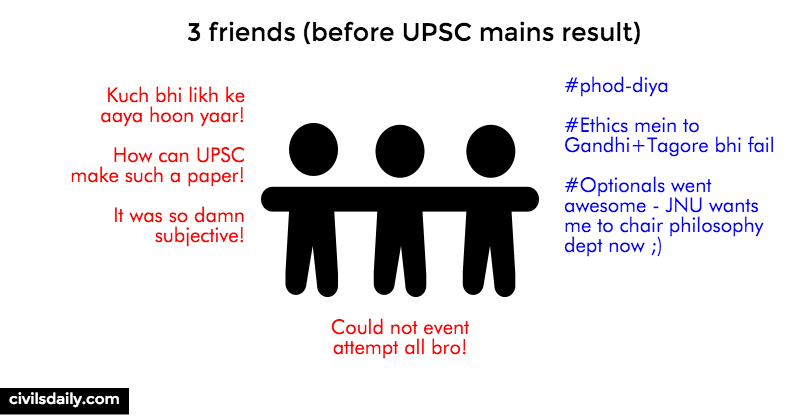
    If you have been sincere with your mains’ attempt, chances are that you would have directly or indirectly been a part of one such group.


    If you happen to identify with the guy on the middle or the left, there are high chances that you already know that you were not playing your “A game” at the mains this year. Your setback is understandable but you will soon be able to analyse your attempts and improve on your scores next year. Unless…. unless of course the scenario is this – 


    You are the guy on the right, who had done most of the things under his/ her control to optimise for high scores – demolished the GS papers comprehensively, quoted philosophers par excellence in the ethics paper and made sure that the optional papers rival the doctoral thesis of the examiner BUT STILL GOT DITCHED BY UPSC.

    And if this were not enough, your two buddies who up until now were not even sure of a respectable exit, qualify for the interview! That’s a classic case of what a famous american slang refers to as –

    SNAFU = Situation normal all fucked up


    If you are at this stage (or have been at it at some point or the other in life), you would agree that no amount of palliatives, niceties, wishes can really help you come out of the zone. You feel betrayed by some weird version of justice which you do not understand.

    You probably would have left a decent job and decided to pursue UPSC (among other choices of MBA, startups) OR made a promise to your parents and those around that you will sit out sincerely for an year for this prestigious exam OR other more equally compelling sacrifices and it’s understandable that you might feel angry for you did not sign up for this.

    Let yourself be. Release your emotions. Don’t put on an artificial smile (but be aware that it is a slippery slope and you need to pull yourself right back up).

    Try and be with people who can empathise with you and not sympathise.


    Preparing for UPSC is like running a marathon. And as with all good runners, with time and patience, you tend to understand yourself better. No other exam in the world expects you to open up your faculties to such gigantic amount of information and force you to process them at a speed which can put a reasonably outdated Intel processor to shame (that is still a lot to compare with you know!)

    By now, you would have developed a fair bit of liking to some subjects, appreciation for some finer aspects of life, possibly a bent of mind for public policy making, well nurtured interest in social sector landscape or a penchant for long distance hiking (or something equally exciting).

    Go to that island in your thoughts now. Remove yourself from the commotion. The shit has hit the fan here and you need to change a room till someone cleans it up!


    You are not alone in this dilemma


    This is the time that you need to be a master of your senses rather than a slave of emotional waves. Answer the big question for yourself. Keep mum but think hard.


    Civilsdaily is not an online coaching portal. We are sure that you are aware of that fact. We are dedicated to the cause of providing news with context and making content approachable to everyone BUT we do believe that many among you have the potential to dent the social fabric of our country in your own unique ways. Go ahead, identify the your angst and your driver and take the plunge.

    If you feel like talking to us, drop a mail at hello@civilsdaily.com

    If you think this long post was worth your time, do share it with your friends who may benefit reading from it.


    Want to read more?

  • [Open] Civilsdaily is looking for a kickass designer

    Hello,

    If you have a friend, relative, college sweetheart senior who can fit the bill, please share this page.

    If you think you are the one, take some time to go through this. We are looking for full time/ part time positions. We are looking for some really crafty, smart and creative people. You do not need to have oodles of work-ex but just be passionate about making great design meet great content!

    The form below will have 3 exercises for you to do – 2 facebook creatives + 1 infograph to make. So brace up for some work coz we are really, really serious about who we pick in our team! You will get to work closely with the core team and needless to say, will be paid handsomely.

    Can’t see the form? Mail us at hello@civilsdaily.com or refresh your browser’s cache.


  • [CLOSED] Civilsdaily is looking for part-time translators

    Thanks for the amazing response. We got over 100 applications and we have shortlisted a few. We will be contacting you guys over phone. The application is closed for now. If you still wish to connect with us, feel free to drop a mail 🙂


    Hello,

    We are looking for part time translators (English to Hindi) to join the content team for its upcoming Hindi version.

    • Role: Candidates are required to translate English news cards into Hindi
    • Experience: No prior experience is required
    • What do we need? Candidates with a good command over both the languages

    You need to do a simple exercise. Translate these two english news cards into hindi. You need to read the text in english and then recreate the same magic in hindi. Do not use google auto translate. Please use google input tools instead – https://www.google.com/inputtools/try/


    You can fill up this application form or provide us with your personal details (along with text translation) over email at hello@civilsdaily.com

    Google application form - Click here

    Translate the following and send over – 

    NITI Aayog: 2nd regional consultation

    1. Context: 2nd Regional Consultations on Agricultural Development in New Delhi
    2. Held by: NITI Task Force on Agricultural Development under the chairmanship of Vice Chair Arvind Panagariya
    3. Demands: southern states pitched for preparation of a model land leasing act and higher remunerative prices for farmers
    4. Other areas: shared best practices in area of agriculture and water resources; river linking and water conservation and harvesting; emphasis on strengthening of agricultural co-operatives

    Pact to develop Vizag as smart city

    1. Context: Pact between US Trade & Development Agency (USTDA) & Andhra Pradesh Government
    2. Aim: To develop infrastructure, communications and data systems
    3. Smart city: Development is in line with its goal to become a Smart City
    4. Award: this cooperation is particularly timely as Vizag recently won 1st phase of Smart Cities Challenge by GoI
    5. Impact: Development and modernization efforts will be partially supported by the central government

    PS: This is a paid position. We are looking to extend our offerings in hindi and we are looking for 2 awesome translators to work with us on that.

  • Story of S R Sankaran: People’s IAS Officer

    R. Sankaran was a senior IAS officer, widely known as ‘an ideal people’s IAS officer’ for the proactive role he played in formulating pro-poor policies. He was a bachelor who devoted his life for the welfare of Scheduled Castes and Scheduled Tribes.


    A personification of simple living, honesty and integrity, unassuming but strong, modest yet firm and affable, the diminutive civil servant was a role model who showed what an IAS officer could do for the marginalised sections of society.

    Simplicity at its peak

    This is a little long story but I bet you’ll be thrilled to read it


    An Indian Airlines flight arrived at the Agartala Airport one late afternoon. It was a full flight. All the passengers scrambled down to pick up their baggage and leave for home. Among them was a short-statured, frail, middle-aged person wearing an ordinary bush shirt and slightly crumpled trousers. The only remarkable feature was his thick crop of well-parted shining black hair. He saw some flamboyant busybodies briskly moving up and down in search of somebody. The gentleman quietly passed by them totally unnoticed. He went to the baggage-claim belt, collected a small suitcase, unobtrusively went out of the building and walked towards the cycle-rickshaw stand. As he was coming out, he noticed some activity around a couple of red-lighted cars and a posse of police constables, smartly uniformed, eagerly waiting for somebody. At the rickshaw-stand he started enquiring in his broken, heavily-accented Hindi about the Circuit House. A rickshaw-puller came forward and agreed to take him after telling him the fare. The rickshaw-puller took the suitcase from him and helped him to get onto the seat.

    A policeman was idly watching the proceedings. He heard the word “Circuit House” a couple of times. He knew that a new Chief Secretary was due to arrive and he was posted at the rickshaw-stand to control the movement of rickshaws till the new Chief Secretary’s convoy passed. He had a suspicion. He ran back to the building and informed his officer-in-charge that perhaps the new Chief Secretary had boarded a rickshaw to go the Circuit House.

    All hell broke loose thereafter. Everyone started running towards the rickshaw-stand and the constable pointed to a smiling gentleman quietly sitting on a rickshaw awaiting the departure of the official cavalcade of red-light cars. The Deputy Secretary, Protocol, very apologetically enquired whether the gentleman was S.R. Sankaran. He politely nodded. Then started furious activity in search of his “missing” luggage. The gentleman calmly told the officials present that he had no “missing” luggage. The small suitcase at the footboard was his only piece of luggage. He was requested to get off the rickshaw and get into the official car waiting at the VIP gate. He quickly pulled out his money bag, took out the money he had agreed to pay to the rickshaw-puller and offered him the money before he got down.

    All the officials protested. He looked at them and said it was a contract between the rickshaw-puller and him. Because of him the rickshaw-puller had missed other passengers. Hence he had to be compensated for the lost fare. He paid him his fare.

    Now the rickshaw-puller returned him half the fare telling him that as he did not take him to the Circuit House he could not accept the contracted fare and that he would get passengers from amongst the persons who had come to see- off the Calcutta-bound passengers.


    Bonded labour

    In his first tenure as Secretary, he took up the issue of bonded labour seriously. Though the abolition of bonded labour and rehabilitation of bonded labourers was part of the first 20-Point programme of Indira Gandhi, and though the Bonded Labour System (Abolition) Act, 1976, (first as ordinance) was in place, some of those in the political leadership were averse to taking it seriously. This was because they were either directly masters of bonded labourers or were beholden to the masters of bonded labourers for political support. This brought him into direct clash with successive Chief Ministers, but he bravely and righteously stood his ground.

    Nationalisation of coal industry

    Before his first tenure in Social Welfare, Sankaran was, in the early 1970s, Special Assistant to Mohan Kumaramangalam, Union Minister for Steel and Mines. The idealist constantly reminded the ideologue about the promise and need to nationalise the coal industry, and it was because of the Kumaramangalam-Sankaran duo that this significant measure went through with the support of Prime Minister Indira Gandhi.

    Dalit issue

    In his second tenure as Principal Secretary, Social Welfare, in addition to revisiting the issue of bonded labour – of pressing urgency for him and the victims, most of whom were Dalits – he took up the issue of atrocities against Dalits, which had assumed a menacing form.

    An important instance of this was his active intervention in the rehabilitation of the victims of the Karamchedu atrocities of 1985 in a new colony named Vijayanagar near Chirala in Andhra Pradesh. This was before the Scheduled Castes and the Scheduled Tribes (Prevention of Atrocities) Act, 1989, was passed.

    These measures again brought him into conflict with the Chief Ministers, which left him without any post for several months until he came to the Centre as Secretary, Ministry of Rural Development, in January 1990.

    Facing the opposition

    Sankaran had to face obstacles and hostility continuously from some powerful persons in politics and the administration though all the work undertaken by him was not only in accordance with the Constitution but mandated by the Constitution upon the state. The oft-mentioned “civil society”, with a few exceptions, was largely indifferent and in some instances hostile to his valuable endeavours.

    Spent his pension on education of dalit students

    After retirement in 1992, he shifted to a modest apartment in busy Punjagutta area and continued to fight for the rights of the poor, sharing his pension with SC/ ST students.

    Lifetime mission

    It became his lifetime mission to demystify the left-wing ideology and try and bring about a meeting point. His initiative, Committee of the Concerned Citizens strove hard through mediatory efforts to find sustainable solution to social turmoil.

    Book on Sankaran

    A book titled ‘Marginalisation, Development and Resistance: Essays in Tribute to SR Sankaran’ Volume-1 was released by CH Hanumantha Rao, former member, Planning and Finance Commission.

    He passed away on 7th October 2010.


    Published with inputs from Swapnil | Image - Frontline
  • The Miracle Man- Armstrong Pame

    armstrong


    The Miracle Man

    He is a harbinger of change and has brought joy to the people of Tousem, a Manipur subdivision considered one of India’s most backward, by giving them what they needed most — a motorable road that connects them to the outside world.

    Wouldn’t you want to know about him!

    Armstrong Pame is a 2009 batch IAS officer.

    Armstrong Pame belongs to Tamenglong district of Manipur.

    He is the first IAS officer from Zeme Tribe of the Naga Peoples.

    He graduated from St.Stephens College, DU.

    The People’s Road

    He is acclaimed for building a 100 km road famously known as the “Peoples’ Road“.

    The road connects Tousem with the rest of Manipur, as also with Assam and Nagaland.

    Now let’s see the inspiring, exciting, sometimes depressing but fascinating story of People’s Road


    road


    Why take so much trouble?

    Pame recounted the incident that led him to launch the 100-km road: “In 2012, I became SDM of Tousem. I travelled to many villages and saw how people were carrying sacks of rice on their backs, walking for hours, and patients being taken on makeshift bamboo stretchers due to the non-availability of motorable roads. When I asked villagers what they wanted me to do for them, their only wish was for a road.”

    He was moved by the plight of people when he saw how they had to trudge for five hours by first crossing a river and then a stretch that can by no stretch of imagination be called a road to reach Tamenglong just 50 km away.

    Hear it in the voice of ‘The Miracle Man’ himself!

    https://www.youtube.com/watch?v=Mvee9TA4LKk


    The fund raising
 no government help


    In August 2012, he raised INR40 Lakh for this purpose through Facebook page.

    Mr. Pame said he asked the government for funds to build the road but his proposal was turned down due to paucity of resources. But he was really moved by the plight of people; so he decided to raise the funds on his own in August 2012 through Facebook.

    Charity must begin from home; so he put in Rs. 5 lakh and his brother, who teaches in the Delhi University, donated Rs.1 lakh. Even his mother paid his dad’s one month’s pension of Rs. 5,000.

    He recalls, “One night I got a call from a person in the U.S. who wanted to donate $2,500 for the road. The next day a Sikh gentleman living in New York said he would give $3,000. And after the media reported about this effort, we never looked back”.

    In a short span of time, Rs. 40 lakh was raised for the road.

    The Recognition

    For his efforts in building road with donation and volunteers he was invited to Facebook headquarters in California.

    In 2012, he was nominated for CNN-IBN Indian of the Year in Public service category.

    But was 40 lakhs enough?

    Since Rs. 40 lakh was not a huge amount for building a road, he convinced local contractors to give earth movers and road-rollers for free.

    Enthused by the way Mr. Pame was able to put together the resources, the residents of Tousem volunteered to build the road — thus saving labour costs.

    The people’s support

    In an interview he said: For me the most touching part was the day when I came to see the work, about 250 people including more than 100 women folk came with spades and tools to work in the road. I asked them “What are they doing?” They replied “It is our road we are doing it with you Sir.” I was speechless.

    It’s a miracle


    He says, “Sometimes I still cannot believe that we have done it. It’s a miracle. I don’t know whether I can do it again.”

    “I was called crazy, but I was determined.”

    His message to the youth

    In his own words- To everyone, I would like to just give words of encouragement to give your best in whatever you do. You should live life to the fullest. When life is lived beyond me, I, and myself; life is just not about surviving but should be a living one.  Let’s live life to the fullest.

    Published with inputs from Swapnil | Image - Quora
  • Video | How to best use Civilsdaily for your IAS Prep

    Hello,

    Since the beginning of time or so, everyone wanted a sitemap to civilsdaily, right? We finally let go our procrastination spiral and did a video to make you comfortable with the web offering.

    Please bear with minor digressions. Enjoy!

    https://www.youtube.com/watch?v=sGu0Glgpcsw


    Did we miss out on something? Drop in with your comments  below.

  • Video Explainer | How to best use Civilsdaily for your IAS preparation

    Hello hello,

    Since the beginning of time or so, everyone wanted a sitemap to civilsdaily, right? We finally let go our procrastination spiral and did a video to make you comfortable with the web offerings.

    Please bear with minor digressions. Enjoy!

    https://www.youtube.com/watch?v=sGu0Glgpcsw&feature=youtu.be

    If you have any further queries, do drop in.