💥Join UPSC 2027,2028 Mentorship (July Batch) + XFactor Notes & Microthemes PDF

Author: CD Staff

  • AI ACTION SUMMIT: How Can Governments Keep Up with AI Advancements

    NOTE4STUDENTS:

    The article explains AI’s impact, ethics, sustainability, and global governance efforts. UPSC often frames AI-related questions in a multidisciplinary way. In GS-3, it links AI with healthcare, economy, or sustainability. In GS-4, it focuses on ethical concerns like fairness, privacy, and decision-making. Recent trends show a shift towards AI governance and its role in public policy. Many students focus only on AI’s definition and applications but miss its real-world challenges. This article provides a global perspective on AI governance, linking international AI summits with India’s policy approach. This gives aspirants a ready framework to answer questions on AI’s ethical, economic, and governance aspects.

    PYQ ANCHORING 

    GS 3: Introduce the concept of Artificial Intelligence (AI). How does AI help clinical diagnosis? Do you perceive any threat to the privacy of the individual in the use of AI in the healthcare? [2023]

    GS 4: The application of Artificial Intelligence as a dependable source of input for administrative rational decision-making is a debatable issue. Critically examine the statement from the ethical point of view. [2024]

    MICROTHEMES: ARTIFICIAL INTELLIGENCE, APPLIED ETHICS

    France and India co-chaired the Artificial Intelligence Action Summit on 10-11 February 2025, bringing together global leaders to advance AI for public good.  The summit built on key milestones from the Bletchley Park (November 2023) and Seoul (May 2024) summits.  France welcomed India as the host of the next AI Summit.

    Key Outcomes of the AI Action Summit (February 2025)

    OutcomeDetails
    Joint Statement on “Inclusive and Sustainable AI for People and the Planet”Signed by 58 countries, including India, China, Brazil, France, Australia, and the European Commission. The U.S. and U.K. abstained.
    Public Interest AI Platform and IncubatorAimed at bridging gaps between public and private AI initiatives and addressing digital divides.
    Founding MembersIndia, Kenya, Germany, Chile, Finland, Slovenia, France, Nigeria, Morocco.
    ObjectiveTo create a trustworthy AI ecosystem by supporting technical projects in data, transparency, model development, talent, financing, and collaboration.
    Observatory on Energy, AI, and Data CentresLed by the International Energy Agency (IEA), this will track AI’s energy consumption and sustainability applications. Report to be released in 2025.
    Coalition for Environmentally Sustainable AIFocuses on integrating AI sustainability into global discussions, similar to AI security and ethics. Initiated by France, UNEP, and ITU.
    Green Digital Action InitiativeA new green computing initiative by ITU, featuring a Sustainable AI working group.
    Current AIA $400 million fund launched by MacArthur Foundation with governments, tech firms, and philanthropists. Aims to raise $2.5 billion for transparent, fair, and ethical AI.
    AI for LabourEstablishes Observatories to track AI’s impact on workplaces, training, education, and productivity.
    Global Dialogue on AI GovernanceA commitment to align AI governance efforts globally, preventing redundancy and ensuring collaboration through an Independent International Scientific Panel on AI.

    Inclusive and Sustainable AI for People and the Planet – Key Highlights

    AspectDetails
    Third Global AI StatementFollows the Bletchley Declaration (UK, 2023) and Seoul Declaration (South Korea, 2024), both of which focused on AI risks and opportunities.
    Bletchley DeclarationSigned by 28 countries + EU, established a shared understanding of AI risks and safety.
    Seoul DeclarationSigned by 10 countries + EU, reinforced the need for responsible AI development.
    Key Priorities
    Accessible AIAI should be widely accessible, ensuring trust and safety in its deployment.
    Fostering InnovationEncourages a competitive AI ecosystem that avoids market monopolization and supports industrial growth.
    Labour SafetyAI should positively impact jobs and labour markets, shaping the future of work responsibly.
    Human Rights-Based AIAI must be ethical, human-centric, safe, and trustworthy, respecting human rights.
    Reducing InequalityCalls for AI capacity-building in developing countries to bridge the global AI divide.
    Sustainable AIAI systems—from data centres to training models—must run on sustainable energy.
    Energy Consumption ConcernIn 2022, data centres consumed 1.65 billion gigajoules of electricity (about 2% of global demand, as per IEA).

    Concerns Regarding The AI Economy

    IssueDetails
    AI’s Massive Energy DemandAI is an energy-intensive sector. A single ChatGPT query consumes 2.9 watt-hours of electricity—10 times more than a Google search (0.3 watt-hours).
    Rising Carbon FootprintData center power demand is projected to increase by 160% by 2030, leading to a social cost of $125-140 billion in carbon emissions.
    AI’s Impact on JobsAI could disrupt entry-level jobs, raising concerns about economic displacement and widening social inequalities.
    Job Loss RiskThe International Labour Organisation (ILO) estimates that 75 million jobs worldwide are at high risk of being automated due to AI.
    Automation InequalityAI benefits could be concentrated in a few developed nations, leaving labour-rich developing countries behind, worsening inequality.
    Bias in AI ModelsAI systems can inherit societal biases from training data, leading to discriminatory decisions in hiring, policing, and lending.
    Diverging AI Governance ApproachesEurope: Focuses on regulation and investment.
    China: Expands AI access through state-backed tech giants.
    U.S.: Favors a deregulated, hands-off approach.

    Way Forward

    1. Energy-Efficient AI: AI systems should be designed to use less energy. This includes optimizing algorithms and integrating AI into smart power grids to improve electricity usage.
    2. AI-Friendly Job Market: Strong institutions should help workers shift to better-skilled jobs where AI supports their work rather than replacing them.
    3. AI Education & Training: AI should be part of school and college curriculums, and workers should have access to upskilling programs to stay relevant in an AI-driven world.
    4. Fair & Inclusive AI Models: AI systems should be open-source, inclusive, and free from biases, including language barriers, so that everyone benefits from them.
    5. Democratizing AI Infrastructure: The control of AI hardware, like Nvidia’s advanced AI chips, should not be limited to a few countries. A fairer distribution of AI resources is necessary for all economies to benefit.

    #BACK2BASICS: SUSTAINABLE AI

    Sustainable Artificial Intelligence (AI) refers to the development and deployment of AI systems that are environmentally friendly, ethically sound, and socially responsible. It encompasses practices that ensure AI technologies contribute positively to society while minimizing negative impacts.

    Five Key Components of Sustainable AI:

    1. Energy Efficiency: Designing AI models and data centers to consume less energy, thereby reducing their carbon footprint. This involves optimizing algorithms and utilizing energy-efficient hardware. For instance, AI can be leveraged to monitor and predict climate and weather-change trends, aiding in environmental conservation efforts. 
    2. Ethical Frameworks: Establishing guidelines that ensure AI systems operate transparently, fairly, and without bias. This includes implementing measures to prevent discriminatory outcomes and protect user privacy. Practicing sustainable AI involves integrating environmental, economic, and social considerations throughout the AI lifecycle. 
    3. AI Governance: Developing policies and regulations that oversee AI development and deployment, ensuring accountability and alignment with societal values. This encompasses creating standards for AI applications and monitoring their adherence. India has launched several initiatives, including the India AI mission, to foster the development and adoption of AI, reflecting a commitment to balanced and ethical AI advancement. 
    4. Social Responsibility: Ensuring AI technologies are accessible and beneficial to all societal segments, addressing issues like job displacement through reskilling programs and promoting inclusivity. The AI for India 2030 initiative aims to integrate AI across the nation’s socio-economic fabric, promoting inclusive growth and equitable access to AI benefits. 
    5. Sustainable AI Corporate Responsibility: Encouraging organizations to adopt sustainable practices in AI development, such as reducing electronic waste and ensuring the ethical sourcing of materials. This also involves companies being transparent about their AI systems’ environmental and social impacts. Achieving sustainable AI involves enhancing energy efficiency, reducing carbon footprints, and promoting ethical practices. 

    India’s Preparedness for Sustainable AI:

    India has demonstrated a proactive approach toward embracing sustainable AI through various initiatives:

    • Policy Initiatives: The Indian government has introduced the AI for India 2030 initiative, aiming to integrate AI into various sectors for inclusive growth. This strategy emphasizes democratizing AI access, ensuring that its benefits reach all societal levels. 
    • Ethical Considerations: Recognizing the importance of responsible AI, India has been involved in global discussions to promote ethical AI development. Collaborations with international organizations like UNESCO reflect India’s commitment to adopting balanced AI approaches that align with societal values. 
    • Corporate Engagement: Indian businesses are increasingly investing in AI-driven sustainability initiatives. A significant percentage of Indian business leaders plan to enhance IT investments to achieve sustainability goals, leveraging AI as a powerful tool in this endeavor. 

    While these steps indicate substantial progress, continuous efforts are necessary to address challenges such as energy consumption, ethical governance, and equitable AI access. Ongoing collaboration between the government, industry stakeholders, and international partners will be crucial in advancing sustainable AI in India.

  • Crowd Control in India Are We Doing Enough to Prevent Stampedes

    NOTE4STUDENTS:

    Stampedes are chaotic, dangerous, and often preventable. This article explores their causes, impacts, and preventive strategies, helping aspirants analyze UPSC questions on disaster management. UPSC often asks questions that test analytical thinking. Instead of asking for definitions, it frames scenarios. The 2013 question on vulnerability and risk assessment in disaster management is a perfect example. It expects aspirants to assess risks, suggest measures, and think like administrators. The focus is not just on theoretical knowledge but on practical application. UPSC wants problem-solvers. Simply stating issues is not enough; one must propose solutions. Case studies, like the Hathras Stampede (2024) or Maha Kumbh Mela (2013), add weight to answers. Many of you miss using them effectively.

    PYQ ANCHORING

    GS 3: How important are vulnerability and risk assessment for pre-disaster manage ment. As an administrator ,what are key areas that you would focus in a disaster management. [2013]

    Microthemes: Vulnerability and Risk Assessment

    A tragic stampede at New Delhi Railway Station led to the death of 18 people. The incident occurred due to a sudden surge in the crowd as passengers rushed to board trains to Prayagraj.

    Stampede

    A stampede is a sudden, uncontrolled movement of a large crowd, often triggered by fear, panic, or space constraints. It can lead to serious injuries or deaths.

    Stampedes in India

    • According to the National Crime Records Bureau (NCRB), nearly 2,000 people died in stampedes between 2000 and 2013.
    • A 2013 study published in the International Journal of Disaster Risk Reduction (IJDRR) found that 79% of stampedes in India occur at religious gatherings and pilgrimages.

    Types of Stampedes

    1. Unidirectional Stampede – Happens when a moving crowd encounters an obstacle or sudden force change.
      • Positive force – Sudden stops like a bottleneck or blocked exit.
      • Negative force – A broken barrier or collapse, causing people to fall.
    2. Turbulent Stampede – Occurs when people from different directions collide, often due to panic.

    Factors leading to Stampede

    FactorExplanationExample
    Human Psychology & PanicIn large crowds, panic spreads quickly, making people act irrationally. When cooperation breaks down, everyone prioritizes their own safety, worsening the chaos.Hathras Stampede (2024) – Devotees rushed to touch a preacher’s feet, leading to uncontrolled movement and 121 deaths.
    Structural Deficiencies & Poor InfrastructureNarrow pathways, weak barriers, and poorly designed exits create bottlenecks, restricting movement and increasing risk.Ratangarh Temple Stampede (2013) – A railing collapse on a bridge led to mass panic, causing 121 deaths and injuring over 100 people.
    High Crowd DensityWhen more than 4 people occupy one square meter, movement becomes difficult, making a stampede more likely.Vaishno Devi Temple (2022) – A sudden surge of pilgrims entering the shrine caused 12 deaths due to suffocation and crushing.
    Poor Crowd Management & Lack of CoordinationUnclear roles among security, organizers, and authorities lead to mismanagement, especially in emergencies.Maha Kumbh Mela Stampede (2025) – Authorities failed to anticipate crowd size, leading to a rush at Sangam Ghat, Prayagraj, causing 30 deaths and 60 injuries. NDMA highlights poor planning as a major cause of crowd disasters in India.
    Rumors and MisinformationFalse alarms like bomb threats or collapsing structures trigger sudden panic and chaos.Chamunda Devi Temple (2008) – A false bomb rumor led to mass panic, resulting in 220+ deaths as people trampled over each other.
    Inadequate Emergency Exits & Escape RoutesPoorly planned exits trap people, causing crushing and suffocation in confined spaces.Uphaar Cinema Fire (1997, Delhi) – Locked emergency exits prevented escape, leading to 59 deaths from smoke inhalation.
    Sudden Surges Due to Religious or Cultural FervorLarge religious gatherings can lead to unpredictable crowd movements, making them hard to control.Sabarimala Temple (2011) – A surge in pilgrims moving down a narrow path led to 100+ deaths due to lack of crowd regulation.

    Causes of Stampede Casualties

    CauseExplanationExample
    Traumatic Asphyxia (Crushing & Suffocation)When people are tightly packed, extreme pressure on the chest prevents breathing, leading to suffocation.NDMA Report (2014) – Compressive asphyxia (external pressure on the chest and abdomen) is the most common cause of death in stampedes.
    Myocardial Infarction (Heart Attacks Due to Stress & Panic)The extreme stress and exertion during a stampede can trigger heart attacks, especially in older individuals.Chun-Hao Shao Study (2018) – Found that people trapped in stampedes often suffer cardiac arrests due to oxygen deprivation and panic.
    Head and Neck Injuries (Falling & Being Trampled)When people lose balance, they get trampled, leading to fatal head, spinal, and internal injuries.Chamunda Devi Temple (2008) – A chaotic rush led to 250 deaths, with most victims suffering head and neck trauma from being trampled.
    Lacerations and Fractures (Blunt Force Trauma)The force exerted by moving crowds can break bones, cause severe bruising, or crush limbs against barriers.Ratangarh Temple Stampede (2013) – A bridge railing collapse led to a pile-up, resulting in fractures and crushed limbs in 100+ victims.
    Hypoxia (Oxygen Deprivation in Confined Spaces)Overcrowding in enclosed areas like tunnels, stadiums, or temples can lead to a lack of oxygen, increasing the risk of suffocation.Uphaar Cinema Fire (1997, Delhi)59 people suffocated to death due to blocked emergency exits, leading to oxygen deprivation.
    Electrocution & Fire HazardsPoor electrical wiring and flammable materials can ignite fires, worsening stampede situations.Dabwali Fire Tragedy (1995, Haryana) – A school function tent caught fire, trapping people inside and causing 446 deaths.
    Drowning in Water-Related StampedesIn waterlogged areas, people falling in large numbers risk drowning or injury from crushing waves of people.Maha Kumbh Mela (2013, Allahabad) – A surge at the Sangam Ghat led to 36 deaths due to drowning and crushing.

    Impacts of Stampedes

    1. Loss of Lives & Injuries – Stampedes often cause mass deaths due to suffocation, crushing, and panic-driven injuries.
      • Example: 2015 Hajj Stampede (Mina, Saudi Arabia) – Over 2,400 people lost their lives.
    2. Psychological Trauma in Survivors – Many survivors develop PTSD, anxiety, and a fear of crowded places.
      • Studies show long-term distress, including claustrophobia and fear of public spaces.
    3. Damage to Infrastructure – Uncontrolled crowds can destroy barriers, bridges, and temporary structures.
      • Crowd pressure in stampedes can be strong enough to bend steel and collapse walls.
    4. Financial Losses & Compensation Costs – Governments and organizers face huge financial burdens due to compensation payouts and security upgrades.
      • Example: Maha Kumbh Mela (2013) – ₹18 crore paid in compensation after 36 deaths.
    5. Strain on Hospitals & Emergency Services – A sudden rush of casualties overwhelms healthcare facilities and emergency responders.
      • Example: Chamunda Devi Temple Stampede (2008) – Over 250 casualties overloaded hospitals in Jodhpur.
    6. Erosion of Public Trust in Authorities – Poor crowd management leads to public outrage and political backlash.
      • Example: Hathras Stampede (2024) – Officials faced criticism and demands for resignations.
    7. Impact on Religious & Social Gatherings – Fear of stampedes reduces participation in festivals and religious events.
      • 70% of stampede deaths in India happen at religious gatherings (NDMA, 2014).

    Way Forward

    1. Risk Assessment & Planning – Identify hazards, assess risks, and implement safety measures to prevent disasters.
    2. Better Space Design – Ensure wide entry/exit points, clear pathways, and designated emergency routes to avoid congestion.
    3. Real-Time Crowd Monitoring – Use CCTV, AI-based analysis, and live surveillance to detect overcrowding and take quick action.
    4. Strong Coordination Between Authorities – Improve communication between police, local administration, event organizers, and medical teams for quick response.
    5. Regulating Crowd Size – Control entry through pre-registration, limit numbers, and deploy trained marshals to prevent overcrowding.
    6. Emergency Preparedness – Ensure ambulances, trauma care units, and trained responders are on standby, with regular mock drills for crisis management.
    7. Public Awareness & Training – Educate attendees on safe crowd behavior, evacuation procedures, and self-protection using announcements, signs, and campaigns.

    #BACK2BASICS: CROWD MANAGEMENT IN INDIA

    Crowd management is the systematic process of planning, organizing, and monitoring large gatherings to ensure the safety and smooth flow of attendees.It involves anticipating risks and planning for worst-case scenarios to mitigate potential dangers before they occur.

    Legal and Constitutional Provisions Related to Crowd Management in India

    • Constitutional Provisions
      • Article 21 (Right to Life & Personal Liberty): Ensures protection of life, making it the duty of the state to safeguard people at mass gatherings.
      • Article 19(1)(b) (Right to Assemble Peacefully): Grants citizens the right to peaceful assembly, subject to reasonable restrictions for public safety and order.
      • Article 47 (Duty of the State to Improve Public Health): Mandates the state to ensure safe public spaces and emergency preparedness.
    • Disaster Management Act, 2005
      • Empowers NDMA, SDMAs, and DDMAs to formulate policies and strategies for managing disasters, including crowd-related incidents.
      • Sections 24 and 34 provide powers to control and restrict vehicular and human traffic to/from vulnerable and affected areas.  
      • Section 33 allows district authority to require any officer or any department at district or local level, if necessary, for disaster management tasks.
    • Police Act, 1861: Provides police with the power to control crowds, maintain public order, and regulate large gatherings.
    • The Epidemic Diseases Act, 1897: Used to restrict public gatherings during health emergencies, such as COVID-19 pandemic regulations.
    • Motor Vehicles Act, 1988: Regulates traffic movement, road safety, and crowd control near transport hubs to prevent congestion-related disasters.
    • Cinematograph Act, 1952 & Delhi Cinematograph Rules, 1953: Mandates fire safety measures, crowd control regulations, and emergency exits at cinema halls and event venues.

    NDMA Guidelines for Effective Crowd Management and Preventing Stampedes

    • Capacity Planning: Monitor visitor flow, provide essential facilities, and establish multiple routes to prevent congestion.
    • Crowd Control: Regulate inflow, movement, and outflow using barriers, queue management, and one-way systems.
    • Hazard, Risk, and Vulnerability Analysis (HRVA): Identify high-risk zones, assess threats, and develop pre-event mitigation plans.
    • Failure Mode and Effect Analysis (FMEA): Rate hazards by severity, frequency, and detection difficulty to prioritize risk reduction.
    • Develop a Course of Action: Formulate an action plan, allocate resources, and ensure coordination among all stakeholders.
  • India’s Fight Against Tuberculosis (TB) 

    Note4Students:

    The MoHFW has released the India TB Report 2024. You should know the basics of TB. From the Mains perspective, 3 key points in this article are the issue of drug resistance (we have had PYQs in 2014), the challenges in eliminating TB (PYQs on Covid challenges in 2020), and our target to eradicate it by 2025 (this makes it an important theme for UPSC). 

    The treatment course for TB mentioned in Back2Basics will help you prepare for any difficult questions that may come out of the woods! 

    UPSC Microthemes & Mains PYQ:

    Q1.) GS3 Can overuse and free availability of antibiotics without Doctor’s prescription, be contributors to the emergence of drug-resistant diseases in India? What are the available mechanisms for monitoring and control? Critically discuss the various issues involved. (2014)

    Q2.) GS3: COVID-19 pandemic has caused unprecedented devastation worldwide. However, technological advancements are being availed readily to win over the crisis. Give an account of how technology was sought to aid management to the pandemic. (2020)

    Microthemes:  Medical and Health Technologies; Achievements of Indians in S&T

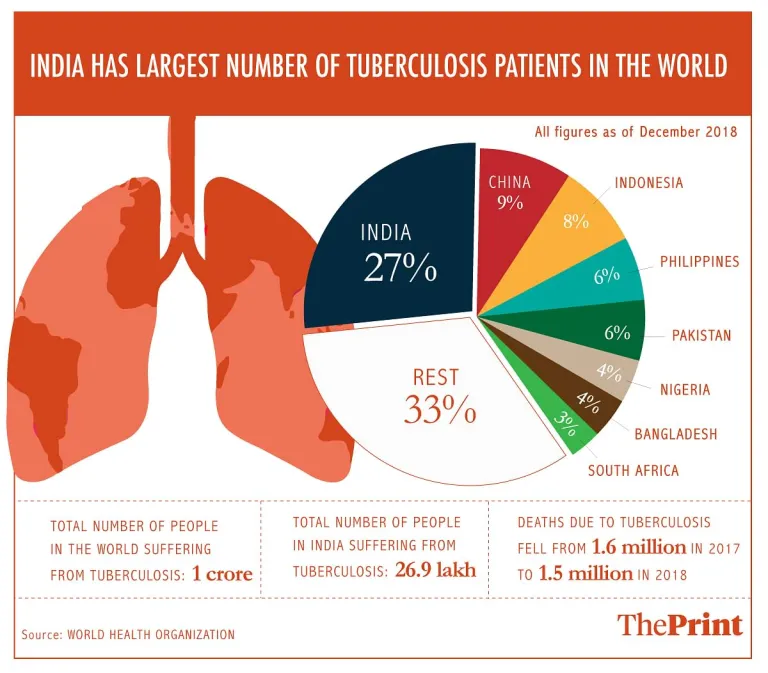
    Tuberculosis (TB) remains a major health issue for India, which accounts for 26% of the world’s TB cases. The 2024 India TB Report by the Ministry of Health and Family Welfare highlights significant achievements, challenges, and areas of concern as the country strives toward its ambitious target of TB elimination by 2025. Here’s a concise look at the findings, challenges, and government initiatives to tackle TB.

    Key Highlights: India TB Report 2024

    YearTotal TB Cases (lakh)Mortality Rate (per lakh)Private Sector TB Cases (lakh)
    201519.1281.9
    202325.5238.4
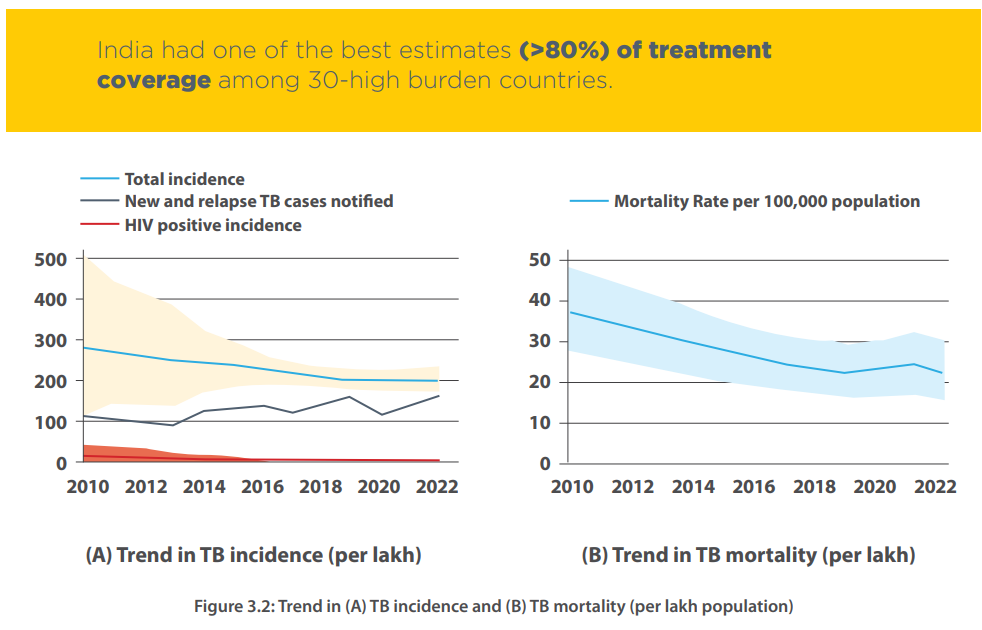
    1. Decline in Mortality Rate: TB mortality dropped from 28 per lakh in 2015 to 23 in 2022.
    2. Increase in Private Sector Involvement: Private sector notifications rose from 1.9 lakh in 2015 to 8.4 lakh in 2023, showing improved engagement in TB detection.
    3. Case and Mortality Trends: While estimated TB incidence slightly increased to 27.8 lakh in 2023, TB mortality held steady at 3.2 lakh.

    Challenges to Eliminate TB by 2025

    ChallengeExplanation
    High burden of TB casesIndia accounts for 28% of all global TB cases (Global TB Report 2022). This makes it difficult to identify and treat cases on time.
    Drug-resistant TBDrug-resistant TB is widespread in India, making treatment more expensive and complicated. This is due to improper antibiotic use and poor adherence to treatment.
    Limited access to healthcareMany people, especially in rural areas, lack access to quality healthcare, leading to delayed diagnosis, treatment, and increased TB spread.
    Stigma and discriminationThe stigma surrounding TB prevents people from seeking treatment or disclosing their illness due to fear of discrimination or isolation.
    Poor living conditionsOvercrowded homes, poor sanitation, and lack of clean water increase the risk of TB transmission.
    Limited awarenessMany people don’t know the symptoms of TB or the importance of completing treatment, leading to delays and further spread.
    Insufficient fundingDespite the severity of TB in India, it receives inadequate funding and attention from policymakers and healthcare providers.

    Government Initiatives Against TB

    InitiativeDescription
    Pradhan Mantri TB Mukt Bharat AbhiyanCommunity-based program offering nutritional support through Ni-kshay Mitras
    National Strategic Plan (NSP)Aims to eliminate TB by 2025, targeting no more than 44 new TB cases per lakh
    Digital Tracking (Nikshay Portal)Digital platform for monitoring patient progress and ensuring treatment adherence
    Free Treatment and Drug AccessFree supply of essential drugs like Bedaquiline and Delamanid
    Expanded Testing AccessIncreased use of molecular diagnostics (CB-NAAT, TureNat) across districts

    Innovative Approaches Adopted by States:

    • Chhattisgarh: By involving Village Health Committees in TPT efforts, Chhattisgarh improved grassroots-level awareness, screening, and treatment adherence for TB prevention, leveraging local networks effectively.
    • Tamil Nadu: Tamil Nadu adopted local procurement of the 3HP TPT regimen, ensuring a shorter, accessible TB prevention therapy, which enhanced patient compliance and streamlined medication availability.
    • Maharashtra and Rajasthan: These states introduced TPT in high-risk groups like prison inmates, integrating preventive therapy into Active Case-Finding (ACF) efforts, reducing TB prevalence in vulnerable populations.

    WHO Recommendations for TB Control

    1. Molecular Diagnostics: Faster, more accurate diagnostics similar to COVID-19 testing.
    2. MDR-TB Management: Better prescription practices, drug quality, and treatment completion.
    3. Patient-Centered Care: Improved support for managing treatment side effects, enhancing treatment completion.

    Moving Forward: Key Recommendations

    • Strengthen Multi-Sectoral Collaboration: Engage healthcare, social services, and education to address TB’s root causes.
    • Enhance Rural Access: Boost local healthcare infrastructure, deploy mobile health units, and train community health workers.
    • Stigma Reduction and Awareness: Implement public campaigns to reduce stigma and educate on TB prevention, symptoms, and treatment.

    India’s path to TB elimination by 2025 requires a holistic, coordinated approach, addressing healthcare gaps and social determinants to ensure accessible and effective TB care. By fostering cross-sector collaboration, enhancing diagnostics, and addressing the social factors influencing TB, India can accelerate its progress toward a TB-free nation.

    #BACK2BASICS

    Understanding Tuberculosis

    ParameterDetails
    CauseBacterial infection caused by Mycobacterium tuberculosis
    TransmissionAirborne, particularly in dense, poorly ventilated areas
    Common SymptomsCough, chest pain, weakness, weight loss, fever, night sweats
    Global ImpactTB infects 10 million and causes 1.5 million deaths annually, affecting HIV patients
    TreatmentStandard 6-month, four-drug course with supervised support

    Drug-Resistant TB:

    • MDR-TB: Resistant to isoniazid and rifampicin, requiring second-line drugs like bedaquiline.
    • XDR-TB: Highly resistant, responding poorly to standard and even second-line treatments.

    TREATMENT FOR TB

    Standard 6-Month Treatment Course

    PhaseDetails
    Intensive Phase (2 months)For new TB cases, the intensive phase includes four drugs: Isoniazid (INH), Rifampicin, Pyrazinamide, and Ethambutol.
    Continuous Phase (4 months)After completing the intensive phase, the continuous phase follows for 4 months.
    For Previously Treated CasesThe intensive phase lasts 12 weeks, with an injection of streptomycin given for 8 weeks along with four drugs.
    Regimen DurationA strictly followed 6-month drug regimen cures most people with TB.

    BPaLM Regimen

    FeatureDetails
    Drugs UsedBedaquiline, Pretomanid, Linezolid, and Moxifloxacin.
    Advantages– Faster, safer, and more effective compared to traditional treatments.
    – Cures MDR-TB in 6 months (compared to 20 months with traditional treatment).
    – Higher success rate for drug-resistant TB treatment.
    – Fewer and milder side effects.
    – Shorter treatment duration and reduced side effects lead to lower overall costs.

    Multidrug-Resistant TB (MDR-TB)

    FeatureDetails
    DiagnosisCBNAAT (Cartridge Based Nucleic Acid Amplification Test) is used for early diagnosis.
    ResistanceMDR-TB is resistant to at least Isoniazid and Rifampicin, the two most powerful anti-TB drugs.
    Treatment ChallengesTreatment options for MDR-TB are limited and expensive.

    Causes of MDR-TB

    CauseDetails
    Mismanagement of TreatmentInappropriate or incorrect drug use, ineffective drug formulations, or premature treatment interruption.
    TransmissionPerson-to-person transmission of the disease.

    Extensively Drug-Resistant TB (XDR-TB)

    FeatureDetails
    Resistance ProfileXDR-TB is a form of MDR-TB with additional resistance to fluoroquinolones and at least one second-line injectable drug (amikacin, kanamycin, capreomycin).

    Treatment for Drug-Resistant TB

    Treatment TypeDetails
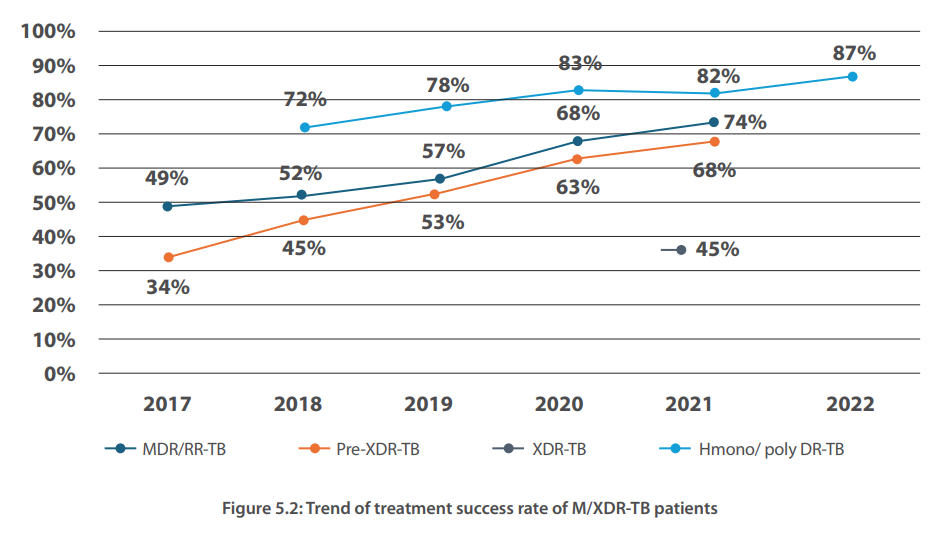
    MDR-TB Treatment SuccessTreatment success for MDR-TB is about 54%.
    XDR-TB Treatment SuccessTreatment success for XDR-TB is about 30%.
    Treatment DurationXDR-TB requires a combination of eight drugs for over a year.
    Success FactorsTreatment success depends on the extent of resistance, disease severity, immune system strength, and adherence to treatment.
    Side EffectsDrugs used for treating MDR-TB and XDR-TB can cause serious adverse effects, including deafness.
  • No Benefits, No Security: The Various Sides of the Gig Hustle

    WHY THIS ?

    The Fairwork India Ratings 2024 highlights that platform companies in India are failing to meet basic fair labor standards for gig workers, particularly regarding living wages and collective bargaining rights. For UPSC, the gig economy intersects with topics in Indian society, governance, economic growth, and labor rights. Moving beyond the challenges and strengths of the Gig economy, you should be able to discuss how gig work challenges traditional labor policies and whether current welfare schemes adequately address gig worker needs. We’ve further included structured notes on labor practices and ethics for you to build impactful answers, giving you a balanced view of worker rights and platform accountability in India’s evolving digital economy.

    GS1 – Indian Society and Globalization: Effects of Globalization on Indian Society, Urbanization and their problems

    Note4Students: Understand how the gig economy, as part of globalization, affects Indian society, particularly urban areas. Analyze the socio-economic challenges faced by gig workers, including job insecurity, unstable earnings, and lack of social protections.

    Microthemes: Emerging Urban issues, Globalisation

    GS2 – Welfare Schemes, Social Justice, and Governance: Government Policies and Interventions for Development in Various Sectors, Role of Civil Services in a Democracy

    Note4Students: Link the growth of the gig economy to governance and social justice issues. Study how welfare schemes and labor rights policies are evolving to address the needs of gig workers, and analyze the role of state interventions in improving working conditions.

    Microthemes:  Government schemes and policies,  structural reforms and actions

    GS3 – Economic Development, Inclusive Growth, and Labor: Employment, Inclusive Growth, Issues relating to Poverty and Hunger.

    Note4Students: Gain insights into the economic challenges faced by gig workers in terms of fair wages, job security, and working conditions. Explore how the gig economy fits into broader issues of inclusive growth, labor welfare, and sustainable economic development.

    Microthemes: Industrial reforms, labour reforms, Inclusive growth

    GS4 – Ethics, Integrity, and Aptitude: Corporate Governance, Work Culture, 

    Note4Students: Study the ethical issues related to labor practices in the gig economy, focusing on fairness, social responsibility, and the ethical obligations of platform companies. Reflect on the moral dimensions of worker rights, fair wages, and corporate responsibility.

    Microthemes: Corporate Governance, Work Culture

    The ‘Fairwork India Ratings 2024’ highlights that platform aggregators in India fail to ensure local living wages and resist recognizing the collective rights of workers.

    Who are the Gig Workers?

    • Gig workers are individuals who take up short-term, flexible work assignments, typically managed via digital platforms. In the Indian context, gig workers operate in various sectors such as food delivery, ride-hailing, logistics, and personal/domestic care services. 
    • These workers are not considered employees in the traditional sense and often lack the benefits associated with full-time employment, such as job security, healthcare, and social protection.
    • Examples of platforms using gig workers include Swiggy, Zomato (food delivery) Uber, Ola (transportation), etc.

    Present Status of Gig Economy  in India

    PrincipleObservationExamples
    GrowthIndia is witnessing rapid growth in the gig economy, with millions of workers depending on digital platforms for their livelihoods.Uber, Zomato, and Urban Company has driven the expansion of gig work across urban areas.
    Government FocusRecent years have seen increasing political and legislative attention to gig worker welfare.Karnataka and Jharkhand have proposed new legislation
    Fair labour standardsNo digital labor platform scored above 6 out of 10, and none met all criteria across the five principles of fair labor standards.Fairwork India Ratings 2024 highlighted gaps in adhering to these standards for all major platforms.
    Fair PayOnly a few platforms, such as BigBasket and Urban Company, ensured a minimum wage. However, no platform guaranteed a living wage.Gig workers on platforms like Zomato and Swiggy often face fluctuating earnings, which may fall short of living wages.
    Fair ConditionsSome platforms (e.g., Amazon Flex, Swiggy, Zepto) provided basic safety equipment and training. However, only a few offered comprehensive accident insurance and income loss compensation.Amazon Flex provides workers with safety gear, while Zepto offers limited accident coverage, with comprehensive coverage largely absent.
    Fair ContractsPlatforms like BigBasket and Swiggy made contracts accessible and easy to understand, and took measures for data protection.BigBasket’s worker contracts include simplified terms and privacy protections, setting a standard in contract clarity.
    Fair ManagementBluSmart and Zomato introduced grievance processes and anti-discrimination protocols to address worker concerns.Zomato’s grievance mechanism allows drivers to report issues without fear of retaliation, promoting a fairer work environment.

    Challenges for Gig Workers

    ChallengeDescriptionExamples
    Low Wages and Unstable EarningsMany platforms fail to ensure a living wage for workers, covering only a minimum wage on some platforms, such as BigBasket and Urban Company. None guarantee a sustainable income after work-related costs are considered.Workers on platforms like Uber often face income volatility, with earnings varying based on demand and without a reliable baseline for stability.
    Lack of Social Security and BenefitsMost gig workers lack benefits such as healthcare, insurance, and paid leave. Although some platforms offer accident insurance, comprehensive social security remains out of reach.Few companies provide social benefits; Swiggy, for instance, offers accident insurance but lacks broader protections like health insurance and retirement benefits.
    Poor Working ConditionsSafety training and protection measures are often inadequate. While Swiggy, Zomato, and Zepto offer basic safety equipment, protections such as income loss compensation and paid sick leave are largely unavailable.Zepto provides basic safety gear but does not cover lost income due to injury or illness, leaving workers vulnerable during downtime.
    Inflexible ContractsContracts are often complex, lengthy, and difficult for workers to fully understand, limiting transparency and awareness of their rights.Gig workers on Amazon Flex have reported issues understanding contract terms, leading to confusion about job requirements and compensation.
    Management Issues and BiasWorkers face arbitrary management decisions, limited appeal options, and potential discrimination in work allocation. Although some platforms have grievance systems, few ensure fair allocation of work.Zomato has a grievance system, but workers sometimes report perceived bias in job assignments, impacting their earnings and job satisfaction.
    Collectivization ChallengesPlatforms resist acknowledging gig workers’ right to unionize or form collective groups. Although worker unions are gaining momentum, no platform currently supports these efforts.The formation of the Indian Federation of App-based Transport Workers highlights the struggle for recognition among gig workers, with limited response from companies.

    Way Forward

    1. Formalizing Worker Protections
      The gig economy needs a regulatory framework that recognizes gig workers as a formal workforce and provides benefits like minimum wage, health insurance, and paid leave. For example, countries like Spain have introduced laws making gig platforms like Uber classify drivers as employees, thus ensuring basic labor rights.
    2. Skill Development and Upskilling Programs
      As gig work often requires specialized skills, governments and platforms can collaborate on upskilling programs to increase workers’ earning potential. For instance, Amazon’s “Upskill 2025” initiative offers technical training to employees, which could be adapted for gig workers, enabling them to take on higher-paying tasks.
    3. Data Transparency and Platform Accountability
      Platforms should be required to ensure transparency in algorithms and data usage to prevent exploitative practices. This could involve transparency in how gig workers are matched with jobs or compensated. For example, California’s Prop 22 requires companies to provide greater transparency around pay and work hours, helping workers make informed decisions.
    4. Creating Portable Benefits
      Gig workers should have access to benefits that are portable across platforms. This would allow workers to move from one gig platform to another without losing accrued benefits like healthcare or retirement savings. New York City has explored options for portable benefits for its gig workers, providing a potential model for broader application.
    5. Expanding Access to Financial Services
      Gig workers often struggle with financial stability, lacking access to traditional banking, loans, and credit. Expanding financial inclusion through specialized products can help. For example, platforms like Grab in Southeast Asia offer microloans to drivers, helping them manage income variability, which could be extended to other gig platforms globally.

    #IMPACT OF GIG ECONOMY ON INDIAN SOCIETY

    Introduction

    The gig economy, characterized by temporary, flexible jobs where individuals work as independent contractors or freelancers, has experienced substantial growth in India. Digital platforms like Uber, Ola, Swiggy, and Zomato have enabled millions to join the workforce with flexible schedules, reshaping traditional employment norms. While this economic model offers flexibility and opportunities for supplemental income, it also introduces social challenges, such as job insecurity and lack of benefits. Here’s a detailed analysis of the impact of the gig economy on Indian society, covering both the benefits and the issues it presents.

    iMPACT ON sOCIETYeXPLAINEDExamples
    Employment across new demographicsThe gig economy has opened new employment avenues for people across diverse demographics, including students, homemakers, and retirees.Students earning as delivery agents for Swiggy, Zomato; homemakers taking up freelance graphic design on Fiverr or Upwork.
    Youth EmpowermentYoung Indians can explore various career paths without long-term commitments, helping them gain skills and build work experience early.College students working as part-time drivers for Uber or freelance digital marketers.
    Income for Rural AreasThe gig economy offers rural Indians an option to earn remotely, helping mitigate urban migration and unemployment.Villagers working on online platforms like Meesho for retailing goods or freelancing on platforms like Freelancer.com.
    Social Status ShiftGig roles have brought in a new social status, where previously marginalized or underrepresented individuals find a respectable means of livelihood and financial autonomy.Women driving autos or delivery bikes in metro cities, financially supporting families and reshaping traditional roles.
    Social Security ConcernsLack of benefits such as health insurance, retirement funds, or paid leave creates insecurity among gig workers, affecting their financial and social stability.Ola and Uber drivers without job benefits or health insurance; Swiggy delivery agents with no paid leave despite accident risks.
    Mental Health ImpactThe uncertainty and erratic hours in the gig economy can contribute to stress, anxiety, and social isolation among workers.Food delivery riders on strict deadlines facing high-stress levels and struggling with mental health issues due to job unpredictability.
    Women’s Workforce GrowthFlexible work hours make gig roles accessible to women, increasing female participation in the workforce and aiding financial independence.Homemakers working on online tutoring platforms or Meesho resellers contributing to household income.
    Erosion of Work-Life BoundariesThe lack of structured hours can blur the line between work and personal life, impacting family time and social engagements.Freelancers working across different time zones or gig workers working late nights to meet job demands, disrupting social interactions and family life.
  • Weaponized Trade: A Strategic Tool or an Economic Time Bomb?

    NOTE4STUDENTS:

    China weaponizes supply chains to exert geopolitical pressure and economic dominance. UPSC may explore questions on trade policies, WTO reforms, and global supply chain vulnerabilities in this respect. It may test conceptual clarity and real-world application. You may struggle linking static knowledge of International Relations since there is no single source for it. This article directly addresses these gaps. It explains China’s supply chain control, trade weaponization tactics, and impact on India with crisp examples. The response measures give a clear roadmap for India’s strategy. The special feature? It connects trade policies with national security, making it a must-read for a multi-dimensional perspective.

    PYQs Anchoring:

    GS2 : What are the Key areas of reform if the WTO has to survive in the present context of “Trade War” especially keeping in mind the interest of India?  2018

    Microthemes: WTO, Regional or global groupings

    Recent restrictions on the export of critical manufacturing equipment and the recall of Chinese engineers and technicians from Indian facilities have highlighted China’s strategic weaponization of supply chains. This raises significant concerns as China leverages its dominance in electronic supply chains to exert geopolitical influence.

    China’s Presence across Supply Chains

    AreaChina’s RoleKey Insights
    Semiconductor & Chip ManufacturingChina is a key player with companies like SMIC producing chips for consumer electronics, AI, and military use.While the U.S. and Taiwan lead in high-end chips, China is investing heavily in self-sufficiency to counter Western sanctions.
    Rare Earth Minerals & ComponentsChina controls over 60% of global rare earth processing, essential for tech industries like EVs, smartphones, and defense.China has restricted rare earth exports before, showing its ability to use them as a geopolitical tool.
    Electronics Manufacturing HubGlobal giants like Foxconn rely on China’s labor and infrastructure for production.China’s well-integrated supply chain makes shifting manufacturing to other countries difficult.
    5G & Telecom InfrastructureHuawei and ZTE dominate global 5G equipment supply.Many nations, including the U.S. and India, have restricted Chinese telecom firms over security concerns.

    China’s use of E-Supply Chains as a Strategic Tool:

    China has systematically built its dominance in global supply chains, allowing it to exert strategic leverage over rival economies. Through its monopoly over key manufacturing technologies and raw materials, China has created an ecosystem where nations remain dependent on its industrial network.

    1. Monopoly Over Critical Manufacturing Equipment

    • China controls production of high-tech machinery required for semiconductor and electronics manufacturing.
    • By restricting exports, it can slow down rival industries and hinder technological self-sufficiency.
    • Example: In 2024, China restricted exports of specialized machinery to Foxconn India, delaying iPhone production.

    2. Control Over Key Raw Materials

    • China dominates global supply of rare earth elements (REEs), crucial for electronics, EV batteries, and defense technology.
    • Export bans disrupt industries worldwide, limiting production capabilities in competing nations.
    • Example: In 2023, China restricted gallium and germanium exports, affecting semiconductor and military production in multiple countries.

    3. Workforce & Knowledge Transfer Restrictions

    • China prevents skilled workers from working in foreign factories to limit knowledge transfer.
    • This weakens competitors by maintaining China’s technical superiority.
    • Example: Chinese engineers at Foxconn India were recalled, creating a skills gap that impacted Apple’s production.

    4. Supply Chain Disruptions as Geopolitical Leverage

    • China manipulates trade policies and export restrictions to pressure dependent nations.
    • This gives China an advantage in diplomatic negotiations by leveraging economic dependencies.
    • Example: During the U.S.-China trade war, China blocked exports of key components to Huawei and Apple, showcasing its influence in electronics manufacturing.

    5. Deep Integration in Global Manufacturing

    • Through initiatives like the Belt and Road Initiative (BRI) and foreign industrial investments, China ensures foreign companies remain tied to its supply chains.
    • Even with sanctions, global giants like Tesla and Apple continue major operations in China due to its efficient supply network.

    6. Technology Dependence & Market Domination

    • China’s tight control over supply chains makes it difficult for emerging economies like India to build self-reliant industries.
    • Dependency on China for raw materials and technology slows down India’s progress in becoming a global manufacturing hub.
    • Example: China’s recall of engineers from Indian Foxconn plants disrupted Apple’s India production goals.

    Impact of China’s E-Supply Chain Control on India

    China’s dominance in e-supply chains creates multiple risks and vulnerabilities for India. This dependency impacts India’s technological advancements, economic security, and geopolitical standing.

    1. Disruptions to Critical Industries

    • India depends on China for over 75% of its electronic components.
    • Any disruption in China’s exports slows down key industries like telecom, automobiles, and defense.
    • Example: The 2020 global chip shortage, worsened by China’s export controls, severely affected India’s smartphone and automobile sectors.

    2. Geopolitical & Economic Coercion

    • China can delay exports or impose restrictions to exert political pressure.
    • Trade weaponization creates instability in India’s economic policies.
    • Example: After the Galwan clash (2020), customs clearance delays on Chinese imports disrupted multiple Indian industries.

    3. Security Risks in Strategic Sectors

    • Dependence on Chinese telecom and defense tech raises cybersecurity and espionage concerns.
    • India has responded by banning Chinese telecom firms like Huawei and ZTE from participating in 5G trials.

    4. Price Manipulation & Market Volatility

    • China controls prices of critical materials like rare earths, semiconductors, and batteries.
    • This affects India’s plans to reduce import reliance and boost local manufacturing.
    • Example: The 2023 gallium and germanium export restrictions caused major price spikes in India’s semiconductor industry.

    5. Hindrance to India’s Manufacturing Growth

    • India’s ambition to become a global manufacturing hub faces resistance from China’s strategic restrictions.
    • China’s ability to limit access to critical machinery, raw materials, and skilled labor slows India’s industrial growth.
    • Example: China’s withdrawal of engineers from Foxconn India affected Apple’s efforts to expand its Indian production base.

    6. India’s Strategic Response

    To counter China’s dominance, India is actively:

    • Strengthening domestic supply chains through Production-Linked Incentives (PLI).
    • Partnering with nations like the U.S., Japan, and Australia to reduce Chinese dependency.
    • Encouraging domestic semiconductor and rare-earth production to improve economic resilience.

    Response Measures undertaken

    Global Measures

    Response AreaKey Actions TakenObjective
    Diversifying Semiconductor Supply ChainThe U.S., Japan, and India are investing in domestic chip production through initiatives like the CHIPS Act (USA) and India’s PLI scheme.Reduce reliance on China and Taiwan for semiconductors.
    Banning High-Risk Chinese Tech FirmsIndia has banned 300+ Chinese apps since 2020; the U.S. has sanctioned Huawei and ZTE, restricting their access to key technologies.Address security threats and prevent foreign influence in critical sectors.
    Strengthening Cybersecurity FrameworksNations are enforcing strict data protection laws, such as the EU’s GDPR and India’s Digital Personal Data Protection Act.Safeguard digital sovereignty and regulate foreign tech firms.
    Developing Alternative Rare Earth Supply ChainsThe U.S. and Australia are investing in rare earth mining to counter China’s dominance.Reduce dependency on China for critical raw materials.
    Strengthening Trade AlliancesQUAD (India, U.S., Japan, Australia) and IPEF focus on secure supply chains and tech collaborations.Build resilient trade networks independent of China.

    India-Specific Measures

    Focus AreaIndia’s ActionsGoal
    Digital Decoupling & Policy BansIndia has banned 300+ Chinese apps and tightened FDI rules to prevent Chinese control over tech firms.Reduce China’s digital influence and secure India’s tech ecosystem.
    Strengthening Domestic ManufacturingThe PLI scheme promotes local production of electronics, semiconductors, and telecom gear.Boost domestic manufacturing and reduce reliance on Chinese imports.
    Semiconductor Manufacturing PushIndia has introduced $4-5 billion incentives to establish chip fabrication plants.Enhance self-sufficiency and achieve $500 billion electronics manufacturing by 2030.
    Diversifying Supply ChainsThe Atmanirbhar Bharat initiative encourages local production of critical electronics and batteries.Strengthen India’s industrial base and reduce foreign dependence.
    Cybersecurity & Data ProtectionIndia enforces data localization and strengthens cybersecurity via organizations like CERT-In.Prevent foreign access to sensitive Indian data and defend against cyber threats.
    Telecom & 5G SecurityIndia is developing indigenous 5G and AI technologies while considering anti-dumping duties on Chinese products.Ensure digital sovereignty and counter China’s ‘Made in China 2025’ strategy.

    Conclusion

    China’s control over e-supply chains presents significant challenges for India’s economic and technological independence. To mitigate these risks, India must diversify its supply sources, develop domestic capabilities, and strengthen global partnerships. As India advances toward self-reliance, reducing dependence on Chinese supply chains will be critical for its long-term economic security and global standing.

    Back to Basics: Understanding Trade Weaponization

    Trade Weaponization:

    Trade weaponization refers to the practice of using trade policies—such as sanctions, tariffs, export restrictions, and trade barriers—to exert political and economic pressure on rival nations. This approach can be used to gain strategic advantages, weaken competitors, or force policy changes.

    Utility of Trade as a Strategic Weapon

    Trade is no longer just an economic activity; it has become a tool for geopolitical influence. Powerful economies use weaponized trade tactics—such as sanctions, tariffs, and export restrictions—to pressure rival nations. India, as a major emerging economy, must carefully navigate these challenges to maintain strategic autonomy while ensuring economic stability.

    1. Externally Oriented Pressure

    • Powerful countries leverage trade restrictions to influence India’s foreign policy.
    • India must balance its global strategic partnerships while managing economic dependencies.
    • Example: India’s oil imports from Iran sharply declined due to U.S. sanctions, demonstrating how trade weaponization impacts strategic autonomy.

    2. Formal and Informal Measures

    • Nations may indirectly pressure private companies to limit investments in India, impacting sectors like technology, telecom, and energy.
    • This reduces India’s ability to attract foreign investment in high-growth industries.
    • Example: U.S.-China trade tensions affected global tech investment, forcing India to take defensive measures, such as banning Chinese apps and scrutinizing Chinese telecom firms.

    3. Legal and Political Grey Zone

    • Some trade measures bypass international norms, limiting India’s legal recourse in global trade bodies.
    • This creates legal ambiguity and economic risks for India.
    • Example: Disputes with China at the WTO over steel tariffs highlight India’s challenges in using international platforms to counter trade weaponization.

    4. Rising Protectionism

    • In response to global protectionist trends, India has implemented defensive trade measures.
    • These policies protect Indian industries from predatory pricing and ensure competitiveness.
    • Example: Over 30 anti-dumping measures in 2024 on Chinese products showcase India’s efforts to shield domestic businesses from unfair trade practices.

    5. Impact on Global Supply Chains

    • India faces the challenge of securing critical sectors from foreign influence, especially from China.
    • Reducing dependency on high-risk nations is crucial for fostering long-term economic growth.
    • Example: India’s participation in frameworks like the Quad highlights its efforts to secure supply chains and strengthen regional partnerships.

    6. Foreign Relations and Trade Strategy

    • India’s foreign policy is increasingly shaped by economic security concerns.
    • Trade disputes, particularly with China, have led India to re-evaluate its global partnerships.
    • Example: The Indo-Pacific Economic Framework for Prosperity (IPEF) highlights India’s pivot toward economically secure, like-minded partners.

    Key Tactics of Trade Weaponization:

    1. Sanctions: Banning trade with specific nations to cripple their economy (e.g., U.S. sanctions on Iran reducing its oil exports).
    2. Tariffs: Imposing high taxes on imports to protect domestic industries or retaliate against foreign trade practices (e.g., U.S.-China tariff war).
    3. Export Restrictions: Blocking the sale of critical resources or technologies to rival nations (e.g., China restricting rare earth exports to Japan and the U.S.).
    4. Economic Coercion: Using trade dependencies to manipulate other nations’ foreign policies (e.g., China slowing customs clearances for Australian imports after political disputes).
    5. Supply Chain Disruptions: Controlling key manufacturing hubs to create bottlenecks in global production (e.g., China’s dominance in semiconductor and rare earth production).

    Significance of Trade Weaponization:

    • Influences Global Politics: Countries use trade to pressure rivals without direct military conflict.
    • Affects Economic Stability: Disruptions in trade can lead to supply shortages and price spikes.
    • Impacts National Security: Dependence on foreign nations for critical goods can pose risks during conflicts.
    • Shifts Trade Alliances: Countries may seek alternative trade partners to reduce dependency on weaponized trade tactics.
  • Gender-Responsive Budgeting: How Well Does This Year’s Budget Address Women’s Needs

    NOTE4STUDENTS:

    UPSC often frames questions on women empowerment by linking it to budgeting, government policies, and economic participation. This article breaks down gender budgeting and explains how the 2025-26 Union Budget aims to make India’s growth more inclusive for women. Many  struggle with connecting static knowledge (concepts like gender budgeting) with current affairs (recent budget allocations). Others miss the big picture—why gender budgeting matters and how it impacts women’s participation in the workforce, entrepreneurship, and agriculture. This article is a one-stop guide to understand – Why gender budgeting is needed, How the 2025-26 budget addresses these issues, Key government initiatives and their impact and the way forward.

    PYQ ANCHORING:

    GS 3: Women empowerment in India needs gender budgeting. What are the require ments and status of gender budgeting in the Indian context? [2016]

    MICROTHEMES: Gender Budgeting

    The Union Budget 2025-26 focuses on inclusive development, prioritizing the needs of the poor, youth, farmers, and women.

    Big Boost for Women’s Welfare

    • The gender budget has been increased to 8.8% of the total Budget, up from 6.8% last year—the highest allocation in 20 years.
    • A total of ₹4.49 lakh crore has been set aside across 49 Union Ministries and departments to support women-centric programs.
    • 12 new Ministries, including railways, ports, land resources, and food processing, have introduced gender budgeting, making it a government-wide initiative.
    • This move ensures that gender equality is not just the responsibility of the Ministry of Women and Child Development but a collective effort across all government departments.

    Why Gender Budgeting is Crucial to Tackle Today’s Challenges

    Gender budgeting is essential to ensure that government spending actively supports women’s economic participation and empowerment. Here’s why:

    1. More Women Are Joining the Workforce, But Challenges Remain

    • Women’s participation in India’s workforce has grown from 33% in 2021-22 to 42% in 2023-24—a big step forward.
    • We’re getting closer to the global average of 47%, but there’s still a huge gap compared to men’s 79% participation rate.
    • To achieve the goal of 70% women’s participation by 2047, significant investments are needed in skilling, employment, entrepreneurship, and social security.

    2. Government Schemes Are Helping, But Need More Support

    The Budget has increased funding for key programs that empower women, including:

    • Skill India Programme & Entrepreneurship Development – Helping women upskill and start businesses.
    • National Rural Livelihoods Mission & MGNREGS – Providing job opportunities, especially in rural areas.
    • PM Vishwakarma & Krishonnati Yojana – Encouraging women’s participation in traditional crafts and agriculture.
    • New Schemes like Dhan-Dhaanya Krishi Yojana and first-time entrepreneurs’ schemes further boost opportunities.

    3. Addressing Job Security for Women in the Informal Sector

    • 90% of working women in India are in the informal sector, lacking job security and benefits.
    • The Budget aims to formalize gig workers through identity cards and registration on the e-Shram portal, giving them access to social security and financial benefits.

    4. Using AI and Technology for Women’s Empowerment

    • The government has allocated ₹600 crore under the India AI Mission to invest in AI-driven education and skill training for women.
    • This ensures women are ready for new-age digital jobs and can thrive in a technology-driven world.

    5. Supporting Women in Business and Agriculture

    • Women own 20.5% of MSMEs in India, employing 27 million people.
    • Expanding women-owned businesses could create up to 170 million jobs, a huge boost to India’s economy.
    • Financial institutions need to recognize and support women entrepreneurs and farmers, as they play crucial roles in driving economic growth.

    Bottom Line: Gender budgeting ensures that women get the right skills, jobs, security, and business opportunities—making India’s economic growth truly inclusive and sustainable.

    Way Forward

    • For Women Farmers: The government is making it easier for women in agriculture to get loans by removing complex paperwork. For example, Kisan Credit Cards will no longer be tied to land ownership, so women farmers can access credit more easily to boost their crop yields, productivity, and farm expansion.
    • For Women Entrepreneurs: More women-led businesses can thrive with easier access to finance through collateral-free loans, alternative credit checks, and financial literacy programs. This will help them grow their businesses and contribute to the economy.
    • Tracking Progress: To ensure these schemes are actually benefiting women, the government will track how many women are using them through gender-specific data. This will help improve policies and ensure better financial and social security support for women.

    #BACK2BASICS : Gender Budgeting: Definition, Evolution in India, and Components

    What is Gender Budgeting?

    Gender budgeting is a strategy to ensure that government budgets address gender equality by allocating funds to programs that benefit women and bridge gender gaps. It is not a separate budget but a way to analyze and restructure financial planning to promote gender-sensitive policies.


    Evolution of Gender Budgeting in India

    YearMilestoneKey Developments
    2000-01Introduction of Gender BudgetingThe National Institute of Public Finance and Policy (NIPFP) first conducted a study on gender budgeting in India.
    2004-05Gender Budget Statement (GBS) IntroducedThe Union Budget introduced a Gender Budget Statement (GBS) to track government spending on women-specific programs.
    2005Formation of Gender Budgeting Cells (GBCs)The Ministry of Finance directed all ministries to establish Gender Budgeting Cells (GBCs) to monitor gender-based allocations.
    2010-11Expansion to More Ministries56 Union Ministries and Departments started reporting their gender allocations in the GBS.
    2020-21Focus on Women’s Economic EmpowermentIncreased focus on women in the workforce, skilling programs, and financial inclusion in line with the Atmanirbhar Bharat initiative.
    2025-26Highest Gender Budget AllocationGender budget increased to 8.8% of total budget, covering 49 ministries and 12 new sectors like railways, ports, and land resources.

    Components of Gender Budgeting with Examples

    ComponentDescriptionExamples from India
    Women-Specific ProgramsSchemes designed exclusively for women to improve their social, economic, and political participation.– Beti Bachao Beti Padhao (girls’ education)
    – Mahila Samman Savings Certificate (financial security for women)
    Pro-Women Components in General ProgramsLarge-scale government schemes with a specific portion allocated for women.– MGNREGS (ensuring one-third participation of women in rural jobs)
    – PM Awas Yojana (home ownership priority for women)
    Capacity Building & Skill DevelopmentPrograms focusing on education, employment, and leadership training for women.– Skill India Programme (vocational training for women)
    – DAY-NRLM (self-help groups for rural women)
    Financial Inclusion & Credit SupportMaking finance accessible for women entrepreneurs and farmers through loans and subsidies.– Mudra Yojana (collateral-free loans for women-led businesses)
    – Kisan Credit Card (KCC) for Women Farmers (simplified loan access)
    Gender Data & MonitoringTracking how government programs impact women using gender-disaggregated data.– Gender Budget Statement (GBS)
    – E-Shram Portal (tracking informal women workers)
  • Death Penalty in India: A Necessary Deterrent or a Human Rights Concern?

    PYQ ANCHORING

    GS 2 : “The Constitution of India is a living instrument with capabilities of enormous dynamism. It is a constitution made for a progressive society”. Illustrate with special reference to the expanding horizons of the right to life and personal liberty. [2023]

    GS 2 : Right to privacy is intrinsic to life and personal liberty and is inherently protect ed under Article 21 of the Constitution. Explain. In this reference discuss the law relating to D.N.A. testing of a child in the womb to establish its paternity. [2024]

    MICROTHEMES: Fundamental Rights

    The recent conviction of Sanjay Roy for the rape and murder of doctor at Kolkata’s R G Kar Medical College and Hospital has sparked widespread public outrage. While the court sentenced Roy to life imprisonment, many are demanding the death penalty.

    Death Penalty Status in India

    1. Expansion Under the Bharatiya Nyaya Sanhita (BNS)

    • India continues to use the death penalty, and its scope has expanded under the new Bharatiya Nyaya Sanhita (BNS), 2023.
    • The number of offenses punishable by death has increased from 12 to 18 under the new criminal law.

    2. Death Sentences in 2023

    • In 2023, most death sentences (64 cases) were awarded for murder involving sexual offenses.
    • There is often public demand for the death penalty in cases of sexual violence, particularly against women and children.
    • This demand is sometimes influenced by cultural and religious perceptions of justice.

    3. Justice Verma Committee Report (2013)

    • The Justice Verma Committee (2013) examined sentencing laws and made key recommendations:
      • Opposed the death penalty for rape cases, arguing that it would not effectively deter such crimes.
      • Recommended removal of the marital rape exception, recognizing it as a form of sexual violence.
    • However, the government did not implement these recommendations when amending laws in 2013.

    SC Guidelines on Death Penalty and Mercy Petitions

    1. Establishment of Dedicated Cells

    • States and union territories must establish dedicated cells within their Home or Prison Departments to handle mercy petitions efficiently and within the prescribed timeframe.
    • These cells will be managed by a designated officer, whose contact details must be shared with all prisons.
    • An official from the Law or Justice Department will oversee legal compliance.

    2. Information Sharing

    • Prison authorities must promptly forward mercy petitions and relevant details, such as:
      • Convict’s background
      • Incarceration history
      • Legal documents
      • Police reports, FIRs, trial evidence, and court judgments
    • The Home Department Secretary and the dedicated cell officer must receive these documents.
    • Mercy petitions must be sent without unnecessary delays to the Secretariats of the Governor or President for further action.

    3. Electronic Communication

    • To enhance efficiency, all communication should be conducted electronically (via email) except in cases requiring confidentiality.

    4. Record Maintenance on Death Sentence Cases

    • Sessions Courts must maintain records of death sentence cases and ensure their prompt listing in the cause list upon receiving orders from the High Court or Supreme Court.
    • Notices must be issued to State Public Prosecutors or investigation agencies to ascertain the status of any pending legal remedies, including:
      • Appeals
      • Review petitions
      • Mercy pleas

    5. Execution Warrant Protocol

    • There must be a mandatory 15-day gap between the issuance of an execution warrant and its implementation.
    • Convicts must be informed of their right to legal representation, and copies of the warrant and the issuing order must be provided immediately.
    • Legal assistance must be provided promptly if the convict requests to challenge the warrant.

    6. State Government Responsibility

    • The State Government must apply for an execution warrant as soon as the death penalty becomes final and enforceable.

    THE TWO SIDES OF ARGUMENTS

    ArgumentsIn Favor of Death PenaltyAgainst Death Penalty
    RetributionSeen as just retribution for murderers.Violates the right to life guaranteed by the Indian Constitution.
    UtilitarianismConveys that the societal welfare outweighs the deprivation of life of the criminal.Life imprisonment offers a chance for rehabilitation, which the death penalty does not.
    DeterrenceServes as a deterrence to potential offenders.Studies show the death penalty has no significant deterrent effect; global opinion favors abolition.
    Public SafetySafeguards the public against the possibility of release of a murderer.Innocent individuals could be executed, especially by special or military courts under counter-terrorism laws.
    HumanenessConsidered the least common and not harsh or inhumane method of execution.State-sanctioned executions must be as comfortable and painless as possible, per the Indian Constitution.
    DiscriminationReport indicates around 76% of death row convicts belong to lower and backward castes, suggesting discriminatory practices.

    Way Forward: A More Just and Humane Approach

    1. Ensuring Fair Sentencing

    The Supreme Court has emphasized the need for a uniform and thoughtful approach when sentencing individuals to death. Before imposing the ultimate punishment, courts should examine all possible alternatives, ensuring justice is not rushed but carefully considered.

    2. Following Supreme Court Guidelines

    Lower courts must strictly follow the Supreme Court’s ruling in Manoj and Ors. vs State of Madhya Pradesh (2022). This ensures that those facing the death penalty receive a fair, humane, and well-informed hearing.

    3. Rethinking the Death Penalty

    The Law Commission of India (2015) recommended abolishing the death penalty, except in terror-related cases. With over 144 countries having abolished capital punishment in law or practice, India too must reflect on its global and moral standing on this issue.

    4. Addressing Social Inequality

    The justice system must acknowledge the structural discrimination that disproportionately affects marginalized communities. A 2016 study revealed that 76% of death row prisoners belonged to Scheduled Castes, Scheduled Tribes, Other Backward Classes, or religious minorities. Reform must ensure that justice is not biased against the vulnerable.

    5. Reforming Outdated Laws

    India has taken steps to modernize its criminal laws by replacing colonial-era legislation with the Bharatiya Nyaya Sanhita, Bharatiya Nagarik Suraksha Sanhita, and Bharatiya Sakshya Bill. These reforms should focus on protecting constitutional rights and ensuring that the justice system prioritizes fairness over retribution.

    #BACK2BASICS : CONSTITUTIONAL VALIDITY OF DEATH PENALTY

    Judicial Evolution

    The Supreme Court of India has upheld the constitutionality of the death penalty, emphasizing its application in the “rarest of rare” cases to prevent its arbitrary use.

    Case Name & YearKey IssueJudgmentSignificance
    Jagmohan Singh v. State of U.P. (1973)Whether the death penalty violates Articles 14, 19, and 21 of the Indian ConstitutionSupreme Court upheld the death penalty, ruling that it does not violate fundamental rights as long as it is imposed through a fair, just, and reasonable procedureEstablished that capital punishment is constitutional if proper legal procedures are followed
    Rajendra Prasad v. State of U.P. (1979)Consideration of social justice and reformation in death penalty sentencingCourt emphasized that the death penalty should be awarded only when the crime demonstrates extreme depravity and there is no possibility of reformationShifted focus toward reformative justice and suggested restricting capital punishment
    Bachan Singh v. State of Punjab (1980)Whether the death penalty is unconstitutional under Article 21Court upheld the death penalty but introduced the “rarest of rare” doctrine, stating that it should only be imposed when no other alternative is viableEstablished the “rarest of rare” doctrine, which remains the standard for awarding capital punishment in India
    Machhi Singh v. State of Punjab (1983)Clarification of “rarest of rare” casesCourt listed five categories where the death penalty may be justified, including the manner of commission, motive, magnitude, personality of the victim, and impact on societyProvided further clarity on when the death penalty should be applied
    Mithu v. State of Punjab (1983)Challenge to mandatory death sentence under Section 303 of IPCCourt struck down Section 303 IPC, ruling that a mandatory death penalty violates Article 21Reinforced that discretion is necessary in sentencing and that blanket mandatory death sentences are unconstitutional
    Deena v. Union of India (1983)Whether the method of execution (hanging) violates Article 21Supreme Court upheld hanging as a constitutional method, stating that it is not inhumaneConfirmed that execution by hanging is a legally valid method in India
    Triveni Ben v. State of Gujarat (1989)Delay in execution and its impact on human rightsSupreme Court held that prolonged delay in execution amounts to inhuman treatment and violates Article 21Established that unnecessary delays in carrying out the death penalty can make it unconstitutional
    Dhananjoy Chatterjee v. State of W.B. (1994)Application of the death penalty in cases of heinous crimesCourt upheld the death penalty, stating that it serves as a deterrent for heinous crimes like rape and murderReinforced that capital punishment is justified in cases where the crime shakes societal conscience
    Shatrughan Chauhan v. Union of India (2014)Rights of death row convicts in cases of delaySupreme Court ruled that undue delay in executing a death sentence is a valid ground for commutation to life imprisonmentStrengthened safeguards for death row convicts by allowing them to seek relief in case of delays
    Mukesh & Anr. v. State (Nirbhaya Case) (2017)Whether the death penalty is appropriate for brutal rape and murder casesSupreme Court upheld the death sentence for the accused, citing the brutality of the crime and its impact on societyReaffirmed the “rarest of rare” doctrine and its application in heinous crimes

    Law Commission Reports

    The Law Commission of India has examined the death penalty in various reports:

    • 35th Report: Recommended retention of the death penalty, citing India’s unique circumstances.
    • 187th Report: Focused on the mode of execution, suggesting a more humane approach.
    • 262nd Report: Advocated for the abolition of the death penalty for non-terrorism-related offences.
  • Lokpal vs. Judicial Independence: Oversight Mechanism or Constitutional Overreach?

    PYQs Anchoring:

    GS 2: ‘A national Lokpal, however strong it may be, cannot resolve the problems of immorality in public affairs’. Discuss. 2013

    Microthemes: Statutory Bodies

    Supreme Court Stays Lokpal’s Order

    On February 20, 2025, a Special Bench of the Supreme Court comprising Justices B.R. Gavai, Surya Kant, and A.S. Oka addressed a crucial constitutional question: Can the Lokpal of India investigate sitting High Court judges? The issue emerged after the Lokpal, led by former Supreme Court judge A.M. Khanwilkar, ruled that High Court judges appointed under Acts of Parliament fall under its jurisdiction.

    This ruling prompted the Supreme Court to intervene suo moto (on its own), with Justice Gavai calling it “very, very disturbing.” The case raises pressing concerns about judicial independence, separation of powers, and the scope of Lokpal’s authority.

    The Complaint before Lokpal:

    The case before the Lokpal revolved around allegations against an Additional Judge of a High Court (whose identity remains undisclosed). The complaint alleged:

    • The judge influenced two other judges to rule in favor of a private company that was previously their client.
    • The decision allegedly compromised judicial neutrality and favored a corporate interest.
    • The complaint raised serious ethical concerns, prompting the Lokpal to initiate an inquiry.
    • The Lokpal justified its jurisdiction under Section 14 of the Lokpal and Lokayuktas Act, 2013.
    • The order referred to a January 3, 2025, precedent where the Lokpal dismissed a complaint against former CJI D.Y. Chandrachud, ruling that Supreme Court judges were not covered as the SC was established under Article 124 of the Constitution, rather than an Act of Parliament.
    • Based on this distinction, the Lokpal asserted that judges of High Courts established under Acts of Parliament, like the Delhi or Gauhati High Courts, were subject to its jurisdiction.

    However, this interpretation was swiftly challenged by the Supreme Court.

    Supreme Court’s Concerns: 

    The Supreme Court questioned the validity of the Lokpal’s assertion, emphasizing key constitutional principles:

    1. Judges Are Constitutional Authorities – Justice Oka noted that all judges, whether of the High Court or Supreme Court, derive their authority from the Constitution, not statutory law.
    2. A Statutory Body Cannot Override the Constitution – The Lokpal Act is a parliamentary statute, whereas judicial independence is a constitutional mandate.
    3. Legal Precedent on Judicial Investigations – The 1991 Supreme Court ruling in K. Veeraswamy v. Union of India clarifies that High Court and Supreme Court judges are public servants under the Prevention of Corruption Act, 1988, but with key restrictions.
    4. Mandatory Consultation with the CJI – The Veeraswamy judgment mandates that before filing a complaint or FIR against a High Court or Supreme Court judge, the President must consult the Chief Justice of India (CJI).
    5. Solicitor General Tushar Mehta’s Argument – Mehta argued that judges are not answerable to the Lokpal, as judicial accountability should be managed within the judiciary itself.
    6. Immediate Stay on Lokpal’s Order – The Supreme Court halted any further action by the Lokpal and issued notices to the Union Government, the Lokpal Registrar, and the complainant.

    This intervention underscores the delicate balance between judicial accountability and judicial independence.

    Key developments:

    The Supreme Court’s stay order sets the stage for a landmark decision on the jurisdictional limits of the Lokpal. 

    • The Union Government’s response will clarify its stance on the judicial accountability framework.
    • The Supreme Court may establish clearer guidelines on handling misconduct allegations against judges.
    • If the Lokpal’s jurisdiction is upheld, it could create significant friction between the executive and judiciary.
    • The case may prompt parliamentary discussions on judicial oversight mechanisms.
    • Chief Justice of India’s (CJI) input will be crucial in shaping the final verdict.
    • The ruling will set a constitutional precedent for future cases involving judicial accountability and Lokpal powers.

    Until then, judicial independence remains a critical constitutional pillar under scrutiny.

    Seven Elements of Judicial Independence

    Judicial independence is fundamental to democracy. Here’s how the Lokpal’s order challenges the seven pillars of judicial independence:

    ElementExplanationImpact of Lokpal’s Order
    Separation from Executive & LegislatureJudiciary must remain free from government control.Allowing Lokpal (a statutory body) to investigate judges risks executive interference.
    Security of TenureJudges can only be removed through impeachment under Articles 124(4) and 217(1)(b).If Lokpal probes judges, it could lead to undue pressure, undermining judicial impartiality.
    Financial IndependenceJudicial salaries and pensions are secured under Article 125 & 221.While Lokpal doesn’t impact funding, external oversight could lead to coercive tactics.
    Power of Judicial ReviewCourts must independently review executive actions.If judges fear Lokpal scrutiny, their ability to check executive overreach could be compromised.
    Contempt of Court PowersCourts have authority to penalize attempts to undermine their dignity.If Lokpal intervenes, courts could lose internal disciplinary autonomy.
    Collegium System for AppointmentsJudges appoint judges to avoid political interference.Judicial appointments could be indirectly influenced if Lokpal gains oversight.
    Freedom from Public & Media PressureJudges should rule based on law, not public sentiment.Lokpal investigations could lead to media trials, affecting judicial neutrality.

    Final Analysis: Lokpal vs. Judicial Independence

    The Supreme Court’s intervention aligns with the core principles of judicial independence. While judicial accountability is essential, it must be regulated within the judiciary to prevent political or executive influence. Key takeaways:

    1. Separation of powers must be upheld – Judges must remain independent of executive oversight.
    2. Existing legal safeguards are sufficient – The Veeraswamy ruling already provides a framework for judicial accountability.
    3. Expanding Lokpal’s jurisdiction could weaken the judiciary – Subjecting judges to external scrutiny risks undermining their independence.
    4. A balanced reform approach is needed – Judicial accountability can be strengthened internally without compromising separation of powers.
    5. The Supreme Court’s final verdict will set a precedent – The ruling could reshape how India handles allegations against sitting judges.
    6. The rule of law depends on an independent judiciary – Ensuring judicial autonomy is key to democratic stability.

    Conclusion

    The Supreme Court’s decision to stay the Lokpal’s order reinforces a constitutional commitment to judicial independence. While judges must be held accountable, allowing an external statutory body like Lokpal to investigate them could disrupt the delicate balance of power. The ongoing case will determine the limits of Lokpal’s authority and redefine judicial accountability in India.

    Back to Basics: Understanding Judicial Independence

    What is Judicial Independence?

    Judicial independence means that the judiciary must be free from executive and legislative influence, ensuring fair and impartial justice. It prevents undue pressure on judges, safeguarding their ability to interpret laws and uphold constitutional values.

    Key Principles of Judicial Independence:

    1. Separation of Powers – The judiciary must remain distinct from the executive and legislature to prevent conflicts of interest.
    2. Security of Tenure – Judges cannot be removed arbitrarily; they serve fixed terms and can only be impeached through constitutional processes.
    3. Financial Independence – Judges’ salaries and pensions are secured under constitutional provisions to prevent economic coercion.
    4. Power of Judicial Review – The judiciary must have the authority to review laws and executive actions for constitutional validity.
    5. Collegium System for Appointments – Ensures judges are appointed based on merit, free from political influence.
    6. Contempt of Court Powers – Allows courts to penalize any attempts to undermine judicial authority.
    7. Freedom from Media & Public Pressure – Judges should decide cases based on law, not public sentiment or political influence.

    Why Does Judicial Independence Matter?

    • Ensures Fair Trials – Prevents external forces from influencing judicial decisions.
    • Maintains Constitutional Supremacy – Judges act as guardians of constitutional rights.
    • Prevents Political Interference – Protects democracy by ensuring an impartial judiciary.
    • Upholds Citizens’ Rights – A strong judiciary safeguards fundamental rights from being undermined by the state.
  • India-Qatar Relations: A Strategic Partnership or an Economic Necessity?

    PYQs Anchoring:

    GS 2: The question of India’s Energy Security constitutes the most important part of India’s economic progress. Analyse India’s energy policy cooperation with West Asian countries. (2017)

    Microthemes: Effect of policies and politics of Countries on India’s interests

    Sheikh Tamim Bin Hamad Al Thani, the Amir of Qatar, visited India to enhance bilateral ties. The focus of the meet was on trade, energy, and investment.  Both nations committed to doubling trade to USD 28 billion and increasing Qatari investment in India. 

    Key Takeaways from the India-Qatar Visit

    1. Strategic Partnership – India and Qatar have upgraded their relationship to a strategic partnership, strengthening ties in trade, investment, energy, and security.
    2. Doubling Trade – Both countries aim to increase bilateral trade from $14 billion to $28 billion by 2030.
    3. Qatar’s Investment in India – Qatar’s sovereign wealth fund has already invested $1.5 billion in India and has committed an additional $10 billion in areas like infrastructure, renewable energy, AI, and machine learning.
    4. Taxation Relief – A Revised Agreement for Avoidance of Double Taxation was signed to improve economic cooperation.
    5. Free Trade Agreement (FTA) – Talks on an India-GCC Free Trade Agreement (which includes Qatar) are ongoing.
    6. Boosting Financial Ties – Discussions were held on launching India’s UPI system in Qatar and expanding Qatar National Bank’s operations in India via GIFT City.
    7. Global Affairs – India reaffirmed its support for a two-state solution in the Israel-Palestine conflict.

    Exploring India-Qatar Bilateral Relations

    1. Defense Cooperation

    • India and Qatar share strong defense ties, including naval training, bilateral maritime exercises, and high-level visits.
    • Key engagements:
      • Za’ir-Al-Bahr (Roar of the Sea) – A joint maritime exercise.
      • Doha International Maritime Defence Exhibition & Conference (DIMDEX) – India participates biennially.

    2. Trade Relations

    • In 2023-24, bilateral trade stood at $14.08 billion.
      • India’s exports: $1.7 billion (cereals, iron, steel, textiles, machinery).
      • India’s imports: $12.3 billion (LPG, LNG, chemicals, petrochemicals, aluminum).
    • India is among Qatar’s top three export destinations (along with China and Japan) and a top three import source (along with China and the US).

    3. Investment & Business Ties

    • Over 15,000 Indian companies operate in Qatar.
    • Indian firms have invested $450 million in various sectors.

    4. Cultural Cooperation

    • India and Qatar have a 2012 Cultural Cooperation Agreement, enabling frequent cultural exchanges.
    • 2019 was celebrated as the India-Qatar Year of Culture.

    5. Indian Community in Qatar

    • Over 835,000 Indians reside in Qatar, making up 27% of the country’s population—the largest expatriate group.

    Challenges in India-Qatar Relations

    Despite strong ties, several structural and policy challenges persist, requiring strategic interventions.

    1. Overdependence on Qatar for LNG – India relies on Qatar for 40% of its LNG, making energy supply vulnerable.
    2. Geopolitical Differences – Qatar’s pro-Palestine stance sometimes conflicts with India’s Middle East diplomacy.
    3. Labor Rights Concerns – Cases of poor conditions, wage delays, and legal challenges for Indian workers persist.
    4. Counterterrorism Policy GapsQatar’s ties with certain Islamist groups differ from India’s strict anti-terrorism stance.
    5. Religious and Diplomatic Sensitivities – The 2022 Prophet remark controversy strained diplomatic ties between the two nations.
    6. Limited investment diversification – Qatar’s investments in India focus primarily on infrastructure, with less engagement in manufacturing and technology.

    As India navigates these challenges, a balanced, multi-faceted approach is necessary to sustain long-term engagement.

    Way Forward: Strengthening India-Qatar Relations

    1. Diversify Economic and Energy Ties

    • Reduce dependency on Qatar for LNG by expanding alternative energy partnerships.
    • Encourage Qatari investments in AI, fintech, and manufacturing beyond infrastructure.

    2. Strengthen Security and Defense Cooperation

    • Expand naval security collaborations to protect vital trade routes.
    • Increase joint counterterrorism efforts and intelligence-sharing mechanisms.

    3. Improve Labor and Migration Policies

    • Ensure stronger labor protections for Indian workers in Qatar.
    • Streamline migration frameworks to facilitate legal employment opportunities.

    4. Expand Cultural and Educational Collaboration

    • Bollywood and tourism events can deepen people-to-people ties.
    • Indian universities can further expand their presence in Qatar’s education sector.

    5. Strengthen Diplomatic and Trade Ties

    • Pursue the India-GCC Free Trade Agreement (FTA) to boost bilateral commerce.
    • Encourage Qatar to take a more active role in India’s regional economic plans.

    Conclusion

    India-Qatar relations are multi-faceted, spanning energy, trade, security, and cultural diplomacy. While challenges remain, proactive engagement, economic diversification, and stronger diplomatic ties can further enhance this strategic partnership in the coming years.


    Back to Basics: India’s Middle East Policy: Expanding Regional Influence

    India’s policy toward the Middle East has evolved beyond energy trade to strategic cooperation, economic investments, and security collaborations. Given Qatar’s growing influence in the Middle East and North Africa (MENA) region, it is a critical partner for India’s broader Gulf engagement.

    1. Economic and Energy Security

    Qatar is India’s largest supplier of liquefied natural gas (LNG), making energy cooperation the backbone of bilateral relations. However, diversifying trade beyond energy is now a key priority.

    • Qatar supplies over 40% of India’s LNG, ensuring long-term energy security.
    • Qatar Investment Authority (QIA) has invested in Indian infrastructure, startups, and fintech, strengthening economic ties.
    • Renewable energy partnerships, including collaborations on green hydrogen, align with India’s clean energy transition goals.
    • Food security initiatives—Qatar has invested in India’s agriculture and food processing sectors to stabilize supply chains.
    • UAE-India CEPA (2022) boosted bilateral trade, providing a model for strengthening India-Qatar trade partnerships.
    • Diversifying exports beyond energy—India is promoting sectors like pharmaceuticals, textiles, and IT services to deepen economic ties.

    2. Strategic and Geopolitical Cooperation

    With shifting global alliances, India and Qatar are redefining their strategic engagements to adapt to regional challenges. Qatar plays a balancing role in the Middle East, and India’s relationship with it is key to maintaining its diplomatic equilibrium in the Gulf region.

    • India-Middle East-Europe Economic Corridor (IMEC), announced at G20 (2023), boosts connectivity and trade.
    • I2U2 (India, Israel, UAE, U.S.) promotes cooperation in food security, technology, and defense.
    • India’s Chabahar Port project with Iran offers alternative trade routes, balancing its Gulf partnerships.
    • Qatar’s mediation role in regional conflicts gives India a diplomatic access point in crisis negotiations.
    • India-GCC Free Trade Agreement (FTA) negotiations are underway, aiming to increase trade partnerships.
    • Maritime security collaborations with Gulf nations enhance trade route safety, ensuring smooth energy imports.

    While India’s Gulf strategy focuses on balancing ties with multiple regional players, Qatar’s growing influence as a mediator and economic powerhouse strengthens India’s engagement with the Arab world.

    3. Manpower and Remittances: The Human Connection

    Beyond energy and trade, the Indian workforce plays a vital role in Gulf economies, particularly in Qatar. The mutual dependency on labor migration and remittances makes workforce policies a key issue in bilateral relations.

    • Over 9 million Indians live and work in the Gulf, including 700,000+ in Qatar, forming a crucial part of Qatar’s workforce.
    • Indian workers send over $40 billion in remittances from the Gulf, supporting India’s economy.
    • The India-Qatar Labor MoU (2023) ensures fair treatment of Indian workers, addressing labor rights concerns.
    • Qatar improved labor laws after FIFA 2022, partly due to Indian diplomatic efforts.
    • India’s skilled workforce in IT, healthcare, and finance is expanding in Gulf markets, boosting employment opportunities.
    • TCS, Infosys, and Wipro are expanding in Qatar and the UAE, contributing to the digital economy.

    As India and Qatar deepen economic and strategic engagements, ensuring fair labor policies and safe migration practices will remain a key priority.

    4. Counterterrorism and Security Cooperation

    Security collaboration has become an important pillar of India-Qatar relations, given the evolving geopolitical risks in the region. From counterterrorism to maritime security, both nations have increased cooperation to safeguard mutual interests.

    • India-UAE “Desert Eagle” military exercises focus on counterterrorism training.
    • India-Saudi Arabia Security Agreement (2019) enhanced intelligence-sharing on regional threats.
    • Indian Navy’s expanded presence in the Arabian Sea secures critical trade routes and energy supplies.
    • Maritime security agreements aim to prevent piracy and illegal trade in the Gulf region.
    • India-Qatar defense dialogue continues to grow, focusing on cybersecurity and intelligence-sharing.
    • India’s counter-radicalization efforts align with Qatar’s regional security initiatives, strengthening bilateral trust.

    With increasing instability in West Asia, reinforcing security collaborations is essential for protecting trade, energy, and diplomatic interests.

    5. Cultural and Diplomatic Engagement: Strengthening Soft Power

    India and Qatar share centuries-old cultural ties, which are reflected in trade, religion, and migration patterns. Strengthening soft power diplomacy through cultural and educational exchanges can further deepen bilateral relations.

    • Bollywood enjoys immense popularity in Qatar, strengthening cultural ties.
    • Indian universities and schools are expanding in Qatar, promoting education diplomacy.
    • “India-UAE Cultural Council” was established to boost heritage collaborations.
    • Indian cuisine and festivals are widely celebrated in the Gulf, enhancing people-to-people connections.
    • Tourism between India and Qatar is growing, with direct flight connectivity increasing visitor exchange.
    • India’s spiritual and yoga centers are gaining recognition across Gulf nations, contributing to cultural diplomacy.

    As India expands its global outreach, leveraging soft power through films, education, and tourism will enhance its influence in Qatar and the broader Gulf region.

  • Will India’s Aviation Sector Overcome Its Challenges to Reach New Heights?

    Note4students: 

    The Indian aviation sector became the world’s third-largest domestic aviation market. Big news from the Mains perspective. PYQs analysis gives us 2 possible lines of questioning: upcoming challenges for the sector to maintain the status quo or your comment on the evolution of aviation sector in India. 

    Avoid writing generic pointers. Standard textbooks won’t help you with notes on the topic of service industry growth story. We have detailed points for each challenge (Operational, financial, administrative, etc.) in the main article. and a snapshot of progress for the aviation sector in the Back2basics to develop your core understanding. 

    UPSC Microthemes & Mains PYQ:

    Q1.)  GS3: Examine the development of Airports in India through joint ventures under Public – Private Partnership (PPP) model. What are the challenges faced by the authorities in this regard? (UPSC 2017)

    Q2.) GS2: The need for cooperation among various service sector has been an inherent component of development discourse. Partnership bridges bring the gap among the sectors. It also sets in motion a culture of ‘Collaboration’ and ‘team spirit’. In the light of statements above examine India’s Development process. (UPSC 2019)

    Microthemes : Airports X Infrastructure, PPP X Infrastructure

    —-

    The Indian aviation industry has emerged as a global powerhouse, becoming the world’s third-largest domestic aviation market. Projected to surpass the United States and China by 2030, India’s aviation sector is poised for immense growth, driven by robust demand, infrastructure expansion, and government support. However, the sector faces significant challenges that must be addressed to unlock its full potential.

    Status of the Industry

    Key MetricData/Statistic
    Global Ranking3rd largest domestic aviation market
    Operational AirportsIncreased from 74 in 2014 to 148 in 2023
    PPP AirportsExpected to increase from 5 in 2014 to 24 by 2024
    FDI InvestmentReached $3.73 billion (2000–2022)

    The rapid increase in operational airports and public-private partnership (PPP) airports demonstrates India’s commitment to expanding infrastructure. Foreign Direct Investment (FDI) has also surged, reflecting investor confidence in the industry.

    The potential of India’s Aviation Sector: 

    The aviation sector holds immense promise for India’s economic development, including enhanced connectivity, job creation, and regional growth.

    1. Increased Market Share: According to the International Air Transport Association (IATA), India is expected to be the world’s third-largest air passenger market by 2030, overtaking China and the United States.
    2. Balanced Economic Growth: Aviation connectivity promotes economic growth in remote areas, as seen in the North East, where enhanced air connectivity has accelerated development.
    3. Tourism Growth: The aviation sector acts as a growth catalyst for tourism, generating employment in supporting sectors like hospitality, retail, and transportation.
    4. Manufacturing Boost: India’s expanding aviation industry has created demand for maintenance, repair, and overhaul (MRO) facilities, providing job opportunities in aerospace manufacturing and engine maintenance.
    5. FDI in Infrastructure: With around $3 billion in FDI, the sector has seen significant investments in projects such as greenfield airports in Navi Mumbai and Noida (Jewar).
    6. Employment Opportunities: The industry is expected to require 10,900 additional pilots by FY30, along with other skilled personnel, highlighting its role in job creation.

    Key Government Initiatives

    Policy/InitiativeDescription
    National Civil Aviation Policy, 2016Promotes international reach of Indian airlines and mandates domestic deployment for international operations.
    UDAN SchemeEnhances regional connectivity to underserved cities in tier 2 and 3 regions.
    Open Sky PolicyLiberalizes aviation, allowing private sector involvement in airport development, with 60% of traffic managed under PPP.
    Open Sky Air Service AgreementsEnables unlimited flights between India and signatory countries.
    FDI and Tax IncentivesAllows 100% FDI in greenfield projects and 74% in brownfield under automatic route, with tax exemptions for airport projects.

    Challenges Facing India’s Aviation Sector 

    Despite its growth potential, India’s aviation sector faces challenges across Operational, Financial, Infrastructural, Regulatory, and Environmental categories. Here is a breakdown:

    1. Operational Challenges
      1. Grounded Unsafe Aircraft: Financially struggling airlines like SpiceJet and GoAir have grounded a significant portion of their fleets. Over 160 aircraft, or about 25% of the total fleet, are currently grounded, reducing service availability.
      2. Crew Shortage: A shortage of trained pilots, engineers, and cabin crew disrupts operations, leading to increased turnaround times and higher operational costs.
      3. Supply Chain Disruptions: Delays in aircraft and component deliveries from original equipment manufacturers (OEMs) hinder the sector’s ability to meet growing demand.
    2. Financial Challenges
      1. Financial Losses: Indian airlines are projected to lose between $1.6 and $1.8 billion in FY24 due to high operating costs and low profitability, with major losses from carriers like Go First, SpiceJet, and Jet Airways.
      2. High Operational Costs: Rising fuel prices, accounting for 45-50% of airline expenses, further burden financially struggling airlines.
      3. Low Domestic Travel Penetration: India’s per capita air travel rate is 0.13 seats per capita, much lower than countries like China (0.49), indicating untapped market potential.
    3. Infrastructural Challenges
      1. Poor Rural Connectivity: Despite initiatives like UDAN, there is limited air connectivity to tier-2 and tier-3 towns, with major airports controlling air traffic and limited regional service.
      2. Underdeveloped MRO Facilities: The lack of Maintenance, Repair, and Overhaul (MRO) infrastructure forces airlines to rely on foreign services, making maintenance more costly.
      3. Gaps in Airport Infrastructure: India’s airport infrastructure and Air Traffic Control (ATC) are insufficient to handle rapid growth, requiring significant upgrades to support future demand.
    4. Regulatory Challenges
      1. High Fuel Taxes: India imposes one of the highest taxes on Aviation Turbine Fuel (ATF), significantly increasing operating costs for airlines.
      2. Outdated Policies: The Aircraft Act, 1934, and Aircraft Rules, 1937, have not kept pace with modern aerospace technology, creating inefficiencies and limiting growth.
      3. Market Duopoly: IndiGo and Tata group airlines dominate the market, with 60% and 20% market shares, respectively, reducing competition and innovation.
    5. Environmental Challenges
      1. Carbon Emissions Pressure: Under the Carbon Offsetting and Reduction Scheme for International Aviation (CORSIA), Indian airlines face increasing pressure to adopt sustainable practices, adding to operational costs.
      2. Sustainability Concerns: The industry is under growing scrutiny to minimize its environmental impact, which may require additional investments in cleaner technology and fuel-efficient practices.

    To unlock its potential, India’s aviation sector requires strategic reforms across these areas, focusing on improving infrastructure, modernizing regulations, and addressing financial sustainability.

    Way Forward

    1. Regulatory Reforms
      1. DGCA Reforms: Appointing aviation professionals, rather than bureaucrats, to lead the Directorate General of Civil Aviation (DGCA) can improve regulatory oversight and bring specialized knowledge to the regulatory body.
      2. Modernization of Aircraft Act and Rules: Updating the Aircraft Act, 1934, and Aircraft Rules, 1937, will help align regulations with modern aerospace technology, streamlining operations and enhancing passenger growth.
    2. Financial Reforms
      1. Tax Rationalization: Reducing taxes on aviation turbine fuel (ATF), cargo, and airport operations can help alleviate cost pressures on airlines, making operations more financially sustainable.
      2. Support for Startups: Encouraging entrepreneurship in the Maintenance, Repair, and Overhaul (MRO) sector under the ‘Start-up India’ initiative can promote local industry development and reduce dependence on foreign services.
    3. Infrastructural Development
      1. Enhanced Rural Connectivity: Expanding air connectivity to Tier 2 and Tier 3 cities through initiatives like the UDAN scheme will increase accessibility and help unlock demand in underserved markets.
    4. Environmental Initiatives
      1. Environmental Sustainability: Implementing the Carbon Offsetting and Reduction Scheme for International Aviation (CORSIA) and investing in sustainable aviation practices will reduce the environmental footprint of the sector, supporting long-term sustainability.

    These initiatives can collectively strengthen India’s aviation sector, making it more competitive, sustainable, and accessible.

    Conclusion: The Indian aviation sector holds transformative potential for economic growth, connectivity, and job creation. However, realizing this potential requires addressing structural challenges, modernizing regulations, and adopting sustainable practices. With targeted reforms and continued investment, India can become a global leader in aviation and an attractive market for international stakeholders.

    #BACK2BASICS: India’s Aviation Sector: A Snapshot of Progress

    1. India’s Aviation Boom:
      India has skyrocketed to become the world’s third-largest domestic aviation market, trailing only the USA and China. Once limited, the sector now thrives as a vibrant and competitive industry. Government policies and initiatives have played a significant role in creating an environment ripe for growth and innovation.
    2. Infrastructure Development:
      India’s airport network has seen incredible expansion, doubling its operational airports from 74 in 2014 to 148 as of April 2023, making air travel accessible to a larger population.
    3. Regional Connectivity Scheme-UDAN:
      Launched in 2016, UDAN (Ude Desh ka Aam Nagrik) connects under-served and unserved airports, enhancing connectivity and boosting local economies. With 517 routes in operation linking 76 airports, UDAN has made air travel accessible to over 13 million people.
    4. Passenger Growth:
      The sector is witnessing strong post-COVID growth. From January to September 2023, domestic airlines carried nearly 113 million passengers, a 29% increase over the previous year. International traffic also surged, with 46 million passengers, up by nearly 40% compared to the same period in 2022.
    5. Carbon Neutrality Efforts:
      The Ministry of Civil Aviation (MoCA) is pushing for carbon-neutral operations, advising airports to map their emissions and work towards net-zero carbon footprints. Newly built airports are also prioritizing green initiatives. Delhi, Mumbai, Hyderabad, and Bengaluru airports have achieved Level 4+ ACI Accreditation for carbon neutrality, and 66 airports in India now operate on 100% green energy.

    India’s aviation sector isn’t just growing—it’s setting the stage for sustainable, accessible, and inclusive air travel.