💥Join UPSC 2027,2028 Mentorship (July Batch) + XFactor Notes & Microthemes PDF

Author: CD Staff

  • [2025 GS1 UPSC MAINS] Does tribal development in India centre around two axes, those of displacement and of rehabilitation? Give your opinion. (15 Marks)

    [2025 GS1 UPSC MAINS] Does tribal development in India centre around two axes, those of displacement and of rehabilitation? Give your opinion. (15 Marks)

    Smash 2025 FLT 05
    Q8. Empowerment of tribal communities requires shifting from top-down policies to bottom-up participation. Examine the extent to which current governance models enable this shift.
    PYQ
    Q. Given the diversities among tribal communities in India, in which specific contexts should they be considered as a single category? (2022)

    Tribal communities (8.6% of India’s population, Census 2011) live in resource-rich but economically poor regions. Post-independence, much of India’s developmental trajectory has led to tribal displacement, making rehabilitation the dominant state response.

    Tribal Development in India: Displacement and Rehabilitation

    Displacement

    • Large Dams & Irrigation Projects – Submergence of tribal villages. Eg– Sardar Sarovar Dam displaced ~40,000 families in Madhya Pradesh, Gujarat, Maharashtra.
    • Mining & Industrial Projects – Resource-rich tribal belts face land alienation. Eg– Niyamgiri Hills mining (Odisha) threatened Dongria Kondhs; coal mining in Chhattisgarh displaced Gond tribals.
    • Wildlife & Conservation Policies – Eviction from forests under protected areas. Eg– Tiger Reserves like Kanha, Simlipal, Nagarhole forced relocation of tribal hamlets.
    • Urban Expansion & Infrastructure – Highways, SEZs, power plants displace tribal settlements. Eg– POSCO steel project (Odisha) displaced betel farmers, many from tribal backgrounds.
    • Environmental Projects – Afforestation under CAMPA led to occupation of FRA land. Eg– Chhattisgarh protests (2021) against afforestation on tribal cultivable land.

    Rehabilitation

    • Compensation Packages – Land-for-land or cash payments. Eg– Narmada Rehabilitation Policy promised land to displaced families (though implementation was uneven).
    • National Rehabilitation & Resettlement Policy (2007) – Guidelines for humane resettlement, skill training, housing, and livelihood restoration.
    • Forest Rights Act (2006) – Recognition of individual and community rights over forest land. Eg– Dongria Kondhs protected rights against Vedanta mining in Niyamgiri.
    • Livelihood Support – Skill-building, agricultural land allocation, and jobs in development projects. Eg– Coal India’s policy of providing employment to one family member of displaced.
    • Social Infrastructure – Resettlement colonies with housing, schools, healthcare. Eg– Resettlement under R&R for Tehri Dam included townships with basic amenities.

    Beyond Displacement and Rehabilitation: Towards Empowerment

    1. Guiding Philosophy: Nehru’s Tribal Panchsheel Policy – Principles included: respect for tribal culture, development along tribal genius, training in self-governance, not over-administering, and building confidence in tribals.
    2. Constitutional Safeguards – Fifth & Sixth Schedules provide self-governance, autonomy in tribal regions.
    3. Legal Empowerment
      • PESA Act, 1996 empowers Gram Sabhas in Scheduled Areas to decide on resources and projects.
      • Forest Rights Act, 2006 secures land and community forest rights.
      • Eg– Dongria Kondhs’ Gram Sabha vetoed Vedanta’s mining project in Niyamgiri Hills (2013).
    4. Socio-Economic Development Schemes – Vanbandhu Kalyan Yojana, TRIFED for minor forest produce, Eklavya Model Residential Schools for education.
    5. Cultural Preservation- Eg– Warli painting (Maharashtra), Gond art (Madhya Pradesh) supported under TRIFED.
    6. Health & Nutrition Focus – Eg– Poshan Abhiyaan with special focus on tribal districts.
    7. Political Representation – Eg– ST reservation in Lok Sabha and State Assemblies; 50% seats in some Panchayats reserved for women, including tribal women.

    Way Forward

    1. Livelihood Diversification – Promote eco-friendly livelihoods such as bamboo, lac, honey, eco-tourism, minor forest produce with MSP and market linkages through TRIFED.
    2. Inclusive Development Planning – Institutionalize Free, Prior and Informed Consent (FPIC) in all projects affecting tribal areas, ensuring genuine participation.
    3. Climate & Resilience Building – Make tribal communities partners in afforestation, watershed management, and renewable energy projects, linking them with green jobs.
    4. Cultural Tourism Corridors – Develop tribal heritage circuits (like Bastar, Nagaland, Meghalaya) to generate revenue while preserving identity.
    5. Xaxa Committee on Tribal Development (2014) – Recommended protection against alienation, better health and education delivery, and promotion of tribal languages in schooling.
    6. N.C. Saxena Committee on Forest Rights Act (2010) – Recommended simplified claim verification, community forest management, and avoiding forced evictions.

    Tribal development in India must move from a “reactive approach of rehabilitation” to a “proactive model of empowerment”. As Verrier Elwin argued, true tribal development means protecting roots while expanding wings.

  • [2025 GS1 UPSC MAINS] Discuss how the changes in shape and sizes of continents and ocean basins of the planet take place due to tectonic movements of the crustal masses. (15 M)

    [2025 GS1 UPSC MAINS] Discuss how the changes in shape and sizes of continents and ocean basins of the planet take place due to tectonic movements of the crustal masses. (15 M)

    Smash 2025 FLT 07Q15. How far can the theory of plate tectonics be used to explain the origin and distribution of major geological features across the Earth’s surface?
    PYQQ. Why are the world’s fold mountain systems located along the margins of continents? Bring out the association between the global distribution of Fold Mountains and the earthquakes and volcanoes. (2014)

    The Earth’s lithosphere is divided into tectonic plates that float over the asthenosphere. Their movements – divergence, convergence, and transform – continually reshape the continents and ocean basins. This dynamic process is explained by Plate Tectonic Theory

    Changes in Shape and Sizes of Continents and Ocean Basins due to Tectonic Movements

    1. Divergent Boundaries
    • Seafloor Spreading – New crust forms as plates move apart, widening oceans. Eg– Mid-Atlantic Ridge causing expansion of the Atlantic Ocean.
    • Rifting – Continental divergence forms rift valleys, potential new oceans. Eg– East African Rift may split Africa, creating a new ocean.
    • Formation of Ridges & Fracture Zones – Oceanic ridges rise above seafloor, altering basin topography. Eg– East Pacific Rise.
    • Volcanic Island Chains – Magma upwelling creates new islands and redefines ocean shape. Eg– Iceland on Mid-Atlantic Ridge.
    1. Convergent Boundaries
    • Subduction & Trench Formation – Oceanic crust sinks, shrinking basins. Eg– Mariana Trench, deepest point on Earth.
    • Mountain Building (Orogeny) – Collisions fold crust, raising mountains. Eg– Himalayas (India–Eurasia), Andes (Nazca–South America).
    • Volcanic Arcs – Subduction creates volcanic island chains altering ocean basin outlines. Eg– Japan, Philippines.
    • Closing of Seas – Prolonged convergence closes small basins. Eg– Tethys Sea closed during India–Asia collision.
    1. Transform Boundaries
    • Lateral Displacement of Crust – Plates sliding alter margins. Eg– San Andreas Fault shifting California coastline.
    1. Long-Term Continental Drift
    • Breakup & Drift of Supercontinents – Continents drift, altering shapes and positions. Eg– Breakup of Pangaea ~200 million years ago.
    • Future Supercontinents – Projections suggest continents may reunite. Eg– “Amasia” or “Pangaea Proxima.”
    • Opening & Closing of Oceans (Wilson Cycle) – Oceans form and vanish over geologic cycles. Eg– Iapetus Ocean closed before Atlantic formed.

    Other Factors Affecting Shape & Size of Continents and Ocean Basins

    1. Volcanism (Hotspots & Intra-plate activity) – Builds volcanic islands and oceanic plateaus, altering coastlines. Eg- Hawaiian Islands (Pacific), Iceland (Mid-Atlantic Ridge hotspot).
    2. Glaciation & Isostatic ReboundIce sheets depress crust; post-glacial rebound uplifts land and shifts coastlines. Eg- Scandinavia, Canadian Shield uplift.
    3. Sea Level Changes (Eustasy) – Due to climate change, glacial melting, thermal expansion, exposing or submerging shelves. Eg- Maldives, Tuvalu threatened by sea-level rise.
    4. Mantle Plumes & Superplume EventsMassive mantle upwellings lead to rifting or flood basalts, fragmenting land. Eg- Deccan Traps (India), Siberian Traps (Russia).

    Understanding these processes not only explains Earth’s past but also prepares us to visualize its future landscapes and evolving continental order.

  • [2025 GS1 UPSC MAINS] Geography: Give a geographical explanation of the distribution of off-shore oil reserves of the world. How are they different from the on-shore occurrences of oil reserves? (15 Marks)

    Smash 2025 Basic test 04

    Q20. Discuss the location of various petroleum crude resources in India and the world. What are some steps taken by the government to make India self-sufficient in supply of petroleum crude. Have they been successful?
    PYQ

    Q. It is said the India has substantial reserves of shale oil and gas, which can feed the needs of country for quarter century. However, tapping of the resources doesn’t appear to be high on the agenda. Discuss critically the availability and issues involved. (2013)

    Q. What are the economic significances of discovery of oil in Arctic Sea and its possible environmental consequences? (2015)

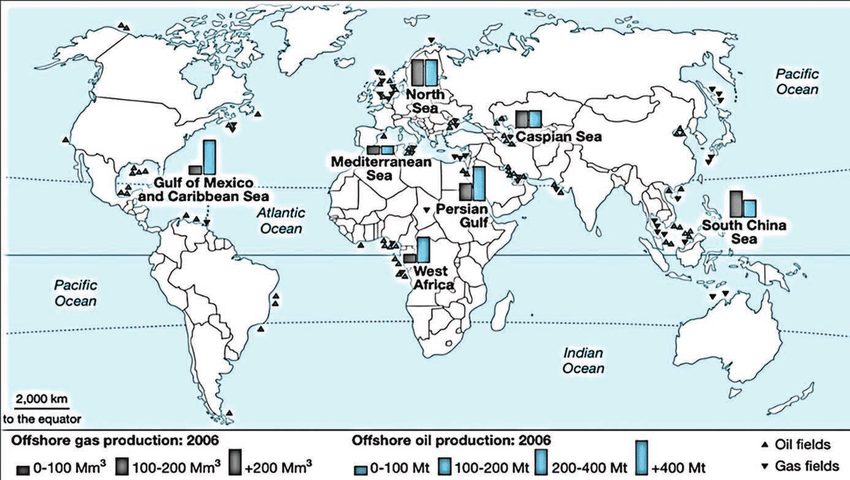
    Petroleum reserves are found in sedimentary basins, where organic matter is trapped under pressure. Offshore reserves, discovered since the mid-20th century, now account for ~30% of global crude oil production. Their distribution is linked to continental shelf geology, passive margins, and deep-water basins.

    Major Offshore Oil Regions 

    Major Offshore Oil Regions of the World

    1. North America – Gulf of Mexico (USA, Mexico), Alaska’s Beaufort & Chukchi Seas.
    2. South America – Brazil’s Campos & Santos Basins (pre-salt), Guyana-Suriname Basin.
    3. Europe – North Sea (UK, Norway, Denmark), Barents Sea (Arctic).
    4. Africa – West Africa (Nigeria, Angola, Ghana), East Africa (Mozambique, Tanzania gas fields).
    5. Middle East – Persian Gulf (Saudi Arabia’s Safaniya, Qatar, UAE, Iran, Kuwait).
    6. Asia – South China Sea, Bay of Bengal (KG-D6 India, Bangladesh, Myanmar), Sakhalin (Russia).
    7. Australia – North-West Shelf (Western Australia).

    Difference between Offshore Reserves and Onshore Reserves

    AspectOnshore ReservesOffshore Reserves
    LocationFound in continental interiors and basins (eg– Middle East deserts, Siberia, Texas).Found in continental shelf, slope, and deep-sea basins (eg– Gulf of Mexico, North Sea).
    Geological SettingRift basins, foreland basins, older sedimentary rocks.Marine sedimentation, deltaic deposits, pre-salt basins (Brazil, West Africa).
    Exploration & TechnologyEasier access, drilling by rigs on land.Complex technology (floating rigs, subsea pipelines, deep-water drilling).
    Cost of ExtractionRelatively cheaper (low capital investment).Highly capital-intensive, requires international oil companies.
    Environmental RisksLand degradation, groundwater pollution.Oil spills, marine ecosystem damage (eg– Deepwater Horizon 2010 in Gulf of Mexico).
    GeopoliticsMostly within national boundaries.Often disputed maritime zones (eg– South China Sea).
    ReservesHistorically dominant (eg– Middle East onshore super-giants like Ghawar, Saudi Arabia).Increasing share, especially deep-water basins (Brazil, West Africa).

    While onshore reserves dominate historically, offshore reserves are growing in importance, representing the future frontier of global petroleum geography.

  • [2025 GS1 UPSC MAINS] Discuss the distribution and density of population in the Ganga River Basin with special reference to land, soil and water resources. (15 Marks)

    [2025 GS1 UPSC MAINS] Discuss the distribution and density of population in the Ganga River Basin with special reference to land, soil and water resources. (15 Marks)

    [UPSC 2024] The groundwater potential of the Gangetic Valley is on a serious decline. How may it affect the food security of India? (Answer in 250 words)

    The Ganga River Basin, spread across 11 states, covers about 26% of India’s geographical area and supports over 40% of India’s population (~520 million people, 2011 Census).

    Distribution and Density Pattern

    1. Upper Ganga Basin (Uttarakhand, Himachal Pradesh)
      • Low density due to rugged relief, narrow valleys, and limited cultivable land.
      • Settlements concentrated in valleys (Haridwar, Dehradun).
    2. Middle Ganga Basin (Uttar Pradesh, Bihar)
      • Very high density (800–1100 persons/km²).
      • Extensive alluvial plains, fertile soils, and perennial water availability.
      • Cities like Kanpur, Lucknow, Patna show urban-industrial concentration.
    3. Lower Ganga Basin (West Bengal)
      • Extremely high density (>1000 persons/km²), especially in the deltaic plains.
      • Fertile deltaic alluvium, abundant water for irrigation, and proximity to ports (Kolkata, Howrah).

    Role of Land, Soil, and Water Resources

    Land Resources

    1. Extensive Alluvial Plains – Flat, fertile Indo-Gangetic plains provide ideal conditions for dense settlement.
    2. Favorable Relief – Gently sloping terrain encourages agriculture, irrigation, and transport networks.
    3. Deltaic Land Advantage – supports rice cultivation, jute, and fisheries. Eg– West Bengal (Kolkata–Howrah region).

    Soil Resources

    1. Highly Fertile Alluvium – Soils rich in nutrients, renewed annually by floods, support intensive agriculture. Eg– Bihar’s Sone–Gandak plains known as India’s “granary belt.
    2. Diverse Soil Types – Khadar (new alluvium) supports rice, wheat, sugarcane; Bhangar (old alluvium) sustains orchards and pulses.
    3. High Agricultural Productivity – Fertility allows multiple cropping, sustaining high rural density. Eg– Rice–wheat belt in eastern UP and Bihar.

    Water Resources

    1. Perennial River Network – Ganga and tributaries (Yamuna, Ghaghara, Gandak, Kosi) ensure year-round water supply.
    2. Irrigation Infrastructure – Canals (Upper & Lower Ganga Canal), tube-wells, and pumps enable irrigated farming.
    3. Groundwater Abundance – Shallow water table supports irrigation and drinking water. Eg– Punjab & western UP use intensive groundwater irrigation.
    4. Fisheries and Inland Navigation – Rivers support livelihood diversification beyond farming.
    5. Hydropower and Urban Water Supply – Eg– Tehri Dam in Uttarakhand; Kolkata draws water from Hooghly.

    The Ganga River Basin is India’s “population heartland”. Ensuring sustainable resource management is vital to balance livelihood security with ecological health.

  • [2025 GS1 UPSC MAINS] How can Artificial Intelligence (AI) and drones be effectively used along with GIS and RS techniques in locational and areal planning? (15 Marks)

    [2025 GS1 UPSC MAINS] How can Artificial Intelligence (AI) and drones be effectively used along with GIS and RS techniques in locational and areal planning? (15 Marks)

    Smash 2025 FLT 11
    13. In recent times, India’s land reform efforts have focused on technological solutions. Though they have improved land administration, they have failed to address the structural challenges that perpetuate India’s land-related problems. Comment

    Land-use planning is the systematic assessment of land and water potential, alternatives for land use, and socio-economic conditions to select and adopt the best land-use options. The integration of technology makes land-use and areal planning more accurate, dynamic, and evidence-based.

    Use of AI along with GIS & RS

    1. Automated Land-Use Classification – AI processes satellite imagery and GIS layers for faster, accurate land-use/land-cover mapping. Eg– ISRO’s FASAL project for crop classification.
    2. Predictive Urban Growth Modelling – AI analyses GIS–RS datasets to forecast urban sprawl, housing demand, and transport pressure. Eg– Bengaluru Smart City uses AI–GIS for traffic simulation.
    3. Disaster Risk Assessment – AI integrates RS hazard maps with GIS to predict floods, landslides, droughts. Eg– Uttarakhand flood risk mapping with AI-enabled RS data.
    4. Resource Optimization – AI processes GIS–RS data to identify optimal sites for renewable energy and infrastructure. Eg– MNRE Solar Atlas combined with AI for solar farm planning.
    5. Climate Change & Environmental Monitoring – AI detects deforestation, wetland shrinkage, and land degradation from RS imagery layered on GIS. Eg– AI models tracking Amazon deforestation using RS data (Brazil).
    6. Agriculture & Food Security – AI with GIS–RS predicts yields, crop stress, and pest infestations.

     Use of Drones along with GIS & RS

    1. High-Resolution Mapping – Drones add centimeter-level accuracy to RS–GIS maps for micro-planning. Eg– Swamitva Yojana drone surveys for rural land records.
    2. 3D City & Infrastructure Models – Drone imagery combined with GIS builds “digital twins” of cities. Eg– Amaravati 3D city model for planning.
    3. Real-Time Disaster Monitoring – Drones provide live data layered on GIS hazard maps. Eg– Drone deployment in Assam floods for evacuation mapping
    4. Precision Agriculture – Drones complement RS crop data with farm-level imagery for soil health, irrigation, and spraying. Eg– Drone spraying under PM-KUSUM scheme.
    5. Asset & Environmental Monitoring – Drone imagery integrated with GIS tracks forests, coasts, pipelines, and solar parks. Eg– NTPC using drones for solar park inspections.

    Challenges in Application of AI and Drones in Land-Use Planning

    1. High Cost of Technology – Import dependence for drones and AI hardware raises expenses; unaffordable for local bodies and farmers.
    2. Limited Skilled Workforce – Shortage of trained drone pilots, GIS analysts, and AI specialists in government and rural institutions.
    3. Regulatory Hurdles – DGCA’s strict norms on drone flying (permissions, no-fly zones) restrict large-scale adoption.
    4. Data Quality & Integration – Inconsistent cadastral maps, poor satellite resolution in some areas, and fragmented databases hamper AI accuracy.
    5. Privacy & Security Concerns – Risks of surveillance misuse, sensitive land data leaks, and cyberattacks on AI systems.

    Way Forward

    1. Policy Support – Simplify drone regulations under DGCA; promote indigenous drone and AI manufacturing through PLI schemes.
    2. Capacity Building – Establish training centres for drone pilots, GIS analysts, and AI specialists in planning departments.
    3. Affordable Access – Subsidize drones for agriculture and rural land-mapping; encourage PPP models for cost-sharing. Eg- Drone Didi Initiative

    India must move from manual surveys to intelligent mapping, ensuring technology becomes a people-centric enabler of sustainable land management.

    Functional and sectional approach

    AI

    1. Functions
    • Data-driven decision making
    • Automation of tasks
    • Predictive analytics and forecasting
    • Personalisation
    • Accuracy and precision
    • Enhanced efficiency and productivity
    1. Sections
    • Agriculture
    • Urbanisation
    • Industries

    Drones

    1. Functions
    • Capability for real-time surveillance and imaging
    • High-resolution mapping and spatial data collection
    • Access to difficult or hazardous terrains
    • Rapid deployment and flexibility in operations
    1. Sections
    • Disasters

  • [2025 GS1 UPSC MAINS] The ethos of civil service in India stands for the combination of professionalism with nationalistic consciousness – Elucidate. (10 Marks)

    [2025 GS1 UPSC MAINS] The ethos of civil service in India stands for the combination of professionalism with nationalistic consciousness – Elucidate. (10 Marks)

    Civil services in India are often called the “steel frame” of governance (Sardar Patel). Their ethos is not only about professional efficiency but also about nationalistic commitment to India’s unity, integrity, and development. 

    Professionalism in Civil Services

    1. Political Neutrality & Impartiality – Civil servants serve any elected government without bias. Eg– enforcing model code of conduct during elections
    2. Rule of Law & Constitutional Supremacy – Administration must be based on legality, not personal preference. Eg– IPS officers implementing SC’s Vishakha Guidelines (1997) on workplace safety before a law was framed.
    3. Efficiency & Competence – Evidence-based policymaking and modern management in service delivery. Eg– Aadhaar-linked DBT saved ₹3.5 lakh crore (2024, MoF) by eliminating ghost beneficiaries.
    4. Transparency & Accountability – Eg– Social audits in MGNREGA institutionalised through CAG guidelines.
    5. Service Orientation – Citizen-centric delivery is a mark of professional ethics. Eg– Passport Seva Kendras reduced processing time from weeks to <7 days in most cities.
    6. Specialisation & Innovation – Eg– Kerala’s e-governance initiatives (Akshaya centres) pioneered ICT delivery at grassroots.

    Nationalistic Consciousness in Civil Services

    1. Commitment to Constitutional Morality – Safeguarding democracy, secularism, equality, and liberty. Eg- peacebuilding and maintaining law and order during communal riots
    2. Nation-Building & Development Orientation – Implementing welfare schemes for inclusive growth. Eg– Civil servants executed Green Revolution programmes in 1960s under C. Subramaniam and M.S. Swaminathan, ensuring food security.
    3. Unity in Diversity & National Integration – Officers posted in insurgency or border regions serve as a bridge between the state and citizens.
    4. Disaster Response as National Duty – Eg– Odisha cadre officers coordinated mass evacuation in 2019 Fani cyclone, limiting deaths to <100 compared to 10,000+ in 1999 super-cyclone.
    5. Social Justice Orientation – Eg– Implementation of PM-KISAN, SC/ST scholarships, and NFSA ensuring food security for 80 crore citizens.
    6. International Representation of India – Eg– Indian Foreign Service officers negotiating Indo-US civil nuclear deal and Paris Climate Agreement (2015).

    Fusion of Professionalism with Nationalism

    1. Nehruvian Vision – Civil services must be “politically neutral, yet deeply committed to the development of India.”
    2. The ethos is not mechanical efficiency alone; it is value-driven governance. Eg– Smart Cities Mission, Swachh Bharat Abhiyan, and Jal Jeevan Mission required technical skill (professionalism) and a vision of inclusive national development (nationalism).
    3. 2nd ARC Report (2005) emphasised professional competence and commitment to constitutional ideals as the twin pillars of civil service ethos.

    The Indian civil servants are  “efficient nation-builders”. They act as servants of the people and guardians of national unity.

  • [2025 GS1 UPSC MAINS] Explain briefly the ecological and economic benefits of solar energy generation in India with suitable examples. (10 Marks)

    [2025 GS1 UPSC MAINS] Explain briefly the ecological and economic benefits of solar energy generation in India with suitable examples. (10 Marks)

    Smash 2025 FLT 07 Q5.
    India has significant potential to lead the global renewable energy transition. Discuss the major opportunities and barriers in scaling up renewable energy infrastructure in India.
    PYQ
    Q. India has immense potential of solar energy though there are regional variations in its development. Elaborate. (2020)

    India, being a tropical country with 300 sunny days annually and high solar insolation (4–7 kWh/m²/day), has immense potential for solar energy. 

    Fact File:

    India ranks 3rd in Solar Power capacity, (IRENA RE Statistics 2025) with capacity of 1.08 GWhTotal solar energy potential stands at 748 GWh

    Ecological Benefits

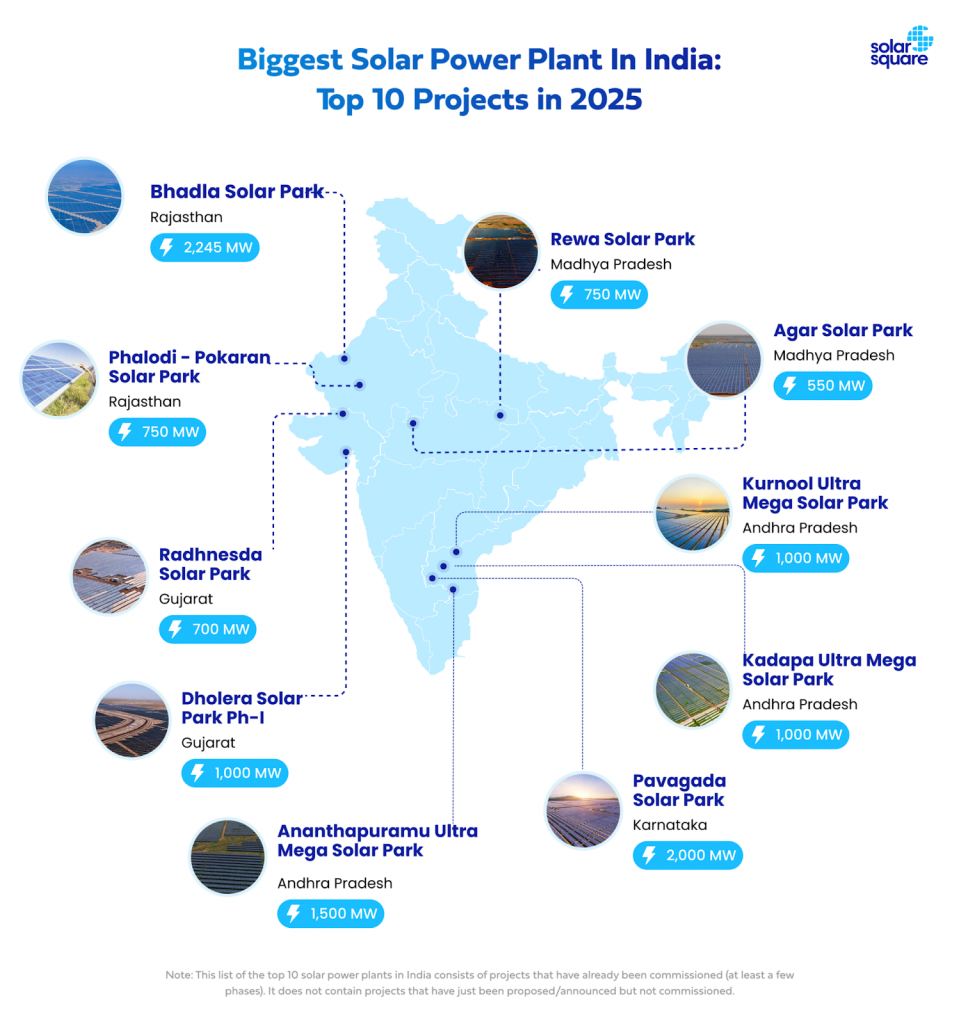
    1. Reduced Greenhouse Gas Emissions – Solar is carbon-neutral during operation. Eg– Bhadla Solar Park (Rajasthan) avoids ~4 million tonnes of CO₂ annually.
    2. Air Quality Improvement – Cuts SO₂, NOx, particulate emissions from coal. Eg– NTPC Dadri has integrated solar to offset coal-based generation.
    3. Water Conservation – Thermal plants need 3–5 m³/MWh water; solar PV is nearly waterless.
    4. Reduced Land Pressure through Innovative Deployment – Rooftop, floating solar, and canal-top solar save agricultural land. Eg– Gujarat’s Narmada canal-top solar.
    5. Synergy with Agriculture – Agrivoltaics allow crops beneath panels, reducing water loss. Eg– Maharashtra pilot projects under PM-KUSUM scheme.
    6. Contributes to Climate Commitments – Key to India’s pledge of 50% power capacity from non-fossil sources by 2030.

    Economic Benefits

    1. Energy Security – Reduces fossil fuel imports.(2024–25: India imported 243 MMT coal)
    2. Cost Competitiveness – Tariffs now among the lowest globally (less than ₹3/unit ).
    3. Job Creation – Solar PV sector employed ~319,000 workers in 2023; total RE jobs ~1.02 million. Eg– CEEW projects 3.4 million clean energy jobs by 2030.
    4. Rural Empowerment – Solar pumps (PM-KUSUM) reduce diesel dependence and enhance farmer income. Eg– Over 2.3 lakh solar pumps installed by 2023.
    5. Boost to Domestic Manufacturing – Under PLI, India’s solar module manufacturing capacity crossed 74 GW in 2025, making it second globally.
    6. Foreign Exchange Savings – According to NITI Aayog, renewable energy expansion could reduce fossil fuel imports by up to $94 billion annually by 2030.
    7. Infrastructure Development & Local Growth – Large solar parks bring roads, transmission lines, and jobs to underdeveloped regions. Eg– Pavagada Solar Park (Karnataka)
    8. Energy Access & Decentralisation – Off-grid solar improves rural electrification.
    ChallengesWay Forward
    High import dependence on modules & cellsBoost domestic manufacturing (PLI scheme)
    Land acquisition issues for mega-parksPromote rooftop, canal-top, floating solar
    Intermittency & storage gapInvest in battery storage, hybrid RE projects
    Grid integration & transmission bottlenecksStrengthen Green Energy Corridors

    Solar energy offers a dual dividendecological sustainability and economic resilience. It is the backbone of India’s path toward green growth and energy transition.

  • [2025 GS1 UPSC MAINS] Do you think that globalization results in only an aggressive consumer culture ? Justify your answer. (10 Marks)

    [2025 GS1 UPSC MAINS] Do you think that globalization results in only an aggressive consumer culture ? Justify your answer. (10 Marks)

    Smash 2025 FLT 09
    Q19. Religious commodification and spiritual consumerism are emerging trends in India’s globalized economy. Examine how these trends are influencing traditional belief systems and social relationships.
    Smash 2025 FLT 03
    Q10. In an interconnected world, the Indian middle class is both a beneficiary and a casualty of globalization. Comment.
    Smash 2025 FLT 07
    Q10. Globalization has brought both cultural homogenization and revivalism. Discuss in context of India’s diversity and pluralism.

    Thomas Friedman, in his book The Lexus and the Olive Tree, defines globalisation as the inexorable integration of markets, nation-states, and technologies, which enables individuals, corporations, and countries to reach farther, faster, deeper, and cheaper than ever before.

    Globalisation has resulted in an aggressive consumer culture

    Arguments in Favour 

    1. Standardisation of Consumption:McDonaldization” and “Coca-Colonization” replace local tastes with uniform global products.
    2. Global Branding & Advertising: MNCs push aspirational lifestyles through aggressive marketing (Eg- fast fashion, luxury brands).
    3. Festival Commercialisation: Events like Black Friday, Cyber Monday, Diwali sales focus on consumption over tradition.
    4. Youth & Identity: Social prestige increasingly tied to branded goods and gadgets.
    5. Rise of Fast Fashion & FMCGs – Quick lifestyle turnover encourages disposability. Eg– Zara, H&M in Indian metros.
    6. Urban Middle-Class Consumerism – Rising incomes + globalization-led aspirations = “showcase economy.”
    7. E-commerce & Algorithms: Platforms encourage impulse buying through personalised ads and flash sales.
    8. Credit Culture: EMIs and “Buy Now, Pay Later” schemes drive overconsumption.
    9. Hybrid Consumer Culture (glocalisation), leading to commodification of local traditions. (Eg- McAloo Tikki in India).
    Globalisation → Liberalisation of Trade → Entry of Global Brands → Aggressive Advertising → E-commerce & Easy Credit → Changing Lifestyles → Aggressive Consumer Culture

    Arguments Against (No, globalization is not only about consumerism)

    1. Promotion of Minimalist Lifestyles through global exchange of ideas. Eg– Scandinavian “Lagom” lifestyle gaining global traction.
    2. Knowledge & Technology Transfer: Facilitates spread of education, science, IT, and health innovations (Eg- telemedicine, online learning).
    3. Global Social Movements: Enabled climate justice, gender equality, human rights campaigns across borders.
    4. Sustainable Consumption: Promotes eco-friendly products, fair trade, and renewable energy solutions (Eg- global anti-plastic movements).
    5. Rise of Sharing Economy – Globalization enables platforms like Uber, Airbnb, and Ola that focus on access rather than ownership, reducing consumerist aggression.
    6. Digital Awareness Campaigns through Social media. Eg- #SayNoToPlastic and anti-fast fashion campaigns.
    7. Global Policy Frameworks Encourage Restraint – Eg- UN SDGs Goal 12: Responsible Consumption
    8. Promotion of Cultural Diversity by opening niche global markets for handicrafts, herbal products, and traditional textiles. Eg– Indian Yoga, Ayurveda, Khadi gaining international demand.

    As Amartya Sen argues, globalization is a “process of interaction”, and its outcomes depend on how societies choose to respond.

    Framework: How Globalisation Fuels Aggressive Consumer Culture

    1. Economic Drivers
    • Global Branding & Advertising: MNCs project aspirational lifestyles through aggressive marketing.
    • Credit Expansion: Easy access to credit cards, EMIs, BNPL schemes fuels overconsumption.
    • Festival Commercialisation: Globalised sales events like Black Friday or Diwali mega-sales shift focus to mass shopping.
    1. Cultural & Social Drivers
    • Cultural Homogenisation:McDonaldization” and “Coca-Colonization” create standardised consumption habits worldwide.
    • Youth & Identity: Social prestige tied to branded clothing, gadgets, and luxury goods.
    • Influencer & Celebrity Culture: Instagram/TikTok influencers promote conspicuous consumption and lifestyle mimicry.
    1. Technological Drivers
    • E-commerce Platforms: Amazon, Flipkart, Alibaba enable instant global access to goods.
    • Algorithmic Targeting: Data-driven personalised ads encourage impulse buying.
    • 24/7 Consumer Connectivity: Smartphones and apps keep consumers constantly exposed to shopping triggers.
    1. Political / Policy Drivers
    • Trade Liberalisation & WTO Regime: Reduction of tariffs/global trade agreements made cheap imports and luxury goods accessible in developing countries.
    • FDI & Retail Globalisation: Entry of global retail chains (Walmart, IKEA) expands consumer choice and encourages bulk consumption.
    • Urbanisation & Infrastructure Push: Globalisation-driven policies expand shopping malls, multiplexes, and retail spaces, institutionalising consumerism.
    1. Psychological & Behavioural Drivers
    • Aspirational Consumerism: Exposure to global lifestyles through movies, OTT, and digital media creates a desire to imitate.
    • FOMO (Fear of Missing Out): Social media algorithms and flash sales induce impulse buying behaviour.
    • Experience Economy: Rise of global experiences (theme parks, global tourism packages, Starbucks culture) promotes consumption as lifestyle.
  • [2025 GS1 UPSC MAINS] Achieving sustainable growth with emphasis on environmental protection could come into conflict with poor people’s needs in a country like India. Comment. (15 M)

    [2025 GS1 UPSC MAINS] Achieving sustainable growth with emphasis on environmental protection could come into conflict with poor people’s needs in a country like India. Comment. (15 M)

    Smash 2025 FLT 09

    Q18. Discuss how poverty acts both as a driver and a consequence of environmental decline in India. How can policy interventions disrupt this cycle?
    PYQ

    Q. COVID-19 pandemic accelerated class inequalities and poverty in India. Comment. (2020)

    Sustainable development aims to balance economic growth, social justice, and environmental protection. However, in a developing country like India, where 228.9 million people still live in poverty (NITI Aayog, 2023 MPI Report), there is often a tension between protecting the environment and meeting the survival needs of the poor.

    Sustainable Growth

    1. Inclusive Development – Balancing GDP growth with reduction in poverty and inequality.
    2. Green Energy Expansion – Scaling renewables energy (500 GW target by 2030).
    3. Sustainable Agriculture – Crop diversification, organic farming, millets promotion
    4. Green Jobs & Skills – Workforce transition towards solar, EVs, waste management.
    5. Resource Efficiency – Circular economy, recycling, sustainable mining and industry.
    6. Digital & Smart Infrastructure – Smart cities, e-mobility, resilient transport.

    Environmental Protection

    1. Pollution Control – Enforcing emission standards, waste management rules.
    2. Climate Action – Low-carbon pathways, adaptation, and resilience (Net Zero 2070).
    3. Biodiversity Conservation – Biodiversity Conservation Act, Environment Protection Act
    4. Water & Soil Conservation – Watershed management, rainwater harvesting, anti-desertification efforts.
    5. Environmental Regulations – EIA, green clearance norms, NGT
    6. Community Participation – Joint Forest Management, people’s biodiversity registers.

    Conflict Between Sustainable Growth, Environmental Protection, and Poor People’s Needs

    1. Dependence on Forests & Commons – Environmental protection restricts access to forests, rivers, and grazing lands. Eg– Tribal and forest-dwelling communities face eviction under wildlife sanctuaries and tiger reserves.
    2. Energy Access vs Green Transition – Shift from coal/wood to renewables raises costs for the poor in the short run as rural poor still depend on biomass. Eg- refilling costs under Ujjwala Yojana.
    3. Employment vs Environmental Norms – Stricter EIA and green clearances delay projects that could generate jobs. Eg– Mining bans in Goa and Bellary impacting informal workers. 
    4. Pollution control vs Job creation – Eg- Vedanta’s Niyamgiri bauxite project (Odisha) scrapped for ecological reasons, blocking potential jobs for locals
    5. Livelihoods in Informal Sector – Eg– Ban on single-use plastics hit informal recycling workers and street vendors.
    6. Climate-Smart Agriculture vs Cost Burden – Eg- Organic/natural farming reduces chemicals but increases labour and costs for marginal farmers.
    7. Cost of Green Alternatives – Eco-friendly housing, EVs, organic food are often unaffordable for low-income groups. Eg– High cost of EV auto-rickshaws.
    8. Displacement by “Green” Projects – Large-scale renewable projects, dams, and afforestation drives can displace marginal communities. Eg- Sardar Sarovar Dam, Tehri Dam displaced 100,000 people

    However, focus on Sustainable Development & Environmental Protection also Fulfils Poor People’s Needs

    1. Securing Livelihoods from Natural Resources – Eg– Joint Forest Management (JFM) in Madhya Pradesh increased forest cover while enhancing tribal incomes from tendu leaves and bamboo.
    2. Health Benefits for the Poor – Eg– National Clean Air Programme (NCAP) in Delhi reduced PM2.5 levels, benefitting vulnerable communities most exposed to air pollution.
    3. Affordable Clean Energy – Eg– Pradhan Mantri Ujjwala Yojana provided over 9 crore LPG connections, reducing indoor air pollution deaths (mostly among poor women).
    4. Resilience Against Climate Shocks – Eg– MGNREGA-linked watershed projects in Bundelkhand improved groundwater and farm incomes.
    5. Green Jobs and Inclusive Growth – Eg– Solar PV sector employed ~319,000 workers in 2023; total RE jobs ~1.02 million.
    6. Food Security through Sustainable Agriculture – Eg– International Year of Millets (2023) promoted climate-resilient crops consumed largely by rural poor.
    7. Rights-Based Environmental Protection – FRA 2006 and biodiversity laws empower poor communities with resource rights. Eg- rights over minor forest produce

    Way Forward

    1. Inclusive Green Growth – Link poverty alleviation with sustainability through green jobs in renewable energy, waste management, eco-tourism.
    2. Just Transition Framework – Reskill workers from polluting industries (mining, coal) for jobs in clean energy and sustainable infrastructure.
    3. Integrated Rural Development – Use MGNREGA, watershed management, afforestation programmes to restore ecosystems while generating rural incomes.
    4. Strengthened Social Safety Nets – Housing, PDS, and health schemes must cushion vulnerable communities during green transitions.
    5. Policy Convergence – Align poverty eradication with SDG-1 (No Poverty), environmental goals with SDG-13 (Climate Action), and growth with SDG-8 (Decent Work and Economic Growth).

    As Indira Gandhi reminded the 1972 Stockholm Conference: “Poverty is the greatest polluter.” Sustainable development in India must therefore mean ending poverty while protecting the environment.

  • [2025 GS1 UPSC MAINS] How do you account for the growing fast food industries given that there are increased health concerns in modern society? Illustrate your answer with the Indian experience. (15 Marks)

    Smash 2025 FLT 10

    Q18. The silent epidemic of lifestyle diseases and mental health disorders is no longer confined to urban India. Discuss the key drivers of this health transition in rural and semi-urban India.

    The rise of fast food reflects the paradox of modern society: while people are increasingly aware of the health risks of processed, high-fat and high-sugar diets, the demand for convenience, speed, and affordability continues to fuel the growth of the industry. The fast food market is projected to reach USD 45 billion by 2030 with CAGR of 10%. (ICRIER)

    Increased health concerns in modern society

    Health IssueIndiaGlobal Scale
    NCD Mortality66% of all deaths, with 22% premature75% of non-pandemic deaths (~43 million/year); 18 million premature (<70 years)
    Diabetes PatientsOver 101 million individuals affected589 million diagnosed (1 in 9 adults); 252 million undiagnosed
    Diabetes Prevalence (Projected)~6,960 per 100,000 population; DALY burden ~1,1603.4 million deaths/year; USD 1 trillion in costs
    Obesity in HouseholdsAll adults overweight/obese in 1 out of 5 households2.5 billion overweight adults; 890 million obese; could reach 3 billion by 2030
    Youth Obesity & Metabolic Risk61.6% of college students overweight or obese; early risk rising

    Despite this there is growing fast food industries due to

    1. Supportive Policies & FDI – Liberalization and 100% FDI in food services attracted global players.
    2. Aggressive Marketing & Branding –  Eg– McDonald’s “McAloo Tikki” or Domino’s “30-minute delivery”
    3. Affordability & Standardization – Fast food offers predictable taste at low cost compared to traditional dining. Eg– Domino’s ₹49 pizzas.
    4. Urbanization & Lifestyle Changes – Migration to cities, rise of nuclear families, and busy work schedules create demand for ready-to-eat meals.
    5. Time Constraints & Convenience – Long commutes and dual-income households push people toward quick meals. Eg– Office-goers in metros rely heavily on QSRs (Quick Service Restaurants).
    6. Changing dietary pattern – Rural households spend 9.84% and urban households 11.09% of their monthly budget on beverages and processed food (Household Consumption Expenditure Survey (2023-24)).
    7. Youth Demographics & Socialization – Young population views eating out as leisure and peer activity.
    8. Globalization & Cultural Influence – Exposure to Western culture fuels acceptance of fast food habits. Eg– Taco Bell India offers Paneer Tikka Tacos to blend global & local.
    9. Technological Enablers – Food delivery platforms, digital payments, and online discounts boost accessibility. Eg– Swiggy and Zomato.
    10. Changing Food Preferences – Shift from home-cooked meals to processed and packaged foods due to taste variety. Eg– Growth of snack foods industry in Tier-2 and Tier-3 towns.
    11. Expansion into Smaller Cities – QSR chains penetrate Tier-2 and Tier-3 markets, tapping aspirational consumers.
    12. Experiential Consumption – Malls, multiplexes, and cafés position fast food as leisure and lifestyle.
    ImpactWay Forward
    Rising NCDs (obesity, diabetes, hypertension) due to high fat, sugar, salt (HFSS) intakeEnforce front-of-pack nutrition labels and promote food reformulation (FSSAI 2025 plan)
    Misleading advertising targeting youth and childrenBan HFSS food ads for minors and mandate truthful nutritional claims
    Food delivery apps increasing junk consumptionImpose digital food safety norms—calorie display, hygiene ratings on Swiggy/Zomato
    Introduce health tax on junk foods and strengthen FSSAI enforcement (Economic Survey recommendation)
    Launch nationwide nutrition literacy campaigns under Poshan Abhiyan & Eat Right Movement

    The future of India’s fast food industry must align with national goals of “Eat Right India” (FSSAI) and SDG-3: Good Health and Well-Being, SDG-12: Responsible Consumption to transform it into a driver of not just convenience, but also public health and sustainability.