💥Join UPSC 2027,2028 Mentorship (July Batch) + XFactor Notes & Microthemes PDF

Author: CD Staff

  • [Burning Issue] Ministry of Cooperation

    Feeling anxious about your UPSC preparation? Don’t worry, speak with our mentors and get your problems resolved, personally! (Click here)

    The Union Government announced the formation of a separate Union Ministry of Cooperation, a subject that till date was looked after by the Ministry of Agriculture. This ‘historic move’ seeks to “provide a separate administrative, legal and policy framework for strengthening the cooperative movement,” apart from deepening a “true people-based movement,” an “economic development model” that will now have a ministry to streamline “ease of doing business” and enhance the multistate cooperative societies.

    What defines a Cooperative?

    • A cooperative is “an autonomous association of persons united voluntarily to meet their common economic, social, and cultural needs and aspirations through a jointly-owned enterprise”.
    • Cooperatives are democratically owned by their members, with each member having one vote in electing the board of directors.

    What will be the new Ministry’s objectives?

    • Ministry created to realize the vision of ‘sahkar se samriddhi’ (through cooperation to prosperity).
    • The Ministry of Cooperation will provide a separate administrative legal and policy framework for strengthening the cooperative movement in the country.
    • It will help deepen Co-operatives as a true people based movement reaching up to the grassroots.
    • In India, a Co-operative based economic development model is very relevant where each member works with a spirit of responsibility.
    • The Ministry will work to streamline processes for ‘Ease of doing business for co-operatives and enable development of Multi-State Co-operatives (MSCS).

    What is the cooperative movement?

    • Cooperatives are organizations formed at the grassroots level by people to harness the power of collective bargaining towards a common goal.
    • Village-level primary agricultural credit societies (PACSs) formed by farmer associations are the best example of grassroots-level credit flow.
    • These societies anticipate the credit demand of a village and make the demand to the district central cooperative banks (DCCBs).
    • State cooperative banks sit at the apex of the rural cooperative lending structure.
    • Given that PACSs are a collective of farmers, they have much more bargaining powers than an individual farmer pleading his case at a commercial bank.
    • There are also cooperative marketing societies in rural areas and cooperative housing societies in urban areas.
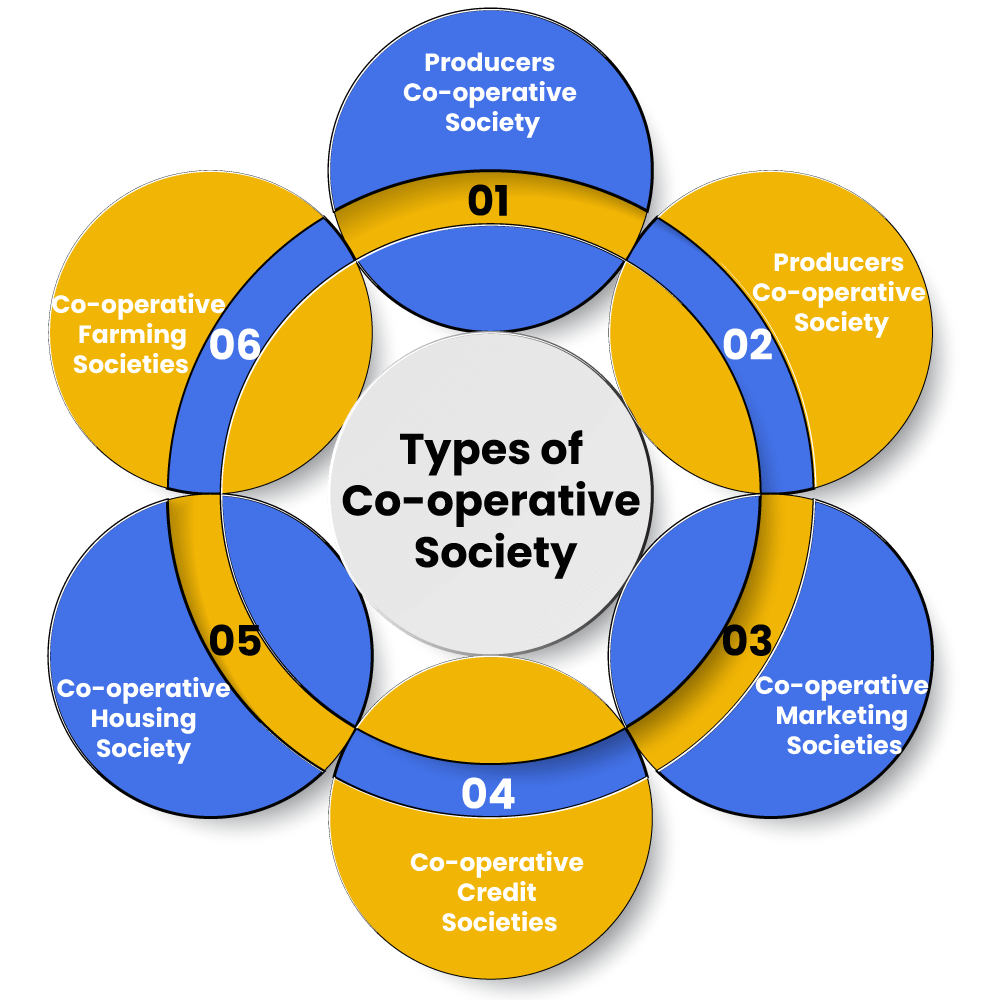
    Sectors in which Cooperative societies have outperformed

    (1) Agriculture:

    • In agriculture, cooperative dairies, sugar mills, spinning mills etc are formed with the pooled resources of farmers who wish to process their produce.
    • The country has 1,94,195 cooperative dairy societies and 330 cooperative sugar mill operations.

    (2) Dairy:

    • In 2019-20, dairy cooperatives had procured 4.80 crore litres of milk from 1.7 crore members and had sold 3.7 crore litres of liquid milk per day. (Annual Report, National Dairy Development Board, 2019-20).
    • In 1991, Manmohan Singh, then finance minister wanted to delicense the dairy sector as well, but there was stiff opposition from Verghese Kurien.
    • It was after 10 years in 2002 that the dairy sector was fully de-licensed. The competition between cooperatives and corporate dairy players has benefitted millions of farmers around the country.
    • With the entry of the private sector, the growth of the dairy sector accelerated at double the speed.
    • Today, both procure roughly the same quantities, and growth in the organised private sector is faster than in cooperatives.

    (3) Sugar Industries: Cooperative sugar mills account for 35% of the sugar produced in the country.

    (4) Banking and Finance: In banking and finance, cooperative institutions are spread across rural and urban areas.

    Performance of cooperative movement in India

    • India’s experience with the cooperative movement has produced mixed results — few successes and many failures.
    • There are cooperatives in the financial sector, be it rural or urban.
    • But the performance of these agencies when measured in terms of their share in overall credit, achievements in technology upgradation, keeping NPAs low or curbing fraudulent deals has been poor to average.
    • Sugar cooperatives of Maharashtra initially touted as exemplars of the movement, are in the doldrums now.
    • Many are being sold to the private sector.

    What laws govern cooperative societies?

    • Agriculture and cooperation are in the state list, which means state governments can govern them.
    • A majority of the cooperative societies are governed by laws in their respective states, with a Cooperation Commissioner and the Registrar of Societies as their governing office.
    • In 2002, the Centre passed a Multistate Cooperative Societies Act that allowed for registration of societies with operations in more than one state.
    • These are mostly banks, dairies and sugar mills whose area of operation spreads across states.
    • The Central Registrar of Societies is their controlling authority, but on the ground the State Registrar takes actions on his behalf.

    Provisions of Indian Constitution related to Cooperatives

    The Constitution (97th Amendment) Act, 2011 made following changes in Constitution

    • New Part IXB regarding the cooperatives working in India added. (Part IXA deals with Municipals)
    • In Art. 19(1)(c) the word “cooperatives” was added after “unions and associations”.  This enables all the citizens to form cooperatives by giving it the status of fundamental right of citizens.
    • A new Article 43B was added in the Directive Principles of State Policy (Part IV) regarding the “promotion of cooperative societies”.

    Retaining the federal character of cooperatives

    • The Supreme Court in Union of India v Rajendra Shah and Others (2021), has partly struck down the 97 constitutional amendments that sought to provide a clear framework for the administration of cooperatives across the country.
    • The courts adjudicated that the amendment violated the powers of state legislatures with respect to items in the state list, by legislating on a matter specifically contained in Item 32 of the state list under Schedule 7.
    • In what is a fillip towards the federal character of cooperatives, the Court clearly stated that cooperatives and any form of legislation pertaining to them are strictly within the domain of the state government and legislatures, and only in matters of multistate cooperatives does Parliament have sanction to legislate.

    Why Cooperatives are so important?

    • It provides agricultural credits and funds where state and private sectors have not been able to do very much.
    • It provides strategic inputs for the agricultural-sector; consumer societies meet their consumption requirements at concessional rates.
    • It is an organization for the poor who wish to solve their problems collectively.
    • It softens the class conflicts and reduces the social cleavages.
    • It reduces the bureaucratic evils and follies of political factions;
    • It overcomes the constraints of agricultural development;
    • It creates a conducive environment for small and cottage industries.

    Why was the new Ministry necessary?

    • In our country, a Co-operative based economic development model is very relevant where each member works with a spirit of responsibility.
    • It was necessary to restore the importance of the cooperative structure in the country. The cooperative structure has managed to flourish and leave its mark only in a handful of states like Maharashtra, Gujarat, Karnataka etc.
    • Under the new Ministry, the cooperative movement would get the required financial and legal power needed to penetrate into other states also.
    • Cooperative institutions get capital from the Centre, either as equity or as working capital, for which the state governments stand guarantee.
    • This formula had seen most of the funds coming to a few states such as Maharashtra, Gujarat, Karnataka while other states failed to keep up.
    • Over the years, the cooperative sector has witnessed drying out of funding. Under the new Ministry, the cooperative structure would be able to get a new lease of life.
    • This creation has signaled its deep commitment to community-based developmental partnerships.

    To what extent do the cooperative structure influence state and national politics?

    • Cooperative institutions, be it the village-level PACS or the urban cooperative housing societies, elect their leaders democratically, with members voting for a board of directors.
    • Thus, in states such as Maharashtra, cooperative institutions have served as schools for development of leadership.
    • In the present Maharashtra legislature, there are at least 150 legislators who have had some connection with the movement.
    • No matter which party is in power in a state like Maharashtra, the purse strings of the local economy always remain with the cooperative institution.

    Challenges

    • Mismanagement and Manipulation: A hugely large membership turns out to be mismanaged unless some secure methods are employed to manage such co-operatives. Money became such a powerful tool in the elections to the governing bodies that the top posts of chairman and vice-chairman usually went to the richest farmers who manipulated the organization for their benefits.
    • Lack of Awareness: People are not well informed about the objectives of the Movement, rules and regulations of co-operative institutions.
    • Restricted Coverage: Most of these societies are confined to a few members and their operations extended to only one or two villages.
    • Dearth of trained staff: The Co-operative Movement has suffered from inadequacy of trained personnel.

    Way forward

    • The new Ministry of Cooperation can work towards ironing out distortions in state price policies due to subsidization such as in Maharashtra and Karnataka milk prices.
    • New areas are emerging with the advancement of technology and cooperative societies can play a huge role in making people familiar with those areas and technologies.
    • The Ministry of Cooperation can give them soft loans for innovation and technology upgradation.
    • But such loans should also be extended to the private sector to ensure a level playing field.
    • The Ministry of Cooperation needs to ensure the least political interference in the operation of cooperatives.
    • To strengthen the cooperatives there should be market linkages for agricultural farmers as well as cooperative societies.

    Conclusion

    Critics argue that the Creation of a new cooperation ministry is an infringement upon the federal rights of the state governments. This is an intrusion into the authority of the state governments. This amounts to challenging the federal system of our country. However, the principle of the cooperative movement is to unite everyone, even while remaining anonymous. The cooperative movement has the capacity to solve people’s problems. The new Ministry of Cooperation can work towards bringing in professionalism in cooperatives and make them more competitive.


    Feeling anxious about your UPSC preparation? Don’t worry, speak with our mentors and get your problems resolved, personally! (Click here)

  • Political Party in pre-independence India

    09th Aug, 2021

    Political Party in pre-independence India

    Political associations before the Indian National Congress

    • The Indian National Congress was not the first political organization in India.
    • However, most of the political associations in the early half of the nineteenth century were dominated by wealthy and aristocratic elements. They were local or regional in character.
    • Through long petitions to the British Parliament most of them demanded:
      • administrative reforms,
      • association of Indians with the administration, and
      • spread of education.
    • The political associations of the second half of the nineteenth century came to be increasingly dominated by the educated middle class and they had a wider perspective and a larger agenda.

    Political Associations in Bengal

    (1) The Bangabhasha Prakasika Sabha

    • It was formed in 1836 by associates of Raja Rammohan Roy.

    (2) The Zamindari Association,

    • More popularly known as the ‘Landholders’ Society’, was founded to safeguard the interests of the landlords.
    • Although limited in its objectives, the Landholders’ Society marked the beginning of an organized political activity and use of methods of constitutional agitation for the redressal of grievances.

    (3) The Bengal British India Society

    • It was founded in 1843.
    • Objective: the collection and dissemination of information relating to the actual condition of the people and to employ such other means of peaceful and lawful character as may appear calculated to secure the welfare, extend the just rights and advance the interests of all classes of our fellow subjects
    • In 1851, both the Landholders’ Society and the Bengal British India Society merged into the British Indian Association.
    • It sent a petition to the British Parliament demanding –
      • establishment of a separate legislature of a popular character;
      • separation of executive from judicial functions;
      • reduction in salaries of higher officers; and
      • abolition of salt duty, abkari and stamp duties.
    • These were partially accepted when the Charter Act of 1853 provided for the addition of six members to the governor-general’s council for legislative purposes.

    (4) The East India Association

    • It was organised by Dadabhai Naoroji in 1866 in London.
    • Objective: to discuss the Indian question and influence public men in England to promote Indian welfare.
    • Later, branches of the association were started in prominent Indian cities.

    (5) The Indian League

    • It was started in 1875 by Sisir Kumar Ghosh.
    • Objective: stimulating the sense of nationalism amongst the people and of encouraging political education.

    (6) The Indian Association of Calcutta

    • It is also known as the Indian National Association superseded the Indian League.
    • It was founded in 1876 by younger nationalists of Bengal led by Surendranath Banerjea and Ananda Mohan Bose, who were getting discontented with the conservative and pro-landlord policies of the British Indian Association.
    • The Indian Association was the most important of pre-Congress associations.
    • Objective: to “promote by every legitimate means the political, intellectual and material advancement of the people.”
    • It set out to
    1. create a strong public opinion on political questions, and
    2. unify Indian people in a common political programme.
    • It protested against the reduction of age limit in 1877 for candidates of the Indian Civil Service examination.
    • The association demanded simultaneous holding of civil service examination in England and India and Indianisation of higher administrative posts.
    • It led a campaign against the repressive arms act and the vernacular press act. Branches of the association were opened in other towns and cities of Bengal and even outside Bengal.
    • The association sponsored an all India conference which first took place in Calcutta on December 28 to 30, 1883. It later merged with the Indian National Congress in 1886.

    Political Associations in Bombay

    (1) The Poona Sarvajanik Sabha

    • It was founded in 1867 by Mahadeo Govind Ranade and others, with the object of serving as a bridge between the government and the people.

    (2) The Bombay Presidency Association

    • It was started by Badruddin Tyabji, Pherozshah Mehta and K.T. Telang in 1885.

    Political Associations in Madras

    The Madras Mahajan Sabha was founded in 1884 by M. Viraraghavachari, B. Subramaniya Aiyer and P. Anandacharlu.

    Pre-congress campaigns

    These campaigns were –

    (i) for the imposition of import duty on cotton (1875)

    (ii) for Indianisation of government service (1878-79)

    (iii) against Lytton’s Afghan adventure

    (iv) against Arms Act (1878)

    (v) against Vernacular Press Act (1878)

    (vi) for the right to join volunteer corps

    (vii) against plantation labour and against Inland Emigration Act

    (viii) in support of Ilbert Bill

    (ix) for an All India Fund for Political Agitation

    (x) campaign in Britain to vote for the pro-India party

    (xi) against reduction in maximum age for appearing in

    Indian national congress

    Foundation of Indian National Congress

    • First session held in 1885 (Bombay).
    • Indian National Union, formed by A.O. Hume, became Indian National Congress.
    • Foundational theories of INC and prominent believers:

    a. Safety Valve Theory —Lala Lajpat Rai

    b. Conspiracy Theory—R.P. Dutt

    c. Lightning conductor Theory—G.K. Gokhale

    Important leaders of Moderate Phase

    • Dadabhai Naoroji, Badruddin Tyabji, Pherozeshah Mehta, P.Ananda Charlu, Surendranath Banerjea, Romesh Chandra Dutt, Ananda Mohan Bose, G.K. Gokhale, etc.

    Early Nationalist Methodology

    • Constitutional agitation within four walls of law
    • Create public opinion in India and campaign for support to Indian demands in England
    • Political education of people
    • Political connections with Britain in India’s interests at that stage
    • Time not ripe for direct challenge to colonial rule

    Contributions of Moderate Nationalists

    • Economic critique of British imperialism
    • Constitutional reforms and propaganda in legislature
    • Campaign for general administrative reforms
    • Defense of civil rights

    All-India Muslim League

    Background:

    • The communal idea that the Muslims are a separate nation was sown into the Indian political ethos first by Sir Syed Ahmed Khan, a philosopher and Muslim reformist.
    • He had founded the Muhammadan Educational Conference in 1886 but this organization stayed away from politics and desisted from even discussing it as per its own code.
    • On 30 December 1906, around 3000 delegates attended a conference of the Muhammadan Educational Conference at Dhaka in which the ban on politics was removed and a motion was moved to form the AIML.
    • The AIML was the first Muslim political party of India.
    • The idea was that the Congress Party was only catering to the needs of the Hindus.
    • Founders: Khwaja Salimullah, Vikar-ul-Mulk, Syed Amir Ali, Syed Nabiullah, Khan Bahadur Ghulam and Mustafa Chowdhury.
    • The first Honorary President of the League was Sir Sultan Muhammad Shah (Aga Khan III).
    • Objective: to promote and secure civil rights for Muslims. It espoused loyalty to the British government as a means to achieve more political and civil rights.
    • Muhammad Ali Jinnah joined the league in 1913.
    • They provided the government with a tool to fight the growing nationalism in the country. Even though partition of the country was not on the minds of Indian Muslims in the early years of the league, it came into the picture after 1930.
    • Leaders of the league began the propaganda that Hindus and Muslims are not one nation and have separate cultures and identities although they have been cohabiting for centuries.
    • In 1940, Jinnah gave a speech in Lahore in which he talked of the impossibility of living as one nation nad formulated the Two-Nation Theory.

    Other important political parties in the Pre-independence era

    (1) Communist Party of India 1925

    • It was formed on 26 December 1925 at the first Party Conference in Kanpur. S.V. Ghate was the first General Secretary of CPI.
    • There were many communist groups formed by Indians with the help of foreigners in different parts of the world.
    • Tashkent group of Contacts were made with Anushilan and Jugantar the groups in Bengal, and small communist groups were formed in Bombay (led by S.A. Dange), Madras (led by Singaravelu Chettiar), United Provinces (led by Shaukat Usmani), Punjab, Sindh (led by Ghulam Hussain) and Bengal (led by Muzaffar Ahmed).

    (2) All India Forward Bloc 1939

    • In April 1939, Subhash Chandra Bose left Congress and on 3 May 1939, he established the “Forward Bloc” of the Indian National Congress.
    • He started publishing a newspaper titled Forward Bloc.

    (3) Ghadar Party 1913-1919

    • The Ghadar Party, initially the Pacific Coast Hindustan Association, was formed in 1913 in the United States.
    • It was founded by Sohan Singh Bhakna and Lala Hardayal. Its aim was to get rid of the colonial super-power by means of an armed struggle and to set up a national democratic government on the sub-continent.

    (4) Swaraj Party 1923-1935

    • After the Chauri Chaura incident, Mahatma Gandhi withdrew the Non-Cooperation Movement in 1922. This was met with a lot of disagreements among leaders of the Congress Party.
    • While some wanted to continue non-cooperation, others wanted to end the legislature boycott and contest elections. The former were called no-changers and such leaders included Rajendra Prasad, Sardar Vallabhai Patel, C Rajagopalachari, etc.
    • The others who wanted to enter the legislative council and obstruct the British government from within were called the pro-changers. These leaders included C R Das, Motilal Nehru, Srinivasa Iyengar, etc.
    • In 1922, in the Gaya session of the Congress, C R Das (who was presiding over the session) moved a proposal to enter the legislatures but it was defeated.
    • Das and other leaders broke away from the Congress and formed the Swaraj Party. C R Das was the President and the Secretary was Motilal Nehru.
    • Prominent leaders: N C Kelkar, Huseyn Shaheed Suhrawardy and Subhas Chandra Bose.

    (5) Hindustan Socialist Republican Association 1928-1936

    • Hindustan Socialist Republican Association (HSRA) was a revolutionary organization, previously it was known as the Hindustan Republican Army.
    • Founded by: Ram Prasad Bismil, Sachindra Nath Bakshi, Sachindranath Sanyal and Jogesh Chandra Chatterjee.
    • A manifesto for the party was written by Sanyal titled ‘Revolutionary’. It contained incendiary material asking the youth of the country to join the party and take part in the freedom struggle.
    • It did not approve of the methods used by Gandhi and criticized them. The manifesto stated that it sought to achieve a ‘Federal Republic of the United States of India’ after overthrowing British rule.
    • It also demanded universal suffrage. The material espoused a socialist society for India.
    • In 1924 – 25, many young people joined the party, prominent among them being Bhagat Singh, Sukhdev and Chandrasekhar Azad.

    Samanvaya: Free 1-to-1 mentorship for UPSC IAS

    Fill up this form to schedule a free on-call discussion with senior mentor from Civilsdaily. Once submitted we will call you within 24 hours.

    Civilsdaily Samanvaya 1-On-1 Mentorship Form

    Field will not be visible to web visitor

  • 60 Days Intensive Plan for Focused Revision 2021 || Target 130 + || Overall Guidance by Santosh Sir

    60 Days Intensive Revision Plan To Score 130+ In Prelims

    This is almost a fact. The next 60 days can make or break or career. You may score 90+ and still NOT qualify or you can get 120-130+ and start preparing for Mains. 

    So, the ONLY question is – Are you ready for that extra edge that can help you score well above the cut-off?

    10 Salient features of 60 days plan

    • 30 Tests for Prelims-2021 (8 Basic + 8 Full-Length Test (FLTs) + 10 Current Affairs + 4 CSAT tests)
    • Evidence-based question making with 360-degree testing
    • One strategy call in the beginning by Santosh Gupta sir and rest through habitat group
    • Current affairs Magazine 2021 by CivilsDaily of one year
    • Economic Survey and Budget Videos for Prelims-2021
    • Video on Score boosting TIKADAMS for prelims-2021
    • Static content (PDF & Videos) on GS for prelims-2021
    • Decimate Prelims Content for Prelims-2021
    • Learn to interlink Static and Current affairs
    • Learn to maintain consistency and boost confidence

    https://www.civilsdaily.com/course/60-days-intensive-plan-for-focused-revision-2021/?tab=tab-overview

    Santosh Sir can make it happen for you. Starting with one individual strategy call with every student, Santosh Sir will guide you through an intensive revision program that will help you score well above the cut-off in THIS attempt!

    For Mentorship from CivilsDaily IAS, please click below

  • Webinar Link Inside || Free Webinar by First  Attempt UPSC Topper || Arnav Shivendu, AIR 283 || My Love for Civil Services and How to Clear the Exam in First Attempt

    Webinar Link Inside || Free Webinar by First Attempt UPSC Topper || Arnav Shivendu, AIR 283 || My Love for Civil Services and How to Clear the Exam in First Attempt

    Webinar Date: 8th August

    Time: 7 PM

    Join Zoom Meeting
    https://zoom.us/j/95489014790?pwd=Q2Z3T3J6TDY0bzdHenM5dmVzZW94QT09

    Meeting ID: 954 8901 4790
    Passcode: 388887


    You and I share the same love and the same dream…to become an IAS officer. But that’s not all that we share. I also share with you the fear and anxiety that comes with this dream. 

    It’s the same struggle every day, isn’t it? 

    1. How do I complete the syllabus?
    2. How do I maintain consistency?
    3. What to study, what not to study?
    4. How do I manage my time?
    5. How do I complete my optionals?
    6. How do write better answers?
    7. How can I remember this all?
    8. How can I manage current affairs? Etc.

    It was the same for me. The same concern every day. I felt lost and overwhelmed too. And I totally understand what you are going through right now!

    But, here’s the thing – All of these are SOLVABLE PROBLEMS!

    You CAN learn how to manage your syllabus, you CAN learn to manage your time, you CAN learn how to write good answers. All you need is the right support and guidance. For example – I too was inconsistent with my studies. But then I broke down the syllabus into small pieces. I prioritised the topics. And my mentors helped me frame a schedule that matched my learning pace. That’s it! With such a small change I was able to bring more consistency in my studies.

    And that’s exactly what I want to share with you. What are the small changes that you can make? What kind of schedule you can keep? Where can you look for the right study materials? Etc. And I would like you to learn from my experience so that your journey is smoother than mine.

    Quite frankly, I am inviting you to share my experiences with you. I would like to share the mistakes I made and how I corrected them. I am hoping that you would learn from these experiences and clear the exam on your first attempt!

    Remember, you can definitely clear this exam and I would like to share everything I learned with you. Do join me on the webinar at 7 P.M. on 8th August, and we can solve the problems together.

    About The Webinar Host:

    The Webinar is being hosted by a civil service officer Arnav Shivendu who cleared his exam in his first attempt in 2019 with AIR 283.

  • Registration Closing at 6 PM || Free Webinar by First  Attempt UPSC Topper || Arnav Shivendu, AIR 283 || My Love for Civil Services and How to Clear the Exam in First Attempt

    Registration Closing at 6 PM || Free Webinar by First Attempt UPSC Topper || Arnav Shivendu, AIR 283 || My Love for Civil Services and How to Clear the Exam in First Attempt

    Webinar Date: 8th August

    Time: 7 PM

    You and I share the same love and the same dream…to become an IAS officer. But that’s not all that we share. I also share with you the fear and anxiety that comes with this dream. 

    It’s the same struggle every day, isn’t it? 

    1. How do I complete the syllabus?
    2. How do I maintain consistency?
    3. What to study, what not to study?
    4. How do I manage my time?
    5. How do I complete my optionals?
    6. How do write better answers?
    7. How can I remember this all?
    8. How can I manage current affairs? Etc.

    It was the same for me. The same concern every day. I felt lost and overwhelmed too. And I totally understand what you are going through right now!

    But, here’s the thing – All of these are SOLVABLE PROBLEMS!

    You CAN learn how to manage your syllabus, you CAN learn to manage your time, you CAN learn how to write good answers. All you need is the right support and guidance. For example – I too was inconsistent with my studies. But then I broke down the syllabus into small pieces. I prioritised the topics. And my mentors helped me frame a schedule that matched my learning pace. That’s it! With such a small change I was able to bring more consistency in my studies.

    And that’s exactly what I want to share with you. What are the small changes that you can make? What kind of schedule you can keep? Where can you look for the right study materials? Etc. And I would like you to learn from my experience so that your journey is smoother than mine.

    Quite frankly, I am inviting you to share my experiences with you. I would like to share the mistakes I made and how I corrected them. I am hoping that you would learn from these experiences and clear the exam on your first attempt!

    Remember, you can definitely clear this exam and I would like to share everything I learned with you. Do join me on the webinar at 7 P.M. on 8th August, and we can solve the problems together.

    About The Webinar Host:

    The Webinar is being hosted by a civil service officer Arnav Shivendu who cleared his exam in his first attempt in 2019 with AIR 283.

  • Last Few Seats left || Free Webinar by First  Attempt UPSC Topper || Arnav Shivendu, AIR 283 || My Love for Civil Services and How to Clear the Exam in First Attempt

    Last Few Seats left || Free Webinar by First Attempt UPSC Topper || Arnav Shivendu, AIR 283 || My Love for Civil Services and How to Clear the Exam in First Attempt

    Webinar Date: 8th August

    Time: 7 PM

    You and I share the same love and the same dream…to become an IAS officer. But that’s not all that we share. I also share with you the fear and anxiety that comes with this dream. 

    It’s the same struggle every day, isn’t it? 

    1. How do I complete the syllabus?
    2. How do I maintain consistency?
    3. What to study, what not to study?
    4. How do I manage my time?
    5. How do I complete my optionals?
    6. How do write better answers?
    7. How can I remember this all?
    8. How can I manage current affairs? Etc.

    It was the same for me. The same concern every day. I felt lost and overwhelmed too. And I totally understand what you are going through right now!

    But, here’s the thing – All of these are SOLVABLE PROBLEMS!

    You CAN learn how to manage your syllabus, you CAN learn to manage your time, you CAN learn how to write good answers. All you need is the right support and guidance. For example – I too was inconsistent with my studies. But then I broke down the syllabus into small pieces. I prioritised the topics. And my mentors helped me frame a schedule that matched my learning pace. That’s it! With such a small change I was able to bring more consistency in my studies.

    And that’s exactly what I want to share with you. What are the small changes that you can make? What kind of schedule you can keep? Where can you look for the right study materials? Etc. And I would like you to learn from my experience so that your journey is smoother than mine.

    Quite frankly, I am inviting you to share my experiences with you. I would like to share the mistakes I made and how I corrected them. I am hoping that you would learn from these experiences and clear the exam on your first attempt!

    Remember, you can definitely clear this exam and I would like to share everything I learned with you. Do join me on the webinar at 7 P.M. on 8th August, and we can solve the problems together.

    About The Webinar Host:

    The Webinar is being hosted by a civil service officer Arnav Shivendu who cleared his exam in his first attempt in 2019 with AIR 283.

  • 07 Aug 2021 | Current Affairs Test 1

    [WpProQuiz 723]


    [WpProQuiz_toplist 720]

  • Important Sessions of Indian National Congress and Important Satyagraha of Mahatma Gandhi

    07th Aug, 2021

    Important facts to remember about leaders of the session

    • Womesh Chandra Bonnerjee was the president of the first session of the Indian National Congress.
    • Annie Beasant was the first female President of the Indian National Congress.
    • Sarojini Naidu was the first Indian woman president of the Indian National Congress.
    • Badruddin Tyabji was the first Muslim President of the Indian National Congress.
    • Rahimtulla Sayani was the second Muslim President of the Indian National Congress.
    • George Yule was the first European President of the Indian National Congress.
    • Dadhabhai Naoroji was the first Parsi President of the Indian National Congress.
    • Sankaran Narayan was the first & the only Keralite President of the Indian National Congress Session.
    • Hakim Ajmal Khan was the only person to be appointed as the President of INC, All India Muslim League & All India Khilafat Committee.

    Important Sessions of Indian National Congress

    Year and PlacePresidentDetails
    Bombay, 1885W C BonnerjeeThis was the first session. 72 delegates attended it. Formation of Indian National Congress.
    Calcutta, 1886Dadabhai NaorojiNational Congress and National Conference were merged. 
    Madras, 1887Syed Badruddin TyabjiAn appeal was made to Muslims to join hands with other national leaders. Syed Badruddin Tyabji, first Muslim President.
    Calcutta, 1896Rahimtullah M. SayaniNational song ‘Vande Mataram’ was sung for the first time
    Benares, 1905Gopal Krishna GokhaleResentment was shown against the partition of Bengal
    Calcutta, 1906Dadabhai NaorojiThe word ‘swaraj’ was mentioned for the first time.
    Surat, 1907Rash Behari GhoshThe ‘Surat Split’- Party splits into extremists and moderates
    Lahore, 1909Madan Mohan MalaviyaDisapproval was expressed over the separate electorates on basis of religion as given in Indian Councils Act, 1909.
    Calcutta, 1911Bishan Narayan DarThe national anthem ‘Jana Gana Mana’ was sung for the first time
    Lucknow, 1916Ambica Charan MazumdarLucknow Pact was signed. The extremists and moderates reunited.
    Calcutta, 1917Annie BesantShe was the first woman president of the INC
    Amritsar, 1919Motilal NehruThe Jallianwalla Bagh massacre was condemned. Khilafat Movement was boosted
    Belgaum, 1924M K GandhiOnly Session presided over by Mahatma Gandhi
    Kanpur, 1925Sarojini NaiduSarojini Naidu, First Indian Woman President
    Lahore, 1929Jawaharlal NehruThis was an iconic session. Resolution for ‘Poorna Swaraj’ was passed. The Civil Disobedience movement was launched. Gandhi- Irwin pact was endorsed.
    Karachi, 1931Vallabhbhai PatelThe Congress adopted a resolution on Fundamental Rights and Economic Policy
    Haripura, 1938Subhas Chandra BoseNational Planning Committed set-up under Nehru
    Tripuri, 1939Subhas Chandra BoseBose had to resign due to differences with Gandhi
    Meerut, 1946Acharya KripalaniLast session before independence

    Important Satyagraha and freedom struggle movements of Mahatma Gandhi

    The Rise of Gandhi in the Indian Freedom Struggle

    M K Gandhi returned from South Africa to India in 1915.

    There he had led a peaceful agitation against the discrimination meted out to Indians and had emerged as a respected leader.

    It was in South Africa that he developed his brand of Satyagraha. In India, he first used this tool against the British government at Champaran in Bihar.

    Champaran Satyagraha (1917)

    • The first civil disobedience movement by Gandhi in the freedom struggle. He is requested by Rajkumar Shukla, an indigo cultivator in Bihar to inspire the peasants to struggle against the oppressive plantation system.
    • The farmers were suffering under heavy taxes and an exploitative system. They were forced to grow indigo by the British planters under the tinkathia system.
    • Gandhi arrived in Champaran to investigate the matter but was not permitted by the British authorities to do so. He was asked to leave the place but he refused.
    • He was able to gather support from the farmers and masses. The case against him was dropped and he was allowed to conduct the inquiry.
    • After peaceful protests against the planters and landlords led by Gandhi, the government agreed to abolish the exploitative tinkathia system.
    • The peasants also received a part of the money extracted from them as compensation.
    • Champaran struggle is called the first experiment on Satyagraha by Gandhi. It was during this time that Gandhi was given the names ‘Bapu’ and ‘Mahatma’ by the people.

    Kheda Satyagraha (1918)

    • 1918 was a year of failed crops in the Kheda district of Gujarat due to droughts.
    • As per law, the farmers were entitled to remission if the produce was less than a quarter of the normal output. But the government refused any remission from paying land revenue.
    • Sardar Vallabhbhai Patel, under Gandhi’s guidance, led the farmers in protest against the collection of taxes in the wake of the famine.
    • People from all castes and ethnicities of the district lend their support to the movement.
    • The protest was peaceful and people showed remarkable courage even in the face of adversities like confiscation of personal property and arrest.
    • Finally, the authorities gave in and gave some concessions to the farmers.

    Ahmedabad Mill Strike (1918)

    • Gandhi used Satyagraha and hunger strike for the first time during an industrial dispute between the owners and workers of a cotton mill in Ahmedabad.
    • The owners wanted to withdraw the plague bonus to the workers while the workers were demanding a hike of 35% in their wages. Gandhi underwent a hunger strike for the workers..
    • The Ahmedabad Mill strike was successful and the workers were granted the wage hike they wanted.

    Satyagraha against the proposed Rowlatt Act (1919)

    • Rowlatt Act gave the government enormous powers to repress political activities, and allowed detention of political prisoners without trial for two years.
    • On 13th April, 1919 the infamous Jallianwalla Bagh incident took place. Seeing violence spread, Mahatma Gandhi called off the movement (18th April, 1919).

    Non-Cooperation Movement (1920-22)

    • At the Calcutta session of the Congress in September 1920, he convinced other leaders of the need to start a non-cooperation movement in support of Khilafat as well as for swaraj.
    • At the Congress session at Nagpur in December 1920, the Non-Cooperation programme was adopted.
    • In February 1922, Mahatma Gandhi decided to withdraw the Non-Cooperation Movement after the Chauri-Chaura incident.

    The Salt March and the Civil Disobedience Movement

    • For several years after the Non-cooperation Movement ended, Mahatma Gandhi focused on his social reform work.
    • In 1930, Gandhiji declared that he would lead a march to break the salt law. According to this law, the state had a monopoly on the manufacture and sale of salt.
    • The march was over 240 miles, from Gandhi’s ashram in Sabarmati to the Gujarati coastal town of Dandi, where they broke the government law by gathering natural salt found on the seashore, and boiling sea water to produce salt.
    • This marked the beginning of the Civil Disobedience Movement.
    • In 1931, Gandhi accepted a truce (the Gandhi-Irwin Pact), called off civil disobedience, and agreed to attend the Second Round Table Conference in London as the sole representative of the Indian National Congress.
    • After returning from London, Mahatma Gandhi relaunched the Civil Disobedience Movement. For over a year, the movement continued, but by 1934 it lost its momentum.

    Quit India Movement

    • With the outbreak of World War II (1939-45), the nationalist struggle in India entered its last crucial phase.
    • The failure of the mission of Sir Stafford Cripps, a British cabinet minister who went to India in March 1942 with an offer that Gandhi found unacceptable.
    • The British equivocation on the transfer of power to Indian hands, and the encouragement given by high British officials to conservative and communal forces promoting discord between Muslims and Hindus impelled Gandhi to demand in the summer of 1942 an immediate British withdrawal from India—what became known as the Quit India Movement.

    Samanvaya: Free 1-to-1 mentorship for UPSC IAS

    Fill up this form to schedule a free on-call discussion with senior mentor from Civilsdaily. Once submitted we will call you within 24 hours.

    Civilsdaily Samanvaya 1-On-1 Mentorship Form

    Field will not be visible to web visitor

  • [Burning Issue] Assam-Mizoram Border Dispute

    Northeast India has been witnessing inter-state border disputes since the early 1960s when the process of carving out states from the undivided Assam commenced.

    The most recent in the series of border disputes that plagued the region is the Assam–Mizoram border, which has been witnessing violent incidents since 2020.

    What is the recent dispute?

    In the recent incident, five policemen lost their lives and many were injured as a result of firing between the forces of Assam and Mizoram. Border disputes are not uncommon but it is the war-like confrontation between police personnel of the same country that is regretful and alarming. The violence spotlights the long-standing inter-state boundary issues in the Northeast, particularly between Assam and the states that were carved out of it.

    About Assam-Mizoram Boundary Dispute

    • The boundary between present-day Assam and Mizoram, 165 km long, dates back to the colonial era, when Mizoram was known as Lushai Hills, a district of Assam.
    • The Assam-Mizoram border is shared between three districts of South Assam — Cachar, Hailakandi and Karimganj — and three districts of Mizoram — Kolasib, Mamit and Aizawl
    • Mizoram says Assam has been pushing its people 10-12 km inside their territory.
    • Mizoram’s official stand is that the boundary should be demarcated on the basis of notification in 1875 that distinguished the Lushai Hills (erstwhile district of Assam that became Mizoram) from the plains of Cachar.
    • The notification is based on the Bengal Eastern Frontier Regulation Act, 1873, which makes it obligatory for Indians beyond to possess a travel document to enter Mizoram.
    • Assam also has border disputes with Arunachal Pradesh, Meghalaya, and Nagaland.

    Had there been any confrontations in the Past?

    • There have been confrontations over territory in the northeast region in the past. For instance, at least 28 policemen were killed in clashes on the Assam-Nagaland border in June 1985.
    • The NSCN’s (National Socialist Council of Nagaland) demand for a Greater Nagaland or Nagalim.
    • This includes parts of Assam, Manipur, and Arunachal Pradesh. It has been a major roadblock in the resolution of the Naga issue.
    • Manipur has had its share of inter-state disputes resulting in destructive economic blockades.
    • The Assam-Mizoram border has seen the increase in violent incidents, particularly since last year, necessitating the deployment of paramilitary forces.

    What is the present situation?

    • At present, the situation remains tense along the border.
    • Central forces are deployed along the border—Sashastra Seema Bal (SSB) and CRPF on Assam side and the Border Security Force (BSF) on Mizoram side of the border—to act as a buffer between the state police forces.
    • Efforts are being made to diffuse the tension. Most of the meetings between the officials intended to defuse tensions following border clashes rather than finding a permanent solution.
    • In this respect, in wake of a similar violent incident in 2018, the Mizo youth and civil society organizations had requested the Union government to constitute a boundary commission to demarcate the boundary.
    • But no decision was taken by the Union government in this regard.
    • Apart from Mizoram, other states in the Northeast are also embroiled in border disputes with Assam. The longest and the bloodiest of these is the border dispute between Assam and Nagaland.

    What are the reasons behind the Assam-Mizoram border dispute and Inter-State border tensions?

    (1) Fault lines created by Britishers in boundary demarcation are still unaddressed

    • They created boundaries as per their commercial interests. In the process, sensitivities of local communities regarding land were either ignored or suppressed.
    • Origin: The border dispute can trace its origins to the demarcation of Lushai Hills from the Cachar plains by the British in 1875. The British had drawn the boundary in consultation with Mizo chiefs.
    • But in 1933, the boundary between Lushai Hills and the then princely state of Manipur was demarcated. Manipur boundary began from the tri-junction of Lushai Hills, Cachar district of Assam, and Manipur state.
    • The Mizos do not accept this demarcation and point to the 1875 boundary, which was drawn in consultation with their chiefs.
    • In the decades after Independence, states and UTs were carved out of Assam based on the 1933 line.
    • This includes Nagaland (1963), Arunachal Pradesh (1972, formerly NEFA), Meghalaya (1972) and Mizoram (1972).

    (2) Targeting migrants and outsiders

    • There has been a proliferation of political conversations that target migrants and “outsiders”.
    • This shrinks the space and scope for fluid borders and fixes the identities of people as per the region, to realize its cultural and economic potential.
    • Last year, volunteers of a Mizo student body started putting up checkpoints reportedly on the Assam side of the border.
    • They alleged that the descendants of the Lushai tribes were being denied their rightful home through increased encroachment by the Bangladeshi immigrants.
    • These checkpoints even prevented Assam government forest officials from carrying out their routine movements.

    (3) Failure of the constitutional machinery empowered to de-escalate tensions at the border

    • The presence of central paramilitary forces should have helped maintain the peace, but it didn’t happen.
    • Further, both the states are ruled by allies of the central government. However, the political leadership failed to preserve peace in the region.

    (4) Economic competition for land and scarcity of non-farm jobs

    Economic competition for land, engendered by a lack of non-farm jobs across the Northeast region, is also enhancing bitterness among states. Most of the population is dependent on agriculture and the rising population is putting pressure on available land.

    (5) Transportation of illegal drugs

    Other issues that complicate the situation on the border include the transportation of illegal drugs that travel via Mizoram to Assam and other parts of the country.

    How such incidents impact on North-East relationship?

    • Assam-Mizoram border dispute has the grave potential of disintegrating the cohesive regional relationship – politically, socially, and economically harboured by states for long.
    • Augments Trust Deficit: It hinders the probability of Interstate cooperation in the future due to enhanced trust deficit. This is testified by competing claims on the issue.
    • Increases Hatred in masses: Such instances tend to increase feelings of animosity between the residents of Mizoram and Assam. This will hamper India’s unity and integrity.
    • China factor and risk to national security: China will be watching these fights with relish. The state which feels more betrayed can be manipulated by China for its vested interests.
    • Domino Effect: If prudent action is not taken and violators are not duly punished, then such clashes will be seen on other disputed borders in the northeast region.

    Need for the Interstate Boundary Commission

    • Considering the contesting claims of both the parties and the complexity of the issue, the foremost priority in working out a solution should be the institution of an Independent Interstate boundary commission.
    • After a careful consultative study, the commission should ideally formulate a solution that is considerate of all the stakeholders’ concerns.
    • One option could be the utilization of the disputed lands by the central government after compensating both the states.
    • Alternatively, an option of compensating one state and awarding land to the other or awarding the disputed land to both the states concerned equally could be considered as per stakeholders’ acknowledgement.
    • Whatever be the solution once worked out and accepted by the states, the Court could play a role of a guardian and take serious note of its arbitrary acts.

    What can be done to bring the situation under control?

    • There is no sure-shot and quick solution possible to the border disputes between various states without a spirit of give and take, and a civic engagement brokered by the Union government.
    • The state leaders must nurture the peace, put in place institutional mechanisms to prevent breakdowns, and negotiate a way out of long-standing disputes.
    • The central government should use the opportunity to settle once and for all, the boundary disputes among states in North East India.
    • The whole stretch of reserve forests has to be freed of encroachments from either side.
    • The Home Ministry must ensure that the Assam-Mizoram border situation should first be subject to de-escalation and then return to the status quo.
    • The Constitution’s mechanisms for addressing inter-state disputes should be duly used. This includes activating an Inter-State Council (Article 263) or asking the Supreme Court to adjudicate (Article 131).
    • Further, a time-bound court-monitored commission involving local communities in joint demarcation exercises should be announced.

    Other boundary issues in North-East India

    During British rule, Assam included present-day Nagaland, Arunachal Pradesh and Meghalaya besides Mizoram, which became separate states one by one. Currently, Assam has boundary problems with each of them.

    Assam-Nagaland

    • Nagaland shares a 500-km boundary with Assam. It achieved statehood in December 1963 and was formed out of the Naga Hills district of Assam and Arunachal Pradesh (then North-East Frontier Agency).
    • Violent clashes and armed conflicts, marked by killings, have occurred on the Assam-Nagaland border since 1965. The boundary dispute is in the Supreme Court.

    Assam-Arunachal Pradesh

    • Both states have a boundary of over 800 km. Arunachal Pradesh was granted statehood by the State of Arunachal Pradesh Act, 1986 in 1987.
    • Clashes were first reported in 1992 and since then, there have been several accusations of illegal encroachment from both sides, and intermittent clashes.
    • This boundary issue is also being heard by the Supreme Court.

    Assam-Meghalaya

    • The 884-km boundary between the two states also witnesses flare-ups.
    • Meghalaya came into existence as an autonomous state within the state of Assam in April 1970 comprising the United Khasi & Jaintia Hills and the Garo Hills districts.
    • In 1972, it got statehood. As per Meghalaya government statements, today there are 12 areas of dispute between the two states.

    Way forward

    • It is important for both the states to accept that any conflict resolution measures involve compromises and sacrifices for the larger good.
    • The intervention of the Ministry of Home affairs by ordering central forces to all areas of disputed land until a lasting and amicable solution is reached should be respected in letter and spirit.
    • Satellite mapping of the actual border locations can be used to settle boundary disputes between the states.
    • Reviving the Inter-state council can be an option for the resolution of an Inter-state dispute.
    • Under Article 263 of the Constitution, the Inter-state council is expected to inquire and advise on disputes, discuss subjects common to all states and make recommendations for better policy coordination.
    • Similarly, Zonal councils need to be revived to discuss the matters of common concern to states in each zone—matters relating to social and economic planning, border disputes, inter-state transport, etc.
    • Ethos of cooperative federalism need to be imbibed by both the center and state governments to maintain and further increase the unity of India.
  • Important British Commissions and Committees

    06th Aug, 2021

    Educational Commissions

    (1) Charles Wood Despatch – 1854
    • Objective: Wood’s despatch proposed several recommendations in order to improve the system of education.
    • According to the recommendations, it was declared that the aim of the Government’s policy was the promotion of western education. In his despatch, he emphasized on the education of art, science, philosophy and literature of Europe.
    • In short, the propagation of European knowledge was the motto of the Wood’s Despatch.
    • According to the despatch, for higher education, the chief medium of instruction would be English.
    • However, the significance of the vernacular language was no less emphasized as Wood believed that through the mediums of vernacular language, European knowledge could reach to the masses.
    • Wood’s Despatch also proposed the setting up of several vernacular primary schools in the villages at the lowest stage.
    • Moreover, there should be Anglo-Vernacular high schools and an affiliated college in the district level.
    • Wood’s Despatch recommended a system of grants-in-aid to encourage and foster the private enterprise in the field of education.
    • The grants-in-aid were conditional on the institution employing qualified teachers and maintaining proper standards of teaching.

    (2) Hunter Commission – 1882

    • Appointed by: Viceroy Lord Ripon
    • Objective: Hunter Education Commission was a landmark commission with objectives to look into the complaints of the non-implementation of the Wood’s Despatch of 1854; the contemporary status of elementary education in the British territories; and suggests means by which this can be extended and improved.
    • Headed by: Sir William Wilson Hunter
    • He submitted its report in 1882.

    Commission suggestions:

    1. There should be two types of education arrangements at the high school level, in which emphasis should be given on giving a vocational and business education and other such literary education should be given, which will help in admission to the university.
    2. Arrangement for emphasis on the importance of education at the primary level and education in local language and useful subjects.
    3. Private efforts should be welcomed in the field of education, but primary education should be given without him.
    4. Control of education at the primary level should be handed over to the district and city boards.

    (3) Hunter Commission of 1882 on Primary Education:

    • Primary education should be regarded as the education of the masses. Education should be able to train the people for self-dependence.
    • The medium of instruction in primary education should be the mother tongue. Normal Schools should be established for the training of teachers.
    • The curriculum should include useful subjects like agriculture, elements of natural and physical science and the native method of arithmetic and measurement, etc.
    • The spread of primary education for the tribal and backward people should be the responsibility of the Government.
    • Fees should be an example to students on the basis of their financial difficulties.

    (4) Raleigh Commission – 1902

    • Appointed under: Raleigh Commission was appointed under the presidency of Sir Thomas Raleigh on 27 January 1902.
    • Objective: To inquire into the condition and prospects of universities in India and to recommend proposals for improving their constitution and working.
    • Evidently, the Commission was precluded from reporting on primary or secondary education.
    • As a result of the report of the recommendations of the Commission the Indian Universities Act was passed in 1904.
    • The main objective of the Act: to improve the condition of education in India and upgrade the system to a better level

    Important changes introduced for the upliftment of University Education:

    1. Universities were empowered to appoint their own staff including the teaching staff.
    2. The number of Fellows of a University was limited within 50 to 100.
    3. The number of elected Fellows was fixed at 20 for the Bombay, Madras and Calcutta Universities and 15 for others.
    4. The Governor-General was now empowered to decide a University’s territorial limits and also affiliation between the universities and colleges.
    5. After the implementation of the provisions of the University Act, though the number of colleges declined, yet the number of students increased considerably.

    Government Resolution on Education Policy (1913)

    • In 1906, the progressive state of Baroda introduced compulsory primary education throughout its territories. In its 1913
    • Resolution on Education Policy, the government refused to take up the responsibility of compulsory education, but accepted the policy of removal of illiteracy and urged provincial governments to take early steps to provide free elementary education to the poorer and more backward sections.
    Timeline: Vernacular education development in India

    (5) Sadler Commission – 1917

    • In 1917, the Calcutta University Commission (Sadler Commission) was appointed by the Government of India under the Chairmanship of Mr. Michel Sadler, the Vice-Chancellor of the University of Leeds.

    Recommendations:

    1. All the teaching resources in the city of Calcutta should be organized so that the Calcutta University may become entirely a teaching university.
    2. A separate teaching and residential university should be established at Dacca.
    3. There was a need for a coordinating agency. Hence an inter-University Board should be set up.
    4. Honors courses should be instituted and they should be distinctly different from the Pass courses.
    5. Full time and salaried Vice-Chancellor should be appointed to be the administrative head of the university.
    6. The Senate and the syndicate should be replaced by the Court and the Executive Council respectively.
    7. Universities should be freed from excessive official control.
    8. Government interference in the academic matters of universities should stop.

    (6) Hartog Commission – 1929

    • Sir Philip Joseph Hartog committee was appointed by the British Indian government to survey on the growth of education in India.
    • The Hartog committee (1929), had devoted more attention to mass education than the secondary and University education.
    • The Hartog committee highlighted the problem of wastage and stagnation in education at the primary level.
    • It recommended the policy of consolidation instead of multiplication of schools. The duration of the primary course was to be fixed to four years.
    • It recommended for the improvements in quality, pay, and service conditions of teachers and relating the syllabus and teaching methods to the local environment of villages and locality
    • The Hartog committee on education recommended for the promotion of technical and commercial education by universities to control the problem of unemployment.
    • The recommendation of the Hartog committee of 1929 was an attempt for consolidation and stabilization of education. The Hartog committee of 1929 was seen as a torchbearer of the government’s effort to improve the quality of education.
    • However, these recommendations of Hartog committee of 1929 remained only on paper and could not be implemented due to the great economic depression of 1930-31.

    (7) Sargent Plan – 1944

    • The Sargent plan of education came after Sir John Sargent was given the task to prepare a comprehensive scheme of education for India in 1944.

    Recommendations:

    1. Pre-primary education for children between 3 to 6 years of age. Universal, compulsory and free primary or basic education for all children between the ages 6—11 (junior basic) and 11—14 (senior basic).
    2. High school education for six years for selected children between the years 11—17.
    3. Degree course for three years beginning after the higher secondary examination for selected students
    4. Technical, commercial, agricultural and art education for full time and part-time students, girls schools are to teach domestic science.
    5. The liquidation of adult illiteracy and the development of a public library system in about 20 years.
    6. Full provision for the proper training of teachers.
    7. Educational provision is made for the physically and mentally handicapped children.
    8. The organization of compulsory physical education.
    9. Provision to be made for social and recreational activities.
    10. The creation of employment bureaus.
    11. The creation of the Department of Education in the centre and in the states.
    12. The use of mother tongue is to be used as the medium of instruction in all high schools.

    Famine Commissions during British Rule in India

    (1) Campbell Commission
    • In 1865-66, a famine engulfed Orissa, Bengal, Bihar, and Madras and took a toll of nearly 20 lakhs of lives with Orissa alone loosing 10 lakh lives, since the famine was most severe in Orissa; it is called the Orissa famine.
    • The Government officers though forewarned took no steps to meet the calamity.
    • The Government adhered to the principles of free trade and the law of demand and supply, the Government did provide employment to the table booked men leaving the work of charitable relief to the voluntary agency.
    • But the famine proved a turning point in the history of Indian famines for it was followed by the appointment of a committee under the chairmanship of Sir George Campbell.

    (2) Stratchy Commission

    • It was set up in 1878 under the Chairmanship of Sir Richard Strachey.
    • The commission recommended state interference in food trade in the event of famine. India witnessed another major famine in 1896-97.

    (3) Lyall Commission

    • It was constituted in 1897 under the Chairmanship of Sir James Lyall. This commission recommended the development of irrigation facilities.

    (4) MacDonnell Commission

    • It was set up in 1900 under the Chairmanship of Sir Anthony (Later Lord) McDonnel to re-evaluate and recommend changes in report of the previous commission, based on the findings of the recent famine.
    • This Commission recommended that the official machinery dealing with a famine must work around the year so that the scarcity of food grains could be controlled well in time.

    Law Commission

    • Law Commissions in India have a pre-independence origin. The first Law Commission was formed in 1834 as a result of the Charter Act, 1833 under the chairmanship of TB Macaulay.
    • The first commission’s recommendations resulted in the codification of the penal code and the Criminal Procedure Code.
    • Three other law commissions were constituted before independence by the British government.
    • All four pre-independent law commissions have contributed to the statute books immensely.
    • After independence, the first Law Commission was constituted in 1955 in a continuance of the tradition of bringing law reforms in the country through the medium of law commissions.
    • Second Pre-Independence Law Commission,1853 – Sir John Romilly.
    • Third Pre-Independence Law Commission, 1862- Sir John Romilly.
    • Fourth Pre-Independence Law Commission, 1879 – Dr Whitley Stokes.

    Currency Commission

    (1) Mansfield Commission by Dufferin in 1886
    • The Indian Currency Committee or Fowler Committee was a government committee appointed by the British-run Government of India on 29 April 1898 to examine the current situation in India.
    • Until 1892, silver was the metal on which Indian currency and coinage had largely been based. In 1892, the Government of India announced its intent to “close Indian mints to silver” and, in 1893, it brought this policy into force.

    Other Commissions on Currency:

    1. Fowler Commission by Elgin II in 1898
    2. Babington Smith Commission by Chelmsford in 1919
    3. Hilton Young Commission by Linlithgow in 1926

    Other Important Commissions

    1. Scott-Moncrieff Commission (Irrigation) by Curzon in 1901
    2. Fraser Commission (Police Reforms) by Curzon in 1902
    3. Hunter Commission (Punjab Disturbances) by Chelmsford 1919
    4. Butler Commission (Indian States relation with British Crown) by Irwin in 1927
    5. Whiteley Commission (Labour) by Irwin in 1929
    6. Sapru Commission (Unemployment) by Linlithgow in 1935
    7. Chalfield Commission (Army) by Linlighgow 1939
    8. Floud Commission (Tenancy in Bengal) by Linlighgow in 1940