💥Join UPSC 2027,2028 Mentorship (July Batch) + XFactor Notes & Microthemes PDF

Category: Ranker Webinars

  • Unable to Score Geography Questions Correctly in your Prelims Mock Test Series? || Then, Attend This Free Live Webinar By CD Mentor Purnima Ma’am|| How to Change Your Preparation Approach for Geography in the Last 60 Days?|| Limited Slots Available, Register Now

    Unable to Score Geography Questions Correctly in your Prelims Mock Test Series? || Then, Attend This Free Live Webinar By CD Mentor Purnima Ma’am|| How to Change Your Preparation Approach for Geography in the Last 60 Days?|| Limited Slots Available, Register Now

    Aspirants who generally have no problem with subjects like History, Polity, Art and Culture and Current Affairs, falter when it comes to Geography. This is because, Geography is a technical subject and one gets confused on what to read and what to give a miss.

    It’s quite amusing but the reality is that there are more facts you might have to remember for geography than, maybe history or polity. This could range from water-bodies, ports, straits, important physical features, natural resources etc.

    Barring a year or two, the number of geography questions that appeared in prelims have averaged in the range of 12-25. Scoring well in this area is important for those who are in the 80-90s range in their test series.

    Geography Questions in UPSC Prelims [2013-2021] | Download Solution PDFs

    Free Open to All, Webinar by CD Geography Mentor Purnima Ma’am

    We understood the UPSC aspirants need of preparing for Geography in a less time consuming manner while understanding the relevant information for the exam.

    That’s why on Thursday we are coming up with a free live webinar by Purnima Ma’am who will give all aspirants the right guidance on how to study for this subject for Prelims 2022. The webinar will be truly focused on Geography for Prelims 2022. By the end of the webinar, students will gain confidence and interest to open their atlas and textbooks and study the subject all over again.

    Purnima Ma’am has completed BA in Geography from Miranda House and MA in Geography from Jawaharlal Nehru University. She is currently pursuing PhD in Geography on Net-JRF scholarship.

    What Will You Learn From This Free Live Webinar?

    1. Which NCERT books to cover? Purnima Ma’am will explain the chapters to read for Geography prelims in NCERT 6-12th books.

    2. Topic wise importance for UPSC Prelims 2022. From Fundamentals of Physical Geography, Fundamentals of Human Geography, India, People and Economy.

    3. What are the online sources to refer for topics not covered in NCERT? Purnima Ma’am will highlight the specific and limited literature which is available online for free.

    4. Live demonstration of Previous Year Question Papers. The direct questions that from NCERT textbooks from Prelims 2016-2021.

    5. How to do weekly revision for maps? Everything from straits, ports, geographic location that will be covered.

    6. Current affair topics of 5 years for Indian and World Geography. How to do a final revision on these topics?

    7. How to allocate time for Geography Revision on a daily basis if that’s the reason you are scoring less?

    8. Certain Mnemonics to remember important facts in Geography. Popular memory techniques used by toppers to ace Geography.

    upsc aspirant preparation moments | Geography lessons, Social studies  worksheets, General knowledge book

    Webinar Details

    Start from where you are, use what you have and still score well in Geography prelims for UPSC-CSE 2022! Clear your doubts with Purnima Ma’am in the upcoming session.

    Date: 24th March, 2022

    Time: 7 PM

  • Prelims Spotlight: Important Seas and Mountain Ranges of the World

    Dear Aspirants,

    This Spotlight is a part of our Mission Nikaalo Prelims-2022.

    You can check the broad timetable of Nikaalo Prelims here

    Session Details

    Morning 12 PM  – Prelims Spotlight Session

    Evening 06:30  PM  – TIKDAM/MCQs Session

    Evening 08 PM  – Tests on Alternate Days

    Join our Official telegram channel for Study material and Daily Sessions Here


    23rd Mar 2022

    Tasman Sea

    The Tasman Sea is a marginal sea of the South Pacific Ocean, situated between Australia and New Zealand. It measures about 2,000 kilometres (1,200 mi) across and about 2,800 kilometres (1,700 mi) from north to south. The sea was named after the Dutch explorer Abel Janszoon Tasman, who was the first recorded European to encounter New Zealand and Tasmania. The British explorer Captain James Cook later extensively navigated the Tasman Sea in the 1770s as part of his first voyage of exploration.

    Persian Gulf

    This inland sea of some 251,000 square kilometres (96,912 sq mi) is connected to the Gulf of Oman in the east by the Strait of Hormuz; and its western end is marked by the major river delta of the Shatt al-Arab, which carries the waters of the Euphrates and the Tigris. Its length is 989 kilometres (615 miles), with Iran covering most of the northern coast and Saudi Arabia most of the southern coast. The Persian Gulf is about 56 km (35 mi) wide at its narrowest, in the Strait of Hormuz. The waters are overall very shallow, with a maximum depth of 90 metres (295 feet) and an average depth of 50 metres (164 feet).

    Countries with a coastline on the Persian Gulf are (clockwise, from the north): Iran; Oman’s exclave Musandam; the United Arab Emirates; Saudi Arabia; Qatar, on a peninsula off the Saudi coast; Bahrain, on an island; Kuwait; and Iraq in the northwest. Various small islands also lie within the Persian Gulf, some of which are the subject of territorial disputes between the states of the region.

    Mediterranean Sea
    The Mediterranean Sea is a sea connected to the Atlantic Ocean, surrounded by the Mediterranean Basin and almost completely enclosed by land: on the north by Southern Europe and Anatolia, on the south by North Africa, and on the east by the Levant. The sea is sometimes considered a part of the Atlantic Ocean, although it is usually identified as a separate body of water.

    The countries with coastlines on the Mediterranean Sea are

    1. Albania
    2. Algeria
    3. Bosnia and Herzegovina
    4. Croatia
    5. Cyprus
    6. Egypt
    7. France
    8. Greece
    9. Israel
    10. Italy
    11. Lebanon
    12. Libya
    13. Malta
    14. Morocco
    15. Monaco
    16. Montenegro
    17. Slovenia
    18. Spain
    19. Syria
    20. Tunisia
    21. Tukey

    In addition, the Gaza Strip (“Palestine” has been associated with the geographical area that currently covers the State of Israel, the West Bank and the Gaza Strip) and the British Overseas Territories of Gibraltar and Akrotiri and Dhekelia have coastlines on the sea.

    Black Sea

    The Black Sea is a marginal sea of the Atlantic Ocean. It has an area of 436,400 km2 (168,500 sq mi) (not including the Sea of Azov). The roughly oval-shaped Black Sea occupies a large basin strategically situated at the southeastern extremity of Europe but connected to the distant waters of the Atlantic Ocean by the Bosporus (which emerges from the sea’s southwestern corner), the Sea of Marmara, the Dardanelles, the Aegean Sea, and the Mediterranean Sea.

    Countries bordering the Black Sea are-

    1. Ukraine
    2. Russia
    3. Georgia
    4. Turkey
    5. Bulgaria
    6. Romania


    Caspian Sea

    The Caspian Sea is the largest enclosed inland body of water on Earth by area, variously classed as the world’s largest lake or a full-fledged sea. It is in an endorheic basin (a basin without outflows) located between Europe and Asia.

    The Caspian Sea is bordered on the northwest by Russia, on the northeast by Kazakhstan, on the west by Azerbaijan, on the southeast by Turkmenistan, and on the south by Iran. It is classified as both a sea and a lake, and it is the largest enclosed inland body of water in the world.

    1. Azerbaijan
    2. Iran
    3. Kazakhstan
    4. Russia
    5. Turkmenistan


    Red Sea

    The Red Sea (also the Erythraean Sea) is a seawater inlet of the Indian Ocean, lying between Africa and Asia. The connection to the ocean is in the south through the Bab el Mandeb strait and the Gulf of Aden. To the north lie the Sinai Peninsula, the Gulf of Aqaba, and the Gulf of Suez (leading to the Suez Canal). The sea is underlain by the Red Sea Rift which is part of the Great Rift Valley.

    The salinity of the Red Sea is greater than the world average, approximately 4 percent. This is due to several factors:

    • Lack of significant rivers or streams draining into the sea.
    • Limited connection with the Indian Ocean, which has lower water salinity.
    • High rate of evaporation and very little precipitation.

    The six countries bordering the Red Sea proper are:


    Eastern shore:

    • Saudi Arabia
    • Yemen
    • Western shore:
      • Egypt
      • Sudan
      • Eritrea
      • Djibouti

    Aral Sea

    The Aral Sea was an endorheic lake lying between Kazakhstan (Aktobe and Kyzylorda Regions) in the north and Uzbekistan (Karakalpakstan autonomous region) in the south. The name roughly translates as “Sea of Islands”, referring to over 1,100 islands that once dotted its waters; in the Turkic languages aral means “island, archipelago”.


    South China Sea

    The South China Sea is a marginal sea that is part of the Pacific Ocean, encompassing an area from the Karimata and Malacca Straits to the Strait of Taiwan of around 3,500,000 square kilometres (1,400,000 sq mi). The area’s importance largely results from one-third of the world’s shipping sailing through its waters and that it is believed to hold huge oil and gas reserves beneath its seabed.

    It is located

    • south of China;
    • east of Vietnam and Cambodia;
    • northwest of the Philippines;
    • east of the Malay peninsula and Sumatra, up to the Strait of Malacca in the western, and
    • north of the Bangka–Belitung Islands and Borneo

    Ross sea

    The Ross Sea is a deep bay of the Southern Ocean in Antarctica, between Victoria Land and Marie Byrd Land. It derives its name from the British explorer James Ross who visited this area in 1841. To the west of the sea lies Ross Island and to the east Roosevelt Island, while the southernmost part is covered by the Ross Ice Shelf, and is about 200 miles (320 km) from the South Pole.

    Weddel sea

    The Weddell Sea is part of the Southern Ocean and contains the Weddell Gyre. Its land boundaries are defined by the bay formed from the coasts of Coats Land and the Antarctic Peninsula. The easternmost point is Cape Norvegia at Princess Martha Coast, Queen Maud Land. To the east of Cape Norvegia is the King Haakon VII Sea. Much of the southern part of the sea is covered by a permanent, massive ice shelf field, the Filchner-Ronne Ice Shelf .
    The sea is named after the Scottish sailor James Weddell, who entered the sea in 1823 and originally named it after King George IV; it was renamed in Weddell’s honour in 1900.


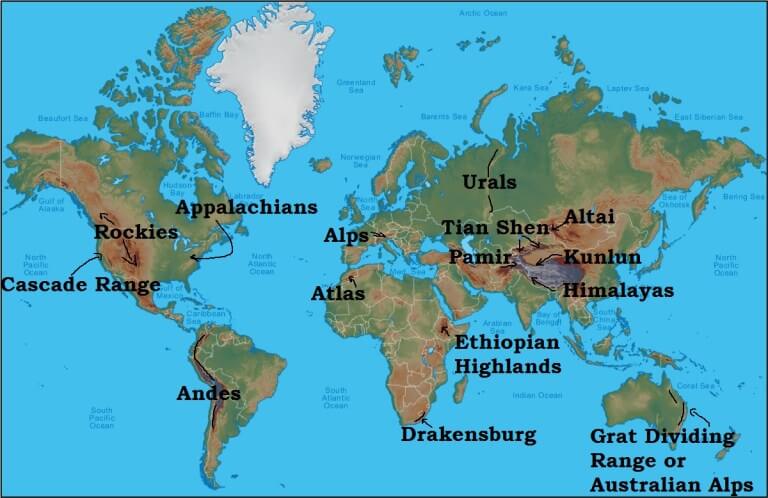
    Mountain Ranges

    Sr. No. Mountain Range Important/Highest Peaks Location Description
    1 Rocky Mountains Mt. Elbert (highest peak in the Rockies) North America It is one of the longest fold mountains in the world and extends from Canada to Western US (New Mexico State)
    2 Appalachian Mountains Mt. Mitchell, North Carolina, US (highest peak of Appalachian Mountains) North America It is a fold mountain with rich in mineral resources
    3 Alps Mont Blanc (French –Italian border) Europe It is a folded mountain and source for rivers like Danube, Rhine, etc.
    4 Sierra Nevada Mt. Whitney California, USA Habitat for many Red Indian tribes
    5 Alaska Range Mt. McKinley North America Mt. McKinley highest peak in North America
    6 Altai Mountains Belukha mountain Central Asia Young folded mountain which extends from Kazakhstan to northern China.
    7 Andes Mountains Mt. Aconcagua South America Longest mountain chain in the world
    8 Atlas Mountains Mt. Toubkal Northwestern Africa Young fold mountain spreading over Morocco and Tunisia.
    9 Drakensberg Mountains Mt. Lesotho South Africa Young folded mountain
    10. Caucasus Mountain Mt. Elbrus Europe Located between the Black Sea and the Caspian Sea
    11. Ural Mountains Mt. Narodnaya Russia This mountain range act as a boundary between Europe and Asia.
    12. Hindukush Mountains Mt. Trich Mir Pakistan and Afghanistan Folded mountain with rugged topography which makes it difficult for transportation.
    13. Himalayas Mt. Everest Asia Young fold mountains in Asia which separates Indian sub-continent from Asian plains
    14. Arakan Yoma Mt. Kennedy peak Myanmar It extends from north to south direction. Shifting cultivation is practised.
    15. Kunlun Mountains Mt. Muztag North of Tibetan plateau and western China It is one of the young folded mountains.
    16. Vosges Mt. Grand Ballon Eastern France, Europe Famous for the cultivation of grapes and manufacture of wines.
    17. Great Dividing Range Mt. Kosciuszko Australia This range is the source for the rivers Darling and Murray.

    Mountains-in-the-world


  • [Sansad TV] Perspective: Nuclear Angle of the Russia-Ukraine Conflict

    UPSC 2022 countdown has begun! Get your personal guidance plan now! (Click here)

    Context

    • The battle between Russia and Ukraine continues for the 22nd day after Russia launched its offensive against its neighbor.
    • Russia has put its nuclear forces on alert, calling it a special regime of combat duty; these include the Intercontinental Ballistic Missiles (ICBMs) that have a range of 5,000 plus and are designed to use nuclear weapons.
    • While the Russian announcement might just be a deterrent as such weapons always maintain a high-level of readiness, the mention of the word ‘nuclear’ cannot be ignored.

    This article analyses all aspects of this conflict including the nuclear angle.

    Russia-Ukraine Conflict: A quick recap

    • The Russian premier said the Russian military action aims to ensure a “demilitarization and denazification” of Ukraine.
    • At the core of the current Ukraine crisis is Russia’s disapproval of the expansion of the North Atlantic Treaty Organization – NATO in its neighbourhood.
    • Russia feels threatened by the rapid expansion of NATO since the late 1990s in the region.
    • NATO and the former USSR were engaged in what was called the Cold War for about 45 years in the game of geostrategic one-upmanship.

    Will there be a nuclear war?

    • Neither country would deliberately launch a “bolt-out-of-the-blue” nuclear attack. 
    • The crisis has now become a war of endurance.
    • At all times, Russia and the US are assumed to keep their land-based and submarine-based nuclear missiles in high readiness.
    • While they carefully select which instruments of coercion to use, they have both established “integrated deterrence” doctrines during the last decade.

    Nuclear capability of Russia

    • Russia has the world’s largest nuclear arsenal, with over 6,000 warheads.
    • Most of those warheads were in reserve when Russia invaded Ukraine, with just roughly 1,600 deployed as land, sea, and air-based weapons, such as missiles in silos or bombs dropped by planes.
    • Nuclear weapons were left on Ukrainian land when the USSR came apart at the conclusion of the Cold War, but Ukraine returned them to Russia.

    US and the Nuclear Umbrella

    • Without recognizing America’s role as a nuclear umbrella, the European countries cannot avert a nuclear attack with military means.
    • The “umbrella” is based on the assumption that the adversaries of NATO will refrain from using nuclear weapons because of the fear of a counterattack.
    • There lies a distinct psychology of deterrence with NATO’s nuclear powers.
    • However, the US President is the first to decide on the use of the US nuclear weapons stored in Germany, Italy and the Netherlands.

    What is the Deterrence Theory?

    • A nuclear deterrent acts as a reminder of the consequences a country can face if they choose to attack another country or state.
    • The ideology dates back to the Cold War and was used to prevent any nuclear aggression.
    • As the US and then-Soviet Union each raced toward the creation and building of nuclear weapons, the US adopted a strategy of nuclear deterrence
    • The concept of nuclear deterrence follows the rationale of the ‘first user’ principle.
    • States reserve the right to use nuclear weapons in self-defense against an armed attack threatening their vital security interests.

    Is Nuclear War eminent?

    • In the light of legality, the use of any nuclear weapon, considering the massive impact it has on civilians, infringes international humanitarian law.
    • Already there is a mass migration of people from Ukraine to Poland and some are seeking shelter in Hungary, Romania, Moldova and Slovakia.
    • A prominent nuclear threat would add to the humanitarian crisis.
    • However, threats of nuclear use impose intimidatory tactics on the sovereignty of a country.

    Issues with Nuclear War

    • Catastrophic destruction: Nuclear weapons wreak devastation and have long-term radiation effects that affect future generations.
    • Environmental degradation: The radioactive fallout from nuclear processes is detrimental to environment and affects nations across borders.
    • Humanitarian Crisis: The very nature of destruction emanating from the use of nuclear weapons is against the very spirit of humanity. 
    • Ethical Crisis: Nuclear weapons do not discriminate between armed personals and civilians. Unleashing nuclear weapons will lead to large scale loss of innocent lives and non-combatants.
    • Huge Proliferation risk: Proliferation is the risk that states that have nuclear weapons increase their weapon stockpiles or that new states become nuclear-armed to match their enemies.
    • Nuclear Terrorism: Large stockpiles of nuclear weapons can be misused by terrorists or some rouge elements to compel the governments to give in to their demands.
    • Domino effect resulting in Proxy Wars: There is a possibility that during times of escalating bilateral disputes, some country may use military operations covertly. Ex. Pakistan.
    India’s No First Use Doctrine

    Minimum Credible Deterrence: Building and maintaining credible minimum deterrence.

    No First use: Nuclear weapons will only be used in retaliation against a nuclear attack on Indian territory or on Indian forces anywhere.

    Non-use against non-nuclear states: Non-use of nuclear weapons against non-nuclear-weapon states. However, in the event of a major attack against India, or Indian forces anywhere, by biological or chemical weapons, India will retain the option of retaliating with nuclear weapons.

    Massive Retaliation: Nuclear retaliation to a first strike will be massive and designed to inflict unacceptable damage.

    Nuclear Command Authority: Nuclear retaliatory attacks can only be authorized by the civilian political leadership through the Nuclear Command Authority.


    Challenges posed to India

    • Declining empathy for Russia: Keeping the prominence of the ongoing crisis intact, there is an emerging trend of Russia losing grounds of empathy and friendship from the international communities.
    • Neutrality put to question: As a result, it creates a massive dilemma for Russia’s old friends like India to retain its neutrality when the majority of the world is unidirectional (against Russia) at this moment.
    • Peer pressure on rise: India has age-old friendship with Russia. It is in true sense India’s all weather and time-tested friend.

    India’s general position on nukes

    • Complete Disarmament:  India has always been an ardent supporter of multilateral nuclear disarmament and non-proliferation efforts.
    • Phased elimination: In 1996, India, one amongst the “Group of 21”, submitted a Programme of Action calling for “phased elimination of nuclear weapons” to the Conference of Disarmament.
    • Non-discriminatory elimination: India reiterated its commitment to a Nuclear Weapons Convention calling for a verifiable and non-discriminatory elimination of all nuclear weapons.

    Way Forward

    • The entire world is at the confluence of confusion and complexities and an anticipation of the severity of the nuclear threat from Russia.
    • Nuclear weapons – for as long as they continue to exist – should serve defensive purposes, deter aggression, and prevent war.
    • Since Russian concerns are genuine, it needs to create a security environment more conducive to progress on dialogue and diplomacy.
  • Clear the Final Hurdle of UPSC-CSE with Civilsdaily Free Mock Interviews|| Unlimited Practice Sessions with India’s Most Experienced & Eminent IAS Interview Panel|| Limited Slots Available, Register Now

    Clear the Final Hurdle of UPSC-CSE with Civilsdaily Free Mock Interviews|| Unlimited Practice Sessions with India’s Most Experienced & Eminent IAS Interview Panel|| Limited Slots Available, Register Now

    After beating lakhs of aspirants to be among the top two thousand UPSC candidiates, you might think the final round would be a breezer and requires no prior preparation. For someone who has prepared current affairs intensively for a year, they feel that they can answer the questions in the interview rounds impromptu.

    However, let’s not forget that though the amount of competition decreases substantially in the interview round so much that you have 50% chances of clearing it, the quality of competition increases. You are set up against those aspirants whose average score in Mains is between 900-1000 marks. Most of the candidates fall in this marks bracket. The only way you can create a difference, is by performing exceeding well in the interview.

    To understand how seriously Civilsdaily conducts its UPSC mock interviews, watch this video.

    Why Mock Interviews Are a Better Way to Practice Than By Yourself or With Your Friends?

    So, how can you practice for Interview round before you attend it? Does it have to be with friends or in front of the mirror? Remember, the most effective option is the one where you are simulating an actual UPSC interview enviornment. .

    Casual DAF-II filling can cost you a UPSC attempt and thus, you must start your preparation with DAF II curation. The aspirants who have cleared UPSC Mains 2021 can register for our interview support program without any fee (FREE).

    The purpose of mock interviews is to refine your approach, attitude and aptitude to excel in UPSC’s personality test. Mock interviews must support your quest at excelling in the final interview. You must be ready to tackle unexpected questions with your knowledge. You must have a solid opinion backed by data and facts for any issue.

    That’s why Civilsdaily has brought the free mock interview initiative for all Mains-Qualified aspirants. You can practice as many times you would like before you are perfect. If you want to analyse your performance, we will share the video for your reference.

    Here Are the Distinguished Panellists of Civilsdaily Mock Interview 2022

    One of the major advantages of attending the free mock interviews of Civilsdaily is that you will gain exposure to some of the finest bureaucrats retired as well as working, subject matter experts, psychoanalysts and faculty members. Our panellists have direct experience in recruitment and personality analysis.

    1. Mr. Shankar Agarwal (Chairman)– Retired IAS Officer, 1980 Batch, Uttar Pradesh Cadre. Last held position: Joint Secretary for the Government of India.

    2. Dr. SD Singh – Retired IFoS Officer, 1984 Batch, Uttarkhand Cadre

    3. Mr. Virendra Pratap Singh – Serving IRPS Officer of 2008 Batch, IIT Kharagpur Alumni

    4. Dr. Kulbir Singh – Retired Indian Postal Service Officer, 1981 Batch

    5. Mr. Amin Usta – Professor at Jamia Milia Islamia University.

    6. Mr. Noor Mohammed – Electoral Management Expert at Democracy and Election Management (IIIDEM)

    What Will You Learn From the Eminent Panellists?

    1. Understand interviewer’s psychology.

    2. Improve your answering style and body language.

    3. Current Affairs update by experts.

    4. Boost your social quotient and emotional quotient.

    5. A video recorded session for critical self-assessment.

    6. Personal discussion with experts after UPSC Interview Guidance Programme for a critical assessment of his/her performance.

    7. Scientific evaluation of strengths and weaknesses of the candidate by experts.

    8. Individual DAF analysis and summary of UPSC interview questions.

    9. Overall balanced feedback by experts on how one can ace the questions asked in UPSC Interview.

    For more details, Contact Pravin, Mentor Head of Civilsdaily.

    Phone Number: 8668582260

  • Unable to Score Geography Questions Correctly in your Prelims Mock Test Series? || Then, Attend This Free Live Webinar By CD Mentor Purnima Ma’am|| How to Change Your Preparation Approach for Geography in the Last 60 Days?|| Limited Slots Available, Register Now

    Unable to Score Geography Questions Correctly in your Prelims Mock Test Series? || Then, Attend This Free Live Webinar By CD Mentor Purnima Ma’am|| How to Change Your Preparation Approach for Geography in the Last 60 Days?|| Limited Slots Available, Register Now

    Aspirants who generally have no problem with subjects like History, Polity, Art and Culture and Current Affairs, falter when it comes to Geography. This is because, Geography is a technical subject and one gets confused on what to read and what to give a miss.

    It’s quite amusing but the reality is that there are more facts you might have to remember for geography than, maybe history or polity. This could range from water-bodies, ports, straits, important physical features, natural resources etc.

    Barring a year or two, the number of geography questions that appeared in prelims have averaged in the range of 12-25. Scoring well in this area is important for those who are in the 80-90s range in their test series.

    Geography Questions in UPSC Prelims [2013-2021] | Download Solution PDFs

    Free Open to All, Webinar by CD Geography Mentor Purnima Ma’am

    We understood the UPSC aspirants need of preparing for Geography in a less time consuming manner while understanding the relevant information for the exam.

    That’s why on Thursday we are coming up with a free live webinar by Purnima Ma’am who will give all aspirants the right guidance on how to study for this subject for Prelims 2022. The webinar will be truly focused on Geography for Prelims 2022. By the end of the webinar, students will gain confidence and interest to open their atlas and textbooks and study the subject all over again.

    Purnima Ma’am has completed BA in Geography from Miranda House and MA in Geography from Jawaharlal Nehru University. She is currently pursuing PhD in Geography on Net-JRF scholarship.

    What Will You Learn From This Free Live Webinar?

    1. Which NCERT books to cover? Purnima Ma’am will explain the chapters to read for Geography prelims in NCERT 6-12th books.

    2. Topic wise importance for UPSC Prelims 2022. From Fundamentals of Physical Geography, Fundamentals of Human Geography, India, People and Economy.

    3. What are the online sources to refer for topics not covered in NCERT? Purnima Ma’am will highlight the specific and limited literature which is available online for free.

    4. Live demonstration of Previous Year Question Papers. The direct questions that from NCERT textbooks from Prelims 2016-2021.

    5. How to do weekly revision for maps? Everything from straits, ports, geographic location that will be covered.

    6. Current affair topics of 5 years for Indian and World Geography. How to do a final revision on these topics?

    7. How to allocate time for Geography Revision on a daily basis if that’s the reason you are scoring less?

    8. Certain Mnemonics to remember important facts in Geography. Popular memory techniques used by toppers to ace Geography.

    upsc aspirant preparation moments | Geography lessons, Social studies  worksheets, General knowledge book

    Webinar Details

    Start from where you are, use what you have and still score well in Geography prelims for UPSC-CSE 2022! Clear your doubts with Purnima Ma’am in the upcoming session.

    Date: 24th March, 2022

    Time: 7 PM

  • 22nd March 2022| Daily Answer Writing Enhancement(AWE)

    Topics for Today’s questions:

    GS-1        Distribution of key natural resources across the world (including South Asia and the Indian sub-continent); factors responsible for the location of primary, secondary, and tertiary sector industries in various parts of the world (including India)

    GS-2        International Relations

    GS-3        Indian Economy, Impact of Liberalization, Industrial Growth

    GS-4      Public/Civil service values and Ethics in Public administration: Status and problems; ethical concerns and dilemmas in government and private institutions; laws, rules, regulations and conscience as sources of ethical guidance; accountability and ethical governance

    Question 1)


    Q.1 State the geographical and economic importance of Hindukush-Himalayan region. How are the critical geographical features of this region changing and what possible consequences will it have? (15 Marks)


    Question 2)

    Q.2 Investments in our strategic, economic, and community ties show what we can achieve when two multicultural democracies join in a spirit of trust and understanding. In the context of this, discuss the factors that are making India-Australia relations stronger than ever and the potential for them to extend the cooperation in various areas. (10 Marks)

    Question 3)

    Q.3 What is a real effective exchange rate (REER)? What are the biases involved in REER? (10 Marks)

    Question 4)  

    Q.4 Discuss how effective corporate governance can ensure the equitable treatment of all stakeholders. (10 Marks)


    HOW TO ATTEMPT ANSWERS IN DAILY ANSWER WRITING ENHANCEMENT(AWE)?

    1. Daily 4 questions from General studies 1, 2, 3, and 4 will be provided to you.

    2. A Mentor’s Comment will be available for all answers. This can be used as a guidance tool but we encourage you to write original answers.

    3. You can write your answer on an A4 sheet and scan/click pictures of the same.

    4.  Upload the scanned answer in the comment section of the same question.

    5. Along with the scanned answer, please share your Razor payment ID, so that paid members are given priority.

    6. If you upload the answer on the same day like the answer of 11th  February is uploaded on 11th February then your answer will be checked within 72 hours. Also, reviews will be in the order of submission- First come first serve basis

    7. If you are writing answers late, for example, 11th February is uploaded on 13th February , then these answers will be evaluated as per the mentor’s schedule.

    8. We encourage you to write answers on the same day. However, if you are uploading an answer late then tag the mentor like @Staff so that the mentor is notified about your answer.

    *In case your answer is not reviewed, reply to your answer saying *NOT CHECKED*. 

    1. For the philosophy of AWE and payment: 

  • Unable to Score Geography Questions Correctly in your Prelims Mock Test Series? || Then, Attend This Free Live Webinar By CD Mentor Purnima Ma’am|| How to Change Your Preparation Approach for Geography in the Last 60 Days?|| Limited Slots Available, Register Now

    Unable to Score Geography Questions Correctly in your Prelims Mock Test Series? || Then, Attend This Free Live Webinar By CD Mentor Purnima Ma’am|| How to Change Your Preparation Approach for Geography in the Last 60 Days?|| Limited Slots Available, Register Now

    Aspirants who generally have no problem with subjects like History, Polity, Art and Culture and Current Affairs, falter when it comes to Geography. This is because, Geography is a technical subject and one gets confused on what to read and what to give a miss.

    It’s quite amusing but the reality is that there are more facts you might have to remember for geography than, maybe history or polity. This could range from water-bodies, ports, straits, important physical features, natural resources etc.

    Barring a year or two, the number of geography questions that appeared in prelims have averaged in the range of 12-25. Scoring well in this area is important for those who are in the 80-90s range in their test series.

    Geography Questions in UPSC Prelims [2013-2021] | Download Solution PDFs

    Free Open to All, Webinar by CD Geography Mentor Purnima Ma’am

    We understood the UPSC aspirants need of preparing for Geography in a less time consuming manner while understanding the relevant information for the exam.

    That’s why on Thursday we are coming up with a free live webinar by Purnima Ma’am who will give all aspirants the right guidance on how to study for this subject for Prelims 2022. The webinar will be truly focused on Geography for Prelims 2022. By the end of the webinar, students will gain confidence and interest to open their atlas and textbooks and study the subject all over again.

    Purnima Ma’am has completed BA in Geography from Miranda House and MA in Geography from Jawaharlal Nehru University. She is currently pursuing PhD in Geography on Net-JRF scholarship.

    What Will You Learn From This Free Live Webinar?

    1. Which NCERT books to cover? Purnima Ma’am will explain the chapters to read for Geography prelims in NCERT 6-12th books.

    2. Topic wise importance for UPSC Prelims 2022. From Fundamentals of Physical Geography, Fundamentals of Human Geography, India, People and Economy.

    3. What are the online sources to refer for topics not covered in NCERT? Purnima Ma’am will highlight the specific and limited literature which is available online for free.

    4. Live demonstration of Previous Year Question Papers. The direct questions that from NCERT textbooks from Prelims 2016-2021.

    5. How to do weekly revision for maps? Everything from straits, ports, geographic location that will be covered.

    6. Current affair topics of 5 years for Indian and World Geography. How to do a final revision on these topics?

    7. How to allocate time for Geography Revision on a daily basis if that’s the reason you are scoring less?

    8. Certain Mnemonics to remember important facts in Geography. Popular memory techniques used by toppers to ace Geography.

    upsc aspirant preparation moments | Geography lessons, Social studies  worksheets, General knowledge book

    Webinar Details

    Start from where you are, use what you have and still score well in Geography prelims for UPSC-CSE 2022! Clear your doubts with Purnima Ma’am in the upcoming session.

    Date: 24th March, 2022

    Time: 7 PM

  • Unable to Score Geography Questions Correctly in your Prelims Mock Test Series? || Then, Attend This Free Live Webinar By CD Mentor Purnima Ma’am|| How to Change Your Preparation Approach for Geography in the Last 60 Days?|| Limited Slots Available, Register Now

    Unable to Score Geography Questions Correctly in your Prelims Mock Test Series? || Then, Attend This Free Live Webinar By CD Mentor Purnima Ma’am|| How to Change Your Preparation Approach for Geography in the Last 60 Days?|| Limited Slots Available, Register Now

    Aspirants who generally have no problem with subjects like History, Polity, Art and Culture and Current Affairs, falter when it comes to Geography. This is because, Geography is a technical subject and one gets confused on what to read and what to give a miss.

    It’s quite amusing but the reality is that there are more facts you might have to remember for geography than, maybe history or polity. This could range from water-bodies, ports, straits, important physical features, natural resources etc.

    Barring a year or two, the number of geography questions that appeared in prelims have averaged in the range of 12-25. Scoring well in this area is important for those who are in the 80-90s range in their test series.

    Geography Questions in UPSC Prelims [2013-2021] | Download Solution PDFs

    Free Open to All, Webinar by CD Geography Mentor Purnima Ma’am

    We understood the UPSC aspirants need of preparing for Geography in a less time consuming manner while understanding the relevant information for the exam.

    That’s why on Thursday we are coming up with a free live webinar by Purnima Ma’am who will give all aspirants the right guidance on how to study for this subject for Prelims 2022. The webinar will be truly focused on Geography for Prelims 2022. By the end of the webinar, students will gain confidence and interest to open their atlas and textbooks and study the subject all over again.

    Purnima Ma’am has completed BA in Geography from Miranda House and MA in Geography from Jawaharlal Nehru University. She is currently pursuing PhD in Geography on Net-JRF scholarship.

    What Will You Learn From This Free Live Webinar?

    1. Which NCERT books to cover? Purnima Ma’am will explain the chapters to read for Geography prelims in NCERT 6-12th books.

    2. Topic wise importance for UPSC Prelims 2022. From Fundamentals of Physical Geography, Fundamentals of Human Geography, India, People and Economy.

    3. What are the online sources to refer for topics not covered in NCERT? Purnima Ma’am will highlight the specific and limited literature which is available online for free.

    4. Live demonstration of Previous Year Question Papers. The direct questions that from NCERT textbooks from Prelims 2016-2021.

    5. How to do weekly revision for maps? Everything from straits, ports, geographic location that will be covered.

    6. Current affair topics of 5 years for Indian and World Geography. How to do a final revision on these topics?

    7. How to allocate time for Geography Revision on a daily basis if that’s the reason you are scoring less?

    8. Certain Mnemonics to remember important facts in Geography. Popular memory techniques used by toppers to ace Geography.

    upsc aspirant preparation moments | Geography lessons, Social studies  worksheets, General knowledge book

    Webinar Details

    Start from where you are, use what you have and still score well in Geography prelims for UPSC-CSE 2022! Clear your doubts with Purnima Ma’am in the upcoming session.

    Date: 24th March, 2022

    Time: 7 PM

  • Prelims Spotlight: Constitutional Developments under British/ British Administrative Measures

    Dear Aspirants,

    This Spotlight is a part of our Mission Nikaalo Prelims-2022.

    You can check the broad timetable of Nikaalo Prelims here

    Session Details

    Morning 12 PM  – Prelims Spotlight Session

    Evening 06:30  PM  – TIKDAM/MCQs Session

    Evening 08 PM  – Tests on Alternate Days

    Join our Official telegram channel for Study material and Daily Sessions Here


    22nd Mar 2022

    In India, the British Government passed various laws and acts before the formulation of the constitution. The Regulating Act of 1773 was enacted as a first step to regulate the working of East India Company. However, the Indian Independence Act, 1947 finally ended the British rule in India and declared India as an independent and sovereign nation with effect from August 15, 1947.

    The Regulating Act of 1773

    • The Regulating Act of 1773 was enacted as a first step to regulate the working of East India Company
    • The Gov of Bengal was made Gov General of Bengal. He was assisted by 4 people. This 4+1 becomes became Supreme Council of Bengal also known as the GG’s Exec Council.
    • A Supreme Court was established in Bengal comprising of a chief justice and three other judges

    Pitts’s India Act, 1784

    • We see a shrinking of the Council from 4 members to 3 members. Hence 3+1 is the renewed GG’s Executive Council.
    • Board of control was established to control the civil, military and revenue affairs of the company
    • The Court of Proprietors was no more empowered to revoke or suspend the resolution of the directors approved by the Board of Control.

    Charter Act of 1833

    • The Governor-General of Bengal was made the Governor-General of India. The first Governor-General of India was William Bentinck.
    • He was given legislative powers over entire India including the Governors of Bombay and Madras.
    • The company lost the status of a commercial body and was made purely an administrative body.
    • This Act. was the first law to distinguish between the executive and legislative powers of the Gov General.
    • A 4th member was introduced who could only discuss and vote only on the legislative matter.
    • Council of India = [(3+1) +  1(4th member also called the Law Member)]
    • The first such Law Member was Macaulay. This Council of India was, to a certain extent, the Legislature. Strength of the Executive remained 3+1 .

    Charter Act of 1853

    • From here on, we see a gradual increase in the membership of the Council and further separation of powers.
    • Access to compete in civil services for Indians.
    • It brought out the separation in the legislative and executive functions of the Governor-General’s council.
    • The 4th member (Law Member)was included as a full-time Member in the GG’s Executive Council. His position was taken by 6 Members referred to as Legislative Councillors.
    • Council of India = [(4+1) + 6(Legislative Councillors) + 1 Commander-in-Chief]
    • 6 Councillors were,
      1. 1 Chief Judge of SC of Calcutta.
      2. 1 Judge of SC of Calcutta
      3. 4 members of the ICS
    •  

    Government of India Act, 1858

    • India was to be governed by and in the name of the crown through Viceroy, who would be the representative of the crown in India.
    • The designation of Governor-General of India was changed to Viceroy. Thus, Governor-General Lord Canning became the first Viceroy of India
    • Board of Control and Board of directors were abolished transferring all their powers to British Crown
    • A new office ‘secretary of state was created with a 15 member council of India to assist him. Indian Councils Act, 1861
    • The major focus of the act was on administration in India. It was the first step to associate Indians to legislation.
    • The act provided that the viceroy should nominate some Indians as non-official members in the legislative council.
    • The legislative powers of Madras and Bombay presidencies were restored.
      It provided for the establishment of legislative councils for Bengal, North-Western Frontier Province (NWFP) and Punjab.
    • Viceroy was empowered to issue ordinances during an emergency without the concurrence of the legislative council.

    Indian Councils Act of 1861

    • After 1861, the Council was called Imperial Legislative Council(ILC) or Indian Legislative Council(ILC). The Executive was further enhanced by 1 member.
    • The Viceroy now had the power to Nominate 6 – 12 Non-Official members in the Legislature who would be holding the office for 2 years.
    • ILC = [(5+1) + (Additional Members -> Minimum 6, Maximum 12)]
    • The composition of Additional Members was as follows:
      1. 50% Nominated Official Members
      2. 50% Nominated Non-Official Members
    • The Act thus sowed the seed for the future Legislative as an independent entity separate from the Executive Council.

    Indian Councils Act of 1892 

    • Due to the excessive demand of the Congress, the Additional Members were increased. Additional Members -> Minimum 10, Maximum 12.
    • ILC = [(5+1) + (Additional Members -> Minimum 10, Maximum 16)]

    The composition of Additional Members was as follows:

    • Nominated official members (those nominated by the Governor-General and were government officials)
    • 5 Nominated Non-Officials (nominated by the Governor-General but were not government officials)
    • 4 Nominated by the Provincial Legislative Councils of Bengal Presidency, Bombay Presidency, Madras Presidency and North-Western Provinces.
    • 1 Nominated by the Chamber of Commerce in Calcutta.

    Indian Councils Act of 1909: The Morley-Minto reforms

    • It introduced for the first time the method of election.
    • The additional members of the Governor-General Council were increased from 16 to a maximum of 60.
    • The composition of Additional Members was as follows:
      1. Nominated official members (those nominated by the Governor-General and were government officials)
      2. Nominated non-official members (nominated by the Governor-General but were not government officials)
      3. Elected Members (elected by different categories of Indian people)
    • It provided for the association of Indians in the executive council of the Viceroy and Governors. Satyendra Prasad Sinha joined the Viceroy’s executive council as a law member.
    • It introduced Separate Electorate for Muslims.

    Indian Councils Act of 1919: The Montagu-Chelmsford Reforms

    • Central Legislature thereafter called the Indian Legislature was reconstituted on the enlarged and more representative character.
    • The act set up bicameral legislatures at the centre consisting of two houses- the Council of the States (Upper House) and the Central Legislative Assembly (Lower House).
    • It consisted of the Council of State consisted of 60 members of whom 34 members were elected and the Legislative Assembly consisted of about 145 members, of whom about 104 were elected and the rest nominated.
    • Of the nominated members, about 26 were officials.  The powers of both the Chambers of the Indian Legislature were identical except that the power to vote supply was granted only to the Legislative Assembly.
    • The central and provincial subjects were demarcated and separated.
    • The Provincial subjects were further divided into Transferred Subjects and Reserved Subjects, the legislative council had no say in the latter. This was known as the system of Diarchy.
    • The principle of separate electorate was further extended to Sikhs, Indian Christians, Anglo-Indians and Europeans.
    • It provided for the appointment of a statutory commission to report the working of the act after ten years

    The Government of India Act 1935

    • It marked the next great stride in the evolution of the Legislatures.
    • The Federal Legislature was to consist of two Houses, the House of Assembly called the Federal  Assembly and the Council of States.
    • The Federal Assembly was to consist of 375 members, 250 to represent Provinces and 125 to represent the Indian States, nominated by the Rulers.
    • The representatives of the Provinces were to be elected not directly but indirectly by the Provincial Assemblies.
    • The term of the Assembly was fixed as five years.
    • The Council of State was to be a permanent body not subject to dissolution, but one-third of the members should retire every three years.
    • It was to consist of 260 members.  104 representatives of Indian States, six to be nominated by the Governor-General, 128 to be directly elected by territorial communal constituencies and 22 to be set apart for smaller minorities, women and depressed classes.
    • The two Houses had in general equal powers but demands for supply votes and financial Bills were to originate in the Assembly.
    • The principle of Separate Electorate was extended to depressed classes, women and workers.
    • Provided for the formation of Reserve bank of India

    Indian Independence Act, 1947

    • The act formalized the Lord Mountbatten Plan regarding the independence of India on June 3, 1947.
    • The Act ended the British rule in India and declared India as an independent and sovereign nation with effect from August 15, 1947.
    • Provided for the partition of India into two dominions of India and Pakistan
    • The office of Viceroy was abolished and a Governor-General was to be appointed in each of the dominions
    • The Constituent Assemblies of the two dominions were to have powers to legislate for their respective territories.
    • Princely states were free to join any of the two dominions or to remain independent.

  • MEETING LINK INSIDE, Kindly Register to Join Now|| Ask Me Anything Session on  UPSC Interview Round & DAF Analysis with Serving IRPS Officer, IIT Alumni & Civilsdaily Mentor Virendra Pratap Singh|| LINK INSIDE to Register For The Free Live Webinar

    MEETING LINK INSIDE, Kindly Register to Join Now|| Ask Me Anything Session on UPSC Interview Round & DAF Analysis with Serving IRPS Officer, IIT Alumni & Civilsdaily Mentor Virendra Pratap Singh|| LINK INSIDE to Register For The Free Live Webinar

    Ask Me Anything || How to Fill Detailed Application Form (DAF-II) for CSE-2021 Personality Test || by Virender Pratap Singh, Core Faculty @Civilsdaily IAS


    Date & Time: Mar 21, 2022 @07:00 PM (Start Login By 06:45 PM) India

    Join Zoom Meeting
    https://zoom.us/j/95394806128?pwd=MldSTHoxU3pxS3ZUdWhJVUlyWlF3Zz09

    Meeting ID: 953 9480 6128
    Passcode: 937565

    Detailed Application Form (DAF) is one of the most important documents that you might have filled for UPSC interviews. A major part of the interview will revolve around the information and details provided in the DAF. It is more than your CV.

    Your ability to defend your DAF before the panel is going to decide your success. Anticipating and preparing for the questions based on your DAF is an essential part of the interview preparation.

    Free, Open to All Q & A session on UPSC Interview Round by Virendra Pratap Sir

    Candidates must ensure they research the relevant questions well enough. They must be able to interlink the questions in DAF to burning issues to national and international importance.

    That’s why we have organised this free live webinar where UPSC Mains qualified aspirants can get their doubts cleared and prepare a solid DAF for the interview panel.

    We make sure that no area of the DAF has been left untouched. This DAF-based questionnaire is an important tool which if used properly in your preparation may allow you to steer your interview in a particular direction.

    Below are some of the pictures and sample of the questions that you are going to get.

    Questions based on Graduation subject

    Questions based on Date of birth

    Questions based on optional subject

    Questions based on Hobbies

    What Will You Learn About UPSC Interview in this Free Live Q&A Webinar with Virendra Pratap Sir?

    1. Sir will answer doubts on how to fill out personal information/details in the DAF.

    2. Doubts regarding service and cadre preferences will be addressed.

    3. Clarification of doubts about hobbies and extracurricular activities.

    4. Sir will talk about the areas of your DAF-II from where the board will ask many questions?

    5. Sir will answer doubts regarding the DAF keywords.

    6. Sir will talk about the trend analysis based on last 6 years’ transcripts.

    7. Sir will talk about certain interview mistakes by other aspirants in the interview which costed them a rank in the final list.

    Free Live UPSC Interview Webinar Details

    Your marks in the personality round will definitely be a dominant deciding factor on whether you will get the service or cadre of your choice. So start practising for it and attend this free Q&A session with Virendra sir to clear your doubts!

    Date: 21st March, 2022 (Monday)

    Time: 7PM

    About Virendra Pratap Sir

    Virendra Pratap Singh is an IRPS officer of 2009 batch. He has completed B.Tech from IIT Kharagpur. Before joining Civil Services, he worked in different private sector organisations such as Tata Steel, Tata Motors and Maruti Suzuki India Ltd.

    He is associated with CivilsDaily in student mentoring program for UPSC interview since it’s inception.