HOW TO ATTEMPT ANSWERS IN DAILY ANSWER WRITING ENHANCEMENT(AWE)?
Daily 4 questions from General studies 1, 2, 3, and 4 will be provided to you.
A Mentor’s Comment will be available for all answers. This can be used as a guidance tool but we encourage you to write original answers.
You can write your answer on an A4 sheet and scan/click pictures of the same.
Upload the scanned answer in the comment section of the same question.
Along with the scanned answer, please share your Razor payment ID, so that paid members are given priority.
If you upload the answer on the same day like the answer of 11th February is uploaded on 11th February then your answer will be checked within 72 hours. Also, reviews will be in the order of submission- First come first serve basis
If you are writing answers late, for example, 11th February is uploaded on 13th February , then these answers will be evaluated as per the mentor’s schedule.
We encourage you to write answers on the same day. However, if you are uploading an answer late then tag the mentor like @Staff so that the mentor is notified about your answer.
*In case your answer is not reviewed, reply to your answer saying *NOT CHECKED*.
This Spotlight is a part of our Mission Nikaalo Prelims-2022.
You can check the broad timetable of Nikaalo Prelims here
Session Details
Morning 12 PM – Prelims Spotlight Session
Evening 06:30 PM – TIKDAM/MCQs Session
Noon 03:00 PM – CSAT Google Meet Session
Evening 08 PM – Tests on Alternate Days
Join our Official telegram channel for Study material for GS and CSATHere
29th March 2022
Mass Movements
The Non-Cooperation Movement- 1920-22
Following events acted as the catalysts which finally resulted in the launch of the Non-Cooperation Movement by Gandhiji on August 1, 1920.
Backdrop
The Rowlatt Act (February 1919), the Jallianwala Bagh massacre (13 April 1919) and martial law in Punjab had belied all the generous wartime promises of the British.
The Montagu-Chelmsford Reforms satisfied few.
The treatment meted out to Turkey after the World War-I incensed had incensed the Indian Muslim, which led to the launch of Khilafat movement.
What were the aspects of Non-Cooperation Movement?
The program of the non-cooperation included within its ambit-
Surrender of titles and honours.
Boycott of government-affiliated schools and colleges, law courts, foreign cloths and could be included to resignation from government service.
Mass civil disobedience.
Non-payment of taxes.
On the other hand, it also included-
Establishing national schools and colleges.
Establishing panchayats to settle the disputes.
Encouraging hand spinning and weaving.
Maintaining Hindu-Muslim unity.
Observing strict non-violence.
Several changes were made in Congress’ creed and organisation, which include-
The goal of the Congress was changed from attainment of self-government to attainment of Swaraj by peaceful and legitimate means.
The Congress was now to have Working Committee of fifteen members to look after its day-to-day affairs (the same proposal made by Tilak in 1916 was not accepted!).
The provincial Congress Committees were now to be organized on linguistic basis.
Congress was to use Hindi as far as possible.
How the movement unfolded?
Gandhiji, along with Ali Brothers (who were the foremost Khilafat leaders) undertook nationwide tour during which he addressed hundreds of meetings and met a large number of students.
R. Das played a major role in promoting the movement and Subhas Bose became the principal of the National College in Calcutta.
The spirit of unrest and defiance of authority engendered by the Non-Cooperation Movement contributed to rise of many local movements in the different parts of the country.
In May 1921, the British Government tried through Gandhi-Reading talks to persuade Gandhiji to ask Ali brothers to withdraw from their speeches those passages that contained suggestions of violence.
This was an attempt to drive the wedge between the Khilafat leaders and Gandhiji.
By December 1921, the Government had changed the policy and started repression of the movement.
Public meeting and assemblies were banned, newspapers gagged, and midnight raids on Congress and Khilafat movement became common.
In response, Gandhiji declared mass civil disobedience movement would begin in Bardoli taluqa of Surat district.
But before the launch of the mass civil disobedience, the Chauri Chaura incident on February 5, 1922, resulted in the withdrawal of the movement by Gandhiji.
The Civil Disobedience Movement 1930-31
On 2 March 1930 Gandhiji addressed his historic letter to the Viceroy Irwin in which he first explained at great length why he regarded British rule as a curse. He then informed the Viceroy his plan of action. When Gandhiji reached the Dandi on 6 April 1930 by picking up a handful of salt he inaugurated the Civil Disobedience Movement.
Backdrop
An announcement on 8 November 1927 of an all-White Simon Commission to recommend whether India was ready for further constitutional progress and on which lines.
The response in India was immediate. That no Indian should be thought fit to serve on a body that claimed the right to decide the political future of India was an insult no Indian of even the most moderate political opinion was willing to swallow.
The Congress resolved on the boycott of the commission at its annual session in Madras in December 1927.
How the movement unfolded?
Once the way was cleared by Gandhiji’s ritual beginning at Dandi, the defiance of salt laws started all over the country.
The Government’s failure to arrest Gandhiji for breaking the salt law was used by the local level leaders to impress upon the people that ‘the Government is afraid of persons like ourselves’.
In Tamil Nadu, C. Rajagopalachari led a salt march from Trichinopoly to Vedaranniyam on the Tanjore coast.
On 23 April, the arrest of Congress leaders in the North-West Frontier Province led to the mass demonstration of unprecedented magnitude in Peshawar.
In Peshawar, the atmosphere created by the Khudai Khidmatgars contributed to the mass upsurge in Peshawar during which the city was virtually in the hands of non-violent revolutionaries.
It was increasingly becoming clear that the Government’s gamble of non-interference with the movement would result in its spending itself out.
On May 4, the Viceroy finally ordered Gandhiji’s arrest.
Gandhiji’s announcement that he would now proceed to continue his defiance of the salt laws by leading a raid on the Dharasana Salt Works had forced the Government to act.
Coming as it did at a high point in the movement, it only acted as a further spur to activity, and caused endless trouble for the government.
Dharsana Satyagraha carried out in the absence of Gandhiji with Sarojini Naidu in the lead, in which Satyagrahis were beaten with the lathis till they fell down.
This form of Satyagraha was adopted by the people who soon made it a mass affair.
But the salt Satyagraha was only the catalyst and the beginning, for a rich variety of forms of defiance that it brought in its wake.
Eastern India became the scene of a new kind of no-tax campaign-refusal to pay the chowkidara tax levied specifically on the villagers.
In Gujarat, in Kheda district, in Bardoli taluqa in Surat district, and Jambusar in Broach district a determined no-tax movement was in progress.
P. was setting up another kind of movement- a no-revenue no-rent campaign.
On January 5, 1931, the Viceroy announced the unconditional release of Gandhiji and all other members of the Congress working committee.
On March 5, 1931 the fortnight-long discussion culminated in Gandhi-Irwin Pact which was variously described as a truce and a provisional settlement and ended the Non-Cooperation Movement.
The Quit India Movement
‘Quit India’, this powerful slogan launched the legendary struggle which also became famous by the name of the ‘August Revolution’.
Backdrop
The failure of the Cripps Mission in April 1942 made it clear that Britain was unwilling to offer an honourable settlement and real constitutional advance during the war.
The empty gesture of the Cripps offer convinced even those Congressmen like Nehru and Gandhiji, who did not want to do anything to hamper the anti-fascist War efforts.
Other factors that made a struggle both inevitable and necessary were-
Popular discontent product of rising prices and war-time shortages.
The growing feeling of an eminent British collapse.
The manner in which British evacuated from Malaya and Burma leaving the people there to their fate
How the movement unfolded?
A fortnight after Cripps’ departure Gandhiji drafted a resolution for the Congress Working Committee, calling for Britain’s withdrawal and the adoption of non-violent non-cooperation against any Japanese invasion.
Congress edged towards Quit India while Britain moved towards arming itself with special powers to meet the threat.
The historic August meeting at Gowalia Tank in Bombay marked the beginning of the movement. The meeting was unprecedented in the popular enthusiasm it generated.
The Government, however, was in no mood to either negotiate with the Congress or wait for the movement to be formally launched.
In the early hours of 9 August, in a single sweep, all the top leaders of the Congress were arrested and taken to an unknown destination.
The sudden attack by the government produced an instantaneous reaction among the people.
As soon as the news of the arrest spread lakhs of people flocked to Gowalia Tank where a mass meeting had been scheduled.
There were similar disturbances on 9 August in Ahmedabad and Poona.
On the 10th, Delhi and many towns in U.P. and Bihar, including Kanpur, Allahabad, Varanasi, and Patna followed the suit with hartals, public demonstrations and processions in defiance of the law.
Meanwhile, many provincial and local level leaders who had evaded arrest returned to their homes through devious routes set about organising resistance.
As the news spread in the rural areas, the villagers joined the townsmen in recording their protest.
For the first six or seven weeks after 9 August, there was a tremendous mass upsurge all over the country.
The brutal and all-out repression succeeded within a period of six or seven weeks in bringing about a cessation of the mass phase of the struggle.
But in the meantime, underground networks were being consolidated in various parts of the country.
This leadership saw the role of the underground movement as being that of keeping up the popular morale by continuing to provide the line of command and a source of guidance and leadership to the activists all over the country.
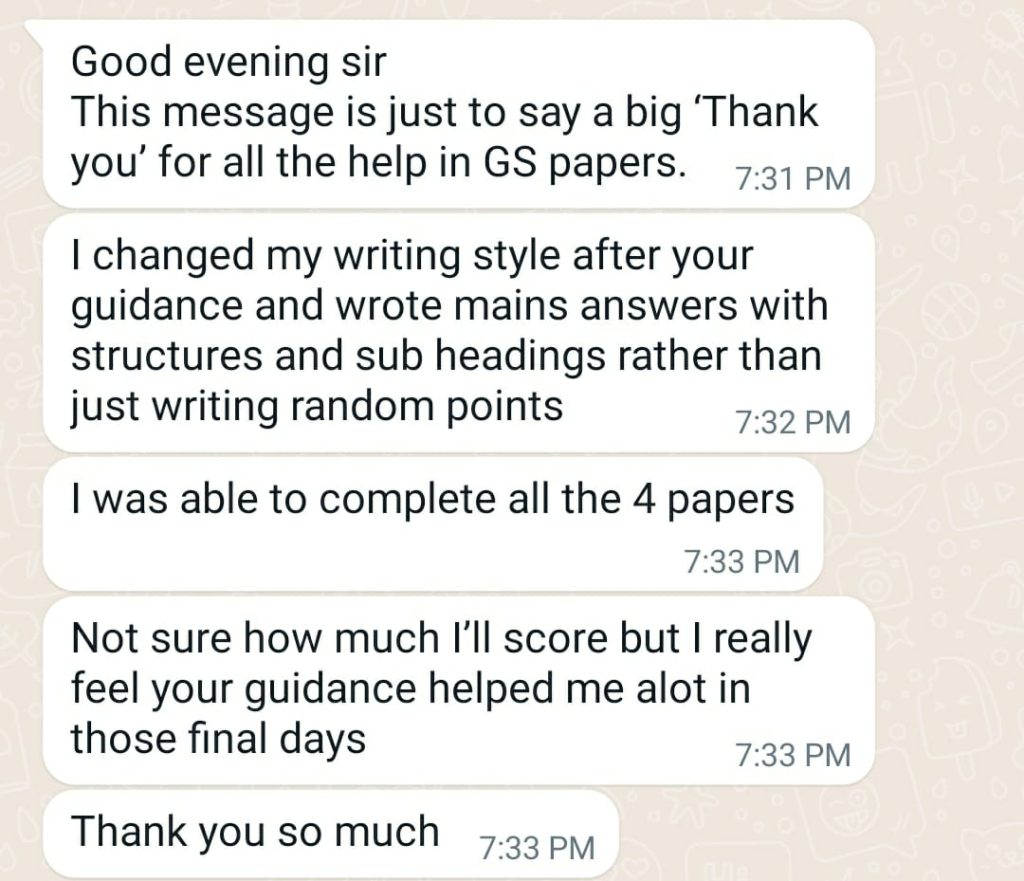
As UPSC Mains results were announced last week, Sajal sir (Co-Founder of Civilsdaily and Mentor ofSmash Mains 2021 Program) was flooded with calls by delighted aspirants who thanked him for his mentorship. Sajal Sir himself is the topper of GS 2017 Mains paper and mentor of 400 UPSC Toppers.
After a quick check, we found out 41 Smash Mains students are qualified to attend the interview this year. As we are waiting for their interview results, we will not be announcing their names right now. However, we are sharing the testimonials of the qualified aspirants. We wish them all the very best!
As prelims is round the corner, you would have already started your revision. The main purpose of the UPSC prelims exam is to test your conceptual clarity in basic topics and application of current affairs in subject-related questions. Since the questions in prelims aren’t direct or straightforward, they appear to be outside the standard book and NCERTs.
Based on our research, we have come up with nearly 30-35 important subject-wise topics for Prelims 2022. In this article, we will be highlighting only 3 topics per subject. Those aspirants interested to get the complete handbook of Must-Read Static+ Current Affairs Prelims Topics can register for ourFree 1-on-1 Mentorship Session.Along With the Free Consultation+Handbook, aspirants will Get Free Personalised 60 Days Revision Timetable for Prelims 2022.
Polity
Important Supreme Court Judgements.
Revise important judgements passed by the Supreme Court in the year 2021 along with those mentioned in your polity standard books like Keshvananda Bharati case, Uman Rao Case and Minerva Mills Case. While reading up the reasoning behind the judgements, you will gain clarity of the constitutional provisions.
Fundamental Rights from Article 12-35
Every year, a minimum of 2-3 questions mandatorily ask about the basic human rights guaranteed by the constitution, their significance and limitations. Sample these questions from Prelims 2021.
1. Under the Indian constitution concentration of wealth violates
(a) The Right to Equality
(b) The Directive Principles of State Policy
(c) The Right to Freedom
(d) The Concept of Welfare
2. A legislation which confers on the executive or administrative authority an unguided and uncontrolled discretionary power in the matter of the application of law violates which one of the following Articles of the Constitution of India?
(a) Article 14
(b) Article 28
(c) Article 32
(d) Article 44
Non-constitutional Bodies
Questions have been consistently asked about the recent developments in the quasi-judicial, statutory and regulatory bodies set up by the state legislatures. Examples include the National Human Rights Commission, National Green Tribunal and National Law Commission. One must be aware of the corresponding laws around which these bodies were established.
Inflation has been a persistent issue that has affected Indians every year. Everytime, there is news on how the RBI plans to tackle the issue or how foreign crises result in inflation of goods in India. Aspirants are expected to understand types of inflation like demand-pull inflation, cost-push inflation and wholesale price inflation. Remedies for inflation can be found in the current affairs section. One can expect 2-3 questions in prelims from this section. The prelims questions would test the conceptual clarity in fiscal policy and inflation.
Money market
Aspirants are expected to have a general and not specialized knowledge on the financial instruments with high liquidity and short term maturities. The different kinds of credit that exist for different sections of the society needs to be read.
GDP Estimates
Every year one question in prelims is about the GDP estimates of a particular year. While reading this topic, aspirants must note down the department that releases this report, the difference between GDP and GVA and the Index of Industrial Production (IIP).
Aspirants are expected to make micronotes from the standard books they are reading on the role of international institutions in combating environmental pollution through conventions, acts and policies. Examples of such conventions are Stockholm convention, Ramsar Convention, CITES etc.
Biogeochemical cycles
Aspirants need to be familiar with the process of biogeochemical cycle, the types of biogeochemical cycle and the significance of the same. Questions around this are typically direct and straightforward.
Mapping of national parks, wildlife sanctuaries and wetlands
Every year, aspirants definitely get 3-5 fact based questions on national parks. Some of these questions could be asked due to a recent development in a particular park. For example, the Chilika Lake wetland was recently in news in January due to migratory birds like the Mongolian Gull staying there. The Chilika Lake is the first wetland of international importance under Ramsar convention. Certain aspects the aspirants must note down are the areas where the particular national park or wetland is spread across, the major attractions, the economic and social significance of the place.
Any report released by an international organisation on the performance of India against other countries under certain parameters must be revised. This includes The Global Hunger Index, World Happiness Report and Human Development Index.
GOI schemes for 2021
Ranging from agriculture, education, MSMEs, vulnerable sections and banking, aspirants need to have awareness on government initiatives in 2021. This will make it easier for them to solve indirect questions as well.
Electric Vehicles: India’s commitment towards electric vehicles and COP26 of Glasgow might be areas where prelims questions would be asked. Aspirants should understand the various measures to develop and promote the EV ecosystem in the country such asFaster Adoption and Manufacturing of Electric Vehicles (FAME II) scheme, Production-Linked Incentive (PLI) scheme for Advanced Chemistry Cell (ACC) and the recently launched PLI scheme for Auto and Automotive Components for manufacturers of electric vehicles.
Dark Genome
This is a hot topic in DNA research and aspirants must understand why research in this area is essential for treatment of diseases. Questions on genetics can be expected from Prelims this time.
Emerging technologies (5G, AI, Machine learning)
In recent years, a lot of questions have appeared about the latest developments in technology, their discoveries and the latest theories related to them. Few of these technologies are 5G, Quantum Key Distribution technology, hydrogen fuel cell etc. Aspirants must micronotes on these topics from prelims perspective.
Aspirants must practice places in the Indian Map on a regular basis. Particularly, they must focus on himalayan rivers like Ganga, Brahmaputra and Yamuna, peninsular rivers like Damodar, Mahanadi, Godavari, Krishna, Kaveri and Periyar. Not only rivers, but aspirants must know where exactly their tributaries are located. Apart from this, North to South Alignment of Mountains in Eastern ghat and Western Ghat, Andaman, Nicobar and Lakshadweep islands and Industrial Location and Ports need to be marked.
Climatic Regions in India
Aspirants must learn about the onset and withdrawal of the Indian Monsoon system, tropical cyclones, different climatic zones, factors that cause shifts in climate and intertropical convergence zone.
Continental Shift Theory
Present in the NCERT textbooks, this theory talks about the formation of different continents. Aspirants must keep an eye for one or two questions that might come from this topic in the Geography section.
Want to Know How a Free 1-on-1 Mentorship Looks Like? Watch This Video
In this video, there is first an initial discussion of the test performance, which is then followed by the mentor discussing the questions which the aspirant had got wrong and then he will ask the aspirant, where did he study the topic and to share the notes he made on that topic. The mentor will find out the problem and suggest the correct method of studying the topics. After the session gets over, the aspirant has to study the topics where he couldn’t score high marks in polity. After this, the next day the mentor will conduct another test only on those topics. This way the aspirant gains an understanding on how to approach the whole subject of polity.
HOW TO ATTEMPT ANSWERS IN DAILY ANSWER WRITING ENHANCEMENT(AWE)?
Daily 4 questions from General studies 1, 2, 3, and 4 will be provided to you.
A Mentor’s Comment will be available for all answers. This can be used as a guidance tool but we encourage you to write original answers.
You can write your answer on an A4 sheet and scan/click pictures of the same.
Upload the scanned answer in the comment section of the same question.
Along with the scanned answer, please share your Razor payment ID, so that paid members are given priority.
If you upload the answer on the same day like the answer of 11th February is uploaded on 11th February then your answer will be checked within 72 hours. Also, reviews will be in the order of submission- First come first serve basis
If you are writing answers late, for example, 11th February is uploaded on 13th February , then these answers will be evaluated as per the mentor’s schedule.
We encourage you to write answers on the same day. However, if you are uploading an answer late then tag the mentor like @Staff so that the mentor is notified about your answer.
*In case your answer is not reviewed, reply to your answer saying *NOT CHECKED*.
As UPSC Mains results were announced last week, Sajal sir (Co-Founder of Civilsdaily and Mentor ofSmash Mains 2021 Program) was flooded with calls by delighted aspirants who thanked him for his mentorship. Sajal Sir himself is the topper of GS 2017 Mains paper and mentor of 400 UPSC Toppers.
After a quick check, we found out 41 Smash Mains students are qualified to attend the interview this year. As we are waiting for their interview results, we will not be announcing their names right now. However, we are sharing the testimonials of the qualified aspirants. We wish them all the very best!
As prelims is round the corner, you would have already started your revision. The main purpose of the UPSC prelims exam is to test your conceptual clarity in basic topics and application of current affairs in subject-related questions. Since the questions in prelims aren’t direct or straightforward, they appear to be outside the standard book and NCERTs.
Based on our research, we have come up with nearly 30-35 important subject-wise topics for Prelims 2022. In this article, we will be highlighting only 3 topics per subject. Those aspirants interested to get the complete handbook of Must-Read Static+ Current Affairs Prelims Topics can register for ourFree 1-on-1 Mentorship Session.Along With the Free Consultation+Handbook, aspirants will Get Free Personalised 60 Days Revision Timetable for Prelims 2022.
Polity
Important Supreme Court Judgements.
Revise important judgements passed by the Supreme Court in the year 2021 along with those mentioned in your polity standard books like Keshvananda Bharati case, Uman Rao Case and Minerva Mills Case. While reading up the reasoning behind the judgements, you will gain clarity of the constitutional provisions.
Fundamental Rights from Article 12-35
Every year, a minimum of 2-3 questions mandatorily ask about the basic human rights guaranteed by the constitution, their significance and limitations. Sample these questions from Prelims 2021.
1. Under the Indian constitution concentration of wealth violates
(a) The Right to Equality
(b) The Directive Principles of State Policy
(c) The Right to Freedom
(d) The Concept of Welfare
2. A legislation which confers on the executive or administrative authority an unguided and uncontrolled discretionary power in the matter of the application of law violates which one of the following Articles of the Constitution of India?
(a) Article 14
(b) Article 28
(c) Article 32
(d) Article 44
Non-constitutional Bodies
Questions have been consistently asked about the recent developments in the quasi-judicial, statutory and regulatory bodies set up by the state legislatures. Examples include the National Human Rights Commission, National Green Tribunal and National Law Commission. One must be aware of the corresponding laws around which these bodies were established.
Inflation has been a persistent issue that has affected Indians every year. Everytime, there is news on how the RBI plans to tackle the issue or how foreign crises result in inflation of goods in India. Aspirants are expected to understand types of inflation like demand-pull inflation, cost-push inflation and wholesale price inflation. Remedies for inflation can be found in the current affairs section. One can expect 2-3 questions in prelims from this section. The prelims questions would test the conceptual clarity in fiscal policy and inflation.
Money market
Aspirants are expected to have a general and not specialized knowledge on the financial instruments with high liquidity and short term maturities. The different kinds of credit that exist for different sections of the society needs to be read.
GDP Estimates
Every year one question in prelims is about the GDP estimates of a particular year. While reading this topic, aspirants must note down the department that releases this report, the difference between GDP and GVA and the Index of Industrial Production (IIP).
Aspirants are expected to make micronotes from the standard books they are reading on the role of international institutions in combating environmental pollution through conventions, acts and policies. Examples of such conventions are Stockholm convention, Ramsar Convention, CITES etc.
Biogeochemical cycles
Aspirants need to be familiar with the process of biogeochemical cycle, the types of biogeochemical cycle and the significance of the same. Questions around this are typically direct and straightforward.
Mapping of national parks, wildlife sanctuaries and wetlands
Every year, aspirants definitely get 3-5 fact based questions on national parks. Some of these questions could be asked due to a recent development in a particular park. For example, the Chilika Lake wetland was recently in news in January due to migratory birds like the Mongolian Gull staying there. The Chilika Lake is the first wetland of international importance under Ramsar convention. Certain aspects the aspirants must note down are the areas where the particular national park or wetland is spread across, the major attractions, the economic and social significance of the place.
Any report released by an international organisation on the performance of India against other countries under certain parameters must be revised. This includes The Global Hunger Index, World Happiness Report and Human Development Index.
GOI schemes for 2021
Ranging from agriculture, education, MSMEs, vulnerable sections and banking, aspirants need to have awareness on government initiatives in 2021. This will make it easier for them to solve indirect questions as well.
Electric Vehicles: India’s commitment towards electric vehicles and COP26 of Glasgow might be areas where prelims questions would be asked. Aspirants should understand the various measures to develop and promote the EV ecosystem in the country such asFaster Adoption and Manufacturing of Electric Vehicles (FAME II) scheme, Production-Linked Incentive (PLI) scheme for Advanced Chemistry Cell (ACC) and the recently launched PLI scheme for Auto and Automotive Components for manufacturers of electric vehicles.
Dark Genome
This is a hot topic in DNA research and aspirants must understand why research in this area is essential for treatment of diseases. Questions on genetics can be expected from Prelims this time.
Emerging technologies (5G, AI, Machine learning)
In recent years, a lot of questions have appeared about the latest developments in technology, their discoveries and the latest theories related to them. Few of these technologies are 5G, Quantum Key Distribution technology, hydrogen fuel cell etc. Aspirants must micronotes on these topics from prelims perspective.
Aspirants must practice places in the Indian Map on a regular basis. Particularly, they must focus on himalayan rivers like Ganga, Brahmaputra and Yamuna, peninsular rivers like Damodar, Mahanadi, Godavari, Krishna, Kaveri and Periyar. Not only rivers, but aspirants must know where exactly their tributaries are located. Apart from this, North to South Alignment of Mountains in Eastern ghat and Western Ghat, Andaman, Nicobar and Lakshadweep islands and Industrial Location and Ports need to be marked.
Climatic Regions in India
Aspirants must learn about the onset and withdrawal of the Indian Monsoon system, tropical cyclones, different climatic zones, factors that cause shifts in climate and intertropical convergence zone.
Continental Shift Theory
Present in the NCERT textbooks, this theory talks about the formation of different continents. Aspirants must keep an eye for one or two questions that might come from this topic in the Geography section.
Want to Know How a Free 1-on-1 Mentorship Looks Like? Watch This Video
In this video, there is first an initial discussion of the test performance, which is then followed by the mentor discussing the questions which the aspirant had got wrong and then he will ask the aspirant, where did he study the topic and to share the notes he made on that topic. The mentor will find out the problem and suggest the correct method of studying the topics. After the session gets over, the aspirant has to study the topics where he couldn’t score high marks in polity. After this, the next day the mentor will conduct another test only on those topics. This way the aspirant gains an understanding on how to approach the whole subject of polity.
This Spotlight is a part of our Mission Nikaalo Prelims-2022.
You can check the broad timetable of Nikaalo Prelims here
Session Details
Morning 12 PM – Prelims Spotlight Session
Evening 06:30 PM – TIKDAM/MCQs Session
Noon 03:00 PM – CSAT Google Meet Session
Evening 08 PM – Tests on Alternate Days
Join our Official telegram channel for Study material for GS and CSATHere
28th March 2022
Important officers and their role in the Maurya Empire
Sannidhata – Treasurer and keeper of the stores in Maurya Period. He was in charge of the collection of revenue from various parts of the kingdom and looked after the income and expenditure by supervising the works of akshapataladhyaksha (Accountant-General)
Samharta– His function was to collect Revenue both in cash and kind.
Amatyas–They were some sort of administrative personnel or civil servants who filled the highest administrative and judicial appointments.
Rajukas–Ashoka appointed a class of officers known as the Rajukas, who were vested with the authority of rewarding as well we punishing people.
Adhyaksas- The officers who looked after the various departments.
Yuktas-They appear to have been the subordinate official whose duties were largely secretarial works and accounting.
Gopa and Sthanika- There was an intermediate level of administration between the district level and village level, which was administered by the Gopa and Sthanikas.
Gramika- Head of the village. He was not a paid servant and was chosen among village elders.
Grambhojaka- Gramika was helped by Grambhojaka.
Pramukha- Eighteen chief handicrafts of the time were organised in guilds called as Shrenis, the president of Shrenis was known as Pramukha.
Important officers of the Gupta empire
Uparika-He was directly appointed by the king as a provincial governor.
Kumaramatyas-A link between the central and the provincial administration under the Guptas was provided by the officers called Kumaramatyas and Ayuktas. Kumaramatyas was a body of top-ranking officials attached not only to the king but also to the crown-prince and sometimes placed in charge of district.
Gopasramin- In Samudraguptas period an officer working as akshapataladhikrita. Their function was to enter numerous matters in the accounts register, recover royal dues and to check embezzlement and recover fines.
Sandhivigrahika-The foreign minister, minister of war and peace. First appeared under the rule of Samudragupta.
Mahabaldikarta-Commander-in-Chief.
Mahadandanayaka-
Mahapratihara- Chief of palace guards.
Pustapala- Record-keeper. Maintained record of land transactions in a district. They were also known as Karanika.
Vishaya- Vishayas were divided into smaller parts called Vithis which were the villages and consisted of the lowest unit of administration.
Mahattama,Mahattaka and Mahattara- Elder who assisted the Gramika in the village administration.
Agharikas- During the reign of Harsha, Agharikas looked after the land given in charity.
Samantas- Feudal chiefs.
Important officers of Satvahana Period
Uparakshita- In Satvahanas kingdom, their function was building caves for monks.
Gaulamika- Administration of the villages was placed under them in the Satvahana period.
Valaikkarars- Troops in the royal service and were the bodyguard of the monarch.
Medieval India
Amils– Revenue officers
Arz-i-mamalik– Minister in-charge of the army of the whole country.
Ahl-i-qalam– Reporter
Baqqal– Trader, grain-dealer
Batai– Division of crop between the cultivator and landlord or the government, payments may be in
kind or cash
Barid- An intelligence officer appointed by the state to collect information
Chachar– Land out of cultivation for 3-4 years.
Chaauth or Chauthaai– One-fourth of the land revenue, originally a Zamindari charge in Gujrat demanded by Shivaji as a war expense.
Charai– A tax on cattle.
Dagh System– A system of branding of horses and animal.
Dam- A copper coin considered as 1/40* the silver rupee for the official purposes.
Dastur-al-amal- Rule book
Dhimmi- A non-Muslim client or subject
Darul Mulk- Capital
Gumashta- An agent or representative
Hamam– A room for the bath of hot and cold water
Hundi- A bill of exchange
Jamabandi– Settlement of the amount of revenue assessed upon an estate or district
Jarib– A measurement, land measurement or survey
Jihat– Extra cesses
Jizya– (a) In the literature of Delhi sultanate, any tax which is not kharaj or land tax
(b) In the Shariat, a personal and yearly tax on non-Muslims.
Kankut– Estimation of land revenue
Karori– A revenue officer.
Khiraj– Land revenue
Mahal- A group of land regarded as a unit for land revenue purposes.
Mansab– A military rank conferred by the Mughal emperor.
Mauza- Revenue term for village
Mokasa- Grant of land for military service, rent-free land.
Nabud– Remission of land revenue on account of natural disasters.
Paibaqi- Land reserved for allotment in jagir
Polaj- Land continuously in cultivation
Sarrafs– Money Chargers, bankers
Saurghal-Rent-free land
Taqavi- Advance of money for sowing or extending cultivation
Civilsdaily Team is inviting you to a scheduled Zoom meeting.
Ask Me Anything || What is the 3-2-1-0 E Method of Solving UPSC Prelims Paper? || by IAS Kunal Chavan (2020 Batch) Date & Time: Mar 27, 2022 @08:00 PM (Start Login By 07:45 PM) India
As UPSC Mains results were announced last week, Sajal sir (Co-Founder of Civilsdaily and Mentor ofSmash Mains 2021 Program) was flooded with calls by delighted aspirants who thanked him for his mentorship. Sajal Sir himself is the topper of GS 2017 Mains paper and mentor of 400 UPSC Toppers.
After a quick check, we found out 41 Smash Mains students are qualified to attend the interview this year. As we are waiting for their interview results, we will not be announcing their names right now. However, we are sharing the testimonials of the qualified aspirants. We wish them all the very best!
What would you do if UPSC Civil Services Preliminary Exam was conducted right now? What method would you use to solve the question paper? Would you start with Question 1 and work your way up to the 100th question, or would you take a different approach? Given the possibility of negative marking, how many questions would you generally attempt?
Any UPSC-CSE topper who has successfully cleared the Prelims exam, use the 3-2-1-0 E method, otherwise also called the 100-50-33-25 per cent method. What’s that?
Free Live Q&A Webinar with IAS Officer Kunal Chavan
The 3-2-1-0 E Method is nothing but the 4 stages of answering the UPSC Prelims paper. In the first round, you have to answer those questions you are 100% sure of (i.e you can eliminate all the 3 options), in the second round, answer those questions you are 50% sure of (can eliminate only 2 options) and the third round answer those question you are only 33% sure of (can eliminate only 1 option). Finally, just check those questions where you are unable to eliminate any options. To be on a safer side, leave those questions unanswered.
However, since UPSC prelims is a competitive exam, what can we do about those questions where you are 50-25% sure of? How do you find the right answers using your exisiting knowledge? This free live webinar, we have invited IAS officer Kunal Chavan to help you out.
IAS Officer Kunal Chavan belongs to the Orissa cadre. He started his UPSC-CSE preparation in 2015. The first time he was unable to clear prelims. In the next three attempts, he reached the interview stage. Finally he cleared the exam with an All India Rank 211 to become an IAS officer.
What Will You Learn in This Q&A Webinar with IAS Officer Kunal Chavan
1. Analysing a test when attempting the paper. How to save time while answering each question?
2. What was the change in Kunal’s strategy after 2015? He will talk about the mistakes he made while studying for his first attempt.
3. The online revision sources Kunal used in the last few days to prelims. Why is it important to revise online sources of those topics you couldn’t score well in your test series?
4. The static part of current affairs and the dynamic part of NCERTs and standard books. What’s that?
5. How to use elimination techniques for each of the 4 rounds? Kunal Chavan speaks from his experience.
6. Finding hints in prelims questions. Kunal Chavan IAS will conduct live demonstration of certain UPSC questions.
7. The important prelims topics for 2022. Kunal Chavan IAS will list out the important topics for every subject.
Webinar Details
The free live webinar will be mostly in Q&A format, where IAS officer Kunal Chavan will answer every aspirant’s doubts. Since, it’s only a 1-hour session, the intake is limited. Hence, fill the registration form ASAP to confirm you slot!
As UPSC Mains results were announced last week, Sajal sir (Co-Founder of Civilsdaily and Mentor ofSmash Mains 2021 Program) was flooded with calls by delighted aspirants who thanked him for his mentorship. Sajal Sir himself is the topper of GS 2017 Mains paper and mentor of 400 UPSC Toppers.
After a quick check, we found out 41 Smash Mains students are qualified to attend the interview this year. As we are waiting for their interview results, we will not be announcing their names right now. However, we are sharing the testimonials of the qualified aspirants. We wish them all the very best!
What would you do if UPSC Civil Services Preliminary Exam was conducted right now? What method would you use to solve the question paper? Would you start with Question 1 and work your way up to the 100th question, or would you take a different approach? Given the possibility of negative marking, how many questions would you generally attempt?
Any UPSC-CSE topper who has successfully cleared the Prelims exam, use the 3-2-1-0 E method, otherwise also called the 100-50-33-25 per cent method. What’s that?
Free Live Q&A Webinar with IAS Officer Kunal Chavan
The 3-2-1-0 E Method is nothing but the 4 stages of answering the UPSC Prelims paper. In the first round, you have to answer those questions you are 100% sure of (i.e you can eliminate all the 3 options), in the second round, answer those questions you are 50% sure of (can eliminate only 2 options) and the third round answer those question you are only 33% sure of (can eliminate only 1 option). Finally, just check those questions where you are unable to eliminate any options. To be on a safer side, leave those questions unanswered.
However, since UPSC prelims is a competitive exam, what can we do about those questions where you are 50-25% sure of? How do you find the right answers using your exisiting knowledge? This free live webinar, we have invited IAS officer Kunal Chavan to help you out.
IAS Officer Kunal Chavan belongs to the Orissa cadre. He started his UPSC-CSE preparation in 2015. The first time he was unable to clear prelims. In the next three attempts, he reached the interview stage. Finally he cleared the exam with an All India Rank 211 to become an IAS officer.
What Will You Learn in This Q&A Webinar with IAS Officer Kunal Chavan
1. Analysing a test when attempting the paper. How to save time while answering each question?
2. What was the change in Kunal’s strategy after 2015? He will talk about the mistakes he made while studying for his first attempt.
3. The online revision sources Kunal used in the last few days to prelims. Why is it important to revise online sources of those topics you couldn’t score well in your test series?
4. The static part of current affairs and the dynamic part of NCERTs and standard books. What’s that?
5. How to use elimination techniques for each of the 4 rounds? Kunal Chavan speaks from his experience.
6. Finding hints in prelims questions. Kunal Chavan IAS will conduct live demonstration of certain UPSC questions.
7. The important prelims topics for 2022. Kunal Chavan IAS will list out the important topics for every subject.
Webinar Details
The free live webinar will be mostly in Q&A format, where IAS officer Kunal Chavan will answer every aspirant’s doubts. Since, it’s only a 1-hour session, the intake is limited. Hence, fill the registration form ASAP to confirm you slot!
As UPSC Mains results were announced last week, Sajal sir (Co-Founder of Civilsdaily and Mentor ofSmash Mains 2021 Program) was flooded with calls by delighted aspirants who thanked him for his mentorship. Sajal Sir himself is the topper of GS 2017 Mains paper and mentor of 400 UPSC Toppers.
After a quick check, we found out 41 Smash Mains students are qualified to attend the interview this year. As we are waiting for their interview results, we will not be announcing their names right now. However, we are sharing the testimonials of the qualified aspirants. We wish them all the very best!
What would you do if UPSC Civil Services Preliminary Exam was conducted right now? What method would you use to solve the question paper? Would you start with Question 1 and work your way up to the 100th question, or would you take a different approach? Given the possibility of negative marking, how many questions would you generally attempt?
Any UPSC-CSE topper who has successfully cleared the Prelims exam, use the 3-2-1-0 E method, otherwise also called the 100-50-33-25 per cent method. What’s that?
Free Live Q&A Webinar with IAS Officer Kunal Chavan
The 3-2-1-0 E Method is nothing but the 4 stages of answering the UPSC Prelims paper. In the first round, you have to answer those questions you are 100% sure of (i.e you can eliminate all the 3 options), in the second round, answer those questions you are 50% sure of (can eliminate only 2 options) and the third round answer those question you are only 33% sure of (can eliminate only 1 option). Finally, just check those questions where you are unable to eliminate any options. To be on a safer side, leave those questions unanswered.
However, since UPSC prelims is a competitive exam, what can we do about those questions where you are 50-25% sure of? How do you find the right answers using your exisiting knowledge? This free live webinar, we have invited IAS officer Kunal Chavan to help you out.
IAS Officer Kunal Chavan belongs to the Orissa cadre. He started his UPSC-CSE preparation in 2015. The first time he was unable to clear prelims. In the next three attempts, he reached the interview stage. Finally he cleared the exam with an All India Rank 211 to become an IAS officer.
What Will You Learn in This Q&A Webinar with IAS Officer Kunal Chavan
1. Analysing a test when attempting the paper. How to save time while answering each question?
2. What was the change in Kunal’s strategy after 2015? He will talk about the mistakes he made while studying for his first attempt.
3. The online revision sources Kunal used in the last few days to prelims. Why is it important to revise online sources of those topics you couldn’t score well in your test series?
4. The static part of current affairs and the dynamic part of NCERTs and standard books. What’s that?
5. How to use elimination techniques for each of the 4 rounds? Kunal Chavan speaks from his experience.
6. Finding hints in prelims questions. Kunal Chavan IAS will conduct live demonstration of certain UPSC questions.
7. The important prelims topics for 2022. Kunal Chavan IAS will list out the important topics for every subject.
Webinar Details
The free live webinar will be mostly in Q&A format, where IAS officer Kunal Chavan will answer every aspirant’s doubts. Since, it’s only a 1-hour session, the intake is limited. Hence, fill the registration form ASAP to confirm you slot!
As UPSC Mains results were announced last week, Sajal sir (Co-Founder of Civilsdaily and Mentor ofSmash Mains 2021 Program) was flooded with calls by delighted aspirants who thanked him for his mentorship. Sajal Sir himself is the topper of GS 2017 Mains paper and mentor of 400 UPSC Toppers.
After a quick check, we found out 41 Smash Mains students are qualified to attend the interview this year. As we are waiting for their interview results, we will not be announcing their names right now. However, we are sharing the testimonials of the qualified aspirants. We wish them all the very best!
What would you do if UPSC Civil Services Preliminary Exam was conducted right now? What method would you use to solve the question paper? Would you start with Question 1 and work your way up to the 100th question, or would you take a different approach? Given the possibility of negative marking, how many questions would you generally attempt?
Any UPSC-CSE topper who has successfully cleared the Prelims exam, use the 3-2-1-0 E method, otherwise also called the 100-50-33-25 per cent method. What’s that?
Free Live Q&A Webinar with IAS Officer Kunal Chavan
The 3-2-1-0 E Method is nothing but the 4 stages of answering the UPSC Prelims paper. In the first round, you have to answer those questions you are 100% sure of (i.e you can eliminate all the 3 options), in the second round, answer those questions you are 50% sure of (can eliminate only 2 options) and the third round answer those question you are only 33% sure of (can eliminate only 1 option). Finally, just check those questions where you are unable to eliminate any options. To be on a safer side, leave those questions unanswered.
However, since UPSC prelims is a competitive exam, what can we do about those questions where you are 50-25% sure of? How do you find the right answers using your exisiting knowledge? This free live webinar, we have invited IAS officer Kunal Chavan to help you out.
IAS Officer Kunal Chavan belongs to the Orissa cadre. He started his UPSC-CSE preparation in 2015. The first time he was unable to clear prelims. In the next three attempts, he reached the interview stage. Finally he cleared the exam with an All India Rank 211 to become an IAS officer.
What Will You Learn in This Q&A Webinar with IAS Officer Kunal Chavan
1. Analysing a test when attempting the paper. How to save time while answering each question?
2. What was the change in Kunal’s strategy after 2015? He will talk about the mistakes he made while studying for his first attempt.
3. The online revision sources Kunal used in the last few days to prelims. Why is it important to revise online sources of those topics you couldn’t score well in your test series?
4. The static part of current affairs and the dynamic part of NCERTs and standard books. What’s that?
5. How to use elimination techniques for each of the 4 rounds? Kunal Chavan speaks from his experience.
6. Finding hints in prelims questions. Kunal Chavan IAS will conduct live demonstration of certain UPSC questions.
7. The important prelims topics for 2022. Kunal Chavan IAS will list out the important topics for every subject.
Webinar Details
The free live webinar will be mostly in Q&A format, where IAS officer Kunal Chavan will answer every aspirant’s doubts. Since, it’s only a 1-hour session, the intake is limited. Hence, fill the registration form ASAP to confirm you slot!


![What is the 3-2-1-0 E Method of Solving UPSC Prelims Paper? || Free Q& A Webinar by IAS Officer Kunal Chavan, Orissa Cadre [2020 Batch]|| Limited Slots Available, Register Now to Get Tikdam: Art of Elimination Handbook for Free|| Also Read: 41 out of 50 Smash Mains 2021 Aspirants Qualify for Interview This Year, They Share Their Joy with Us](https://d18x2uyjeekruj.cloudfront.net/wp-content/uploads/2022/03/Kunal-Chavan.jpg)