GS-1 Salient features of Indian Society, Diversity of India.
GS-2 Devolution of powers and finances up to local levels and challenges therein.
GS-3 Internal Security
GS-4 Aptitude and foundational values for Civil Service, integrity, impartiality and non-partisanship, objectivity, dedication to public service, empathy, tolerance and compassion towards the weaker sections.
HOW TO ATTEMPT ANSWERS IN DAILY ANSWER WRITING ENHANCEMENT(AWE)?
Daily 4 questions from General studies 1, 2, 3, and 4 will be provided to you.
A Mentor’s Comment will be available for all answers. This can be used as a guidance tool but we encourage you to write original answers.
You can write your answer on an A4 sheet and scan/click pictures of the same.
Upload the scanned answer in the comment section of the same question.
Along with the scanned answer, please share your Razor payment ID, so that paid members are given priority.
If you upload the answer on the same day like the answer of 11th February is uploaded on 11th February then your answer will be checked within 72 hours. Also, reviews will be in the order of submission- First come first serve basis
If you are writing answers late, for example, 11th February is uploaded on 13th February , then these answers will be evaluated as per the mentor’s schedule.
We encourage you to write answers on the same day. However, if you are uploading an answer late then tag the mentor like @Staff so that the mentor is notified about your answer.
*In case your answer is not reviewed, reply to your answer saying *NOT CHECKED*.
GS-1 Salient features of Indian Society, Diversity of India.
GS-2 Mechanisms, laws, institutions and bodies constituted for the protection and betterment of these vulnerable sections.
GS-3 Cyber Security
GS-4 Attitude: content, structure, function; its influence and relation with thought and behaviour; moral and political attitudes; social influence and persuasion.
HOW TO ATTEMPT ANSWERS IN DAILY ANSWER WRITING ENHANCEMENT(AWE)?
Daily 4 questions from General studies 1, 2, 3, and 4 will be provided to you.
A Mentor’s Comment will be available for all answers. This can be used as a guidance tool but we encourage you to write original answers.
You can write your answer on an A4 sheet and scan/click pictures of the same.
Upload the scanned answer in the comment section of the same question.
Along with the scanned answer, please share your Razor payment ID, so that paid members are given priority.
If you upload the answer on the same day like the answer of 11th February is uploaded on 11th February then your answer will be checked within 72 hours. Also, reviews will be in the order of submission- First come first serve basis
If you are writing answers late, for example, 11th February is uploaded on 13th February , then these answers will be evaluated as per the mentor’s schedule.
We encourage you to write answers on the same day. However, if you are uploading an answer late then tag the mentor like @Staff so that the mentor is notified about your answer.
*In case your answer is not reviewed, reply to your answer saying *NOT CHECKED*.
Only 10000 out of around 11 Lakhs aspirants who appear, qualify in the UPSC Prelims. Just the 1%. This leaves no scope for mistakes, yet many of you keep committing the same mistakes again and again.
Considering the competition, complexity, and vastness of the syllabus, and a long drawn-out preparation cycle clearing IAS prelims becomes a formidable challenge for almost 99% of the aspirants. The key lies in staying in the green zone.
Stay in the Green Zone of Optimum performance with Santosh sir’s Mentorship
In UPSC Prelims preparation it is not just the number of mocks you had attempted, syllabus covered, or UPSC experience you have had that matters but it is rather a combination of many factors. (Click here to discuss with a senior mentor)
UPSC preparation is a long journey and ups and downs, are a part of it. While intensity or motivation can give you a high for a few days but it is consistency that will sail you through. You got to stay in the green zone of optimum preparation for the longest period of time.
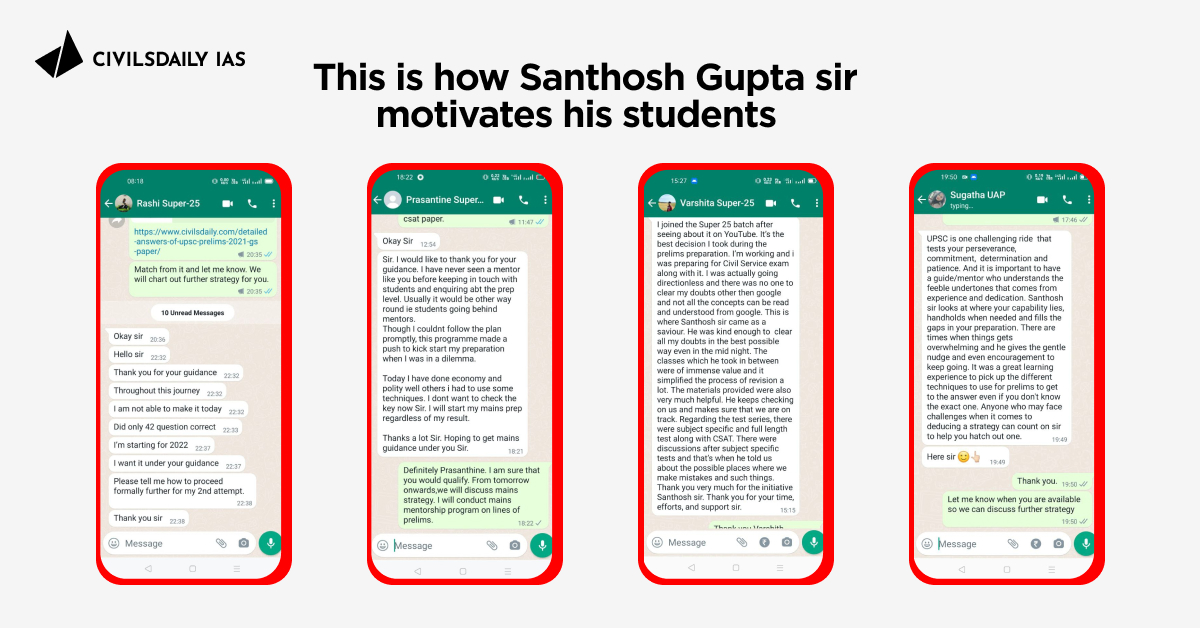
Under Santosh sir’s mentorship, students can feel consistency and improvement in UPSC Prelims preparation.
Santosh sir is always there to ensure his students are following the right sources, makes them understand the concepts, plans strategies for his students, reviews and analyses their progress even on 1-1 calls. Along with academics, he is there with his students through the bouts of demotivation and lows.
A quick bit about Santosh Gupta:
Santosh Gupta sir has scored above 140 twice in UPSC prelims and always 120 plus in all 6 attempts. He wrote all 6 mains and appeared for Interviews 3 times. He has qualified UPSC EPFO and BPSC 56-59th also. He has been teaching and mentoring UPSC aspirants for the last 5 years with tremendous interest in the environment and ecology and Polity.
Consistent effort as per a well-devised strategy and expert mentorship of Santosh sir will sail you through this challenge.
Tavishi failed thrice in the Prelims before but after joining Santosh sir’s mentorship cleared Prelim 2022 in her 4th attempt. Schedule a call with Tavishi’s mentor
SMASH PRELIMS 2023: PERSONALIZED MENTORSHIP, TEST SERIES, LECTURES, NOTES
Our Smash Prelims Program started as a pilot project last year with an aim to introduce step-wise improvement in our chosen 40 aspirants. Over a period of 2 months, Santhosh sir inculcated confidence in aspirants who were either newbies or gave too many attempts. This year, we achieved a remarkable 80% success ratio. This year, we have set our eyes on 100%. Yes, we are as ambitious and aspirational just like any other UPSC aspirant.
Moreover, aspirants must be prepared for the googlies thrown at them by UPSC in the Prelims (new things being tried out by UPSC- like options, topics, etc).
Only barrier between your success and your failure is YOU. If required, change yourself and keep working on your strengths and weaknesses.
About 6 pillared approach of Smash Prelims 2023
Pillar-1: 44 Prelims test
Prelims Tests: 44 (14 Basic + 8 Advanced + 6 CA tests + 10 Full tests + 6 CSAT tests)
Pillar-2: Special Value Additions Notes and Classes by Santosh Gupta
50 Special classes on topics including Polity, History, Economics, Geography, Sessions to cover Environment innovatively, Science & Technology and more.
Pillar-3: Mentorship calls
One-to-one mentorship by core faculty and toppers
One to one Mentor calls after tests
Habitat/WhatsApp support from mentors
Frequent sessions with toppers for support and guidance.
You are 8 times more likely to clear Prelims 2023 with Santosh sir’s mentorship
Almost 39 years after India signed the Antarctic Treaty; the Parliament last week passed the Indian Antarctic Bill 2022.
With a growing number of Indian scientists in Antarctica’s research stations and in accordance with India’s commitment to the Antarctic treaty, the center introduced this bill.
About Antarctica
Antarctica is the southernmost continent and does NOT have any indigenous population.
The entire region is demilitarized and is used for scientific and peaceful purposes as per the Antarctic Treaty that came into force on June 23, 1961.
What is the Antarctic Treaty?
The Antarctic Treaty was signed on December 01, 1959, by 12 countries: Argentina, Australia, Belgium, Chile, France, Japan, New Zealand, Norway, South Africa, the USSR, the UK, and the US.
Their objective was to:
Demilitarise Antarctica
Promote international scientific cooperation, and
To set aside territorial sovereignty disputes
In the following years, more countries joined the Antarctic treaty.
There are now 54 members, of which 29 countries have consultative (voting) status in the Antarctic Consultative Meetings held annually and 25 countries have non-consultative membership.
India and Antarctic Treaty
India became a member of the Antarctic Treaty on August 19, 1983, and on September 12 of the same year, it received consultative status.
Following the Antarctic treaty, member countries signed the ‘Convention on the Conservation of Antarctic Marine Living Resources at Canberra in 1980 which India ratified in 1985.
The countries also signed the ‘Protocol on Environmental Protection” to the Antarctic Treaty (the Madrid Protocol) in 1991, which designates the continent as a natural reserve, devoted to peace and science.’
India in Antarctica
Though there is no permanent human habitation in Antarctica, there are over 70 research stations scattered across the region from 29 countries that are signatories of the Antarctic treaty.
These countries are obliged to protect and preserve the well-being of the environment and to cooperate with fellow researchers.
India currently has two operational research stations in Antarctica:
Maitri (Commissioned in 1989) and
Bharati (Commissioned in 2012
It has also successfully launched 40 annual scientific expeditions to date.
With Himadri station in Ny-Alesund, Svalbard, above the Arctic Circle, India is among the elite set of nations that have multiple research centers in the Polar Regions.
Indian Antarctic Expedition
India’s Antarctic expeditions started in 1981 with a team of 21 scientists and support staff.
Thereafter, India launched 40 annual expeditions to the continent and set up the Antarctic Scientific Division and the Antarctic Logistics Division.
India has conducted a wide range of research on topics including the climate process and its connection with climate change, environmental processes and conservation, terrestrial ecosystem, observational research, and polar technology in the Antarctic.
The entire Indian Antarctic program is managed by the National Centre for Polar and Ocean Research (NCPOR) in Goa.
On November 15, 2021, India launched its latest exploration in the Antarctic with two major programs which aim to explore the link between India and Antarctica in the past and to understand the Antarctic climate.
Why need this bill?
The bill provides a regulatory framework for India’s Antarctic activities through legal mechanisms which will help in the efficient operation of the Indian Antarctic Programme.
It confers jurisdiction on Indian courts to deal with crimes and disputes committed by Indian citizens in parts of Antarctica.
Legislation of such a kind will bind the citizens to the policies of the Antarctic treaty system.
The bill plans to facilitate India’s involvement in the management of tourism in the Antarctic and the sustainable development of fisheries.
It also aims to increase India’s international visibility and credibility in Polar governance for cooperation in scientific studies and logistics.
The Bill prohibits activities that contaminant the Antarctic continent including, nuclear explosion and radioactive waste disposal, introduction of non-sterile soil, and discharge of plastic, garbage and other substance into the sea.
Key feature: Indian Antarctic Authority (IAA)
The Bill plans to set up IAA as an apex decision-making authority under the Earth Sciences Ministry, to provide an accountable process for supervision of Antarctic research and expeditions.
IAA will ensure the protection and preservation of the Antarctic environment and will ensure compliance by Indian citizens engaged in the Antarctic programs and activities with relevant rules and internationally agreed standards.
It will be headed by the secretary of the Ministry of Earth Sciences and will have members from other relevant ministries.
Hurdles for India
The issue of a polar research vessel, however, still needs to be addressed immediately.
So far, India has been chartering such ships from countries like Russia and Norway while China has raced ahead and has two of its own.
A decision was indeed taken by the Union Cabinet in October 2014 for India to have its own research ship with ice-breaking and other advanced technological capabilities but it remains unimplemented.
Way forward
The acquisition of a vessel on a permanent basis is a logical next step to the passage of the Bill as also the revamp of the quite old Maitri research station.
The polar research vessel will also be required as India expands its association with and involvement in the Arctic as well.
GS-1 Salient features of Indian Society, Diversity of India.
GS-2 Bilateral, regional and global groupings and agreements involving India and/or affecting India’s interests.
GS-3 Conservation, environmental pollution and degradation, environmental impact assessment.
GS-4 Attitude: content, structure, function; its influence and relation with thought and behaviour; moral and political attitudes; social influence and persuasion.
HOW TO ATTEMPT ANSWERS IN DAILY ANSWER WRITING ENHANCEMENT(AWE)?
Daily 4 questions from General studies 1, 2, 3, and 4 will be provided to you.
A Mentor’s Comment will be available for all answers. This can be used as a guidance tool but we encourage you to write original answers.
You can write your answer on an A4 sheet and scan/click pictures of the same.
Upload the scanned answer in the comment section of the same question.
Along with the scanned answer, please share your Razor payment ID, so that paid members are given priority.
If you upload the answer on the same day like the answer of 11th February is uploaded on 11th February then your answer will be checked within 72 hours. Also, reviews will be in the order of submission- First come first serve basis
If you are writing answers late, for example, 11th February is uploaded on 13th February , then these answers will be evaluated as per the mentor’s schedule.
We encourage you to write answers on the same day. However, if you are uploading an answer late then tag the mentor like @Staff so that the mentor is notified about your answer.
*In case your answer is not reviewed, reply to your answer saying *NOT CHECKED*.
Procrastination is the act of unnecessarily delaying or postponing decisions or actions. For a UPSC aspirant, it is a sure-shot killer of their IAS dream.
A certain UPSC dream killer.
You decide to study a particular topic or write answers for the day – You get distracted or are lazy or simply confused- You put off these for later and promise to do them tomorrow – That tomorrow never comes – You realize that you have wasted your time – You regret – You are sad the whole day thinking about it – You waste the whole day mourning your wasted time – You realize you have wasted another day – Days turn to weeks and weeks to months. And it is yet another wasted attempt.
Procrastination is often detrimental to people’s ability to successfully pursue their goals.
It also results in anxiety, low self-esteem, demotivation, low confidence, stress, and at times depression. A good chunk of UPSC aspirants face these issues.
CivilsDaily’s mentorship ensured Working Professional aspirants like Mourya, AIR 28 made the best use of the time they have. Click and Talk to Mourya’s mentor
We need to understand why we procrastinate
After talking to thousands of aspirants and Rankers from CivilsDaily we came to a conclusion that almost 99% of the aspirants procrastinate, to varying degrees. You are not alone. There are several reasons for putting things off for a later time:
1. Fear of failure, or performing badly in the initial stages of preparation is one of the chief reasons. Aspirants often feel underconfident and not prepared to start writing answers, or attempting a Prelims Mock.
2. Overthinking, mostly about irrelevant things – due to ignorance, excess of information. Most of the IAS aspirants waste a lot of time thinking a lot on the best resources, reading a lot of irrelevant books, discussing and fantasizing about various political concepts, etc. You gotta stop it.
3. Perfectionismor waiting for the most appropriate time– 95% is not good as 100%. But its a lot better than zero
It’s tempting to want the best UPSC resources, collect the finest of the notes, try to memorize every concept before you start writing your first answer, or attempt your first IAS Prelims mock.
Don’t wait till you have covered the whole GS syllabus to write your first Essay or first answer. Writing daily answers, even if they are not of UPSC standard will take you a long way to actually writing UPSC level answers in the actual UPSC Mains exam hall.
4. Fear of the wrong choice- any decision is better than no decision. But when a lot of time (attempts), finances, and efforts are at stake the informed decision is the best. Talk to a senior mentor to decide on optional, when, and how to start writing answers, when to start attempting the mock tests, and other important decisions.
5. Boring topics, culture, geography, CSAT, writing long essays. You can’t delegate here, and nor can you leave it, especially when you have time. Talk to some senior, mentor, or teacher who will point out important topics, will help make it a fun activity, or chart out a plan to cover the ‘boring topics’.
You need to understand the reasons why you are procrastinating before you can begin to tackle it.
Aspirants and people, in general, shy away from routines, timetables, systems, and processes because they want to have “freedom” or maybe due to ignorance. But in order to get things done, you need a process, bound by certain rules. It will include:
Breaking down the whole syllabus into small chunks (chapters and sections).
Setting a clear plan of action for the coming week and months, daily targets which are flexible as per your time requirement, and considering other factors. Click here to get a timetable made by UPSC Ranker
Make yourself accountable to the process or mentor so that you are executing (covering the syllabus, giving tests, etc.) on a daily basis.
Measuring your progress on a regular basis. This is best done by a senior or someone experienced who can evaluate your progress based on the tests, and answer writing.
Not fearing bad performance, but instead understanding where you went wrong and how to improve.
Why do you need a mentor to help you fight procrastination?
1. Setting an accountability system in place: If you make yourself accountable to someone else, you’re far more likely to achieve your goals. Ask them to check in on your progress from time to time.
2. Setting your own deadlines never works. We rarely respect self-imposed deadlines because we don’t feel too bad about breaking promises we’ve made to ourselves. But we do respect promises we make to others.
Introducing three layers of Mentorship with IAS/UPSC Ranker as your mentor.
3. Prioritising and target setting: A experienced mentor will help you prioritize topics beforehand and set targets. At times aspirants leave topics or subjects like Ethics, Optional till the post-prelims preparation phase. A mentor will integrate these into your preparation from the start.
4. Maintaining motivation and emotional self-control: Not always you will be in a jolly mood or motivated. UPSC prep is a long journey and there will be bouts of lows. An experienced mentor who has gone through the same journey helps in maintaining sanity during the UPSC process.
Mentoring UPSC aspirants like an elder brother.
How does Samanvaya Mentorship work? Introducing 3 layers of mentorship: Get IAS or UPSC ranker as your mentor
1. 1st step starts with this Samanvayacall: Once you fill in the form, we get on a 30-40 minute call with you to understand your prep level, working/ study constraints, and current strategies and create a step-by-step plan for the next week, next month and so on.
2. You are directed and given access to relevant resources and invite-only platform, Habitat where you can ask your daily doubts, discuss your test-prep questions and have real-time, live sessions on news and op-eds, and find your optional groups.
Daily target monitoring.
3. The third and the most personalized tier is the 1 on 1 mentor allotment who stays with you through the course of your UPSC preparation – always-on chat and on scheduled calls to help you assess, evaluate, and chart the next milestone of your IAS 2023-23 journey.
We will also connect you to a UPSC ranker or IAS, who will mentor you in this journey.
Layer 1: You will be assigned a dedicated in-house mentor who will keep track of our progress from start till your final interview.
Layer 2: Sajal Singh sir and the team will be constantly with you through various programs like Samachar Manthan, Prelims, Essay, etc.
Layer 3: A UPSC IAS ranker (one who has cleared this exam) will be supervising your progress as your super mentor.
Who are you?
Working Junta? If you are preparing for IAS 2023-24 and working simultaneously, we can help you design a timetable that fits right in your hectic schedule.
First-time prep? If you are in the last year of college or thinking of dropping a year and preparing for IAS 2023-24 full-time, we can help you pick the right books and craft a practical & personal strategy.
In our interaction with almost 12,000 working professional aspirants (those with a full-time job and preparing for UPSC CSE) over the past couple of months it was revealed that Time management and consistency were the major issue to their preparation.
This is something you aspirants can’t avoid and move on. This Sunday we conducted another power-packed FREE Masterclass session with an IPS officer.
Dilpreet Singh was a CivilsDaily’s mentorship and Samachar Manthan student. He was a Mechanical Engineer who cleared PCS twice and was a working professional at the time of his UPSC attempt which landed him an AIR 237 and IPS.
Why time management?
Time management with the help of a mentor makes your preparation effective.
Time management is a #UPSCskill that tops all other skills in this long journey. Moreover, the complexity and vastness of the syllabus, unpredictability and ever-changing pattern of the UPSC exam, and cut-throat competition necessitate you to invest your time wisely.
Over that, if you are a working professional, college student, or homemaker, and preparing for this exam, and if you don’t have a workable timetable, you won’t be able to stay consistent and your preparation will suffer.
There is no consistency and discipline without time-management. You need guidance for that.
Consistency is the key
Masterclass details
Dilpreet took up an interactive session (1-1 questions) from the aspirants on time management, timetable, and staying consistent. This session in particular is a must for UPSC aspirants who are working professionals and in general, for all aspirants with a serious time crunch.
Other than the points mentioned above we will be discussing the following issues as well.
Management of Priorities – UPSC, family, life, and work.
Reducing time on non-priorities and maintaining focus on daily and weekly targets.
Planning ahead, making targets, staying consistent w.r.t targets and your UPSC preparation.
How should the syllabus be approached to complete it 2 months before UPSC Prelims?
Balancing prelims-mains on one hand and GS-current affairs on the other.
How to determine the primary focus areas of the Prelims, Mains, and Personality tests?
How to apply bookish as well as classroom knowledge to the exam?
Not every UPSC aspirant has an IAS uncle or bhaiya to guide them in this UPSC journey. Moreover, due to the sheer competition in this exam, vast and complex syllabus, and the unpredictable nature of UPSC clearing this exam becomes a task not all can achieve.
Aspirants due to lack of guidance get stuck in a vicious cycle of back-to-back failures. We at CivilsDaily understand the importance of mentorship and we have upgraded our mentorship program to include three layers in Super Mentorship Program:
Layer 1: You will be assigned a dedicated in-house mentor who will keep track of our progress from start till your final interview.
Layer 2: Sajal Singh sir and the team will be constantly with you through various programs like Samachar Manthan, Prelims, Essay, etc.
Layer 3: A UPSC IAS ranker (one who has cleared this exam) will be supervising your progress as your super mentor.
Hi friends, if anything, the most important round of the UPSC exam is none other than the Prelims. Because it is such a bloody elimination attack where the dreams of many a IAS aspirants get shattered.
And the sad news is that 99% of candidates fail not because of knowledge scarcity but because they miss the concept of ‘Pattern Prioritizing’.
Purnima ma’am will be interacting with you 1-1 in the FREE Masterclass. Scroll for more details.
Geography + Environment + Mapping questions = 35 % of UPSC Prelims paper
As change is the law of nature, UPSC is the most dynamic with its subjective trends.
According to traditional advice, questions from conventional subjects like History, Politics, Economics, and Geography are fairly straightforward, and a basic conceptual understanding of NCERT should suffice. But still, 1% of candidates can crack the exam.
A high score in Geography and Environment section is the key to 120+ score in UPSC IAS prelims.
CivilsDaily has planned a FREE Masterclass for UPSC Prelims 2023-24 to enable you to secure 35% of IAS Prelims 2023-24 papers with Geography and Environment. This is a must for all the IAS 2023-24 aspirants.
(You will also be getting CD prelims package and a FREE Mentorship session by Purnima madam’s team)
How do develop Mapping skills for UPSC Prelims and Mains? Geography preparation without Map is the worst mistake. But developing mapping skills for not background students is somehow difficult too. So, this issue will be made easy in this masterclass.
How to learn geographical locations on the map? Geography is such a subject that let us know which soils refer to what type of climate and natural vegetation. And an IAS aspirant must have a grip on the such a deep concept.
Learn to tackle current affairs-based questions. To tackle current affairs charged questions, one must explore the dimensions of the topic in news. For example; Russia- the Ukraine war is in the news, and there may be questions about Ukraine’s geography or Ukraine’s mineral resources or industrial regions, or countries of the Eurasian Union.
Previous Year Questions trend analysis and strategy development. The most factual questions are generally asked by the PYQs. One has to look closely. But the data or statements are altered. To tackle such questions, what should be your approach with PYQs will be discussed thoroughly.
Anticipating questions in the upcoming exam. When you make your strategy with a senior IAS mentor and subjective expert, you are getting more likely to anticipate which type of questions, we are expecting in our upcoming exam.
How to learn, link, and make use of environmental organizations, treaties, meetings, etc.? Again current affairs of the previous 2 years play an important role here. So, what organizations, Etc. are highly important will be discussed.
Making notes for Geography and Environment for Prelims and Mains. For better revision and recollecting only exam-oriented information, what is the most effective way of making notes? These pointers will be discussed in this LIVE Masterclass.
HOW TO ATTEMPT ANSWERS IN DAILY ANSWER WRITING ENHANCEMENT(AWE)?
Daily 4 questions from General studies 1, 2, 3, and 4 will be provided to you.
A Mentor’s Comment will be available for all answers. This can be used as a guidance tool but we encourage you to write original answers.
You can write your answer on an A4 sheet and scan/click pictures of the same.
Upload the scanned answer in the comment section of the same question.
Along with the scanned answer, please share your Razor payment ID, so that paid members are given priority.
If you upload the answer on the same day like the answer of 11th February is uploaded on 11th February then your answer will be checked within 72 hours. Also, reviews will be in the order of submission- First come first serve basis
If you are writing answers late, for example, 11th February is uploaded on 13th February , then these answers will be evaluated as per the mentor’s schedule.
We encourage you to write answers on the same day. However, if you are uploading an answer late then tag the mentor like @Staff so that the mentor is notified about your answer.
*In case your answer is not reviewed, reply to your answer saying *NOT CHECKED*.