MASTERCLASS on how do Toppers write ‘Impactful Intro’ in UPSC Essay & score 150+ concluded |Register and get FREE mentorship and Samachar Manthan current week’s module
Whether it’s Philosophical or topical or any other UPSC essay topic, ideally, the introduction should not only introduce mere the topic/issue/concept to the examiner but also (very) briefly describe the central premise of the answer. Zeeshan sir says that a good essay doesn’t require very advanced English.
But the introduction should be such that the examiner knows in advance that you know the answer and you’re not going to beat around the bush or weave a boring net of ornamental words looking for the right answer.
Feedback on Zeeshan sir’s mentorship by AIR 65, Pranav (from Quora: https://qr.ae/pvH4yA)
Acknowledging the need to ensure removing difficulties, the students face, we are conducting an on-demand MASTERCLASS on How to write an impactful introduction in UPSC Essay to make a great first impression on the examiner.
You don’t want to miss out on this great chance to learn the subtleties of the Essay introduction and discuss your queries in a 1-1 session with a senior IAS expert.
An advanced technique for writing successfully is to create an impactful introduction for different types of UPSC essays that you can recall at short notice.
UPSC Essay favorite topics
Philosophical Essay: You shouldn’t ignore them as UPSC is focused on them. In 2021, most of the questions were philosophical. So, how to write that intro? Should you start with a quote/story/anecdote/or self-written poem? Will be thoroughly discussed.
Topical essay: You should not ignore them completely and prepare a few important topics which are repeated often like IR, Women, Health and Education, Environment, Agriculture, etc. A fitting mark-leaving intro will be different from that of a ‘Philosophical essay’. All these super important points are going to be discussed in this masterclass.
Whichever essay topic you choose – It should be based on the topic you like or you are comfortable with. You have to write impactful introductions that leave a great first impression on the examiner.
Though you can prepare for UPSC and give your attempts anytime till 32 years, the optimal time to begin your preparation is during your college days. A graduation degree is for 3 years and almost all toppers have prepared for the same amount of time to get the success they now enjoy.
One of the biggest advantages for a college student is that they can easily switch to study mode as there are no other additional family responsibilities or expectations. Plus, an IAS officer who clears the exam within 23 years is more likely to hold the highest position of cabinet secretary than someone who cleared it in their late twenties. Youthful enthusiasm is the biggest internal motivation that college students possess which can help them in clearing this exhausting exam.
So, now that you have broken the news to your parents about wanting to write the UPSC-CSE exam, you might be now wondering — what is UPSC-CSE? How to prepare for it? Should I attend a coaching institute? What is the syllabus? How many hours to study… the list is endlessand daunting.
However, you would have missed the obvious question— What kind of questions come in the paper and what kind of answers UPSC expects from an aspirant?
Is UPSC CSE really about reading Unlimited Sources?
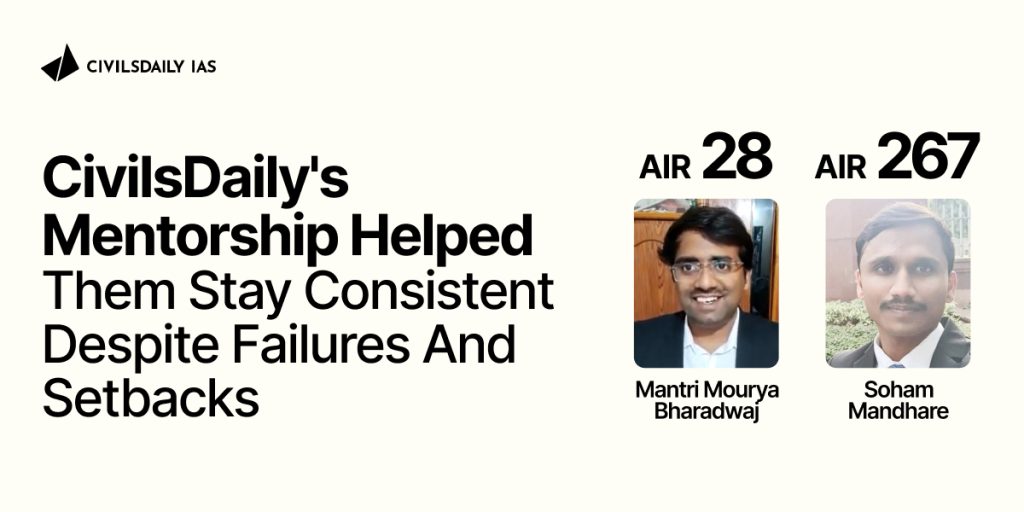
Some of us will ask advices from all our friends and family on how to prepare for the exam, resulting in confusion in following through the UPSC syllabus. Don’t let these questions play the devil and make you postpone your UPSC preparation by a few more years. Having the right direction and guidance can help you save 2-3 critical attempts in UPSC. Listen to our Civilsdaily student and AIR 32 2021 UPSC topper Anay on how he improved his performance after 2 attempts with the guidance of Civilsdaily mentor, Sajal sir.
Without much ado, register yourself for our free 1-on-1 counselling session at Civilsdaily known as Samanvaya. Your counsellors are trained mentors who have given the Mains exam six times and have attended UPSC interview multiple times. Experienced mentors like Sajal sir and his team have nearly mentored 500+ students.
How Sajal sir and CivilsDaily helped these toppers?
List goes on and on.
What are the other mistakes in UPSC preparation first-time aspirants are likely to make?
About 60% of the UPSC toppers have mostly prepared the wrong way in their first attempt. This could range from books, notes to time and consistency. If you want to start in the right direction, then it’s about time you booked a slot with your Samanvaya mentor.
First-time aspirants often make the mistake of reading many sources for a single subject. If there is a new book in the market, they will not hesitate to buy it. UPSC preparation is not about reading multiple books, but one book multiple times.
Few others, answer the essay paper in a very academic and technical manner.
Most of the first-time aspirants skip studying for the language and CSAT paper.
In the first few months of preparation, all of us read the entire 24 pages of the newspaper and waste 3-4 hrs of time. Some of us are over-confident of clearing the exam with our own preparation or by our institute’s coaching. We might be making notes but we will not be updating them or revising them.
First-time aspirants struggle to understand what to skip in a book or what to cover. They take atleast 2-3 months to finish books like Laxmikanth and yet don’t have conceptual clarity.
You can go through this video over here to get a basic understanding of the UPSC preparation.
Toppers were once Beginners. And they began with Samanvaya.
We, at Civilsdaily, are extremely proud to announce the incredible success of our students who have made their dreams come true. Today, we celebrate the hard work, commitment, and dedication with which they prepared for this exam, and succeeded! They are the heroes of today and leaders of tomorrow, and we are extremely glad to have been a part of their journey.
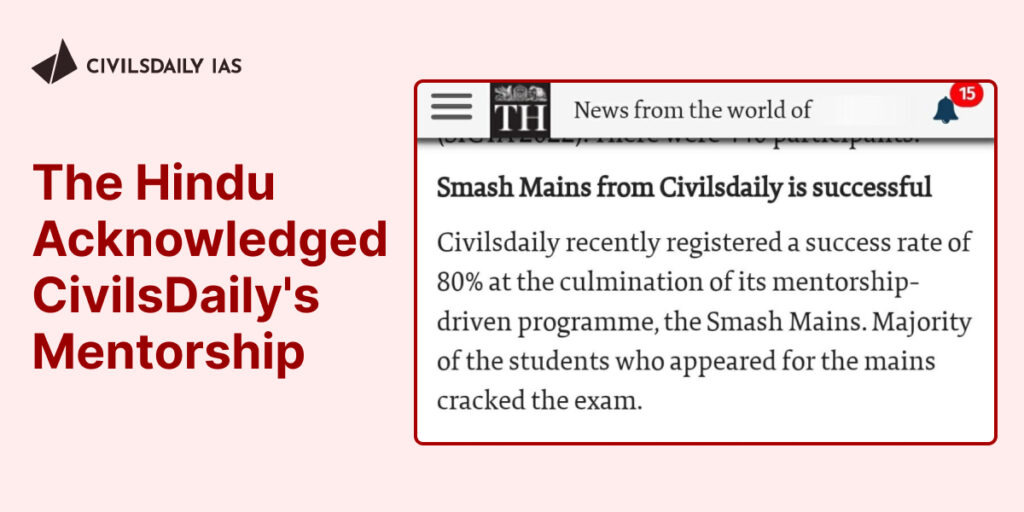
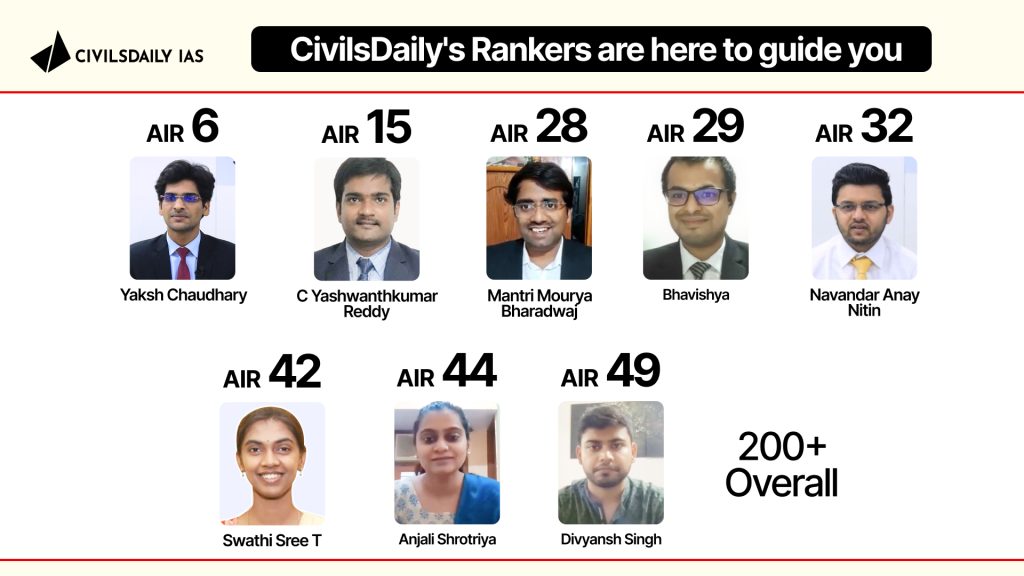
We are also happy to announce that 78 Civilsdaily students (and counting) are now rank holders in UPSC. Our success rate has increased by 77% from last year in terms of rank holders. Civilsdaily is proud to say that 20 of our students are in the top 100 ranks. And this is a phenomenal 25% increase in our success rate for the top 100 positions since last year.
And finally, we are extremely proud of our mentors whose tireless efforts helped our students become officers today. Their daily guidance, skilled mentorship, round-the-clock support, and dedication to work with the students day-in and day-out has led to this wonderful occasion where we celebrate the success of our students together!
How is Samanvaya, UPSC Counselling Session Planned?
At Civilsdaily, your assigned mentors interact with you on a daily basis. They are not just teachers, but coaches, philosophers, and guides. And this is how they will help you succeed:
Motivating you for one whole year and pushing you to complete the modules on time.
Helping you restart preparation despite low scores in test series.
Helping you study for 6 hours every day if you are working.
Guiding you on how to revise the whole syllabus 3 months before prelims and mains.
Providing you topic-wise notes.
Teaching you elimination techniques, tikdams and helpful strategies like 4-2-4 model of preparation.
Keeping you updated on what to study and from where to study.
Three stages of Samanvaya FREE mentorship
1.30-minute counseling session:Once you fill the form, our senior mentors get on a 30-40 minute call with you to understand your preparation level, study constraints, your strategy for the last 6 months, and create measurable targets for next week, next month and so on. You will hear back from us within 24 hours. The first counseling session is absolutely free for all, however, there are limited slots available. So please register now.
2.Access to our invite-only chat platform, Habitat: This is where you can post your daily doubts, discuss your test questions and have real-time, live discussions on news and op-eds, and connect with other aspirants in your optional groups.
3. 1 on 1 mentor allotment: The mentor will be available on scheduled calls with you throughout all the stages of your UPSC preparation and will daily assess, evaluate, and plan the next module according to the available time. We will help you pick the right books, make you practice answers daily, evaluate them and design practical & personalstrategies that you can follow everyday
Former Tata Sons chairman Cyrus Mistry was recently killed in a horrific and unfortunate road accident!
Context
Deaths by accidents on roads increased by almost 17 per cent in 2021 compared to 2020.
This indicates an INCREASE in the rate of deaths per 1,000 vehicles in India, according to the latest NCRB report.
Road Accidents in India
In 2021, 1.55 lakh people died in accidents on Indian roads, up from 1.33 lakh in 2020, when much of the year saw a nationwide lockdown.
Total road accidents reported was 4.03 lakh in 2021, up from 3.54 lakh the year before.
But the 2021 accident numbers were significantly lower than those in 2019, when 4.37 lakh mishaps had been recorded, killing 1.54 lakh people.
As in previous years, two-wheelers accounted for most deaths (44.5%). Buses accounted for 3% of deaths in accidents.
Speeding caused 87,000 deaths, accounting for over half of all deaths, while dangerous and careless driving was attributed as cause for 42,000 deaths, the report stated.
State-wise data
The maximum increase in number of traffic accident cases from 2020 to 2021 was reported in Tamil Nadu (from 46,443 to 57,090), followed by Madhya Pradesh (from 43,360 to 49,493), Uttar Pradesh (from 30,593 to 36,509), Maharashtra (from 24,908 to 30,086), and Kerala (from 27,998 to 33,051).
These traffic accidents resulted in injuries to 3,73,884 people and 1,73,860 deaths in 2021.
Uttar Pradesh (24,711 deaths) followed by Tamil Nadu (16,685 deaths) and Maharashtra (16,446 deaths) have reported the maximum fatalities in traffic accidents in the country.
Factors causing Road Accidents
A new analytical series on road safety worldwide, published by The Lancet, proposes that India and other countries could cut accident-related deaths by 25 to 40%.
This is based on evidence that preventive interventions produce good outcomes when applied to four well-known risk factors:
High speed
Driving under the influence of alcohol
Not using proper helmets
Not wearing seat-belts and not using child restraints
Issues highlighted in developing countries
The structural problems linked to unplanned motorisation and urbanisation remain.
In India, speedy highway construction takes place without reconciling fast and slow-moving traffic.
There is a rampant presence of ramshackle vehicles, wrong-side driving, absence of adequate traffic police forces etc.
Why are there so many road fatalities in India alone?
Weak enforcement of traffic laws: People hardly oblige to traffic rules and find easier to bribe policemen rather than paying hefty challans.
Speeding issue: More accidents on the highways have been attributed to higher vehicle speeds and higher volume of traffic on these roads.
Engineering bottlenecks: Issues such as gaps in the median on the national highways, untreated intersections, and missing crash barriers are some of the biggest engineering issues.
Behavioural issue: Driver violations such as wrong-side driving, wrong lane usage by heavy vehicles, and mass violation of traffic lights, intoxication are the biggest behavioural issues.
Lack of Golden hour treatment: Lack of rapid trauma care on highways leads to such high fatalities.
Various steps taken by India
India amended Motor Vehicles Act in 2019, but its implementation by State governments is not uniform or complete.
A National Road Safety Board was constituted under the Act, with advisory powers to reform safety.
The World Bank has approved a $250 million loan to support for India State Support Programme for Road Safety.
Issues with implementation
The focus of State governments, however, remains conventional, with an emphasis on user behaviour (drivers and other road users), education and uneven enforcement.
Low emphasis is placed on structural change such as raising engineering standards for roads, signages, signals, training for scientific accident investigation, raising policing skills and fixing responsibility on government departments for the design, creation and maintenance of road infrastructure.
What can be done to cut death and injury rates?
The ambitious amendments to the Motor Vehicles Act in 2019 (MV Act) have not yielded significant results.
Major interventions in India, first suggested by the Sundar Committee (2007) and ordered by the Supreme Court in Rajasekaran vs Union of India have not made a dent in the problem.
Key findings of Sundar Committee
The Sundar Committee pointed out that India lacked a technically competent investigation arm that could determine the cause of accidents.
There is little clarity on whether the States have formed such units to aid traffic investigation, or whether the insurance industry has pressed for these to accurately determine fault.
In the absence of scientific investigation, perceptions usually guide the fixing of liability.
Solutions provided by the Lancet
The Lancet calculated that 17% of road traffic injury-related deaths could be avoided iftrauma care facilities improved.
This is significant as several accidents take place in rural areas on highways, and victims are taken to poorly-equipped district hospitals or medical college hospitals.
While positive user behaviour — slower travel, wearing of helmets, seat belts and so on — could save thousands of lives.
In the short term, slowing down traffic, particularly near habitations, segregating slower vehicles, enforcing seat belt and helmet use and cracking down on drunken drivers could produce measurable gains.
Imbibing road safety: Way forward
Road safety education
Better road design, maintenance and warning signage
Crackdown on driving under influence of alcohol and drugs
HOW TO ATTEMPT ANSWERS IN DAILY ANSWER WRITING ENHANCEMENT(AWE)?
Daily 4 questions from General studies 1, 2, 3, and 4 will be provided to you.
A Mentor’s Comment will be available for all answers. This can be used as a guidance tool but we encourage you to write original answers.
You can write your answer on an A4 sheet and scan/click pictures of the same.
Upload the scanned answer in the comment section of the same question.
Along with the scanned answer, please share your Razor payment ID, so that paid members are given priority.
If you upload the answer on the same day like the answer of 11th February is uploaded on 11th February then your answer will be checked within 72 hours. Also, reviews will be in the order of submission- First come first serve basis
If you are writing answers late, for example, 11th February is uploaded on 13th February , then these answers will be evaluated as per the mentor’s schedule.
We encourage you to write answers on the same day. However, if you are uploading an answer late then tag the mentor like @Staff so that the mentor is notified about your answer.
*In case your answer is not reviewed, reply to your answer saying *NOT CHECKED*.
Register and we’ll email you the Mains 250+ VAM | Highly researched, 360° Comprehensive coverage | You will also get FREE mentorship session on How to make the most out of this material.
With less than a month left for UPSC Mains 2022 your focus must shift towards revision, value addition and improvement of your Mains answers.
It is time now to polish your skills and prepare productively. Collecting important information, news and current affairs, making notes, etc. on your own, at this point in time is a recipe for disaster.
Don’t waste your precious time.
Our CivilsDaily’s Mains team under Sajal sir has handpicked and compiled the most important 250+ topics for UPSC Mains 2022 and we are providing these to you for FREE.
Each topic has been covered in a crisp manner in 2-3 pages.
Every topic has forward backward linkages with current and static part of the syllabus.
All the relevant factual data and statistics has been highlighted in bold for every topic that will help you provide a solid introduction and conclusion.
Relevant case studies and examples have been provided for content enrichment.
How Mains 250+ Value Added Material be useful right now?
You might be wondering, with just a month away is it wise to register for any program right now, even for free? You don’t have to worry. The Mains 250+ VAM is not new information. It’s consolidated revision notes from the standard books and current affairs of UPSC-CSE Mains.
Our initiative last year of compiling issues and topics that had a high probability of being asked in Mains 2021 was a thumping success– our toppers said they greatly benefitted from it.
Coverage of topics in Mains 250+ VAM will have one and only one purpose – to enable you to write great answers to any question from a particular topic. To be able to write a convincing 250-word answer for a topic, you need to know at least 1-2 pages of content for it.
At this point in time studying everything is not desirable nor is it feasible. You don’t have time to read everything, segregate what is important and what’s not, make notes, cover different dimensions, and then find a way to utilize that. What you need at this point in time is efficient and organized coverage of the most relevant topics for the IAS mains exam. With Mains 250+ VAM we aim to help you achieve all this.
Mains 250+ Value Added Material is an intensive and holistic program for IAS Mains 2022 GS papers. We aim to cover 250+ most relevant issues with a 360-degree view, covering all dimensions of each and every topic. Not only you’ll learn and analyze these issues but will also understand how to utilize them via Daily Answer Writing and Mains Test Series.
Topic-Wise Current Affairs From An Issue Perspective
Current affairs in the IAS mains exam must be covered from an ‘issue perspective’ and almost all of them have multiple dimensions to it, various stakeholders involved, have interconnectedness, and can be solved with a multipronged approach only. This should reflect in your answers.
Mains 250+ VAM will help you enrich your pre-existing coverage and will add quality to it. With tests and mentorship, you will get an evaluation and necessary course correction. And we will provide daily answer writing to help you sharpen your answer writing skills and knowledge with our daily initiatives on Habitat.
Excluding your optional subject, we will be providing topic-wise notes from all the other GS papers for free. This includes Ethics case studies as well!
Block your Thursday (1st September), 2022 | An important Masterclass by IPS, Dr. Amol on how to read newspapers & cover UPSC Current Affairs | Get Samachar Manthan current week’s module for FREE
You have only 24 hours a day and lots of things to prepare for current affairs. Newspapers are the most significant part of your preparation. Considering how much time a person spends studying them, the foremost goal for beginners, or first attempters, should be to clear the Prelims.
UPSC beginners always find it difficult and complain about spending too much time reading newspapers. And this is a genuine concern because if someone spends 4-5 hours in the newspaper, then their problem is justified but not to be ignored. Sadly this happens with aspirants who have attempted UPSC twice thrice as well.
A fundamental problem with Current affairs is the deluge of reading material. Freshers, in their earlier attempts, are tempted to buy Current Affairs material out of whim, in a delusional hope that more current affairs notes = more marks. Their room is filled with CSR, Pratiyogita Darpan, EPW, Chronicle, Yojana, and every random magazine you can name.
Alas! The harsh reality is they buy them out of excitement, keep them safely on their desk, and never reopen them again for lack of time. Such too much material becomes counter-productive. Sheer quantity dominates over quality.
Dr. Amol Murkut, IPS (2020), Super Mentor at CivilsDaily
Acknowledging the need to ensure removing difficulties, the students face, Dr. Amol Murkut, IPS (2020) & Super Mentor at CivilsDaily is going to host an on-demand MASTERCLASS on how to read newspapers and cover UPSC-centric current affairs for Prelims and Mains. So, if you wish to get your name on the 2023 merit list, don’t miss out on this great chance to discuss your queries in a 1-1 session with an IPS officer.
Points that we will be discussing in the Masterclass on 1st September, (Thursday) at 7 PM.
How to cover current affairs holistically for Prelims, Mains, and Interviews?
Supplementing Newspapers with Magazines like Yojana, Kurukshetra, etc, and making notes from them.
How to focus on these:
Socio-economic issues like Women issues, Education or Health related issues, Issues or policies affecting vulnerable sections etc.
Issues of national and international importance.
Political issues related to Indian Constitution, Legislative and Administrative processes.
Supreme Court or High Court verdicts.
Good analysis of current issues.
Parliamentary Debates.
Government policies and orders.
How to make 2 paged crisp notes for Prelims and Mains revision and answer writing?
How to collect examples, case studies, and important fodder for Mains answers?
Finishing newspaper within 40 mins max.
How to connect Current Affairs with GS?
Those who understand the exam syllabus and pattern well, have less anxiety but a beginner (due to less understanding of syllabus and pattern) takes enough time to read and prepare.
GS-1 Distribution of key natural resources across the world (including South Asia and the Indian sub-continent)
GS-2 Mechanisms, laws, institutions and Bodies constituted for the protection and betterment of the vulnerable sections.
GS-3 Indian Economy
GS-4 Public/Civil service values and Ethics in Public administration: accountability and ethical governance; strengthening of ethical and moral values in governance; ethical issues in international relations and funding; corporate governance.
HOW TO ATTEMPT ANSWERS IN DAILY ANSWER WRITING ENHANCEMENT(AWE)?
Daily 4 questions from General studies 1, 2, 3, and 4 will be provided to you.
A Mentor’s Comment will be available for all answers. This can be used as a guidance tool but we encourage you to write original answers.
You can write your answer on an A4 sheet and scan/click pictures of the same.
Upload the scanned answer in the comment section of the same question.
Along with the scanned answer, please share your Razor payment ID, so that paid members are given priority.
If you upload the answer on the same day like the answer of 11th February is uploaded on 11th February then your answer will be checked within 72 hours. Also, reviews will be in the order of submission- First come first serve basis
If you are writing answers late, for example, 11th February is uploaded on 13th February , then these answers will be evaluated as per the mentor’s schedule.
We encourage you to write answers on the same day. However, if you are uploading an answer late then tag the mentor like @Staff so that the mentor is notified about your answer.
*In case your answer is not reviewed, reply to your answer saying *NOT CHECKED*.
HOW TO ATTEMPT ANSWERS IN DAILY ANSWER WRITING ENHANCEMENT(AWE)?
Daily 4 questions from General studies 1, 2, 3, and 4 will be provided to you.
A Mentor’s Comment will be available for all answers. This can be used as a guidance tool but we encourage you to write original answers.
You can write your answer on an A4 sheet and scan/click pictures of the same.
Upload the scanned answer in the comment section of the same question.
Along with the scanned answer, please share your Razor payment ID, so that paid members are given priority.
If you upload the answer on the same day like the answer of 11th February is uploaded on 11th February then your answer will be checked within 72 hours. Also, reviews will be in the order of submission- First come first serve basis
If you are writing answers late, for example, 11th February is uploaded on 13th February , then these answers will be evaluated as per the mentor’s schedule.
We encourage you to write answers on the same day. However, if you are uploading an answer late then tag the mentor like @Staff so that the mentor is notified about your answer.
*In case your answer is not reviewed, reply to your answer saying *NOT CHECKED*.
As External Affairs Minister Dr S Jaishankar wrapped up a visit to Argentina, Brazil and Paraguay, we take an in-depth look at India’s ties with Latin America.
Latin America is generally understood to consist of the entire continent of South America in addition to Mexico, Central America, and the islands of the Caribbean.
India-Latin America Relations: A Backgrounder
Latin America
(i) Beginning
India’s ties with certain Latin American nations are longstanding and Mexico was the first Latin American country to recognize India after its independence in 1947.
When Fidel Castro ousted the Batista regime in Cuba in 1959, India was one of the first countries to recognize the new government, set-up an embassy in Havana and establish diplomatic relations.
However, relations between India and Latin America did not gather momentum throughout most of India’s post-independence history.
(ii) Post-independence
India and Latin American nations were both colonies of European powers. After achieving independence, both adopted socialist policies, which did little to enhance relations.
Many Latin America and the Caribbean (LAC) countries joined the Non-Aligned Movement (NAM).
India also supported LAC countries against US interventions in the UN and other multilateral gatherings, but this did not address the deficit in the relationship.
Why does Latin America matter to India?
(i) Economic determinants
Energy demand is rising: In a view of India’s growing demand for energy and its interest in seeking overseas investments, Latin America attracts New Delhi’s interest. After all, the region is rich in extractive resources.
Important markets: Given that three G20 economies, i.e. Brazil, Mexico, and Argentina are in Latin America, Indian businesses are keen to tap its expansive market.
IT collaboration: During the last two decades, India’s trade with Latin American countries has grown substantially and its investments are diversified in sectors such as Information Technology (IT) and manufacturing.
Export hub: Moreover, the region has emerged as an important market for the Indian pharmaceutical and automobile industries.
(ii) Geopolitical determinants
China’s emergence in the region: Analysts within India’s strategic community are of the view that China is fast emerging as Latin America’s economic and strategic partner, and that India must begin expanding its own footprint in the region.
India’s Soft Power is making difference: To its advantage, India’s status as a rising power, its economic growth, as well as its soft power in the form of its cultural and civilizational practices such as yoga have gained traction in Latin America.
Hurdles in cooperation
Geographic distance: Relations between India and Latin America did not gather momentum owing mainly to the geographical distance between the two regions, and differing domestic and international priorities.
Lack of cultural connection: There has also been a lack of cultural, linguistic and diaspora connections between the two regions in the past.
Significance of India-Latin America Relations
Pharma exports: India exports a billion dollars worth of generic medicines to Latin America, which has helped these countries reduce the cost of healthcare.
FDI: Latin American firms have invested about a billion dollars in India in areas such as soft drinks, multiplexes, theme parks, and auto parts.
Software production: Latin American software firms have also established development and delivery centres in India, employing over a thousand Indian software engineers
Energy security: Latin America has also emerged as a key contributor to India’s energy security. India now imports 20% of its crude oil from Brazil, Columbia, Mexico and Venezuela.
ITES exports: India also constitutes one of the largest suppliers of IT services to Latin America. Over 35,000 Latin Americans are employed in Indian IT companies operating in the region
Key factor: Countering Chinese domination
Although India has steadily expanded its footprint in Latin American countries over the past several years, it is still dwarfed by China’s immense presence in the region.
Many Latin Americans governments resent Chinese imports, which flood their markets at the cost of local businesses.
They are also worried by their growing dependence on Chinese investments.
By contrast, India’s modest trade and investments are welcomed with virtually no opposition.
This gives New Delhi an unexpected, long-term competitive advantage over China.
India’s interests in Latin America
(1) Economic
Latin America is also very rich in minerals such as copper, lithium, iron ore, gold and silver. It gives India an opportunity to increase investments for their extraction as well as for their imports at cheaper rates.
India’s exports to Latin America increased by 9.6% in 2018-19 (April to March) reaching $13.16 billion from $12 billion in 2017-18.
(2) Strategic
The region is very important for India in order to achieve its global ambitions such as in order to pursue its membership of the UNSC, the NSG and at various other negotiations like climate change, terrorism, trade, etc
India is cooperating with Brazil at platforms like BRICS, IBSA which has provided an alternative platform for developing countries and reduces their dependence on existing institutions controlled by west.
(3) Energy security
Currently India sources 15% of its crude oil from Latin America countries.
Latin America is also an important partner in the India led International Solar Alliance.
(4) Food security
Latin America region is five times that of India and only has half as much population.
India is importing pulses and oil seeds from many of African and Southeast Asian countries at very high costs.
Why India should expand ties with Latin American countries
Growth prospect: With a collective GDP of more than $6 trillion, and a combined population of more than 600 million, half of which is under the age of thirty, Latin America constitutes a dynamic, growing and resource-rich part of the world with huge economic prospects for India.
Food Security: Latin America can also contribute towards food security. The region is five times the size of India and has only half the population. India is currently importing pulses and oilseeds from other countries at high costs.
Cheaper imports: Latin America is also very rich in minerals such as copper, lithium, iron ore, gold and silver, and could give India an opportunity to increase investments for their extraction as well as for their import at cheaper rates.
Way Forward
Bringing India and Latin America together will require effective institutional framework as well as businesses and people-to-people networks.
India must also promote Latin American studies, invest in shipping industries, and conclude preferential trade agreements and free trade agreements at the earliest.
Latin American languages must be encouraged in India to incentivise Indian professionals to take jobs in these countries, and to promote trading ties.
The commerce ministry should revive its ‘Focus: LAC’ programme, which has previously helped encourage and support Indian exporters to explore business opportunities in the region.
Conclusion
Despite recent improvements on many fronts, however, both India and the LAC countries face some formidable challenges.
They still have some of the highest inequality indices in the world, as well as serious deficiencies in infrastructure, technology, innovation and competitiveness.
India and the LAC region could approach these challenges as opportunities to forge new partnerships to promote growth and development through increased trade and investment.
GS-1 Salient features of world’s physical geography.
GS-2 Comparison of the Indian constitutional scheme with that of other countries.
GS-3 Conservation, environmental pollution and degradation, environmental impact assessment.
GS-4 Public/Civil service values and Ethics in Public administration: Status and problems; ethical concerns and dilemmas in government and private institutions
HOW TO ATTEMPT ANSWERS IN DAILY ANSWER WRITING ENHANCEMENT(AWE)?
Daily 4 questions from General studies 1, 2, 3, and 4 will be provided to you.
A Mentor’s Comment will be available for all answers. This can be used as a guidance tool but we encourage you to write original answers.
You can write your answer on an A4 sheet and scan/click pictures of the same.
Upload the scanned answer in the comment section of the same question.
Along with the scanned answer, please share your Razor payment ID, so that paid members are given priority.
If you upload the answer on the same day like the answer of 11th February is uploaded on 11th February then your answer will be checked within 72 hours. Also, reviews will be in the order of submission- First come first serve basis
If you are writing answers late, for example, 11th February is uploaded on 13th February , then these answers will be evaluated as per the mentor’s schedule.
We encourage you to write answers on the same day. However, if you are uploading an answer late then tag the mentor like @Staff so that the mentor is notified about your answer.
*In case your answer is not reviewed, reply to your answer saying *NOT CHECKED*.
![[MASTERCLASS] How do UPSC toppers write ‘Impactful Intoductions’ in UPSC Essay and score 150+ marks? | Register for the recorded *VIDEO* & Get Best Introduction PDF and Essay Test (FREE)](https://d18x2uyjeekruj.cloudfront.net/wp-content/uploads/2022/07/Zeeshan.jpg)




![[Masterclass by IPS, Dr. Amol] How to read newspapers and cover current affairs holistically for UPSC 2023-24 Prelims and Mains? Last chance to register](https://d18x2uyjeekruj.cloudfront.net/wp-content/uploads/2022/08/Dr.-Amol-Murkut-IPS-UPSC-2021-1.jpg)


