💥Join UPSC 2027,2028 Mentorship (August Batch) + XFactor Notes & Microthemes PDF

Distribution: weekly

  • A Sense of Drift: Democracy at the Crossroads: Youth, Corruption and the New Global Malaise

    Introduction

    Democracy, once celebrated as the ultimate safeguard of freedom and governance, is witnessing profound crises across continents. Nepal’s weak institutions, France’s protest-prone presidentialism, and America’s violent polarisation reveal that democratic malaise is not confined to one geography. The recurring theme is stark: young people feel robbed of their future.

    Why is democracy back in crisis?

    1. Recurring crises: Democracies appear to follow cycles of expansion (40–50 years) followed by exhaustion.
    2. Current triggers: Corruption in Nepal, unsustainable economic models in France, and violent political divisions in the US.
    3. Historical echoes: Similar crises were witnessed in the 1920s–30s and the 1960s–70s, culminating in debates such as the Trilateral Commission’s 1975 report on “The Crisis of Democracy.”

    What role does youth disillusionment play?

    1. Stolen future: Across Nepal, France, and the US, young people feel alienated and betrayed.
    2. Lack of consensus: Youth anger does not translate into youth unity; it produces anxiety but not collective solutions.
    3. Gerontocracy problem: Democracies like India and the US are led largely by older generations, deepening generational divides.

    How does inequality and polarisation fuel the malaise?

    1. Different consensus: Unlike the 1970s when “excess participation” was blamed, today growing inequality is seen as the root of discontent.
    2. Dual polarisation: A clash of values coupled with diametrically opposed economic visions — Left demanding more state investment, Right fearing socialist excess.
    3. Jobless growth: Declining employment elasticity of capital threatens to erode trust even in well-designed policies.

    Why does corruption persist as a democratic fault line?

    1. Structural vs transactional corruption: Elites monopolising power versus ostentatious lifestyles of politicians.
    2. Anti-corruption paradox: Movements rarely eliminate corruption and often fuel authoritarian turns, seen in Nepal’s staggering levels of rent extraction.
    3. Authoritarian co-option: Anti-corruption rhetoric is used to justify illiberal governance.

    What is the role of war and misinformation?

    1. Historical corrosion: Vietnam and Iraq wars eroded democratic legitimacy in the US.
    2. Current crises: Gaza conflict risks corroding Western liberal legitimacy.
    3. Misinformation cycle: Radical democratisation of information through social media has dissolved authority and deepened adversarial suspicion.

    Can democracies reinvent themselves?

    1. Past reinventions: Post-1930s depression and 1970s crises were followed by new waves of democratisation.
    2. Paradox of protest: While protests mobilise energy, they often breed drift, violence, or nihilism.

    Way Forward for Democracies

    1. Institutional Reinvention: Strengthen checks and balances through judicial independence, parliamentary accountability, and free media — preventing democratic backsliding.
    2. Inclusive Growth: Address structural inequality and jobless growth by creating policies focused on employment elasticity and equitable redistribution.
    3. Youth Participation: Channel youth disillusionment into institutionalised participation (youth parliaments, policy fellowships, digital consultative platforms).
    4. Taming Polarisation: Build broad-based social coalitions that transcend Left–Right economic divides and cultural polarisation.
    5. Responsible Information Order: Regulate misinformation while protecting freedom of speech; strengthen media literacy to combat nihilism fuelled by social media.
    6. Corruption Reform: Focus on structural corruption (elite monopolisation of power) rather than episodic “anti-corruption crusades” that risk authoritarian capture.
    7. Global Learning: Draw lessons from past crises (1930s, 1970s) where institutional reinvention, new social contracts, and reform waves revitalised democracy.

    Value Addition

    Samuel P. Huntington’s Views and Theory on Democracy

    Political Order and Institutionalisation

    • Book: Political Order in Changing Societies (1968).
    • Core Argument: The stability of a political system depends more on the strength of its institutions than on the level of modernisation.
    • Key Point: Modernisation without strong institutions leads to instability (e.g., corruption, coups, unrest).
    • Quote: “The most important political distinction among countries is not their form of government but their degree of government.”

    The Third Wave of Democratisation

    • Book: The Third Wave: Democratisation in the Late Twentieth Century (1991).
    • Theory: Democracies emerge in “waves,” each followed by a possible “reverse wave.”
      • First Wave (1828–1926): Expansion in Western countries.
      • First Reverse Wave (1922–1942): Rise of fascism, military regimes.
      • Second Wave (1945–1962): Post-WWII, decolonisation.
      • Second Reverse Wave (1960–1975): Coups in Latin America, Africa, Asia.
      • Third Wave (1974 onwards): Started with Portugal’s Carnation Revolution, followed by democratisation in Latin America, Eastern Europe, parts of Asia and Africa.

    Key Factors for Third Wave:

    • Declining legitimacy of authoritarian regimes.
    • Economic growth and rising middle class.
    • Religious changes (e.g., Catholic Church’s role in Latin America).
    • Global democratic norms (influence of EU, US).
    • Snowballing effect” (success in one country inspired others).
    • Relevance: Many current democracies (including in Asia, Latin America, Eastern Europe) emerged in this wave

    Clash of Civilisations (1993)

    • Book: The Clash of Civilizations and the Remaking of World Order.
    • Argument: Post-Cold War conflicts would be driven not by ideology or economics, but by cultural and civilisational differences.
    • Link to Democracy: Democracies rooted in Western civilisation may clash with non-Western civilisations (Islamic, Sinic/Chinese).

    Relevant Quotes on Democracy 

    On Cycles and Fragility

    • John Adams: “Democracy never lasts long. It soon wastes, exhausts, and murders itself.”
    • Samuel Huntington: “Democracy is the only political system that is self-correcting.”

    On Reinvention

    • Winston Churchill: “Democracy is the worst form of government — except for all those other forms that have been tried from time to time.”
    • Amartya Sen: “No famine has ever taken place in the history of the world in a functioning democracy.”

    On Corruption and Morality

    • Mahatma Gandhi: “Corruption and hypocrisy ought not to be inevitable products of democracy, as they undoubtedly are today.”
    • Alexis de Tocqueville: “The health of a democratic society may be measured by the quality of functions performed by private citizens.”

    On Youth and Future

    • Jawaharlal Nehru: “The future belongs to those who can give to the next generation reasons for hope.”
    • Kofi Annan: “Young people should be at the forefront of global change and innovation.”

    How to Use in UPSC Answers

    • Quote John Adams or Huntington when talking about cycles of democracy.
    • Quote Gandhi or Amartya Sen when linking democracy with corruption or development outcomes.
    • Quote Churchill when emphasising democracy’s resilience despite flaws.

    PYQ Relevance:

    [UPSC 2023] Constitutionally guaranteed judicial independence is a prerequisite of democracy. Comment.

    Linkage: The current crisis of democracy, as highlighted in Nepal, France, and the US, shows that without robust and independent institutions, democratic legitimacy erodes. Judicial independence acts as a bulwark against corruption, elite capture, and authoritarian drift. Thus, safeguarding constitutional autonomy of the judiciary is indispensable for reinvigorating democracy.
  • BS-VII Emission Norms

    Why in the News?

    To align India’s automobile sector with global standards, the government is planning to introduce BS VII emission norms by 2026-27.

    About BS7 Norms:

    • Overview: India’s equivalent of Euro 7 emission standards, aimed at reducing vehicular pollution and aligning with global benchmarks.
    • Coverage: Applies uniformly to cars, vans, buses, trucks, petrol, diesel, hybrid, and electric vehicles.
    • On-Board Monitoring (OBM): New system to monitor tailpipe emissions in real time, covering NOx, ammonia, PM, engine gases.
    • Non-Exhaust Regulation: First-time regulation of brake dust (PM) and tyre microplastics.
    • EV Standards: Introduces battery safety, durability, and longevity index to lower raw material use and build consumer confidence.
    • Digital Safeguards: Ensures vehicles are not tampered with and remain within emission limits.
    • Testing Scope: Expands checks to real driving conditions beyond lab-based cycles.

    Key Differences: BS6 vs BS7

    • OBD vs OBM: BS6 used On-Board Diagnostics (OBD); BS7 brings OBM for direct emission monitoring.
    • NOx Standards: BS6 allowed 60 mg/km petrol, 80 mg/km diesel; BS7 sets uniform 60 mg/km.
    • Coverage: BS6 regulated exhaust only; BS7 adds non-exhaust (brakes, tyres).
    • EV Inclusion: BS6 ignored EVs; BS7 regulates battery life, safety, and replacement cycles.
    • Testing: BS6 relied on defined test cycles; BS7 uses broader real-world conditions.
    • Technology Push: BS7 compels automakers towards advanced emission-control systems and turbo, direct-injection engines.
    • Cost Factor: BS7 compliance raises vehicle costs; some older models may be discontinued.

    History of Emission Norms in India:

    Year / Period Key Development
    1991 Mass emission norms introduced for petrol vehicles.
    1992 Mass emission norms introduced for diesel vehicles.
    April 1995 Mandatory catalytic converters in new petrol cars in Delhi, Mumbai, Kolkata, Chennai; unleaded petrol (ULP) introduced.
    2000 Introduction of Euro I equivalent “India 2000” norms for passenger and commercial vehicles; stricter norms for two-wheelers.
    2001 Euro II equivalent Bharat Stage II (BS II) norms introduced in Delhi, Mumbai, Chennai, Kolkata.
    August 2002 First Auto Fuel Policy announced, outlining emission and fuel roadmap up to 2010.
    April 2005 Bharat Stage III (BS III) norms implemented in 13 metro cities; rest of India continued with BS II.
    April 2010 Bharat Stage IV (BS IV) implemented in 13 metro cities; rest of India adopted BS III.
    October 2014 BS IV extended to 20 more cities.
    2013 Auto Fuel Policy 2025 submitted to MoPNG (Ministry of Petroleum & Natural Gas), outlining roadmap up to 2025.
    April 2017 Nationwide implementation of BS IV.
    April 2020 Direct leap to BS VI (skipping BS V) due to severe pollution in Delhi NCR.
    Upcoming (BS VII) To be aligned with Euro 7 standards: stricter norms, On-Board Monitoring (OBM), coverage of brake & tyre emissions, and EV battery standards.


    [UPSC 2004] Consider the following statements:

    1. The Oil Pool Account of Government of India was dismantled with effect from 1-4-2002.

    2. Subsidies on PDS kerosene and domestic LPG are borne by Consolidated Fund of India.

    3. An expert committee headed by Dr. R.A. Mashelkar to formulate a national auto fuel policy recommended that Bharat Stage-II Emission Norms should be applied throughout the country by 1 April, 2004.

    Which of these statements given above are correct?

    Options: (a) 1 and 2 (b) 2 and 3 (c) 1 and 3 (d) 1, 2 and 3*


  • Researchers develop Red Ivy Plant-Based Wound-Healing Pad

    Why in the News?

    Researchers at JNTBGRI has developed a multifunctional wound-healing pad using nanomaterials, inspired by the red ivy plant (Strobilanthes alternata), traditionally used in folk medicine.

    About the Red Ivy Plant:

    • Overview: Strobilanthes alternata, locally called murikooti pacha, belonging to the Acanthaceae family.
    • Habitat: Found abundantly in tropical regions, including India.
    • Traditional Use: Used in folk medicine for treating cuts and wounds.
    • Scientific Discovery: JNTBGRI, Palode isolated acteoside, a natural bioactive compound, for the first time in this plant.
    • Therapeutic Use: Acteoside, known elsewhere for medicinal activity, showed high wound-healing efficacy at 0.2% concentration in red ivy.

    Features of the Wound-Healing Pad:

    • Design: India’s first multifunctional herbal wound dressing pad, combining traditional knowledge with nanotechnology.
    • Components: Electro-spun nanofiber layer (biodegradable, porous, antimicrobial barrier); Acteoside + neomycin sulfate blend (healing and infection control); Sodium alginate sponge (absorbs exudates); Activated carbon layer (controls odour).
    • Significance: Affordable, scalable, and a model of herbal medicine integrated with modern nanotech innovation.
    [UPSC 2021] Which one of the following is used in preparing a natural mosquito repellent?

    Options:

    (a) Congress grass (b) Elephant grass (c) Lemongrass* (d) Nut grass


  • Expedition ‘Samudra Pradakshina’

    Why in the News?

    Defence Minister flagged off Samudra Pradakshina, the world’s first tri-service all-women circumnavigation sailing mission, from the Gateway of India, Mumbai.

    About Expedition ‘Samudra Pradakshina’:

    • Overview: First-ever all-women tri-service circumnavigation sailing expedition in the world.
    • Crew: Ten women officers from the Army, Navy, and Air Force, led by Lt. Col. Anuja Varudkar.
    • Vessel: IASV Triveni, a 50-foot yacht built indigenously in Puducherry.
    • Duration & Route: Nine months, covering 26,000 nautical miles, crossing the Equator twice, and rounding Capes Leeuwin, Horn, and Good Hope.
    • Port Calls: Fremantle (Australia), Lyttelton (New Zealand), Buenos Aires (Argentina), Cape Town (South Africa).
    • Mission Objectives: Showcase Nari Shakti, promote joint military cooperation, advance Atmanirbhar Bharat, strengthen maritime diplomacy, and conduct ocean research with the National Institute of Oceanography.

    Historic Precursors:

    • Sir Robin Knox-Johnston (UK):  First solo non-stop circumnavigation (1969).
    • Captain Dilip Donde (2009–10): First Indian solo circumnavigation. Commander Abhilash Tomy (2012–13) — first Indian solo non-stop circumnavigation.
    • Women-led Expeditions: Navika Sagar Parikrama (2017–18)– first all-women Indian Navy circumnavigation on INSV Tarini. Navika Sagar Parikrama-II (2024–25) – second successful all-women naval circumnavigation on INSV Tarini.
    [UPSC 2025] Operations undertaken by the Army towards upliftment of the local population in remote areas to include addressing of their basic needs is called:

    Options:

    (a) Operation Sankalp (b) Operation Maitri (c) Operation Sadbhavana* (d) Operation Madad


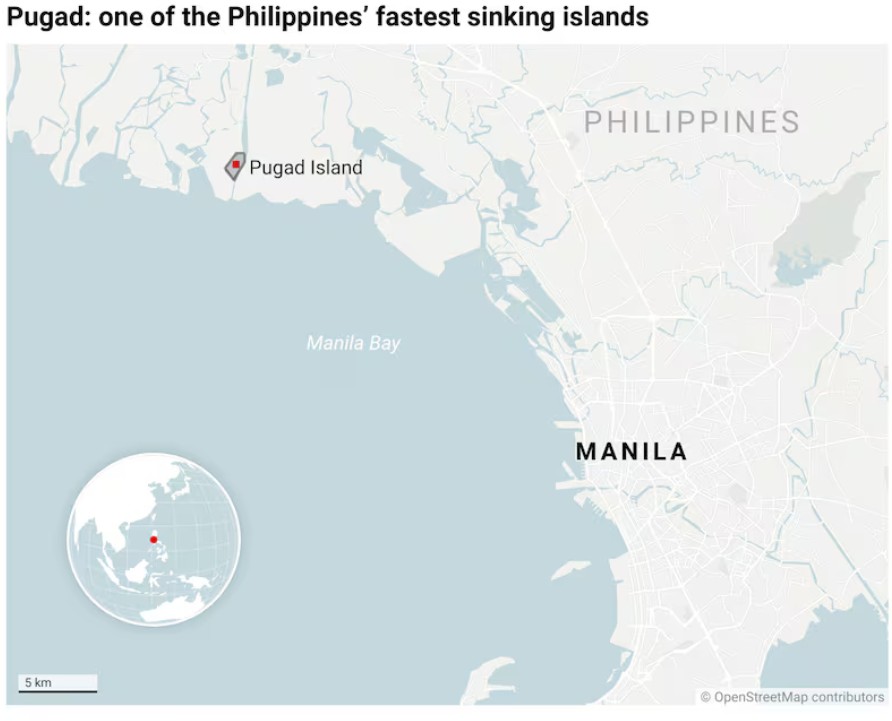
  • In news: Pugad Island

    Why in the News?

    The Philippine island of Pugad in Manila Bay is facing an existential threat as rising sea levels and rapid land subsidence combine to submerge homes and livelihoods.

    About Pugad Island:

    • Overview: Small 7-hectare island in Manila Bay, situated at the mouth of the Angat–Pampanga River Delta, under Hagonoy municipality, Bulacan province, Philippines.
    • Population: Home to about 1,636–2,056 residents, living in a single clustered village of roughly 384 houses.
    • Livelihoods: Community depends on fishing and aquaculture, with families cultivating clams, mussels, and whiting fish in converted fishponds.
    • Living Conditions: Houses built mainly from bamboo and old metal sheets, with poor sanitation, minimal healthcare facilities, and only elementary-level schooling.
    • Flooding Challenge: Regularly hit by high-tide and monsoon floods, made worse by land subsidence (11 cm/year) and sea-level rise (three times global average).
    • Environmental Hazards: Loss of mangroves, urban encroachment, and exposure to typhoons increase risks of disaster and displacement.
    [UPSC 2018] Which of the following has/have shrunk immensely/dried up in the recent past due to human activities?

    1.Aral Sea 2.Black Sea 3.Lake Baikal

    Select the correct answer using the code given below:

    (a) 1 only (b) 2 and 3 only (c) 2 only (d) 1 and 3*


  • Swami Vivekananda and Vedanta Philosophy

    Why in the News?

    On the 132nd anniversary of his 1893 Chicago address, Swami Vivekananda was remembered for introducing Indian spirituality and Vedanta to the world with a message of tolerance and unity.

    About Swami Vivekananda:

    • Early life: Born Narendranath Datta in 1863, Kolkata; Chief disciple of Sri Ramakrishna.
    • Role: Monk, reformer, and founder of the Ramakrishna Mission (1897).
    • Chicago Speech: Rose to global fame with his 1893 Parliament of Religions address in Chicago, calling for religious tolerance and universal brotherhood.
    • Teachings: Advocated social service, education, and spiritual sovereignty as means of national regeneration.
    • Legacy: Inspired the rise of Vedanta Societies worldwide, spread yoga and meditation in the West, and became a key figure in the Indian renaissance and freedom movement.

    What is Vedanta Philosophy?

    • Roots: Derived from the Upanishads, especially Advaita Vedanta (non-dualism).
    • Oneness of Existence: The universe is one absolute Brahman; all souls are divine.
    • Religious Pluralism: All religions are valid paths to the same truth; promotes harmony, not division.
    • Self-Realization: The aim of life is to realize and manifest one’s innate divinity.
    • Karma Yoga: Selfless service is a spiritual practice — “Jiva is Shiva” (service to man is service to God).
    • Practical Vedanta: Application of spiritual wisdom to daily life and social reform, bridging tradition and modernity.

    Back2Basics: Indian Classical Philosophy

    There are 6 classical schools of Indian philosophy in the orthodox (Astika) tradition, which accept the authority of the Vedas:

    1. Nyaya: School of logic and reasoning
    2. Vaisesika:  Atomism and categories of reality
    3. Sankhya: Dualism of consciousness (purusha) and matter (prakriti)
    4. Yoga: Practical discipline based on Patanjali’s Yoga Sutras
    5. Mimamsa (Purva Mimamsa): Ritual action and dharma
    6. Vedanta (Uttara Mimamsa): Philosophy of the Upanishads

    Apart from these, there are also heterodox (Nastika) schools, which do not accept Vedic authority, such as Buddhism, Jainism, and Charvaka (materialism).


  • A joint and new journey along the SCO pathway

    Introduction

    The Shanghai Cooperation Organisation (SCO), now the largest regional grouping after 24 years of evolution, witnessed its biggest summit in Tianjin with 23 countries and 10 international organisations participating. The presence of Indian Prime Minister Narendra Modi and Chinese President Xi Jinping signalled a possible recalibration of bilateral ties amid a tense global order. This summit was not only about regional security but also about shaping global governance, fostering sustainable development, and exploring new pathways of cooperation.

    Why in the News

    The Tianjin SCO Summit is in the news because it marked the largest gathering in SCO’s history and produced high-yielding outcomes, such as the creation of security centres, a development bank, and long-term strategies in energy, green industry, and digital economy. Importantly, India and China engaged in dialogue during the diamond jubilee year of China-India diplomatic ties, projecting partnership rather than rivalry. This reflects a striking shift from the border tensions that have dominated headlines in recent years, positioning the summit as a turning point in regional cooperation and global governance.

    High-Yield Outcomes of the Tianjin Summit

    1. Tianjin Declaration: Announced creation of four security centres, including an Anti-drug Center and a Universal Countering Security Challenges Center.
    2. SCO Development Bank: Decision to set up a regional bank to finance cooperative projects.
    3. Fair Stance on Trade: SCO states collectively defended multilateral trading systems and WWII legacy.
    4. 10-Year Strategy: Leaders adopted a development strategy for the next decade.
    5. China’s Initiatives: Xi announced three platforms for energy, green industry, and digital economy; and three centres for innovation, higher education, and vocational training.

    How the Summit Shaped Global Governance

    1. Global Governance Initiative: Xi proposed principles such as sovereign equality, international rule of law, and multilateralism.
    2. People-Centered Approach: Emphasis on real actions for peace and justice.
    3. Leadership Platform: SCO positioned as a space to counter the “governance deficit” in world politics.

    India’s Role in the SCO

    1. Active Member since 2017: India has advanced SCO’s development agenda.
    2. Support for Presidency: India extended full support to China’s SCO presidency.
    3. Areas of Cooperation: Security, energy, green industry, and digital economy identified as convergence points.

    75 Years of India-China Ties

    1. Anniversary Diplomacy: Modi and Xi stressed partnership over rivalry.
    2. Dragon and Elephant Metaphor: Xi urged for “dragon and elephant to dance together.”
    3. Consensus vs Disagreement: Leaders agreed that consensus outweighs differences.

    Road Ahead for Bilateral Cooperation

    1. Strategic Mutual Trust: Resume dialogue mechanisms, embrace peaceful coexistence, and mutual respect.
    2. Expanding Exchanges: Focus on trade, investment, technology, culture, and people-to-people bonds.
    3. Good-Neighbourliness: Reinforce Panchsheel principles, keep border differences from overshadowing wider relations.
    4. Global South Leadership: India and China to lead BRICS presidencies, resist hegemony, and promote fairness in world order.

    Conclusion

    The Tianjin Summit reflects a recalibration of SCO’s role as a platform for regional stability and global governance. For India, it marks a moment of balancing rivalry with cooperation in ties with China. If trust and exchanges are consolidated, India-China relations can shape the future of Asia and the Global South. The challenge lies in ensuring border disputes do not overshadow wider opportunities.

    Value Addition

    Shanghai Cooperation Organisation (SCO) 

    • Establishment: Permanent intergovernmental organisation founded on 15 June 2001 in Shanghai by China, Russia, Kazakhstan, Kyrgyzstan, Tajikistan, Uzbekistan. Predecessor: Shanghai Five (1996).
    • Charter: Adopted in 2002 (St. Petersburg), in force since 2003, laying down goals, principles, and structure.
    • Goals:
      • Strengthen trust, friendship, good-neighbourliness.
      • Promote cooperation in politics, economy, science, culture, education, energy, environment, etc.
      • Maintain peace, security, stability in the region.
      • Promote a fair, democratic international order.
    • Principles (Shanghai Spirit): Mutual trust, benefit, equality, consultation, respect for civilizational diversity, common development; externally—non-alignment, openness, non-targeting others.
    • Structure:
      • Council of Heads of State (CHS) – supreme body (annual).
      • Council of Heads of Government (CHG) – economic strategy, budget (annual).
      • Numerous sectoral mechanisms.
    • Permanent Bodies: Secretariat (Beijing) & Regional Anti-Terrorist Structure (RATS, Tashkent).
    • Membership:
      • 10 Members – India, China, Russia, Pakistan, Iran, Belarus, Kazakhstan, Kyrgyzstan, Tajikistan, Uzbekistan.
      • 2 Observers – Afghanistan, Mongolia.
      • 14 Dialogue Partners – incl. Nepal, Sri Lanka, Turkey, Saudi Arabia, UAE, Egypt, Qatar, Maldives, etc.

    Key Takeaways from SCO Summit 2025

    • 24 Documents Approved – including Tianjin Declaration and SCO Development Strategy till 2035.
    • Security Cooperation – agreement on SCO Anti-Drug Center and Universal Center for Countering Challenges & Threats.
    • Counter-Terrorism – joint declaration condemned Pahalgam (India), Jaffer Express & Khuzdar (Pakistan) terrorist attacks – significant as Pahalgam was earlier omitted.
    • Membership Expansion – Lao PDR granted Dialogue Partner status; CIS given Observer status.
    • Cultural Capital – Cholpon-Ata (Kyrgyzstan) designated SCO Tourist & Cultural Capital (2025–26).
    • Civilisation Dialogue Forum – proposed by PM Modi to strengthen people-to-people ties & civilizational exchange.
    • Global Governance Initiative – proposed by Xi Jinping for multilateralism, just & equitable order, Global South leadership.
    • SCO Chairmanship – passed to Kyrgyz Republic (2025–26) with theme: “25 years of SCO: together for a stable world, development, prosperity.”

    What SCO Means for India’s Global and Regional Interests

    1. Strategic Pillars – PM Modi outlined India’s SCO vision as S–Security, C–Connectivity, O–Opportunity.
    2. Central Asia Engagement – SCO provides a rare forum to deepen ties with resource-rich Central Asia and expand India’s role as a pan-Asian player beyond the South Asian paradigm.
    3. Counter-Terrorism – Access to the Regional Anti-Terrorist Structure (RATS) helps India with intelligence-sharing against the “three evils” (terrorism, separatism, extremism), beyond Pakistan-centric frameworks.
    4. India–Russia Cooperation – SCO strengthens Delhi’s strategic proximity with Moscow, which backed India’s full membership in 2016.
    5. Balancing China – India’s presence acts as a countervailing force to Chinese dominance in Eurasia, supported by Russia.
    6. BRI Opposition – India continues to reject the Belt and Road Initiative (BRI) as it passes through Pakistan-occupied territory, asserting sovereignty concerns.
    7. Diplomatic Battlefield – While enabling multilateral engagement, SCO also reflects great-power rivalries, making it both an opportunity and a challenge for India.

    PYQ Relevance

    [UPSC 2023] ‘Virus of Conflict is affecting the functioning of the SCO.’ In the light of the above statement, point out the role of India in mitigating the problems.

    Linkage: The SCO faces internal strains due to rivalries among major members, including China-Pakistan ties and regional security tensions. India has sought to mitigate these by emphasizing its three-pillared approach of Security, Connectivity, and Opportunity, pushing for counter-terrorism cooperation through RATS, and resisting divisive projects like BRI while promoting dialogue, civilizational exchange, and balanced economic engagement. Thus, India positions itself as a stabilizing force to preserve SCO’s collective agenda despite conflicts.

  • [pib] Gyan Bharatam Mission

    Why in the News?

    The Ministry of Culture has launched the ‘Gyan Bharatam’, a landmark national initiative dedicated to preserving, digitising, and disseminating India’s manuscript heritage.

    About Gyan Bharatam Mission:

    • Launch: A national initiative by the Ministry of Culture to preserve, digitise, and disseminate India’s manuscript heritage.
    • Scheme Type: Approved as a Central Sector Scheme (2024–31) with an outlay of ₹482.85 crore.
    • Background: Builds on the National Mission for Manuscripts (2003), which documented 44.07 lakh manuscripts in the Kriti Sampada repository.
    • Vision: Integrates tradition with modern technology (AI, cloud systems, digital archives) to safeguard manuscripts as living knowledge resources.
    • Philosophy: Linked to PM’s Viksit Bharat @2047 vision, positioning India as Vishwa Guru by combining heritage with innovation.

    Key Features:

    • Identification & Documentation: Establishment of Manuscript Resource Centres (MRCs) for systematic registration across India.
    • Conservation & Restoration: Strengthening Manuscript Conservation Centres (MCCs) for preventive and curative preservation using scientific techniques.
    • Digitisation & Repository: Large-scale digitisation with AI-based Handwritten Text Recognition (HTR), microfilming, and creation of a National Digital Repository accessible worldwide.
    • Youth & Public Engagement: Programs like Gyan-Setu AI Innovation Challenge to involve youth, start-ups, and researchers in heritage innovation.
    [UPSC 2008] Recently, the manuscripts of which one of the following have been included in UNESCO’s Memory of the World Register?

    Options: (a) Abhidhamma Pitaka (b) Mahabharata (c) Ramayana (d) Rig Veda*


  • [pib] Adi Sanskriti Digital Learning Platform

    Why in the News?

    The Ministry of Tribal Affairs has launched the beta version of “Adi Sanskriti”, a pioneering digital learning platform.

    About Adi Sanskriti:

    • What is it: A digital learning platform launched by the Ministry of Tribal Affairs.
    • Objective: To preserve tribal art forms, create livelihoods, and connect tribal communities with the world; scale into a Tribal Digital University with certifications, research opportunities, and transformative learning pathways.
    • Significance: Envisioned as the world’s first Digital University dedicated to tribal culture and traditional knowledge.
    • Developed by: MoTA collaboration with State Tribal Research Institutes (TRIs) to ensure authentic documentation and grassroots participation.
    • Integration with TRIs: Contributions from TRIs of 14 states including Andhra Pradesh, Assam, Bihar, Chhattisgarh, Gujarat, Kerala, Madhya Pradesh, Maharashtra, Odisha, Rajasthan, Tamil Nadu, Telangana, and Uttar Pradesh.

    Key Components of Adi Sanskriti:

    1. Adi Vishwavidyalaya (Digital Tribal Art Academy): Currently offering 45 immersive courses on tribal dance, painting, crafts, music, and folklore.
    2. Adi Sampada (Socio-Cultural Repository): Houses over 5,000 curated documents covering paintings, dance, clothing and textiles, artefacts, and livelihood practices.
    3. Adi Haat (Online Marketplace): Linked with TRIFED, designed to evolve into a dedicated e-marketplace for tribal artisans, ensuring sustainable livelihoods and direct consumer access.
    [UPSC 2016] SWAYAM’, an initiative of the Government of India, aims at:

    Options: (a) promoting the Self Help Groups in rural areas

    (b) providing financial and technical assistance to young start-up entrepreneurs

    (c) promoting the education and health of adolescent girls

    (d) providing affordable and quality education to the citizens for free*


  • Himachal Pradesh declared to be ‘Fully Literate’

    Why in the News?

    Himachal Pradesh was recently declared a ‘fully literate’ state, becoming the 5th State/UT after Goa, Ladakh, Mizoram, and Tripura.

    Various Definitions of Literacy / Full Literacy:

    • Ministry of Education (MoE) Definition: Literacy is the ability to read, write, and compute with comprehension, along with digital literacy and financial literacy as critical life skills.
    • Full Literacy (MoE): A State/Union Territory (UT) is considered fully literate at 95% literacy rate.
    • Census of India (2011): Any person aged 7 years or above who can read and write with understanding in any language is considered literate. Ability to read without writing is NOT counted as literacy.
    • ULLAS Programme: Understanding Lifelong Learning for All in Society launched in 2022. Literacy here means acquiring foundational skills of reading, writing, and arithmetic plus functional knowledge like time, currency, and digital use.
    • NILP: New India Literacy Programme (centrally sponsored, aligned with NEP 2020). Defines full literacy as achieving ≥95% literacy rate certified via assessments.

    How is Literacy attained under ULLAS / NILP?

    • Target Group: Adults (15+) who missed formal schooling are identified through door-to-door surveys or other state data.
    • Basic Training: Learners are taught reading, writing, and arithmetic (up to Class 3 level), along with practical skills like using calendars, reading time, handling currency/cheques, and making safe digital transactions.
    • Delivery Mechanism: Training delivered through the ULLAS mobile app or offline by student volunteers and community workers.
    • Assessment: Learners appear for FLNAT (Foundational Literacy and Numeracy Assessment Test), a 150-mark test available in regional languages.
    • Certification: On passing FLNAT, learners are certified by the NIOS (National Institute of Open Schooling) as literate.
    • Outcome: States/UTs are declared ‘fully literate’ when identified non-literates clear FLNAT and the literacy rate crosses the 95% threshold.
    [UPSC 2017] What is the aim of the programme ‘Unnat Bharat Abhiyan’ ?

    Options:

    (a) Achieving 100% literacy by promoting collaboration between voluntary organizations and government’s education system and local communities.

    (b) Connecting institutions of higher education with local communities to address development challenges through appropriate technologies. *

    (c) Strengthening India’s scientific research institutions to make India a scientific and technological Power.

    (d) Developing human capital by allocating special funds for health-care and education of rural and urban poor, and organizing skill development programmes and vocational training for them.