💥Join UPSC 2027,2028 Mentorship (August Batch) + XFactor Notes & Microthemes PDF

Distribution: weekly

  • ‘Maratha Military Landscapes’ included in the UNESCO World Heritage List

    Why in the News?

    The ‘Maratha Military Landscapes’ of India have been inscribed on the UNESCO World Heritage List under the cultural category during the 47th session of the World Heritage Committee held in Paris.

    About Maratha Military Landscapes:

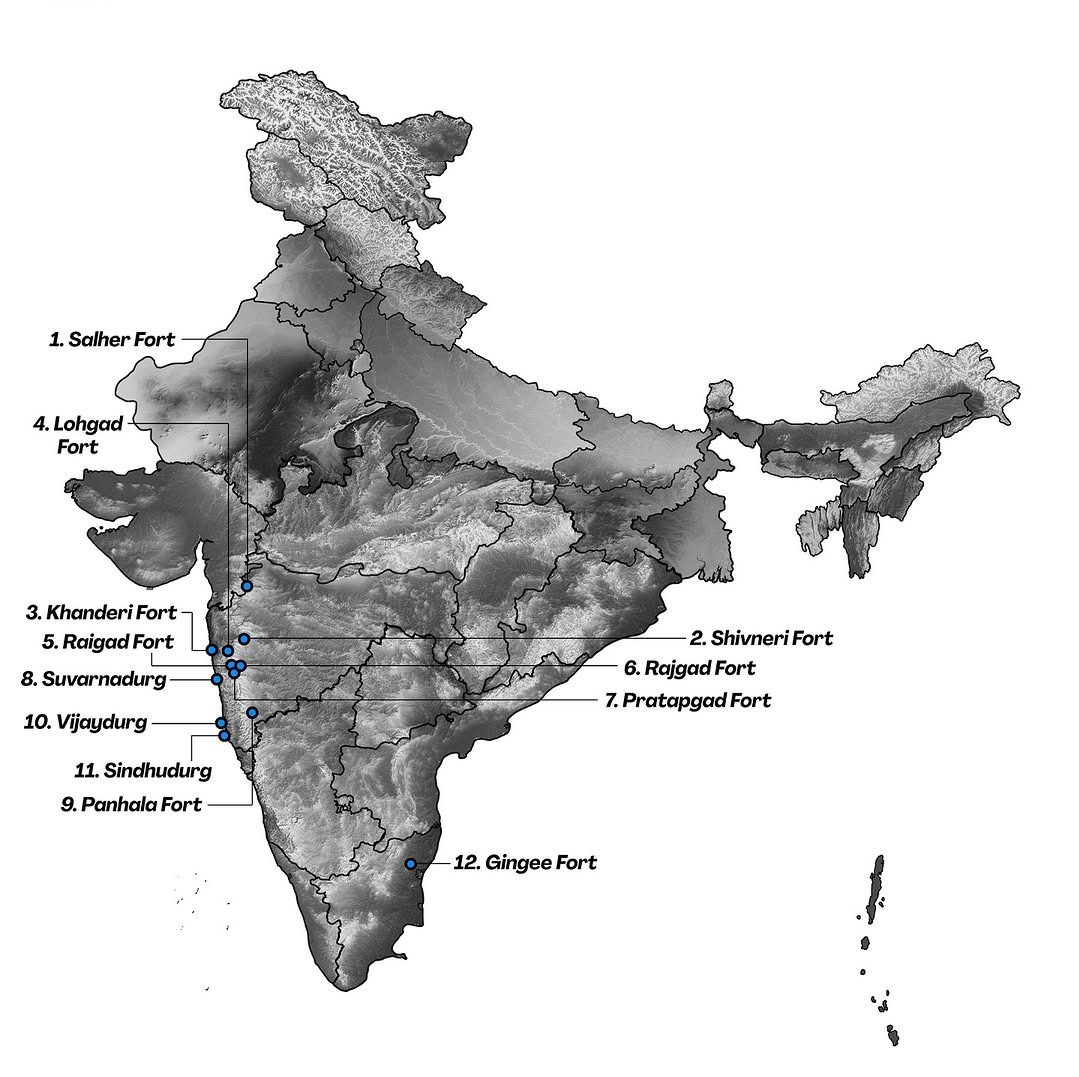
    • Overview: A network of 12 forts showcasing the Maratha Empire’s military architecture and strategic fortification from the 17th to 19th centuries.
    • Time Period: Developed between 1670 CE (Shivaji’s era) and 1818 CE (end of Peshwa rule).
    • Geographical Spread: 11 forts in Maharashtra and 1 in Tamil Nadu (Gingee Fort), covering hill, coastal, forest, plateau, and island terrains.
    • Key Forts: Salher, Shivneri, Lohgad, Raigad, Rajgad, Pratapgad, Khanderi, Suvarnadurg, Panhala, Vijaydurg, Sindhudurg (Maharashtra); Gingee (Tamil Nadu).
    • Types:
      • Hill forts: Rajgad, Raigad
      • Hill-forest: Shivneri
      • Coastal: Suvarnadurg, Vijaydurg
      • Island: Khanderi, Sindhudurg
    • Protection:
      • 8 forts by Archaeological Survey of India (ASI)
      • 4 forts by Maharashtra’s Directorate of Archaeology & Museums
    • Ideology: Reflects Shivaji’s military decentralization, terrain-based defense, and self-sustaining fort systems.
    • Tagged under cultural criteria:
      • (iii) Exceptional testimony to a cultural tradition
      • (iv) Outstanding example of military architecture
      • (vi) Association with historic events and traditions

    What are UNESCO World Heritage Sites?

    • A WHS is a landmark or area recognized for its cultural, historical, natural, or scientific value to humanity.
    • It is governed by the UNESCO World Heritage Convention (1972).
      • India formally signed the Convention on November 14, 1977.
    • Sites are selected by the World Heritage Committee, comprising 21 elected state parties.
    • Categories include:
      • Cultural (e.g., forts, temples, cities)
      • Natural (e.g., forests, parks, biodiversity sites)
      • Mixed (having both cultural and natural value)
    • Selection is based on 10 criteria (6 cultural + 4 natural); at least one must be met.
    • Once inscribed, sites are eligible for global recognition, protection, and funding.


    [UPSC 2024] Consider the following properties included in the World Heritage List released by UNESCO:

    1. Shantiniketan 2. Rani-ki-Vav 3. Sacred Ensembles of the Hoysalas 4. Mahabodhi Temple Complex at Bodhgaya

    How many of the above properties were included in 2023?

    Options: (a) Only one (b) Only two* (c) Only three (d) All four


  • [pib] Sanchar Mitra Scheme

    Why in the News?

    The Department of Telecommunications (DoT) has launched an expanded Sanchar Mitra Scheme to engage engineering students as digital ambassadors for promoting telecom literacy, digital safety, and citizen engagement.

    What is the Sanchar Mitra Scheme?

    • Launching Body: An initiative by the Department of Telecommunications (DoT), Government of India.
    • Primary Aim: To engage student volunteers as “Sanchar Mitras” or digital ambassadors to spread awareness about telecom-related issues.
    • Purpose:
      • Bridge the communication gap between citizens and the telecom ecosystem.
      • Promote safe and informed use of telecom services.
      • Encourage public participation in India’s digital transformation.
    • Implementation Status:
      • Piloted in select institutions.
      • Now being scaled up for nationwide rollout.

    Key Features and Highlights:

    • Target Audience: It primarily targets students from engineering and technical backgrounds such as telecommunications, computer science, electronics, and cybersecurity.
    • Selection of Volunteers: Students will be nominated as Sanchar Mitras in consultation with DoT field units and educational institutions.
    • Training Modules: Volunteers will be trained to conduct grassroots campaigns on cyber fraud prevention, EMF radiation concerns, and responsible digital behavior.
    • Training Institutions: Training will be delivered by the National Communications Academy–Technology (NCA-T) and the Media Wing of the DoT.
    • Core Pillars: The scheme is structured around three key pillars: Connect, Educate, and Innovate.
    • Tech Awareness Promotion: Sanchar Mitras will promote awareness on emerging telecom technologies like 5G, 6G, AI, and cybersecurity.
    • Community Outreach: Students will engage with communities, NGOs, and schools to foster a culture of informed digital citizenship.
    • Strategic Alignment: It aligns with India’s strength in the “Four Ds”: Democracy, Demography, Digitisation, and Delivery.
    [UPSC 2010] Which among the following do/does not belong/belongs to the GSM family of wireless technologies?

    Options: (a) EDGE (b) LTE (c) DSL* (d) Both EDGE and LTE


  • [pib] E-Truck Incentive Scheme

    Why in the News?

    The Ministry of Heavy Industries (MHI) has launched E-Truck Incentive Scheme to provide financial incentives for electric trucks (e-trucks) under the PM E-DRIVE initiative.

    What is E-Truck Incentive Scheme?

    • Overview: It is a dedicated scheme to provide financial incentives for electric trucks under the broader PM E-DRIVE initiative.
    • First-of-its-Kind Support: This is the first direct government support specifically for electric trucks to promote clean, efficient, and sustainable freight mobility.
    • Target Vehicle Categories: It targets N2 and N3 category trucks, as per Central Motor Vehicle Rules (CMVR):
      • N2: GVW above 3.5 tonnes up to 12 tonnes
      • N3: GVW above 12 tonnes up to 55 tonnes
    • Incentive for Articulated Vehicles: For articulated vehicles, the incentive applies only to the puller tractor of the N3 category, not the trailer.
    • Warranty Requirements:
      • Battery: 5 years or 5 lakh km, whichever comes first
      • Motor & Vehicle: 5 years or 2.5 lakh km
    • Incentive Details:
      • Based on Gross Vehicle Weight (GVW)
      • Maximum support capped at ₹9.6 lakh per e-truck
      • Incentives are given as upfront discounts, reimbursed to Original Equipment Manufacturers (OEMs) through the PM E-DRIVE portal
    • Deployment Goal: It aims to support the deployment of 5,600 electric trucks across India.
      • 1,100 trucks reserved for Delhi, with ₹100 crore allocated due to high pollution levels
    • Mandatory Scrappage Clause: To qualify, applicants must scrap an old diesel truck via scrappage centres approved by the Ministry of Road Transport and Highways (MoRTH).
    • Sectoral Impact: It is expected to benefit sectors like steel, ports, cement, and logistics by reducing fuel costs and improving air quality.

    About PM E-DRIVE Scheme:

    • Overview: It stands for Prime Minister’s Electric Drive Revolution in Innovative Vehicle Enhancement, launched by the Ministry of Heavy Industries in September 2024.
    • Long-Term Goal: To to foster an EV ecosystem, reduce carbon emissions, and help India achieve Net Zero emissions by 2070.
    • Budget Allocation: It has a total outlay of ₹10,900 crore for two years, aimed at accelerating India’s electric mobility transition.
    • Scope and Coverage: It supports multiple vehicle categories: Two-wheelers; Three-wheelers; Electric trucks; Electric buses and Electric ambulances.
    • Demand Incentive: It provides direct demand incentives to buyers through OEMs, lowering the upfront cost of EVs.
    • Category-wise Allocation:
      • 3,679 crore: For two-wheelers, three-wheelers, ambulances, and trucks
      • 500 crore: Specifically for electric ambulance procurement
      • 4,391 crore: To procure 14,028 electric buses in 9 major cities (Delhi, Mumbai, Kolkata, Chennai, Ahmedabad, Surat, Bangalore, Pune, Hyderabad)
    • Charging Infrastructure: ₹2,000 crore allocated to build 72,300 public charging stations nationwide, including:
      • Fast chargers for four-wheelers, buses, two-wheelers, and three-wheelers
    • Digital E-Voucher System:
      • Incentives claimed through Aadhaar-authenticated e-vouchers
      • Signed digitally by both buyer and dealer for transparency
    • Vehicle Scrappage Mandate: Scrapping of old vehicles is mandatory to claim certain incentives, especially for electric trucks, promoting fleet modernization.


    [UPSC 2025] Consider the following types of vehicles:

    I. Full battery electric vehicles II. Hydrogen fuel cell vehicles III. Fuel cell electric hybrid vehicles

    How many of the above are considered as alternative (powertrain) vehicles?

    Options: (a) Only one (b) Only two (c) All the three* (d) None


  • What are Autonomous District Councils (ADC)?

    Why in the News?

    Mizoram Governor has imposed Governor’s Rule in the Chakma Autonomous District Council (CADC) due to prolonged political instability and repeated leadership changes.

    About Autonomous District Councils (ADCs):

    • Basis: They are local self-governing institutions established under the Sixth Schedule of the Indian Constitution.
    • Coverage: ADCs are constituted in tribal areas of the northeastern states—Assam, Meghalaya, Tripura, and Mizoram (ATM2) [Sixth Schedule] 
    • Purpose: These councils aim to provide autonomy to tribal communities to preserve their culture, customs, and govern their local affairs.
    • Notification: Each tribal area notified under the Sixth Schedule is declared an autonomous district, governed by its respective ADC.
    • Objective: The primary objectives of ADCs are to promote tribal self-governance, ensure local development, and protect tribal identity and rights.

    Note: The Constitution provides for the reservation of seats in Panchayats for STs.

    Key Features of ADCs

    • Legal Status: ADCs are formed through constitutional provisions under the Sixth Schedule and are not governed by state laws.
    • Council Composition: Each ADC comprises up to 30 members, of which 26 are elected by adult suffrage and 4 are nominated by the Governor.
    • Tenure: The tenure of an ADC is 5 years from the date of its constitution.
    • Scope of Authority: ADCs have legislative, executive, and limited judicial powers specific to the needs of tribal communities.
    • Applicability of Laws: State and Central laws do not automatically apply in ADC areas unless explicitly extended by the Governor.

    Powers and Functions of ADCs:

    • Law-Making Powers: ADCs can enact laws on land management, agriculture, and forest use (excluding reserved forests).
    • Customary Regulations: They can regulate inheritance, marriage, divorce, and social customs, and appoint traditional chiefs and headmen.
    • Local Administration: It oversee services such as primary education, dispensaries, roads, markets, and fisheries.
    • Judicial Functions: Councils can establish village courts to try civil and criminal cases involving tribal members, with sentencing powers up to five years.
    • Regulation of Trade: They may regulate money lending and trade by non-tribals, subject to Governor’s approval.
    • Revenue Sources: It can levy taxes on professions, trades, animals, vehicles, markets, ferries, and public infrastructure like roads and schools.

    Autonomy and Limitations:

    • Degree of Autonomy: ADCs enjoy substantial legislative and administrative autonomy within their territorial jurisdiction.
    • Non-Applicability of General Laws: Parliamentary and State laws apply only when directed by the Governor, ensuring self-rule.
    • Governor’s Oversight: Despite autonomy, the Governor retains discretionary powers and can approve, modify, or annul council decisions.
    • Financial Constraints: ADCs often face limited revenue generation, which restricts their developmental effectiveness.
    • Administrative Challenges: Operational issues include leadership instability, shortage of trained personnel, and state-level interference in council functions.
    [UPSC 2015] The provisions in Fifth Schedule and Sixth Schedule in the Constitution of India are made in order to:Options: (a) protect the interests of Scheduled Tribes * (b) determine the boundaries between States (c) determine the powers, authority and responsibilities of Panchayats (d) protect the interests of all border States
  • In news: International Criminal Court (ICC)

    Why in the News?

    The International Criminal Court (ICC) has issued arrest warrants for senior Taliban leaders in Afghanistan over the persecution of women, a crime against humanity.

    About the International Criminal Court (ICC):

    • Established: 2002 under the Rome Statute (1998); headquartered at The Hague, Netherlands.
    • Nature: First permanent international court to try individuals for grave crimes.
    • Jurisdiction over 4 core crimes:
    1. Genocide
    2. Crimes against humanity
    3. War crimes
    4. Crime of aggression
    • Members: 124 States Parties
      • NON-members: India, China, USA, Russia, Israel, Ukraine
    • Structure:
      • Office of the Prosecutor – investigates and prosecutes cases.
      • 18 Judges – elected for 9 years.
      • Assembly of States Parties – governs ICC administration.
      • Trust Fund for Victims, Detention Centre
    • Languages: English, French, Arabic, Chinese, Russian, Spanish
    • Funding: Annual budget (2025) ~ €195 million (mostly from member states)

    Reach of an ICC Warrant:

    • Applicability:
      • Crimes by nationals of member states
      • Crimes committed on member state territory
      • UNSC referrals can extend jurisdiction to non-member states (e.g., Libya, Darfur)
    • Obligations on States:
      • Member states must execute arrest warrants and cooperate fully.
      • Non-compliance can be reported to Assembly of States Parties or UN Security Council (for UNSC referrals)
    • Challenges:
      • ICC lacks an independent enforcement mechanism
      • Non-members (e.g., US, Russia) are not bound to cooperate
      • Political and diplomatic constraints hinder the execution of warrants
    • Special Mechanisms: ICC established an Arrest Working Group (2016) to enhance warrant enforcement through better intelligence-sharing.
    [UPSC 2019] Consider the following statements:

    1.The International Criminal Court (ICC) has jurisdiction to prosecute nationals of even those States that have not ratified the Rome Statute.

    2. The International Criminal Court is a ‘court of last resort’ intended to complement national judicial systems.

    3. The United Nations Security Council can refer a situation to the Prosecutor of the ICC even if the State concerned is not a party to the Statute.

    Which of the statements given above are correct?

    Options:  (a) 1 and 3 only (b) 2, 3 and 4 only (c) 2 and 4 only (d) 1, 2, 3 and 4*


  • ExplainSpeaking: Why govt claims on reducing inequality in India are being contested

    Why in the News?

    The Indian government recently claimed that India is among the world’s most equal societies, citing a Gini Index of 25.5 from the World Bank’s Poverty and Equity Brief, which would place India as the fourth most equal country globally. However, this claim has sparked debate and criticism from economists and inequality researchers.

    What is the Gini Index?

    The Gini Index (or Gini coefficient) is a statistical measure of inequality within a population. It is commonly used to measure income or wealth inequality, but can also be applied to consumption inequality.

    What are the flaws in using consumption-based Gini to measure inequality?

    • Underestimates Real Inequality: Consumption is usually smoother than income because high earners tend to save more rather than spend proportionately. This leads to an underestimation of inequality. Eg: A billionaire may consume modestly while saving most income, appearing similar to a middle-class consumer in surveys, but with vastly different wealth.
    • Poor Cross-Country Comparability: India uses consumption-based data while most other countries use income-based Gini, making international comparisons misleading. Eg: India’s Gini of 25.5 (consumption-based) appears more equal than OECD countries, but income-based Gini (62) shows much higher inequality.
    • Low survey participation: Surveys often miss the richest due to non-response or sampling issues, failing to reflect the real inequality they contribute to. Eg: The richest 1% earn disproportionately more, but their low survey participation leads to underreported inequality.

    Why is the World Inequality Database seen as more reliable?

    • Uses Income and Wealth Tax Data: Unlike consumption surveys, WID incorporates income tax and wealth tax data, which captures the top 1% of earners often missed in surveys. Eg: WID shows India’s income Gini Index rose from 52 in 2004 to 62 in 2023, revealing growing inequality missed by consumption-based metrics.
    • Captures Extreme Disparities: WID focuses on distributional national accounts, helping identify disparities between the top 10% and bottom 50%, which Gini often misses. Eg: In 2023-24, the top 10% in India earned 13 times more than the bottom 10%, a gap accurately captured by WID.
    • Global Comparability and Peer Review: WID data is transparent, methodologically standardised, and peer-reviewed by global economists, making it a trusted source for cross-country comparison. Eg: Countries like France and the US use WID for policy framing on progressive taxation and redistribution.

    What are the alternatives to the Gini Index that better reflect extreme disparities?

    • Palma Ratio: The Palma Ratio compares the income share of the top 10% to that of the bottom 40%, focusing directly on income inequality between the rich and poor. Eg: In countries like South Africa, the Palma Ratio highlights stark disparities that are often missed by the Gini Index.
    • Theil Index (Generalized Entropy Measures): The Theil Index allows for decomposition of inequality within and between population groups like rural vs urban. Eg: In Brazil, it has been used to analyze racial and regional disparities more precisely than the Gini Index.

    What are the policy risks of underestimating inequality?

    • Misguided Policy Design: When inequality is underestimated, governments may prioritize growth-focused policies without ensuring inclusive development. This can lead to insufficient investment in social protection, health, and education for marginalized groups.
    • Widening Socioeconomic Gaps: Underestimating inequality allows elite capture of resources and opportunities, worsening wealth concentration. This can deepen inter-generational poverty, especially for rural, low-caste, and female-led households.
    • Social and Political Instability: Failure to address real inequality can fuel public discontent, protests, and even extremism. It undermines trust in institutions and weakens democratic legitimacy over time.

    What are the policy risks of underestimating inequality?

    • Misguided Policy Priorities: Underestimating inequality leads to policies focused only on aggregate growth, neglecting equity. Eg: India’s high GDP growth often overshadowed poor social investment in rural health and education, worsening human development gaps.
    • Weak Targeting of Welfare Schemes: If inequality is not accurately measured, social protection may miss the truly needy. Eg: Exclusion errors in schemes like PDS or PM-KISAN arise because top income groups are not properly excluded due to lack of granular data.
    • Rising Social Unrest and Distrust: Ignoring inequality can result in resentment, protests, and political instability. Eg: Farmer protests in India reflected deeper rural-urban income divides and perceived neglect of smallholder concerns.

    Way forward: 

    • Improve Data Collection Methods: Strengthen surveys by combining consumption data with income tax records, and ensure better representation of top income groups to capture true inequality.
    • Adopt Comprehensive Inequality Metrics: Use alternative indicators like the Palma Ratio or income shares of top 10% vs bottom 50%, alongside the Gini Index, for a more accurate assessment.
    • Design Inclusive Policy Frameworks: Align fiscal policies, welfare schemes, and tax reforms with accurate inequality data to target marginalized groups effectively and reduce social and regional disparities.

    Mains PYQ:

    [UPSC 2024] Despite comprehensive policies for equity and social justice, underprivileged sections are not yet getting the full benefits of affirmative action envisaged by the Constitution. Comment.

    Linkage: This question critically examines the effectiveness of current policies intended to reduce inequality and promote social justice. It suggests that, despite official claims or stated objectives, the intended benefits are not effectively reaching the marginalised groups, thereby raising doubts about the actual progress in reducing inequality. It reflects the broader issue of implementation challenges in governance.

  • UNEP Frontiers 2025 Report on Legacy Pollutants

    Why in the News?

    The United Nations Environment Programme (UNEP), in its latest Frontiers 2025 report titled The Weight of Time, has warned that increased river and coastal flooding caused by climate change could unearth dangerous legacy pollutants from water bodies.

    About Legacy Pollutants:

    • Definition: Legacy pollutants refer to toxic substances like heavy metals and persistent organic pollutants (POPs) that continue to remain in the environment even decades after their use has been banned or restricted.
    • Examples:
      • Heavy Metals: Lead, Cadmium, Mercury, Arsenic.
      • Persistent Organic Pollutants (POPs):
        • Pesticides: DDT (Dichlorodiphenyltrichloroethane), Aldrin, Endrin, Chlordane.
        • Industrial Chemicals: PCBs (Polychlorinated Biphenyls), Dioxins, Furans.
        • By-products: Produced from incineration, metal smelting, and waste burning.
    • Persistence: These substances are highly resistant to environmental degradation and accumulate in riverbeds, lakes, estuaries, and other sediment-rich ecosystems.
    • Health Hazards: Even at low exposure levels, legacy pollutants can cause: Neurotoxicity (nervous system damage), Immunotoxicity (immune disruption), Hepatotoxicity (liver damage), Reproductive toxicity (infertility, birth defects), Carcinogenicity (various cancers), Endocrine disruption etc.
    • Sources:
      • Past industrial practices, use of banned agricultural chemicals, and obsolete pesticide stockpiles.
      • Improperly managed chemical landfills, which still hold an estimated 4.8–7 million tonnes of POP waste globally.

    UNEP Frontiers 2025 Report on Legacy Pollutants

    Key Highlights of Frontiers 2025: The Weight of Time (UNEP):

    • Retreat of Toxins: Climate change-induced flooding can unearth and redistribute toxic legacy pollutants from contaminated sediments into the environment and food chain.
    • How? Floodwaters re-suspend heavy metals and POPs trapped in sediment.
    • Case Studies Cited:
      • Hurricane Harvey (Texas, 2017): Released mercury and carcinogenic chemicals from flood-induced sediment dispersal into Galveston Bay.
      • Niger Delta Floods (Nigeria, 2012): Mobilised Polycyclic Aromatic Hydrocarbons (PAHs) from oil-contaminated sediments.
      • Pakistan Floods (2010 & 2022): Washed away obsolete pesticide stockpiles, spreading DDT and other POPs into floodwaters and soils.
    • India-Specific Findings:
      • Sediments of Ganga, Hindon, and Vaigai Rivers show dangerously high levels of Cadmium.
      • Cadmium is a known carcinogen and endocrine disruptor, with potential to cause kidney, bone, and reproductive harm.
      • Ayad and Vaigai Rivers also showed up deadly levels of Lead concentration.
    [UPSC 2016] Which of the following can be found as pollutants in the drinking water in some parts of India?

    1. Arsenic 2. Sorbitol 3. Fluoride 4. Formaldehyde 5. Uranium

    Options: (a) 1 and 3 only (b) 2, 4 and 5 only (c) 1, 3 and 5 only* (d) 1, 2, 3, 4 and 5


  • [pib] Fossils reveal Kashmir Valley’s Climatic Past

    Why in the News?

    Researchers from Birbal Sahni Institute of Palaeosciences (BSIP), Lucknow, have found strong evidence that the Kashmir Valley, now cool and temperate, was once a warm, humid subtropical region.

    About the Study on Fossils:

    • Site of Fossil Discovery: The fossils were recovered from the Karewa sediments of the Kashmir Valley, known for preserving ancient plant remains.
    • Analysis: Researchers used CLAMP (Climate Leaf Analysis Multivariate Program) to analyze fossil leaf shape, size, and margins to estimate past temperature and rainfall patterns.
    • Coexistence Approach: It was also used, comparing fossil plants with their modern relatives to reconstruct the region’s ancient climate.

    Key Findings:

    • Past Climate Type: The Kashmir Valley once had a warm, humid subtropical climate, very different from the cool, Mediterranean-type climate it experiences today.
    • Vegetation Evidence: Fossilized leaves showed diverse subtropical plant types no longer found in the region’s current vegetation.
    • Role of Tectonic Uplift: The tectonic uplift of the Pir Panjal Range was identified as a key factor that blocked the Indian summer monsoon from entering the valley.
    • Climatic Transition: This led to gradual drying of the region and a shift from subtropical forests to temperate ecosystems.
    • Impact of Mountain-Building: The study shows that mountain-building (tectonic uplift) can directly affect climate patterns by altering monsoon routes.
    • Relevance to Climate Change: The findings provide insight into natural climate shifts over millions of years, helping contextualize modern climate change.
    • Ecological Vulnerability: It also highlights the fragility of mountain ecosystems like the Himalayas, which are vulnerable to both natural and human-induced environmental changes.

    Back2Basics:

    • Karewa Sediments: They are plateau-like terraces in the Kashmir Valley, made up of lacustrine (lake) and fluvio-glacial deposits; They are known to preserve ancient fossils, especially of plants.
    • Subtropical Climate: A warm and humid climate with moderate to high rainfall, supporting dense vegetation. Ex: Climate of northeastern India.
    • Mediterranean-Type Climate: Characterized by mild, wet winters and hot, dry summers; Ex: Current climate of parts of the Kashmir Valley.


    [UPSC 2025] Which of the following are the evidence of the phenomenon of continental drift?

    I. The belt of ancient rocks from Brazil coast matches with those from Western Africa. II. The gold deposits of Ghana are derived from the Brazil plateau when the two continents lay side by side. III. The Gondwana system of sediments from India is known to have its counterparts in six different landmasses of the Southern Hemisphere.

    Options: (a) I and III only (b) I and II only (c) I, II and III * (d) II and III only


  • What are Zonal Councils?

    Why in the News?

    Union Home Minister recently highlighted that 83% of issues discussed in Zonal Council meetings have been resolved, reaffirming their role as effective platforms for intergovernmental cooperation.

    What are Zonal Councils?

    • Establishment: They are statutory bodies established under the States Reorganisation Act, 1956; they are not constitutional bodies.
    • Purpose: Their main goal is to promote cooperation and coordination among states, union territories, and the central government.
    • Basis for Zoning: Zones were drawn based on natural divisions, cultural and linguistic affinity, river systems, and security needs.
    • Zonal Division: India is divided into five zones—Northern, Central, Eastern, Western, and Southern—with a separate Zonal Council for each:
      1. Northern Zonal Council: Haryana, Himachal Pradesh, Jammu & Kashmir, Punjab, Rajasthan, Delhi, Chandigarh
      2. Central Zonal Council: Chhattisgarh, Uttarakhand, Uttar Pradesh, Madhya Pradesh
      3. Eastern Zonal Council: Bihar, Jharkhand, Odisha, West Bengal
      4. Western Zonal Council: Goa, Gujarat, Maharashtra, Dadra & Nagar Haveli, Daman & Diu
      5. Southern Zonal Council: Andhra Pradesh, Karnataka, Kerala, Tamil Nadu, Puducherry

    Note: 

    • North-Eastern Council (NEC) (separate body): Assam, Arunachal Pradesh, Manipur, Tripura, Mizoram, Meghalaya, Nagaland, Sikkim (added in 2002)
    • The union territories of Andaman and Nicobar Islands and Lakshadweep are NOT members of any of the Zonal Councils. However, they are presently special invitees to the Southern Zonal Council.

    Composition and Structure of Zonal Councils:

    • Chairperson: Each Zonal Council is chaired by the Union Home Minister.
    • State Representation: The Chief Ministers of all states in the respective zone are members of the Council.
    • Additional Members: Each state nominates two additional ministers; administrators of union territories also participate.
    • Vice-Chairperson Role: The role of Vice-Chairperson rotates annually among the Chief Ministers.
    • Standing Committees: These are formed with Chief Secretaries of states and meet ahead of full sessions to finalize the agenda.

    Functions and Responsibilities:

    • Cooperation & Consensus: Promote interstate and Centre-state cooperation through dialogue and consensus-building.
    • Key Issues Addressed: Economic and social planning, Border disputes, Inter-state transport, Linguistic minority concerns etc.
    • Advisory Role: While the councils’ recommendations are advisory, they play a vital role in dispute resolution and coordinated policy formulation.

    Recent Developments and Significance:

    • Leadership in NEC: In 2018, the Union Home Minister became the Chairperson of the North Eastern Council, signaling a push for broader integration.
    • Revitalization under Modi Government: Zonal Councils have evolved into dynamic, action-oriented platforms rather than passive advisory bodies.
    • Strengthening Federalism: These councils now actively contribute to cooperative federalism, resolve disputes, and accelerate regional development.
    • Efficacy in Implementation: With 83% of agenda issues resolved, Zonal Councils demonstrate increasing political will and effectiveness in addressing regional challenges.
    [UPSC 2013] Which of the following bodies is/are not mentioned in the Indian Constitution?

    1. National Development Council 2. Planning Commission 3. Zonal Councils

    Select the correct answer using the codes given below.

    Options: (a) 1 and 2 only (b) 2 only (c) 1 and 3 only (d) 1, 2 and 3


  • [pib] Dhammachakra Pravartana Divas

    Why in the News?

    The International Buddhist Confederation (IBC) recently celebrated Ashadha Purnima, also known as Dhammachakra Pravartana Divas at Mulagandha Kuti Vihara, Sarnath.

    About Dhammachakra Pravartana Divas:

    • First Sermon: It marks the day when Gautama Buddha delivered his first sermon after attaining enlightenment.
    • Date of Observance: The day is observed annually on the full moon of Ashadha (Ashadha Purnima), usually in July.
    • Name and Location: The sermon, called Dhammacakkappavattana Sutta, was delivered at Deer Park (Isipatana), Sarnath, near Varanasi.
    • Core Teachings Introduced: It laid the foundational teachings of Buddhism by introducing the Four Noble Truths and the Noble Eightfold Path.
    • Formation of Sangha: His five former ascetic companions—Kaundinya, Bhaddiya, Vappa, Mahanama, and Assaji—became the first monks of the Buddhist Sangha.
    • Symbolic Representation: The Dharma Chakra (Wheel of Dharma) symbolizes this “turning of the wheel of law” and spread of the Buddha’s teachings.
    • Significance:
      • Monastic Practice: It marks the beginning of the Varsha Vassa, a three-month monastic retreat during the rainy season.
      • Religious Importance: It is the second most important Buddhist festival after Buddha Purnima.

    Modern Day Significance:

    • Ambedkarite Movement: In India, it is also significant for commemorating Dr. B.R. Ambedkar’s conversion to Buddhism with his followers at Deekshabhoomi, Nagpur (14 October 1956).
    • Social Commitment: On this day, millions reaffirm their commitment to Buddhist values and the 22 vows taken to renounce caste-based discrimination.
    • Global Observance: The day is celebrated internationally under various names—Esala Poya (Sri Lanka), Asanha Bucha (Thailand), and Asadha Purnima (India).

    Tap to read more about philosophical tenets of Buddhism.

    Back2Basics: Buddhist Councils

    Council Date & Venue Patron & President Objective Key Outcomes
    1st Buddhist Council 483 BCE, Rajagriha (Bihar) Ajatashatru (Haryanka dynasty), Presided by Mahakasyapa To preserve the Buddha’s teachings after his Mahaparinirvana Vinaya Pitaka compiled by Upali (rules for monks)
    Sutta Pitaka compiled by Ananda (discourses of Buddha)
    2nd Buddhist Council 383 BCE, Vaishali (Bihar) Kalasoka (Shishunaga dynasty), Presided by Sabakami To resolve disputes over lax discipline and the ‘Ten Points’ followed by Vaishali monks – Split into Sthaviravadins (orthodox) and Mahasamghikas (liberal)
    – Reaffirmation of stricter Vinaya rules
    3rd Buddhist Council 247 BCE, Pataliputra (Patna) Ashoka (Maurya dynasty), Presided by Moggaliputta Tissa To eliminate heretical monks and consolidate Buddhist doctrine – Compilation of Abhidhamma Pitaka
    – Composition of Kathavattu (philosophical debates)
    – Launch of Buddhist missions to 9 countries
    4th Buddhist Council 72 CE, Kashmir Kanishka (Kushan dynasty), Presided by Vasumitra (with Asvaghosha) To formalize doctrines and address doctrinal splits – Formal split into Hinayana and Mahayana schools
    – Compilation of Vibhasha Sastras (commentaries)
    5th Buddhist Council 1871 CE, Mandalay (Burma) Burmese Monarchy To preserve Buddhist texts 729 stone slabs inscribed with the Pali Canon
    – Considered a Burmese affair; not internationally recognized
    6th Buddhist Council 1954 CE, Yangon (Burma) Burmese Govt & International Sangha To commemorate 2500 years of Buddhism and preserve Theravada canon – Global recitation and review of entire Pali Canon
    – Participation from monks across Buddhist countries


    [UPSC 2008] The concept of Eight-fold path forms the theme of-

    Options: (a) Dipavamsa (b) Divyavadana (c) Mahaparinibban Sutta (d) Dharma Chakara Pravartana Sutta*