Three Great Indian Bustard (Godawan) chicks bred at the Godawan Conservation Centre, Jaisalmer, have been placed in a specially designed rewilding tunnel to prepare them for release into the Desert National Park under India’s captive breeding and species recovery programme.
Background
The initiative is part of the Great Indian Bustard Recovery Programme, implemented by the Ministry of Environment, Forest and Climate Change (MoEFCC) in collaboration with the Wildlife Institute of India (WII), Rajasthan Forest Department and international conservation partners.
Great Indian Bustard (Ardeotis nigriceps)
One of the heaviest flying birds in the world and endemic to the Indian subcontinent.
Locally known as Godawan in Rajasthan.
Inhabits arid grasslands, scrublands and semi-desert ecosystems.
Rajasthan’s Desert National Park holds the largest surviving wild population.
Conservation Status
IUCN Red List: Critically Endangered
Wildlife (Protection) Act, 1972: Schedule I (highest protection)
CITES: Appendix I
CMS (Bonn Convention): Appendix I
Major Threats
Collision with overhead power transmission lines (largest cause of mortality).
Habitat loss and fragmentation due to agriculture, infrastructure and renewable energy projects.
Predation of eggs and chicks by feral dogs and other predators.
Low reproductive rate (typically one egg per breeding season).
Conservation Measures
National Conservation Action Plan for Great Indian Bustard (2013).
Species Recovery Programme under the Integrated Development of Wildlife Habitats (IDWH) scheme.
Captive Breeding Centre at Jaisalmer for population augmentation.
Undergrounding or bird diverters on power lines in priority habitats following Supreme Court directions.
Habitat protection and predator management in key breeding areas.
[2012] Which one of the following groups of animals belongs to the category of endangered species? (a) Great Indian Bustard, Musk Deer, Red Panda and Asiatic Wild Ass (b) Kashmir Stag, Cheetal, Blue Bull and Great Indian Bustard (c) Snow Leopard, Swamp Deer, Rhesus Monkey and Saras (Crane) (d) Lion tailed Macaque, Blue Bull, Hanuman Langur and Cheetal
With the Prime Minister set to inaugurate the Bhogapuram Greenfield International Airport in Andhra Pradesh on August 1, an analysis compared its execution with Tamil Nadu’s stalled Parandur airport project.
Key Highlights
Bhogapuram Greenfield International Airport is scheduled for inauguration on 1 August 2026.
Parandur Greenfield Airport in Tamil Nadu continues to face delays due to land acquisition and rehabilitation concerns.
Land acquisition, compensation, and rehabilitation of affected families remain the principal bottlenecks in large greenfield infrastructure projects.
The comparison highlights the importance of timely clearances, stakeholder consultation, and fair compensation for successful infrastructure development.
Greenfield Airport
A new airport developed from scratch on previously undeveloped land, unlike a brownfield airport, which expands or upgrades an existing airport.
In India, greenfield airports are approved under the Greenfield Airports Policy, 2008.
Approval is granted by the Ministry of Civil Aviation after assessing:
Demand and traffic potential
Site suitability
Environmental and statutory clearances
Financial viability
Airports are generally developed through public, private, or Public-Private Partnership (PPP) models.
Value Addition
Nodal Ministry: Ministry of Civil Aviation.
Airport Development Agency: Airports Authority of India (AAI) provides technical support and develops many airports.
Constitutional Basis for Land Acquisition: Governed by the Right to Fair Compensation and Transparency in Land Acquisition, Rehabilitation and Resettlement (RFCTLARR) Act, 2013, which mandates fair compensation, rehabilitation, and social impact assessment.
Significance: Greenfield airports improve regional connectivity under the UDAN (Ude Desh ka Aam Nagrik) scheme, promote tourism, attract investment, and support balanced regional economic development.
[2024] Consider the following airports:
1. Donyi Polo Airport
2. Kushinagar International Airport
3. Vijayawada International Airport.
In the recent past, which of the above have been constructed as Greenfield projects?
Prime Minister Modi constituted a six member high powered task force headed by Nandan Nilekani to recommend steps to secure India’s examination system, as the Public Examinations (Prevention of Unfair Means) Amendment Bill, 2026 is set to be introduced in Parliament.
Key Highlights
The task force is headed by Nandan Nilekani and includes S. Somanath, Tapan Deka, V. Kamakoti, Anita Karwal, and Amrit Lal Meena.
It has been tasked with recommending measures to make the public examination system leak proof, transparent, secure, and technology driven.
The Public Examinations (Prevention of Unfair Means) Amendment Bill, 2026 is scheduled to be introduced during the Monsoon Session of Parliament.
The proposed reforms seek to strengthen exam security, digital monitoring, accountability, and integrity in recruitment and entrance examinations.
Pralhad Joshi has assumed additional charge as Union Education Minister following the resignation of Dharmendra Pradhan.
Public Examinations (Prevention of Unfair Means) Act, 2024
Enacted to prevent unfair practices such as paper leaks, impersonation, and organised cheating in public examinations.
Covers examinations conducted by bodies such as: UPSC, SSC, RRBs, NTA, IBPS, and Other notified central recruitment agencies
Prescribes:
Imprisonment of 3 to 5 years and a fine up to ₹10 lakh for individuals involved in unfair means.
Imprisonment of 5 to 10 years and a fine of at least ₹1 crore for organised paper leak syndicates.
Offences are cognizable, non-bailable, and non-compoundable.
[2024, GS2, 15 marks] What are the aims and objects of the recently passed and enforced, The Public Examination (Prevention of Unfair Means) Act, 2024? Whether University/State Education Board examinations, too, are covered under the Act?”
[2018] Consider the following statements:
As per the right to education (RTE) Act, to be eligible for appointment as a teacher in a state, a person would be required to possess the minimum qualification laid down by the concerned State council of Teacher education.
As per the RTE Act, for teaching primary classes, a candidate is required to pass a Teacher Eligibility Test conducted in accordance with the National Council of Teacher Education guidelines
In India, more than 90 % of teacher education institutions are directly under the State Governments.
Which of the statements given above is/are correct?
The United States’ new forced labour tariffs under Section 301, covering more than 60 countries, face legal pushback from Brazil and Australia over WTO compliance.
Key Highlights
Tariffs are imposed under a Section 301 forced labour enforcement investigation, covering over 60 trading partners.
Brazil and Australia are contesting the tariffs’ compliance with WTO rules.
The dispute remains open, legally and diplomatically.
Section 301 (U.S. Trade Act, 1974)
Empowers the Office of the United States Trade Representative (USTR) to investigate and respond to unfair foreign trade practices.
Authorises the U.S. to impose tariffs or other trade restrictions if another country’s actions are found to burden or restrict U.S. commerce.
Frequently used in disputes involving intellectual property, market access, subsidies, and labour practices.
World Trade Organization (WTO)
Established in 1995, succeeding the General Agreement on Tariffs and Trade (GATT), 1947.
Headquarters: Geneva, Switzerland.
Objective: Ensure rules-based, predictable, and non-discriminatory international trade.
Functions include administering trade agreements, resolving disputes, monitoring trade policies, and providing technical assistance.
Value Addition
Most-Favoured-Nation (MFN) Principle (Article I, GATT): WTO members must treat all trading partners equally unless an exception applies.
Dispute Settlement Understanding (DSU): Discourages unilateral trade retaliation and requires members to resolve disputes through the WTO mechanism.
Relevance for India: Increasing use of unilateral tariffs by major economies can affect export competitiveness and test the credibility of the multilateral trading system.
[2018, GS2, 15 marks] What are the key areas of reform if the WTO has to survive in the present context of ‘Trade War’, especially keeping in mind the interest of India?”
Rajasthan’s cumin and fennel farmers have objected to Geographical Indication tags granted to Gujarat’s ‘Unjha Jeera’ and ‘Unjha Fennel’ (saunf), arguing Unjha is a trading hub, not the growing region.
Key Highlights
The GI tags for ‘Unjha Jeera’ and ‘Unjha Fennel’ were registered in the name of Gujarat’s Agricultural Produce Market Committee (APMC), Unjha.
Farmers from Rajasthan contend that a significant share of the crops is cultivated in Rajasthan, making the GI registration misleading.
The Unjha APMC has defended the GI registrations, citing over 1,000 pages of scientific, historical, and commercial evidence submitted during the registration process.
The dispute raises questions over the criteria for GI registration, particularly the link between a product’s reputation, production area, and marketing centre.
Geographical Indication (GI) Tag
A Geographical Indication (GI) identifies goods that possess qualities, reputation, or characteristics essentially attributable to their geographical origin.
Governed by the Geographical Indications of Goods (Registration and Protection) Act, 1999.
Registration is granted by the Geographical Indications Registry, Chennai, under the Department for Promotion of Industry and Internal Trade (DPIIT).
Validity: 10 years, renewable indefinitely.
GI protection applies to agricultural products, natural products, handicrafts, manufactured goods, and foodstuffs.
Value Addition
First GI tag in India:Darjeeling Tea (2004-05).
Benefits of GI: Protects producers from misuse, preserves traditional knowledge, enhances product value, promotes exports, and supports rural livelihoods.
Difference from Trademark: A GI belongs collectively to eligible producers from a specific region, whereas a trademark is an exclusive right owned by an individual or company.
[2018] India enacted The Geographical Indications of Goods (Registration and Protection) Act, 1999 in order to comply with the obligations to
An analysis of India’s port sector found capacity utilisation at about 60%, against a global benchmark of 70%, as Sagarmala 2.0 continues to expand port linked infrastructure.
Key Highlights
Port capacity utilisation stands at roughly 60%, below the 70% global benchmark.
Sagarmala 2.0 is the next phase of the Sagarmala Programme, aligned with the Maritime Amrit Kaal Vision (MAKV) 2047.
MAKV 2047 targets positioning India as a global maritime innovation hub.
Sagarmala Programme
Launched in 2015 by the Ministry of Ports, Shipping and Waterways.
Vision: Port-led development to accelerate economic growth and reduce logistics costs.
Four key pillars:
Port modernisation and new port development
Port connectivity enhancement
Port-led industrialisation
Coastal community development
[2026] Consider the following statements with reference to the Sagarmala Programme of the Government of India:
I. The Sagarmala Programme seeks to achieve port led economic growth through cost effective and sustainable coastal infrastructure.
II. The success of the Sagarmala Programme is reflected in significant growth in coastal and inland waterway shipping, along with improved global port rankings.
III. Sagarmala 2.0 aims to position India as a global maritime innovation hub aligned with Atmanirbhar Bharat and Viksit Bharat 2047 visions.
Which of the following relationships among the above statements is/are correct?
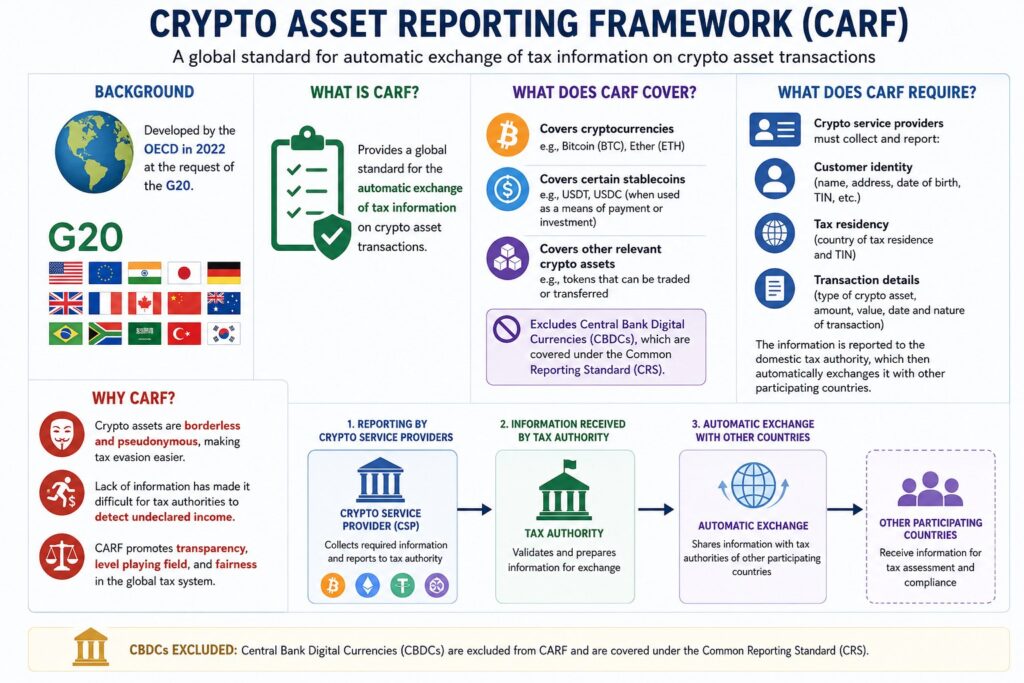
The Central Board of Direct Taxes (CBDT) issued a 198 page guidance note on crypto asset reporting under the Income tax Act, 2025, aligned with the OECD’s Crypto Asset Reporting Framework (CARF).
Key Highlights
The guidance note runs to 198 pages and is issued under the Income tax Act, 2025.
It aligns India’s crypto asset reporting with the OECD’s Crypto Asset Reporting Framework (CARF).
The framework enables automatic global information exchange on crypto asset holdings starting next year.
[2016] With reference to ‘Bitcoins’, sometimes seen in the news, which of the following statements is/are correct? 1. Bitcoins are tracked by the Central Banks of the countries. 2. Anyone with a Bitcoin address can send and receive Bitcoins from anyone else with a Bitcoin address. 3. Online payments can be sent without either side knowing the identity of the other. Select the correct answer using the code given below.
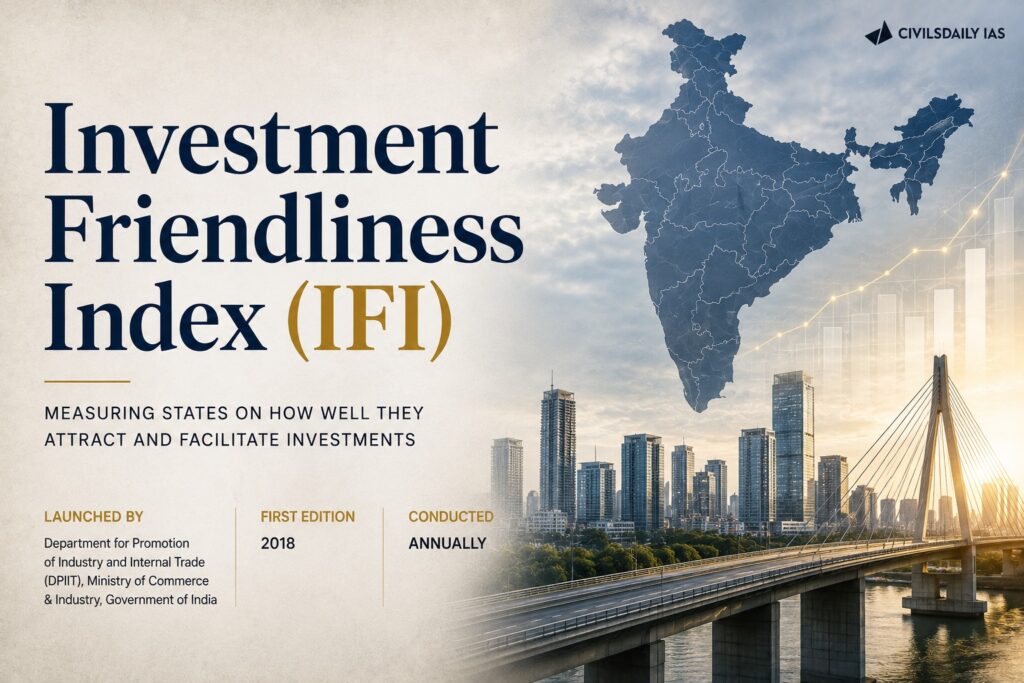
NITI Aayog launched the Investment Friendliness Index (IFI) to assess and improve the investment ecosystem across States and UTs through competitive and cooperative federalism.
What is IFI?
A data driven index that benchmarks how effectively States and UTs attract and sustain investments by evaluating their policy, regulatory, institutional, and infrastructure ecosystem.
Background
Proposed after the 9th NITI Aayog Governing Council Meeting (2024).
Announced in the Union Budget 2025-26.
Key Features
Covers 28 States and 8 UTs.
Based on 84 indicators using: Secondary data and Investor perception survey.
Eight Pillars
Infrastructure. Business Climate, Resources, Government Policy, Regulatory Ease, Institutional Environment, Financial Health, and Environmental Resilience
Performance Categories
Top Performers: Above 50
Frontrunners: 45 to 50
Emerging Performers: 40 to <45
Aspiring States: Below 40
Top Performers
Overall: Gujarat, Maharashtra, Tamil Nadu, Goa, Odisha.
Hilly & NE States: Uttarakhand.
UTs & City States: Goa.
Significance
Promotes competitive and cooperative federalism.
Encourages State level reforms and ease of investment.
Supports Viksit Bharat @2047 and Viksit Rajya @2047.
[2019] Which one of the following is not a sub-index of the World Bank’s ‘Ease of Doing Business Index’?
Padma Vibhushan awardee Teejan Bai (1956–2026), the foremost exponent of Pandavani, passed away at AIIMS Raipur. She played a pivotal role in taking Chhattisgarh’s traditional folk art to the global stage.
Key Highlights
Born in Ganiyari village (Durg district), Chhattisgarh.
Learned Pandavani from her maternal grandfather Brajlal Pardha and gave her first public performance at 13 years of age.
Broke gender barriers by performing in the Kapalika style, traditionally reserved for men.
Performed in over 17 countries, popularising Indian folk traditions worldwide.
Received the Padma Shri, Padma Bhushan, and Padma Vibhushan.
About Pandavani
A traditional folk storytelling and musical art form of Chhattisgarh.
Narrates episodes from the Mahabharata through singing, narration, acting, and dialogue.
The performer uses a tanpura (tambura) as both a musical instrument and a symbolic prop.
Two Styles of Pandavani
Vedamati Style: Performed while sitting, with greater emphasis on narration.
Kapalika Style: Performed while standing, combining dramatic acting, gestures, expressions, and dialogue.
[2014] A community of people called Manganiyars is well-known for their:
India’s drug regulator, the Central Drugs Standard Control Organisation (CDSCO), has approved Qdenga, the country’s first dengue vaccine, after its licensing in over 40 countries and World Health Organisation (WHO) prequalification, arriving amid some of India’s worst dengue outbreaks.
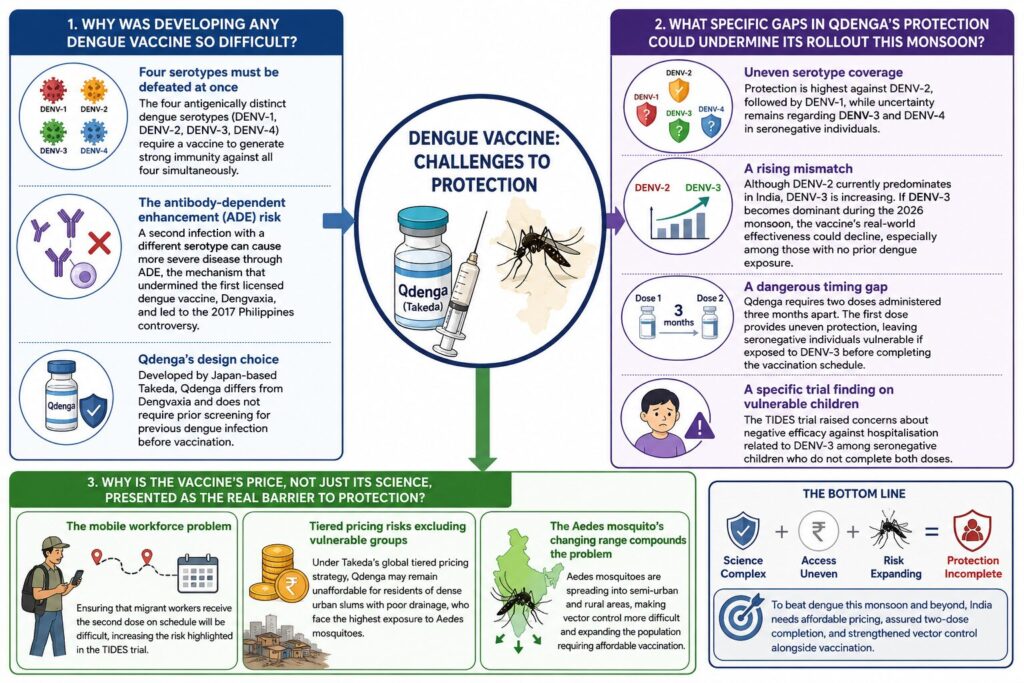
Why was developing any dengue vaccine so difficult in the first place?
Four serotypes must be defeated at once: The four antigenically distinct dengue serotypes (DENV-1, DENV-2, DENV-3, DENV-4) require a vaccine to generate strong immunity against all four simultaneously.
The antibody-dependent enhancement (ADE) risk: A second infection with a different serotype can cause more severe disease through antibody-dependent enhancement (ADE), the mechanism that undermined the first licensed dengue vaccine, Dengvaxia, and led to the 2017 Philippines controversy.
Qdenga’s design choice: Developed by Japan-based Takeda, Qdenga differs from Dengvaxia and does not require prior screening for previous dengue infection before vaccination.
What specific gaps in Qdenga’s protection could undermine its rollout this monsoon?
Uneven serotype coverage: Protection is highest against DENV-2, followed by DENV-1, while uncertainty remains regarding DENV-3 and DENV-4 in seronegative individuals.
A rising mismatch: Although DENV-2 currently predominates in India, DENV-3 is increasing. If DENV-3 becomes dominant during the 2026 monsoon, the vaccine’s real-world effectiveness could decline, especially among those with no prior dengue exposure.
A dangerous timing gap:Qdenga requires two doses administered three months apart. The first dose provides uneven protection, leaving seronegative individuals vulnerable if exposed to DENV-3 before completing the vaccination schedule.
A specific trial finding on vulnerable children: The Tetravalent Immunization against Dengue Efficacy Study (TIDES) trial raised concerns about negative efficacy against hospitalisation related to DENV-3 among seronegative children who do not complete both doses.
Why is the vaccine’s price, not just its science, presented as the real barrier to protection?
The mobile workforce problem: Ensuring that migrant workers receive the second dose on schedule will be difficult, increasing the risk highlighted in the TIDES trial.
Tiered pricing risks excluding vulnerable groups: Under Takeda’s global tiered pricing strategy, Qdenga may remain unaffordable for residents of dense urban slums with poor drainage, who face the highest exposure to Aedes mosquitoes.
The Aedes mosquito’s changing range compounds the problem:Aedes mosquitoes are spreading into semi-urban and rural areas, making vector control more difficult and expanding the population requiring affordable vaccination.
Conclusion
The approval of Qdenga is a significant milestone in India’s fight against dengue, but its public health impact depends on addressing serotype-specific protection gaps, ensuring completion of the two-dose schedule, and making the vaccine affordable for high-risk populations. The editorial argues that price negotiations are essential for the vaccine to achieve meaningful public health outcomes.
Back2Basics
About Dengue:
Dengue (break-bone fever) is a viral infection that is spread from mosquitoes to people. It is more common in tropical and subtropical than in temperate climates.
Transmission: The dengue virus is transmitted to humans through the bites of infected female mosquitoes, primarily the Aedes aegypti mosquito. Other species within the Aedes genus can also act as vectors, but their contribution is normally secondary to Aedes aegypti.
Human-to-mosquito transmission: Mosquitoes can become infected by people who are viremic with DENV. This can be someone who has a symptomatic dengue infection, someone who is yet to have a symptomatic infection (those who are pre-symptomatic), and also someone who shows no signs of illness (those who are asymptomatic).
Dengue Serotype
Four Types: The virus exists as four closely related strains: DENV-1, DENV-2, DENV-3, and DENV-4.
Immunity: Catching one serotype gives you lifelong immunity to that specific type, but only short protection against the other three.
Severe Risk: Getting infected a second time by a different serotype can raise your chance of getting severe dengue.
Important Keywords:
Antibody-dependent enhancement (ADE): A phenomenon in which antibodies generated from a previous infection with one dengue serotype enhance, rather than prevent, severe disease during infection with a different serotype, making dengue vaccine development particularly challenging.
WHO prequalification: A World Health Organization (WHO) assessment that certifies a vaccine meets international standards of quality, safety, and efficacy, enabling procurement by governments and international agencies.
PYQ Relevance
[UPSC 2022] What is the basic principle behind vaccine development? How do vaccines work? What approaches were adopted by the Indian vaccine manufacturers to produce COVID-19 vaccines?
Linkage: The PYQ examines the science behind vaccine development and immunization, a core GS-3 Science & Technology theme. The article applies these principles to dengue, highlighting challenges of multi-serotype vaccines, ADE, efficacy, and rollout.