💥Join UPSC 2027,2028 Mentorship (August Batch) + XFactor Notes & Microthemes PDF

Distribution: weekly

  • NCRB data shows chronic pendency under the National Honour Act, even as government moves to add Vande Mataram

    Why in the News?

    National Crime Records Bureau (NCRB) data spanning 2014 to 2024 on the Prevention of Insults to National Honour Act, 1971 shows pendency above 90% and a conviction rate below 16%. The government is simultaneously pushing an amendment to criminalise insult to Vande Mataram on par with the national anthem, despite the existing law’s poor enforcement record.

    What is the Prevention of Insults to National Honour Act, 1971?

    1. The Prevention of Insults to National Honour Act, 1971 is an Indian law that bans the burning, mutilation, destruction, or disrespect of the national flag, the Constitution, and the national anthem.

    Key Rules and Penalties

    1. National Flag and Constitution: Section 2 prohibits burning, damaging, defacing, or showing disrespect to the flag or Constitution in any public place.
    2. National Anthem: Section 3 penalizes anyone who stops people from singing the national anthem or creates a disturbance during it.
    3. Punishment: Violations are punishable by up to three years in prison, a fine, or both. Repeat offenders face a minimum prison term of one year.
    4. Exceptions: Peaceful or lawful criticism aimed at changing or amending the Constitution or flag does not count as a crime

    Why does the enforcement record complicate the case for expanding the law?

    1. Pendency scale: Over 90% of cases registered under the Act between 2014 and 2024 remain pending, indicating a chronic backlog rather than an occasional delay.
    2. Low conviction: A conviction rate below 16% suggests weak evidentiary standards, prosecutorial capacity constraints, or both, in cases actually brought to trial.
    3. Expansion without fixing enforcement: Adding Vande Mataram to the Act’s protected symbols expands what the law covers without addressing why the existing provisions on the national anthem and flag are so poorly enforced.
    4. Symbolic versus functional legislation: A law with a sub-16% conviction rate functions more as a symbolic statement of state intent than as an operative deterrent.

    Conclusion

    The government’s push to expand the Prevention of Insults to National Honour Act, 1971 proceeds without addressing why the existing law convicts fewer than one in six prosecuted cases. Enforcement capacity, not statutory scope, is the constraint the amendment leaves unaddressed.

      Back2Basics

      The Prevention of Insults to National Honour (Amendment) Bill, 2026:

      1. It is a legislative proposal introduced in the Rajya Sabha on July 24, 2026. It amends the Prevention of Insults to National Honour Act, 1971, to extend statutory protection to India’s national song, Vande Mataram.

      Key Provisions

      1. Inclusion of the National Song: Amends Section 3 of the 1971 Act to place Vande Mataram under the same legal umbrella as the national anthem, Jana Gana Mana.
      2. Offenses Covered: Criminalizes intentionally preventing the singing of the national song or causing a disturbance at an assembly engaged in its rendition.
      3. Penalties: Proposes imprisonment for up to three years, a monetary fine, or both for first-time offenders, and a mandatory minimum of one year in prison for subsequent convictions

    1. India’s Rs 40,000 crore mine closure corpus opens a circular economy opportunity, but needs inter ministry coordination

      Why in the News

      India has accumulated a Rs 40,000 crore mine closure corpus, alongside the 2025 Mine Closure Guidelines, opening opportunities for circular economy activity and eco-tourism at exhausted mine sites. Realising this potential requires coordination across the Coal, Mines and Environment Ministries, a structure that does not currently exist.

      What does the Mine Closure Guidelines framework provide for?

      1. Corpus purpose: The Rs 40,000 crore corpus is built from contributions mining companies make toward the eventual environmental restoration of a mine site.
      2. Progressive closure: The 2025 guidelines push miners toward progressive closure, restoring parts of a mine as operations wind down rather than waiting until full exhaustion.
      3. Repurposing scope: Restored sites can potentially host circular economy activity, such as reprocessing mine waste, or be converted into eco-tourism destinations.

      Why does inter ministry coordination remain the binding constraint?

      1. Divided jurisdiction: Mine closure decisions touch the Ministry of Coal, the Ministry of Mines, and the Ministry of Environment, Forest and Climate Change, each with separate approval processes.
      2. No single owner: No single ministry currently holds end to end responsibility for converting a closed mine site into a productive circular economy or tourism asset.
      3. Execution gap: The problem is not the availability of funds in the corpus, but the absence of an institutional mechanism to direct that money toward a repurposing plan across ministries.

      Conclusion

      The mine closure corpus and the 2025 guidelines create the financial and regulatory basis for circular economy and eco-tourism use of closed mine sites. Whether that potential is realised depends on whether the Coal, Mines and Environment Ministries build a coordinated execution mechanism, not on the size of the corpus itself.

      1. Rupee’s Real Effective Exchange Rate turns undervalued, more so than the yuan

        Why in the News

        India’s Real Effective Exchange Rate (REER) has moved from overvalued, above 100 until mid-2025, to undervalued at around 91 in June 2026. The rupee is now more undervalued than China’s yuan, a shift driven by oil price volatility and the West Asia war.

        What is the Real Effective Exchange Rate (REER)?

        1. Definition: REER measures a currency’s value against a trade weighted basket of other currencies, adjusted for inflation differentials, with 100 as the base year benchmark.
        2. Above 100: A REER above 100 signals overvaluation, meaning the currency is more expensive than its trade weighted fair value, hurting export competitiveness.
        3. Below 100: A REER below 100 signals undervaluation, meaning exports become cheaper and more competitive in foreign markets.
        4. Current reading: The rupee’s REER at around 91 in June 2026 places it firmly in undervalued territory, a reversal from above 100 as recently as mid-2025.

        Why does rupee undervaluation matter now?

        1. Export competitiveness: An undervalued rupee makes Indian exports cheaper relative to competitors, a potential offset to the tariff pressure Indian exporters face from the United States.
        2. Oil price link: Volatility from the West Asia war affects oil import costs, which in turn move the rupee’s value against the dollar and the wider currency basket.
        3. Comparative position: The rupee being more undervalued than the yuan reverses a longstanding pattern where China’s currency was seen as the more actively managed, undervalued one.
        4. Policy dilemma: Sustained undervaluation aids exporters but raises import costs, including for oil, creating a trade off the Reserve Bank of India must weigh in its currency management.

        Conclusion

        The rupee’s shift from overvalued to undervalued reflects oil price and West Asia conflict volatility more than a deliberate policy choice. Whether this undervaluation becomes a durable export advantage or reverses with oil price stabilisation remains the open question.

      2. ICMR-NICPR validates oral therapy SHetA2 to block HPV’s cancer causing proteins

        Why in News?

        The Indian Council of Medical Research-National Institute of Cancer Prevention and Research (ICMR-NICPR) has validated an oral small molecule therapy, SHetA2, that blocks Human Papillomavirus (HPV)’s cancer causing proteins, potentially treating pre-cancerous and cancerous cervical lesions. The molecule has been transferred to Emcure for larger human trials.

          Key Highlights

          1. Therapy: SHetA2, an oral small molecule drug.
          2. Mechanism: Blocks HPV oncoproteins (E6 and E7), which drive cervical cancer development.
          3. Target: Designed to treat pre-cancerous (CIN) and cancerous cervical lesions.
          4. Validating body: ICMR-National Institute of Cancer Prevention and Research (ICMR-NICPR).
          5. Next stage: Technology transferred to Emcure for advanced human clinical trials.
          6. Significance: Represents a potential non-surgical, oral treatment for HPV-related cervical disease.

          What is Human Papillomavirus (HPV)?

          1. HPV is a common DNA virus that infects the skin and mucous membranes.
          2. It is transmitted mainly through sexual contact.
          3. Persistent infection with high-risk HPV types, especially HPV-16 and HPV-18, is the leading cause of cervical cancer.
          4. HPV is also associated with cancers of the anus, vulva, vagina, penis and oropharynx.

          How Does SHetA2 Work?

          1. Inhibits the activity of HPV’s E6 and E7 oncoproteins.
          2. Restores the function of tumour suppressor proteins (p53 and Rb), allowing abnormal cells to undergo programmed cell death (apoptosis).
          3. May help prevent progression from pre-cancerous lesions to invasive cervical cancer.

          Significance

          1. Offers a non-invasive oral treatment option for HPV-related cervical lesions.
          2. May reduce the need for surgical procedures in early-stage disease.
          3. Supports India’s efforts to reduce the burden of cervical cancer, one of the most common cancers among women.
          4. Demonstrates the growing role of indigenous biomedical research and public-private collaboration.

          Government Initiatives

          1. National Programme for Prevention and Control of Non-Communicable Diseases (NP-NCD) includes cervical cancer screening.
          2. Introduction of Cervavac, India’s indigenous HPV vaccine, to expand cervical cancer prevention.
          3. Promotion of HPV vaccination, screening and early diagnosis under national health programmes.

          [2021] Consider the following statements:
          1. Adenoviruses have single-stranded DNA genomes whereas retroviruses have double-stranded DNA genomes.
          2. Common cold is sometime caused by an adenovirus whereas AIDS is caused by a retrovirus.
          Which of the statements given above is/are correct?

          [A] 1 only

          [B] 2 only

          [C] Both 1 and 2

          [D] Neither 1 nor 2

        1. All four dengue virus serotypes found co-circulating nationally, ICMR-VRDL study finds

          Why in News?

          A two year Indian Council of Medical Research-Virus Research and Diagnostic Laboratory (ICMR-VRDL) surveillance study finds all four dengue virus serotypes co-circulating nationally, raising hyperendemicity concerns and complicating future vaccine rollout.

            Key Highlights

            1. Study duration: Conducted over two years through nationwide surveillance.
            2. Conducting body: ICMR-Virus Research and Diagnostic Laboratory (VRDL) Network.
            3. Key concern: Simultaneous circulation of all serotypes indicates hyperendemicity, increasing the risk of severe dengue and complicating vaccine strategies.
              • Note: A serotype is a distinct subgroup or variation of a microorganism (such as a bacterium or virus) classified by the specific antigens found on its surface

            What is Dengue?

            1. Dengue is a viral disease caused by the dengue virus (DENV).
            2. It is transmitted by the female Aedes aegypti mosquito (also Aedes albopictus).
            3. The virus has four distinct serotypes: DENV-1, DENV-2, DENV-3 and DENV-4.
            4. Infection with one serotype provides lifelong immunity only against that serotype and temporary protection against the others.

            What is Hyperendemicity?

            1. Hyperendemicity refers to the simultaneous circulation of multiple serotypes of the same pathogen in a region.
            2. It increases the likelihood of secondary infections, which can lead to severe dengue due to Antibody-Dependent Enhancement (ADE).

            About the ICMR-VRDL Network

            • Established by the Indian Council of Medical Research (ICMR).
            • Functions as a nationwide network for diagnosis, surveillance and research on viral diseases.
            • Supports early detection and monitoring of emerging and re-emerging viral infections.

            [2017] Consider the following statements:
            1. In tropical regions, Zika virus disease is transmitted by the same mosquito that transmits dengue.
            2. Sexual transmission of Zika virus disease is possible.
            Which of the statements given above is/are correct?

            [A] 1 only

            [B] 2 only

            [C] Both 1 and 2

            [D] Neither 1 nor 2

          1. Fiscal Health Index (FHI) 2026

            Why in News?

            NITI Aayog has released the second edition of the Fiscal Health Index (FHI) 2026, providing a comprehensive assessment of the fiscal performance of Indian States during FY 2023–24. The report expands its coverage to include 10 North-Eastern and Himalayan States, in addition to the 18 major States assessed in the inaugural edition.

            Key Highlights

            • Expanded coverage: Evaluates 28 States (18 major States + 10 North-Eastern and Himalayan States).
            • Purpose: Measures the fiscal health of States using a transparent and data-driven framework.
            • Fiscal significance: States account for nearly two-thirds of public expenditure and about one-third of the general government debt.
            • Key finding: Most States recorded moderate fiscal performance, with significant variations across regions.
            • Recommendations: Improve own tax revenue, rationalise committed expenditure, strengthen capital expenditure, enhance public financial management, and ensure debt sustainability.

            What is the Fiscal Health Index (FHI)?

            • The Fiscal Health Index (FHI) is an annual report released by NITI Aayog to evaluate the fiscal performance of States using objective indicators. It promotes fiscal discipline, financial sustainability, and evidence-based policymaking while encouraging States to improve public financial management.

            Key Parameters of the Fiscal Health Index

            • Quality of Expenditure
            • Revenue Mobilisation
            • Fiscal Prudence
            • Debt Management

            Significance of the Fiscal Health Index

            • Encourages competitive and cooperative federalism.
            • Helps identify strengths and weaknesses in State finances.
            • Supports informed policy decisions and fiscal reforms.
            • Promotes sustainable public finances and efficient resource allocation.
            • Enhances transparency and accountability in fiscal governance.

            Challenges Highlighted by the Report

            • Low own tax revenue in several States.
            • High committed expenditure on salaries, pensions, and interest payments.
            • Rising debt burden in some States.
            • Limited fiscal space for developmental expenditure.
            • Regional disparities in fiscal performance.
          2. CBSE On Screen Marking crisis exposes gaps in evaluation transparency

            Why in the News

            The Central Board of Secondary Education’s On Screen Marking system left roughly 18 lakh Class XII students unable to access their evaluated answer scripts, with only about 4 lakh managing to view them. The Supreme Court has flagged this as a source of frustration of young minds, exposing a gap between the Board’s digital evaluation push and its duty to let students verify their own results.

            What is On Screen Marking (OSM)?

            1. Definition: On Screen Marking is a digital evaluation method where scanned answer scripts are marked by examiners on a screen instead of on paper.
            2. Objective: The Central Board of Secondary Education (CBSE) adopted it to standardise evaluation and speed up result processing.
            3. Access problem: Students are meant to view their own scanned, marked scripts after results, but the current system does not guarantee this access at scale.
            4. CIC role: The Central Information Commission (CIC) had already advised CBSE to frame a standard operating procedure (SOP) for script access before this crisis became public.

            Why has script access broken down for most students?

            1. Capacity gap: The Board built a system that could evaluate scripts digitally but did not build matching capacity to let all students retrieve their own scripts afterward.
            2. Verification denied: Without script access, students cannot check whether their marks were recorded and totalled correctly.
            3. Court intervention: The Supreme Court’s intervention signals that the current process fails a basic due process test for an examination body.
            4. Trust deficit: The gap between the promise of a transparent digital system and the reality of restricted access has deepened student distrust in board evaluation.

            What are the challenges to CBSE’s On Screen Marking system?

            1. Server capacity: Providing 18 lakh students simultaneous access to scanned scripts requires infrastructure the Board has not demonstrated it has built.
            2. Re-evaluation load: A universal access policy will likely increase re-evaluation requests, straining CBSE’s examination machinery further.
            3. Accountability gap: No fixed timeline currently binds CBSE to release scripts or resolve discrepancies once a student flags one.
            4. Precedent for other boards: State boards using similar digital evaluation systems face the same access question, but have no shared standard to follow.
            5. Data security: Wider script access at scale raises the risk of manipulation or leakage of evaluation data if access controls are weak.

            What are the Core Safeguards Used Globally?

            1. Item-Level Marking: Slicing whole papers into isolated questions, sending each question to a different subject specialist to minimize bias or fatigue.
            2. Seed Scripts: Silently injecting pre-marked test scripts into an evaluator’s queue; failing to match the benchmark locks the user out for recalibration.
            3. Centralized Tracking: Real-time dashboards tracking marker progress, turnaround times, and statistical consistency across distributed pools.

            Conclusion

            The central issue is not the shift to digital evaluation itself but the absence of a guaranteed, time bound right for students to view their own scripts. A proposed seven day transparency framework standard operating procedure would fix the access gap, but only if CBSE is bound to a deadline rather than treating disclosure as discretionary.

            PYQ Relevance

            [UPSC 2020] National Education Policy 2020 is in conformity with the Sustainable Development Goal-4 (2030). It intends to restructure and reorient education system in India. Critically examine the statement.

            Linkage: The PYQ evaluates reforms aimed at improving quality, equity and governance in education. The OSM controversy underscores that digital reforms in education must be accompanied by transparency, accountability and robust grievance redressal to achieve quality education.

          3. Style and substance of the Saudi Arabia nuclear deal

            Why in the News

            1. The United States and Saudi Arabia have concluded a civil nuclear cooperation agreement while the wider region remains unsettled by the US Iran conflict.
            2. Saudi Arabia has not adopted the IAEA Additional Protocol, raising the question of how much oversight this new nuclear relationship actually carries.

            What is the IAEA Additional Protocol?

            1. Definition: The Additional Protocol is a legal instrument that gives the International Atomic Energy Agency (IAEA) expanded rights to inspect and verify a country’s nuclear activities beyond its baseline safeguards agreement.
            2. Effect: A state that signs it must declare a wider range of nuclear related activities and permit broader IAEA access to sites.
            3. India’s position: India’s own Additional Protocol with the IAEA entered into force in 2014, covering only its civilian nuclear facilities.
            4. Saudi status: Saudi Arabia has not adopted the Additional Protocol, leaving its nuclear activities under a narrower verification regime than India’s.

            Why does the absence of the Additional Protocol matter here?

            1. Verification gap: Without the Additional Protocol, the IAEA has narrower legal access to confirm that Saudi nuclear material is not diverted toward weapons use.
            2. Weaponisation risk: Critics read the deal, agreed without this safeguard, as tolerating a higher proliferation risk in a volatile region.
            3. Precedent concern: Allowing a partner state nuclear cooperation without the stricter protocol could weaken the norm that such protocols are a baseline expectation.
            4. Political linkage: The Trump administration has separately linked nuclear cooperation to shifting conditions on Saudi Arabia joining the Abraham Accords.

            Conclusion

            1. The deal proceeds without the stronger IAEA verification standard that a comparable agreement, such as India’s own, already carries.
            2. Whether the absence of the Additional Protocol becomes a lasting proliferation risk depends on whether Saudi Arabia is later pressed to adopt it.

            “[2018] In the Indian context, what is the implication of ratifying the ‘Additional Protocol’ with the ‘International Atomic Energy Agency (IAEA)’? (a) The civilian nuclear reactors come under IAEA safeguards.

            (b) The military nuclear installations come under the inspection of IAEA.

            (c) The country will have the privilege to buy uranium from the Nuclear Suppliers Group (NSG).

            (d) The country automatically becomes a member of the NSG. Answer: (a)”

          4. Cabinet’s National Investment Policy for Urea (NIPU) 2026

            Why in the News?

            The Union Cabinet has approved the National Investment Policy for Urea (NIPU) 2026, restructuring the return framework for urea manufacturers to attract fresh investment in domestic capacity. This comes against an annual urea subsidy bill of Rs 1,42,175.74 crore for 2025-26.

              What are the Pillars of the National Investment Policy for Urea (NIPU) 2026?

              1. Aim: The policy aims to encourage the establishment of new gas-based urea manufacturing plants across the country to reduce dependence on imports and bridge the gap between domestic production and demand.
              2. The National Investment Policy for Urea-2026 (NIPU-2026) rests on three core pillars: cost separation, assured returns, and foreign exchange risk mitigation.
              3. Return band: The policy sets a Return on Equity (ROE) band of 12 to 16 percent for new urea manufacturing investment.
              4. Cost restructuring: It restructures how production costs are calculated and reimbursed to manufacturers.
              5. Subsidy delivery: Distribution continues through Direct Benefit Transfer (DBT), credited after retailers confirm sale to farmers.
              6. Self-reliance objective: The stated goal is to reduce India’s dependence on imported urea by making domestic capacity commercially viable.

              Why does urea self-reliance remain unresolved despite this policy?

              1. Subsidy scale: The current annual subsidy bill of Rs 1,42,175.74 crore reflects the price gap between controlled retail urea prices and actual production cost.
              2. Investment history: Previous urea policy revisions have not sufficiently attracted new private investment in domestic plants.
              3. Import dependence: India continues to import a share of its urea requirement despite decades of subsidy support to domestic units.
              4. Farmer price link: Retail urea prices remain fixed for farmers regardless of the ROE band offered to manufacturers.

              Conclusion

              The National Investment Policy for Urea 2026 targets manufacturer incentives rather than farm gate prices, betting that better returns on investment will draw the domestic capacity that decades of subsidy alone did not. Whether the 12 to 16 percent ROE band is sufficient to shift investment decisions remains to be tested against actual capacity additions.

              Value Addition:

              Urea Subsidy Scheme:

              Urea fertiliser subsidy in India is a central government scheme where the state fixes a low Maximum Retail Price (MRP) of ₹242 per 45-kg bag for farmers, while the government pays the remaining high production or import cost directly to manufacturers.

              Scheme Mechanics

              1. Fixed MRP: Farmers pay a low, controlled price of ₹242 per 45-kg bag (excluding taxes and neem-coating charges).
              2. Government Payout: The center pays the difference between the actual high cost of making or importing urea and the low selling price directly to the factory owners.
              3. Control: The Ministry of Chemicals and Fertilizers manages the policy and distribution across the country.

              PYQ Relevance

              [UPSC 2023] What are the direct and indirect subsidies provided to farm sector in India? Discuss the issues raised by the World Trade Organization (WTO) in relation to agricultural subsidies.

              Linkage: The PYQ examines India’s fertiliser subsidy regime and related WTO concerns. NIPU 2026 reforms urea subsidies to boost domestic production while retaining farmer subsidies, linking directly to agricultural subsidy debates.

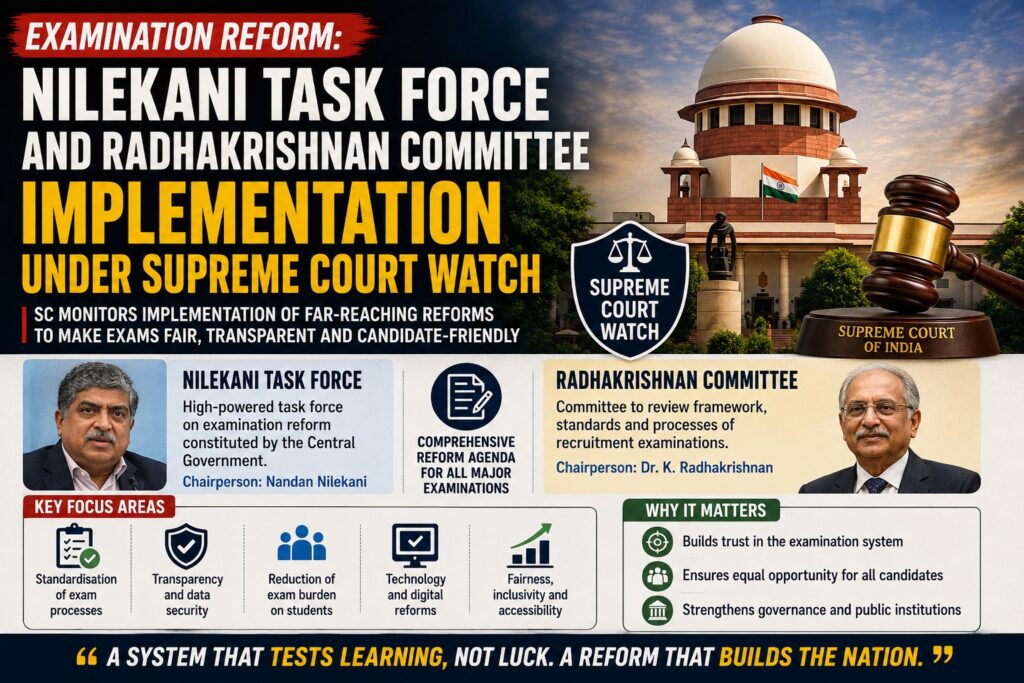
              1. Examination reform: Nilekani task force and Radhakrishnan committee implementation under Supreme Court watch

                The Supreme Court will consult the Nandan Nilekani-led task force at its next hearing on 3 August 2026 regarding the proposed transition of NEET-UG from a pen-and-paper examination to Computer-Based Testing (CBT). The Court is also examining the government’s progress in implementing the K. Radhakrishnan Committee’s recommendations on examination reforms.

                Key Highlights

                • Implementation review: The Centre has submitted an affidavit on the implementation status of the 101 recommendations of the K. Radhakrishnan Committee.
                • Committee recommendations:
                  • 60 short-term and 35 medium/long-term reforms.
                  • Restructuring of the National Testing Agency (NTA).
                  • Introduction of Computer-assisted Secure Pen-and-Paper Testing (CPPT).
                  • Adoption of DIGI-EXAM for secure candidate authentication.
                • Infrastructure plan: Establishment of 1,000 Secure Testing Centres across the country.
                • Related development: Concerns over examination integrity have also emerged in the Jharkhand Combined Civil Services Examination, highlighting the need for broader examination reforms.

                About the National Testing Agency (NTA)

                • Established in 2017 as an autonomous organisation under the Ministry of Education.
                • Conducts major national entrance examinations such as NEET-UG, JEE Main, CUET and UGC-NET.
                • Objective is to ensure fair, transparent, efficient and technology-driven examinations.

                What is Computer-Based Testing (CBT)?

                • Candidates answer questions on a computer terminal instead of paper.
                • Responses are digitally recorded and securely transmitted.
                • Reduces risks associated with paper leaks, manual handling and evaluation delays.

                What is Computer-assisted Secure Pen-and-Paper Testing (CPPT)?

                • Question papers are generated digitally and printed securely at authorised centres shortly before the examination.
                • Minimises transportation and storage of printed question papers.
                • Reduces the possibility of paper leaks while retaining a pen-and-paper examination format.