20,000 pompano fingerlings were released into the sea off Vizhinjam as part of an artificial reef project aimed at replenishing marine fishery resources and promoting sustainable fishing.
About the Artificial Reef Project in Kerala:
Details
Location
• Covers 42 fishing villages in Thiruvananthapuram district, from Pozhiyoor to Varkala.
Aims and Objectives
• Enhance fish resources along Kerala’s coast.
• Support sustainable fishing and improve fishing community livelihoods.
• Implemented by KSCADC (Kerala State Coastal Area Development Corporation).
• Technical support from CMFRI (Central Marine Fisheries Research Institute).
Future Expansion Plans:
• Phase II: Proposed to cover 96 villages in Kollam, Alappuzha, Ernakulam, and Thrissur districts (₹29.76 crore).
• Phase III: Proposed to cover 96 villages in northern districts (₹25.82 crore).
Significance
• Boosts marine biodiversity.
• Increases fish stocks and supports breeding environments.
• Promotes sustainable fishing practices.
• Enhances livelihoods of local communities.
Q) Public health system has limitations in providing universal health coverage. Do you think that private sector can help in bridging the gap? What other viable alternatives do you suggest? (UPSC CSE 2015)
Q) The increase in life expectancy in the country has led to newer health challenges in the community. What are those challenges and what steps need to be taken to meet them? (UPSC CSE 2022)
India’s Public Health System needs to focus on preventing and controlling non-communicable diseases like hypertension, diabetes, cardiovascular diseases, stroke, and cancer. These diseases affect people of all income levels, but the poor and old aged population is the most vulnerable.
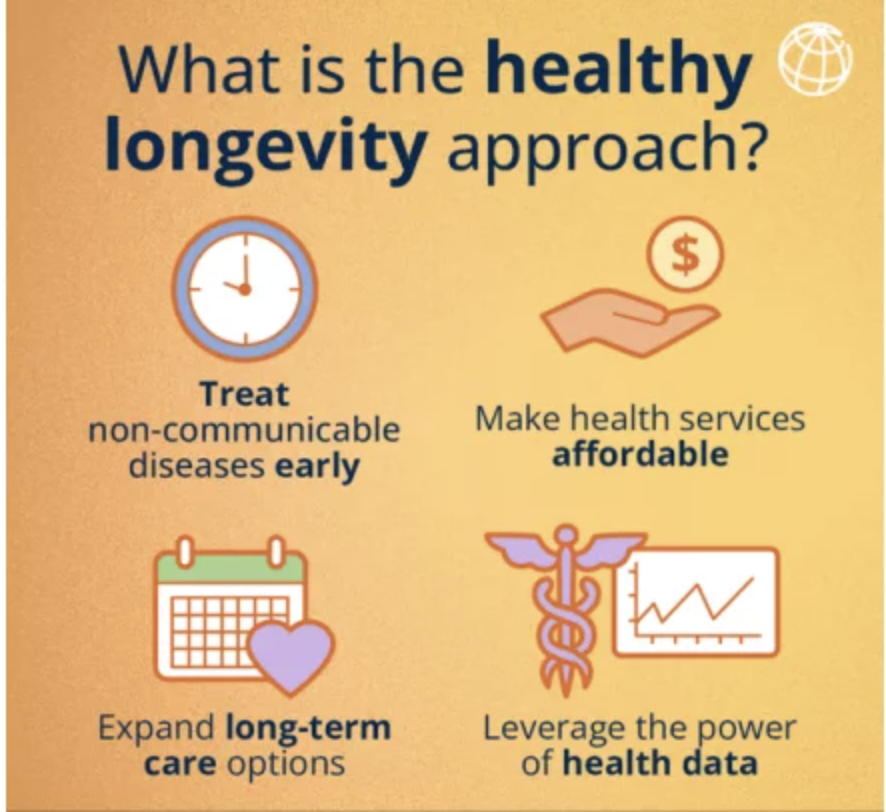
In this scenario, Health Longevity is an evidence-based approach to help countries define prioritized, costed interventions and policy changes to save and extend people’s lives. According to World Bank, investing in healthy longevity could save 150 million lives in low- and middle- income countries.
Today’s editorial emphasizes the issues related to the health sector in India especially with respect to Non-communicable diseases.
_
Let’s learn!
Why in the News?
The World Bank publishes an important and forward-thinking report on a key issue affecting people’s well-being. The report is Unlocking the Power of Healthy Longevity: Demographic Change, Non-communicable Diseases, and Human Capital, released in Washington D.C. in September 2024.
Key Findings of the Report:
● Aging and NCD Burden: Global aging is accelerating, with non-communicable diseases (NCDs) causing over 70% of deaths, especially in low- and middle-income countries. ● Potential Life Savings: Investing in healthy longevity could save 150 million lives and significantly improve productivity and economic growth by 2050. ● Life-Course Health Investments: Addressing health from maternal to elderly care, with a focus on NCD prevention, is essential for promoting healthier aging populations. ● Gender and Social Equity: Women, who often bear caregiving responsibilities and live longer with NCDs, require targeted health and social protections to ensure equity in aging.
Issues related to the Elderly Population in India:
Size of Elderly Population: India has the second-largest elderly population in the world, with approximately 140 million people aged 60 years and above.
Growth Rate: The elderly population is growing at a rate nearly three times higher than India’s overall population growth, indicating a significant demographic shift.
Aging Population Challenge: This rapidly aging population places considerable pressure on health services, social systems, and the economy.
What are the Disease Concerns in India?
Rise in Non-Communicable Diseases (NCDs): India is witnessing an increasing burden of NCDs, including heart disease, diabetes, cancer, and chronic respiratory diseases, which are now the leading causes of death.
Health Risks for the Elderly: As the elderly population grows, the prevalence of age-related diseases and NCDs is expected to surge, straining healthcare systems.
Impact on Public Health: The health challenges are compounded by the underdeveloped infrastructure for treating chronic diseases, particularly in rural areas.
Issues related to Hospital Expenses in India:
Rising Healthcare Costs: Medical expenses for elderly care, especially for chronic diseases and long-term care, are escalating. Private hospitals often charge exorbitantly, making healthcare unaffordable for many elderly individuals.
Inaccessibility of Healthcare: The elderly often face challenges in accessing healthcare facilities due to geographic and economic barriers, leading to delays in diagnosis and treatment.
Catastrophic Health Expenditure: Many elderly people, particularly in lower-income segments, face catastrophic health expenses that can push them into poverty. Even with government schemes, the out-of-pocket expenses remain high.
Steps taken by the Indian Government:
● National Programme for Health Care of the Elderly (NPHCE): This program aims to provide comprehensive healthcare services specifically tailored for older adults. ● National Social Assistance Programme (NSAP): Aimed at providing financial assistance to the elderly who are below the poverty line. ● Maintenance and Welfare of Senior Citizens Act, 2007: This act mandates maintenance and welfare provisions for senior citizens. ● Atal Vayo Abhyuday Yojana (AVYAY): A scheme focused on promoting the welfare of senior citizens through various support services. ● Elderline: A national helpline established to assist elderly individuals in accessing information and services related to their needs
Efficacy of Social Security Schemes:
Limited Coverage: India’s social security schemes, including pensions and health insurance, often do not adequately cover the elderly, especially those in lower income brackets or rural areas.
For example: Public health schemes like Ayushman Bharat aim to provide health insurance to underprivileged populations, but the coverage and access remain limited for the elderly.
Vulnerable Groups: The elderly in India, particularly those without formal employment or savings, remain highly vulnerable to financial distress from healthcare expenses and lack sufficient social security support.
Way forward:
Enhance and Expand Social Security Coverage: Strengthen existing social security schemes like Ayushman Bharat to ensure comprehensive health insurance and pension coverage for elderly populations, particularly in rural and low-income areas. This can help alleviate financial strain from healthcare costs.
Invest in Geriatric Healthcare Infrastructure: Improve healthcare facilities and services for the elderly, focusing on chronic disease management and accessible healthcare, especially in rural areas. This includes training healthcare workers in geriatric care and increasing the availability of affordable long-term care options.
On October 20, Indonesia saw a big change in leadership. Nationalist Prabowo Subianto became president.
What are the implications of Indonesia’s new leadership for India-Indonesia relations?
Increased Competition with China: Prabowo’s administration may lead to a more assertive Indonesian foreign policy that seeks to leverage its strategic position between China and India. However, the extent of this assertiveness will depend on how Indonesia navigates its growing economic reliance on China while maintaining its sovereignty.
Potential for Enhanced Cooperation: Despite the challenges posed by China’s influence, India has an opportunity to deepen its engagement with Indonesia. This could involve collaborative efforts in sectors such as defence, maritime security, and trade, particularly given Indonesia’s strategic location and resource-rich economy.
How does Indonesia’s relationship with China impact its foreign policy choices?
Strategic Balance: Prabowo’s decision to make China his first visit signals Indonesia’s pragmatic balancing between major powers. Despite concerns about China’s assertiveness in the Natuna Sea, Indonesia engages China for its economic clout and investments, especially in sectors like infrastructure and technology.
Wariness Over Chinese Influence: Indonesia’s hesitance toward China’s extensive control over economic assets provides India an opportunity to position itself as a complementary partner that respects Indonesia’s sovereignty, especially given mutual interests in upholding maritime security in the Indo-Pacific.
US-Indonesian Relations: Prabowo’s tenuous ties with the U.S. due to historical human rights allegations might encourage him to seek alternative partnerships, where India can play a constructive role in regional stability.
What opportunities exist for India to enhance its economic engagement with Indonesia?
Energy and Mineral Resources: Indonesia’s rich reserves of coal, palm oil, nickel, and tin offer significant opportunities for India to secure its mineral and energy requirements, which aligns with India’s growing manufacturing and EV industries.
Infrastructure and Maritime Cooperation: India’s existing partnerships in infrastructure, such as developing the Sabang port, can be expanded to reinforce connectivity and enhance trade routes between the Nicobar Islands and Indonesia.
Services Sector Collaboration: India’s strength in IT and financial services can support Indonesia in reducing business costs and improving economic efficiency, particularly as it seeks to modernize and diversify its economy.
Tourism and Cultural Exchange: Given Indonesia’s growing middle class and India’s appeal as a tourist destination, there is potential to expand tourism and cultural exchanges that celebrate shared heritage, including Hindu-Buddhist traditions.
Way forward:
Strengthen Strategic and Economic Partnerships: India should actively engage Indonesia in joint initiatives across defense, maritime security, and infrastructure, leveraging Indonesia’s strategic location and resources to build a resilient Indo-Pacific framework that counters China’s regional influence.
Deepen Cultural and Economic Ties: Expanding collaborations in sectors like IT, energy, and tourism, and celebrating shared heritage, will foster goodwill and position India as a trusted and complementary partner to Indonesia, reinforcing mutual growth and stability in the region.
Mains PYQ:
Q Indian Diaspora has an important role to play in South-East Asian countries’ economy and society. Appraise the role of Indian Diaspora in South- East Asia in this context. (UPSC IAS/2017)
The India-Middle East-Europe Corridor (IMEC), announced at the 2023 G20 summit, aims to cut travel time by 40% and costs by 30%, which could transform global shipping once it’s up and running.
What is IMEC (India-Middle East-Europe Corridor)?
The IMEC (India-Middle East-Europe Corridor) is a major trade route connecting India, the Middle East, and Europe to reduce transit times and transportation costs, launched in 2023 during the G20 Summit.
It aims to strengthen regional partnerships through improved infrastructure, energy grids, and digital connectivity, providing an alternative to traditional maritime routes like the Suez Canal.
What are the current challenges facing the IMEC initiative?
Geopolitical Tensions: The Israel-Palestine conflict, which escalated in October 2023, has stalled progress on the IMEC’s western segment, with Saudi Arabia and Jordan delaying collaboration due to potential geopolitical and optics issues related to their interactions with Israel.
Lack of Progress in West Asia: Due to the conflict, connectivity efforts in West Asia are moving slowly, affecting the northern part of the corridor, particularly the integration of infrastructure and trade processes with Israel and other stakeholders.
Incomplete Development of Additional Infrastructure: Beyond basic connectivity, elements such as clean energy exports, undersea fiber-optic cables, and telecommunication linkages are delayed and are expected to proceed only once stability is restored in West Asia.
Organizational and Logistical Framework: The absence of a central governing structure, like an IMEC secretariat, hinders streamlined cross-border trade processes and systematic project implementation, leading to coordination challenges among participating nations.
How IMEC Aims to Enhance Regional Cooperation and Economic Growth?
Strengthening India-UAE Economic Relations: India and the UAE are advancing bilateral trade, leveraging frameworks like the Comprehensive Economic Partnership Agreement (CEPA) and the Virtual Trade Corridor to standardize trade processes, reduce costs, and simplify logistics.
Improving Connectivity in the East: Progress on the eastern segment, particularly between India and UAE, is increasing trade and setting a foundation for cooperation through standardized trade practices and growing non-oil trade, which diversifies exports and enhances India’s regional integration.
Capacity Building: As the western segment awaits resolution of the regional conflict, eastern countries, especially India, are enhancing port infrastructure, digitalizing logistics, and developing economic zones to support connectivity and reduce trade barriers.
Potential for Economic Integration: Once operational, IMEC can link South Asia, the Middle East, and Europe, encouraging deeper economic ties, lowering costs, and creating a stable trade pathway that could foster regional development and integration.
What are the implications of IMEC for global trade dynamics?
Reduced Dependency on the Suez Canal: IMEC offers a strategic alternative to the Suez Canal, with an anticipated reduction in transit time by 40% and costs by 30%, which could significantly impact global trade routes by diversifying options and lowering shipping times and expenses.
India’s Role as a Supply Chain Alternative: By leveraging IMEC, India can enhance its position in global value chains as an alternative supply chain hub, aligning with its manufacturing ambitions and increasing export competitiveness through improved infrastructure and reduced logistics costs.
Reshaping Trade Infrastructure: The project introduces a new corridor that supports not only connectivity but also potentially includes energy infrastructure and digital linkages, providing a comprehensive trade infrastructure model that could influence future trade frameworks in the Indo-Pacific and beyond.
Attracting Participation: The IMEC secretariat, once established, could guide strategic decision-making, build empirical support for trade benefits, and encourage more countries to join the corridor, potentially expanding IMEC’s impact on international trade and cooperation in regions connected to it.
Way forward:
Strengthen Geopolitical Stability: Address regional tensions, especially in West Asia, to ensure smoother collaboration among stakeholders and accelerate the development of the western segment of the IMEC.
Develop an IMEC Secretariat: Establish a central coordinating body to streamline operations, facilitate cross-border trade, and guide infrastructure projects, ensuring systematic progress and attracting further global participation.
Mains PYQ:
Q How will I2U2 (India, Israel, UAE and USA) grouping transform India’s position in global politics? (UPSC IAS/2022)
The Inter-State Council has been reconstituted with Prime Minister as its chairman, all CMs and 9 Union ministers as members and 13 Union ministers as permanent invitees.
About the Inter-State Council (ISC):
Details
Formation
Established on May 28, 1990, by a presidential order following the Sarkaria Commission (1988) recommendations.
Headquartered in New Delhi.
The Council has met 12 times since its formation in 1990.
Constitutional Provisions
Not a permanent body nor a constitutional body;
Created by the President under Article 263 of the Constitution.
Powers and Functions
Investigate and discuss subjects of common interest.
Make recommendations for better coordination on subjects.
Deliberate on matters referred by the Chairman.
Composition
PM as Chairman.
Chief Ministers of all states and union territories with legislative assemblies.
Lieutenant Governors/Administrators of union territories without assemblies.
6 Union Cabinet Ministers nominated by the Prime Minister.
Governors of states under President’s rule.
Standing Committee:
Union Home Minister as Chairman.
5 Union Cabinet Ministers and 9 Chief Ministers.
PYQ:
[2013] Which of the following bodies is/are not mentioned in the Indian Constitution?
1. National Development Council
2. Planning Commission
3. Zonal Councils
Select the correct answer using the codes given below:
The National Commission for Scheduled Tribeshas asked the Union Home Ministry and the states of Chhattisgarh, Maharashtra, Andhra Pradesh, and Odisha to submit a detailed report on the condition of Gotti Koya tribals.
Why did the NCST urge the Centre and States?
An estimated 50,000 Gotti Koya tribals were displaced due to Left-Wing Extremismand now live in 248 settlements across Odisha, Andhra Pradesh, Telangana, and Maharashtra.
Reports indicate that Telangana has reclaimed land from internally displaced persons (IDPs) in 75 settlements, impacting the tribals’ livelihoods and increasing their vulnerability.
About the Gotti Koya Tribe:
Details
Location
Multi-racial and multi-lingual communities found in the forests, plains, and valleys on both sides of the Godavari River in AP, Telangana, Chhattisgarh, and Odisha.
Migrated from Bastar, northern India.
Society and Culture
Koya language (Koyi) is a Dravidian language related to Gondi and influenced by Telugu.
Most speak Gondi or Telugu alongside Koyi.
Divided into five subdivisions (gotrams).
Patrilineal and patrilocal family structure, with a focus on monogamous, nuclear family.
Worship their own ethnic religion alongside Hindu gods, with Mother Earth being a significant deity.
Burial or cremation of the dead, with the erection of menhirs in memory.
Pastoralists and shifting cultivators (Podu), are now engaged in settled cultivation, animal husbandry, and seasonal forest collection.
Grow Jowar, Ragi, Bajra, and other millets.
Maintain community funds and grain banks for food security.
Festivals
Vijji Pandum (Seeds charming festival) and KondalaKolupu (Festival to appease hill deities).
Perform the Permakok (Bison horn dance) during festivals and marriages.
Sammakka Saralamma Jatra, held once every two years on the full moon day of Magha Masam (January/February) at Medaram village, Warangal district.
Challenges Faced
Many fled to Andhra Pradesh (now Telangana) in the mid-2000s due to violent conflicts between Maoist insurgents and Salwa Judum (Govt backed tribal militia).
Salwa Judum was later banned by the Supreme Court of India in 2011.
PYQ:
[2014] Every year, a month long ecologically important campaign/festival is held during which certain communities/tribes plant saplings of fruit-bearing trees. Which of the following are such communities/ tribes?
(a) Bhutia and Lepcha
(b) Gond and Korku
(c) Irula and Toda
(d) Sahariya and Agariya
Ranks over 1,300 institutions across 100+ countries.
Key Indicators
– Academic Reputation (survey of academic experts)
– Employer Reputation (survey of employers)
– Citations per Faculty (research influence)
Regional Rankings
Includes regional rankings for Asia, Latin America, Europe, etc.
Annual Release
Published annually, typically in June.
Key Insights from QS Asia Rankings 2025
The 2025 rankings cover 984 institutions across 25 countries in Eastern, Southern, South-Eastern, and Central Asia, offering a detailed comparison of institutional performance in the region.
India made impressive gains, with 2 institutions in the top 50 and seven in the top 100 of the QS Asia Rankings 2025.
India has the highest number of ranked institutions, dominating the top 10 universities in Southern Asia with seven Indian institutions.
Top Rankings for India:
Top 50: IIT Delhi (44th) and IIT Bombay (48th).
Top 100: Includes IIT Madras (56), IIT Kharagpur (60), Indian Institute of Science (62), IIT Kanpur (67), and University of Delhi (81).
Top 150: Features IIT Guwahati, IIT Roorkee, JNU, Chandigarh University (120), UPES (148), and Vellore Institute of Technology (150).
IIT Delhi achieved India’s highest rank at 44th with a 99% employer reputation score, while IIT Bombay follows with 99.5% employer reputation and 96.6% academic reputation.
University of Delhi improved its ranking from 94th to 81st, with a high score of 96.4% in the International Research Network indicator.
Anna University scored a perfect 100 in Papers per Faculty, highlighting its strong research output.
15 universities scored over 99% in the Staff with PhD indicator, reflecting India’s focus on qualified faculty and teaching quality.
North Eastern Hill University and University of Agricultural Sciences, Bangalore, both scored 100 in faculty-student ratio, indicating top-tier academic credibility.
PYQ:
[2014] Should the premier institutes like IITs/IIMs be allowed to retain premier status, allowed more academic independence in designing courses and also decide mode/criteria of selection of students. Discuss in light of the growing challenges.
Q) What changes has the Union Government recently introduced in the domain of Centre-State relations? Suggest measures to be adopted to build the trust between the Centre and the States and to strengthen federalism. (UPSC CSE 2024) Q) The jurisdiction of the Central Bureau of Investigation (CBI) regarding lodging an FIR and conducting a probe within a particular State is being questioned by various States. However, the power of the States to withhold consent to the CBI is not absolute. Explain with special reference to the federal character of India. (UPSC CSE 2021) Q) Though the federal principle is dominant in our Constitution and that principle is one of its basic features, it is equally true that federalism under the Indian Constitution leans in favour of a strong Centre, a feature that militates against the concept of strong federalism. (UPSC CSE 2014)
Prelims:
Which one of the following in Indian polity is an essential feature that indicates that it is federal in character? (UPSC CSE 2021) a) The independence of the judiciary is safeguarded. b) The Union Legislature has elected representatives from constituent units. c) The Union Cabinet can have elected representatives from regional parties. d) The Fundamental Rights are enforceable by Courts of Law.
Mentor’s Comment:Kerala filed an original suit under Article 131 of the Constitution, which allows the Supreme Court to resolve disputes between state and central governments. The state claims that the Net Borrowing Ceiling (NBC), set at 3% of its Gross State Domestic Product (GSDP) for FY2023-24, arbitrarily restricts its ability to borrow funds, thereby threatening its financial stability.
Today’s editorial discusses the implications of the NBC imposed by the central government on state governments, particularly focusing on Kerala’s situation. The article also highlights Constitutional provisions, Fiscal decentralization, and the ongoing legal challenges regarding borrowing powers.
_
Let’s learn!
Why in the News?
The Supreme Court of India is currently reviewing a case brought by the Kerala government challenging the Net Borrowing Ceiling (NBC) imposed by the central government.
This case raises significant questions about federalism and fiscal autonomy in India, particularly regarding the borrowing powers of state governments.
What is Net Borrowing Ceiling (NBC) imposed by the Central government on the states?
It is a fiscal policy tool imposed by the Indian central government to regulate the borrowing capacity of state governments where the NBC is set at 3% for FY 2023-24 from the projected Gross State Domestic Product (GSDP) for each state (recommended by the Fifteenth Finance Commission).
This ceiling encompasses all forms of borrowing, including loans from financial institutions, open market borrowings, and liabilities from the public accounts of the states.
The NBC includes not only direct borrowings by state governments but also extends to borrowings by state-owned enterprises (SOEs) that are serviced through state budgets, which aims to prevent states from bypassing borrowing limits through SOEs.
Constitutional Provisions:
The Constitution of India outlines borrowing powers under Chapter II of Part XII: • Article 266(2): This article provides that all money received by the government should be credited to the Consolidated Fund of India or the Consolidated Fund of the State. It implies that funds not part of these consolidated accounts can be managed separately, suggesting that certain state revenues should not be included in calculations for borrowing limits. • Article 292 allows the central government to borrow against the Consolidated Fund of India. • Article 293 empowers state governments to borrow against their own Consolidated Funds but requires prior consent from the central government if previous loans are outstanding. • Entry 43 of the State List: This entry allows states to legislate on matters concerning public debt, indicating that states have a degree of autonomy over their financial affairs.
What are the arguments presented? • Kerala’s Position: The imposition of NBC violates principles of fiscal federalism and undermines its Constitutional autonomy. The ability to determine borrowing limits should reside with individual states, allowing them to address their unique financial situations effectively. • Union Government’s Defense: The borrowing limits are based on recommendations from Finance Commissions and are applied uniformly across all states. Kerala’s financial difficulties are attributed to its fiscal mismanagement over two decades. Allowing Kerala to exceed its borrowing limits could set a dangerous precedent that might encourage other states to disregard fiscal discipline. • Supreme Court’s Interim Ruling: On April 1, 2024, the SC declined to grant interim relief to Kerala, stating that any financial hardship faced by the state could not be attributed solely to the NBC. The Court emphasized that providing additional funds could have broader implications for national fiscal health. It noted that Kerala had already received substantial relief from the Centre during its financial crisis.
Restrictions imposed by the NBC and their implications on the States:
Financial Constraints: States may find it challenging to meet essential expenditures such as pensions and welfare schemes due to limited borrowing capacity.
Impact on Development: The ceiling restricts states’ ability to invest in infrastructure and developmental projects, potentially stunting economic growth and public service delivery
Legal Challenges: The ongoing legal disputes highlight tensions between state autonomy and central control over fiscal policies, raising questions about the balance of power in India’s federal structure.
How do these borrowing restrictions affect Fiscal Federalism in India?
Constraints on State Autonomy: The NBC limits states’ ability to borrow, undermining their financial independence and capacity to manage their own budgets.States struggle to finance essential services and infrastructure projects, which can hinder economic development and public welfare initiatives.
For Example, Kerala’s ability to finance initiatives through the Kerala Infrastructure Investment Fund Board (KIIFB) is hampered, leading to delays in development activities crucial for economic growth.
Erosion of Cooperative Federalism:The imposition of NBC reflects a shift towards central control, potentially eroding the principles of cooperative federalism that empower states to address local needs.
Legal challenges, like Kerala’s case against the NBC, highlight conflicts between state rights and central authority, raising questions about the balance of power in fiscal governance.
Implications for Fiscal Responsibility: While the Centre argues that NBC promotes fiscal discipline, states contend that it infringes on their constitutional rights, creating tension between maintaining national fiscal health and respecting state autonomy.
Need for the Reform:
Article 293 needs to be strengthened to enhance cooperative federalism. Proposed reforms include:
Establishing a commission similar to the Finance Commission to address loan approvals based on states’ financial conditions.
Implementing guidelines for transparency and equitable treatment in borrowing decisions made by the Centre.
Ensuring that restrictions do not excessively hinder states’ fiscal management capabilities.
Way Forward: Without reforming the current borrowing framework, states like Kerala may face severe financial constraints, hampering their ability to meet essential expenditures. The ongoing legal discourse around NBC reflects broader concerns about fiscal decentralization and the balance of power between state and central governments in India that needs to be addressed soon.
Since liberalization opened up new opportunities, there has been a lot of excitement about India’s demographic dividend, which is the advantage of having a large working-age population but there are major challenges like the middle-income trap.
Can India leverage its sustained economic growth?
Harnessing the Demographic Dividend: With a large working-age population, India has a potential advantage, but it must ensure that this workforce is employed in productive sectors, particularly by shifting labor from low-productivity agriculture to higher-productivity manufacturing and services.
Strengthening the Manufacturing Sector: The manufacturing sector, especially labor-intensive industries like textiles, has the potential to create millions of jobs. By addressing barriers such as complex regulations, high tariffs, and infrastructure constraints, India can boost manufacturing growth, empower women, and drive economic mobility.
Reforming Infrastructure and Business Environment: Improving ease of doing business, simplifying trade and labor regulations, and increasing investment in infrastructure are critical for unlocking India’s potential for sustained growth. These reforms will enable large-scale job creation and enhance India’s global competitiveness.
Challenges arising due to the middle-income trap
Declining Demographic Dividend: The proportion of working-age individuals in India’s population is set to decline in the coming decade, marking the potential end of the demographic dividend. Fertility rates have dropped across various states, which means India may face an aging population sooner than expected.
Stagnation in Key Sectors: India has struggled to reduce its agricultural workforce in the same way China did after liberalisation, making it harder to transition people to higher-productivity industries. Despite some growth in the services sector, manufacturing has stagnated and failed to generate the necessary number of jobs, especially in labor-intensive industries.
Limited Economic Mobility: High levels of youth unemployment and the lack of opportunities for individuals to move up the economic ladder have hindered India’s economic progress. The country’s labor force participation rate (LFPR) remains low, particularly among women, and urban job creation has not been sufficient to absorb the growing population.
Infrastructure and Regulatory Bottlenecks: The business environment is constrained by complex regulations, high tariffs, cumbersome licensing procedures, and a lack of access to land, all of which prevent the manufacturing sector from thriving. India’s slow regulatory reforms have stifled growth in manufacturing, which is essential for absorbing the workforce.
How the Manufacturing sector can help India grow?
Job Creation: Manufacturing, especially in labour-intensive sectors like textiles and apparel, can create large numbers of jobs. This is vital for absorbing the surplus labour from agriculture and providing employment opportunities for the youth.
For example, the textile and apparel industry employs 45 million people compared to just 5.5 million in IT-BPM, highlighting its potential for mass employment.
Women’s Empowerment: Manufacturing, particularly industries like textiles, offers significant employment to women (60-70% of factory workers), helping reduce gender disparities in the labour force.
Economic Mobility: By creating better job opportunities, manufacturing helps people transition from low-productivity agricultural jobs to higher-wage, more stable positions in the industrial and service sectors. This transition is key to achieving sustained economic growth and avoiding the middle-income trap.
Global Competitiveness: Reducing barriers to manufacturing — such as simplifying business licensing, lowering tariffs on inputs, improving access to land, and streamlining trade regulations — can help India increase its competitiveness globally. Expanding market access through free trade agreements and making the business environment more conducive to manufacturing can unlock the potential of this sector.
Steps taken by the government:
“Make in India” Initiative: Launched in 2014, this initiative aims to transform India into a global manufacturing hub by promoting domestic production, reducing regulatory hurdles, and attracting foreign direct investment (FDI) in key manufacturing sectors such as electronics, textiles, and automobiles.
Atmanirbhar Bharat (Self-reliant India): This program focuses on reducing dependence on imports by boosting local manufacturing, especially in strategic sectors like defense, electronics, and pharmaceuticals.
It includes initiatives such as the Production-Linked Incentive (PLI) scheme, which offers incentives for manufacturing and exporting specific products like electronics, textiles, and solar panels.
Way forward:
Enhance Skill Development and Workforce Transition: India must invest in targeted skill development programs to equip its labor force, particularly those transitioning from agriculture, with the necessary skills for higher-productivity manufacturing and services sectors.
Accelerate Regulatory and Infrastructure Reforms: To unlock the full potential of the manufacturing sector, India should expedite regulatory reforms, simplify land acquisition processes, and enhance infrastructure.
Mains PYQ:
Q Can the strategy of regional-resource-based manufacturing help in promoting employment in India? (UPSC IAS/2019)