💥Join UPSC 2027,2028 Mentorship (July Batch) + XFactor Notes & Microthemes PDF

Distribution: yearly

  • [21st September 2024] The Hindu Op-ed: The stakes in Sri Lanka’s ninth Presidential election 

    [21st September 2024] The Hindu Op-ed: The stakes in Sri Lanka’s ninth Presidential election 

    PYQ Relevance:

    Q). ‘India is an age-old friend of Sri Lanka.’ Discuss India’s role in the recent crisis in Sri Lanka in the light of the preceding statement. (UPSC CSE 2022)
    Q). In respect of India — Sri Lanka relations, discuss how domestic factors influence foreign policy. (UPSC CSE 2013)

    Mentor’s Comment:  The preference for leftist and rightist ideologies in global geopolitics is influenced by a variety of factors, each reflecting distinct political, economic, and social dynamics. In times of economic distress, leftist ideologies often resonate with populations facing inequality and poverty. They advocate for social welfare programs, wealth redistribution, and increased government intervention in the economy to address systemic issues. 

    The recent presidential elections in Sri Lanka, held on September 21, 2024, marked a significant turning point in the country’s political landscape. Anura Kumara Dissanayake, the leader of the leftist National People’s Power (NPP) coalition and chief of the Janatha Vimukthi Peramuna (JVP), emerged victorious, signaling a departure from the traditional political parties that have dominated Sri Lankan politics for decades.

    _

    Let’s learn!

    Why in the News?

    There are some significant political developments following the recent ninth presidential election held on September 21, 2024.

    • It marks the first time in Sri Lanka’s history that a presidential election required a second round of counting to determine the winner.
    • This change reflects a significant shift in the electoral landscape since the introduction of the executive presidency in 1978.

    What does leftist victory signify for Sri Lanka’s political landscape?

    • Political Paradigm Shift: Dissanayake’s leadership marks the first time a president with a pronounced leftist ideology has taken office, indicating a potential shift towards more state intervention in the economy. It signals a rejection of the traditional parties that have dominated Sri Lankan politics for decades.
    • Public Sentiment and Economic Crisis: Dissanayake’s campaign focused on anti-corruption and economic reform, resonating with voters who blame corruption for the nation’s economic collapse.
    • Geopolitical Implications: The new administration’s leftist leanings may influence Sri Lanka’s foreign relations, particularly its ties with China and India, as Dissanayake is perceived as potentially favoring China.

    What are the future Governance challenges?

    • Need for Parliamentary Majority: Although elected president, Dissanayake faces the challenge of securing a parliamentary majority to implement his policies effectively.
    • Balancing Act: He must navigate between leftist ideals and the need for foreign investment and cooperation, particularly with entities like the IMF, which has provided crucial financial support.
    • Addressing Tamil Aspirations: Engaging with the Tamil minority and addressing their calls for greater autonomy will be critical for national unity and stability.
    • Systemic Change: the Leftist party has promised to address systemic corruption and may seek to abolish or reform the executive presidency, reflecting a desire for democratic renewal.
    Implication on India:

    • Economic Impact: Sri Lanka’s share in India’s total exports has declined from 2.16% in FY15 to just 1.3% in FY22. India relies heavily on the port of Colombo for global trade, with approximately 60% of India’s transhipment cargo handled by the port.
    Strategic Implications: India sees the crisis as an opportunity to counter China’s influence in Sri Lanka, which has been a concern due to Sri Lanka’s proximity to China. India has provided $4 billion in financing facilities to Sri Lanka.
    • Strengthening Bilateral Relations: Although India’s support during the crisis has generated goodwill, underlying anti-India sentiment and the need for Sri Lanka to balance relations with multiple major economies pose challenges to deeper engagement.
    • Refugee Influx: India has witnessed a large influx of ethnic Tamil community refugees from Sri Lanka during past political or social crises.

    How will this address the ongoing economic crisis?

    • Renegotiation of IMF Terms: The leftist leaders have committed to renegotiating the austerity measures imposed by the IMF.
      • Further, they also have plans to adjust taxation policies, including raising the personal income tax exemption threshold and removing VAT on essential goods.
    • Production-Based Economy: The present government envisions transforming into a production-based economy. This shift aims to reduce reliance on imports and enhance local production capabilities.
    • Bilateral Debt Agreements: Sri Lanka inherits a complex debt situation but aims to seek better terms for existing agreements with international creditors, including China and India. Hence they will prioritize negotiations that enhance fiscal sustainability while addressing public needs.

    Opportunities for India:

    • Tea Exports: Amid the decline in Sri Lanka’s tea production, India is well-positioned to capture markets significantly in countries that import orthodox tea, such as Iran, Turkey, Iraq, China, and Canada.
    • Textile Exports: Indian apparel exporters are receiving orders from the UK and Latin American countries where Indian textiles had very little or no presence before the crisis.

    Conclusion: As the first leftist candidate to be elected president, he faces the daunting challenge of steering the nation through its worst economic crisis while navigating complex geopolitical dynamics and entrenched political interests.
  • Nagaland’s King Chilli Festival

    Why in the News?

    The village of Seiyhama in Nagaland hosted the 3rd edition of the Naga King Chilli Festival, celebrating the importance of the Naga king chilli, one of the world’s hottest chillies.

    About Naga King Chilli

    • The Naga King Chilli, also known as Raja Mircha or Bhut Jolokia, is one of the world’s hottest chillies, with heat levels exceeding 1 million Scoville Heat Units (SHU).
    • It is primarily grown in the Northeast Indian states of Nagaland, Assam, Manipur, and Arunachal Pradesh.
    • In 2006, it was certified by the Guinness World Records as the hottest chilli in the world, a title it held for several years.
    • In 2008, it received a GI tag, recognizing its unique origin and significance in the global spice market.
    • The chilli has a heat range of 800,000 to 1,041,427 SHU, making it significantly hotter than common chillies like the jalapeño, which has a SHU of 2,500 to 8,000.
    • Benefits offered:
      • Rich in capsaicin, it is known for its pain-relieving properties and potential health benefits, such as boosting metabolism, promoting heart health, and relieving pain and inflammation.
      • Traditionally, the chilli has been used to preserve food in Nagaland’s hot, humid climate, helping to extend the shelf life of food and reduce waste.
    • Cultivation:
      • The chilli is grown in bamboo groves using ancient cultivation methods.
      • Farming begins in December or January, with peak harvests in August and September.
      • Approximately 150 households in Seiyhama village, Nagaland, cultivate the Naga King Chilli, with the annual harvest reaching 14,000 kg, valued at ₹70 lakh.

    PYQ:

    [2015] Which of the following has/have been accorded ‘Geographical Indication’ status?

    1. Banaras Brocades and Sarees

    2. Rajasthani Daal-Bati-Churma

    3. Tirupathi Laddu

    Select the correct answer using the codes given below:

    (a) 1 only

    (b) 2 and 3 only

    (c) 1 only 3 only

    (d) 1, 2 and 3

  • Square Kilometer Array (SKA) becomes partially functional

    Why in the News?

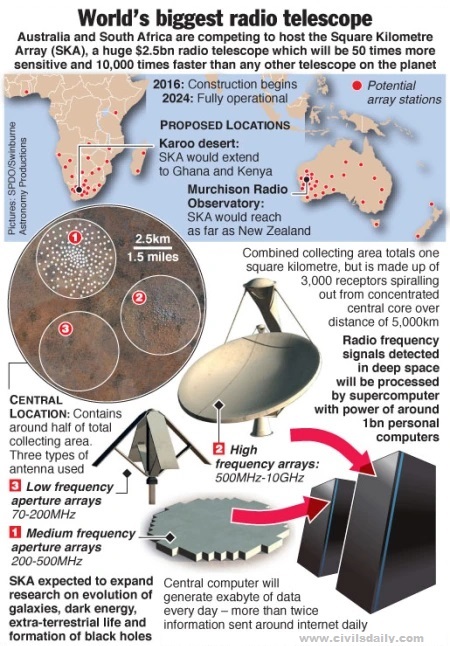
    The Square Kilometer Array (SKA), the world’s largest radio telescope, has carried out its first observations, marking a major milestone.

    About Square Kilometer Array (SKA) Project:

    Details
    Project Overview SKA is a global project aimed at building the world’s largest radio telescope network to explore the universe, galaxies, dark matter, and extraterrestrial life.
    Construction Phases Two phases:

    1. SKA-Mid in South Africa operates in higher frequency ranges.
    2. SKA-Low in Australia operates in lower frequency ranges.

    Phase 1 (SKA- Mid) began in December 2022. Full operations expected by 2029.

    Headquarters Jodrell Bank Observatory, UK
    Site Locations Telescope arrays in Australia (low-frequency) and South Africa (mid-frequency).
    Design and Features
    • 197 parabolic radio antennae in South Africa
    • 131,072 low-frequency antennae in Australia

    These are capable of detecting faint radio signals from vast distances.

    Global Consortium 16 member countries, including Australia, South Africa, India, China, Japan, and several European nations.
    India’s Role
    • India’s Giant Metrewave Radio Telescope (NCRA, TIFR) is a key partner
    • SKA India consortium (20+ institutions) involved in software, signal processing, and digital hardware development
    Key Technologies Advanced interferometer system using wave interference for data collection.
    Scientific Objectives
    • Explore galaxies at the edge of the universe
    • Study the ‘Dark Ages’ and phenomena like dark matter and dark energy
    • Search for extraterrestrial life
    Frequency Range Operates between 50 MHz to 15.4 GHz
    Global Collaboration Key collaboration among India, Australia, South Africa, Italy, and other member nations for data generation, analysis, and installation of antennas.


    PYQ:

    [2022] Launched on 25th December, 2021, James Webb Space Telescope has been much in the news since then. What are its unique features which make it superior to its predecessor Space Telescopes? What are the key goals of this mission? What potential benefits does it hold for the human race?

    [2015] In the context of modern scientific research, consider the following statements about ‘IceCube’, a particle detector located at South Pole, which was recently in the news:

    1. It is the world’s largest neutrino detector, encompassing a cubic kilometre of ice.

    2. It is a powerful telescope to search for dark matter

    3. It is buried deep in the ice.

    Which of the statements given above is/are correct?

    (a) 1 only

    (b) 2 and 3 only

    (c) 1 and 3 only

    (d) 1, 2 and 3 only

  • [20th September 2024] The Hindu Op-ed: Acclamation for an Indian leadership that still endures

    [20th September 2024] The Hindu Op-ed: Acclamation for an Indian leadership that still endures

    PYQ Relevance:

    Q) Do you think BIMSTEC is a parallel organisation like the SAARC? Waht are the similarities and dissimilarities between the two? How are Indian foreign policy objectives realized by forming this new organisation? (UPSC CSE 2022)

    Q) The Indian Diaspora has an important role to play in the South-East Asian country’s economy and society. Appraise the role of Indian Diaspora in South- East Asia in this context (UPSC CSE 2017)

    Q) What problems were pertinent to the decolonization in the Malay Peninsula? (UPSC CSE 2017)

    Mentor’s Comment:  Malaysian PM Anwar Ibrahim’s recent visit to India highlighted the enduring legacy of Jawaharlal Nehru and India’s leadership role in shaping the Global South agenda. He praised India’s G20 Chairmanship and Voice of Global South Summits, emphasizing the importance of Nehru’s vision for a just and prosperous nation. Despite domestic criticism, Nehru’s reputation remains intact globally. Anwar’s references to historical Indian figures reflect shared cultural heritage and intellectual ties. The visit aimed to strengthen India-Malaysia relations and promote cooperation on global issues while acknowledging complexities surrounding minority rights and regional conflicts.

    _

    Let’s learn!

    Why in the News?

    Malaysian PM Anwar Ibrahim during his visit to India (August 19-21, 2024),  praised India’s role in shaping the Global South agenda, highlighting its capacity for cooperation with the Global North and commending India’s G20 Chairmanship.

    Enduring Legacy of Nehru
    Struggle against Imperialism: Nehru was deeply concerned with the fight against European colonial powers, particularly in Asia. 
    He believed newly independent nations should unite to resist imperialism and promote their sovereignty.
    Asian Relations Conference: In 1947, Nehru organized the Asian Relations Conference in New Delhi, which aimed to foster solidarity among Asian countries and chart a collective path forward in the post-colonial era.
    Non-Alignment Movement: Nehru championed the concept of non-alignment, advocating that newly independent states should not align with either the USA or the USSR during the Cold War. 
    This approach allowed these nations to maintain their sovereignty and avoid being drawn into great power conflicts.
    Bandung Conference: Nehru played a crucial role in this conference, where leaders from Asian and African nations gathered to promote economic and cultural cooperation while opposing colonialism.
    This conference laid the groundwork for the Non-Aligned Movement (NAM), which sought to protect the interests of developing nations.

    Historical overview of India-Malaysia Relations since Nehru:

    • Early Ties and Independence: India and Malaysia share historical ties dating back over a millennium, influenced by trade and cultural exchanges established during the Chola Empire (9th-13th centuries).
      • India established diplomatic relations with the Federation of Malaya in 1957, coinciding with Malaysia’s independence.
    • Strengthening Bonds in the 1960s: The relationship flourished in the 1960s due to the personal rapport between Indian PM J. Nehru and Malaysian PM T. Rahman. This era marked a significant phase of political, economic, and socio-cultural cooperation.
    • Enhanced Strategic Partnership: In 2015, during Prime Minister Narendra Modi’s visit, India-Malaysia relations were elevated to an Enhanced Strategic Partnership, reflecting a commitment to deepen cooperation across various sectors.
    • High-Level Visits: Numerous high-level visits have nurtured ties, including visits by Indian Prime Ministers such as Indira Gandhi and Manmohan Singh, and Malaysian leaders like Mahathir Mohamad and Najib Razak.
    Areas of Cooperation:

    Geopolitical Cooperation: Both countries are members of key international forums like the Commonwealth, NAM, and ASEAN, facilitating mutual cooperation on global issues.
    Defense Ties: Since signing a defense cooperation memorandum in 1993, India and Malaysia have expanded military collaboration through joint exercises and training programs.
    Economic Relations: Bilateral trade reached approximately USD 19.5 billion, with Malaysia being India’s 13th largest trading partner. Both nations engage in significant investment activities across various sectors.
    Cultural and Diaspora Links: Malaysia hosts a large Indian diaspora (over 2.95 million), fostering cultural ties through institutions like the Indian Cultural Centre in Kuala Lumpur.

    Challenges and Complexities:

    • Political Dynamics: The relationship has faced challenges due to domestic political sentiments in Malaysia, particularly during Mahathir Mohamad’s tenure when he had to balance his Indian heritage with Malay nationalism.
    • Controversies: Issues such as the treatment of Indian expatriates in Malaysia have occasionally strained relations, but diplomatic efforts have often resolved these tensions.

    Conclusion: India-Malaysia relations since post-independence, despite facing challenges, the bilateral relationship remains robust, characterized by ongoing cooperation in various sectors and mutual respect for each nation’s sovereignty and cultural diversity

    https://www.thehindu.com/opinion/op-ed/acclamation-for-an-indian-leadership-that-still-endures/article68660980.ece

  • White Revolution 2.0

    Why in the News?

    The Ministry of Cooperation unveiled White Revolution 2.0, focusing on empowering women farmers and creating job opportunities in the dairy cooperative sector.

    What is White Revolution 2.0?

    Details
    Objective Transforming India’s dairy sector by empowering women farmers, increasing milk production, and modernizing dairy infrastructure.
    Target  Increase procurement from the current 660 lakh litres per day to 1,000 lakh litres per day.
    Funding • Initial funding of ₹40,000 per Multi-Purpose Primary Agricultural Credit Society (PACS) by National Dairy Development Board.
    • Total outlay of ₹70,125 crore with full government budgetary support.
    Provisions and Features 1. Women Empowerment: Focus on empowering women in the dairy sector and strengthening women’s cooperatives.
    2. Increase in Milk Procurement: Aims to raise procurement by 50% over the next five years.
    3. Cooperative Infrastructure: 100,000 new and existing cooperative societies (district cooperative societies and Primary Agricultural Credit Societies) to be set up or enhanced.
    4. RuPay Kisan Credit Cards: Nationwide rollout for dairy farmers, with micro-ATMs at cooperative societies.
    5. Computerisation of Primary Agricultural Credit Societies: 67,930 Primary Agricultural Credit Societies will be computerised for better management.
    Significance 1. Women Empowerment: Creates leadership opportunities for women in dairy, promoting gender equality.
    2. Boost to Rural Economy: Strengthening cooperatives and milk procurement will improve rural livelihoods.
    3. Improved Infrastructure: Modern technology, micro-ATMs, and computerisation will increase efficiency.
    4. Job Creation: Expanding cooperatives and modern practices will generate jobs for 130 million farmers.
    5. Malnutrition Reduction: Enhances dairy quality to combat malnutrition.
    6. Cooperative Modernisation: Focus on Artificial Intelligence and advanced technologies.
    7. Dairy Exports Boost: Improved production and quality to enhance India’s dairy exports.


    PYQ:

    [2017] Explain various types of revolutions, took place in Agriculture after Independence in India. How these revolutions have helped in poverty alleviation and food security in India?

  • 100 Years of Harappan Civilization

    Why in the News?

    It has been 100 years since the discovery of the Harappan Civilization, announced by John Marshall on September 20, 1924.

    Harappa: Remains of a Civilization

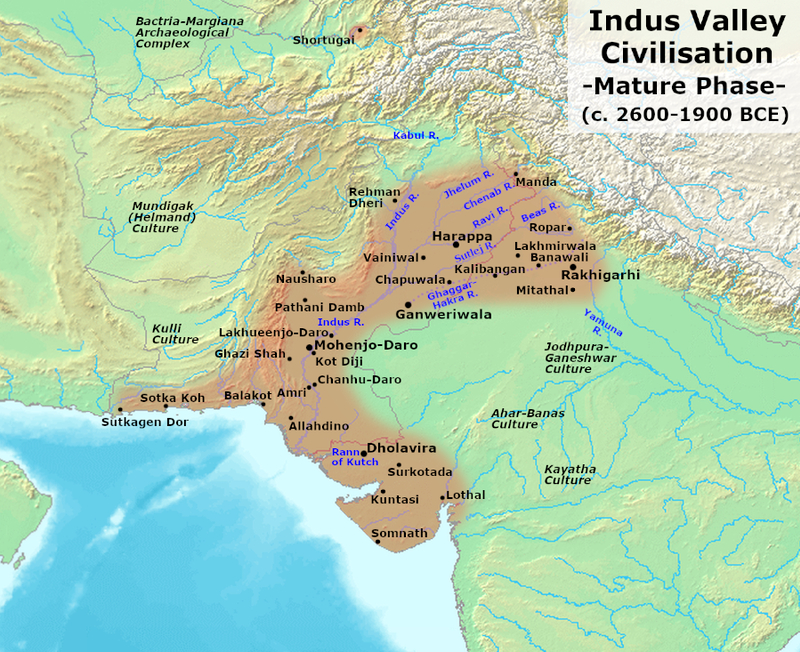
    • The Harappan Civilization, also known as the Indus Valley Civilization, flourished between 2600 BCE and 1900 BCE, with earlier settlements dating back to 3200 BCE.
    • The origins of this civilisation are traced back to Mehrgarh in Balochistan, which dates to 7000 BCE.
    • It is considered one of the three earliest civilizations, alongside Egypt and Mesopotamia.
    • The civilization covered over 1.5 million sq. km, stretching across modern-day India, Pakistan, and Afghanistan.
    • Remains of the civilization include:
      • Well-planned cities with a grid layout, intersecting streets, and fortified structures.
      • Advanced drainage systems with underground sewers and covered drains, showing a strong emphasis on hygiene.
      • Granaries, warehouses, and dockyards, indicating the presence of structured trade and food storage mechanisms.
      • The discovery of seals made of steatite, often engraved with animals and an un-deciphered script, suggesting a sophisticated administrative system.
      • Craftsmanship in pottery, bead-making, terracotta figurines, metal artefacts, and weaving.
      • Water management systems such as reservoirs, wells, and baths, indicating an advanced understanding of hydraulic engineering.

    The Discoverers:

    • Two ASI archaeologists were credited with the discovery:
      • Daya Ram Sahni excavated Harappa in 1921-22, discovering seals, pottery, and beads.
      • Rakhal Das Banerji began excavating Mohenjo-daro in 1922, finding similar items such as seals and copper objects.
    • John Marshall noticed the similarity between the objects found at Harappa and Mohenjo-daro, despite the sites being 640 km apart.

    About the Mohenjo-daro Site:

    • Mohenjo-daro is one of the largest cities of the Harappan Civilization, located in the Sindh province of Pakistan, discovered in 1922 by Rakhal Das Banerji.
    • The city represents one of the finest examples of ancient urban planning:
      • Great Bath: A large, centrally located structure thought to be used for ritual bathing or religious ceremonies. It is considered one of the earliest public water tanks in history.
      • Granaries: Massive storage facilities near the citadel suggest an organized system of storing food for the community.
      • Citadel and Lower Town: The city was divided into a raised citadel for the ruling elite and a lower town for common people. Both areas had well-planned streets and residential complexes.
      • Drainage Systems: Mohenjo-daro featured covered drainage systems with individual toilets connected to the drainage network, showcasing an impressive public sanitation system.
      • Residential Buildings: Homes were built from uniform mud bricks, with courtyards and bathrooms, and were often multi-storied. The use of standardised brick sizes (ratio 1:2:4) and cubic weights showed their high degree of organisation.
    • Artefacts found at Mohenjo-daro include:
      • Seals with animal motifs and the un-deciphered Harappan script, believed to have been used for administrative or trade purposes.
      • Pottery and tools made of bronze and copper.
      • Terracotta figurines, jewellery, and toys that reflect a highly developed artistic culture.
      • Weights and measures based on a uniform standard, indicating the use of a standardized economic system.
    • The city’s streets were aligned north-south and east-west, cutting at right angles, allowing for efficient transportation, including bullock carts.
    • Mohenjo-daro is believed to have had trade links with Mesopotamia, as suggested by artefacts with Mesopotamian connections.

    PYQ:

    [2013] Which of the following characterizes/characterize the people of Indus Valley Civilization?

    1. They possessed great palaces and temples.

    2. They worshipped both male and female deities.

    3. They employed horse-drawn chariots in warfare.

    Select the correct statement/statements using the codes given below.

    (a) 1 and 2 only

    (b) 2 only

    (c) 1, 2 and 3

    (d) None of the statements given above is correct

  • Why Earth will temporarily get a ‘Mini-Moon’ in September?

    Why in the News?

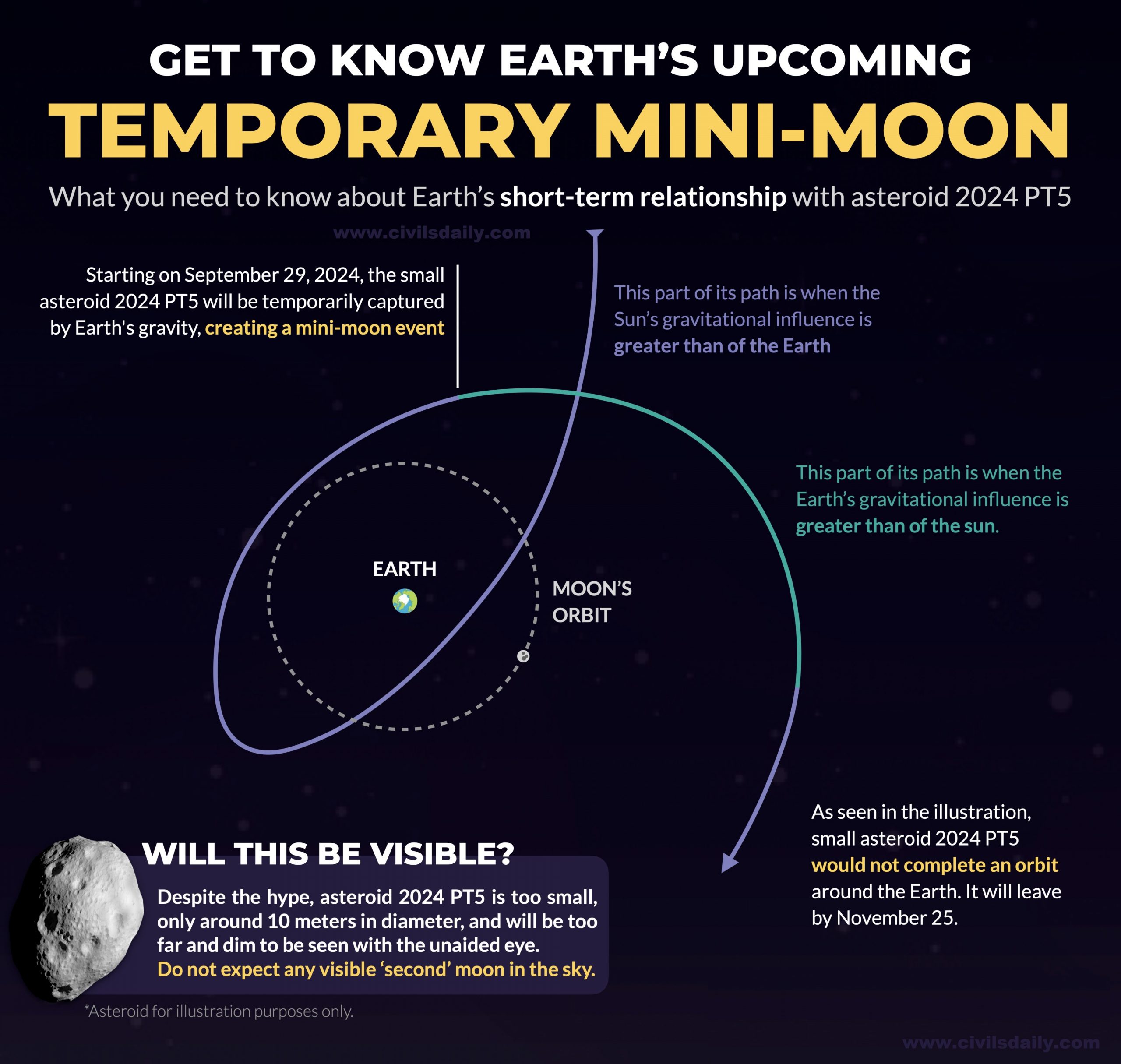
    In a rare celestial event, Earth’s gravitational field will witness a small asteroid, 2024 PT5, creating a “mini-moon” for two months.

    What is Mini-Moon?

    • A mini-moon is a small asteroid temporarily captured by Earth’s gravitational field, orbiting the planet for a short period before escaping back into space.
    • Unlike Earth’s permanent moon, mini-moons only stay for a few months to a few years before being ejected from orbit.
    • Mini-moons are a rare occurrence because most asteroids either pass by Earth or burn up in the atmosphere rather than being captured by Earth’s gravity.
    • Mini-moons are usually small, often just a few meters in diameter.
      • For example, 2024 PT5 is only about 33 feet (10 meters) in length.
    • They are hard to detect and are usually discovered using advanced telescopic surveys like NASA’s Asteroid Terrestrial-impact Last Alert System (ATLAS).

    Significance of Mini-Moons

    • Mini-moons offer scientists a unique opportunity to study near-Earth objects, enhancing our understanding of asteroids’ behavior and composition.
    • Mini-moons could contain valuable minerals or water, making them potential targets for future space missions to extract resources.
    • Studying mini-moons helps scientists learn more about Earth’s gravitational influence and how it interacts with space objects.

    PYQ:

    [2011] What is the difference between asteroids and comets?

    1. Asteroids are small rocky planetoids, while comets are formed of frozen gases held together by rocky and metallic material.
    2. Asteroids are found mostly between the orbits of Jupiter and Mars, while comets are found mostly between Venus and Mercury.
    3. Comets show a perceptible glowing tail, while asteroids do not.

    Which of the statements given above is/are correct?

    (a) 1 and 2 only
    (b) 1 and 3 only
    (c) 3 only
    (d) 1, 2 and 3

  • [pib] A poem on ‘National War Memorial’ and a chapter on ‘Veer Abdul Hameed’ included in NCERT

    Why in the News?

    A poem on National War Memorial and a chapter about Veer Abdul Hameed (PVC) introduced by the Ministries of Defence and Education has been included in the NCERT Class VI curriculum.

    About National War Memorial

    • The National War Memorial was unveiled on 25th February 2019 to honor Indian soldiers who sacrificed their lives in conflicts with Pakistan, China, 1961 Goa war and Operation Pawan.
    • The monument is designed in a C-hexagon layout, with names of the fallen soldiers inscribed on its walls.
    • It was designed by Yogesh Chandrasan of WeBe Design Lab.
    • Key features include the Amar Chakra (Circle of Immortality) with the ‘Eternal Flame’ symbolizing the nation’s commitment to remembering the soldiers.
    • The Veerta Chakra showcases six bronze murals depicting acts of bravery.
    • The Rakshak Chakra symbolizes protection with trees representing troops safeguarding the nation.
    • Tyag Chakra (Circle of Sacrifice) features concentric granite walls honoring the soldiers who have died since Independence.
    • The memorial also features busts of 21 soldiers who have received the Param Vir Chakra, India’s highest gallantry award.

    Who was Veer Abdul Hameed?

    • Abdul Hamid was a soldier in the 4th Grenadiers of the Indian Army.
    • He fought in the Battle of Asal Uttar during the 1965 India-Pakistan war, which took place near the India-Pakistan border in Punjab.
    • On 10th September 1965, he destroyed 3 Pakistani tanks and damaged a 4th near Chima village. He was killed during the battle.
    • For his exceptional bravery, he was posthumously awarded the Param Vir Chakra, India’s highest military honour.
    • A war memorial now stands at the site of his death, featuring a captured Pakistani Patton tank as a tribute to his courage.
  • [19th September 2024] The Hindu Op-ed: In Wilmington, juxtaposing immediacy with legacy

    [19th September 2024] The Hindu Op-ed: In Wilmington, juxtaposing immediacy with legacy

    PYQ Relevance:

    Q Quadrilateral Security Dialogue (Quad) is transforming itself into a trade bloc from a military alliance, in present times Discuss. (UPSC CSE 2020)

    Q The new tri-nation partnership AUKUS is aimed at countering China’s ambitions in the Indo-Pacific region. Is it going to supersede the existing partnerships in the region? Discuss the strength and impact of AUKUS in the present scenario. (UPSC CSE 2021)

    Q What are the maritime security challenges in India? Discuss the organisational, technical and procedural initiatives taken to improve the maritime security. (UPSC CSE 2022)

    Mentor’s Comment: The Quad leaders (Australia, India, Japan, and the U.S.) will meet for their fourth summit in Wilmington, Delaware, on September 21, marking a return to where their in-person summits began in 2021. This meeting, held alongside the UNGA and Summit of the Future, is crucial amid global challenges and leadership transitions. U.S. President Joe Biden, not seeking re-election, and Japan’s Prime Minister Fumio Kishida, facing political uncertainty, seek to solidify the Quad’s direction. India, initially set to host, deferred to accommodate Biden’s tight election-year schedule.

    _

    Let’s learn!

    Why in the News?

    • The Quad leaders (Australia, India, Japan, U.S.) will convene their fourth summit in Wilmington on September 21, amidst global challenges and leadership transitions, alongside UNGA events. 
    • At their July 2024 meeting in Tokyo, Quad Foreign Ministers announced the expansion of the “Indo-Pacific Partnership for Maritime Domain Awareness” to the Indian Ocean region.
    The Indo-Pacific Partnership for Maritime Domain Awareness (IPMDA) is a significant initiative aimed at enhancing maritime security and cooperation among Quad countries—India, Australia, Japan, and the United States—as well as other regional partners.  

    Objectives of IPMDA

    • Enhancing Maritime Domain Awareness: The IPMDA seeks to improve situational awareness at sea, allowing nations to monitor maritime activities effectively. This includes tracking illegal fishing, smuggling, and other illicit activities through advanced technology and data sharing.
    • Integration of Regions: The initiative aims to connect the Pacific Islands, Southeast Asia, and the Indian Ocean region into a cohesive maritime security framework, promoting a unified approach to regional challenges.
    • Rules-Based Order: Central to the IPMDA is the reinforcement of international maritime norms and laws, particularly under the United Nations Convention on the Law of the Sea (UNCLOS). This supports freedom of navigation and operational capabilities for all nations involved.

    Strategic Initiatives

    • Information Sharing: The IPMDA promotes real-time information sharing among countries in the region through various Information Fusion Centres (IFCs). This facilitates a common operating picture that enhances collective maritime security efforts.
    • Capacity Building: There is a strong emphasis on training and equipping regional partners with the necessary tools and knowledge to improve their maritime security capabilities. This includes collaborative training programs and technology transfers.
    • Operationalisation of IFC-IOR: The Information Fusion Centre for the Indian Ocean Region (IFC-IOR) plays a crucial role in operationalizing the South Asia program, enhancing India’s role in maritime domain awareness by facilitating real-time data sharing with allies.

    Challenges and Opportunities

    • Geopolitical Dynamics: The IPMDA is positioned against a backdrop of increasing geopolitical tensions, particularly concerning China’s assertiveness in maritime claims. The initiative aims to build resilience among smaller nations against such pressures through enhanced cooperation and support.
    • Technological Integration: The use of cutting-edge technologies such as satellite data collection and AI-driven analytics is central to improving MDA. However, there are concerns about technical compatibility among partner nations which need addressing for effective implementation.
    • Collective Security Framework: By fostering a cooperative approach to maritime security, the IPMDA aims to create a networked solution that addresses transnational threats effectively. This includes piracy, illegal fishing, and environmental challenges that require collective action from multiple stakeholders.

    Way forward: 

    • Strengthen Technological Integration: Enhance interoperability among Quad nations by investing in shared technology platforms, ensuring compatibility for real-time data sharing and AI-driven analytics across regions.
    • Expand Capacity Building: Continue collaborative training programs and technology transfers to empower smaller nations in the Indo-Pacific, improving their ability to monitor and secure maritime domains.
  • INCOIS Launches Integrated Ocean Energy Atlas  

    Why in the News?

    INCOIS unveiled an ‘Integrated Ocean Energy Atlas’ for India’s EEZ, highlighting vast marine energy potential from solar, wind, waves, tides, currents, and thermal resources.

    About INCOIS:

    • The Indian National Centre for Ocean Information Services (INCOIS) is an autonomous body established in 1999 under the Ministry of Earth Sciences (MoES) in India.
    • Its primary mission is to provide ocean data, information, and advisory services to various stakeholders, including society, industry, government, and the scientific community through sustained ocean observations.

    Key Features of the Integrated Ocean Energy Atlas

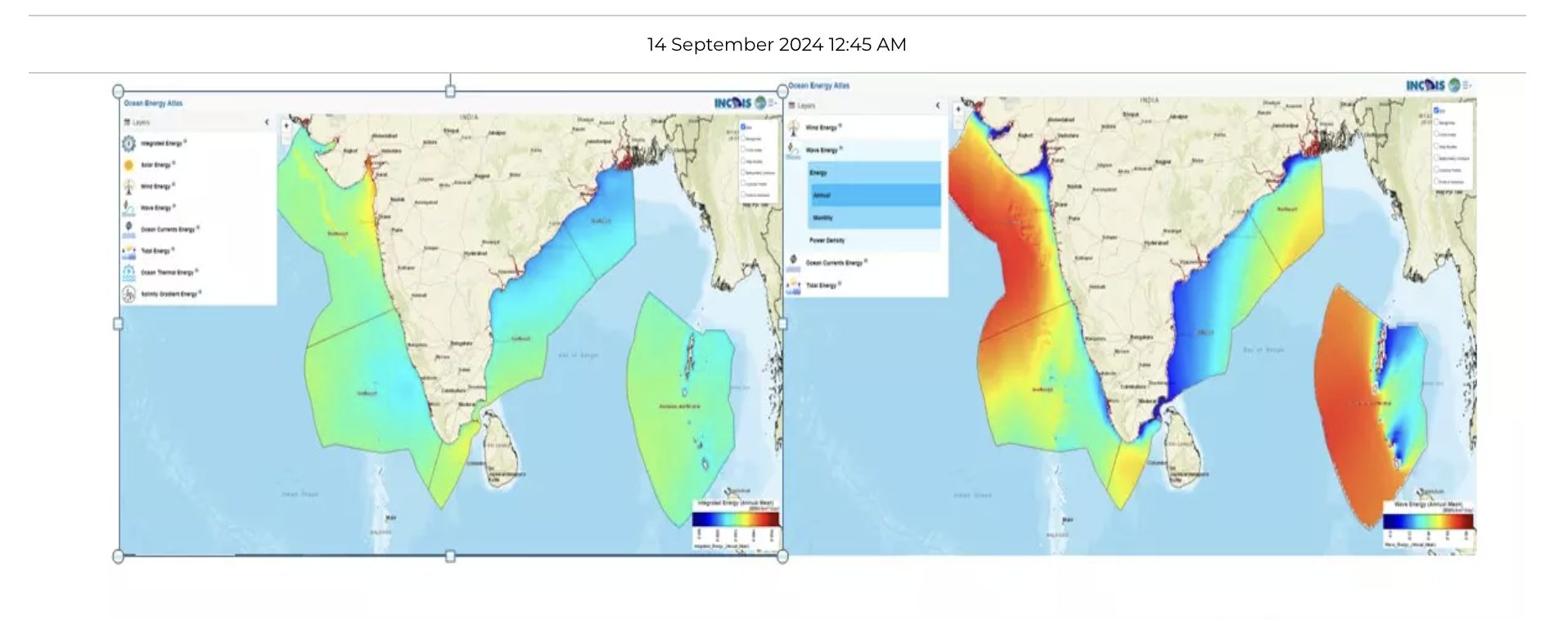
    • The Atlas encompasses marine meteorological energy sources like solar and wind, and hydrological energy forms such as waves, tides, currents, ocean thermal, and salinity gradients within India’s EEZ.
    • It identifies areas with high potential for energy generation and will serve as a reference for policymakers, industry and researchers for harnessing these rich energy resources.
    • INCOIS prepared the annual, monthly, and daily energy estimates of ocean energy components that can be visualised through a WebGIS interface at 5 km grid resolution.

    Significant potential of the Indian Exclusive Economic Zone (EEZ)

    • INCOIS has estimated integrated ocean energy of approximately 9.2 lakh TWh per annum within the EEZ of India.
    • The vast coastline of over 7,000 km and the EEZ covering up to 220 km from the coast offers ample scope for generating energy from blue renewable sources like tidal waves, currents, solar and wind.

    What India can learn from this Report? (Way forward)

    • The Atlas provides a blueprint for India to tap into its vast untapped ocean energy resources to meet its growing energy demands in a sustainable manner.
    • It offers estimated values of renewable energy that can be generated from individual or integrated blue renewable sources at potential sites along the coast
    • The detailed mapping of energy potential at a granular 5 km grid level can help industries plan and make informed decisions for developing offshore renewable energy projects.
    • Collaborating with industrial partners and public sector companies to harness energy at high-potential zones identified in the Atlas can accelerate the adoption of marine energy technologies.
    • The Atlas can serve as a model for other countries in the Indian Ocean region to assess their blue energy reserves and promote regional cooperation in harnessing ocean energy resources.

    Mains PYQ:

    Q Describe the benefits of deriving electric energy from sunlight in contrast to the conventional energy generation. What are the initiatives offered by our government for this purpose? (UPSC IAS/2020)