💥Join UPSC 2027,2028 Mentorship (July Batch) + XFactor Notes & Microthemes PDF

Distribution: yearly

  • Supreme Court Guidelines on DNA Evidence in Criminal Cases

    Why in the News?

    The Supreme Court has issued guidelines in the Kattavellai @ Devakar v. State of Tamil Nadu Judgement to standardise DNA handling in criminal cases to prevent contamination and delays after evidence lapses in a major case.

    Key Highlights of the Supreme Court Guidelines:

    • Case Context: It involved rape, murder, and robbery. Court flagged delays in Forensic Science Laboratory (FSL) submission, lack of chain of custody, and risk of contamination.
    • Need: Lack of uniform procedures across states despite scattered rules. Since Police and Public Order are in the State List, Supreme Court intervened for national uniformity.
    • Guidelines Issued:
      • Collection and Documentation: Samples must be packaged properly, labelled with FIR details, and signed by medical officer, Investigating Officer, and witnesses.
      • Transportation: Investigating Officer (IO) must deliver samples to FSL within 48 hours. Reasons for any delay must be recorded.
      • Storage Pending Trial: Packages cannot be opened or resealed without trial court approval.
      • Chain of Custody Register: Maintained until conviction or acquittal. IO responsible for explaining lapses.

    Previous SC Observations on DNA Evidence:

    • Anil v. Maharashtra (2014): DNA reliable only if laboratory procedures are maintained.
    • Manoj v. Madhya Pradesh (2022): DNA rejected as recovery was from open area with contamination risk.
    • Rahul v. Delhi (2022): DNA held inadmissible after being kept in police custody for two months.
    • Pattu Rajan v. Tamil Nadu (2019): DNA value depends on corroborating evidence; absence not fatal.
    • Sharda v. Dharmpal (2003): DNA test orders valid; no violation of Article 21.
    • Das @ Anu v. Kerala (2022): DNA not self-incrimination under Article 20(3). Section 53A CrPC permits collection in rape cases.

    Back2Basics: DNA Profiling

    • Overview: DNA profiling, also called DNA fingerprinting, is a forensic technique to identify individuals by analysing unique DNA regions, mainly Short Tandem Repeats (STRs).
    • How it works: Human DNA is 99.9% identical; the 0.1% variability forms the basis of personal identification.
    • Sources: DNA can be extracted from blood, semen, saliva, hair, bone, skin, or even “touch DNA.”
    • Processes: The process includes isolation, purification, amplification, visualization, and statistical comparison of DNA markers.
    • Methods:  miniSTRs and mitochondrial DNA (mtDNA) help in degraded or limited samples.
    • Legal Status: Treated as expert opinion under Indian Evidence Act Section 45 (now BSA 2023 Section 39). DNA is corroborative, not substantive evidence.
  • [pib] Exercise Pacific Reach, 2025

    Why in the News?

    INS Nistar, the Navy’s new indigenous Diving Support Vessel, made its maiden port call at Singapore to join the multinational Exercise Pacific Reach 2025.

    About Exercise Pacific Reach:

    • Overview: A biennial, multinational submarine rescue exercise initiated in 1996 (Asia-Pacific).
    • Objective: Enhances cooperation, interoperability, and readiness in submarine rescue.
    • Pacific Reach 2025 (XPR-25): 9th edition, hosted by Singapore.
    • Phases:
      • Harbour Phase: Seminars, Subject Matter Expert Exchanges (SMEE), medical symposium, cross-deck visits.
      • Sea Phase: Live submarine rescue drills, intervention ops, deep-water simulated emergencies, and Mass Evacuation Exercises (MASSEVEX).
    • Participation: 40+ countries (participants + observers).

    India’s Participation:

    • INS Nistar: India’s indigenous Diving Support Vessel (DSV), mothership for Deep Submergence Rescue Vehicle (DSRV).
    • Submarine Rescue Unit (East): Taking part in live rescue drills.
    • Significance: Showcases 80% indigenous capability (built by Hindustan Shipyard Ltd), and positions India as a regional leader in humanitarian submarine rescue.

    Back2Basics: INS Nistar

    • Commissioning: First indigenous DSV, commissioned July 2025 at Visakhapatnam.
    • Design: Built with 80% indigenous content, in line with Aatmanirbhar Bharat.
    • Capability: Supports DSRV rescue ops up to 300 m; equipped with ROVs, hyperbaric lifeboats, subsea cranes, helipad, and medical facilities.
    • Role: Provides endurance for long missions, reinforcing India’s deep-sea rescue & maritime safety architecture.
  • [15th September 2025] The Hindu Op-ed: Improving Macros: Period of low inflation and relatively high growth

    PYQ Relevance

    [UPSC 2019] Do you agree with the view that steady GDP growth and low inflation have left the Indian economy in good shape? Give reasons in support of your arguments.

    Linkage: The present scenario of low inflation (2.1%) coupled with high growth directly resonates with the 2019 PYQ, as it exemplifies how such a macro mix strengthens household purchasing power and policy space. However, just as in 2019, questions about data reliability and sustainability remain valid. Thus, India’s current economic outlook offers both affirmation and nuance to the earlier debate.

    Mentor’s Comment

    India’s macroeconomic trajectory has taken a remarkable turn, shifting from the troubling “low growth, high inflation” trap of last year to a far more favorable “high growth, low inflation” outlook. With inflation dipping within RBI’s comfort band and food prices contracting sharply, the macro story is compelling and holds lessons for India’s policy and global positioning. This article unpacks the nuances of the recent data, explores what it means for the future, and situates it within the UPSC Mains framework with value addition, practice questions, and micro-themes.

    Introduction

    The August 2025 retail inflation numbers marked a critical juncture in India’s economic narrative. Retail inflation, though it rose slightly, stood at 2.1%, comfortably within the Reserve Bank of India’s (RBI) target range of 2%-6%. This snapped a nine-month declining streak but did not trigger alarm. Food inflation remained subdued, with striking contractions of 15.9% in vegetable prices and 14.5% in pulses. Combined with welfare provisions under the National Food Security Act, this ensured affordability of essential items. With low inflation across housing, fuel, and clothing, India’s macroeconomic picture looks vastly different from last year, when high inflation coupled with low growth defined the economic outlook. The gap between growth and inflation has widened from 2.1 percentage points last year to 5.5 percentage points now—an enviable reversal.

    Understanding the Current Inflation Trends

    1. Retail inflation at 2.1%: Marginally within RBI’s comfort zone of 2%-6%, reflecting stability despite global uncertainty.
    2. Food prices contracting sharply: Vegetables fell by 15.9% and pulses by 14.5%, easing household expenditure.
    3. Other necessities stable: Housing, clothing, footwear, and fuel inflation are all lower in August than in July.
    4. Welfare cushioning: Free foodgrains under the NFSA ensure food affordability despite global volatility.

    How Has the Macro Picture Changed Since Last Year?

    1. From high inflation to low inflation: Inflationary pressures last year eroded purchasing power, but now they remain subdued.
    2. From sluggish growth to robust growth: Growth has accelerated, giving policymakers breathing room.
    3. Growth–inflation differential widened: From 2.1 percentage points last year to 5.5 points this year, a striking macro improvement.
    4. Comparability holds: Concerns about data integrity existed last year too, hence the relative improvement is valid.

    What Role Do Global and Domestic Policies Play?

    1. Russian oil purchases: Even if India abandons Russian crude under U.S. pressure, the inflationary impact will be limited due to already-low global crude prices.
    2. GST rate cuts: Effective September 22, lower GST rates are expected to reduce consumer prices further.
    3. RBI’s cautious optimism: While Q1’s low inflation-high growth dynamic raises hopes of a rate cut, global uncertainties may push this decision to December instead of September.

    What Lies Ahead for India’s Economic Outlook?

    1. Benign inflation trajectory: Indicators point to sustained price stability.
    2. Limited global oil shock risk: Declining discounts from Russia and stable crude prices mean less volatility for India.
    3. Prospects for rate cuts: The Monetary Policy Committee may consider easing monetary policy in December, enhancing growth.
    4. Strengthened fiscal space: Low inflation allows government welfare and investment measures to operate without inflationary spirals.

    Conclusion

    India’s macroeconomic outlook in 2025 is a story of resilience and reversal. The sharp transition from a vulnerable high-inflation, low-growth setup to a robust high-growth, low-inflation phase underscores effective price stabilization and cushioning mechanisms like NFSA. While global uncertainties remain, the benign inflation trajectory coupled with strong growth provides a foundation for India’s economic policy to focus on sustainable and inclusive development.

  • PLI Scheme for White Goods

    Why in the News?

    The Centre has announced reopening of the application window for the Production-Linked Incentive (PLI) Scheme for White Goods, following the strong response and success of earlier rounds.

    Note: White goods refer to large household appliances like refrigerators, washing machines, and air conditioners, so named because they were traditionally white.

    About the PLI Scheme for White Goods:

    • Objective: To create a complete component ecosystem for ACs and LED lights, integrating India into global supply chains and boosting domestic manufacturing.
    • Approval: Cleared by the Union Cabinet in April 2021; implemented by the Department for Promotion of Industry and Internal Trade (DPIIT).
    • Duration: Implemented over seven years (FY 2021–22 to FY 2028–29) with a total outlay of ₹6,238 crore.
    • Incentives: Provides 4–6% incentive on incremental turnover (over base year 2019–20) for both domestic sales and exports, applicable for five years to eligible companies.
    • Eligibility:
      • Applicant must be a company incorporated under the Companies Act, 2013.
      • Eligibility depends on achieving threshold levels of incremental sales and investments.
      • Entities availing benefits under any other PLI scheme for the same products are not eligible.
    • Beneficiaries So Far: 83 companies with committed investment of ₹10,406 crore have been approved under the scheme, covering AC and LED components across the entire value chain.
    • Employment and Exports: Expected to create jobs, expand exports, and enhance self-reliance in components that were earlier imported.
    [UPSC 2023] Consider the following statements:

    Statement I: India accounts for 3.2% of global exports of goods.
    Statement II: Many local companies and some foreign companies operating in India have taken advantage of India’s ‘Production-linked Incentive’ scheme.
    Which one of the following is correct in respect of the above statements?
    (a) Both Statement-I and Statement-II are correct and Statement-II is the correct explanation for Statement-I
    (b) Both Statement-I and Statement-II are correct and Statement-II is not the correct explanation for Statement-I
    (c) Statement-I is correct but Statement-II is incorrect
    (d) Statement-I is incorrect but Statement-II is correct *


  • In news: Cauvery River Dispute

    Why in the News?

    On the Cauvery dispute, Karnataka CM has said that water will be released to Tamil Nadu since the rainfall is adequate, while stressing the Mekedatu Dam’s role in water balance and clean energy.


    Back2Basics: Cauvery River

    • Origin & Course: Rises at Talakaveri, Brahmagiri range (Kodagu, Karnataka); flows ~800 km through Karnataka & Tamil Nadu into the Bay of Bengal.
    • Catchment: Spreads across Karnataka, Tamil Nadu, Kerala, Puducherry.
    • Tributaries: Harangi, Hemavati, Kabini, Suvarnavathi, Bhavani.
    • Nature: Perennial river, sustained by both advancing & retreating monsoons.
    • Protected Areas: Cauvery WLS, Biligirirangan Hills, Pushpagiri, Muthathi, Ranganathittu, Bhimeshwari, Nagarhole, Bandipur.

    About Cauvery Water Sharing Dispute:

    • Colonial Origins: Began in 1892 (Madras Presidency vs Mysore); 1924 Agreement (50 years, expired 1974).
    • Post-Independence: Disputes arose with dam projects by Karnataka (1960s–80s); Supreme Court referred to Cauvery Water Disputes Tribunal (CWDT).
    • Interim Phase: Cauvery River Authority (CRA, 1998) issued temporary orders.
    • CWDT Final Award (2013): Tamil Nadu 419 TMC, Karnataka 270, Kerala 30, Puducherry 7.
    • Karnataka’s Obligation: In normal years, release 177.25 TMC to TN, including 123.14 TMC in SW monsoon.
    • Challenges: Disputes sharpen in weak monsoons, triggering use of a “distress formula”.
    • Legal Basis: Governed by Article 262, Inter-State River Water Disputes Act, 1956; Seventh Schedule entries 17 (State List) & 56 (Union List).

    cauvery

    About Mekedatu Dam Project:

    • Location: Deep gorge at Cauvery–Arkavathi confluence near Kanakapura, Karnataka.
    • Design: Balancing reservoir of ~66 TMC capacity.
    • Objectives: Provide Bengaluru drinking water, generate 400 MW hydropower, regulate flows to TN in drought years.
    • Importance: Karnataka argues it benefits both states by ensuring regulated water release.
    • Opposition: Tamil Nadu objects, fearing reduced downstream availability.
    • Current Status: Karnataka insists on moving ahead, requiring Centre & TN’s clearance.
    [UPSC 2022] Gandikota canyon of South India was created by which one of the following rivers?

    Options: (a) Cauvery (b) Manjira (c) Pennar* (d) Tungabhadra


  • Places in news: Erra Matti Dibbalu

    Why in the News?

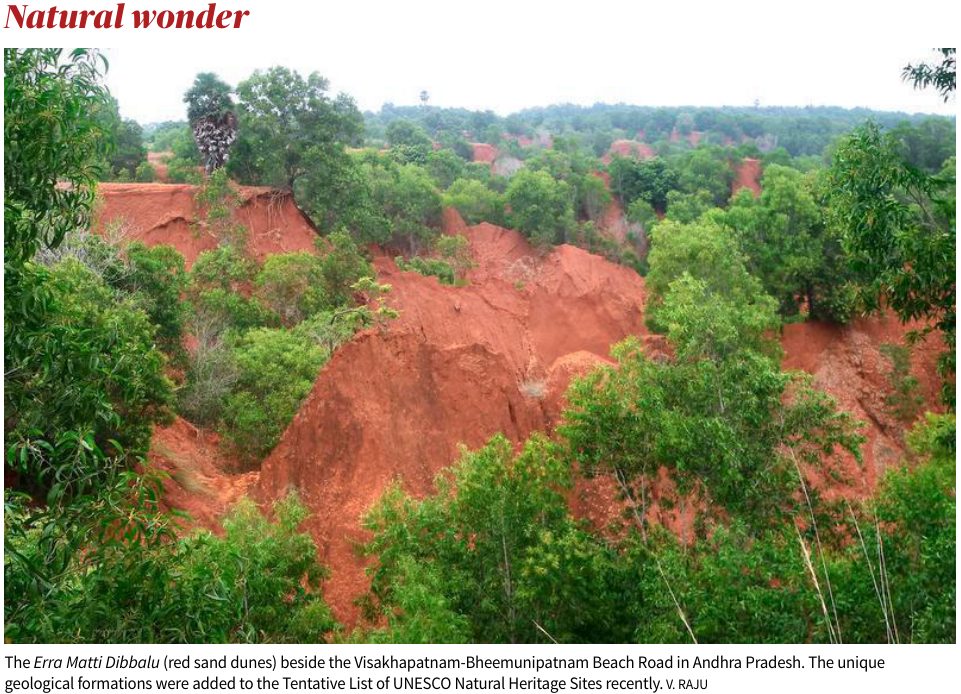
    This newscard is an excerpt from a photo published in ‘The Hindu’.

    About Erra Matti Dibbalu:

    • Location: Found between Visakhapatnam and Bheemunipatnam in Andhra Pradesh, stretching 5 km along the coast, with widths ranging from 200 m to 2 km.
    • Meaning: In Telugu, “Erra Matti” means red soil and “Dibbalu” means mounds, describing the reddish sand dunes.
    • Geological Heritage: Listed among the 34 National Geological Heritage Monument Sites of India by the Geological Survey of India (GSI).
    • Formation: Created around 12,000–18,500 years ago through the combined effect of tectonic activity (2.5 million–11,000 years ago), sea-level changes, monsoonal variability, and global climatic shifts.
    • Composition: Derived mainly from Khondalite rocks of the Eastern Ghats hinterland, with the red colour due to oxidation of iron-rich sediments.

    Significance:

    • Geological Value: Acts as a paleo-environment indicator, providing evidence of climate change, sea-level fluctuations, and coastal evolution during the late Quaternary period.
    • Archaeological Importance: Artefacts from Mesolithic and Neolithic periods and sediment layers dating back to the Late Pleistocene epoch have been found here.
    • Conservation Status: Declared a National Geo-heritage Monument (2016) and included in UNESCO’s Tentative List of World Heritage Sites (2025) for global recognition and protection.
    • Unique Landscape: Features badland topography with sand dunes, buried channels, gullies, and dendritic drainage patterns.
    • Rare Formation: Only two other similar red sand dune systems exist globally—the Teri dunes in Tamil Nadu and one site in Sri Lanka.
    [UPSC 2014] When you travel in Himalayas, you will see the following:

    1. Deep gorges 2. U-turn river courses 3. Parallel mountain ranges 4. Steep gradients causing land sliding

    Which of the above can be said to be the evidence for Himalayas being young fold mountains?

    Options: (a) 1 and 2 only (b) 1, 2 and 4 only (c) 3 and 4 only (d) 1, 2, 3 and 4*


  • Scarborough Shoal in South China Sea

    Why in the News?

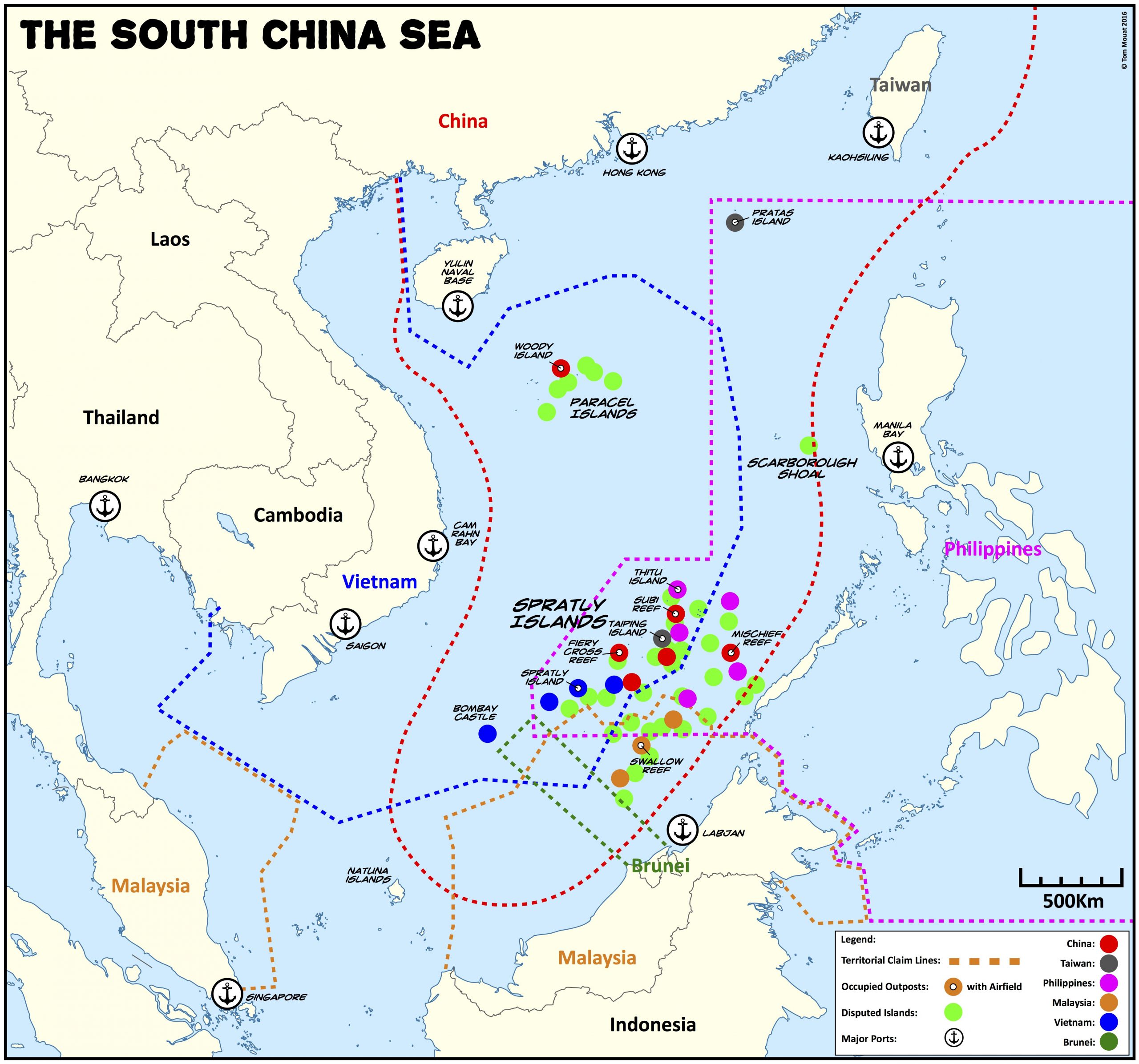
    China’s State Council has approved the creation of a national nature reserve at Scarborough Shoal (Huangyan Dao in Chinese, Bajo de Masinloc/Panatag Shoal in the Philippines).

    About Scarborough Shoal:

    • Geography: A triangle-shaped chain of reefs and rocks in the South China Sea, about 200 km from Luzon (Philippines) and 800+ km from Hainan (China).
    • Status: Uninhabited but strategic, located near shipping lanes carrying $3 trillion in trade annually.
    • Significance: The lagoon shelters boats, and surrounding waters hold rich fish stocks vital for Zambales and Pangasinan communities.

    Disputes about it:

    • Sovereignty Claims: Both China and the Philippines claim ownership.
    • 2016 Arbitration Ruling: Permanent Court of Arbitration (The Hague) held China’s nine-dash line claim invalid, declaring Scarborough a traditional fishing ground under UNCLOS; China rejected the verdict.
    • Philippines’ Grounds: Lies within Manila’s Exclusive Economic Zone (EEZ), making China’s reserve “illegitimate and unlawful.”
    • International Response: The US, Japan, Australia, and Canada conduct naval patrols/drills supporting the Philippines and freedom of navigation.
    [UPSC 2022] Which one of the following statements best reflects the issue with Senkaku Islands, sometimes mentioned in the news ?

    Options: (a) It is generally believed that they are artificial islands made by a country around South China Sea.

    (b) China and Japan engage in maritime disputes over these islands in East China Sea.*

    (c) A permanent American military base has been set up there to help Taiwan to increase its defence capabilities.

    (d) Though International Court of Justice declared them as no man’s land, some South-East Asian countries claim them.


  • PM inaugurated India’s first Bamboo-based Ethanol Plant

    Why in the News?

    PM has inaugurated the world’s first bamboo-based ethanol plant in Golaghat district, Assam, marking a significant step in India’s green energy journey.

    Note: Ethanol is prepared from bamboo using a multi-step biochemical conversion process that transforms its rich cellulose content into fermentable sugars, which are then fermented and distilled into ethanol.

    About Assam Bioethanol Plant:

    • Overview: World’s first 2G bamboo-based bioethanol facility, developed jointly by Numaligarh Refinery Limited (NRL), Fortum (Finland), and Chempolis OY.
    • Feedstock: Uses 5 lakh tonnes of green bamboo annually, sourced from Assam, Arunachal Pradesh, and other NE states.
    • Production Capacity: Generates 48,900 MT ethanol, 11,000 MT acetic acid, 19,000 MT furfural, and 31,000 MT food-grade CO₂ per year.
    • Benefits: Adds ~₹200 crore annually to Assam’s rural economy; supports farmers and tribal communities with assured markets.
    • Policy Enabler: Reclassification of bamboo (no longer a tree) allowed free cultivation and harvesting, unlocking industrial potential.

    Back2Basics: Regulation of Bamboo in India

    • Earlier Status: The Indian Forest Act, 1927 classified bamboo as a “tree”, though botanically it is a grass.
    • Regulatory Impact: Even in non-forest areas, felling, cutting, and transport of bamboo required permits like timber, discouraging farmers and traders.
    • 2017 Amendment: The Act was amended to remove “bamboos” from the definition of “tree” under Section 2(7), but only for non-forest areas.
    • Policy Goal: Intended to ease regulatory burdens, promote bamboo cultivation and trade, and strengthen agroforestry.
    • Current Rule: Bamboo on private/agricultural land can now be freely grown, cut, and transported without permits; bamboo in forest areas remains regulated.
    • Scientific Alignment: Recognises bamboo correctly as a grass (Poaceae family).
    • Significance: Supports rural farmers, artisans, and tribal communities by making bamboo a viable cash crop.


    [UPSC 2023] According to India’s National Policy on Biofuels, which of the following can be used as raw materials for the production of biofuels?

    1. Cassava 2. Damaged wheat grains 3. Groundnut seeds 4. Horse gram 5. Rotten potatoes 6. Sugar beet

    Select the correct answer using the code given below:

    Options: (a) 1, 2, 5 and 6 only * (b) 1, 3, 4 and 6 only (c) 2, 3, 4 and 5 only (d) 1, 2, 3, 4, 5 and 6


  • Ho Tribes’ Manki-Munda System

    Why in the News?

    Members of the Ho tribe in Jharkhand’s West Singhbhum district staged a protest for alleged interference in their traditional Manki-Munda governance system by removing village heads (Mundas).

    About Ho Tribes:

    • Location: Major community of Jharkhand (Kolhan, West Singhbhum), with presence in Odisha and Chhattisgarh.
    • Language: Speak Ho language (Munda branch, Austroasiatic family), traditionally written in Warang Citi script.
    • Livelihoods: Primarily agriculturalists, with farming, hunting, and forest produce as traditional occupations.
    • Festivals: Mage Parab, Ba Parab, Sohrai, tied to agriculture, celebrated with dance, music, rituals.
    • Resistance: Historically fought outsiders; staged Ho Revolt (1821–22) and Kol Revolt (1831) against British.
    • Social Fabric: Clan-based, community-oriented, guided by customary law and collective decision-making.

    What is the Manki-Munda System?

    • Structure:
      • Munda: Village head (hereditary), resolves disputes, represents village.
      • Manki: Head of pidh (cluster of 8–15 villages), adjudicates inter-village disputes.
    • Pre-British: Purely internal self-rule, no taxation or external sovereign authority.
    • British Codification:
      • Wilkinson’s Rules (1833–37) codified system into 31 rules, formally recognising Mankis/Mundas as British agents.
      • Introduced private property; Ho became raiyats (tenants) instead of communal landholders.
      • Led to demographic influx of dikkus (outsiders), rising from ~1,500 (1867) to ~15,700 (1897).
    • Post-Independence: Kolhan Government Estate dissolved (1947) but Wilkinson’s Rules still operative; Kolhan largely exempt from civil laws.
    • Judicial View: In Mora Ho vs State of Bihar (2000), Patna HC treated Wilkinson’s Rules as customs, not law, but upheld their continuance.
    • Current Practice: System governs village disputes; ~200 vacant posts filled by Gram Sabhas.
    • Criticism: Hereditary leadership limits efficiency; many leaders lack education for modern administration.
    • Reform Debate: Youth demand limiting hereditary succession and inclusion of non-tribal raiyats.
    • Contemporary Role: Remains a symbol of tribal autonomy yet requires modernisation for democratic governance.
    [UPSC 2010] Which one of the following pairs of primitive tribes and places of their inhabitation is not correctly matched?

    (a) Buksa : Pauri-Garhwal

    (b) Kol : Jabalpur

    (c) Munda : Chhotanagpur

    (d) Korba : Kodagu*


  • Bengaluru gets its 2nd Biodiversity Heritage Site (BHS)

    Why in the News?

    The Karnataka government declared 8.6 acres of green cover at Cantonment Railway Colony in Bengaluru as a Biodiversity Heritage Site (BHS), the second such site in the city after Gandhi Krishi Vigyan Kendra (GKVK).

    About Biodiversity Heritage Sites (BHS):

    • Legal Basis: Recognized under Section 37(1) of the Biological Diversity Act, 2002 as ecologically sensitive areas of high biodiversity.
    • Notifying Authority: The State Government, in consultation with local bodies, can declare an area as a BHS.
    • Objective: Conserves wild and domesticated species, including rare, threatened, and keystone species, vital for ecological balance.
    • Significance: Marked as ecologically fragile zones, essential for sustaining local ecosystems and long-term sustainability.
    • Community Role: Local communities and institutions are actively involved in management and protection.
    • Restrictions Put: Declaration does NOT restrict customary uses; aims to enhance quality of life through conservation.
    • Institutional Support: State Biodiversity Boards (SBBs) and Biodiversity Management Committees (BMCs) assist in proposing, managing, and monitoring BHS.
    • First BHS in India: Nallur Tamarind Grove, Bengaluru, Karnataka, notified in 2007.
    [UPSC 2023] Consider the following statements:

    1. In India, the Biodiversity Management Committees are key to the realization of the objectives of the Nagoya Protocol.

    2. The Biodiversity Management Committees have important functions in determining access and benefit sharing, including the power to levy collection fees on the access of biological resources within its jurisdiction.

    Which of the statements given above is/are correct?

    Options: (a) 1 only (b) 2 only (c) Both 1 and 2* (d) Neither 1 nor 2