💥Join UPSC 2027,2028 Mentorship (July Batch) + XFactor Notes & Microthemes PDF

Distribution: yearly

  • [pib] Incentive Scheme to Promote Critical Mineral Recycling

    Why in the News?

    The Union Cabinet approved a ₹1,500 crore Incentive Scheme to promote recycling of critical minerals from secondary sources such as e-waste and battery scrap.

    About Critical Mineral Recycling Incentive Scheme:

    • Launch: Approved under the National Critical Mineral Mission (NCMM).
    • Outlay: ₹1,500 crore over 6 years (FY 2025–26 to FY 2030–31).
    • Objective: Build domestic recycling capacity for critical minerals (lithium, cobalt, nickel, copper, rare earths) from secondary sources.
    • Rationale: Provides a near-term solution to supply chain challenges as mining projects require long lead times.
    • Targets:
      • 270 kilotonnes annual recycling capacity.
      • 40 kilotonnes minerals yield per year.
      • ₹8,000 crore investment mobilised.
      • ~70,000 jobs created.

    Key Features:

    • Beneficiaries: Large recyclers, small/new recyclers, start-ups; one-third funds reserved for small/new entrants.
    • Feedstock Sources: E-waste, lithium-ion battery scrap, catalytic converters, other industrial scrap.
    • Coverage: Support for new units, as well as expansion, modernisation, and diversification of existing plants.
    • Capex Subsidy: 20% subsidy on plant & machinery for timely commissioning; reduced rates for delays.
    • Opex Subsidy: Tied to incremental sales over FY 2025–26 base year.
      • 40% subsidy released in FY 2026–27.
      • 60% subsidy released in FY 2030–31.
    • Incentive Caps:
      • Large entities: ₹50 crore cap (₹10 crore max for opex).
      • Small entities: ₹25 crore cap (₹5 crore max for opex).
    • Eligibility Restriction: Only for firms engaged in actual mineral extraction, not just intermediate “black mass” processing.
    [UPSC 2021] Consider the following statements:

    I. India has joined the Minerals Security Partnership as a member.

    II. India is a resource-rich country in all the 30 critical minerals that it has identified.

    III. The Parliament in 2023 has amended the Mines and Minerals (Development and Regulation) Act, 1957 empowering the Central Government to exclusively auction mining lease and composite license for certain critical minerals.

    Which of the statements given above are correct?

    Options: (a) I and II only (b) II and III only (c) I and III only* (d) I, II and III


  • BHARATI Initiative

    Why in the News?

    The Agricultural and Processed Food Products Export Development Authority (APEDA) has launched the BHARATI initiative — Bharat’s Hub for Agritech, Resilience, Advancement and Incubation for Export Enablement.

    About BHARATI Initiative:

    • Launched by: APEDA (Agricultural and Processed Food Products Export Development Authority) in September 2025.
    • Purpose: To incubate and empower 100 agri-food and agri-tech startups, making them export-ready.
    • Target: Support APEDA’s vision of reaching US$ 50 billion (₹4.4 lakh crore) in agri-food exports by 2030.
    • Focus Areas: Export enablement, innovation, incubation, and addressing challenges like perishability, logistics, quality compliance, and sustainability.
    • Policy Alignment: Linked to Atmanirbhar Bharat, Start-Up India, Vocal for Local, and Digital India.

    Key Features:

    • Targeted Products: GI-tagged items, organic foods, superfoods, AYUSH products, processed foods, livestock-based products.
    • Technology Integration: AI-based quality control, blockchain-enabled traceability, IoT-based cold chains, and agri-fintech solutions.
    • Acceleration Model: 3-month programme to build export readiness, ensuring compliance with international food safety and quality standards.
    • Partnership Ecosystem: Collaboration with state boards, IITs/NITs, universities, industry bodies, and accelerators.
    • Scalability: Designed for annual expansion, gradually increasing the number of supported startups.
    [UPSC 2011] With what purpose is the Government of India promoting the concept of “Mega Food Parks”?

    1. To provide good infrastructure facilities for the food processing industry.

    2. To increase the processing of perishable items and reduce wastage.

    3. To provide emerging and

    eco-friendly food processing technologies to entrepreneurs.

    Select the correct answer using the code given below:

    Options: (a) 1 only (b) 1 and 2 only* (c) 2 and 3 only (d) 1, 2 and 3


  • 20 Years of MGNREGS

    Why in the News?

    On the 20th anniversary of Mahatma Gandhi National Rural Employment Guarantee Act, 2005, concerns were raised over chronic underfunding of the scheme during the past decade.

    About MGNREGS:

    • Overview: MGNREGS is a rights-based Centrally Sponsored Scheme launched under the MGNREGA Act of 2005 to ensure the Right to Work for rural households.
    • Origins:
      • The idea of employment guarantee in India began with Maharashtra’s pilot, Employment Guarantee Scheme (MEGS), in 1965 under the Vasantrao Naik government.
      • At the national level, the idea was first proposed in 1991 by then PM P. V. Narasimha Rao and later enacted in 2005.
    • Employment Guarantee: It provides 100 days of wage employment per year to any adult willing to do unskilled manual labour in rural India.
    • Legal Obligation: It is the first law in India that imposes a legal duty on the government to provide employment and compensate for non-compliance.
    • Development Goal: The scheme aims to promote livelihood security, inclusive growth, and rural development.

    Key Features:

    • Statutory Right: Employment under MGNREGS is a legal entitlement, not just a welfare scheme.
    • Eligibility: Any rural adult aged 18 or above can apply and must be offered work within 15 days.
    • Proximity and Wages: Work must be provided within 5 km of the applicant’s residence with minimum wage, and delays attract compensation.
    • Unemployment Allowance: If work is not provided on time, the state must pay an allowance.
    • Demand-Driven Model: The scheme is worker-initiated, requiring the government to respond to demand.
    • Transparency and Audits: Regular social audits and online updates ensure accountability in job cards, muster rolls, and fund use.
    • Local Implementation: It is decentralised, led by Gram Panchayats, with support from block and state officials, and centrally funded.
    • Women’s Inclusion: At least one-third of beneficiaries must be women, enhancing gender equity.
    • Sustainable Assets: Projects focus on durable rural infrastructure like ponds, roads, canals, and plantations.
    [UPSC 2006] Consider the following statements in respect of the National Rural Employment Guarantee Act, 2005:

    1. The Act provides 100 days of employment to households as a fundamental right.

    2. Women are given priority such that half of the employment seekers are women.

    Which of the statements given above is/are correct?

    Options: (a) 1 only (b) 2 only (c) Both 1 and 2 (d) Neither 1 nor 2 *


  • [5th September 2025] The Hindu Op-ed: GST 2.0 is a landmark in India’s Tax Journey

    PYQ Relevance

    [UPSC 2020] Explain the rationale behind the Goods and Services Tax (Compensation to States) Act of 2017. How has COVID-19 impacted the GST compensation fund and created new federal tensions?

    Linkage: The GST (Compensation to States) Act, 2017 was meant to assure states of revenue stability post-GST rollout, but COVID-19 strained the fund, creating federal tensions over delayed compensation. In contrast, GST 2.0 reflects cooperative federalism, with consensus on slab rationalisation, inverted duty correction, and GSTAT. This marks a shift from fiscal disputes to collaborative reform, strengthening trust in India’s tax federalism.

    Mentor’s Comment

    The 56th meeting of the Goods and Services Tax (GST) Council has ushered in a decisive set of reforms, marking a new chapter in India’s fiscal federalism. By moving towards a simplified two-rate structure and addressing long-standing distortions, GST 2.0 promises to reshape consumption patterns, boost competitiveness, and build a fairer system. For UPSC aspirants, this development offers lessons on economic governance, cooperative federalism, social security, and inclusive growth.

    Introduction

    The 56th GST Council meeting (September 3, 2025) has been hailed as a watershed in India’s taxation history. For the first time since the rollout of GST in 2017, the complex multi-slab structure has been significantly rationalised. The new structure introduces just two core slabs, 18% (Standard Rate) and 5% (Merit Rate), with a 40% demerit rate for a few goods, while several essentials are exempt. These reforms are not limited to technical tax changes; they are a “people’s reform” with direct impact on households, farmers, industries, and the healthcare sector.

    The significance of GST 2.0 reforms

    1. Historic simplification: Earlier GST had 5%, 12%, 18%, and 28% slabs. The new 2-rate system with exemptions marks the biggest simplification since 2017.
    2. People-centric relief: Daily-use goods like soap, shampoo, bicycles, and kitchenware now taxed at 5%; essentials like milk, paneer, parathas exempt. This makes taxation citizen-friendly.
    3. Social security boost: All life and health insurance products are exempted from GST for the first time, improving affordability and raising insurance penetration.
    4. Correcting distortions: Long-pending inverted duty structures, particularly in textiles and fertilizers, have been corrected.
    5. Institutional strengthening: The announcement of GST Appellate Tribunal (GSTAT) by year-end promises faster dispute resolution.

    Impact of reforms on households and social security

    1. Cheaper essentials: Items like soap, shampoo, toothpaste, bicycles, and kitchenware moved to the 5% slab.
    2. Exemptions on food: UHT milk, paneer, chapatis, and parathas exempt, easing burden on middle and low-income families.
    3. Insurance relief: GST exemption on life and health insurance makes coverage accessible to senior citizens and low-income groups.
    4. Healthcare affordability: Cancer drugs, medicines for rare diseases, and critical devices made cheaper through exemptions and cuts.

    Benefits of GST 2.0 for farmers and rural India

    1. Lower cultivation cost: Fertilisers, sulphuric acid, and ammonia shifted from 18% to 5%.
    2. Cheaper farm equipment: Tractors and machinery brought to 5% slab, improving productivity and rural income.
    3. Structural correction: By rationalising inputs and outputs, GST 2.0 reduces price distortions and supports agricultural sustainability.

    Implications for industries and employment

    1. Labour-intensive sectors: Handicrafts, marble, granite, and leather goods get rate reductions, boosting employment.
    2. Textile competitiveness: GST on man-made fibres and yarn reduced to 5%, resolving a major inverted duty issue. This is expected to improve exports and domestic value-addition.
    3. Infrastructure multiplier: Cement rate cut from 28% to 18% to spur housing and infrastructure.
    4. Green economy boost: Cuts on renewable energy devices and auto components support sustainable growth.

    Institutional reforms under GST 2.0

    1. Operationalisation of GSTAT: To be functional by year-end, ensuring quicker dispute resolution and taxpayer confidence.
    2. Process reforms: Provisional refunds for inverted duty structures, risk-based compliance, and harmonised valuation rules reduce business uncertainty.
    3. Ease of doing business: These reforms align India’s tax system with global best practices and make compliance less cumbersome.

    Phased rollout and implementation strategy

    1. Gradual rollout: Effective from September 22, 2025, reforms are phased to balance fiscal stability and consumer benefits.
    2. Revenue neutrality: Phasing prevents sudden fiscal shocks while stimulating demand and investment.
    3. Stakeholder partnership: Council’s decisions reflect responsiveness to industry, consumers, and state governments.

    Conclusion

    GST 2.0 represents not just a fiscal reform but a societal shift. By rationalising slabs, correcting distortions, and easing compliance, it strengthens the foundation for a Viksit Bharat 2047. The reforms are inclusive, covering farmers, workers, households, and industries alike, while building institutions like GSTAT. The success of these reforms will ultimately depend on smooth implementation and sustained cooperative federalism.

    Value Addition

    Economic Reforms: GST 2.0 and Global Best Practices

    Two-rate model adoption: GST 2.0 moves from a complex four-slab structure (5%, 12%, 18%, 28%) to a simplified two-rate system (5% Merit Rate and 18% Standard Rate), with a 40% demerit rate for select goods. This mirrors global practices where most advanced economies prefer fewer slabs for simplicity.

    International parallels:

    1. Canada follows a dual rate Goods and Services Tax/Harmonized Sales Tax model, with exemptions for essentials like food and healthcare.
    2. Australia operates a uniform GST at 10% but exempts basic food, health, and education, similar in spirit to India’s exemptions on milk, paneer, chapati, and healthcare.
    3. Singapore maintains a single GST rate (currently 9%) with targeted exemptions.

    Benefits of convergence:

    1. Ease of compliance: Fewer slabs reduce classification disputes and litigation.
    2. Predictability for businesses: Encourages investment by aligning India’s tax structure with global investors’ expectations.
    3. Revenue neutrality with inclusivity: Exemptions for essentials ensure equity while maintaining fiscal stability.

    Reform trajectory: GST 2.0 represents a shift towards global standards without fully copying them, adapting the model to India’s socio-economic realities — balancing growth, inclusion, and fiscal prudence.


  • Should Commercial speech on digital platform be regulated

    Introduction

    On August 25, 2025, the Supreme Court of India asked the Union government to frame guidelines for regulating social media content, noting that influencers often commercialise speech in ways that offend vulnerable groups. The case arose from derogatory remarks made by comedians about persons with Spinal Muscular Atrophy. While well-intentioned, the order has raised concerns about overregulation of free speech.

    Why in the news

    The Supreme Court of India’s intervention is significant because it directs the executive to draft specific rules for social media despite existing laws such as the Bharatiya Nyaya Sanhita, 2023 (BNS) and the Information Technology Act, 2000 (IT Act) already providing mechanisms. For the first time, the Court has nudged the government toward formal regulation triggered by a single incident, raising alarms of censorship and judicial overreach.

    The presence or absence of a regulatory vacuum

    1. Existing provisions: FIRs can be filed under the Bharatiya Nyaya Sanhita, 2023 and the Information Technology Act, 2000. The IT Act already empowers courts or the executive to order takedowns.
    2. Opaque enforcement: Takedowns often occur without notifying the affected individual, undermining natural justice.
    3. Critics’ view: No regulatory vacuum exists; additional rules may be an overreaction to a single case.

    The question of dignity as a ground for restricting free speech

    1. Constitutional limits: Article 19(2) of the Constitution of India exhaustively lists permissible restrictions, security of the state, public order, decency, morality, etc. Dignity is not among them.
    2. Judicial precedents: In Subramanian Swamy v. Union of India (2016), the Supreme Court of India upheld criminal defamation, indirectly protecting individual dignity, but did not treat dignity as an independent ground.
    3. Slippery slope risk: Recognising dignity as a separate basis for restriction could legitimise expansive censorship.

    The risk of silencing uncomfortable speech

    1. Chilling effect: Overbroad regulations may deter comedians, satirists, and artists from bold expression.
    2. Supreme Court stance: In March 2025, in Imran Pratapgadhi v. State of Gujarat, the Court quashed charges against a Member of Parliament, reaffirming that Article 19(1)(a) protects even disturbing or offensive views.
    3. Censorship creep: Proposals like the Broadcasting Services (Regulation) Bill may expand state control over independent creators.

    The place of commercial speech in free expression

    1. Judicial recognition: In Sakal Papers Pvt. Ltd. v. Union of India (1962) and Tata Press Ltd. v. Mahanagar Telephone Nigam Limited (1995), the Supreme Court of India affirmed that commercial speech falls under Article 19(1)(a).
    2. Commerce and speech: Just as newspapers rely on advertisements, comedians and influencers rely on monetisation. Profit motive does not make speech less deserving of protection.
    3. Criticism: Comedy and satire do not neatly fall into the narrow category of “commercial speech,” traditionally reserved for advertisements.

    Judicial polyvocality and consistency of precedent

    1. Court’s nature: Divergent views are part of common law, but binding precedent ensures continuity.
    2. Problem here: Directing the executive to draft rules risks giving regulations undue legitimacy and making constitutional challenges harder.
    3. Judicial discipline: When coordinate Benches depart from earlier rulings, proper procedure is referral to a larger Bench.

    Safeguards needed in future regulations

    1. Transparent review: Any regulation must ensure robust review mechanisms and fairness in takedown procedures.
    2. Broad consultation: Stakeholder engagement should extend beyond industry associations to include civil society and affected communities.
    3. Opacity concerns: Section 69A of the Information Technology Act, 2000 and its rules (2009) are already opaque; future regulations must not repeat these flaws.

    Conclusion

    The Supreme Court’s intention to protect dignity is laudable, but creating fresh regulations risks undermining the freedom of expression. India already has legal frameworks to tackle offensive content. Expanding restrictions based on vague concepts like dignity may lead to excessive censorship, weaken democratic discourse, and erode artistic freedom.

    Value Addition

    Social Media Regulation in India

    Existing legal framework:

    1. Information Technology Act, 2000 (IT Act) – Section 69A empowers the government to block content in the interest of sovereignty, security, or public order.
    2. Information Technology (Intermediary Guidelines and Digital Media Ethics Code) Rules, 2021 – impose obligations on intermediaries (traceability, grievance redressal, content takedown within 24 hours).
    3. Bharatiya Nyaya Sanhita, 2023 (BNS) – contains provisions criminalising hate speech, obscenity, and defamation.

    Judicial interventions:

    1. Shreya Singhal v. Union of India (2015) – struck down Section 66A of the IT Act for being vague and unconstitutional.
    2. Subramanian Swamy v. Union of India (2016) – upheld criminal defamation, linking dignity and reputation to Article 21.
    3. Concerns: Opaque takedown orders, executive overreach, limited transparency, chilling effect on creators.

    Comparative Global Perspective

    • European Union (EU):
      • Digital Services Act (DSA), 2022 – imposes strict obligations on platforms to remove illegal content, ensures algorithmic transparency, and penalises non-compliance heavily.
      • Focus on user rights, platform accountability, and transparency reports.
    • United States:
      • Section 230 of the Communications Decency Act, 1996 – grants platforms immunity for third-party content but allows them to moderate in “good faith.”
      • Debate ongoing about reforming Section 230 to tackle misinformation and hate speech.
    • United Kingdom: Online Safety Act, 2023 – places a “duty of care” on platforms to protect children and curb illegal content.
    • Australia: Online Safety Act, 2021 – empowers the eSafety Commissioner to order removal of harmful content (cyberbullying, image-based abuse, terrorist material).
    • China: Heavily restrictive model – extensive censorship, mandatory real-name verification, and state monitoring of digital platforms.
    • Global South: Many countries (e.g., Nigeria, Pakistan) have passed restrictive social media laws under the pretext of national security, raising concerns about authoritarian misuse.

    International Bodies and Global Norms

    • United Nations Human Rights Council (UNHRC): Stresses that restrictions on online speech must comply with Article 19 of the International Covenant on Civil and Political Rights (ICCPR) – legality, necessity, and proportionality.
    • UNESCO: Advocates for a multi-stakeholder approach to digital governance, focusing on protecting human rights, access to information, and pluralism.
    • OECD (Organisation for Economic Cooperation and Development): Encourages transparency and accountability frameworks for digital platforms.
    • Global Internet Forum to Counter Terrorism (GIFCT): A tech industry-led initiative to remove extremist content online.

    Good Examples

    • Germany: Network Enforcement Act (NetzDG), 2017 – requires platforms to remove “manifestly unlawful” content (hate speech, fake news) within 24 hours. Criticised for overblocking but effective in quick takedowns.
    • France: Passed “Avia Law” (2020) against online hate but was struck down by the Constitutional Council for disproportionate restrictions. Illustrates the tension between free speech and regulation.
    • EU’s GDPR (General Data Protection Regulation) indirectly regulates platforms by holding them accountable for data privacy and targeted advertising.

    Way Forward for India

    • Principle-based framework: Regulations should follow constitutional safeguards (Article 19(2)), ensure proportionality, and avoid vague categories like “dignity.”
    • Transparency and due process: Mandatory publication of takedown orders, notice to affected parties, and avenues for appeal.
    • Independent oversight: Instead of executive dominance, an independent regulator (like an ombudsman or tribunal) could review takedown requests.
    • Stakeholder-driven approach: Consultation must involve civil society, creators, tech companies, and vulnerable communities.
    • Digital literacy: Public campaigns to counter hate speech and misinformation organically, rather than relying solely on punitive regulation.
    • Learning from global practices: India could adapt elements of the EU’s Digital Services Act (transparency), US’s Section 230 immunity, and Australia’s safety-first approach, while avoiding China’s over-control.

    UPSC Relevance

    [UPSC 2013] Discuss Section 66A of IT Act, with reference to its alleged violation of Article 19 of the Constitution.

    Linkage: Section 66A of the Information Technology Act, 2000 was struck down in Shreya Singhal v. Union of India (2015) for being vague and violating Article 19(1)(a) beyond the limits of Article 19(2). The present debate on regulating commercial speech on digital platforms raises a similar concern, as introducing “dignity” as a restriction risks the same arbitrariness. Both highlight the constitutional need for clear, proportionate, and narrowly defined limits on free speech in India.
  • Particularly Vulnerable Tribal Groups (PVTGs)

    Why in the News?

    The Ministry of Tribal Affairs (MoTA) has written to the Registrar General and Census Commissioner of India (RGI) to enumerate PVTGs separately in Census 2027.

    Who are the PVTGs?

    • Overview: Sub-category of Scheduled Tribes (STs) marked by stagnant or declining population, geographical isolation, pre-agrarian subsistence, economic backwardness, and very low literacy.
    • Origin: Concept recommended by the Dhebar Commission (1960–61) noting inequalities among STs.
    • Historical Evolution:
      • Fourth Five-Year Plan (1969–74): creation of Primitive Tribal Groups (PTGs).
      • Fifth Five-Year Plan (1974–79): 52 groups identified.
      • 2006: PTGs renamed as PVTGs.
    • Present Status: 75 PVTGs recognized across 18 states and 1 UT (Andaman & Nicobar Islands).
    • Characteristics: Small numbers, remote habitation, pre-agricultural practices, hunting and gathering reliance, and in some cases zero or negative population growth.

    Enumeration and Population Estimates:

    • 2011 Census Status: PVTGs were NOT separately enumerated, counted under the broader ST category.
    • Special Cases:
      • 2011 Census: Baigas counted separately, while Abujh Marias, Bharias, Hill Korbas, Kamars subsumed under STs.
      • 2013: Abujh Maria and Hill Korba explicitly added to Chhattisgarh’s ST list via legislation.
    • Recent Estimates: 2023 PM JANMAN survey estimated the population at 47.5 lakh.
      • Madhya Pradesh: 13.22 lakh (highest).
      • Maharashtra: about 6.7 lakh.
      • Andhra Pradesh: about 5.18 lakh.
    • Largest and Smallest:
      • Largest: Baiga of Madhya Pradesh with about 4.14 lakh.
      • Smallest: Sentinelese of Andaman & Nicobar Islands with just 15 individuals.
    • Micro Groups: In 2011, 13 PVTGs had populations below 1,000 including Jarawa, Onge, Sentinelese, Shompen (A&N Islands), Raji (Uttarakhand), Kota (Tamil Nadu), Birhor (Odisha/Bihar), Kamar (Madhya Pradesh), and others.
    [UPSC 2019] Consider the following statements about Particularly Vulnerable Tribal Groups (PVTGs) in India:

    1. PVTGs reside in 18 States and one Union Territory.

    2. A stagnant or declining population is one of the criteria for determining PVTG status.

    3. There are 95 PVTGs officially notified in the country so far.

    4. Irular and Konda Reddi tribes are included in the list of PVTGs.

    Which of the statements given above are correct?

    Options: (a) 1, 2 and 3 (b) 2, 3 and 4 (c) 1, 2 and 4* (d) 1, 3 and 4


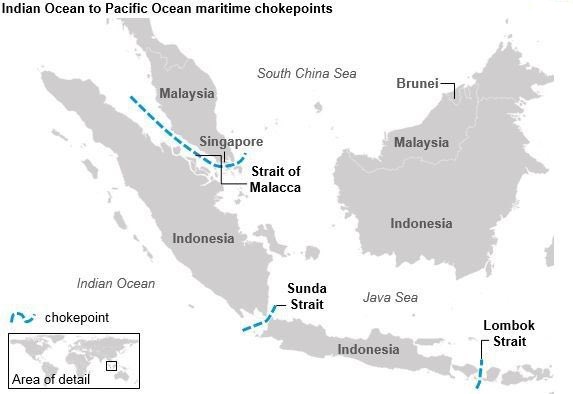
  • In news: Strait of Malacca

    Why in the News?

    Singapore’s PM has acknowledged India’s intent to join the Malacca Straits Patrol (currently undertaken by Malaysia, Indonesia, Thailand, and Singapore).

    In news: Strait of Malacca

    About Strait of Malacca:

    • Location: Narrow waterway in Southeast Asia, between the Malay Peninsula (northeast) and Sumatra, Indonesia (southwest).
    • Length & Width: Extends about 800–900 km; width varies from 65 km in the south to 250 km in the north.
    • Depth: The southern end is narrow and shallow, usually less than 37 m deep, posing navigational challenges.
    • Geological Setting: Part of the Sunda Shelf formation, created after post-glacial sea level rise around 2.6 million years ago.
    • Key Ports: Hosts major hubs like Singapore, Port Klang, Penang, and Melaka, making it one of the busiest shipping lanes globally.

    Strategic and Economic Importance:

    • Global Chokepoint: Links the Indian Ocean (Andaman Sea) with the Pacific Ocean (South China Sea), forming a vital maritime chokepoint.
    • Trade Corridor: The shortest sea route between the Middle East/Africa and East Asia, critical for global commerce.
    • Volume of Trade: Handles about 60% of world maritime trade, including large-scale oil shipments from the Middle East to China, Japan, and Southeast Asia.
    • Economic Impact: Any disruption could severely affect supply chains and energy security worldwide.
    • Geopolitical Significance: Attracts competing interests of India, China, the US, and ASEAN states, making it a hotspot for regional and global strategic rivalry.
    [UPSC 2010] Which one of the following can one come across if one travels through the Strait of Malacca ?

    Options: (a) Bali (b) Brunei (c) Java (d) Singapore*


  • Centre approves creation of ‘Environment Auditors’

    Why in the News?

    The Ministry of Environment, Forest and Climate Change (MoEFCC) has introduced the Environment Audit Rules, 2025, creating an independent class of Environment Auditors.

    Who are the Environment Auditors?

    • Overview: Independent, certified professionals comparable to Chartered Accountants, but for environmental compliance.
    • Accreditation: Certification and registration granted by the Environment Audit Designated Agency (EADA).
    • Responsibilities:
      • Ensure compliance across environmental domains.
      • Conduct project audits and assess performance.
      • Collect and analyze environmental samples.
      • Verify self-reported project data.
      • Check conformity with environmental clearances and consents.
      • Calculate environmental compensation in case of violations.
      • Support implementation of Green Credit Registry, Ecomark Certification, and Coastal Regulation Zone (CRZ) compliance.

    About Environment Audit Rules, 2025:

    • Introduced by: MoEFCC in August 2025.
    • Purpose: Establishes independent auditors to assist Central Pollution Control Board (CPCB), SPCBs, and Pollution Control Committees facing manpower/resource gaps.
    • Objectives:
      • Strengthen monitoring and compliance.
      • Enhance transparency, accountability, credibility.
      • Promote sustainable governance and stakeholder trust.
    • Scope of Audits: Covers compliance with Green Credit Rules, Ecomark Rules 2024, E-Waste Rules 2022, Plastic Waste Rules 2016, Battery Waste Rules 2022, Van (Sanrakshan Evam Samvardhan) Adhiniyam 1980, Wild Life Protection Act 1972 and related rules.
    • Institutional Features:
      • EADA certifies, registers, and monitors auditors.
      • Categories: Certified Environment Auditor (qualified) and Registered Environment Auditor (certified + authorised).
    • Certification Pathways:
      • Recognition of Prior Learning (RPL) for experienced professionals.
      • National Certification Examination (NCE) for new entrants.
    • Registration: Valid for 5 years, renewable on review; requires technical proof and clean track record.
    • Oversight: A Steering Committee (chaired by MoEFCC Additional Secretary) supervises; government retains powers to issue guidelines, resolve disputes, and order audits.
    [UPSC 2022] Which one of the following has been constituted under the Environment (Protection) Act, 1986 ?

    Options: (a) Central Water Commission (b) Central Ground Water Board (c) Central Ground Water Authority* (d) National Water Development Agency


  • What is Free Movement Regime (FMR)?

    Why in the News?

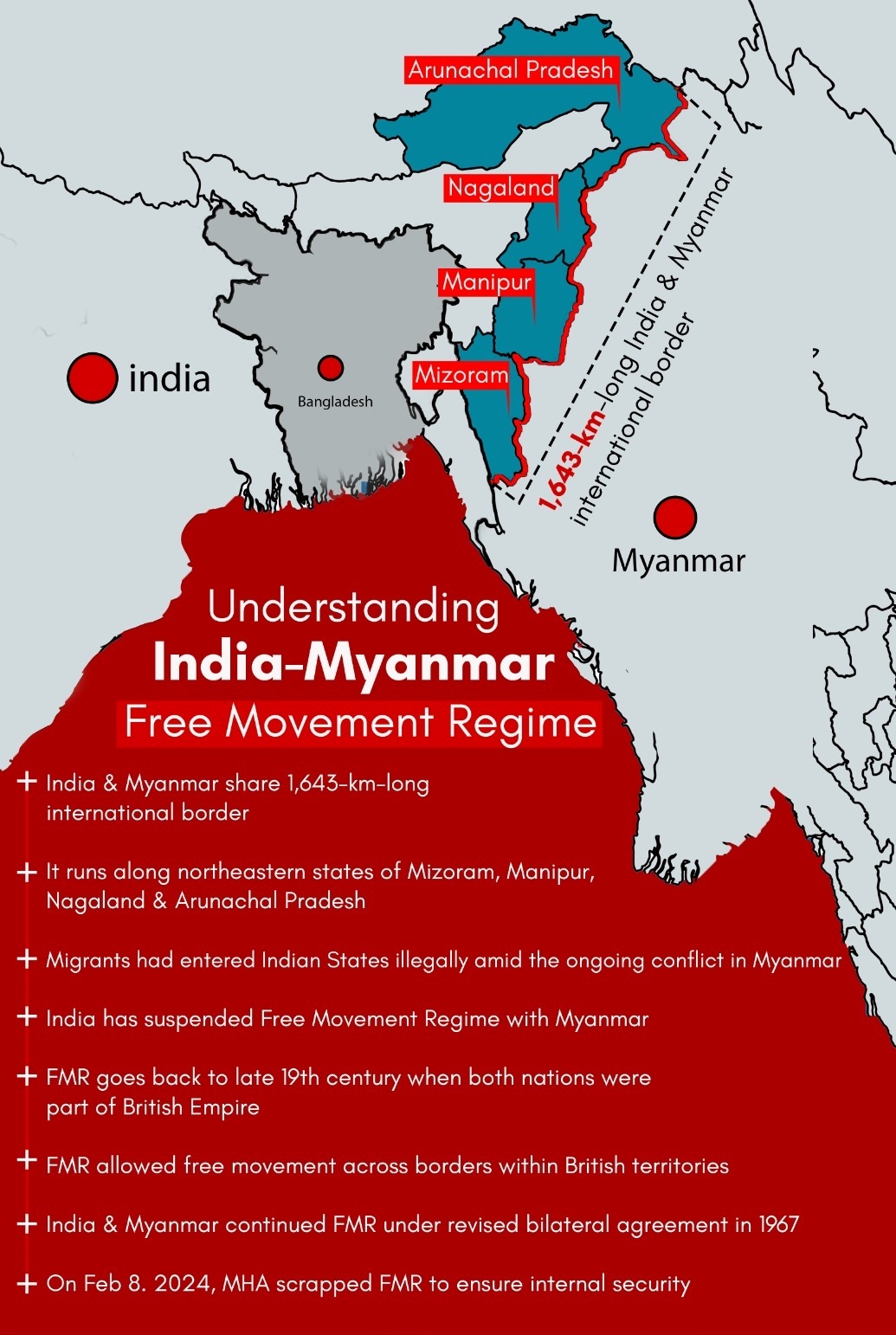
    Ahead of PM Modi’s Manipur visit, United Naga Council (UNC) has announced a trade embargo from against the India–Myanmar border fence and the suspension of the Free Movement Regime (FMR).

    What is Free Movement Regime (FMR)?

    About the Free Movement Regime (FMR):

    • Overview: Introduced in the 1970s, FMR allowed residents within 16 km of the India–Myanmar border to travel freely up to 16 km across without visa requirements.
    • Border length: India–Myanmar border stretches 1,643 km across four states: Arunachal Pradesh (520 km), Nagaland (215 km), Manipur (398 km), Mizoram (510 km).
    • Purpose: To recognize ethnic, cultural, and familial ties of communities (Kuki, Naga, Mizo, etc.) living across the unfenced border.
    • Revision: Last revised in 2016 under the Act East Policy.
    • Suspension: On February 8, 2024, MHA formally announced its scrapping, citing:
      • Internal security risks.
      • Illegal immigration and demographic changes in NE states.
      • Cross-border drug trafficking and insurgency links.

    Stakeholder Perspectives:

    • Kuki groups: View FMR suspension and fencing as an attack on shared ethnic ties, even comparing it to the Berlin Wall. Recently reached an understanding with MHA negotiators.
    • Naga groups (UNC): Strongly opposed to border fencing and FMR suspension, claiming it undermines homeland, land rights, and identity. Announced a trade embargo in protest.
    • Meiteis (Valley population): Support suspension, arguing that FMR facilitated illegal migration, illicit drug trade, and aggravated ethnic tensions.
    • Government of India: Defends suspension on security and demographic grounds, while attempting to balance peace talks with tribal groups.
    [UPSC 2016] Consider the following statements:

    I. Assam shares a border with Bhutan and Bangladesh

    II. West Bengal shares a border with Bhutan and Nepal

    III. Mizoram shares a border with Bangladesh and Myanmar

    Which of the statements given above are correct?

    Options: (a) I, II and III * (b) I and II only (c) II and III only (d) I and III only


  • Immigration and Foreigners (Exemption) Order, 2025

    Why in the News?

    The Ministry of Home Affairs (MHA) has issued the Immigration and Foreigners (Exemption) Order, 2025, notified under Section 33 of the Immigration and Foreigners Act, 2025.

    What is Immigration and Foreigners Act, 2025?

    • Enactment: Passed by Parliament, effective 1 Sept 2025.
    • Objective: Unifies scattered immigration laws into a single framework, balancing national security, demographic protection, humanitarian obligations, and economic openness.
    • Repeals: Passport (Entry into India) Act, 1920; Registration of Foreigners Act, 1939; Foreigners Act, 1946; Immigration (Carriers’ Liability) Act, 2000.
    • Key Provisions:
      • All foreigners must enter, stay, exit with valid passport & visa, unless exempted.
      • Digital system with biometrics, AI-based monitoring, and real-time agency coordination.
      • New visa categories: Skilled Talent, Startup, Investor, Digital Nomad, Business Plus.
      • Mandatory reporting by hotels, landlords, universities, hospitals on foreign guests/students/patients.
      • Entry to protected/restricted areas subject to special permits; mountaineering expeditions need prior approval.
    • Penalties: Up to 7 years imprisonment and ₹10 lakh fine for forged documents; detention centres allowed for illegal foreigners till deportation.
    • Institutions:
      • National Immigration Authority for policy and central database.
      • Bureau of Immigration, led by Commissioner, for operations.

    About Immigration and Foreigners (Exemption) Order, 2025:

    • Overview: Issued by Ministry of Home Affairs (MHA) on 1 Sept 2025 under Section 33 of the Immigration and Foreigners Act, 2025.
    • Objective: Consolidates earlier scattered exemptions to simplify rules, enable regional mobility with Nepal & Bhutan, extend humanitarian relief to refugees/persecuted minorities, and provide legal clarity to carriers.
    • Replaces: The Registration of Foreigners (Exemption) Order, 1957 and Immigration (Carriers’ Liability) Order, 2007.
    • Exemptions:
      • Indian Armed Forces members on duty and families using govt transport.
      • Indian citizens entering via Nepal/Bhutan borders.
      • Nepal & Bhutan citizens (except if entering from China, Hong Kong, Macau, Pakistan).
      • Tibetans registered with India, religious minorities from Afghanistan, Bangladesh, Pakistan (who entered before Dec 31, 2024), and Sri Lankan Tamils sheltered till Jan 9, 2015.
      • Diplomats, visa-on-arrival nationals, foreign military personnel on goodwill or exercises.
    • Carriers’ Liability: Rail, road, air, sea operators exempted where forged documents need expert verification or ships/aircraft are diverted.
    [UPSC 2021] With reference to India, consider the following statements:

    1.There is only one citizenship and one domicile.

    2.A citizen by birth only can become the Head of State.

    3.A foreigner, once granted citizenship, cannot be deprived of it under any circumstances.

    Which of the statements given above is/are correct?

    Options: (a) 1 only* (b) 2 only (c) 1 and 3 (d) 2 and 3