💥Join UPSC 2027,2028 Mentorship (July Batch) + XFactor Notes & Microthemes PDF

Distribution: yearly

  • MoSPI to integrate 8th Economic Census with 16th Population Census

    Why in the News?

    The Ministry of Statistics and Programme Implementation (MoSPI) is preparing for India’s 8th Economic Census by integrating it with the upcoming 16th Population Census.

    About the Economic Census:

    • Conducting Body: Ministry of Statistics and Programme Implementation (MoSPI).
    • Purpose: Creates a detailed database of non-agricultural economic establishments in India.
    • Key Data Captured: Covers location, clustering, ownership, employment size, and type of economic activity.
    • Unorganised Sector Inclusion: Includes informal units, vital for understanding employment dynamics.
    • Historical Background:
      • Economic Enquiry Committee: Proposed by Visvesvaraya Committee (1925); Setup by Bowley-Robertson Committee (1934).
      • Outcome: Led to the creation of the Central Statistical Office (CSO) in 1951 and national statistical systems.
      • First Census: Conducted in 1977 (excluding Lakshadweep), targeting non-agricultural units with at least one hired worker.
    • Timeline of Economic Censuses:
      • Years Conducted: 1980, 1990, 1998, 2005, 2013, and 2019–21 (7th Census).
      • Integration with Population Census: 2nd and 3rd rounds were aligned with the 1981 and 1991 Population Censuses.
      • 7th Census Status: Completed in 2021, but results pending due to COVID-related data quality issues.
      • Execution Support: MoSPI partnered with the CSC (Common Service Centre) network for grassroots-level implementation.

    Integration with the 16th Population Census:

    • Objective: Improve efficiency and reduce costs by leveraging shared field operations.
    • Data Collection: Enumerators will note household-based economic activity for MoSPI processing.
    • Census Schedule:
      • Oct 1, 2026: Snow-bound and remote regions (e.g., Ladakh, J&K, HP, Uttarakhand).
      • Mar 1, 2027: Rest of the country.
    • Preparatory Work: State and district committees have been formed to plan the 8th Census.
    [UPSC 2018] As per the NSSO 70th Round “Situation Assessment Survey of Agriculture Households”, consider the following statements:

    1.Rajasthan has the highest percentage share of agriculture households among its rural households.

    2.Out of the total households in the country, a little over 60 percent being to OBCs.

    3.In Kerala, a little over 60 percent of agriculture households reported to have received maximum income from sources other than agriculture activities.

    Which of the statements given above is/are correct?

    Options: (a) 2 and 3 only (b) 2 only (c) 1 and 3 only* (d) 1, 2 and 3


  • [pib] New Lichen Species reveals ancient Symbiosis

    Why in the News?

    A team of Indian scientists has discovered a new species of lichen, Allographa effusosoredica, in the Western Ghats, a global biodiversity hotspot.

    What are Lichens?

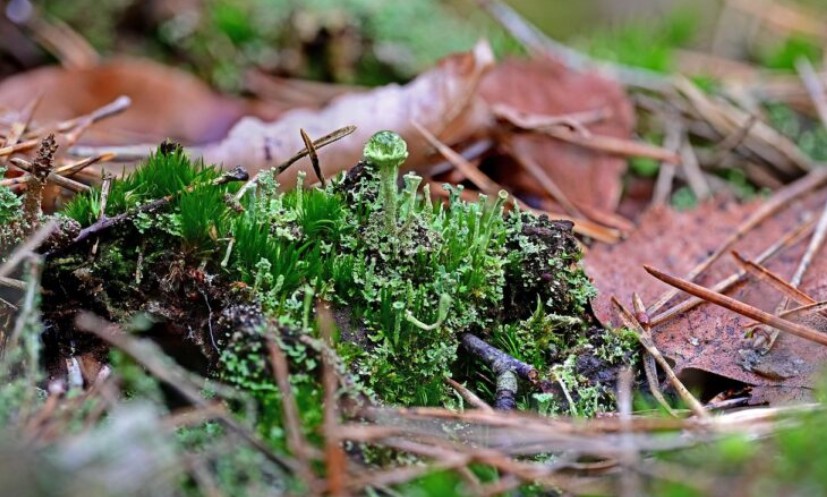
    lichen

    • Lichens are symbiotic organisms, composed of a fungus (mycobiont) and a photosynthetic partner (photobiont)—either a green alga or a cyanobacterium.
    • The fungus provides structure and protection, while the photobiont produces food through photosynthesis.
    • Lichens are key ecological contributors:
      • They build soil by breaking down rocks.
      • Serve as bioindicators of environmental and air quality.
      • Provide food for insects and small animals.
    • Despite being often overlooked, lichens are vital to ecosystem stability and resilience.

    About the Newly Discovered Lichen Species:

    • Discovery: Allographa effusosoredica was discovered in the Western Ghats by MACS-Agarkar Research Institute, Pune.
    • First of Its Kind: First Indian Allographa species confirmed using molecular data.
    • Biodiversity Addition: 53rd Allographa species in India; 22nd from the Western Ghats.
    • Funding Support: Research funded by Anusandhan National Research Foundation (ANRF) under a lichen symbiosis project.

    Key Features Revealed:

    • Morphology: Crustose body with effuse soredia; Contains norstictic acid—rare among related species.
    • Algal Partner: Photobiont identified as Trentepohlia, expanding understanding of tropical lichen symbiosis.
    • Molecular Markers: Analysis used fungal markers (mtSSU, LSU, RPB2) and algal marker (ITS).
    • Phylogenetic Placement: Closely related to Allographa xanthospora; visually similar to Graphis glaucescens.
    [UPSC 2014] Lichens, which are capable of initiating ecological succession even on a bare rock, are actually a symbiotic association of:

    Options: (a) algae and bacteria (b) algae and fungi* (c) bacteria and fungi (d) fungi and mosses


  • Successful trial of Akash Prime Air Defence System

    Why in the News?

    India successfully tested the Akash Prime Missile System in Ladakh, neutralizing two high-speed aerial targets at high altitude.

    About Akash Prime:

    • What It Is: Akash Prime is an upgraded version of the Akash Surface-to-Air Missile (SAM) system.
    • High-Altitude Capability: Designed to operate effectively above 4,500 metres.
    • Development: Developed by DRDO with BDL, BEL, and Army Air Defence.
    • Operational Use: Proven in Operation Sindoor against aerial threats.
    • Production Trials: Validated through First of Production Model (FoPM) firing trials.
    • Deployment: Already in use at IAF bases and forward posts along the LAC in Ladakh.

    Key Features:

    • Seeker Upgrade: Equipped with an indigenous active Radio Frequency (RF) seeker for better accuracy.
    • Altitude Adaptability: Engineered for high-altitude, cold-climate operations.
    • Multi-Target Engagement: Capable of engaging multiple aerial threats at once.
    • Speed & Accuracy: Travels at Mach 2.5 with up to 90% kill probability.
    • Electronic Warfare: Equipped with ECCM features to resist electronic jamming.
    • Radar Integration: Uses Rajendra radar for detection, targeting, and tracking.
    • Operational Range: Effective engagement range of 25–30 km.

    Other Variants of Akash:

    • Akash Mark-I (1990–2005): First version under IGMDP; achieved successful dual-target intercepts by 2005.
    • Akash-1S (2019): Enhanced version with 30 km range and 60 kg warhead; effective against aircraft and drones; tested successfully in May 2019.
    • Akash Prime (2021 onwards): Added active RF seeker and altitude/weather resistance; tested on September 27, 2021.
    • Akash-NG (Next Generation): Approved in 2016 with ₹470 crore funding; offers faster response and improved aerial threat protection.


    [UPSC 2009] In the context of Indian defence, consider the following statements:

    1. The Shourya missile flies with a speed of more than 8 Mach. 2. The range of Shourya missile is more than 1600 km. Which of the statements given above is/are correct ?

    Options: (a) 1 only (b) 2 only (c) Both 1 and 2 (d) Neither 1 nor 2*


  • IIST Scientists detected Circular Polarisation near massive Protostar

    Why in the News?

    Researchers at the Indian Institute of Space Science and Technology (IIST) has detected radio emissions with circular polarisation near a massive young protostar, IRAS 18162-2048.

    About Protostars:

    • Definition: Early-stage stars formed by the gravitational collapse of dense regions in molecular clouds.
    • Accretion Phase: They actively gather gas and dust but have not yet begun sustained nuclear fusion.
    • Jet Ejection: Bipolar jets—high-speed streams of particles—are commonly emitted from their poles.
    • Massive Protostars: Expected to evolve into stars with masses over 8–10 times that of the Sun.
    • Role of Magnetism: Magnetic fields likely influence both jet formation and ejection mechanisms.

    About the Protostar IRAS 18162-2048:

    • Overview: Situated about 4,500 light years away in the Milky Way.
    • Jet Feature: Powers the HH80-81 jet—one of the galaxy’s largest and brightest protostellar jets.
    • Magnetic Detection: First direct evidence of magnetic fields from the protostar itself, not just its jet.
    • Observation Challenges: Heavily shrouded in dense gas and dust, making traditional observation difficult.
    • Jet Dynamics: Suggests that magnetic fields and rotational energy drive its development.

    Recent Observations:

    • Detection Method: Observed circular polarisation in radio waves—where electromagnetic fields rotate along their path.
    • Rarity: Circular polarisation is extremely faint and seldom detected, even in intense sources like active galactic nuclei.
    • Scientific Milestone: First-ever estimation of magnetic field strength near a massive protostar using circular polarisation.
    • Magnetic Field Strength: Estimated to be 100 times stronger than Earth’s magnetic field.
    • Theoretical Support: Findings reinforce the theory that magnetic fields power jets from both stars and black holes.
    [UPSC 2023] Consider the following pairs:

    Objects in space :: Description

    1. Cepheids : Giant clouds of dust and gas in space

    2. Nebulae : Stars which brighten and dim periodically

    3. Pulsars : Neutron stars that are formed when massive stars run out of fuel and collapse How many of the above pairs are correctly matched?

    Options: (a) Only one* (b) Only two (c) All three (d) None


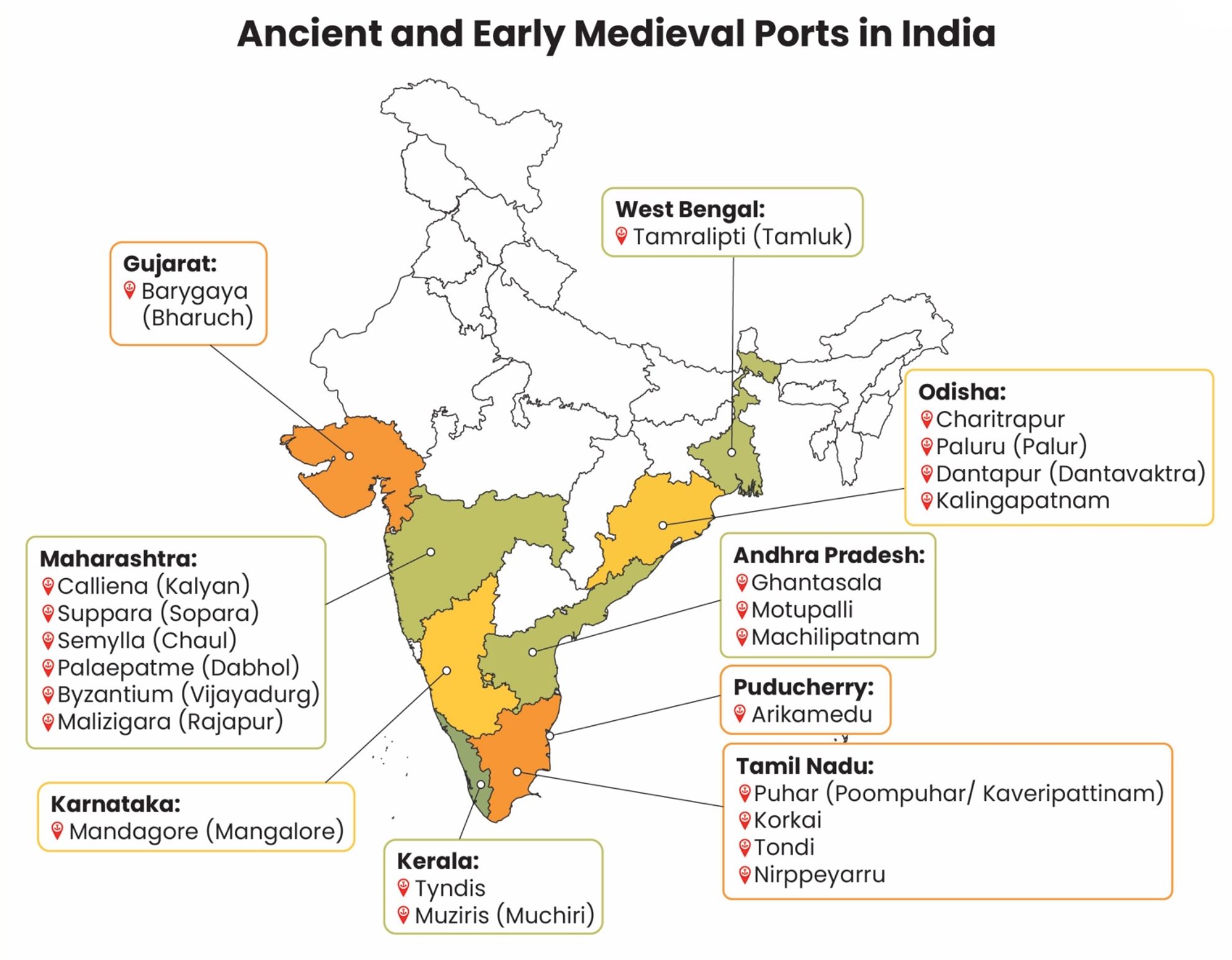
  • Machilipatnam as Ancient Port is set for big Revival

    Why in the News?

    Machilipatnam, once a flourishing ancient port city on India’s east coast, is witnessing a major transformation with the construction of a modern Greenfield port.

    Machilipatnam as Ancient Port is set for big Revival

    About Machilipatnam:

    • Alternate Names: Also known as Masulipatnam, Maisolia, or Manjarika.
    • Geographic Location: Located in Krishna district, Andhra Pradesh, on the southeastern Coromandel Coast, at the mouth of River Krishna, ~70 km east of Amaravati.
    • Historical Importance:
      • One of the most significant east coast port cities for ~1,700 years.
      • Played a key role in maritime trade across ancient, medieval, and early modern periods.
    • Global Trade Connections:
      • Attracted traders from Rome, Arabia, Persia, Southeast Asia, and Europe.
      • Known for exporting high-quality Muslin textiles prized in Roman markets.
      • The term “muslin” likely derives from “Maisolia,” an ancient name of the city.
    • Cultural Contributions:
      • Known for Kalamkari art, a traditional textile art featuring hand-painted or block-printed designs.
    • Dynastic Port Usage:
      • Satavahanas (1st BCE – 2nd CE): Used as a major trade gateway.
      • Vishnukundins (4th–6th CE): Trade wealth supported Buddhist monument construction (e.g., Nagarjunakonda).
      • Qutb Shahis (16th–17th CE): Transformed it into a global hub for diamonds, muslin, and Kalamkari.
      • Nizams of Hyderabad (18th century): Controlled the port until partial cession to the British.
    • Mentions in Ancient Texts:
      • Appears as Maisolia in Periplus of the Erythraean Sea.
      • Listed as Maisolos in Ptolemy’s Geographia.
    • Colonial Involvement:
      • Dutch built a fort in the 17th century.
      • British East India Company established its first Bay of Bengal factory here in 1611.
      • Between 1686–1759, it changed hands among French, Dutch, and British; seized by British from the French in 1759.
    • Decline of the Port:
      • Anchorage Issue: Unsuitable for large ships, with anchorage 5 miles offshore.
      • Cyclone Damage: A severe cyclone in 1779 killed ~20,000 and destroyed Dutch structures.
      • Trade Shift: Decline due to growing prominence of Madras (Chennai) and Visakhapatnam under British rule.
    • Post-Independence Claim:
      • In 1947, 7th Nizam of Hyderabad attempted to reclaim it for sea access to an independent Hyderabad state.
    • Modern Revival:
      • A Greenfield port at Manginapudi is under construction, expected to be operational by 2026.
      • Aims to restore Machilipatnam’s historical maritime legacy.
    [UPSC 2023] With reference to ancient South India, Korkai, Poompuhar and Muchiri were well known as:

    (a) capital cities (b) ports* (c) centres of iron and steel making (d) shrines of Jain Tirthankaras


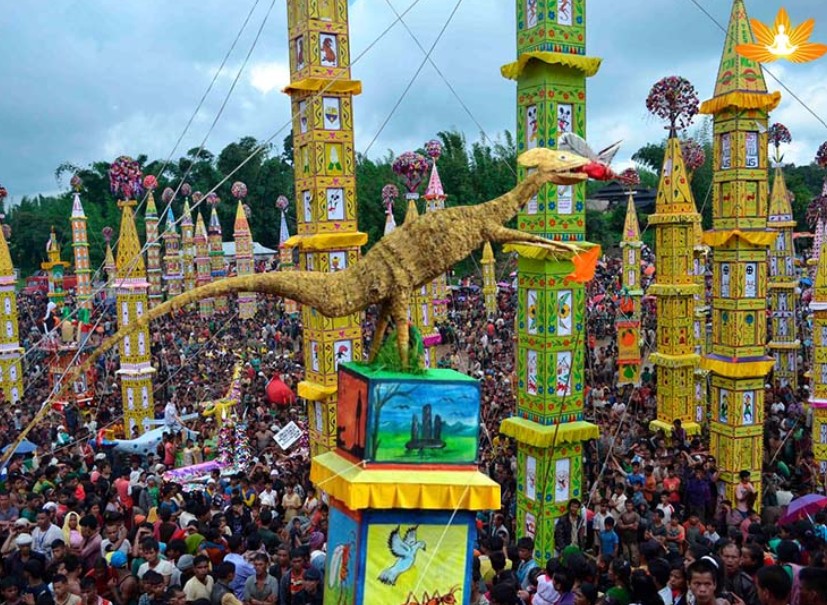
  • Behdeinkhlam Festival celebrated in Meghalaya

    Why in the News?

    The Behdienkhlam Festival of Pnar (Jaintia) community in Meghalaya was recently celebrated.

    Behdeinkhlam Festival celebrated in Meghalaya

    About Behdienkhlam Festival:

    • Cultural Role: Major religious and cultural festival of the Pnar (Jaintia) community in Meghalaya.
    • Location: Four-day festival held in Jowai, West Jaintia Hills.
    • Meaning: Means driving away the plague or evil.
    • Timing: Celebrated in mid-July after sowing season.
    • Purpose: Prayers for a good harvest and community cleansing.
    • Faith: Observed mainly by followers of the Niamtre religion.
    • Women’s Role: Women offer food to ancestors but do not dance in rituals.

    Key Features:

    • Rituals: Dolois perform rites to drive away disease and evil.
    • Symbolic Act: Youth beat rooftops with bamboo sticks to expel evil.
    • Rots: 30–40 ft decorated bamboo structures with social themes.
    • Khnong Ritual: Teams pull a large wooden beam and immerse it in mud.
    • Dad-Lawakor: Traditional football-like game predicting harvest success.
    • Celebrations: Mass dancing at Wah Aitnar pool with drums and pipes.
    [UPSC 2012] Chapchar Kut is a festival celebrated in the state of:

    Options: (a) Arunachal Pradesh (b) Assam (c) Mizoram* (d) Sikkim


  • [17th July 2025] The Hindu Op-ed: A tectonic shift in thinking to build seismic resilience

    PYQ Relevance:

    [UPSC 2015] Earthquakes along the plate margins are still a cause of concern. India’s preparedness for mitigating their impact has significant gaps. Discuss various aspects.

    Linkage: The article emphasizes that India’s seismic risk is rooted in the northward drift of the Indian Plate colliding with the Eurasian Plate, which shaped the Himalayas and makes the region “overdue for a ‘Great Himalayan Earthquake’.  The question specifically mentions “earthquakes along the plate margins” and critically highlights “India’s preparedness for mitigating their impact has significant gaps.


    Mentor’s Comment:  The 4.4 magnitude tremor in Delhi on July 10, 2025, though moderate, exposed the critical fragility of India’s infrastructure, especially in Delhi, where over 80% of buildings violate seismic safety norms. This event is part of a wider pattern of seismic activity across Asia, underlining the urgent need for earthquake preparedness. India, particularly northern and northeastern regions, lies in high-risk seismic zones (IV & V) due to the collision of tectonic plates, making a massive quake imminent. Urbanisation, outdated construction, and poor enforcement of seismic codes like IS 1893:2016 worsen the risk.

    Today’s editorial analyses the vulnerability to earthquakes in India. This topic is important for GS Paper I (Geography) and  GS Paper III (Disaster Management) in the UPSC mains exam.

    _

    Let’s learn!

    Why in the News?

    On July 10, 2025, a 4.4 magnitude earthquake struck near Delhi, exposing the fragile state of infrastructure.

    Why is Delhi vulnerable to earthquakes?

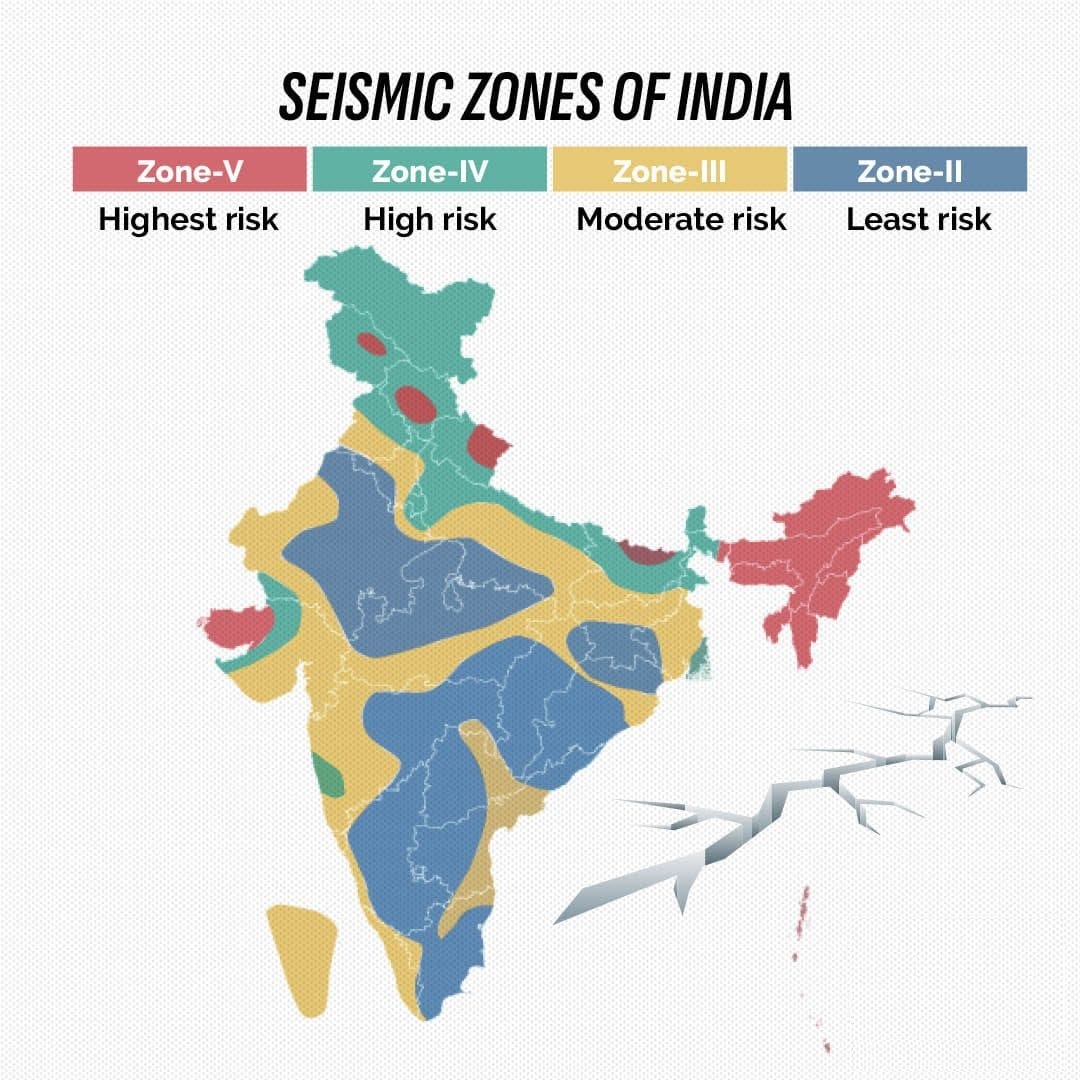
    • High Seismic Risk Zone: Delhi lies in Seismic Zone IV, indicating a severe seismic hazard with a peak ground acceleration (PGA) of around 0.24g. Eg: Similar Zone IV cities like Srinagar and Patna have experienced strong tremors in the past.
    • Poor Structural Compliance: Over 80% of buildings in Delhi, especially those constructed before 2000, do not comply with seismic safety codes. Eg: Unregulated high-rise apartments in East Delhi lack ductile detailing or shear walls, making them prone to collapse.
    • Liquefaction-Prone Areas: Areas like East Delhi and Yamuna floodplains are built on soft alluvial soils, which are susceptible to liquefaction during earthquakes. Eg: In the 2001 Bhuj earthquake, structures on soft soil experienced severe tilting and collapse.
    • Rapid Urbanisation Without Planning: Delhi’s urban sprawl and dense population (over 33 million) have led to haphazard construction, often violating zoning and structural norms. Eg: Many illegal colonies like those in outer Delhi lack any seismic design considerations.

    What are the vulnerable areas in India? 

    • Himalayan Region: The Himalayan belt is highly prone to earthquakes due to the collision of the Indian and Eurasian tectonic plates. Eg: Regions like Jammu & Kashmir, Himachal Pradesh, Uttarakhand, and parts of Northeast India fall under Seismic Zone V.
    • Indo-Gangetic Plain: This region experiences significant seismic activity due to the tectonic stress transfer from the Himalayan region. Eg: Parts of Bihar, Uttar Pradesh, Delhi, and West Bengal lie in Seismic Zones III and IV.
    • Peninsular India Fault Zones: Though considered geologically stable, intraplate faults in Peninsular India can still trigger strong earthquakes. Eg: Areas like Latur (Maharashtra), Koyna (Maharashtra), and Bhuj (Gujarat) have witnessed major quakes in the past.
    What are the steps taken by the Indian Government? 

    • Building Code Reforms: The government enforces Earthquake-Resistant Building Codes to ensure structural safety in seismic zones. Eg: The Bureau of Indian Standards (BIS) revised IS 1893 and IS 4326 to include updated seismic design norms across construction sectors.
    • National Seismic Zoning: India has been zoned into seismic risk areas to guide planning and construction based on earthquake vulnerability. Eg: The country is divided into Zone II to Zone V, with Zone V (like parts of Uttarakhand, Kashmir) being most earthquake-prone.
    • Disaster Management Framework: The government has established a dedicated institutional framework to coordinate disaster preparedness and response. Eg: The National Disaster Management Authority (NDMA) issues guidelines for earthquake risk mitigation and conducts regular mock drills and capacity-building programs.

    What are the steps taken at the international level?

    • Sendai Framework for Disaster Risk Reduction (2015–2030): The United Nations adopted this global framework to strengthen disaster preparedness, promote resilient infrastructure, and reduce disaster losses. Eg: Countries like Japan and Chile have aligned their national disaster policies with Sendai priorities, emphasizing risk governance and early warning.
    • Global Seismic Hazard Assessment Program (GSHAP): Led by the International Lithosphere Program, this initiative provides seismic hazard maps to help countries plan safer infrastructure. Eg: Italy and other European nations use GSHAP data to revise building codes and zoning laws in earthquake-prone zones.
    • Early Warning Systems and Technology Sharing: Countries are collaborating to develop earthquake early warning systems and share real-time seismic data across borders. Eg: The Pacific Tsunami Warning Center and Japan’s Earthquake Early Warning System help neighbouring nations prepare faster for seismic events.

    What global lessons can India adopt from other countries? (Way forward)

    • Building Code Enforcement: Strong and regularly updated building codes ensure that infrastructure can withstand seismic shocks, reducing casualties and damage. Eg: After the 1995 Kobe earthquake, Japan revised its seismic building codes, which helped limit destruction during the 2011 Tōhoku earthquake.
    • Early Warning Systems: Timely alerts enable people to take quick protective actions, such as evacuation or shutting down utilities, before the shaking begins. Eg: In 2017, Mexico City’s SASMEX system gave a 20-second alert before the quake struck, allowing residents to prepare.
    • Retrofitting Incentives: Providing financial support for retrofitting older buildings motivates citizens to strengthen structures against earthquakes. Eg: The Earthquake Brace + Bolt program in California offers funds to homeowners, promoting structural safety in vulnerable areas.
  • Share of Clean Energy in Electricity still below 30%

    Why in the News?

    Recently, India has achieved 50% of its installed power capacity from non-fossil sources, five years ahead of its Paris Agreement target. However, clean energy contributes under 30% of actual electricity supply due to low capacity utilisation rates.

    Why is clean energy generation lower than installed capacity?

    • Low Capacity Utilisation Factor (CUF): Clean energy sources operate at lower efficiency. For example, solar power has a CUF of ~20% and wind ~25–30%, while coal operates at ~60% CUF and nuclear at ~80%. Eg: As of June 2025, India’s installed non-fossil fuel capacity was 50% of 484 GW, but the actual electricity supplied from clean sources was only 28% of the total.
    • Intermittent Generation and Time Dependence: Renewable energy depends on natural conditions — solar is only available during daylight hours, and wind is seasonal. Eg: In 2014-15, clean energy contributed 17% to total generation; despite reaching 50% installed capacity by 2025, generation rose only to 28%, reflecting the limitations of time-bound output.
    • Lack of Energy Storage and Grid Flexibility: India lacks sufficient battery storage and smart grid infrastructure to store and distribute excess renewable energy. Eg: During daytime in summer, solar plants reduce coal dependence, but in the evening, coal still supplies 75% of the energy mix, due to the absence of stored solar power.

    How does coal still dominate India’s energy mix?

    • High Reliability and Base Load Supply: Coal provides consistent, round-the-clock electricity, making it ideal for base load demand that must be met continuously. Eg: Thermal power plants in Chhattisgarh and Jharkhand run 24/7 to supply power to industrial zones in eastern India.
    • Established Infrastructure: India has a vast network of coal-based plants, railways for coal transport, and supply chains, making coal a readily usable resource. Eg: The Singrauli region in Madhya Pradesh has integrated coal mines and thermal plants that supply electricity to multiple states.
    • Lower Initial Costs for Generation: Coal-based plants are already built and operational, allowing them to generate electricity at a lower short-term marginal cost than new renewable setups. Eg: NTPC’s older thermal plants continue operating profitably with sunk capital costs.
    • Policy and Economic Dependence: Coal is a major contributor to government revenue and employment, especially in coal-rich states like Odisha and Jharkhand. Eg: The Mahanadi Coalfields Limited (MCL) contributes significantly to Odisha’s economy and supports thousands of livelihoods.

    What can improve renewable energy reliability?

    • Expansion of Renewable Energy Targets: India set a target of achieving 500 GW of non-fossil fuel capacity by 2030, in line with its Nationally Determined Contributions (NDCs) under the Paris Agreement.
    • Promotion of Solar Energy (PM-KUSUM & Rooftop Solar): Schemes like PM-KUSUM promote solar pumps for agriculture, while the Rooftop Solar Programme aims to increase solar adoption in residential and commercial sectors.
    • Green Energy Corridor Development: The government is investing in Green Energy Corridors to enable the smooth transmission of renewable power from generation points to demand centres. Eg Under Green Energy Corridor Phase-I, over 9700 circuit km of transmission lines and 220 substations were planned.
    • Production-Linked Incentive (PLI) Scheme for Solar Manufacturing: Under the PLI scheme, the government provides financial incentives to boost domestic manufacturing of solar PV modules, reducing import dependence.
    • Push for Energy Storage and Hybrid Projects: Promotion of battery storage, pumped hydro projects, and hybrid renewable energy parks (solar + wind + storage) to ensure round-the-clock clean energy supply.

    Case studies: 

    • Germany – Battery Storage and Smart Grids: Germany has invested heavily in battery storage systems and smart grid technology under its Energiewende (energy transition) policy. This enables better integration of solar and wind energy, helping maintain grid stability even during peak renewable generation hours.
    • Australia – Hybrid and Community-Based Renewable Projects: Australia has developed hybrid power plants that combine solar, wind, and battery storage (e.g., the Hornsdale Power Reserve in South Australia). It also supports community-led microgrids, improving reliability in remote areas with limited access to conventional grids.

    What can improve renewable energy reliability?

    • Energy Storage Systems: Deploying large-scale battery storage and pumped hydro storage can store surplus energy from solar and wind sources and release it during periods of high demand or low generation.
    • Smart Grid Infrastructure: Implementing smart grids enables real-time demand-supply balancing, better integration of variable renewables, and supports differential pricing to shift demand to renewable-rich hours.
    • Hybrid Renewable Projects: Promoting hybrid systems that combine solar, wind, and storage ensures more consistent power output by compensating for the variability of individual sources.

    Mains PYQ:

    [UPSC 2022] How much of India’s energy requirements are met by renewable energy by 2030 ? Justify your answer. How will the shift of subsidies from fossil fuels to renewables help achieve the above objective? Explain.

    Linkage: The article talks about the India has achieved a significant milestone with 50% of its total electric power capacity sourced from non-fossil fuels (solar, wind, biomass, hydro, and nuclear power), the actual share of clean energy in the electricity supplied is below 30%. This question directly related to the India’s energy requirements are met by renewable energy.

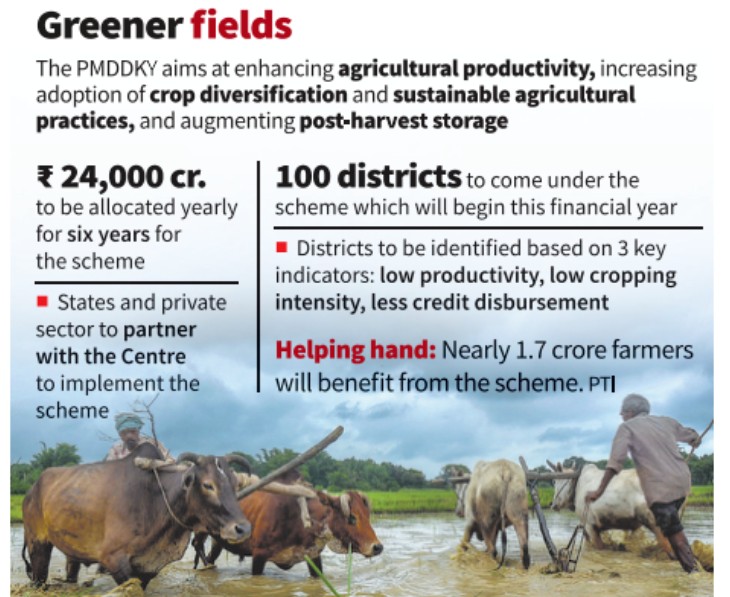
  • Prime Minister Dhan-Dhaanya Krishi Yojana

    Why in the News?

    The Union Cabinet has approved the Prime Minister Dhan-Dhaanya Krishi Yojana (PMDDKY), aimed at enhancing agricultural productivity, promoting sustainable practices, and improving rural livelihoods.

    Prime Minister Dhan-Dhaanya Krishi Yojana

    About Prime Minister Dhan-Dhaanya Krishi Yojana (PMDDKY)

    • Objective: Aims to transform agriculture in 100 low-performing districts by addressing productivity gaps.
    • Inspiration: Modelled on NITI Aayog’s Aspirational Districts Programme; first scheme focused solely on agriculture and allied sectors.
    • Launch: Announced in Union Budget 2025–26 and approved by the Union Cabinet chaired by PM Narendra Modi.
    • Approach: Driven by convergence of schemes, collaboration across stakeholders, and healthy competition among districts.

    Key Features:

    • Scheme Integration: Merges 36 schemes from 11 ministries into one unified framework.
    • Budget & Duration: ₹24,000 crore annual outlay for six years (starting 2025–26).
    • District Selection:
      • 100 districts with low productivity, cropping intensity, and credit access
      • At least one district from each state/UT
    • Focus Areas:
      • Boosting productivity
      • Promoting crop diversification and sustainability
      • Improving irrigation and water efficiency
      • Expanding post-harvest storage
      • Enhancing credit access
    • Performance Monitoring: Monthly ranking on 117 Key Performance Indicators (KPI) via centralized dashboard.
    • Support Mechanism: NITI Aayog to provide capacity-building and reviews.
    • Expert Note: Credit-based selection criteria may require refinement.

    Implementation:

    • District Planning: Each district to prepare an Agriculture and Allied Activities Plan.
    • Plan Approval: Handled by District Dhan Dhaanya Samiti, chaired by the Collector and including progressive farmers.
    • National Alignment:
      • Agricultural self-sufficiency
      • Soil and water conservation
      • Promotion of organic/natural farming
    • Governance: Committees at district, state, and national levels to guide execution.
    • Monitoring: Central Nodal Officers (CNOs) to conduct field visits and track progress.
    • Technical Support: Agricultural universities to serve as knowledge partners.
    • Expected Outcomes: Boost farm income, create local livelihoods, and support Atmanirbhar Bharat through enhanced agri-productivity.
    [UPSC 2020] Under the Kisan Credit Card scheme, short-term credit support is given to farmers for which of the following purposes?

    1. Working capital for maintenance of farm assets

    2. Purchase of combine harvesters, tractors and mini truck

    3. Consumption requirements of farm households

    4. Post-harvest expenses

    5. Construction of family house and setting up of village cold storage facility

    Select the correct answer using the code given below:

    (a) 1, 2 and 5 only (b) 1, 3 and 4 only* (c) 2, 3, 4 and 5 only (d) 1, 2, 3, 4 and 5


  • GW231123: Biggest Black Hole Merger Detected

    Why in the News?

    Researchers have reported the detection of an exceptionally massive black hole merger, labelled GW231123.

    GW231123: Biggest Black Hole Merger Detected

    About Black Holes and Black Hole Merger:

    • Overview: Black holes are extremely dense celestial objects whose gravitational pull is so strong that even light cannot escape.
    • Types of Black Holes:
      1. Stellar-mass: Around 20 times the mass of the Sun or more.
      2. Intermediate-mass: Between 100 and 100,000 times the mass of the Sun.
      3. Supermassive: From 100,000 to several billion times the mass of the Sun.
    • Black Hole Merger:
      • Occurs when two black holes orbit each other, lose energy via gravitational waves, and merge into a larger black hole.
      • The GW231123 event involved black holes of approximately 140 and 100 solar masses, forming a final black hole of 225 solar masses — the largest detected through gravitational waves.
      • Scientists suggest such massive black holes may form via hierarchical mergers (successive black hole mergers).
      • Supports theories on the formation of supermassive black holes, often found at galactic centers.

    Recent Observations:

    • Event Timing: The GW231123 event was detected on November 23, 2023, though it occurred billions of years ago.
    • Signal Characteristics:
      • Lasted only a tenth of a second but matched Einstein’s predictions under General Relativity.
      • Both black holes were rapidly spinning, hinting at a complex formation history.
    • Scientific Significance:
      • Involved intermediate-mass black holes, rarely observed in nature.
      • Challenges existing models of black hole formation via stellar collapse.
      • Indicates the presence of black holes in the so-called “forbidden mass gap”.
    • Conference Presentation:
      • Findings to be presented at the 24th International Conference on General Relativity and Gravitation (GR24) and the 16th Edoardo Amaldi Conference on Gravitational Waves, held in Glasgow, UK (July 14–18, 2025).
    • Broader Implications:
      • Opens new questions about the origin of massive black holes.
      • Offers insights into gravitational physics, cosmology, astrophysics, and potentially particle physics or cosmic string theory.
      • Model refinements are ongoing to better understand such extreme cosmic phenomena.

    Gravitational Wave Detection Network:

    • Nature of Gravitational Waves: Invisible ripples in spacetime caused by cataclysmic cosmic events like black hole collisions; predicted by Einstein in 1916.
    • Global Detection Network (LIGO–Virgo–KAGRA):
      • Laser Interferometer Gravitational-Wave Observatory (LIGO):
        • Operates two detectors in the United States (in the states of Louisiana and Washington).
        • First detected gravitational waves in 2015, leading to a Nobel Prize in Physics in 2017.
      • Virgo Observatory: Located near Pisa, Italy and operated by the European Gravitational Observatory.
      • Kamioka Gravitational Wave Detector (KAGRA): Located underground in the Kamioka mine, Japan, and notable for its cryogenic mirror technology.
    • LIGO-India:
      • Under construction in Hingoli, Maharashtra in partnership with the US National Science Foundation.
      • Involves scientists from 17 Indian institutions.
    [UPSC 2019] Recently, scientists observed the merger of giant ‘blackholes’ billions of light-years away from the Earth.

    What is the significance of this observation?

    Options: (a) Higgs boson particles’ were detected. (b) Gravitational waves’ were detected * (c) Possibility of inter-galactic space travel through ‘wormhole’ was confirmed. (d) It enabled the scientists to understand ‘singularity’.