As of 2024–25, India’s “invisibles” trade—comprising services exports and private money transfers—has not only surpassed its merchandise exports but also emerged as a key stabiliser of the current account deficit.
What are Invisible Exports (in India’s context)?
What is it: Invisible exports refer to international trade in services and income flows that do not involve physical goods crossing borders. These transactions are digital or financial, rather than visible at ports or airports.
Types of Services Included: They comprise a wide range of service-based exports such as IT services, financial consulting, legal and accounting services, R&D, and BPO operations.
Inclusion of Remittances: Private remittances—money sent home by Indians working abroad—are counted as part of invisibles in India’s Balance of Payments (BoP).
BoP Classification: These transactions are recorded under the “Current Account” of the BoP, specifically in the sub-categories of services, primary income, and secondary income.
Characteristics: Unlike physical exports, invisible exports do not require shipping, face fewer trade barriers, and rely heavily on skilled human capital.
Leading Examples: India’s key invisible exports include software and IT-enabled services (by firms like Infosys, TCS, Wipro), Global Capability Centers, financial and legal services, and education, tourism, and medical services.
Role of Migrant Remittances: Remittances from NRIs and migrant workers play a crucial role and are one of the largest components of India’s invisible receipts.
Their Contribution in Trade
Higher Value than Goods Exports: In 2024–25, India’s gross invisible receipts reached $576.5 billion, surpassing merchandise exports of $441.8 billion. Services alone brought in $387.5 billion, a major leap from $26.9 billion in 2003–04, while remittances added $135.4 billion.
Buffer Against Trade Deficits: While the merchandise trade deficit stood at $287.2 billion, a net invisible surplus of $263.8 billion helped reduce the overall current account deficit to just $23.4 billion, providing crucial stability.
Resilience Across Global Crises: Invisible exports remained strong during major disruptions like the 2008 financial crisis, COVID-19 pandemic, and ongoing geopolitical tensions, showcasing greater resilience than merchandise trade.
Human Capital-Driven Growth: Services exports are powered by India’s skilled workforce, not physical infrastructure. India thrives as the “office of the world”, moving beyond the traditional “back office” label.
Less Policy Dependence: Growth in invisible exports occurred largely without heavy government incentives or trade agreements. India still lacks strong service-sector provisions in its major trade deals.
[UPSC 2006] Assertion (A): Balance of Payments represents a better picture of a country’s economic transactions with the rest of the world than the Balance of Trade.
Reason (R): Balance of Payments takes into account the exchange of both visible and invisible items whereas Balance of Trade does not.
Options: (a) Both A and R are individually true and R is the correct explanation of A ** (b) Both A and R are individually true and R is not the correct explanation of A (c) A is true but R is false (d) A is false but R is true
We’re overjoyed to announce the launch of the Samachar Manthan Batch 2 for IAS 2021 – our flagship program for Current Affairs. It will start from 27th September 2020.
What is Samachar Manthan?
Samachar Manthan is our flagship program designed to help you develop a solid command on your newspaper reading and current affairs analyzing skills. We are also going to focus on imparting skills required to utilize current affairs. Since it builds your core, it is important for both Prelims and Mains. (sample lecture below)
Our unique four-stage methodology helps ensure maximum retention and rock-solid preparation. Each component has been meticulously crafted which repeated every week creates a virtuous cycle.
Diversified and Comprehensive coverage
We let news develop over a week, and a team under Sajal Sir daily covers it from various sources which include newspapers (The Hindu, The Indian Express, LiveMint, etc.), magazines (Yojana, Kurukshetra, EPW, Down to Earth), important websites (PIB, PRS, govt ministries, IDSA, etc.).
UPSC is a generalist exam. It’s important to cover more issues than to cover a few, in more depth. Samachar Manthan ensures that fine balance of comprehensive news coverage and detailed discussion on the most important topics.
Videos and Notes
Carefully selected relevant news is analyzed and delivered in a weekly lecture spanning over 3 hours.
You will be getting high quality, well-designed notes. They are detailed with proper categorization of news into the Mains and Prelims category.
Our focus is on conceptual clarity, simplicity, relevance, and making interlinkages between current affairs and basic/static part of the syllabus.
Samachar Manthan will also help you understand how to utilize current affairs in all your Prelims and Mains papers. A part of which is done by tests.
Weekly Mains Test and Evaluation
Because learning is not enough, you must apply. Every week a 10 question UPSC level current affairs test follows with video and notes. The focus here is on Mains answer writing skills and practice.
It’s a skill that is learned, honed, and perfected gradually. And this is why it should be done regularly. Our team of subject experts evaluate your answers and provide you with feedback. Answer enhancement is one of the objectives of this exercise.
This was a feedback that we had received from our students. Now every month we provide a Current Affairs prelims test package.
All this completes a study loop and enhances your retention.
Civilsdaily Handholding
You’ll be assigned to a special group on Civilsdaily’s Habitat, it’s headed by Sajal Sir, Atul Sir, Ravi Sir and rankers like Dr Vipin Garg (AIR 20), Swapnil Pawar (AIR 525) and others.
Habitat is where everything comes together learning, doubt clearing, notes, references, mentors, and a focussed community. You’re going to learn and discuss like never before.
How will your queries be resolved?
The moment you have a query, you post it in the group. At 11PM, 3AM, doesn’t matter. No need to schedule a call, or drop an email. Just drop a chat. Once our team is up, it will be resolved.
More often than not, your peers will take part in your doubt discussions adding a lot of value.
Besides doubts, what else is there on Habitat?
#DDS sessions – We have dedicated sessions every day to resolve doubts in real-time. Never keep a doubt to yourself.
An ecosystem for co-learning and active learning.
A highly motivated community to bring flexibility and consistency to your preparation.
That’s not all, we’ve Daily news analysis and Op-ed discussion sessions on Habitat. Other activities like revisions, quizzes, test discussion, CSAT, etc. are also planned.
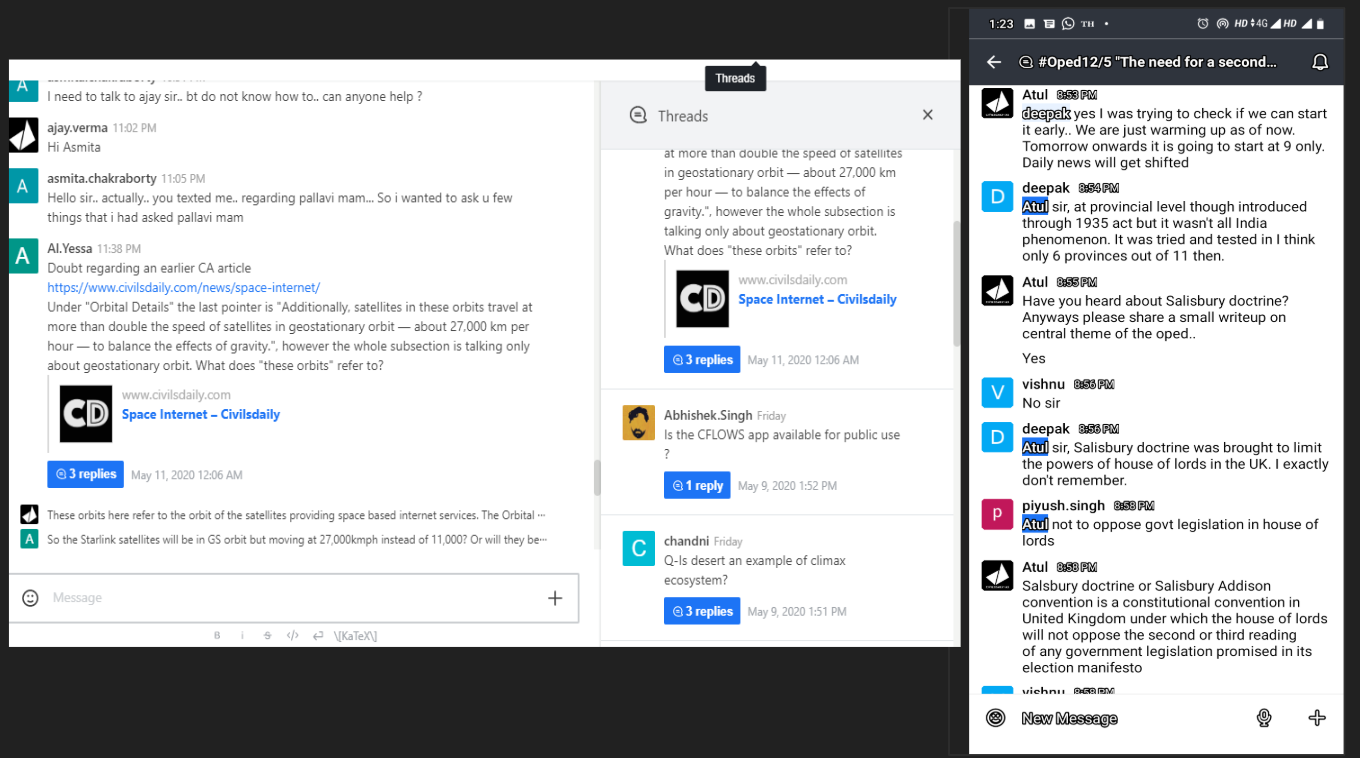
Civilsdaily’s Habitat – Desktop and Mobile view
Program inclusion
1. Weekly 3+ hours video lecture
2. High-quality Notes and reference material
3. Admission to Samachar Manthan special group on Habitat
4. Weekly Current Affairs based Mains Test (10 Questions) and Evaluation
5. Current Affairs Monthly Prelims Test package
How to cover Samachar Manthan Week 1-16?
Since you will be getting Samachar Manthan Week 1-16 (From June till date), we need to cover them as well. Starting this week you will need to cover two per week. For e.g. Week 1 and Week 16 this from Monday, Week 2 and Week 17 from the following week and like that.
Going in this manner your backlog will be over and you will be on track. We are always available for you to discuss this.
This is what our students have to say about Samachar Manthan and Sajal Sir.
There is no doubt that Current Affairs is an important part of IAS exam preparation. But it should be done in a planned and strategic manner where every action of yours is objectively defined and results, measurable.
Should you have any doubt or query reach out to us at hello@civilsdaily.com or call us at +91 8929987787.
The clock is ticking, the hours are going by. Some good 30 days are left for the UPSC Prelims, all your hardwork is going to be tested in a short span of just 2 hours.. It is the time to make utmost use of these days very effectively, focus more on execution rather than thinking “exam hoga, nii hoga”, as it is said “When the going gets tough, the tough get going”. We understand your concern in these uncertain times and that’s why to ease your preparation and to streamline it further, we’ve come up with another initiative i.e NIKALO PRELIMS 2.0 on our Habitat.
Focus of the Initiative:
Revision and intense interlinkage for extended understanding rather than mere expansion. Not taking something as obvious especially when it is important. Dealing with important issues on priority basis. Conceptual understanding so that even if closely framed sentences are given in a definition, selecting the appropriate becomes a habit. For instance, in PYQs one can find rephrased definition of judicial activism, liberty, etc which can not be marked correctly unless concepts are understood in revisions. Involving the area which can create confusion for most of the students. For example, status of pending bills with change in the government, devolution versus decentralisation, etc.
Revision not a business-as-usual:
Aspirant is expected to have concentrated enriched sessions of self-study to gain the benefits of this schedule. Rely on single source for each current and static portions.
Interlinkage is the key to gain access in the zone of confidence. Infact, a true candidate is the one who is motivated to generate probable questions while revising the course content. This not only helps to grasp the topic better also create different possible dimensions in which question might be asked.
Here, the involvement is active. Not merely passive that is to say only depending upon what’s being provided. Discussion is to include even the missing zones in individual’s preparation. Even, if you are at your very first reading of the syllabus, this is equally important for you to make this part of preparation for this Pre-2020. It will increase the pace of syllabus coverage since this is a time bound and practical initiative. Also, you will know how much importance is to be given to one topic or sub-topic.
Once done with this cycle of discussion and interaction you will be comfortable with concepts and your strengths.
The coverage of topics list and approach is comprehensive.
For any incremental needs which we see during the process, why don’t we start our regular engagement at revision interactions to yield better!!
Not just the start. Let’s make it a habit to improve consistently on daily basis even by 1% better efforts than that of the previous day’s and meaningful discussion. Consequently, one can improve huge margins towards the end of this initiative. This is the power of compounding.
Schedule for the discussion and timings:
7 to 8 pm for static syllabus and 8 to 9 pm for current affairs:
Date
Static Topic
Current Affairs
24th Aug.
POLITY: Basic Concepts of Polity
July 2020-May 2020
25th Aug.
POLITY: Part I (States and UTs) till Part IVA (Fundamental Duties)
April 2020-Feb.2020
26th Aug.
POLITY: Legislature (Union as well as State)
Jan. 2020-Nov. 2019
27th Aug.
POLITY: Constitutional Bodies
Oct.2019-Sep. 2019
28th Aug.
POLITY: Judiciary
Aug. 2019-July 2019
29th Aug.
ECONOMY: Basic Economics
31st Aug.
ECONOMY: Monetary Policy and Banking Sector
July 2020-May 2020
1st Sep.
ECONOMY: Fiscal Policy, Taxation, and Budget
April 2020-Feb.2020
2nd Sep.
ECONOMY: Agriculture and Schemes
Jan.2020-Nov.2019.
3rd Sep.
ECONOMY: Regional Trade Groupings and Agreements
Oct.2019-Sep.2019
4th Sep.
ECONOMY: Infrastructure Sector, related schemes, and programs
Aug.2019-July 2019
5th Sep.
GEOGRAPHY: Important Strait, Lakes, Rivers, and Seas
Places in News
7th Sep.
GEOGRAPHY: Physiographic Divisions of India
8th Sep.
GEOGRAPHY: Important Mountain Ranges and Mountains
9th Sep.
GEOGRAPHY: Economic Geography
10th Sep.
HISTORY: Important Personalities
11th Sep.
HISTORY: Important Organizations (in terms of freedom movement as well as social and cultural development)
12th Sep.
HISTORY: Important Movements and Constitutional and Political developments in the Freedom Movement
14th Sep.
HISTORY: Tribal, Peasant and Working-class movements
15th Sep.
HISTORY: The Economy of British India (will cover agriculture and land policies as well)
16th Sep.
E&B: Pollution, Environmental Degradation and Conservation Efforts
July 2020-May 2020
17th Sep.
E&B: Flora and Fauna
April 2020-Feb.2020
18th Sep.
E&B: International environment treaties and organization, funds and initiatives
Jan.2020-Nov.2019
19th Sep.
E&B: Alternative sources of energy, their mechanism and India’s efforts in them
Oct.2019-Sep. 2019
21st Sep.
E&B: The national park, sanctuary, biosphere reserve
We’re overjoyed to announce the launch of Samachar Manthan for IAS 2021 – our flagship program for Current Affairs.
Absolutely no part of the IAS exam syllabus gets the level (even similar) of attention or emphasis as is received by Current Affairs. It is as ubiquitous as Oxygen on Earth, and for the exam, it’s importance is of similar magnitude.
In this informative article, we’ll discuss what makes Current Affairs indispensable for every stage of the IAS exam, and how to cover them and utilise them. (Check out the questions and links provided below)
As a would-be administrator, UPSC expects you to be fully aware of happenings in the local, national and international level. You must be aware of the current and future potential/problem/challenges faced by the society, economy, polity, governance structure, etc.. It’s not just about information and knowledge, you must have a sound understanding of the interconnectedness of various issues and topics.
UPSC questions are interesting and at the same time challenging. Most of the times, UPSC uses current issues and links it with basic fundamental concepts in questions, which becomes tricky to answer. Take this question.
Q) “The Central Administration Tribunal which was established for redressal of grievances and complaints by or against central government employees nowadays is exercising its powers as an independent judicial authority.” Explain. (UPSC 2019 Mains, GS Paper 2)
Here you’ll be using static part i.e. CAT and its powers ( most probably from Laxminkant for Polity), but Current Affairs will come in explaining the latter part, i.e. how CAT is using its mandate to act as an independent judicial authority.
Using Current Affairs will also give a context to this question and will bring relevance to your answer. Without interlinking it with Current Affairs your answer will be incomplete.
Current Affairs in Prelims
Pick up the UPSC prelims syllabus and guess what is mentioned in the first sentence. Yes, Current Affairs.
2016 onwards UPSC Prelims exam has been dominated by Current Affairs. Questions are being compiled directly from newspapers. Even the static part asked in Pre is asked because it was related to some current event in one way or the other.
Number of questions (out of 100) in UPSC prelims directly from Current Affairs.
Importance of CA in mains
Have a look at UPSC previous years mains question papers and you’ll be amazed to know the number of questions asked that are directly influenced by Current Affairs.
Number of Questions (out of 20) asked directly from Current Affairs in UPSC Mains.
Even for GS Paper1 which is considered to be dominated by static part of the syllabus from History, Culture, Geography, etc., this holds true. Look at the questions from GS Paper 1 here and observe the Current Affairs orientation.
Q1.) What are the challenges to our cultural practices in the name of secularism? (UPSC 2019)
Q2.) Are we losing our local identity for the global identity? Discuss. (UPSC 2019)
Q3.) Safeguarding the Indian art heritage is the need of the moment. Discuss. (UPSC 2018)
Q4.) Throw light on the significance of the thoughts of Mahatma Gandhi in the present times. (UPSC 2018)
Q5.) Discuss the factors for localization of agro-based food processing industries of North-West India. (UPSC 2019)
Similarly, in GS Paper 2, the questions have to be interlinked with Current Affairs but a majority of them are directly from the CA. These are some of the previous year questions.
Q1.) ‘Too little cash, too much politics, leaves UNESCO fighting for life.’ Discuss the statement in the light of US’ withdrawal and its accusation of the cultural body as being ‘anti-Israel bias’.( UPSC 2019)
Q2.) In the light of recent controversy regarding the use of Electronic Voting Machines (EVM), what are the challenges before the Election Commission of India to ensure the trustworthiness of elections in India? (UPSC 2018)
Q3.) Whether the Supreme Court Judgement (July 2018) can settle the political tussle between the Lt. Governor and elected government of Delhi? Examine. (UPSC 2018)
In GS Paper 3, as you can see from the above table, almost 95% of the questions are from Current Affairs. (Pick up the last year’s paper)
Importance in Essays
Topics curated in the Essay exam may seem random and abstract but all of them are highly relevant in the context of Current Affairs. They are there because the central idea of the topic was in the news.
Decide for yourself, these are the topics from Section B in UPSC 2019 Essay paper:
South Asian societies are woven not around the state, but around their plural cultures and plural identities
Neglect of primary health care and education in India are reasons for its backwardness
Biased media is a real threat to Indian democracy
Rise of Artificial Intelligence: the threat of jobless future or better job opportunities through reskilling and upskilling
Importance in interview
In Personality Tests often your opinions are asked on various issues and even from information provided in your DAF. Current Affairs make you aware of the surrounding and allow you to give practical answers to the problems faced by the country. Even till the last minute interview candidates can be seen with newspapers in their hands.
Other than all these stages Currents Affairs important for many of the Optional papers also.
Understanding and realising the importance of current affairs is just one part of the puzzle. You might be struggling with hundreds of other questions like- What all to read? From where to cover CA? What is important for Pre and what’s for Mains? How to make use of CA? (Yup, difficult questions)
Samachar Manthan’s philosophy (It should be yours too!)
1. Diversified and comprehensive coverage
Your coverage should be extensive if not exhaustive. Various sources must be referred to, which include newspapers (The Hindu, The Indian Express, LiveMint, etc.), magazines (Yojana, Kurukshetra, EPW, Down to Earth), important websites (PIB, PRS, govt ministries, IDSA, etc.).
At Civilsdaily it’s done by a team under Sajal Sir, that goes through six national newspapers and four magazines, daily.
They research them thoroughly, go in and out of every news and find information relevant for UPSC. Carefully selected relevant news is analyzed and delivered in a weekly lecture spanning over 3 hours. Click to know more.
2. Segregating important from unimportant.
It includes two components: News you must cover and the one you can ignore. And from the important news, Prelims and Mains worthy information is extracted.
Important news
One should be able to anticipate what news could form a basis for UPSC mains question. Almost all aspirants struggle to segregate important news from the junk.
The following are the previous year questions that are directly based on the news pieces from popular publications like Down to Earth, LivemMint, Scroll, The Wire. The link of the sources has been given with the questions.
Q1.) If an amendment bill to the Whistleblowers Act, 2011 tabled in the Parliament is passed, there may be no one left to protect.” Critically evaluate. (Source: Scroll.in)
Q2.) What can France learn from the Indian Constitution’s approach to secularism? (Source: The Wire)
Q3.) How can the mountain ecosystem be restored from the negative impact of development initiatives and tourism? (Source: Down To Earth)
Q4.) The public expenditure management is a challenge to the government of India in the context of budget-making during the post-liberalization period. Clarify it. (Source: Livemint)
What to ignore?
While your coverage should be comprehensive, there is news which you should ignore else you’re duplicating your efforts or wastingyour time or doing both, and hence, bringing inefficiency to your preparation.
Examples: Op-ed with repeated themes on COVID and Fiscal stimulus.
Then there are news items like these, as given below. Have a look at them. Ignore them.
3. Extracting UPSC relevant information from the news
Now, this is the Holy Grail. If you fail to extract UPSC relevant information from the important current affairs, all your effort will go in vain. It is the most important skill and takes time to perfect it. Even students with multiple UPSC interview experiences struggle at this stage.
On how to do it, take the example of this news regarding Reverse Repo Rate.
News: How the reverse repo rate became the benchmark interest rate in the Indian economy?
The following are the mains and prelims worth topics that can be extracted from this single news item.
Mains relevant: Critically examine the efficacy of reverse repo rate as the benchmark interest rate in the Indian economy. “
Rather than just learning and mugging up the information, the focus should be on understanding various dimensions, interlinkages, related issues, and conceptual clarity w.r.t. static parts as well.
5. Utilising information from Current Affairs.
It’s the ultimate purpose of doing Current Affairs. And being able to do this, you must be very regular with CA-based Mains answer writing, solving prelims questions and identifying errors and making required changes.
(Current Affairs based Mains answer writing is an important component of Samachar Manthan 2021)
Answer writing must become second nature of an IAS aspirant. “Rome wasn’t built in a day, but they were laying bricks every hour.“
6. Evaluation and active learning
Getting your views (in the form of answers) evaluated is an important step. You’ll not only know what mistakes you are committing but you’ll also learn important answer writing skills. Answer enhancement must be the focus (it’s in Samachar Manthan 2021).
(Through our platform Habitat and Civilsdaily’s Handholding, we’ll ensure that you are right on track.)
There is no doubt that Current Affairs is an important part of IAS exam preparation. But it should be done in a planned and strategic manner where every action of yours is objectively defined and results, measurable.
Should you have any doubt or query reach out to us at hello@civilsdaily.com or call us at +91 8929987787.
What comes naturally to some veterans is doubted by most first-timers. Watch Zeeshan Sir put these techniques (Tikdams) to practical use. Hopefully, these refined techniques will resonate with you.
Before we jump into the finer details of our crash course for IAS Prelims 2020, let’s take you to a quick re-cap on the changing trends of the IAS Prelims from 2015 to date.
There was a time when aspirants were coaxed to prepare for IAS Mains and let Prelims be taken care of as a by-product of that preparation. This is not that time.
There was a time when in-service officers aspiring to improve their ranks and get the coveted IAS, IPS, IFS used to fine-tune their optional and interview strategies and cruise through the IAS Prelims with a month’s worth preparation. This is not that time either.
Here’s how IAS Prelims evolved over the last 4-5 years:
IAS Prelims 2015
Equal emphasis on traditional and current affairs based questions. a combination of logical understanding and factual clarity.
Which one of the following National Parks has a climate that varies from tropical to subtropical, temperate and arctic? a) Khangchendzonga National park b) Nandadevi National Park c) Neora Valley National Park d) Namdapha National park
With reference to art and archaeological history of India, which one among the following was made earliest? a) Lingaraja Temple at Bhubaneswar b) Rock-cut Elephant at Dhauli c) Rock-cut Monuments at Mahabalipuram d) Varaha Image at Udayagiri
IAS Prelims 2016:
Heavily based on CA and mostly one-liners: a major digressed from the earlier pattern
The term ‘Regional Comprehensive Economic Partnership’ often appears in the news in the context of the affairs of a group of countries known as a) G20 b) ASEAN c) SCO d) SAARC
Recently, for the first time in our country, which of the following States has declared a particular butterfly as ‘State Butterfly’? a) Arunachal Pradesh b) Himachal Pradesh c) Karnataka d) Maharashtra
IAS Prelims 2017:
Paper was difficult in terms of understanding and clarity in concepts. Polity more based on conceptual clarity, questions were little twisted
Which one of the following statements is correct? a) Rights are claims of the State against the citizens. b) Rights are privileges which are incorporated in the Constitution of a State. c) Rights are claims of the citizens against the State. d) Rights are privileges of a few citizens against the many.
Recognition of Prior Learning Scheme’ is sometimes mentioned in the news with reference to a) Certifying the skills acquired by construction workers through traditional channels. b) Enrolling the persons in Universities for distance learning programmes. c) Reserving some skilled jobs to rural and urban poor in some public sector undertakings. d) Certifying the skills acquired by trainees under the National Skill Development Programme.
IAS Prelims 2018:
The questions based on the broader perspective of any topic; Current affairs were very indirect; History questions required logic rather than just facts; Polity questions were more analytical
The staple commodities of export by the English East India Company from Bengal in the middle of the 18th century were: a) Raw cotton, oil-seeds and opium b) Sugar, salt, zinc and lead. c) Copper, silver, gold, spices and tea d) Cotton, silk, saltpeter and opium
Which one of the following reflects the most appropriate relationship between law and liberty? a) If there are more laws, there is less liberty. b) If there are no laws, there is no liberty. c) If there is liberty, laws have to be made by the people. d) If laws are changed too often, liberty is in danger.
IAS Prelims 2019:
More common sense (Tikdam) based questions in CA and Polity; in-depth analysis to be done in Science and Technology and this is a stark departure from how easy S&T used to be!
In the context of proposals to the use of hydrogen-enriched CNG (H-CNG) as fuel for buses in public transport, consider the following statements:
1) The main advantage of the use of H-CNG is the elimination of carbon monoxide emissions. 2) H-CNG as fuel reduces carbon dioxide and hydrocarbon emissions. 3) Hydrogen up to one-fifth by volume can be blended with CNG as fuel for buses. 4) H-CNG makes the fuel less expensive than CNG.
Which of the statements given above is/are correct? (a) 1 only (b) 2 and 3 only (c) 4 only (d) 1, 2, 3 and 4
44. Why are dewdrops not formed on a cloudy night? (a) Clouds absorb the radiation released from the Earth’s surface. (b) Clouds reflect back the Earth’s radiation. (c) The Earth’s surface would have low temperature on cloudy nights. (d) Clouds deflect the blowing wind to ground level.
We have been following this space very closely and we were among the first ones who called out the pitfall of over reliance on traditional sources for IAS Prelims. We have been advocating smart study and calculated risks via our score boosting techniques (Tikdams/ तिकड़म) right from 2016.
We understand what it feels like to get so close to clearing the exam but eventually not making it. For many, this feeling would be worse than not clearing prelims. Don’t be shattered by failures, don’t let them slow you down. Team Civilsdaily will ensure that your LBSNAA dream is fulfilled.
In this Video, Sajal sir will discuss key details of the smash Mains Program. Smash Mains is a 3-Phase program for UPSC veterans only. Entry Restricted to those who have given mains in the past 2 years and have failed to score high marks.
Click here to fill Samanvaya form | We will call you
[New Launch] Decimate Prelims (Crash Course for IAS Pre 2020)
A good memory is a prerequisite for performing well in not just CSE, but also in almost every other part of life. This video discusses how IAS aspirants can make their memory stronger and sharper.
NOTE: Want to speak to a mentor at Civilsdaily for your IAS Prep queries? Please fill out this form, we will call you back [Click2Fill]
To help you score high marks in UPSC Prelims 2020, Sajal sir and Zeeshan sir shed light on relevance of the DECIMATE PRELIMS Program in this short video.
[New Launch]Decimate Prelims (Crash Course for IAS Pre 2020)
Click here to fill Samanvaya form | We will call you