💥Join UPSC 2027,2028 Mentorship (August Batch) + XFactor Notes & Microthemes PDF

GS Paper: GS1

  • In news: Goa Liberation Day

    goa

    The President of India tweeted her greetings to the nation on December 19, marking Goa Liberation Day, which is celebrated annually to mark the success of ‘Operation Vijay’ undertaken by the Indian armed forces to defeat Portuguese colonial forces and liberate Goa in 1961.

    What is the news?

    • Goa was liberated 15 years after India attained freedom.
    • Last year PM Modi accused Nehru as guilty of leaving satyagrahis in the dismay, refusing to send the Indian Army to liberate Goa, even after 25 of them were shot dead by the Portuguese Army.

    Goa’s Colonization: A backgrounder

    • Goa became a Portuguese colony in 1510, when Admiral Afonso de Albuquerque defeated the forces of the sultan of Bjiapur, Yusuf Adil Shah.
    • The next four and a half centuries saw one of Asia’s longest colonial encounters — Goa found itself at the intersection of competing regional and global powers.
    • It received a religious and cultural ferment that lead eventually to the germination of a distinct Goan identity that continues to be a source of contestation even today.
    • By the turn of the twentieth century, Goa had started to witness an upsurge of nationalist sentiment opposed to Portugal’s colonial rule, in sync with the anti-British nationalist movement.

    Beginning of freedom movement

    • Tristao de Braganza Cunha, celebrated as the father of Goan nationalism, founded the Goa National Congress at the Calcutta session of the Indian National Congress in 1928.
    • In 1946, the socialist leader Ram Manohar Lohia led a historic rally in Goa that gave a call for civil liberties and freedom, and eventual integration with India.
    • This event became a watershed moment in Goa’s freedom struggle.
    • At the same time, there was a thinking that civil liberties could not be won by peaceful methods, and a more aggressive armed struggle was needed.
    • This was the view of the Azad Gomantak Dal (AGD), whose co-founder Prabhakar Sinari is one of the few freedom fighters still living today.
    • Finally, Goa was liberated on December 19, 1961 by swift Indian military action that lasted less than two days.

    Recognition of Goa

    • The Supreme Court of India recognized the validity of the annexation and rejected the continued applicability of the law of occupation.
    • In a treaty with retroactive effect, Portugal recognized Indian sovereignty in 1974.
    • Under the jus cogens rule, forceful annexations including the annexation of Goa are held as illegal since they have taken place after the UN Charter came into force.

    Why was Goa left un-colonized?

    As India moved towards independence, however, it became clear that Goa would not be free any time soon, because of a variety of complex factors.

    • No immediate war: Then PM Nehru felt that if he launched a military operation (like in Hyderabad) to oust the colonial rulers, his image as a global leader of peace would be impacted.
    • Trauma of Partition: The trauma of Partition and the massive rupture that followed, coupled with the war with Pakistan, kept the Government of India from opening another front.
    • Internationalization of the issue: This might have led the international community to get involved.
    • No demand from within: It was Gandhi’s opinion that a lot of groundwork was still needed to raise the consciousness of the people, and the diverse political voices emerging within be brought under a common umbrella.

    Nehruvian dilemma

    • India’s global image: Nehru was headed in shaping India’s position in the comity of nations.
    • Trying peaceful options: He was trying to exhaust all options available to him given the circumstances that India was emerging from.
    • Portuguese obsession: Portugal had changed its constitution in 1951 to claim Goa not as a colonial possession, but as an overseas province.
    • Portugal in NATO: The move was apparently aimed at making Goa a part of the newly formed North Atlantic Treaty Organisation (NATO) military alliance. Hence the collective security clause of the treaty would be triggered.
    • Weak indigenous push: Nehru saw it prudent to pursue bilateral diplomatic measures with Portugal to negotiate a peaceful transfer while, at the same time, a more ‘overt’ indigenous push for liberation.

    Why did Nehru wait until December 1961 to launch a full-scale military offensive?

    India could no longer be seen to delay the liberation of Goa because:

    • Portuguese offensive against Satyagrahis: The firing incident also provoked a sharp response from the Government of India, which snapped diplomatic and consular ties with Portugal in 1955.
    • India as torchbearer of de-colonization: India got itself firmly established as a leader of the Non Aligned World and Afro-Asian Unity, with decolonization and anti-imperialism as the pillars of its policy.
    • Criticisms from African nations: An Indian Council of Africa seminar on Portuguese colonies organized in 1961 heard strong views from African as this was hampering their own struggles against the ruthless regime.
    • Weakening Colonialism: The delegates were certain that the Portuguese empire would collapse the day Goa was liberated.


    Click and get your FREE Copy of CURRENT AFFAIRS Micro Notes

    (Click) FREE 1-to-1 on-call Mentorship by IAS-IPS officers | Discuss doubts, strategy, sources, and more

  • Disparities in Climate Change Financial Responsibility

    Financial

    Context

    • Extreme weather events are becoming more prevalent with each passing year and countries are increasingly taking cognizance of this. Yet, there remains a rift between developing and developed countries, largely on account of asymmetries between the incidence of and the financial responsibility assumed for climate change.

    Click and get your FREE Copy of CURRENT AFFAIRS Micro Notes

    Background: Rift between developed and developing countries

    • Historical emission by developed countries: It is estimated that 92 per cent of excess historical emissions are attributable to developed countries.
    • Burden on developing countries: Yet the economic impact of climate change is disproportionately borne by vulnerable developing countries. The 58 vulnerable countries (or V20) account for 5 per cent of global emissions while the costs incurred are significant.
    • UNEP estimates that efforts on climate adaptation would require $160-340 billion by 2030. But, current financial flows are inadequate, with developing countries receiving only a third of what is required.
    • The dual costs of shifting away from fossil fuels and that of climate catastrophes are expected to further chip away at fiscal resilience as developing countries reel under the pressures of slowdown, inflation and excess sovereign debt.

    Financial

    COP27 decisions on accelerating finance

    • Recognized the need of transforming the financial system: In its draft decision, the UN highlighted that to meet the scale of funding will require a transformation of the financial systems, structures and processes. It will require engaging with all financial actors.
    • Recognized discontent of green climate fund: In the past there have been funding facilities such as the Green Climate Fund, which were meant to support adaptation and mitigation. But there is wide discontent with the pace and extent of access to such facilities.
    • Announcement of Loss and Damage (L&D) fund: The announcement of a Loss and Damage (L&D) fund stole the attention. However, reflections from past experiences are essential.

    Challenges on developing inclusive financial structure

    • Visible reluctance to contribute among big economies: The institutional architecture of multilateral funds has been demonstrably slow to deliver. Then there is the visible reluctance to contribute among the big economies. To restore its lost legitimacy, the US made several announcements at COP27 but its lack of support to the L&D fund and financing of the global shield meant to support vulnerable countries to address risks of climate change must be factored in.
    • Mismatch between financial expectations, regulations and society’s requirement: As the demands placed on economies dwarf public finances, it is intuitive to expect private capital to step up. For decades, developing countries have competed to attract private capital leading to frail legal and tax systems. Even as private capital shifts to the green sectors on account of regulatory action, it is reasonable to expect that its pace will be tempered by financial expectations.
    • National carbon tax is rarely discussed: Interestingly, experts are beginning to see climate actions connected with tax policy. This is evident from the revival of the repeatedly shelved Financial Transaction Tax in the EU. Every package announced involves a redistribution of incomes within and across countries. Therefore, a general overhaul of tax architecture is inevitable. Yet, a dedicated national carbon tax is rarely discussed.

    Financial

    Hypocrisy of developed countries and India’s call of Phase down

    • Policy makers discussed the inadequacies of the system: COP27 was a spectacle of distractions. Experts from around the world assembled in the comforts of their echo chambers, reciting the promise of the transition, as policy makers reiterated the inadequacies of the system.
    • Growing pressure on developing countries to abandon access to fossil fuel: There is also growing pressure on developing countries to abandon their access to fossil fuels, overlooking the view that a hastened transition can have adverse consequences for growth.
    • Systematically sidelined India’s Phase down Call: There have been repeated questions as to why India chooses to use the term “phase down” and its slow response. The hypocrisy of the developed countries was stark as countries chose to sideline India’s call to phase down all fossil fuels.

    Way ahead

    • While the release of the long-term low carbon development strategy is a fitting response from India, there needs to be better guidance on the pathway to net zero.
    • With India chairing the G-20 this year, the question of phasing down coal will be asked repeatedly.
    • There is already growing interest in signing a just energy transition partnership with India.

    Conclusion

    • The learnings from COP27 must inform the G-20 presidency. It is also important to remain conscious that dramatic shifts in policy are pursued domestically and not all change is pursued by consensus. The principle of common but differentiated responsibility should not be traded for the promise of finance.

    Mains question

    In the context of COP27, The principle of common but differentiated responsibility should not be traded for the promise of finance. Comment

    (Click) FREE1-to-1 on-call Mentorship by IAS-IPS officers | Discuss doubts, strategy, sources, and more

  • Indian student at Cambridge decodes Panini’s Language Machine

    panini

    A grammatical problem by Panini that has defeated Sanskrit scholars since the 5th Century BC has finally been solved by an Indian Ph.D. student at the University of Cambridge.

    Who was Panini?

    • Panini was a Sanskrit philologist, grammarian, and revered scholar in ancient India, variously dated between the 6th and 4th century BCE.
    • Since the discovery and publication of his work by European scholars in the nineteenth century, Panini has been considered the “first descriptive linguist” and even labelled as “the father of linguistics”.
    • Panini’s grammar was influential on such foundational linguists as Ferdinand de Saussure and Leonard Bloomfield.

    Major literary works

    • Panini is known for his texts- Astadhyayi, a sutra-style treatise on Sanskrit grammar, verses or rules on linguistics, syntax and semantics in “eight chapters” which is the foundational text of the Vyakarna branch of the Vedanga.
    • His text attracted numerous bhashya (commentaries), of which Patanjali’s Mahabhashya is the most famous.
    • His ideas influenced and attracted commentaries from scholars of other Indian religions such as Buddhism.

    What is the recent breakthrough?

    • Panini had an extraordinary mind and he built a language machine unrivaled in human history.
    • The 2,500-year-old algorithm decoded by him makes it possible, for the first time, to accurately use Panini’s so-called “language machine”.
    • This discovery makes it possible to “derive” any Sanskrit word, to construct millions of grammatically correct words, using Panini’s language machine.
    • This is widely considered to be one of the greatest intellectual achievements in history.

    How does this language machine works?

    • Panini’s system – 4,000 rules detailed in his renowned work, the Astadhyayi, which is thought to have been written around 500 BC – is meant to work like a machine.
    • Feed in the base and suffix of a word and it should turn them into grammatically correct words and sentences through a step-by-step process.

    Significance of this development

    • A major implication of the recent discovery is that now there is an algorithm that runs Panini’s grammar.
    • We can potentially teach this grammar to computers.
    • Computer scientists working on Natural Language Processing (NLP) gave up on rule-based approaches over 50 years ago.
    • NLP is a branch of Artificial Intelligence (AI) and Machine Learning.
    • So teaching computers how to combine the speaker’s intention with Panini’s rule-based grammar to produce human speech would be a major milestone in the history of human interaction with machines.


    Click and get your FREE Copy of CURRENT AFFAIRS Micro Notes

    (Click) FREE 1-to-1 on-call Mentorship by IAS-IPS officers | Discuss doubts, strategy, sources, and more

  • States can enact laws on Uniform Civil Code (UCC): Union Law Minister

    States are empowered to enact personal laws that decide issues such as succession, marriage and divorce, in their endeavor to secure a uniform civil code (UCC), Law Minister informed the Rajya Sabha.

    What did Law Minister say?

    • Personal laws such as intestacy and succession; wills; joint family and partition; marriage and divorce, relate to Entry 5 of List-III-Concurrent List of the Seventh Schedule to the Constitution.
    • Hence, the States are also empowered to legislate upon them.
    • And many states are announcing the implementation of UCC in the election manifestos.

    What is a Uniform Civil Code (UCC)?

    • A UCC is one that would provide for one personal civil law for the entire country.
    • This would be applicable to all religious communities in their personal matters such as marriage, divorce, inheritance, adoption etc.

    Basis for UCC

    • Article 44, one of the Directive Principles of the Constitution lays down that the state shall endeavour to secure a UCC for the citizens throughout the territory of India.
    • These, as defined in Article 37, are not justiciable (not enforceable by any court) but the principles laid down therein are fundamental in governance.

    UCC vs. Right to Freedom of Religion

    1. Article 25 lays down an individual’s fundamental right to religion
    2. Article 26(b) upholds the right of each religious denomination or any section thereof to “manage its own affairs in matters of religion”
    3. Article 29 defines the right to conserve distinctive culture

    Reasonable restrictions on the Freedom of Religion

    • An individual’s freedom of religion under Article 25 is subject to “public order, health, morality” and other provisions relating to FRs, but a group’s freedom under Article 26 has not been subjected to other FRs.
    • In the Constituent Assembly, there was division on the issue of putting UCC in the fundamental rights chapter. The matter was settled by a vote.
    • By a 5:4 majority, the fundamental rights sub-committee headed by Sardar Patel held that the provision was outside the scope of FRs and therefore the UCC was made less important.

    Enacting and Enforcing UCC

    • Fundamental rights are enforceable in a court of law.
    • While Article 44 uses the words “state shall endeavour”, other Articles in the ‘Directive Principles’ chapter use words such as “in particular strive”; “shall in particular direct its policy”; “shall be obligation of the state” etc.
    • Article 43 mentions “state shall endeavour by suitable legislation” while the phrase “by suitable legislation” is absent in Article 44.
    • All this implies that the duty of the state is greater in other directive principles than in Article 44.

    What are more important — fundamental rights or directive principles?

    • There is no doubt that fundamental rights are more important.
    • The Supreme Court held in Minerva Mills (1980): Indian Constitution is founded on the bed-rock of the balance between Parts III (Fundamental Rights) and IV (Directive Principles).
    • To give absolute primacy to one over the other is to disturb the harmony of the Constitution.
    • Article 31C inserted by the 42nd Amendment in 1976, however, lays down that if a law is made to implement any directive principle, it cannot be challenged on the ground of being violative of the FRs under Articles 14 and 19.

    What about Personal Laws?

    • Citizens belonging to different religions and denominations follow different property and matrimonial laws which are an affront to the nation’s unity.
    • If the framers of the Constitution had intended to have a UCC, they would have given exclusive jurisdiction to Parliament in respect of personal laws, by including this subject in the Union List.
    • “Personal Laws” are mentioned in the Concurrent List.

    Various customary laws

    • All Hindus of the country are not governed by one law, nor are all Muslims or all Christians.
    • Muslims of Kashmir were governed by a customary law, which in many ways was at variance with Muslim Personal Law in the rest of the country and was, in fact, closer to Hindu law.
    • Even on registration of marriage among Muslims, laws differ from place to place.
    • In the Northeast, there are more than 200 tribes with their own varied customary laws.
    • The Constitution itself protects local customs in Nagaland. Similar protections are enjoyed by Meghalaya and Mizoram.
    • Even reformed Hindu law, in spite of codification, protects customary practices.

     Why need UCC?

    • UCC would provide equal status to all citizens
    • It would promote gender parity in Indian society.
    • UCC would accommodate the aspirations of the young population who imbibe liberal ideology.
    • Its implementation would thus support the national integration.

    Hurdles to UCC implementation

    • There are practical difficulties due to religious and cultural diversity in India.
    • The UCC is often perceived by the minorities as an encroachment of religious freedom.
    • It is often regarded as interference of the state in personal matters of the minorities.
    • Experts often argue that the time is not ripe for Indian society to embrace such UCC.

    These questions need to be addressed which are being completely ignored in the present din around UCC.

    1. Firstly, how can uniformity in personal laws are brought without disturbing the distinct essence of each and every component of the society.
    2. Secondly, what makes us believe that practices of one community are backward and unjust?
    3. Thirdly, has other uniformities been able to eradicate inequalities which diminish the status of our society as a whole?

    Way forward

    • It should be the duty of the religious intelligentia to educate the community about its rights and obligations based on modern liberal interpretations.
    • A good environment for the UCC must be prepared by the government by explaining the contents and significance of Article 44 taking all into confidence.
    • Social reforms are not overnight but gradual phenomenon. They are often vulnerable to media evils such as fake news and disinformation.
    • Social harmony and cultural fabric of our nation must be the priority.


    Click and get your FREE Copy of CURRENT AFFAIRS Micro Notes

    (Click) FREE 1-to-1 on-call Mentorship by IAS-IPS officers | Discuss doubts, strategy, sources, and more

  • The silent revolution of “Nari Shakti”

    revolution

    Context

    • On the occasion of the 75th year of India’s independence, the Prime Minister articulated a bold vision that in the coming 25 years, “Nari Shakti” would play a vital role in India’s socio-economic developmental journey.

    Click and get your FREE Copy of CURRENT AFFAIRS Micro Notes

    Background: Status of women In India

    • Elevated status in ancient texts and thoughts: Culturally and mythologically, women have enjoyed an elevated status in India. For example, it is mentioned in the Kena Upanishad that it was the goddess Uma who enlightened the three powerful but ignorant gods, Indra, Vayu, and Agni, to the profound mystery of Brahman.
    • Experience of women in modern era is far from ideal: Women have faced discrimination in the household and at jobs, and for a long time, they were victims of political indifference and neglect.
    • Recognizing the Nari Shakti: In recent decades, “Nari Shakti” has been reasserted through micro and silent revolutions. There are some silent women-led changes transforming our society politically and economically But there is need to highlight the challenges that remain in women fulfilling their true potential as modern nation-builders of India.

    revolution

    Nari Shakti The silent revolution: Role of Women in Indian democracy

    • Gender gap in voter turnout is diminishing rapidly as women often exceeds male voter turnout: Research on women voters using historical data has revealed that since 2010, the gender gap in voter turnout has diminished significantly and the recent trends show women voter turnout often exceeds male voter turnout. This massive increase is a nationwide phenomenon and is also observed in less developed regions of the country where traditionally, the status of women has been significantly lower.
    • Dramatic increase in women contesting election particularly in panchayat level: Since 2010, many more women have been contesting elections. To put this in perspective, in the 1950s, in the state assembly elections, women contested elections in approximately 7 per cent of the constituencies, but by the 2010s, women were competing in 54 per cent of the constituencies. This is particularly remarkable at the grass roots panchayat level where 50 per cent seats have been reserved for women for over a decade now.

    Results of this positive change

    • Women voters can no longer be neglected or marginalized: A key implication of this is that women voters can no longer be marginalised or neglected; they demand respect and command attention.
    • Political entrepreneurs compelled to address women issues: This silent revolution has compelled political entrepreneurs and grounded leaders to design policies addressing issues that women care about. It is not surprising that some of the most dramatic policy changes concerning poverty reduction since 2015-16 have been in the form of networking of households across the nation through amenities such as cooking fuel, sanitation, water, and electricity. These are also the key drivers of long-term economic growth.
    • Rising women voters compelled political parties to make law and order a critical issue: In less developed regions where women and children have been the biggest victims of lawlessness, the silent revolution of rising women voters has compelled political parties to make law and order a critical political issue.
    • Positive response by political parties: Political parties and leaders are now responding to this by improving access and affordability to basic needs of ordinary people like amenities and infrastructure rather than focusing on the rhetoric of caste and communalism. This is in sharp contrast to the “democratic recession” that is being experienced in the rest of the world.

    revolution

    Challenges ahead

    • Women employment a biggest challenge: According to World Bank data, the female labour force participation rate has declined from 32 per cent in 2005 to 19 per cent in 2022. Labour force participation does not consider unpaid domestic services, which include household services such as taking care of the children and the elderly.
    • More hours spent is in unpaid domestic services: Our research based on data from the time use surveys in India in 2018–19 reveals that women in the age group of 25 to 59 years spend approximately seven hours daily in unpaid domestic services.
    • Double burden of working is one of the reasons behind decline of women labour participation: Double burden of working women perhaps is one of the critical reasons for the decline in the women’s labour force participation rate. In sharp contrast, working or non-working men in the same age group spend less than 45 minutes on unpaid domestic or caregiving services.
    • Declined fertility rate: Fertility rates have declined dramatically below the replacement rate, the share of the ageing population has increased, and there is an alarming increase in the percentage of kinless elderly.

    Did you know Baumol Cost Disease?

    • The care industry is labour-intensive and, therefore, subject to Baumol Cost Disease, implying that the cost of providing care would keep rising over time.

    Way ahead

    • On labour force participation: It is essential to look at the experience of advanced countries, where increased participation of women in the labour force has come at the expense of family structure.
    • On dynamics of household and elderly care, sharing burden by men is a necessity: If we want more women to participate in the labour force, and at the same time preserve the family structure, then men would have to share the burden of unpaid domestic services. This would require a break from tradition and the creation of new modern narratives and myths.

    revolution

    Conclusion

    • As India takes over the presidency of G20, it is an occasion to celebrate “Nari Shakti” and political empowerment a stupendous increase in women voter turnout in the decade has strengthened and made our democracy more progressive. Women’s political empowerment has been a bottom-up revolution in India and holds lessons for other countries.

    Mains question

    Q. Culturally and mythologically, women hold a high position in India. However, there are still challenges in women fulfilling their true potential as India’s modern nation-builders. Discuss.

    (Click) FREE1-to-1 on-call Mentorship by IAS-IPS officers | Discuss doubts, strategy, sources, and more

  • India’s experience under colonial rule: A study by Dylan Sullivan and Jason Hickel

    colonial

    Context

    • A recent study of India’s experience under colonial rule by Dylan Sullivan and Jason Hickel concludes that data from the Census of India reveal that between 1880 and 1920 approximately 100 million Indians died due to British policy in India. Their method is to calculate the excess mortality, being the difference between the actual deaths and the deaths that may be expected.

    Click and get your FREE Copy of CURRENT AFFAIRS Micro Notes

    What are assumptions made by their study?

    • Mortality rate before colonial rule: Before colonial rule, the mortality rate of India is unlikely to have been very different from that of contemporary England.
    • Deaths due to colonial policies during the period of 1880-1920: The resulting estimates for excess deaths during 1880-1920 are 50 million in the first case and 160 million in the second one, respectively. The authors settle for the midway figure of approximately 100 million for the deaths caused in India due to colonial policy.
    • Figure is greater than deaths from famine in other countries: For perspective, they point out that this figure is greater than the death from famine in “the Soviet Union, Maoist China, North Korea, Pol Pot’s Cambodia, and Mengistu’s Ethiopia”. In their view, this provides a direct assessment of the consequences of the Raj for India.

    Study quantifying the impact of colonial rule in India

    • Change in national income as a basis to quantify impact of colonial rule is non-existent: Attempts to quantify the impact of colonial rule in India have mostly relied on the change in national income. But reliable income data for the nineteenth century are almost non-existent. Population figures, though, are available from the time of the first Census of India in 1871.
    • Steady rise in mortality rate: The mortality rate in British India is seen to rise steadily after 1881, recording an increase of close to 20% by 1921. As it is unusual for the mortality rate of a country to rise continuously due to natural causes, this suggests that the living conditions worsened during this period.
    • Mortality rate dipped in last census in British India but famine is not recorded: The mortality rate dipped in 1931, which was the last census conducted in British India, but the last famine recorded in the country was yet to come. It took place in Bengal in 1943, in the last five years of the close to two centuries of British colonial rule.

    colonial

    How recurring famines are recorded?

    • British arguments for the empire: Arguments include “English forms of land tenure, the English language, banking, the common law, Protestantism, team sports, the limited state, representative assemblies, and the idea of liberty”, have been advanced by the Harvard historian Niall Ferguson.
    • No mention of the famines: There is no mention of the famines which started almost at the onset of rule by the East India Company in Bengal, the de-industrialisation of India in the nineteenth century, the drain of wealth, or the worsening food security as India’s peasants were forced to grow commercial crops for export so that Britain could balance its trade.
    • Population explosion but the life expectancy increased: The belief that British policy in India caused repeated famines is bolstered by the fact that there has not been a single famine since 1947. This is despite a population explosion following a sharp fall in death rates. The decline in the mortality rate surely signals improved living conditions. The Census shows that in the 1950s, life expectancy at birth of Indians increased by more than it did in the previous seventy years.

    Census as a double-edged sword

    • Worsening gender inequality in India after 1947: It points to a worsening gender inequality in India. A simple indicator of this would be the ratio of females to males in the population. It is believed that in the absence of factors that lower the life chances of women, including foeticide, this ratio would tend to one. The Census of India shows that we have not attained that level in our recorded history, except in pockets within the country.
    • Trend in gender inequality: While this is disturbing in itself what is more so is that this ratio has steadily declined after 1947. After declining for four decades from 1951 it started inching up in 1991. But in 2011, it was yet lower than what it was in 1951.
    • Life expectancy faster for man than women: So, even though life expectancy increased soon after Independence, in the early years at least it increased faster for men than it did for women.

    Conclusion

    • The Census of India not only helps understand the perils of British rule, but also flags the roadblocks lying ahead. As India chants Vasudhaiva Kutumbakam at the G-20, implying that the nations of the world are a family, it behooves us to ensure that all the persons in our own family enjoy the same freedoms.

    Mains Question

    Q. According to the census of the time discuss the impact of colonial rule in India. The Census of India not only helps understand the perils of British rule, but also flags the roadblocks lying ahead. Discuss.

    (Click) FREE1-to-1 on-call Mentorship by IAS-IPS officers | Discuss doubts, strategy, sources, and more

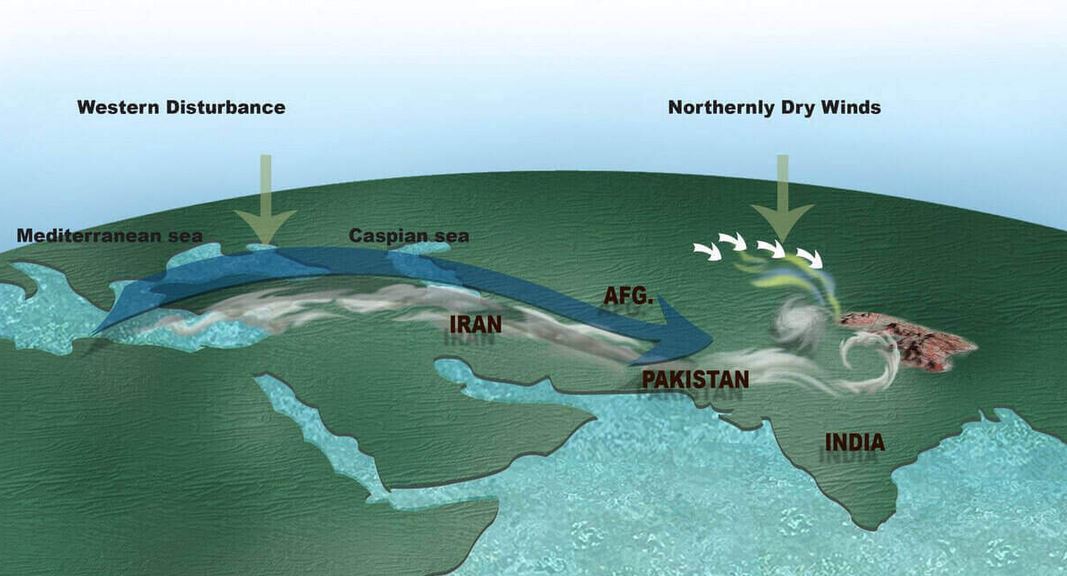
  • What are Western Disturbances?

    disturbance

    The days have been unusually warm for winter in New Delhi with the maximum temperature remaining above normal mostly on account of fewer western disturbances affecting this year.

    Western Disturbances

    • A western disturbance is an extratropical storm originating in the Mediterranean region that brings sudden winter rain to the northwestern parts of the Indian subcontinent.
    • They are labelled as an extra-tropical storm originating in the Mediterranean, is an area of low pressure that brings sudden showers, snow, and fog in northwest India.
    • In the term “extra-tropical storm”, storm refers to low pressure. “Extra-tropical” means outside the tropics. As the WD originates outside the tropical region, the word “extra-tropical” has been associated with them.
    • It is a non-monsoonal precipitation pattern driven by the westerlies.
    • The moisture in these storms usually originates over the Mediterranean Sea, the Caspian Sea and the Black Sea.
    • Extratropical storms are global phenomena with moisture usually carried in the upper atmosphere, unlike their tropical counterparts where the moisture is carried in the lower atmosphere.
    • In the case of the Indian subcontinent, moisture is sometimes shed as rain when the storm system encounters the Himalayas.
    • Western disturbances are more frequent and strong in the winter season.

    Impact: Winter Rainfall and Extreme Cold

    • Western disturbances, specifically the ones in winter, bring moderate to heavy rain in low-lying areas and heavy snow to mountainous areas of the Indian Subcontinent.
    • They are the cause of most winter and pre-monsoon season rainfall across northwest India.
    • An average of four to five western disturbances forms during the winter season.

    Its significance

    • Precipitation during the winter season has great importance in agriculture, particularly for the rabi crops.
    • Wheat among them is one of the most important crops, which helps to meet India’s food security.

    Try this PYQ:

    Consider the following statements:

    1. The winds which blow between 30°N and 60°S latitudes throughout the year are known as westerlies.
    2. The moist air masses that cause winter rains in the North-Western region of India are part of westerlies.

    Which of the statements given above is/are correct?

    (a) Only 1

    (b) Only 2

    (c) Both 1 and 2

    (d) Neither 1 nor 2


    [wpdiscuz-feedback id=”uouc14yg8a” question=”Please leave a feedback on this” opened=”1″]Post your answers here.[/wpdiscuz-feedback]


    Click and get your FREE Copy of CURRENT AFFAIRS Micro Notes

    (Click) FREE 1-to-1 on-call Mentorship by IAS-IPS officers | Discuss doubts, strategy, sources, and more

  • [pib] 150th birth anniversary of Sri Aurobindo’s

    aurobindo

    PM will participate in a program commemorating Sri Aurobindo’s 150th birth anniversary.

    Sri Aurobindo (1872 –1950)

    • Sri Aurobindo Ghose was a philosopher, yogi, maharishi, poet, and Indian nationalist.
    • He was also a journalist, editing newspapers such as Vande Mataram.
    • He joined the Indian movement for independence from British colonial rule, until 1910 was one of its influential leaders.

    Major activities                

    • Aurobindo studied for the Indian Civil Service at King’s College, Cambridge, England.
    • After returning to India he took up various civil service works under the Maharaja of the Princely state of Baroda.
    • He became increasingly involved in nationalist politics in the Indian National Congress and the nascent revolutionary movement in Bengal with the Anushilan Samiti.
    • He was arrested in the aftermath of a number of bombings linked to his organization in a public trial where he faced charges of treason for Alipore Conspiracy.
    • However, Sri Aurobindo could only be convicted and imprisoned for writing articles against British colonial rule in India.


    Try this PYQ:

    Q. What was the main reason for the split in the Indian National Congress at Surat in 1907?

    (a) Introduction of communalism into Indian politics by Lord Minto

    (b) Extremists’ lack of faith in the capacity of the moderates to negotiate with the British Government

    (c) Foundation of Muslim League

    (d) Aurobindo Ghosh’s inability to be elected as the President of the Indian national Congress


    [wpdiscuz-feedback id=”3p7o9675ds” question=”Please leave a feedback on this” opened=”1″]Post your answers here.[/wpdiscuz-feedback]


    Click and get your FREE Copy of CURRENT AFFAIRS Micro Notes

    (Click) FREE 1-to-1 on-call Mentorship by IAS-IPS officers | Discuss doubts, strategy, sources, and more

  • Is it Jawaharlal Nehru’s fault?

    Nehru

    Context

    • Jawaharlal Nehru has recently come under criticism for declining to accept the Kashmir Maharaja’s initial offer to accede to India in September 1947, several weeks before the tribal invasion. Even great statesmen make occasional mistakes and Nehru was no exception. However, a careful examination of the historical background shows that Prime Minister Nehru cannot be faulted in this case.

    Click and get your FREE Copy of CURRENT AFFAIRS Micro Notes

    Background: Jammu and Kashmir’s Maharaja Hari Singh and his stand on accession

    • Stand against accession with either India or Pakistan: Maharaja Hari Singh of Jammu and Kashmir was one of the few princely rulers who had held out against accession to either India and Pakistan before the partition of British India.
    • Lord Mountbatten visit and assurance: a couple of months prior to the partition, the Viceroy, Lord Mountbatten, visited Srinagar in an attempt to persuade the Maharaja to opt for one or the other of the two states, offering him an assurance from Sardar Patel that India would raise no objection if the ruler were to opt for Pakistan.
    • Maharaja evaded discussion and hopes for an independent state: The Maharaja entertained his guest in regal style but evaded any discussion on the political issue, pleading a stomach ailment. Hari Singh evidently hoped that, with the lapse of British paramountcy, he would become the ruler of an independent and sovereign state.

    How Maharaja’s hope of a sovereign state got dashed?

    • Uprising assisted by Pakistan: An uprising in Poonch assisted by Pakistani elements.
    • Economic sanctions by Pakistan: an undeclared economic embargo imposed by the Pakistani authorities. Since Kashmir’s main trade exchanges in those days were with Pakistan, the unofficial embargo resulted in great hardship.

    How Maharaja revised his position on accession?

    • Decided to talk on terms of accession and a message to Nehru: Maharaja asked Justice Mehr Chand Mahajan, his prime minister-designate, to convey to Nehru the terms on which he was prepared to accede to India.
    • Nehru urging Maharaja to induct Sheikh Abdullah into state government: Nehru had been urging the Maharaja to induct Sheikh Abdullah, the leader of the secular National Conference, into the state government in order to ensure popular support for the administration.
    • Reluctant to have immediate administrative reforms Maharaja refused: The Maharaja was not agreeable to introducing immediate reforms in the administration of the state. The Maharaja indicated that he was not prepared to do so, at least at this stage.
    • Nehru reiterated to associate Abdullah with the governance of the state: When Mahajan conveyed these terms to Nehru in the third week of September, the latter reiterated that Abdullah should be freed from prison and associated with the governance of the state.

    Nehru

    Why did Nehru insist on bringing Sheikh Abdullah into the administration?

    • He anticipated the armed intervention by Pakistan and armed rebellion: Nehru anticipated armed intervention by Pakistan in Kashmir and foresaw that this could be repulsed only by a government that enjoyed popular support.
    • A letter to Sardar patel before a month before tribal invasion: He set out his views in a letter to Sardar Patel on September 27, 1947, nearly a month before the tribal invasion. This remarkable letter has not received the attention it deserves.
    • Anticipating the demand of the time, he confirmed his way: Nehru, therefore, concluded that the only acceptable course was for the Maharaja to seek the cooperation of Sheikh Abdullah and the National Conference while acceding to India. This was the only effective way of countering Pakistani designs.

    Interesting: Nehru’s letter to Sardar Patel a month before tribal invasion assisted by Pakistan

    • “The Muslim League in the Punjab and the NWFP are making preparations to enter Kashmir in considerable numbers. The approach of winter is going to cut off Kashmir from the rest of India,” he wrote. “I understand that the Pakistan strategy is to infiltrate into Kashmir now and to take some major action as soon as Kashmir is more or less isolated because of the coming winter. I rather doubt if the Maharaja and the State forces can meet the situation by themselves without some popular help… Obviously the only major group that can side with them is the National Conference under Sheikh Abdullah’s leadership.”

    Nehru

    Rest is the story of accession

    • Nehru’s assessment confirmed and Maharaja agreed to his advice: Nehru’s assessment of Pakistan’s plans to invade Kashmir were confirmed within three weeks. It was only at this stage that the Maharaja heeded Nehru’s advice. He inducted Sheikh Abdullah into the government and acceded to India. This had momentous consequences for the defence of Kashmir against the invaders.
    • Resistance against Pakistani invaders: The normal administrative machinery had broken down and responsibility for maintaining law and order had been taken over by National Conference volunteers. Abdullah and his followers organised the popular resistance against the Pakistani invaders.
    • Advance of raiders and then Indian troops were airlifted to assist and protect the state: With the advance of the raiders towards Srinagar, the Maharaja’s administration had virtually collapsed. By the time Indian troops were airlifted to Srinagar on October 27, 1947, the Maharaja had departed to Jammu for safety. The first batches of Indian troops who had been airlifted to Srinagar had arrived without transport vehicles.

    Conclusion

    • Far from being a blunder, Jawaharlal Nehru’s insistence on linking accession to the installation of a popular government in Jammu and Kashmir bears testimony to his foresight and statesmanship.
  • Cyclone Mandous makes landfall in Tamil Nadu

    mandous

    Cyclone Mandous crossed the north Tamil Nadu coast with fierce winds and heavy downpour.

    Cyclone Mandous

    • ‘Mandous’ was a name submitted by WMO member United Arab Emirates and is pronounced as ‘Man-Dous.’
    • It means ‘treasure box’ in Arabic.

    What are Tropical Cyclones?

    • A tropical cyclone is an intense circular storm that originates over warm tropical oceans and is characterized by low atmospheric pressure, high winds, and heavy rain.
    • Cyclones are formed over slightly warm ocean waters. The temperature of the top layer of the sea, up to a depth of about 60 meters, need to be at least 28°C to support the formation of a cyclone.
    • This explains why the April-May and October-December periods are conducive for cyclones.
    • Then, the low level of air above the waters needs to have an ‘anticlockwise’ rotation (in the northern hemisphere; clockwise in the southern hemisphere).
    • During these periods, there is an ITCZ in the Bay of Bengal whose southern boundary experiences winds from west to east, while the northern boundary has winds flowing east to west.
    • Once formed, cyclones in this area usually move northwest. As it travels over the sea, the cyclone gathers more moist air from the warm sea which adds to its heft.

    Requirements for a Cyclone to form

    There are six main requirements for tropical cyclogenesis:

    • Sufficiently warm sea surface temperatures
    • Atmospheric instability
    • High humidity in the lower to middle levels of the troposphere
    • Enough Coriolis force to develop a low-pressure centre
    • A pre-existing low-level focus or disturbance
    • Low vertical wind shear

    How are the cyclones named?

    • In 2000, a group of nations called WMO/ESCAP (World Meteorological Organisation/United Nations Economic and Social Commission for Asia and the Pacific) decided to name cyclones.
    • It comprised Bangladesh, India, the Maldives, Myanmar, Oman, Pakistan, Sri Lanka and Thailand, decided to start naming cyclones in the region.
    • After each country sent in suggestions, the WMO/ESCAP Panel on Tropical Cyclones (PTC) finalized the list.
    • The WMO/ESCAP expanded to include five more countries in 2018 — Iran, Qatar, Saudi Arabia, United Arab Emirates and Yemen.

    Basics

    Cyclones

    • The atmospheric disturbances which involve a closed circulation of air around a low pressure at the center and high pressure at the periphery, rotating anti-clockwise in the northern hemisphere and clockwise in the southern hemisphere (due to the Coriolis force) are called “cyclones”.

    Cyclones are broadly classified into two types based on the latitudes of their origin-

    • Tropical cyclones
    • Temperate/Extra-tropical cyclones

    Tropical Cyclones

    • Tropical cyclones develop in the region between the tropics of Capricorn and Cancer. These are violent storms that originate over oceans in tropical areas and move on to the coastal regions bringing large-scale destruction caused by violent winds, very heavy rainfall and storm surges. These cyclones are one of the most devastating natural calamities.
    • Tropical cyclones mostly move along with the direction of trade winds, so they travel from east to west and make landfall on the eastern coasts of the continents.
    • Tropical cyclones are known by different names depending on the regions of the world. They are known as Hurricanes in the Atlantic, Typhoons in the Western Pacific and South China Sea, Willy-willies in Western Australia and Cyclones in the Indian Ocean.

    Temperate Cyclones/Extra-Tropical Cyclones

    • It occurs between 30°-60° latitude in both hemispheres (in between the Tropic of Cancer and the Arctic circle in the northern hemisphere and in between the Tropic of Capricorn and the Antarctic Circle in the southern hemisphere).
    • These cyclones move with the westerlies and are therefore oriented from west to east.

    Click and get your FREE Copy of CURRENT AFFAIRS Micro Notes

    (Click) FREE 1-to-1 on-call Mentorship by IAS-IPS officers | Discuss doubts, strategy, sources, and more