💥Join UPSC 2027,2028 Mentorship (August Batch) + XFactor Notes & Microthemes PDF

GS Paper: GS1

  • How the US’ Trinity Test led to the dawn of the atomic age?

    On this day, exactly 75 years ago, US scientists tested ‘Gadget’— the world’s first atomic bomb — in what was dubbed as the ‘Trinity Test’.

    Practice question for mains:

    Q.What is the Manhattan Project? Describe its consequences on the post-world war scenario.

    The Trinity Test

    • The super bomb, nicknamed ‘Gadget’, was built by a team of scientists at a top-secret site in Los Alamos, New Mexico.
    • It was developed as part of the US-led Manhattan Project, which sought to build nuclear weapons to give the allied forces an edge over Germany, Japan and Italy in World War 2.
    • Very soon after the Trinity test, an identical nuclear bomb called ‘Fat Man’ was dropped on the Japanese city of Nagasaki, killing tens of thousands of people.
    • Before it detonated, the scientists had placed bets on what could happen. Some believed that the bomb would be a dud and would fail to explode.

    What was the Manhattan Project?

    • Germany initiated World War II by invading Poland.
    • A letter signed by Nobel prize-winning physicist Albert Einstein warned then-US President Franklin D Roosevelt of the potential threat posed by an atomic weapon being developed by Adolf Hitler.
    • Soon after, the US launched a secret atomic research undertaking, code-named the Manhattan Project, which sought to develop an atomic weapon to end the war.

    Execution of the project

    • The Project remained a relatively small-scale initiative for the next two years.
    • It was only after the bombing of Pearl Harbour the project was officially kicked into gear.
    • By December 1942 facilities were established in remote locations across the US, as well as in Canada.
    • However, the superbomb was finally designed and conceptualized by a team of scientists at a top-secret laboratory in Los Alamos.
    • The Los Alamos team developed two types of bombs — one was uranium-based, which was later code-named ‘the Little Boy’ before it was dropped on Hiroshima; the other had a plutonium core.

    Looping-in nuclear physicists

    • The project brought together some of the country’s leading atomic experts as well as exiled scientists and physicists from Germany and other Nazi-occupied nations.
    • The team at Los Alamos was headed by J Robert Oppenheimer, a physics professor at the University of California, Berkeley.
    • Oppenheimer later came to be known as the “father of the atomic bomb”.
    • His team included famous Danish scientist Niels Bohr and Italian scientists Enrico Fermi.

    What were the repercussions of the Trinity Test?

    • New Mexico residents were pointedly not warned before the test, to ensure that it was carried out secretly.
    • Data collected by the New Mexico health department, which showed the adverse impact of radiation caused by the detonation, was ignored for years after the test.
    • A sudden rise in infant mortality was reported in the months after the explosion. Several residents also complained that the number of cancer patients went up after the Trinity Test.
    • The dust outfall from the explosion was expected to have travelled nearly 100 miles from the test site, posing a serious threat to residents in the area.
    • Many families complained that their livestock suffered skin burns, bleeding and loss of hair.

    Impact of bombing on Japan

    • The Hiroshima and Nagasaki bombings are known to have killed well over 200,000 people — many of whom succumbed to radiation poisoning in the weeks after the blasts.
    • The uranium bomb in Hiroshima on August 6, 1945, destroyed around 70 per cent of all buildings and caused around 140,000 deaths by the end of 1945.
    • The plutonium bomb explosion over Nagasaki, which took place three days later, killed 74,000 people that year, according to International Campaign to Abolish Nuclear Weapons (ICANW) data.
    • After seeing the destruction caused to the two Japanese cities, Oppenheimer publicly admitted that he regretted building a bomb that could cause an apocalypse.

    Nuclearisation of the world thus began

    • Seventy-five years after the Trinity Test, as many as nine countries around the world are currently in possession of nuclear weapons.
    • These include the US, the UK, Russia, France, India, China, Israel, Pakistan and North Korea.
    • At least eight countries have detonated over 2,000 nuclear test explosions since 1945.
    • The most recent instance of nuclear bomb test explosions conducted by India, were the series of five explosions done as part of the Pokhran-II tests in May 1998.
    • The first test, code-named Smiling Buddha, took place in May 1974.
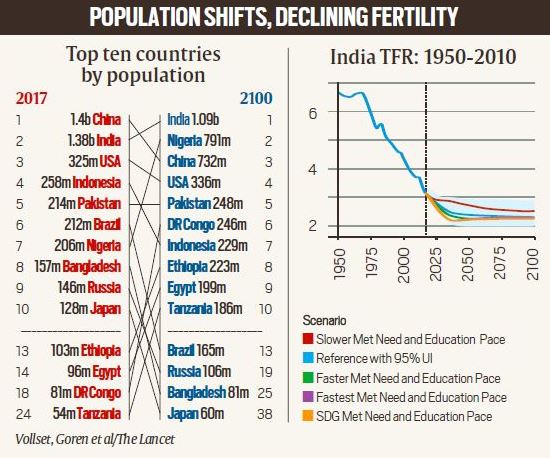
  • Lancet’s analysis of population trends for 2017-2100

    When this century ends, India may no longer be a country of a billion, says a projection that appears in the online edition of the Lancet. The reference forecasts for China and India peaked before 2050 and both countries thereafter had steep declining trajectories.

    Try this question from CSP 2011:

    Q.India is regarded as a country with ‘Demographic Dividend’. This is due to

    (a) Its high population in the age group below 15 years

    (b) Its high population in the age group of 15-64 years

    (c) Its high population in the age group above 65 years

    (d) Its high total population

    World to see the peak

    • A new analysis published in The Lancet has projected that the world population will peak much earlier than previously estimated.
    • It projects the peak at 9.73 billion in 2064, which is 36 years earlier than the 11 billion peaks projected for 2100 by last year’s UN report World Population Prospects.
    • For 2100, the new report projects a decline to 8.79 billion from the 2064 peak.

    5 most populated countries

    • The five largest countries in 2100 are projected to be India, Nigeria, China, the U.S. and Pakistan.
    • However, these forecasts showed different future trajectories between countries.
    • Nigeria is forecast to have continued population growth through 2100 and was expected to be the second-most populous country by then.

    Predictions on India’s population

    • For India, the report projects a peak population of 1.6 billion in 2048, up from 1.38 billion in 2017.
    • By 2100, the population is projected to decline by 32% to 1.09 billion.
    • However, meeting UN Sustainable Goal Development targets, the peak would be earlier and see a population decline to 929 million.
    • Conventional wisdom is that though a decline in population is expected, it is expected to begin only around 2046.
    • The fall according to the latest 2019 assessment by the UNDP calculation, is expected to see India’s population settle at a little over 1.4 billion.

    Reasons for fall

    • The sharper fall is due to the assumption that all women globally will have much higher access to contraception and education.
    • This scenario will lead to a sharper reduction in the Total Fertility Rate, a metric that shows on average how many children a woman must have to keep replenishing the population.
    • A TFR is lower than 2.1leads to a decline in a country’s population.
  • Who are the Tangams?

    Last week Arunachal CM released a book titled “Tangams: An Ethnolinguistic Study Of The Critically Endangered Group of Arunachal Pradesh”.

    Try this question from CSP 2019:

    Q.Consider the following statements about Particularly Vulnerable Tribal Groups (PVTGs) in India:

    1. PVTGs reside in 18 States and one Union Territory.
    2. A stagnant or declining population is one of the criteria for determining PVTG status.
    3. There are 95 PVTGs officially notified in the country so far.
    4. Irular and Konda Reddi tribes are included in the list of PVTGs.

    Which of the statements given above are correct?

    (a) 1, 2 and 3

    (b) 2, 3 and 4

    (c) 1, 2 and 4

    (d) 1, 3 and 4

    Who are the Tangams?

    • The Tangams is a little-known community within the larger Adi tribe of Arunachal Pradesh and resides in the hamlet of Kugging in Upper Siang district’s Paindem circle.
    • In 1975, the community’s population was pegged at 2,000 spread across 25 villages.
    • From 2016 to 2020, a team from the Centre for Endangered Languages (CFEL) of Rajiv Gandhi University (RGU), carried out extensive field research and documented the community.
    • Their survey revealed that Tangams were now concentrated in only one village (Kugging), with only 253 reported speakers.
    • As per the UNESCO World Atlas of Endangered Languages (2009), Tangam — an oral language that belongs to the Tani group, under the greater Tibeto-Burman language family — is marked ‘critically endangered’.

    Why are there only a few speakers?

    • Kugging is surrounded by a number of villages inhabited by Adi subgroups such as Shimong, Minyongs, as well as the Buddhist tribal community of Khambas, among others.
    • To communicate with their neighbours over the years, the Tangams have become multilingual, speaking not just Tangam, but other tongues such as Shimong, Khamba and Hindi.
    • They rarely speak their own language now since their population is restricted to a single village. Moreover, the Tangams are relatively unknown — even within their state.
    • The village lacks proper infrastructure in all basic sectors of education, health, drinking water facilities, road and electricity. Roads have reached Kugging only in 2018.
    • Not a single person from the community has gone to university.

    Why are the languages at risk?

    • The diversity of languages has led various communities to depend on English, Assamese and colloquial variety of Hindi called Arunachalee Hindi as the link languages.
    • Many believe this shift has led to the loss of native languages of the tribal communities.
    • Even the numerically larger tribes like Nyishi, Galo, Mishmi, Tangsa etc. whose population exceed the ten thousand mark are also not safe from endangerment, hence marked unsafe.
    • The younger generation of these tribes especially in the urban areas has mostly discarded the use of their mother tongue.
  • Mapping: Islands of Polynesia

    How did the Polynesian peoples come to live on the far-flung islands of the Pacific? The question has intrigued researchers for centuries.

    The newscard contains some trivial facts. However, aspirants are advised to observe the map.

    Study on Polynesia

    • Norwegian explorer Thor Heyerdahl brought the topic to public attention when he sailed a balsa-wood raft called the Kon-Tiki from Peru to Polynesia in 1947.
    • His goal was to demonstrate such voyages were possible, supporting theories linking Polynesian origins to the Americas.
    • Decades of research in archaeology, linguistics and genetics now show that Polynesian origins lie to the west, ultimately in the islands of Southeast Asia.

    New evidence for American interlopers

    • A new study published in Nature reports genetic evidence of Native American ancestry in several Polynesian populations.
    • Other researchers have previously found evidence of indigenous American DNA in the genomes of the modern inhabitants of Rapa Nui.
    • Rapa Nui, also known as Easter Island, is the part of Polynesia closest to South America.
    • This suggests the “Amerindian” genetic component was likely introduced later via Chilean colonists.
  • Mapping: Mont Blanc

    The melting Mont Blanc glacier in the French Alps yielded a clutch of newspapers with banner headlines from when Indira Gandhi became India’s first and so far only woman Prime Minister in 1966.

    Try this MCQ

    Q.The Mont Blanc in the Alps can be located near the conflux of which of the following two countries?

    a)France and Spain

    b)France and Italy

    c)Spain and Italy

    d)Greece and Slovenia

    Mont Blanc

    • Mont Blanc is the second-highest mountain in Europe after Mount Elbrus. It is the highest mountain in the Alps and Western Europe.
    • It rises 4,808 m above sea level and is ranked 11th in the world in topographic prominence.
    • The mountain stands in a range called the Graian Alps, between the regions of Aosta Valley, Italy, and Savoie and Haute-Savoie, France.
    • It is the tallest peak in the Alps and the highest summit in Western Europe, hence its epithet the “Roof of Europe”.
  • ‘Churachandpur Mao Fault’ in Mizoram

    Mizoram’s zone of “scary” earthquakes is caught between two subterranean faults called the ‘Churachandpur Mao Fault’.

    Try this question from CSE Mains 2014:

    Q.Why are the world’s fold mountain systems located along the margins of continents? Bring out the association between the global distribution of Fold Mountains and the earthquakes and volcanoes.

    Churachandpur-Mao Fault (CMF)

    • The CMF is named after two places in Manipur and runs north-south into Myanmar along the border of Champhai.
    • The Mat Fault runs northwest-southeast across Mizoram, beneath river Mat near Serchhip.
    • It is defined by straight valleys; most prominent being between Kangpokpi and Maram region of Mizoram.
    • The fault takes a north-easterly trend from Maram where the fault zone is characterized by active landslides during the monsoon.

    Why study CMF?

    • Faults are discontinuities or cracks that are the result of differential motion within the earth’s crust.
    • Vertical or lateral slippage of the crust along the faults causes an earthquake.
  • Rabari, Bharvad and Charan Tribes of Gujarat

    The Gujarat government will constitute a commission to identify the members of Rabari, Bharvad and Charan communities who are eligible to get the benefits of Schedule Tribe (ST) status.

    Try this question from CSP 2017:

    Q.Every year, a monthlong ecologically important campaign/festival is held during which certain communities/ tribes plant saplings of fruit-bearing trees. Which of the following are such communities/ tribes?

    (a) Bhutia and Lepcha

    (b) Gond and Korku

    (c) lrula and Toda

    (d) Sahariya and Agariya

    About the Tribes

    (1) Rabari

    • The Rabari, also called the Rewari are an indigenous tribal caste of nomadic cattle and camel herders and shepherds that live throughout northwest India, primarily in the states of Gujarat, Punjab and Rajasthan.
    • The word “Rabari” translates as “outsiders”, a fair description of their primary occupation and status within Indian society.
    • They speak ‘Bhopa’ which is a mixture of Gujarati, Kachchi, Marwari words and Pharasi (Persian) and use Gujarati script.
    • The Rabari are known for their distinctive art, particularly the mirrored and whitewashed mud sculpture-work that adorns their homes and villages.
    • Rabari women are responsible for this artwork and also traditionally spin the wool from their sheep and goats, and give it to local weavers to make their woollen skirts, veils, blankets and turbans.

    (2) Bharvad

    • The Bharwad are tribals primarily engaged in herding livestock.
    • The Bharwad name may derive from the Gujarati word badawad, constructed from bada (sheep) and wada (a compound or enclosure).
    • The Bharwads have numerous subgroups known as ataks or guls (clans) whose main purpose is to determine eligibility for marriage.
    • Constrained exogamy is practised between clans.

    (3) Charan

    • The Charan, also called Gadhvi, is a small tribe in Gujarat and the name Charan is derived from the word ‘Char’ which means grazing.
    • Members of the caste are considered to be divine by a large section of society.
    • Women of the caste are adored as mother goddesses by other major communities of this region.
  • [pib] Mongolian Kanjur Manuscripts

    The Ministry of Culture has taken up the project of reprinting of 108 volumes of Mongolian Kanjur under the National Mission for Manuscripts (NMM).  The first sets of five volumes were presented to the President of India.

    Try this question from CSP 2011:

    Q.India maintained its early cultural contacts and trade links with Southeast Asia across the Bay of Bengal. For this preeminence of early maritime history of Bay of Bengal, which of the following could be the most convincing explanation/explanations?

    (a) As compared to other countries, India had a better ship-building technology in ancient and medieval times.

    (b) The rulers of southern India always patronized traders, Brahmin priests and Buddhist monks in this context.

    (c) Monsoon winds across the Bay of Bengal facilitated sea voyages.

    (d) Both (a) and (b) are convincing explanations in this context.

    Mongolian Kanjur

    • Mongolian Kanjur, the Buddhist canonical text in 108 volumes is considered to be the most important religious text in Mongolia.
    • In the Mongolian language ‘Kanjur’ means ‘Concise Orders’- the words of Lord Buddha in particular. It has been translated from Tibetan.
    • It is held in high esteem by the Mongolian Buddhists and they worship the Kanjur at temples and recite the lines of Kanjur in daily life as a sacred ritual.
    • The Kanjur is kept almost in every monastery in Mongolia.
    • The language of the Kanjur is Classical Mongolian and it is a source of providing a cultural identity to Mongolia.

    About National Mission for Manuscripts

    • The Mission was launched in February 2003 under the Ministry of Tourism and Culture, with the mandate of documenting, conserving and disseminating the knowledge preserved in the manuscripts.
    • One of the objectives of the mission is to publish rare and unpublished manuscripts so that the knowledge enshrined in them is spread to researchers, scholars and the general public at large.
    • Under this scheme, reprinting of 108 volumes of Mongolian Kanjur has been taken up by the Mission.
  • Sindhu Darshan Puja

    During his day-long whirlwind visit, PM Narendra performed Sindhu Darshan Puja at Nimu, the forward brigade place in Ladakh.

    Sindhu Darshan Puja.

    ⦁ Sindhu Darshan Festival is a festival of India held every year on full moon day (on Guru Purnima) in the month of June.
    ⦁ It is held at Leh, in Ladakh District of Ladakh. It stretches for three days.
    ⦁ It was first started in the October by veteran politician L.K. Advani, 1997 and continues to be held every year since then, attracting large number of foreign and domestic tourists.
    ⦁ The main reason behind the celebration of Sindhu Darshan Festival is to endorse the Indus River (Sindhu River) as an icon of the communal harmony and unity of India.

  • What is the Hagia Sophia?

    Turkey’s highest court this week convened to decide whether Istanbul’s iconic Hagia Sophia museum can be turned into a mosque.

    Try this question:

    Q. The iconic Hagia Sophia, a UNESCO World Heritage site was recently in news. It is situated in:

    a) Greece b) Turkey c) Israel d) Iran

    What is the Hagia Sophia?

    • The construction of this iconic structure in Istanbul started in 532 AD during the reign of Justinian I, the ruler of the Byzantine Empire when the city was known as Constantinople.
    • The structure was originally built to become the seat of the Patriarch of the Eastern Orthodox Church and remained so for approximately 900 years.
    • In 1453, when Constantinople fell to Sultan Mehmet II’s Ottoman forces, the Hagia Sophia was ransacked by the invading forces and turned into a mosque shortly after.
    • For a long time, the Hagia Sophia was Istanbul’s most important mosque.
    • The 1,500-year-old structure, listed as a UNESCO World Heritage site, was originally a cathedral before it was turned into a mosque.

    What is the controversy about?

    • In the 1930s, Mustafa Kemal Ataturk, the founder of the Republic of Turkey, shut down the mosque and turned it into a museum in an attempt to make the country more secular.
    • There have been calls for long from extremists groups to convert the Hagia Sophia back into a mosque.