💥Mains Ready By December. Smash Mains & Smash PYQ Admissions Open

GS Paper: GS3-16.Achievements of Indians in Science & Technology

  • GRSE launches indigenous vessel for deep-sea research

    Why in the News

    Garden Reach Shipbuilders and Engineers (GRSE) has launched Sagar Manthan, an indigenously built ocean research vessel for the National Centre for Polar and Ocean Research (NCPOR). The Rs 840 crore vessel is being built for the Ministry of Earth Sciences and is expected to be ready for use by early 2028. India’s existing ocean research ships were built abroad, and its polar voyages have run on chartered vessels. The capability being added is therefore the domestic construction of the platform itself, not a new branch of ocean science.

    What has actually been launched?

    1. The vessel and the builder: Sagar Manthan is an ocean research vessel built at GRSE, the Kolkata based defence shipyard under the Ministry of Defence.
    2. The cost and the date: The vessel costs Rs 840 crore and is expected to be ready for use by early 2028.
    3. What a launch is: Launch is the stage at which the completed hull enters the water, and outfitting, sea trials and delivery to the user follow it.

    Why does an indigenously built research vessel matter?

    1. The existing fleet came from abroad: The oceanographic research vessel Sagar Kanya was built in Germany and delivered in 1983, and Sagar Nidhi was built in Italy and delivered in 2008.
    2. Polar voyages run on hired ships: Indian Antarctic expeditions have been carried on chartered ice class vessels rather than on an Indian owned polar research ship.
    3. The capability stays onshore: Building a scientific platform domestically keeps design, repair and refit capacity inside the country, which shortens the turnaround between expeditions.

    Where does the vessel fit in India’s ocean programme?

    1. The Deep Ocean Mission: Approved in 2021, the mission is developing the crewed submersible Matsya-6000 under the Samudrayaan project to carry three people to a depth of 6,000 metres.
    2. India’s seabed exploration rights: India holds an exploration contract with the International Seabed Authority for polymetallic nodules in the Central Indian Ocean Basin, and a second contract for polymetallic sulphides on the Indian Ocean Ridge, both of which require sustained survey and sampling at sea.

    Challenges to India’s deep-sea research capability

    1. Programme timelines slip: Deep sea hardware moves from design to sea trials over years, and the science schedule is rebuilt each time a date moves. Eg. The crewed dive under the Samudrayaan project has slipped repeatedly from its original 2022 target.
      The Fix: Publish dated milestones for each mission element and release funding tranches against those milestones rather than against annual budget cycles.
    2. Exploration rights do not convert into extraction: A seabed contract permits survey and testing, and commercial recovery waits on an international mining code that has not been adopted. Eg. Negotiations on the seabed mining code at the International Seabed Authority have run for over a decade without a final text.
      The Fix: Use the contract period to build a domestic metallurgical route for processing nodule metals, so capability exists before the code opens extraction.
    3. The polar operating window is narrow: A hull without ice strengthening cannot work in polar waters for most of the year, so polar science is compressed into a short season. Eg. Resupply of India’s Antarctic research stations is confined to the austral summer.
      The Fix: Commission a dedicated ice class polar research vessel alongside this platform, rather than treating one research hull as cover for both tropical and polar work.

    Conclusion

    The hull is in the water and the science is still two years away, since launch is the start of outfitting rather than the end of construction. What the milestone settles is that India can build this class of ship for itself. What it does not settle is the shortage of sea time against a mandate that runs from the Arctic to the Antarctic and across the Indian Ocean seabed. The marker to watch is whether a dedicated ice class polar vessel is sanctioned to sit alongside it, or whether polar expeditions continue on chartered ships after this one is delivered.

    Back2Basics

    1. What NCPOR is: Set up in 1998 as the National Centre for Antarctic and Ocean Research, and renamed the National Centre for Polar and Ocean Research in 2018.
    2. Status and location: An autonomous institute of the Ministry of Earth Sciences, based at Vasco da Gama in Goa.
    3. Mandate: The nodal agency for India’s polar and Southern Ocean research, which plans and executes the annual Antarctic and Arctic expeditions.
    4. Stations it runs: Maitri and Bharati in Antarctica, and Himadri at Ny-Alesund in Svalbard in the Arctic.

    Matching Previous Year Question

    “[2026] Which of the following statements with regard to India’s Deep Ocean Mission is/are correct? 1. It was launched by the Ministry of Ports, Shipping and Waterways, Government of India. 2. Matsya-6000 has been designed to carry 3 people for deep sea exploration. 3. Samudrayaan is a project under this mission. (a) 1 only (b) 2 and 3 only (c) 1 and 2 only (d) 1, 2 and 3 ANSWER: (b)”

  • China, US are in race to connect science with industry. India must catch up [Express]

    China, US are in race to connect science with industry. India must catch up [Express]

    Mentor Comment

    Beijing’s second World Humanoid Games has showcased a Chinese project to become the world’s leading science power, rooted in the Chinese President’s call to mobilise “new quality productive forces” released by the current revolutions in science and technology. The US administration has released Science: A New Golden Age, billed as the first major reset in US science policy since World War II, aimed at reintegrating discovery with production. Both powers are building an ecosystem that connects science with industry, from opposite starting points. India has launched missions on artificial intelligence (AI), semiconductor production and quantum technologies, but its private capital has retreated from science and its state-led scientific institutions remain unreformed.

    How are China and the United States racing toward the same goal from opposite directions?

    1. China’s break with the old growth model: The Chinese President holds that the next phase of growth cannot rely on cheap labour, large-scale manufacturing, infrastructure and capital accumulation, and must come from innovation.
    2. AI diffused across the physical economy: Beijing’s objective is to diffuse AI across robotics, machine tools, automobiles, biotechnology, materials, energy, agriculture and scientific research.
      • It bets that fusing digital intelligence with the world’s largest industrial ecosystem will make China the leading technological power.
    3. From adaptation to original discovery: For decades China absorbed foreign technology, improved it through manufacturing and dominated production. It now wants to move upstream to original discovery.
    4. China’s spending signal: China spent 2.8 per cent of GDP on research and development (R&D) in 2025, and its basic-research expenditure rose by 11 per cent.
    5. China’s four-step logic: AI accelerates discovery; discovery produces technology; technology transforms industry; industrial strength generates national power and a geopolitical edge.
    6. The US reset names its own weakness: Science: A New Golden Age, released in July, recognises American strengths in universities, laboratories, technology companies and capital markets. It acknowledges the erosion of the capacity to turn discoveries into production.
    7. How globalisation split US innovation from manufacturing: Companies designed at home, produced abroad and depended on long supply chains. That model generated wealth and also the vulnerabilities exposed by the pandemic, China’s rise and geopolitical rivalry.
    8. Mirror-image fears: China begins with the largest manufacturing base and moves upstream into science. The US begins with the strongest scientific system and moves downstream into manufacturing. China fears dependence on American technology; the US fears dependence on Chinese production.

    What does “connecting science with industry” actually mean in this contest?

    1. AI as an accelerator of knowledge, not a product: Washington and Beijing see AI not merely as a general-purpose technology but as an accelerator central to the production of new knowledge that in turn transforms industry.
    2. Discovery made continuous with manufacturing: By making discovery continuous with design and manufacturing, AI-driven science transforms production itself and converts scientific speed into economic power and geopolitical capability.
    3. The ecosystem, not the model, is the prize: The contest is not about who unveils the cleverest AI model or the most sophisticated humanoid. It is about building the most effective ecosystem connecting universities, laboratories, entrepreneurs, finance, energy, factories, supply chains and markets.

    Where does India stand as the race intensifies?

    1. Missions exist on paper: Delhi recognises the trend and has launched missions on AI, semiconductor production and quantum technologies, and has a draft robotics policy.
    2. The spending gap: The Economic Survey 2025-26 puts India’s R&D expenditure at 0.64 per cent of GDP, against about 2.8 per cent for China and 3.5 per cent for the US.
    3. The absolute gap is wider: The World Intellectual Property Organisation estimates India’s total R&D spend at $75 billion in purchasing-power-adjusted dollars, against $786 billion for China and $782 billion for the United States. In nominal dollar terms India looks even smaller.

    Why does the first weakness, the retreat of private capital from science, matter most?

    1. Ambition lives in government declarations: Ambition and imagination are concentrated in government declarations at a time when the private sector contributes more than ever to producing knowledge in the US and China.
    2. Indian capital has no science project: Indian capital rarely articulates a project for mastering the new forces of production or a new project for science and basic research.
    3. It was not always so: Jamsetji Tata helped create the Indian Institute of Science in 1909. The Kirloskars and other western Indian business families sent their children to the Massachusetts Institute of Technology from the 1920s, recognising that independent India’s future lay in mastering modern science.
    4. Private philanthropy built the strategic programmes: The Sir Dorabji Tata Trust supported Homi Bhabha in establishing the Tata Institute of Fundamental Research, which formed the nucleus of India’s atomic energy and space programmes. Indian capital has retreated from that tradition.

    Why does the second weakness, unreformed scientific institutions, compound the first?

    1. No overhaul in India’s reform era: China’s reform era, launched in the late 1970s under Deng Xiaoping, put the revitalisation of science and technology at the heart of the Four Modernisations. India’s reform era, beginning in the 1990s, produced no comparable overhaul.
    2. Same American training, different follow-through: India and China both benefited from access to American universities that trained their vast talent pools. China combined that opportunity with massive domestic investment in science and higher education and incentives for researchers to return.
    3. India does not draw talent back: India’s science sector fails to attract its trained talent home, and the shortfall is severe rather than marginal.

    Can “technological sovereignty” be built without global science?

    1. Bureaucratisation, then cultural nationalism: The Congress era saw the steady bureaucratisation of Indian science, and the BJP era is adding cultural nationalism to it.
    2. Mythology is not evidence: Civilisational pride cannot make mythology a substitute for evidence, experiment and scientific temper. India’s most confident claim should be that the greatest Indian contributions lie in the future, not that all modern science was discovered in its past.
    3. The cost of talking tall, once before: Delhi’s radical posturing on technological “self-reliance” in the 1970s and 1980s isolated India from global technological advances. Today there is grandiose talk of “technological sovereignty”.
    4. Two tracks at once: India must deepen cooperation with global science, capital, technology and talent, and at the same time build domestic research, industrial and institutional capacity. Neither track substitutes for the other.

    Challenges to India’s science-industry linkage

    1. Research sits outside the universities that supply the workforce: Most public research is done in mission agencies and Council of Scientific and Industrial Research (CSIR) laboratories, so graduates and firms rarely meet discovery where it happens. Eg. The Defence Research and Development Organisation, the Indian Space Research Organisation, the Department of Atomic Energy and CSIR absorb the bulk of central research spending, and State universities receive a marginal share.
      The Fix: Route Anusandhan National Research Foundation grants preferentially to State universities with mandatory industry co-investment.
    2. Industry does not fund its own research: The private sector contributes 36 per cent of India’s gross R&D expenditure, against 77 per cent in China and 79 per cent in the US and Japan. Eg. The weighted tax deduction on in-house R&D under Section 35(2AB) of the Income Tax Act, 1961 was cut from 200 per cent to 100 per cent from 2020-21, removing the one fiscal incentive firms used.
      The Fix: Restore a weighted deduction tied to patents filed and products commercialised rather than to spending alone.
    3. Deep technology has no patient capital: Venture funds back consumer applications that return within five years, not fabs or materials that need fifteen. Eg. Micron’s assembly and test plant at Sanand, approved in 2023, needed roughly 70 per cent of its project cost as central and Gujarat subsidy before private capital moved.
      The Fix: Deploy the Research Development and Innovation scheme corpus as long tenure, low interest loans and fund-of-funds equity for private deep technology projects.
    4. Public procurement does not buy the first unit: Government buyers demand a track record, so an Indian prototype finds no first customer and licenses abroad. Eg. The United States’ Small Business Innovation Research programme reserves a fixed share of federal agency R&D budgets for small firms’ first contracts, and India has no equivalent set-aside.
      The Fix: Add a first-buyer set-aside in the General Financial Rules for Indian deep technology products validated by a designated national laboratory.

    Conclusion

    The contest India has to enter is an ecosystem contest, and an ecosystem cannot be declared into existence by a mission document. Two things remain unreconciled: a state-led science system that has never been restructured, and a private sector that has stopped funding discovery. Whether Indian capital returns to the tradition that built the Indian Institute of Science and the Tata Institute of Fundamental Research is the marker to watch, and the disbursal of the new research finance corpus to private laboratories is where it will first show.

    About India’s Research and Innovation Ecosystem

    1. What the ecosystem measures: Gross expenditure on R&D (GERD) counts spending by government, industry and higher education on basic research, applied research and experimental development.
    2. Who does the research: Central agencies dominate, with a small set of premier institutes such as the Indian Institutes of Technology, the Indian Institute of Science and the National Institute of Immunology providing the academic base.
    3. Global standing: India ranked 39th of 133 economies in the World Intellectual Property Organisation’s Global Innovation Index 2024, first among lower middle income economies.

    Laws and Rules Governing India’s Research and Innovation Ecosystem

    1. Anusandhan National Research Foundation Act, 2023: Creates an apex body to seed, grow and promote research in universities and laboratories, with a planned Rs 50,000 crore over 2023-28 of which Rs 36,000 crore is to come from non-government sources.
    2. The Act repealed the Science and Engineering Research Board Act, 2008 and subsumed that board into the new foundation.
    3. Patents Act, 1970: Governs the grant and enforcement of patents; the 2005 amendment introduced product patents in pharmaceuticals, chemicals and food to comply with the World Trade Organisation’s TRIPS agreement.

    Government Initiatives for India’s Research and Innovation Ecosystem

    1. Research Development and Innovation scheme: Approved by the Union Cabinet in July 2025 with a Rs 1 lakh crore corpus to finance private sector research in sunrise sectors through long tenure, low or nil interest loans and equity.
    2. IndiaAI Mission: Launched in 2024 by the Ministry of Electronics and Information Technology, anchored in shared compute of 38,000-plus GPUs, the AI Kosh open dataset platform, and 570 FutureSkills and AI Labs in Tier 2 and Tier 3 cities.
    3. National Quantum Mission: Launched in April 2023 with an outlay of Rs 6,003 crore for 2023-31, building four Thematic Quantum Technology Hubs in computing, communication, sensing and metrology, and materials and devices.
    4. India Semiconductor Mission: Approved in December 2021 with a Rs 76,000 crore outlay to subsidise fabrication, display and assembly plants and to fund chip design startups.
    5. VAIBHAV Fellowship: Launched in 2023 by the Department of Science and Technology to bring diaspora scientists to Indian institutions for collaborative research stints.

    Key Facts about India’s Research and Innovation Ecosystem

    1. National Science Day, 28 February: Marks the announcement of the Raman effect in 1928.
    2. National Technology Day, 11 May: Marks the Pokhran-II nuclear tests of 1998 and the first flight of the indigenous Hansa aircraft the same day.

    Back2Basics

    1. What they were: China’s programme to modernise agriculture, industry, national defence, and science and technology.
    2. When adopted: First articulated by Premier Zhou Enlai in 1963 and again in 1975, and made the centrepiece of the reform era at the Third Plenum of December 1978.
    3. Why science was listed: Science and technology was named as the modernisation that enabled the other three, which is why the reform era began by rehabilitating scientists and reopening universities to competitive entrance examinations.

    [2019, GS3, 10 marks] How was India benefited from the contributions of Sir M.Visvesvaraya and Dr. M. S. Swaminathan in the fields of water engineering and agricultural science respectively?”

  • Navy Chief: INS Nipun will enhance our critical underwater capabilities

    Navy Chief: INS Nipun will enhance our critical underwater capabilities

    Why in the News

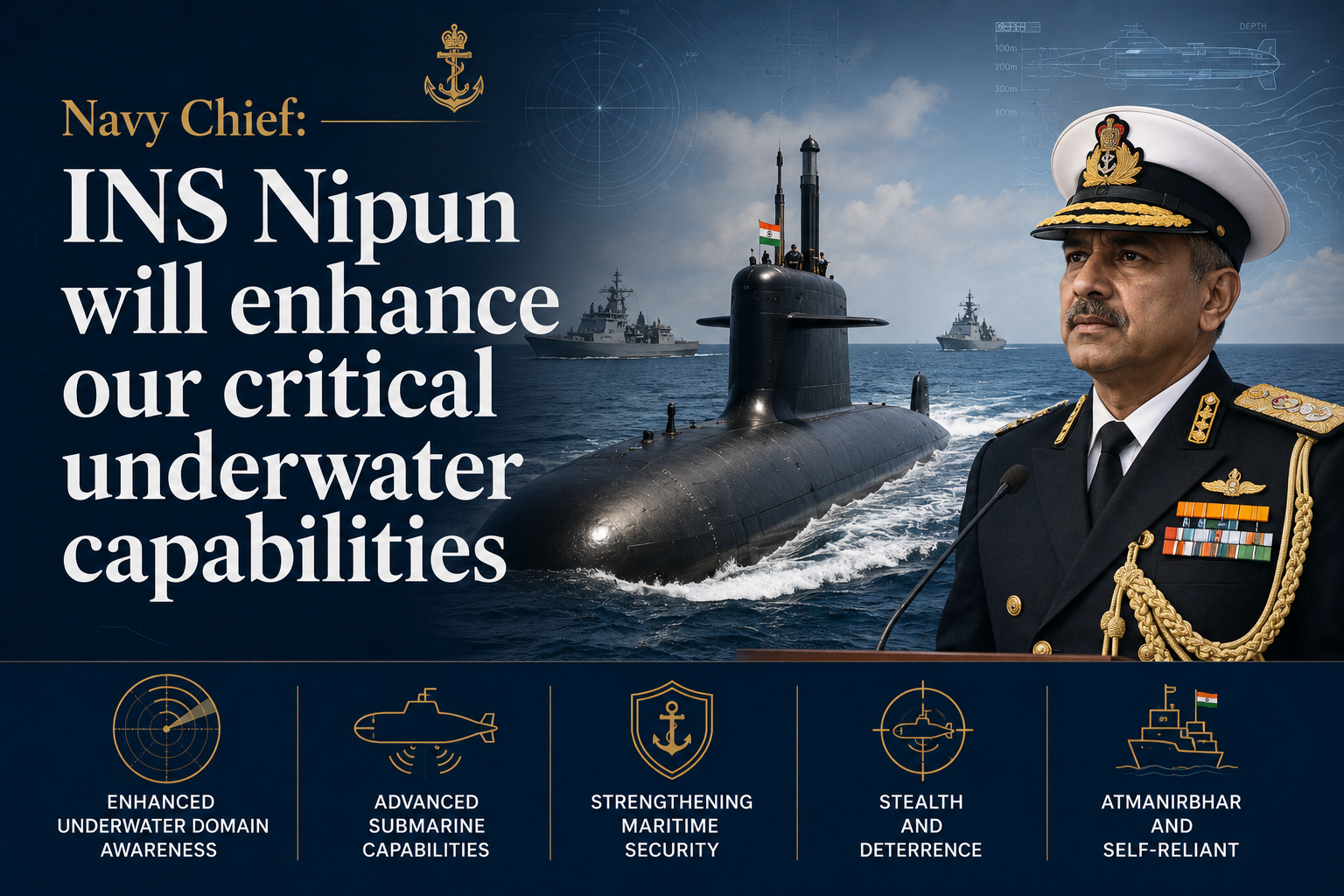
    The Indian Navy has commissioned INS Nipun at Mumbai, a dedicated Diving Support and Submarine Rescue Vessel built for work beneath the surface.

    What capability does INS Nipun add?

    1. It is a specialist platform for underwater work: The vessel is built for deep sea diving, underwater intervention and submarine rescue.
    2. It can carry the rescue submersible: Its ability to embark and operate the Indian Navy’s Deep Submergence Rescue Vessel is what converts it into a rescue platform.
    3. The rescue role extends beyond Indian submarines: It can respond to a distressed submarine of the Indian Navy or of a partner navy, which is the basis of the claim that India can emerge as the region’s preferred submarine rescue partner.
    4. Its diving capability supports relief work: The specialised diving capability can assist partner nations in underwater salvage and in humanitarian assistance and disaster relief (HADR) missions.
    5. Few navies hold the combination: The vessel brings together a range of capabilities possessed by only a handful of navies.

    Why does the Navy frame this as a strategic requirement?

    1. The maritime environment is described as contested: The Chief of the Naval Staff assessed that threat perceptions are constantly evolving and morphing into newer forms.
    2. Preparedness is the stated response: The exact nature of future threats cannot be predicted, so robust capability has to be built against anticipated threats in advance.
    3. The Western Naval Command gains a full column capability: The addition allows the command to operate above, on and beneath the waves.
    4. Integration is the immediate task: The command is to fold the vessel into operational plans, exercise her capabilities rigorously and develop proficiency around her systems.

    What does the vessel mean for indigenous shipbuilding?

    1. The builder is an Indian yard: Hindustan Shipyard Limited at Visakhapatnam designed and built the vessel indigenously.
    2. The class is new to the fleet: INS Nipun is the second ship of the Nistar class of diving support vessels.
    3. The Ministry of Defence frames it as self-reliance: The induction is presented as a further step towards self-reliance in defence shipbuilding.
    4. The platform type is rarely built domestically: A diving and rescue vessel is a niche design, so building it in India establishes a capability that cannot be sourced quickly from imports.

    Challenges to India’s submarine rescue and underwater capability

    1. Rescue is a race against the air supply: A disabled submarine’s crew survives on limited oxygen, so a rescue system has to be transported and mated within hours. Eg. All 118 crew aboard the Russian submarine Kursk died in the Barents Sea in 2000 before foreign rescue assistance was accepted.
      The Fix: Keep rescue systems prepositioned on both seaboards with standing mating certification against partner navy hatch designs.
    2. The fleet operates on two seaboards with few rescue platforms: Indian submarines patrol the Arabian Sea and the Bay of Bengal, and dedicated rescue assets are limited in number. Eg. India inducted its first Deep Submergence Rescue Vehicle system only in 2018, with the second following the next year.
      The Fix: Retain air transportable rescue systems that can be flown to the nearest usable port instead of sailed from a home base.
    3. Rescue only works where the hatch fits: A rescue vehicle can dock only with a submarine whose escape hatch matches its mating skirt, so cross navy rescue depends on standardisation. Eg. The International Submarine Escape and Rescue Liaison Office exists to run exercises that test exactly this compatibility.
      The Fix: Certify Indian rescue systems against partner navy hatch standards and publish the compatibility list to regional navies.
    4. Naval shipbuilding timelines stretch: Indian yards have delivered warships and submarines behind their original schedules, which delays the capability rather than the contract. Eg. Deliveries under the Scorpene class submarine programme ran years behind the timeline set at signing.
      The Fix: Link yard payments to certified milestone completion rather than to calendar tranches.
    5. Saturation diving is a scarce skill: Deep diving support needs trained saturation divers and chamber operators, and that trained pool is small worldwide. Eg. Offshore energy operators and navies draw saturation divers from the same limited global workforce.
      The Fix: Run a joint naval and commercial diving training school whose certification is recognised for offshore industry work, so the pool grows beyond service requirements.

    Back2Basics: Hindustan Shipyard Limited

    1. Status: A shipyard at Visakhapatnam that was transferred to the Ministry of Defence in 2010 from the Ministry of Shipping.
    2. Origin: It was founded in 1941 as Scindia Shipyard and built India’s first indigenous merchant ship, Jala Usha, in 1948.
    3. Work: It builds and repairs merchant and naval vessels and carries out submarine refits for the Indian Navy.
    4. Current orders: It is building the Nistar class diving support vessels and the fleet support ships ordered for the Navy.

    [2026] Which of the following items of defence hardware is/are manufactured in India?

    1. Su-30 MKI Fighter Jets

    2. T-90 MK-III Tanks

    3. Akula Class Submarine

    (a) 1 and 2

    (b) 1 and 3

    (c) 1 only

    (d) 2 only

  • Nuclear power operator plans new design unit to support pvt players

    Nuclear power operator plans new design unit to support pvt players

    Why in the News

    The Nuclear Power Corporation of India Limited (NPCIL) is setting up a new design vertical to support private companies deploying Pressurised Heavy Water Reactor (PHWR) technology. This follows recent legal reform enabling private participation in civil nuclear power. The move marks a shift from NPCIL’s traditional role as sole builder and operator of India’s nuclear fleet toward a design-support role for private entrants, addressing India’s stated need to scale nuclear capacity to meet rising electricity demand while keeping deployment within a technology NPCIL already operates at scale.

    Why does India favour PHWR technology for private entry?

    1. Established domestic supply chain: PHWR technology has been indigenised in India since the 1980s, giving it a mature domestic manufacturing and fuel-cycle base that a newly entering private player can draw on.
    2. Natural uranium fuel cycle: PHWRs use natural, unenriched uranium, avoiding dependence on enrichment technology that remains tightly controlled internationally.

    What does NPCIL’s new design unit change?

    1. From sole operator to technology enabler: NPCIL will now provide design support to private players rather than being the only entity that builds and runs reactors, opening a role private companies previously could not access.
    2. Institutional capacity test: Whether NPCIL’s new vertical can support multiple private projects simultaneously, without diverting engineering capacity from its own ongoing reactor construction, remains to be demonstrated.

    Pressurised Heavy Water Reactor (PHWR)

    • PHWR = Pressurised Heavy Water Reactor uses heavy water (deuterium oxide, D₂O) as moderator and Coolant
    • It uses natural, unenriched uranium as fuel.

    Key Features of PHWR

    Heavy Water

    • Heavy water contains deuterium, an isotope of hydrogen.
    • It acts as both the moderator and coolant in PHWRs.

    Natural Uranium

    • PHWRs can operate using natural uranium, avoiding the need for uranium enrichment for the reactor fuel.

    Online Refuelling

    • PHWRs permit online refuelling.
    • Fuel bundles can be replaced while the reactor continues operating.
    • Therefore, the reactor does not need to be shut down for routine fuel replacement.

    “[2017, GS3, 15 marks] Give an account of the growth and development of nuclear science and technology in India. What is the advantage of fast breeder reactor programme in India?”

    [2023] Consider the following statements:
    Statement-IIndia, despite having Uranium deposits, depends on coal for most of its electricity production.
    Statement-II:Uranium, enriched to the extent of at least 60%, is required for the production of electricity.
    Which one of the following is correct in respect of the above statements

    [A] Both Statement-I and Statement – II are correct and Statement- II is the correct explanation for Statement- I

    [B] Both Statement I and Statement II are correct and Statement-II is not the correct explanation for Statement-I.

    [C] Statement- I is Correct but Statement-II is incorrect.

    [D] Statement-I incorrect but Statement-II is correct.

  • Draft rules under the SHANTI Act could favour Russia’s Rosatom in India’s nuclear opening

    Why in the News

    Draft rules issued by the Department of Atomic Energy under the Sustainable Harnessing and Advancement of Nuclear Energy for Transforming India (SHANTI) Act require any foreign nuclear technology brought into India to be design certified by the regulator in its country of origin and already operational there or in another foreign country. Only two Small Modular Reactors are operational anywhere in the world, so a clause written as a safety filter narrows India’s field of eligible suppliers to the one country that already has an operating unit.

    Mentor’s Comment

    A proven technology test is the most defensible condition a regulator can write. It is also the condition that most reliably locks out every new entrant, because nothing can be operational before someone allows it to operate somewhere first.

    What is the SHANTI Act?

    1. Full name: The Sustainable Harnessing and Advancement of Nuclear Energy for Transforming India Act, referred to as the SHANTI Act.
    2. Function: It is the statute under which India’s expansion of nuclear power generation is being governed, including the terms on which foreign nuclear technology may be sourced for an Indian plant or reactor.
    3. Rule making authority: The Department of Atomic Energy (DAE) frames the subordinate rules under the Act, and has now issued them in draft.
    4. Operative clause in the draft rules: Foreign nuclear technology sourced for a nuclear power plant or reactor in India must mandatorily carry design certification or approval from the regulatory body in its country of origin, and must already be operational there or in another foreign country.

    What is a Small Modular Reactor?

    1. Definition: A Small Modular Reactor (SMR) is an advanced nuclear reactor with about one third the generating capacity of a conventional large power reactor, built from factory made modules rather than site fabricated components.
    2. Intended use: SMRs are aimed at supplying clean electricity to remote regions with limited grid infrastructure and to individual industrial enterprises.
    3. India’s interest: India is examining SMRs for localised applications such as energy hungry data centres, and for scaling up baseload capacity quickly.

    What do the draft rules actually require of a foreign supplier?

    1. Home regulator certification: The design must be certified or approved by the regulatory body of the technology’s country of origin.
    2. Prior operating record: The technology must already be operational in that country or in another foreign country.
    3. Cumulative condition: Both tests must be met together, so a design certified but not yet built fails the rule, and a demonstration unit without home regulator certification also fails it.
    4. Practical filter: The clause screens out first of a kind designs, which is the entire category most SMR developers currently sit in.

    What does the global SMR field look like?

    1. Russia, Akademik Lomonosov: A floating power unit with two modules of 35 MWe that began commercial operation in May 2020. It is a non self propelled power barge docked at Pevek harbour, supplying heat to the Arctic port town and electricity to the regional grid, and is the world’s northernmost nuclear power plant.
    2. China, HTR-PM: A demonstration project grid connected in December 2021 that started commercial operations in December 2023, the second of the two SMRs operational globally.
    3. United States, Holtec International: The New Jersey based developer’s SMR is still in the design certification phase and is yet to be cleared by its domestic regulator.
    4. United Kingdom, Rolls-Royce SMR: Also in the design certification phase, with no operating unit anywhere.
    5. United States, GE-Hitachi BWRX-300: A boiling water reactor derived SMR, likewise awaiting domestic regulatory clearance.
    6. What the set demonstrates: Only Russia and China clear the operational test today, and Russia is the only country in the world with expertise in floating nuclear power solutions.

    What is Russia already positioned to supply in India?

    1. Existing build: Russia is already constructing conventional nuclear projects in India and holds a lead in the nascent SMR field.
    2. Kudankulam: The Kudankulam Nuclear Power Project (KKNPP) in Tamil Nadu is India’s largest nuclear power station and the flagship project of Russian and Indian energy cooperation. Units 1 and 2 use Russia’s earlier VVER-1000 light water reactors, where water cools the reactor, and are connected to the national grid supplying south India.
    3. Serial construction pitch: A key negotiating point from the Russian side is serial construction of high capacity units of Russian design in India based on the new generation VVER-1200 reactor models, with technical specifications being proposed by Russia.
    4. SMR pitch: Rosatom State Corporation has made a strong pitch for deploying its SMRs for targeted applications in India, and construction of SMRs of Russian design in India is under discussion.
    5. Floating solutions: In April 2024, Rosatom presented its Indian partners with information on its floating nuclear power solutions.
    6. Bilateral track: Progress on Kudankulam and the SMR proposal was reviewed at a working meeting in Mumbai on 10 November between the Chairman of the Department of Atomic Energy and the Director General of Rosatom.

    Why does cost also point the same way?

    1. Indigenous benchmark: India’s indigenous pressurised heavy water reactors (PHWRs) cost about Rs 18 crore per MW-electric.
    2. Russian comparison: Russian reactors are estimated at about Rs 34 crore per MW-electric, which industry insiders describe as only marginally more expensive.
    3. Western comparison: Light water reactors offered by French and United States companies are significantly more expensive than India’s indigenous PHWRs.
    4. Where the cost sits: Fuel accounts for a relatively small share of the overall cost of nuclear generation, so the capital number dominates.
    5. Financing and time: High upfront capital cost remains the key challenge for new projects, and financing costs and the length of the construction period are critical determinants of the final cost of nuclear power.

    What are the other major changes in India’s nuclear framework?

    1. Change to an existing monopoly: The reform track opens nuclear power generation beyond the exclusive preserve of state owned entities, which the Atomic Energy Act, 1962 had reserved for the government.
    2. Change to an existing liability regime: The Civil Liability for Nuclear Damage Act, 2010, whose Section 17(b) gives the operator a right of recourse against the supplier, is part of the same reform track because that provision is the standing deterrent for foreign vendors.
    3. New institutional target: A Nuclear Energy Mission for Viksit Bharat carries an outlay of Rs 20,000 crore for research and development on Small Modular Reactors, with at least five indigenously designed SMRs targeted to be operational by 2033.
    4. New capacity goal: A national target of 100 GW of nuclear capacity by 2047 anchors the entire framework, against present installed capacity of under 9 GW.
    5. New subordinate rules: The draft rules now released are the first set of subordinate legislation under the SHANTI Act governing sourcing of foreign nuclear technology.

    Does a proven technology test buy safety at the cost of competition?

    1. The case for the clause: A design already certified and operating abroad carries demonstrated safety performance, which is the strongest assurance a regulator can demand before a first Indian deployment.
    2. The cost of the clause: Almost every SMR developer is in the design certification phase, so a rule keyed to operating status excludes the field rather than ranking it.
    3. Competition effect: With Holtec, Rolls-Royce SMR and the GE-Hitachi BWRX-300 all outside the gate, price discovery for Indian projects narrows to one supplier’s quotation.
    4. Reciprocity problem: India’s own first of a kind designs have no operating record either, so a mirror clause applied abroad would keep Indian reactors out of foreign markets.
    5. Strategic dependence: Serial construction of VVER-1200 units plus SMR supply from the same country deepens a single supplier relationship in a sector with sixty year asset lives.

    Challenges to the design certification and prior operation clause

    1. The eligible field collapses to two countries: Only Russia and China have an operating SMR, e.g. Akademik Lomonosov since May 2020 and HTR-PM since December 2023, so every other developer is excluded until its home regulator acts.
    2. First of a kind Indian designs get no reciprocal entry: An indigenous SMR has no operating unit anywhere, e.g. the Bharat Small Modular Reactor of about 200 MWe exists only on paper, so a comparable foreign rule would bar it abroad.
    3. Supplier liability still deters western vendors independently of this clause: Section 17(b) of the Civil Liability for Nuclear Damage Act, 2010 has kept projects frozen, e.g. the Jaitapur project with French supply has been under negotiation since 2010 without a single unit built.
    4. Construction period risk dominates project cost: Long build times inflate financing cost, e.g. Kudankulam Unit 1 was sanctioned in 1988 and reached criticality only in 2013.
    5. Fuel supply remains external for safeguarded reactors: Imported uranium underpins the light water fleet, e.g. India sources uranium from Kazakhstan, Uzbekistan, Russia and Canada under Nuclear Suppliers Group waiver arrangements.
    6. Local acceptance and land acquisition delay siting: Public opposition has stalled commissioning, e.g. protests at Kudankulam through 2011 and 2012 delayed the first unit by over a year.
    7. SMR economics depend on serial factory production: A handful of units cannot amortise a module factory, e.g. Pevek’s barge served a single Arctic town, which is not a template for grid scale Indian demand.

    Conclusion

    The rules under the SHANTI Act are at the stage of a draft released by the Department of Atomic Energy for public comment, and the operative clause requires foreign nuclear technology to be design certified in its country of origin and already operational there or abroad. The next milestone is the close of the comment window on 4 September 2026, after which the rules are to be finalised and notified. As drafted, the clause leaves Rosatom as effectively the only qualifying SMR supplier, with Holtec International, Rolls-Royce SMR and the GE-Hitachi BWRX-300 all still in design certification.

  • ₹3,070 Crore Defence Boost: 405 Items to Go Indigenous

    Why in the News

    The Department of Defence Production notified the sixth Positive Indigenisation List, covering 405 strategically important defence items with an estimated business potential of Rs 3,070 crore. The list moves the import ban from whole platforms down to the spares, sub-assemblies and raw materials layer that keeps imported fleets flying and floating.

    What is the Positive Indigenisation List?

    1. Definition: A Positive Indigenisation List (PIL) is a notified list of defence items that can be procured only from Indian industry after a stated deadline passes.
    2. Legal effect: The listed item stays importable until its deadline. After that date, procurement is exclusively domestic.
    3. Issuing authority: The Department of Defence Production (DDP) under the Ministry of Defence notifies the list.
    4. Two families of lists: One family covers capital acquisition platforms for the armed forces. The second family covers line replaceable units, sub-systems, sub-assemblies, spares, components and raw materials of Defence Public Sector Undertakings (DPSUs), which is the family the sixth list belongs to.
    5. Policy anchor: The Ministry placed the sixth list within the Aatmanirbhar Bharat initiative for self reliance in defence manufacturing.

    What is a Line Replaceable Unit?

    1. Definition: A Line Replaceable Unit (LRU) is a self contained module on a platform that a technician can swap out at the operating unit itself, without sending the platform to a depot.
    2. Why it matters: LRU import dependence decides fleet availability, since an aircraft grounded for one imported module is as unusable as an aircraft never bought.

    What is the SRIJAN Defence Portal?

    1. Definition: The SRIJAN Defence Portal is the Ministry of Defence’s online indigenisation platform on which DPSUs and the Services publish items they currently import and invite Indian vendors to develop them.
    2. Use in this case: The detailed sixth list has been uploaded on the portal, so vendors can see item level specifications rather than only the headline count.

    Components of the sixth list, by lifecycle stage

    The release’s own categorisation phrase is “line replaceable units, sub-systems, sub-assemblies, spares, components and raw materials”. The table below keeps that official grouping and maps each element to the stage of the platform lifecycle it sits at.

    Official category (lifecycle stage)Platforms and systems coveredOfficial figuresPrimary stakeholder
    Raw materials (input stage)Feedstock for the listed platforms and systemsNo separate figure given in the releaseIndian industry, particularly MSMEs
    Components and spares (production stage)Armoured platforms T-72, T-90 and BMP-II, and warshipsNo separate figure given in the releaseDPSUs with MSME participation
    Sub-assemblies and sub-systems (assembly stage)Advanced Light Helicopter, Light Utility Helicopter, Chetak and Cheetah helicopters, Su-30MKI, Jaguar, MiG-29, the Light Combat Aircraft and the AL-31FP engineNo separate figure given in the releaseDPSUs, in house development route
    Line replaceable units (sustainment stage)Missile systems Konkurs-M, Invar and MRSAM, defence electronics covering radars, sonars, fire control systems and satellite communication systems, and High Explosive Anti-Tank ammunitionPart of the 405 items worth Rs 3,070 crore16 items for the Indian Coast Guard, 389 items for DPSUs
    Exclusive domestic procurement (offtake stage)All 405 listed itemsDeadlines running up to December 2031Indian industry as the sole permitted source

    Why does the list target spares and sub-systems rather than whole platforms?

    1. Sustainment is where imports survive: A platform built in India under licence still draws imported modules through its service life, so a platform level ban leaves the recurring import bill untouched.
    2. Legacy Russian and Western fleets stay in service: The Su-30MKI, MiG-29, Jaguar, T-72, T-90, BMP-II, Konkurs-M and Invar are all of foreign origin and remain in front line use, so their spares are the standing demand.
    3. MSMEs can enter at this scale: The Ministry stated that DPSUs and the Indian Coast Guard will indigenise through several routes including in house development, with participation from industry and particularly MSMEs.
    4. Deadlines create assured demand: Once an item is developed locally, it will be procured exclusively from Indian industry, which converts a technical goal into a guaranteed order.
    5. Stated economic objective: The Ministry expects the list to expand opportunities for Indian industry, strengthen the domestic defence manufacturing ecosystem, promote investment and innovation, and reduce import dependence.

    What does the record of the previous five lists show?

    1. Cumulative coverage: The last five positive indigenisation lists together comprised 5,012 critical items of DPSUs.
    2. Delivery so far: 3,200 of those items have already been indigenised.
    3. Value realised: The indigenised items carry an import substitution value of over Rs 3,900 crore.
    4. Completion gap: 1,812 items from the earlier five lists remain to be indigenised even before the sixth list’s 405 are added.
    5. Scale of the new tranche: The sixth list’s Rs 3,070 crore business potential is close to the entire import substitution value the previous five lists have delivered so far.

    Challenges to the Positive Indigenisation List

    1. Design authority remains abroad: Reverse engineering a spare does not transfer the original equipment manufacturer’s design data, so upgrades and configuration changes still need foreign clearance, e.g. Su-30MKI serviceability fell sharply when Russian spares supply was disrupted after February 2022.
    2. Certification is the real bottleneck: A developed item still needs airworthiness or seaworthiness clearance before induction, and that queue is longer than the development itself, e.g. clearances from the Centre for Military Airworthiness and Certification for a single aviation grade module routinely run into years.
    3. An import ban does not create capability: Prohibiting an import without a working domestic alternative simply postpones the requirement, e.g. the Kaveri engine programme began in 1989 and the Light Combat Aircraft still flies on the imported GE F404.
    4. Working capital stress for small vendors: An MSME must fund development, tooling and inventory ahead of an order it may receive years later, e.g. procurement cycles under the Defence Acquisition Procedure, 2020 routinely run beyond 100 weeks from acceptance of necessity to contract.
    5. Quality escapes damage the case for domestic sourcing: A defective indigenous item costs more credibility than an imported one, e.g. the Comptroller and Auditor General’s 2019 report on ammunition management flagged defective ammunition from Ordnance Factory Board units causing accidents and monetary loss.
    6. Import substitution is not export competitiveness: Substituting an import for the home market does not make the product globally saleable, e.g. India stayed among the world’s largest arms importers through 2020 to 2024 even after five lists had been notified.

    Conclusion

    The sixth Positive Indigenisation List stands notified, with 405 items worth Rs 3,070 crore, split as 16 Indian Coast Guard items and 389 DPSU items, and uploaded on the SRIJAN Defence Portal. The next milestone is item wise indigenisation within the notified timeframes, with the outer deadlines running to December 2031, after which the listed items may be procured only from Indian industry.

  • Rotating detonation engines: the science and the promises

    Why in the News

    An India based defence startup announced that it had successfully demonstrated a rotating detonation engine (RDE) at a Defence Research and Development Organisation (DRDO) facility in Hyderabad. The physics of the design has been understood since the 1960s, and the binding constraint has never been the theory but the materials, computing and diagnostics needed to hold a continuous supersonic detonation inside a compact chamber. Despite a global cluster of tests and funding rounds in 2026, no model is known to be ready for commercial or military use anywhere.

    What is a rotating detonation engine (RDE)?

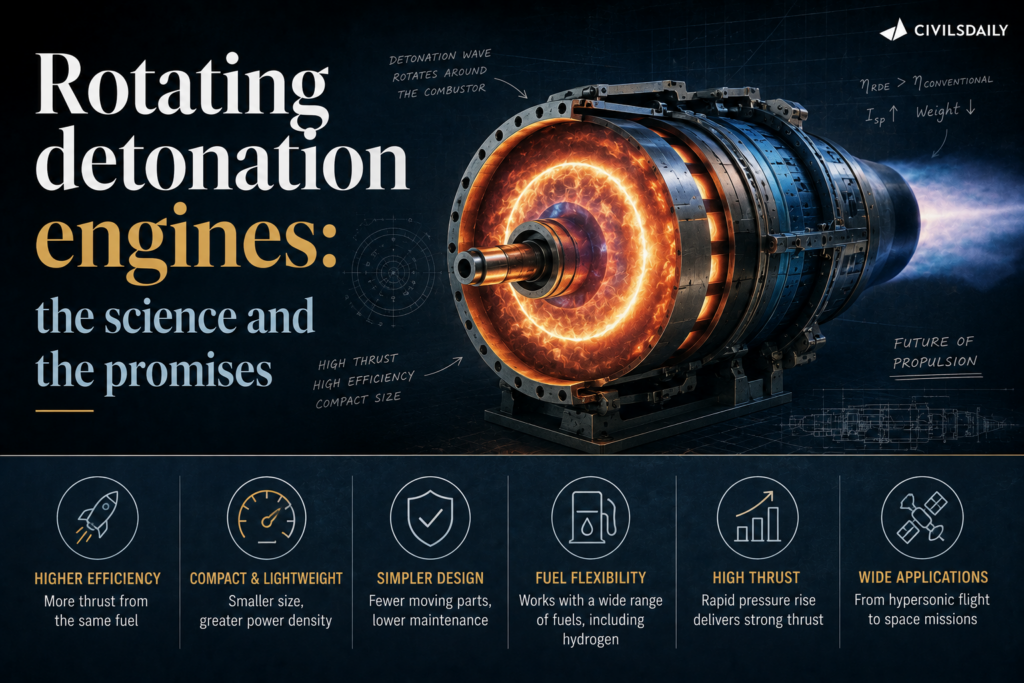
    1. What it is: An engine design in which combustion happens as a continuous detonation travelling in a circle inside a ring shaped chamber, rather than as a flame front sweeping through a cylinder.
    2. Its promise: It uses fuel more efficiently than conventional rocket engines, so the same task needs correspondingly less fuel.
    3. Why the saving matters: Launching satellites and carrying explosives to distant targets are both expensive, and fuel saved can be passed to the payload, whether a satellite or a warhead.
    4. The efficiency figure: Going by physics alone, RDEs offer around 10 per cent to 25 per cent more thermodynamic efficiency than conventional combustors, with the exact value depending on real world conditions and engine design.
    5. What it produces: It can continuously generate thrust, or mechanical energy if coupled to a piston.
    6. Its current state: RDEs are confined to research and development, and there are no models known to be ready for commercial or military use.

    What is deflagration?

    1. What it is: Combustion in which a flame introduced into a fuel and air mixture travels through that mixture at less than the speed of sound.
    2. What it does thermodynamically: The combustion happens at constant pressure, because the mixture is free to expand as it heats up instead of being confined under pressure.

    What is detonation?

    1. What it is: Combustion in which the flame travels through the mixture at more than the speed of sound, imposing a shock wave on the mixture and heating it, which triggers rapid combustion behind the wave.
    2. What it does thermodynamically: The combustion happens at constant volume, because the shock wave compresses the unburned mixture immediately before combustion and the mixture has no time to expand.

    What is a pulsed detonation engine (PDE)?

    1. What it is: The simplest type of detonation engine, using a long tube as the combustion chamber so a detonation can pass through the whole mixture.
    2. Its cycle: The detonation races down the tube, compressing and burning the fuel and air mixture, and the hot high pressure products expand out of the open end at high speed. The tube is then purged before the next cycle begins.

    What is an annular combustor?

    1. What it is: A combustion chamber shaped as two concentric cylinders with a narrow ring shaped gap between them, the gap being called the annulus.
    2. Why the RDE uses it: The annulus gives the detonation wave a closed circular path to travel, which is what converts a one shot detonation into a continuous one.

    What is thermodynamic efficiency?

    1. What it measures: How much of a fuel’s chemical energy becomes useful work rather than being shed as waste heat.
    2. What a gain translates into: An RDE that improves thermodynamic efficiency by 20 per cent could theoretically require around 17 per cent less fuel for the same output, assuming other losses are unchanged.

    Why does detonation deliver more efficiency than deflagration?

    1. The regular engine case: A spark plug introduces a flame into the fuel and air mixture in the combustion chamber, and it travels through at subsonic speed.
    2. The expansion difference: In deflagration the mixture expands freely as it heats, so combustion proceeds at constant pressure.
    3. The compression difference: In detonation the shock wave compresses the unburned mixture just before it burns, so combustion proceeds at constant volume.
    4. The pressure outcome: A detonation engine therefore produces combustion products at a higher pressure.
    5. The energy conversion: More of the fuel’s chemical energy is converted into pressure rather than being shed as heat, and that is the entire basis of the fuel efficiency claim.
    6. The comparison held constant: The advantage holds for a detonation engine against a regular engine burning the same fuel.

    How does an RDE sustain a continuous detonation?

    1. The design choice: Instead of the detonation passing through a long tube once, it is made to flow in a circle.
    2. The chamber: The combustion chamber has an annular shape, and fuel and oxidiser are injected continuously into the ring shaped gap.
    3. The wave: One or more detonation waves race through the annulus while injection continues.
    4. The timing requirement: Fuel is injected into the annulus just ahead of the detonation wave, so the wave always meets fresh mixture.
    5. The exhaust: The wave consumes the fresh fuel and air mixture and expels the products through the nozzle along its axis.
    6. The rate: As long as fuel keeps arriving at the right time and in the right condition, the detonation can keep going even at thousands of times per second.
    7. The output: By Newton’s third law the momentum of the expelled gases produces an equal and opposite momentum on the engine, which is what generates thrust.

    Who is developing rotating detonation engines and with what funding?

    1. D-Propulse, India: The India based defence startup that recently announced a successful RDE demonstration at a DRDO facility in Hyderabad.
    2. NASA, United States: Ran a full scale RDE test in 2023 in which the engine fired for 251 seconds, a record at the time.
    3. GE Aerospace and Lockheed Martin: Demonstrated an RDE for hypersonic missiles in January, using air drawn from the atmosphere.
    4. SpaceWorks, United States: Reported hot fire tests of its RDE for rockets in February.
    5. Astrobotic, United States: Test fired its Chakram RDE continuously for 300 seconds.
    6. L3Harris, United States: Announced that it had tested two RDEs, in April and May respectively.
    7. Stellar Alpina, Switzerland: Completed a commercial RDE hot fire test and raised CHF 3.5 million.
    8. Juno Propulsion: Raised $1.4 million to develop an RDE for spacecraft thrusters.
    9. Venus Aerospace, United States: Raised $91 million in July to scale its tested RDE, then partnered with Lockheed Martin.
    10. What the roster shows: Activity is concentrated in the United States and in venture funded startups, and it spans rockets, hypersonic missiles and spacecraft thrusters rather than a single application.

    Why was a 1960s concept only testable now?

    1. The theory was settled early: Scientists worked out how an RDE could function by the 1960s, and building one was a different matter.
    2. Injection and pressure control: Sustaining a continuous detonation in a compact chamber requires engineers to precisely control fuel injection and internal pressure.
    3. Chamber geometry: The chamber needs a specific geometry for the engine to work as intended.
    4. Instability sensitivity: Unlike in regular engines, even small instabilities in the fuel and air mixture can destabilise an RDE.
    5. Temperature threshold: Engine materials must withstand more than 2,000 degrees Celsius.
    6. Pressure threshold: Materials must survive 10 to 100 atmospheres of pressure, and much higher in brief moments.
    7. Speed threshold: Detonation speeds exceed 1,500 m/s.
    8. Oscillation and loading: Pressures oscillate at several thousand cycles per second, and the structure sees potentially tens to hundreds of g depending on the design.
    9. What had to arrive first: Working RDEs required advances in high speed computing, diagnostics, fuel injection, materials and manufacturing.

    Why does the efficiency gain matter for launch and strike systems?

    1. Cost of access to space: Launching satellites on rockets is expensive, and fuel is a dominant share of the launch mass.
    2. Cost of long range strike: Carrying explosives to distant targets on missiles is equally expensive on the same fuel logic.
    3. The trade converted: Less fuel for the same task means more mass available for payload.
    4. Commercial consequence: Passing that saving to the satellite or warhead increases the profitability of the mission.
    5. Why launch benefits most: The gain is considered significant specifically for rocket launches, where the fuel to payload ratio is most punishing.
    6. The air breathing variant: For hypersonic missiles the engine draws oxidiser from the atmosphere, which removes the need to carry it.

    Why does a settled physics advantage still have no deployable engine?

    1. The stated status: RDEs remain confined to research and development, with no models known to be ready for commercial or military use.
    2. The evidence gap: Actual data from many tests by commercial entities are not available in the public domain.
    3. What the efficiency claim rests on: The 10 per cent to 25 per cent figure is derived from physics alone, not from fielded performance.
    4. The qualification the source itself attaches: The saving that can be passed to the payload holds at least on paper.
    5. Where the difficulty sits: The obstacle is not the thermodynamics but the survivability of materials and the controllability of the detonation.
    6. The demonstration versus product gap: A successful hot fire test proves the wave can be sustained, and it does not prove an engine can be throttled, restarted, integrated and qualified for flight.
    7. The funding signal: Capital is arriving before a product exists, which is a bet on the remaining engineering rather than a proof that it is solved.

    Challenges to rotating detonation engine development

    1. Material survivability under cyclic thermal load: Wall materials face more than 2,000 degrees Celsius and pressure oscillations of several thousand cycles per second, which drives fatigue cracking. e.g. regeneratively cooled chamber liners in conventional engines already fail at far lower thermal cycling rates.
    2. Detonation wave instability: Wave count, direction and mode can shift during a run, which changes thrust unpredictably. e.g. test campaigns commonly report transitions between single wave and multiple wave modes in the same firing.
    3. Injector design and mixing: Fuel and oxidiser must mix fully in the microseconds before the wave arrives, and incomplete mixing quenches the detonation. e.g. deflagration to detonation transition failures reported in early pulsed detonation engine work.
    4. Nozzle matching: The exhaust leaves the annulus with a rotating, unsteady pressure field that a conventional bell nozzle is not designed for. e.g. aerospike and plug nozzle concepts are being revisited specifically for detonation exhausts.
    5. Absence of validated test data: Commercial developers do not release performance data, so independent verification of efficiency claims is not possible. e.g. the hot fire results announced by several firms in 2026 carry no published specific impulse figures.
    6. Qualification and certification burden: Flight qualification requires demonstrated restart, throttling and life cycle margins that no RDE has yet shown. e.g. human rated engines must clear multiple full duration firings with margin, a standard the 251 second NASA record does not yet meet.
    7. Dual use export control: Detonation propulsion for hypersonic applications falls within missile technology control regimes, which restricts collaboration. e.g. Missile Technology Control Regime Category I restrictions on complete rocket systems and their major subsystems.
    8. Manufacturing tolerance: The annulus gap must be held to fine tolerance across a hot, deforming structure, which requires additive manufacturing at aerospace grade. e.g. additive manufactured combustion chambers have to be qualified for porosity and residual stress before flight use.
    9. Talent and facility scarcity: Very few facilities can instrument a detonation at these speeds and pressures. e.g. high speed schlieren and pressure diagnostics capable of resolving events at several thousand cycles per second exist in a handful of laboratories.

    Conclusion

    The rotating detonation engine’s advantage is a settled point of physics: replacing constant pressure deflagration with constant volume detonation converts more chemical energy into pressure instead of shedding it as heat, and that is worth roughly 10 per cent to 25 per cent in thermodynamic efficiency. What remains unsolved is entirely an engineering problem of materials, wave control and diagnostics, which is why a design understood in the 1960s still has no commercially or militarily ready model anywhere. The Hyderabad demonstration places India inside the small group attempting that engineering, and a demonstration is not yet a qualified engine.

    “[2026] Consider the following statements about involvement of private entities in India’s space programme:
    1. IN-SPACe is an autonomous agency formed to facilitate participation of private entities.
    2. Agnikul Cosmos launched the world’s first flight using 3D-printed rocket engine.
    3. Skyroot Aerospace has developed liquid fuel for GSLV.
    (a) 1 only
    (b) 2 and 3 only
    (c) 1 and 2 only
    (d) 1, 2 and 3

  • NASA invites ISRO to join its mission for lunar outpost

    Why in the News:

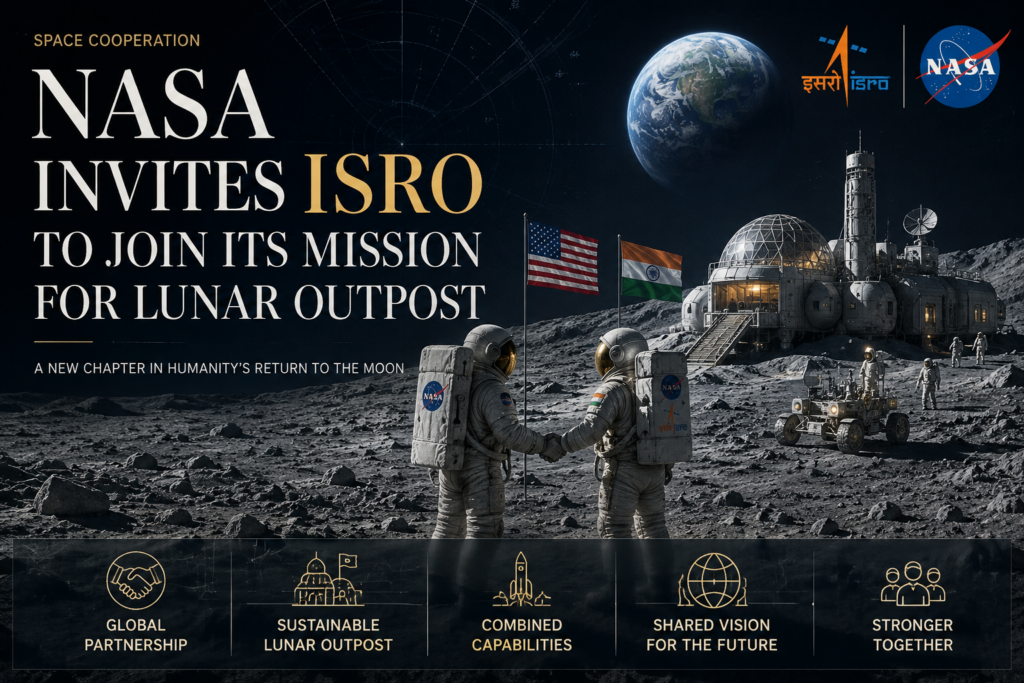
    The National Aeronautics and Space Administration (NASA) has invited the Indian Space Research Organisation (ISRO) to join its Moon Base programme, the effort to return humans to the Moon and set up a permanent settlement near the lunar South Pole. The invitation was extended at the ninth meeting of the India and United States Civil Space Joint Working Group, deepening a partnership that already spans the Artemis Accords and a joint radar satellite.

    What was announced and what is the Moon Base programme?

    1. The invitation: NASA invited ISRO to join its Moon Base programme, building on the two countries’ partnership under the Artemis Accords.
    2. The venue: The offer was made at the ninth meeting of the India and United States Civil Space Joint Working Group, held in Bengaluru on 5 and 6 August.
    3. The programme: The Moon Base programme aims to establish humanity’s first outpost on another celestial body, near the South Pole of the Moon.
    4. Wider setting: The meeting advanced civil and commercial space cooperation under a strategic technology initiative aligned with the February 2025 Joint Leaders’ Statement.

    What are the Artemis Accords?

    1. Definition: The Artemis Accords are a United States led set of non binding principles to govern the peaceful civil exploration and use of outer space, including the Moon.
    2. India’s role: India signed the Accords in 2023 as the 27th country, and a total of 70 countries are now part of them.
    3. Relevance: The Moon Base invitation and agreed open scientific data sharing are being pursued under this framework.

    What deepening ties does the invitation reflect?

    1. NISAR mission: The two agencies last year launched the NASA and ISRO Synthetic Aperture Radar (NISAR) mission, a dual frequency radar satellite and a first of its kind joint venture.
    2. Human spaceflight: An Indian astronaut flew to the International Space Station in 2025 through an Axiom mission, a result of a strategic framework for human spaceflight cooperation.
    3. Data cooperation: Both sides agreed to advance open scientific data sharing and discussed joint missions to the Moon and beyond.
    4. Outer space governance: They reaffirmed commitment to United Nations guidelines on the long term sustainability of outer space activities.

    What are India’s own lunar and human spaceflight programmes?

    1. Gaganyaan: ISRO is pursuing its human spaceflight programme to send Indian astronauts to low Earth orbit.
    2. Moon landing target: India has stated plans to achieve a human landing on the Moon by 2040.
    3. Chandrayaan legacy: India’s earlier lunar missions established its capability, including a South Pole region landing.
    4. Complementary strengths: NISAR’s success is seen as a base for more complex joint missions, including the lunar base and human spaceflight.

    Back2Basics: NISAR Mission

    1. Full form: NASA and ISRO Synthetic Aperture Radar mission.
    2. Nature: A joint Earth observation satellite using dual frequency radar, a first of its kind.
    3. Purpose: Monitors changes in land surface, ice sheets, ecosystems and natural hazards.
    4. Significance: Regarded as a landmark joint venture that could enable more complex India and United States space missions.

    Government Initiatives / Programmes in Indian Space

    1. Gaganyaan: India’s human spaceflight programme to send astronauts to low Earth orbit.
    2. Chandrayaan Programme: Series of lunar missions advancing India’s Moon exploration.
    3. IN-SPACe: Regulator and promoter enabling private sector participation in space.
    4. Indian Space Policy 2023: Framework opening the sector to non governmental entities.

    Key Facts about India and Global Space Cooperation

    1. Artemis signatory: India was the 27th country to sign the Artemis Accords in 2023, now numbering 70 countries.
    2. Working group: The invitation came at the ninth India and United States Civil Space Joint Working Group in Bengaluru.
    3. Moon landing goal: India targets a human landing on the Moon by 2040.
    4. South Pole focus: The Moon Base aims for humanity’s first outpost near the lunar South Pole.

    “[2016] Consider the following statements: The Mangalyaan launched by ISRO

    1. is also called the Mars Orbiter Mission

    2. made India the second country to have a spacecraft orbit the Mars after USA

    3. made India the only country to be successful in making its spacecraft orbit the Mars in its very first attempt

    Which of the statements given above is/are correct?

    (a) 1 only

    (b) 2 and 3 only

    (c) 1 and 3 only

    (d) 1, 2 and 3

  • BioE3 Policy Reports Early Biomanufacturing Gains

    Why in the News

    The Government has highlighted the early achievements of the Biotechnology for Economy, Environment and Employment (BioE3) Policy, demonstrating growing investments and capacity in India’s biomanufacturing sector.

    What is the BioE3 Policy?

    • Full form: Biotechnology for Economy, Environment and Employment (BioE3) Policy.
    • Approved: 2024 by the Union Cabinet.
    • Implementing Agency: Department of Biotechnology (DBT).
    • Objective: Promote high capacity biomanufacturing to drive economic growth, environmental sustainability, and employment generation.

    Key Features of the Policy

    • Focus Areas: The policy identifies six thematic sectors:
      • Bio based chemicals.
      • Smart proteins.
      • Precision biotherapeutics.
      • Climate resilient agriculture.
      • Biofuels and carbon capture.
      • Marine and space biotechnology.
    • Funding Pattern:
      • Government support of up to 70% of project cost.
      • Remaining contribution from the private sector.
    • Industry Participation:
      • Over 600 beneficiaries have utilised BioE3 facilities.
      • Private investment commitments have reached about ₹602 crore.
    • Long term Goal: Support India’s vision of a $300 billion bioeconomy by 2030.

    What is Biomanufacturing?

    • Definition: The production of chemicals, fuels, materials, pharmaceuticals and other products using biological systems such as microorganisms, enzymes or engineered cells.
    • Benefits:
      • Reduces dependence on fossil fuel based manufacturing.
      • Promotes sustainable industrial production.
      • Supports the circular bioeconomy.

    What is a Biofoundry?

    • A highly automated research facility that designs, builds, tests and analyses biological systems.
    • Accelerates the development of new biotechnology products through automation and artificial intelligence.

    [2026] Which of the following statements with regard to GenomeIndia Project is/are correct ?
    1. It is a part of the Human Genome Project.
    2. The project is funded by the Department of Biotechnology (DBT), Government of India.
    3. Its primary aim is to build a catalogue of genetic diversity of the Indian population.
    Select the answer using the code given below:

    [A] 1 only

    [B] 2 and 3 only

    [C] 1 and 2 only

    [D] 1, 2 and 3

  • ISRO and Japanese scientists review mission Chandrayaan 5 preparation

    Why in the News?

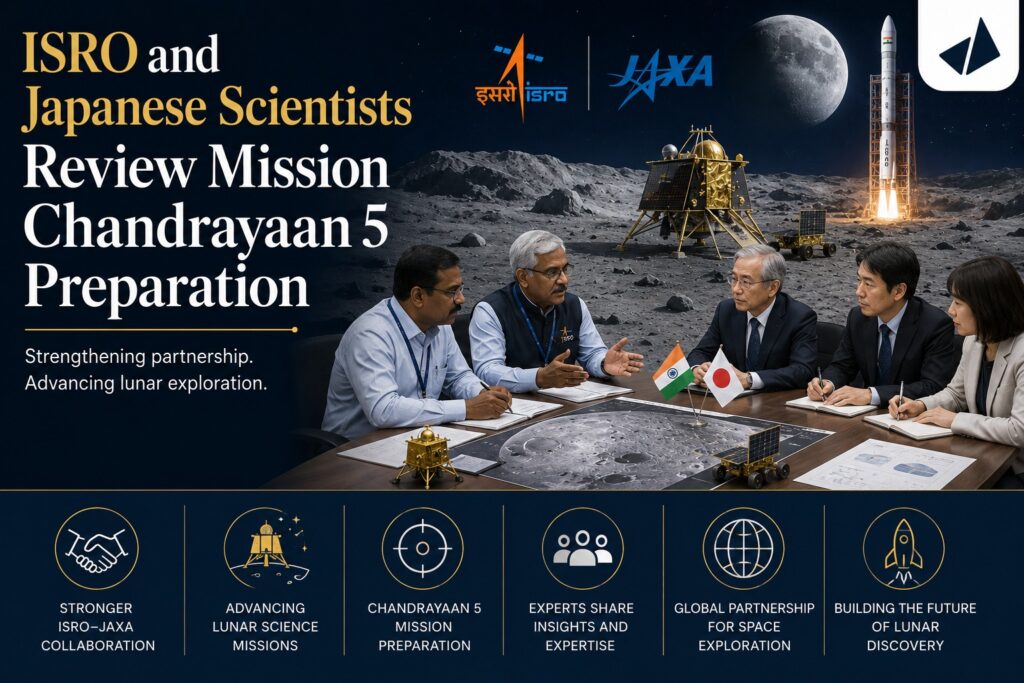
    An ISRO–JAXA delegation reviewed preparations for Chandrayaan-5 (LUPEX), India’s joint lunar mission with Japan, targeted for 2028. ISRO also informed Parliament that the Crew and Service Modules for the Gaganyaan-1 uncrewed mission are nearing completion.

    What is Chandrayaan-5 (LUPEX)?

    • Full Name: Lunar Polar Exploration Mission (LUPEX).
    • A joint lunar mission of ISRO and JAXA.
    • Target Launch: 2028.
    • Objective: Explore and study water and water ice at the Moon’s south polar region.

    Mission Components

    • Lander: Developed by ISRO.
    • Rover: Developed by JAXA.
    • Launch Vehicle: Japan’s H3 Rocket.
    • Scientific Payloads:
      • NASA: Neutron Spectrometer.
      • ESA: Mass Spectrometer.
    • Mission Duration: Around 100 days.
    • Scientific Instruments: 7 across the lander and rover.

    Mission Objectives

    • Detect and analyse surface and subsurface water ice.
    • Study the lunar south pole.
    • Support future human lunar exploration and resource utilisation.

    What is the status of Gaganyaan-1?

    • Gaganyaan-1 is an uncrewed precursor mission.
    • Crew and Service Modules are in the final stages of assembly and testing.
    • Intended to validate: Crew Module, Service Module, Crew Escape System, Life Support Systems
    • Launch has been delayed, and a revised schedule is yet to be announced.

    Significance

    • Strengthens India–Japan space cooperation.
    • Demonstrates multi-agency collaboration involving ISRO, JAXA, NASA, and ESA.
    • Advances lunar science and technologies for future exploration.
    • Supports India’s long-term human spaceflight ambitions under Gaganyaan.

    Challenges

    • Budget and resource constraints across multiple space missions.
    • Integration of ISRO’s lander with JAXA’s rover.
    • Dependence on Japan’s H3 launch vehicle.
    • Delays in the Gaganyaan programme.

    Chandrayaan Missions

    • Chandrayaan-1 (2008): Confirmed the presence of water molecules on the Moon.
    • Chandrayaan-2 (2019): Orbiter remains operational; lander hard-landed.
    • Chandrayaan-3 (2023): India became the first country to achieve a soft landing near the lunar south pole.
    • Chandrayaan-4: Planned Indian mission for lunar sample return.
    • Chandrayaan-5 (LUPEX): Joint ISRO–JAXA mission to explore lunar polar water ice.

    Gaganyaan Programme

    • India’s first human spaceflight mission.
    • Objective: Demonstrate the capability to send Indian astronauts to Low Earth Orbit (LEO) and return them safely.
    • Implemented by ISRO.

    ISRO’s Major International Collaborations

    • JAXA: Chandrayaan-5 (LUPEX).
    • NASA: NISAR mission and Chandrayaan payloads.
    • ESA: Scientific payloads and deep-space support.

    [2025] Consider the following space missions:
    I. Axiom-4
    II. SpaDeX
    III. Gaganyaan
    How many of the space missions given above encourage and support microgravity research?

    [A] Only one

    [B] Only two

    [C] All the three

    [D] None