Why in the News
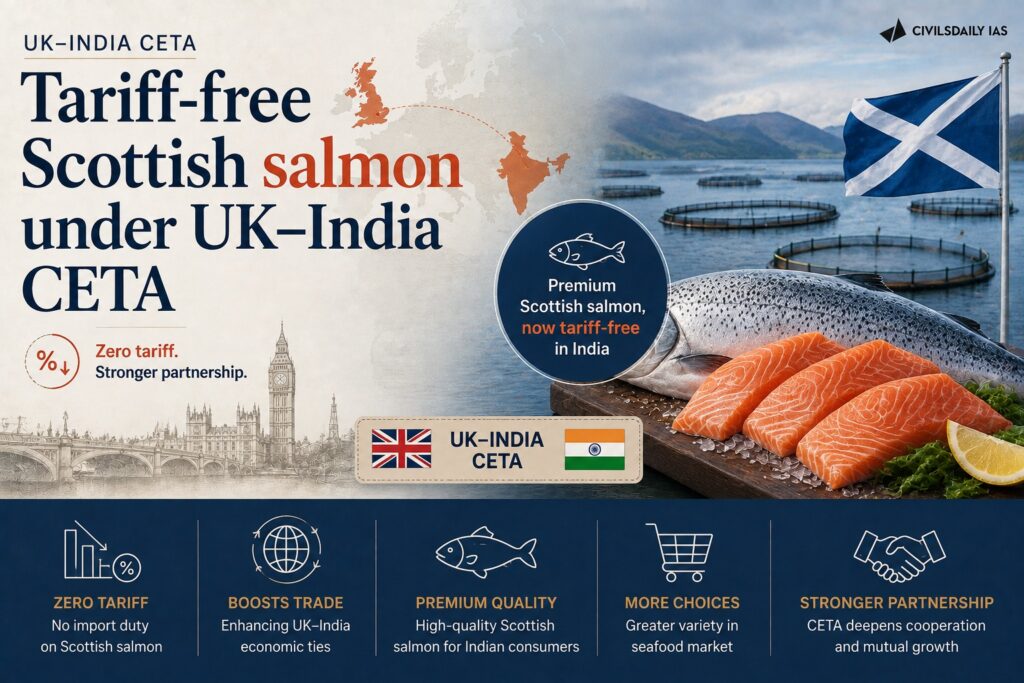
The first tariff free shipment of Scottish salmon reached Bengaluru on July 31 under the UK India Comprehensive Economic and Trade Agreement (CETA), eliminating India’s earlier 33 percent import tariff on the product. A single consignment marks the transition of a trade agreement from signed text into commercial reality, with industry estimating up to £130 million in additional export opportunity for Scotland’s salmon sector over the next decade.
What is the UK India CETA?
- Comprehensive Economic and Trade Agreement (CETA): CETA is the bilateral free trade agreement between the United Kingdom and India that eliminates or reduces tariffs across a wide range of goods and services traded between the two countries, recently operationalised as part of the broader India-UK Comprehensive Strategic Partnership.
Why does the tariff removal matter?
- Immediate price effect: Removing the 33 percent import tariff makes Scottish salmon significantly cheaper for Indian importers and retailers, directly affecting shelf pricing for consumers.
- Early proof of implementation: A commercial shipment moving within months of the agreement taking effect signals that CETA’s tariff schedules are being implemented on the ground, not just agreed on paper.
- Export opportunity for Scotland: Industry estimates suggest the tariff elimination could unlock up to £130 million in additional export opportunities for Scotland’s salmon sector over the next decade.
What are the challenges to realising CETA’s full trade potential?
- Cold chain and logistics: Perishable goods such as fresh salmon require reliable cold chain logistics from the United Kingdom to Indian cities, infrastructure that must scale alongside tariff-driven demand growth.
- Domestic industry exposure: Cheaper imported salmon could pressure India’s own aquaculture and seafood sector as volumes scale beyond this early shipment.
- Uneven sector by sector implementation: Tariff elimination for individual products such as salmon does not guarantee equally smooth implementation across CETA’s other covered sectors, some of which involve more complex regulatory alignment.
- Consumer market development: Realising the full projected export opportunity depends on Indian consumer demand for premium imported seafood growing at the pace industry estimates assume.
Conclusion
The Scottish salmon shipment is an early, narrow proof point for CETA’s tariff provisions rather than evidence of the agreement’s full commercial impact. Subsequent months will show whether tariff elimination translates into sustained trade volumes across the agreement’s broader list of covered goods.
